For questions or customized filtering of this matrix, please contact ABS Regulatory Affairs (E-mail: ) - Shutterstock/Sky Cinema
←
→
Page content transcription
If your browser does not render page correctly, please read the page content below
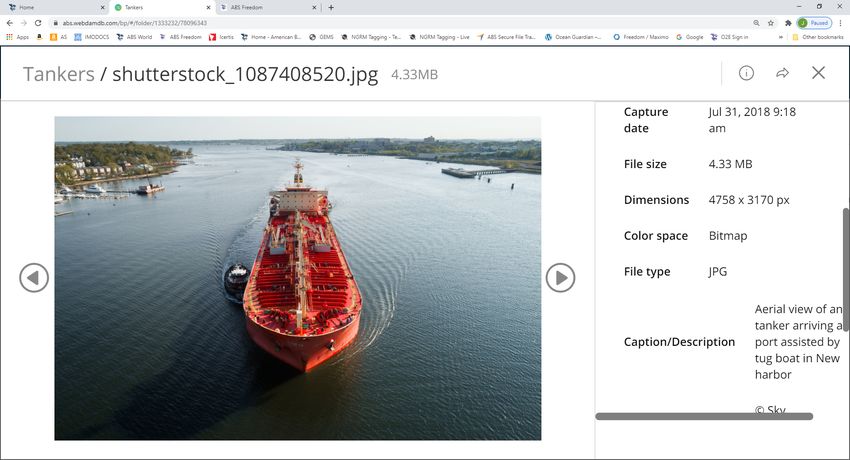
© Shutterstock/Sky Cinema

                            For questions or customized filtering of this matrix, please contact ABS Regulatory Affairs (E-mail: ABSRegAff@eagle.org)
Table 1 - Summary of SOLAS, MARPOL, Load Line, AFS and BWM Requirements for Tankers (Oil, Gas and Chem) in 2021 Onwards
Black (mandatory hardware requirements) Green (Mandatory operational requirements) Blue (recommended hardware guidelines) Red (recommended operational guidelines)
Reg Status Size Parameter Compliance Date Age of Ship Overview of Regulation
(All,
Fish Vessel Conv (FV)
Safe Container (CSC)
Bst Cpty (m )
Mandatory or Guidance
New or Retroactive)
Ship Recycling (SR)
3
(Keel Lay, Delivery, or
Anti-Fouling (AFS)
STCW Convention
MODU Code (MC)
No of Passengers
Load Line (L)
MARPOL(M)
Operational or
Application to Age
SOLAS (S)
BWM (B)
DWT (tons)
Reference
Hardware
Contract)
LOA (m)
LLL (m)
month
month
Notes
Document -
year
year
day
day
Regulation Ship Type
GT
Hyperlink if
Underlined
(refer to actual regulation for details)
SOLAS II-1
The amendments to SOLAS II-1/15 specify watertight and structural integrity of
Watertight and
1 MSC.474(102) H M S All ≥ 500 N 1 1 2028 D on after 1 1 2028 cargo ports and other similar openings (e.g. gangway and fueling ports) in the
weathertight
side of ships below the bulkhead or freeboard deck.
integrity
Amendments to SOLAS II-1/3-8 require that the design and arrangement of
mooring and towing equipment used during the normal operation of the ship
SOLAS II-1 / 3-8
shall meet the requirements of the flag Administration or its recognized
Mooring and
2 MSC.474(102) H M S All Ships ≥ 500 N 1 1 2027 D on after 1 1 2027 organization (class society). Fittings and equipment are to be clearly marked
Towing Equipment
with any limitations associated with its safe operation. The mooring
Design
arrangement and equipment, including lines, on ships ≥ 3,000 gt shall be
designed and selected based on MSC.1/Circ.1619.
MARPOL VI
MARPOL Annex VI has been amended to accellerate the Phase 3 reduction
3 Amendments to MEPC.324(75) H M M GasLng ≥15000 N 1 4 2026 D on after 1 4 2026
factor (which is applied to the Required EEDI) by 3 years from 2025 to 2022.
EEDI Regulations
Amendments to SOLAS II-1/3-8 require that the design and arrangement of
mooring and towing equipment used during the normal operation of the ship
SOLAS II-1 / 3-8
shall meet the requirements of the flag Administration or its recognized
Mooring and
4 MSC.474(102) H M S All Ships ≥ 500 N 1 7 2024 KL on after 1 7 2024 organization (class society). Fittings and equipment are to be clearly marked
Towing Equipment
with any limitations associated with its safe operation. The mooring
Design
arrangement and equipment, including lines, on ships ≥ 3,000 gt shall be
designed and selected based on MSC.1/Circ.1619.
Amendents to the IGF Code cover the following:
1) Conditions for permitting higher loading limits of cargo tanks, where cargo
tank insulation and location make the probability for the tank contents to be
heated up due to an external fire very small;
SOLAS II-1 2) Protection requirements for gaseous fuel pipes passing through enclosed
5 IGF Code MSC.458(101) H M S All Ships ≥ 500 N 1 1 2024 C on after 1 1 2024 spaces;
3) Requirements for explosion relief systems on exhaust systems of piston-type
external combustion engines; and
4) Crediting the use of fuel storage hold spaces as a cofferdam for type C tanks
that are not located directly above category A machinery spaces or other rooms
with high fire risk.
Amendents to the IGF Code cover the following:
1) Conditions for permitting higher loading limits of cargo tanks, where cargo
tank insulation and location make the probability for the tank contents to be
heated up due to an external fire very small;
SOLAS II-1 2) Protection requirements for gaseous fuel pipes passing through enclosed
6 IGF Code MSC.458(101) H M S All Ships ≥ 500 N 1 1 2024 KL on after 1 7 2024 spaces;
3) Requirements for explosion relief systems on exhaust systems of piston-type
external combustion engines; and
4) Crediting the use of fuel storage hold spaces as a cofferdam for type C tanks
that are not located directly above category A machinery spaces or other rooms
with high fire risk.
Amendents to the IGF Code cover the following:
1) Conditions for permitting higher loading limits of cargo tanks, where cargo
tank insulation and location make the probability for the tank contents to be
heated up due to an external fire very small;
SOLAS II-1 2) Protection requirements for gaseous fuel pipes passing through enclosed
7 IGF Code MSC.458(101) H M S All Ships ≥ 500 N 1 1 2024 D on after 1 1 2028 spaces;
3) Requirements for explosion relief systems on exhaust systems of piston-type
external combustion engines; and
4) Crediting the use of fuel storage hold spaces as a cofferdam for type C tanks
that are not located directly above category A machinery spaces or other rooms
with high fire risk.
An amendment to 4.4.8.1 of the LSA Code clarifies that buoyant oars need not
be provided as lifeboat equipment for free-fall lifeboats and for those lifeboats
which have two independent propulsion systems (two separate engines, shaft
lines, fuel tanks, piping systems and any other associated ancillaries). An
SOLAS III
8 MSC.459(101) H M S All ≥500 A INS 1 1 2024 KL on after 1 1 1900 amendments to paragraph 6.1.1.3 of the LSA Cod permits, on cargo ships, the
LSA Code
dedicated rescue boat to be manually launched (in lieu of being fitted with stored
mechanical power) provided its mass does not exceed 700 kg in fully equipped
condition without the crew and that a means is arranged to bring and hold the
craft against the ship's side so that persons can embark safely.Table 1 - Summary of SOLAS, MARPOL, Load Line, AFS and BWM Requirements for Tankers (Oil, Gas and Chem) in 2021 Onwards
Black (mandatory hardware requirements) Green (Mandatory operational requirements) Blue (recommended hardware guidelines) Red (recommended operational guidelines)
Reg Status Size Parameter Compliance Date Age of Ship Overview of Regulation
(All,
Fish Vessel Conv (FV)
Safe Container (CSC)
Bst Cpty (m )
Mandatory or Guidance
New or Retroactive)
Ship Recycling (SR)
3
(Keel Lay, Delivery, or
Anti-Fouling (AFS)
STCW Convention
MODU Code (MC)
No of Passengers
Load Line (L)
MARPOL(M)
Operational or
Application to Age
SOLAS (S)
BWM (B)
DWT (tons)
Reference
Hardware
Contract)
LOA (m)
LLL (m)
month
month
Notes
Document -
year
year
day
day
Regulation Ship Type
GT
Hyperlink if
Underlined
(refer to actual regulation for details)
To complement the revised SOLAS II-1/Regulation 3-8 (resolution
MSC.474(102)), mooring equipment and lines on ships will be subject to
inspection by the Company based on criteria of the new MSC.1/Circ.1620
SOLAS II-1 / 3-8
"Guidelines for inspection and maintence of mooring equipment including lines ".
Mooring/Towing
9 MSC.474(102) H M S All Ships ≥ 500 A 1 1 2024 KL on after 1 1 1900 An onboard maintenance plan or equivalent maintenance management system
Inspection and
should be established by the Company based on the manufacturer's
Maintenance
recommendations. Records of inspection, maintenance and replacement of
mooring lines should be retained on board for a period not less than the
completion date of the next annual survey
Amendments to SOLAS II-1/3-8 require that the design and arrangement of
mooring and towing equipment used during the normal operation of the ship
SOLAS II-1 / 3-8
shall meet the requirements of the flag Administration or its recognized
Mooring and
10 MSC.474(102) H M S All Ships ≥ 500 N 1 1 2024 C on after 1 1 2024 organization (class society). Fittings and equipment are to be clearly marked
Towing Equipment
with any limitations associated with its safe operation. The mooring
Design
arrangement and equipment, including lines, on ships ≥ 3,000 gt shall be
designed and selected based on MSC.1/Circ.1619.
SOLAS II-1
The amendments to SOLAS II-1/15 specify watertight and structural integrity of
Watertight and
11 MSC.474(102) H M S All ≥ 500 N 1 1 2024 C on after 1 1 2024 cargo ports and other similar openings (e.g. gangway and fueling ports) in the
weathertight
side of ships below the bulkhead or freeboard deck.
integrity
SOLAS II-1
The amendments to SOLAS II-1/15 specify watertight and structural integrity of
Watertight and
12 MSC.474(102) H M S All ≥ 500 N 1 1 2024 KL on after 1 7 2024 cargo ports and other similar openings (e.g. gangway and fueling ports) in the
weathertight
side of ships below the bulkhead or freeboard deck.
integrity
The IGF Code amendments remove the need for tank cofferdams to be
provided with a suitable pressure relief system; require fuel preparation rooms
SOLAS II-1
containing pumps, compressors or other potential ignition sources shall be
13 IGF Code MSC.475(102) H M S All Ships ≥ 500 N 1 1 2024 KL on after 1 1 2024
provided with a fixed fire-extinguishing system under SOLAS II-2/10.4.1.1 and
extend the cross-weld tensile strength to materials such as aluminum alloys
MARPOL VI
MARPOL Annex VI has been amended to accellerate the Phase 3 reduction
14 Amendments to MEPC.324(75) H M M GasLng ≥15000 N 1 10 2022 K on after 1 10 2022
factor (which is applied to the Required EEDI) by 3 years from 2025 to 2022.
EEDI Regulations
The BWM Convention has been amended to require that upon installation of a
BWMS, a commissioning test is carried out (as part of either an Initial Survey or
BWM E-1 Additional Survey) in order to validate the installation of any ballast water
15 Commissioning MEPC.325(75) H M B All ≥ 400 A FS 1 6 2022 KL on after 1 1 1900 management system by demonstrating that its mechanical, physical, chemical
Test of BWMS and biological processes are working properly. The commissioning test is to
take into account BWM.2/Circ.70/Rev.1 "2020 Guidance for the Commissioning
Testing of Ballast Water Management Systems".
MARPOL VI
MARPOL Annex VI has been amended to accellerate the Phase 3 reduction
16 Amendments to MEPC.324(75) H M M GasLng ≥15000 N 1 4 2022 C on after 1 4 2022
factor (which is applied to the Required EEDI) by 3 years from 2025 to 2022.
EEDI Regulations
SOLAS V
Minor amendments to the Record of Equipment which supplements the Form E,
Appendix
Form C and Form P certificates relates to the section concerning "Details of
Details of
17 MSC.456(101) O M S All Ships ≥ 500 R P 1 1 2024 KL on after 1 1 1900 navigational systems and equipment", where Item 8.1 "Rudder, propeller, thrust,
navigational
pitch and operational mode indicator" will have an added footnote to permit
systems and
deletion of items which are not applicable in this line.
equipment
SOLAS II-2
Amendments to the FSS Code clarify the location of the valve that isolates the
FSS Code Ch.15
18 MSC.457(101) O M S All Ships ≥ 500 N 1 1 2024 KL on after 1 1 2024 inert gas main from the external supply of inert gas, and associated
Inert Gas Systems
instrumentation requirements.
MARPOL Annex VI has been amended to introduce definitions distinguishing
MARPOL VI between "in-use" and "on board" fuel oil samples taken from a vessel. The
19 Procedures for FO MEPC.324(75) O M M All Ships ≥400 R P 1 4 2023 KL before 1 4 2022 entirety of Appendix VI of MARPOL Annex VI has also been revised to simplify
Sampling the verification procedure in for the “MARPOL delivered fuel oil sample” and to
add verification procedures for the “in-use sample” and the “on board sample”.
MARPOL VI MARPOL Annex VI has been amended to mandate the reporting of required and
20 Amendments to MEPC.324(75) O M M Oil ≥4000 N 1 11 2022 D on after 1 4 2022 attained EEDI values to the IMO. Tables providing EEDI reduction factors have
EEDI Regulations been replaced.Table 1 - Summary of SOLAS, MARPOL, Load Line, AFS and BWM Requirements for Tankers (Oil, Gas and Chem) in 2021 Onwards
Black (mandatory hardware requirements) Green (Mandatory operational requirements) Blue (recommended hardware guidelines) Red (recommended operational guidelines)
Reg Status Size Parameter Compliance Date Age of Ship Overview of Regulation
(All,
Fish Vessel Conv (FV)
Safe Container (CSC)
Bst Cpty (m )
Mandatory or Guidance
New or Retroactive)
Ship Recycling (SR)
3
(Keel Lay, Delivery, or
Anti-Fouling (AFS)
STCW Convention
MODU Code (MC)
No of Passengers
Load Line (L)
MARPOL(M)
Operational or
Application to Age
SOLAS (S)
BWM (B)
DWT (tons)
Reference
Hardware
Contract)
LOA (m)
LLL (m)
month
month
Notes
Document -
year
year
day
day
Regulation Ship Type
GT
Hyperlink if
Underlined
(refer to actual regulation for details)
MARPOL VI MARPOL Annex VI has been amended to mandate the reporting of required and
21 Amendments to MEPC.324(75) O M M Chem ≥4000 N 1 11 2022 D on after 1 4 2022 attained EEDI values to the IMO. Tables providing EEDI reduction factors have
EEDI Regulations been replaced.
MARPOL VI MARPOL Annex VI has been amended to mandate the reporting of required and
22 Amendments to MEPC.324(75) O M M GasLng ≥2000 N 1 11 2022 D on after 1 4 2022 attained EEDI values to the IMO. Tables providing EEDI reduction factors have
EEDI Regulations been replaced.
Resolution MSC.477(102) provides a consolidated text of The International
SOLAS VII
Maritime Dangerous Goods (IMDG) Code. In addition to the periodic review of
23 IMDG Code MSC.477(102) O M S All Ships >0 A 1 6 2022 KL on after 1 1 1900
carriage requirements for new and existing substances, the amendments also
introduce a new handling code for medical waste and other updated guidance.
MARPOL Annex VI has been amended to introduce definitions distinguishing
MARPOL VI between "in-use" and "on board" fuel oil samples taken from a vessel. The
24 Procedures for FO MEPC.324(75) O M M All Ships ≥400 N 1 4 2022 KL on after 1 4 2022 entirety of Appendix VI of MARPOL Annex VI has also been revised to simplify
Sampling the verification procedure in for the “MARPOL delivered fuel oil sample” and to
add verification procedures for the “in-use sample” and the “on board sample”.
A comprehensive set of revisions for the carriage requirements of products in
Chapter 17 of the IBC Code was adopted, primarily as a consequence of the
revised Chapter 21 on the criteria for assigning carriage requirements for
SOLAS VII products subject to the IBC Code. Additionally, specific products are now
25 MSC.460(101) O M S Chem ≥ 500 A 1 1 2021 KL on after 1 7 1986
IBC Code required to undergo prewash procedures under MARPOL Annex II. Chapter 15
was revised to require hydrogen sulphide detection equipment shall be provided
on board ships carrying bulk liquids prone to formation. Similar amendments
were approved for the BCH Code.
Extensive amendments to the 2011 ESP Code provide a complete revision of
the text. Numerous editorial amendments were made, and the following
substantive amendments: 1) clarify the responsibilities and working
arrangements where the 2011 ESP Code requires at least two exclusive
surveyors to attend on board at the same time to perform the required survey; 2)
SOLAS XI-1/2
26 MSC.461(101) O M S Oil ≥ 500 A 1 1 2021 KL on after 1 1 1900 provide consistency with IMO goal-base standards, GBS, regime (e.g., number
ESP Code
and location of thickness measurements to be taken, acceptance criteria for
corrosion and renewal of structure and longitudinal strength evaluation); 3)
clarify specific elements that are subject to close-up survey in tanks on one side
of the ship; 4) specify conditions for using hydraulic arm vehicles or aerial lifts
for the close-up survey.
Amendments to the IMSBC Code are provided in a consolidated version of the
SOLAS VI/1
27 MSC.462(101) O M S Cargo ≥ 500 N 1 1 2021 KL on after 1 1 1900 Code. The revisions are editorial in nature. Administrations may authorize early
IMSBC Code
application of th amendments on a voluntary basis from 1 January 2020.
Amendments to the BCH Code require hydrogen sulphide detection equipment
SOLAS VII onboard when carrying certain cargoes, and also require specific operational
28 MSC.463(101) O M S Chem ≥500 A 1 1 2021 KL before 1 7 1986
BCH Code measures related to tank washings of persistent floating products (by reference
to regulation 13.7.1.4 of MARPOL Annex II, resolution MEPC.315(74)).
The discharge of tank washings from tanks carrying products defined as
MARPOL II/13
"persistent floaters" is regulated by amendments to MARPOL II. The
Cargo residues
amendments apply to specific geographic areas, and will require a prewash
29 and tank washings MEPC.315(74) O M M Cargo >0 A 1 1 2021 KL on after 1 1 1900
procedure which discharges the tank washings to a reception facility at the port
of persistent
of unloading. Related amendments have been made to the IBC Code and BCH
floating products
Code.
The discharge of tank washings from tanks carrying products defined as
MARPOL II/13
"persistent floaters" is regulated by amendments to MARPOL II. The
Cargo residues
amendments apply to specific geographic areas, and will require a prewash
30 and tank washings MEPC.315(74) O M M Cargo >0 A 1 1 2021 KL on after 1 1 1900
procedure which discharges the tank washings to a reception facility at the port
of persistent
of unloading. Related amendments have been made to the IBC Code and BCH
floating products
Code.
MARPOL II Amendments to the BCH Code require require hydrogen sulphide detection
BCH Code equipment onboard when carrying certain cargoes, and also requires specific
31 H2S Detection, MEPC.319(74) O M S Chem ≥ 500 A 1 1 2021 KL before 1 7 1986 operational measures related to tank washings of persistent floating products
Prewash (by reference to regulation 13.7.1.4 of MARPOL Annex II, resolution
Requirements MEPC.315(74)).Table 1 - Summary of SOLAS, MARPOL, Load Line, AFS and BWM Requirements for Tankers (Oil, Gas and Chem) in 2021 Onwards
Black (mandatory hardware requirements) Green (Mandatory operational requirements) Blue (recommended hardware guidelines) Red (recommended operational guidelines)
Reg Status Size Parameter Compliance Date Age of Ship Overview of Regulation
(All,
Fish Vessel Conv (FV)
Safe Container (CSC)
Bst Cpty (m )
Mandatory or Guidance
New or Retroactive)
Ship Recycling (SR)
3
(Keel Lay, Delivery, or
Anti-Fouling (AFS)
STCW Convention
MODU Code (MC)
No of Passengers
Load Line (L)
MARPOL(M)
Operational or
Application to Age
SOLAS (S)
BWM (B)
DWT (tons)
Reference
Hardware
Contract)
LOA (m)
LLL (m)
month
month
Notes
Document -
year
year
day
day
Regulation Ship Type
GT
Hyperlink if
Underlined
(refer to actual regulation for details)
Amendments to the IBC Code require hydrogen sulphide detection equipment
MARPOL II onboard when carrying certain cargoes, and also requires specific operational
IBC Code measures related to tank washings of persistent floating products (by reference
32 H2S Detection, MEPC.318(74) O M S Chem ≥ 500 A 1 1 2021 KL on after 1 7 1986 to regulation 13.7.1.4 of MARPOL Annex II, resolution MEPC.315(74)). Various
Prewash other amendments were made pertaining to definitions provided in the IBC
Requirements Code, as well as specific cargo carriage requirements given by a complete
revision of Chapters 17, 18 and 19.
MARPOL II Amendments to the BCH Code require require hydrogen sulphide detection
BCH Code equipment onboard when carrying certain cargoes, and also requires specific
33 H2S Detection, MEPC.319(74) O M S Chem ≥ 500 A 1 1 2021 KL before 1 7 1986 operational measures related to tank washings of persistent floating products
Prewash (by reference to regulation 13.7.1.4 of MARPOL Annex II, resolution
Requirements MEPC.315(74)).
Amendments to the IBC Code require hydrogen sulphide detection equipment
MARPOL II onboard when carrying certain cargoes, and also requires specific operational
IBC Code measures related to tank washings of persistent floating products (by reference
34 H2S Detection, MEPC.318(74) O M S Chem ≥ 500 A 1 1 2021 KL on after 1 7 1986 to regulation 13.7.1.4 of MARPOL Annex II, resolution MEPC.315(74)). Various
Prewash other amendments were made pertaining to definitions provided in the IBC
Requirements Code, as well as specific cargo carriage requirements given by a complete
revision of Chapters 17, 18 and 19.
The Committee adopted the "Revised Recommendation on the Use and Fitting
of Retro-Reflective Materials on Life-Saving Appliances", in order to provide
LSA Code
updated guidance on accelerated weathering tests for such materials. The
Fitting of Retro-
35 MSC.481(102) O M S All ≥ 500 A INS 9 11 2020 KL on after 1 1 1900 previous Recommendation given by resolution A.658(16) will be revoked and
Reflective
replaced by resolution MSC.481(102). Administrations may accept life-saving
Materials on LSA
appliances which are already fitted with retro-reflective materials in accordance
with resolution A.658(16).
MARPOL Annex VI has been amended to permit the use of Electronic Record
Books, in lieu of hard copies, for the purpose of recording discharges, transfers
MARPOL VI or other operations as required by Annex VI provided the electronic recording
36 Electronic Record MEPC.316(74) O M M All Ships >0 A P 1 10 2020 KL on after 1 1 1900 system is approved by the Administration on or before the first International Air
Books Pollution Prevention (IAPP) Certificate renewal survey carried out on or after 1
October 2020, but not later than 1 October 2025, taking into account Guidelines
adopted by resolution MEPC.312(74).
MARPOL Annex VI has been amended to permit the use of Electronic Record
Books, in lieu of hard copies, for the purpose of recording discharges, transfers
MARPOL VI or other operations as required by Annex VI provided the electronic recording
37 Electronic Record MEPC.316(74) O M M All Ships >0 A R 1 10 2020 KL on after 1 1 1900 system is approved by the Administration on or before the first International Air
Books Pollution Prevention (IAPP) Certificate renewal survey carried out on or after 1
October 2020, but not later than 1 October 2025, taking into account Guidelines
adopted by resolution MEPC.312(74).
Amendments to the recommended performance standard for presentation of
SOLAS V MSC.466(101) navigation-related information on shipboard navigation displays incorporate
38 H G S All Ships ≥500 A INS 1 1 2024 KL on after 1 1 1900
Bridge Equipment MSC.191(79) reference to circular SN.1/Circ243 and MSC.1/Circ.1609, which are intended to
provided standardization for the user interface of navigation equipment.
SOLAS II-1 Due to the extensive revisions to subdivision and damage stability regulations in
39 (Explanatory MSC.429(98) H G S All Ships ≥ 500 N 1 1 2024 D on/after 1 1 2024 SOLAS chapter II-1, adopted by resolution MSC.421(98), revised Explanatory
Notes) Notes on the application of the revised SOLAS II-1 are provided.Table 1 - Summary of SOLAS, MARPOL, Load Line, AFS and BWM Requirements for Tankers (Oil, Gas and Chem) in 2021 Onwards
Black (mandatory hardware requirements) Green (Mandatory operational requirements) Blue (recommended hardware guidelines) Red (recommended operational guidelines)
Reg Status Size Parameter Compliance Date Age of Ship Overview of Regulation
(All,
Fish Vessel Conv (FV)
Safe Container (CSC)
Bst Cpty (m )
Mandatory or Guidance
New or Retroactive)
Ship Recycling (SR)
3
(Keel Lay, Delivery, or
Anti-Fouling (AFS)
STCW Convention
MODU Code (MC)
No of Passengers
Load Line (L)
MARPOL(M)
Operational or
Application to Age
SOLAS (S)
BWM (B)
DWT (tons)
Reference
Hardware
Contract)
LOA (m)
LLL (m)
month
month
Notes
Document -
year
year
day
day
Regulation Ship Type
GT
Hyperlink if
Underlined
(refer to actual regulation for details)
SOLAS IV Ship earth station which forms part of the GMDSS, if designed to operate in a
GMDSS mobile satellite service recognized on or after 1 January 2021, complies with the
40 MSC.434(98) H G S All Ships ≥ 500 A INS 1 1 2021 K on after 1 1 1900
Performance relevant requirements of A.1001(25) and conforms to performance standards
Standards MSC.434(98).
Ship earth station which forms part of the GMDSS, if designed to operate in a
SOLAS IV mobile satellite service recognized on or after 1 January 2021, complies with the
GMDSS relevant requirements of A.1001(25) and conforms to performance standards
41 MSC.434(98) H G S All Ships ≥ 500 A INS 1 1 2021 K on after 1 1 1900
Performance MSC.434(98) or MSC.130(75), if installed after 1 February 1999; A.808(19) if
Standards installed on or after 23 November 1996 and before 1 February 1999; A.698(17)
if installed before 23 November 1996
In support of Worldwide Radionavigation System (WWRNS) standardization,
the Committee adopted the "Performance Standards for Shipborne Japanese
Japanese QZSS Quasi-Zenith Satellite System (QZSS) Receiver Equipment. QZSS provides
42 MSC.480(102) O G S All ≥ 300 A INS 1 1 2024 KL on after 1 1 1900
Equipment positioning, navigation and timing service within a specified Asia-Oceania
coverage area. These standards are applicable to Japanese QZSS receiver
equipment installed on or after 1 January 2024.
SOLAS IV A new standard governs the performance of Float-Free Emergency Position-
Performance Indicating Radio Beacons (EPIRBs) operating on 406 MHz, which form part of
Standards for the Global Maritime Distress and Safety System (GMDSS). The standard is
43 MSC.471(101) O G S All >0 A INS 1 7 2022 KL on after 1 1 1900
Float-Free EPIRBs intended to standardize the physical attributes of these devices and the ambient
Operating on conditions in which they are expected to perform, as well as the technical
406MHz characteristics of the transmitted signal.
Recommendations on the implementation of cyber risk management take into
account that safe operational practices in ship operation should identify risks
SOLAS IX
44 MSC.428(98) O G S All Ships ≥ 500 A AD 1 1 2021 K on after 1 1 1900 and establish appropriate safeguards to ships, personnel and the environment
Cyber Security
under the ISM. Approved safety management system should take into account
cyber risk management and addressed in safety management systems.
An amendment to Part B of the STCW Code was adopted by the Committee in
STCW Code order to provide an updated list of certifications which should be maintained by
45 List of Certificates MSC.478(102) O G STCW All Ships ≥ 500 A 1 1 2021 KL on after 1 1 1900 those in various shipboard roles. This guidance is provided for the benefit of
Administrations, PSC authorities, recognized organizations and other relevant
parties in order to consistently enforce the STCW Code.Table 1 - Summary of SOLAS, MARPOL, Load Line, AFS and BWM Requirements for Tankers (Oil, Gas and Chem) in 2021 Onwards
Black (mandatory hardware requirements) Green (Mandatory operational requirements) Blue (recommended hardware guidelines) Red (recommended operational guidelines)
Reg Status Size Parameter Compliance Date Age of Ship Overview of Regulation
(All,
Fish Vessel Conv (FV)
Safe Container (CSC)
Bst Cpty (m )
Mandatory or Guidance
New or Retroactive)
Ship Recycling (SR)
3
(Keel Lay, Delivery, or
Anti-Fouling (AFS)
STCW Convention
MODU Code (MC)
No of Passengers
Load Line (L)
MARPOL(M)
Operational or
Application to Age
SOLAS (S)
BWM (B)
DWT (tons)
Reference
Hardware
Contract)
LOA (m)
LLL (m)
month
month
Notes
Document -
year
year
day
day
Regulation Ship Type
GT
Hyperlink if
Underlined
(refer to actual regulation for details)
Ship Types
All - all types of ships, barges and MODUs
All Ships - is a self-propelled ship of any type and SP-MODUs certificated under SOLAS
Pass - a Passenger Ship is a ship which carries more than the indicated number of passengers
PassC - a cruise passenger ship not having a cargo deck, designed exclusively for commercial transportation of passengers in overnight accommodations on a sea voyage
RoRo - a ship with RoRo cargo spaces as defined in SOLAS II-2/3(41)
RoRoV – a RoRo cargo ship (vehicle carrier) means a multi deck roll-on-roll-off cargo ship designed for the carriage of empty cars and trucks
RoRoC – a RoRo cargo ship means a ship designed for the carriage of roll-on-roll-off cargo transportation units
RoRoP – a RoRo passenger ship means a passenger ship with roll-on-roll-off cargo spaces
HSC - is a High Speed Craft capable of a maximum speed in meters per second (m/s) equal to or exceeding a value of 3.7(VOL DISPL)0.1667
Cargo - is any ship type (including SP-MODUs) which is not a passenger ship
Cont - is a ship designed exclusively for the carriage of containers in holds and on deck
GenCargo - means a ship, other than a tanker or a bulk carrier, with a multi-deck or single deck hull designed primarily for the carriage of general cargo
Refer means a ship designed exclusively for the carriage of refrigerated cargoes in holds.
Tanker - a "cargo ship" constructed or adapted for the carriage in bulk of liquid cargoes of an inflammable nature
Oil - a tanker constructed or adapted primarily to carry oil in bulk in its cargo spaces and includes combination carriers and any "chemical tanker" as defined in Annex II of the present Convention
Crude - an oil tanker engaged in the trade of carrying crude oil
Product - an oil tanker engaged in the trade of carrying oil other than crude oil
Chem - a cargo ship constructed or adapted primarily to carry a cargo of noxious liquid substances in bulk and includes an "oil tanker" as defined in Annex I of the present Convention when it is
GasLng - a cargo ship constructed or adapted and used for the carriage in bulk of any liquid gas (including LNG) or other product listed in Chapter 19 of the International Gas Carrier Code.
LNG carrier - means a cargo ship constructed or adapted and used for the carriage in bulk of liquefied natural gas (only LNG)
Bulk - a bulk carrier is a ship which is constructed generally with single deck, top-side and hopper side tanks in cargo spaces, and is intended primarily to carry dry cargo in bulk and includes such types as ORE carriers
Combo - a combination carrier is a ship designed to carry either oil or alternatively solid cargoes in bulk.
Ore - a single deck ships having two longitudinal bulkheads and a double bottom throughout the cargo region and intended for the carriage of ore cargoes in the centre holds only.
OSV - A vessel primarily engaged in the transport of stores, materials and equipment to offshore installations which is designed with accommodation and bridge erections in the forward part of the vessel and an
Fish Fishing Vessel
DSC Dynamically Support Craft
MODU - a Mobile Offshore Drilling Unit is any vessel capable of engaging in drilling operations for the exploration or exploitation of resources beneath the sea-bed such as liquid or gaseous hydrocarbons, sulphur or salt
SP-MODU - a self propelled MODU
Ship Size
LOA - length overall
LLL - 1966 Load Line Length
gt - gross tonnage as per the 1969 Tonnage Convention
dwt - deadweight
88L - length according to the 1988 Load Line Protocol
66L - length according to the 1966 Load Line ConventionYou can also read


