Gastric Sleeve and Nutrition - Western Sussex Hospitals
←
→
Page content transcription
If your browser does not render page correctly, please read the page content below

Gastric Sleeve and Nutrition
Journey countdown

Bariatric surgery permanently changes how you eat and drink.
This booklet aims to provide you with essential information to achieve the best
possible results. Please read it carefully.

    Planning and preparation             Research, attend support groups, online
                                         forums, get questions for the team ready,
                                         stop smoking

    Paperwork                            Complete questionnaire and online
                                         psychological assessment

    MDT Assessment                       Day long appointment with the dietitian,
                                         anaesthetist, physician, nurse and
                                         surgeon
    Pre-op Assessment                    Appointment with nurse and dietitian, blood
    (2-3 months before surgery)          test, measurements and MRSA screen

    1-2 weeks before surgery             Start pre operative diet (milk diet)

    Surgery                              Hospital stay for 2 nights

    6 weeks post-op                      Appointment with nurse

    3 months post-op                     Appointment with dietitian

    6 months post-op                     Appointment with dietitian

    12 months post-op (1 year)           Appointment with dietitian & blood test

    18 months post-op                    Appointment with dietitian

    24 months post-op (2 years)          Appointment with dietitian & blood test

           You will be under our care for 2 years after your surgery.
             It is necessary to attend all follow up appointments.

2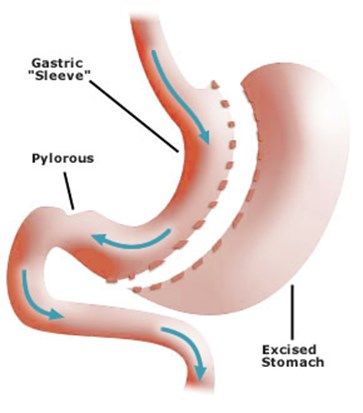
Questions to ask your Bariatric Team at your next appointment

                                                                3
How does the gastric sleeve work?
Restriction
The surgery reduces the size of your stomach. The stomach is divided to form a
narrow tube, or ’sleeve’, which can only hold about 100mls. The remaining part
of the stomach is removed. If you pay attention to the signals, you will feel the
sensation of fullness after a small amount of food. Over-eating can cause
tummy discomfort and vomiting.
Hormones
The surgery affects the hormones that regulate your appetite. After surgery
most patients feel less hungry and often forget to eat. If you do feel hunger, it is
useful to establish if the hunger is actual physical hunger or emotional hunger.
Even if you don’t feel hungry it is still important to eat. You should try to have
something small and nutritious 3-6 times a day to keep your mood and energy
levels elevated.
If for any reason you cannot attend your appointment please call the
bariatric office at the earliest opportunity.
4How much weight will I lose?
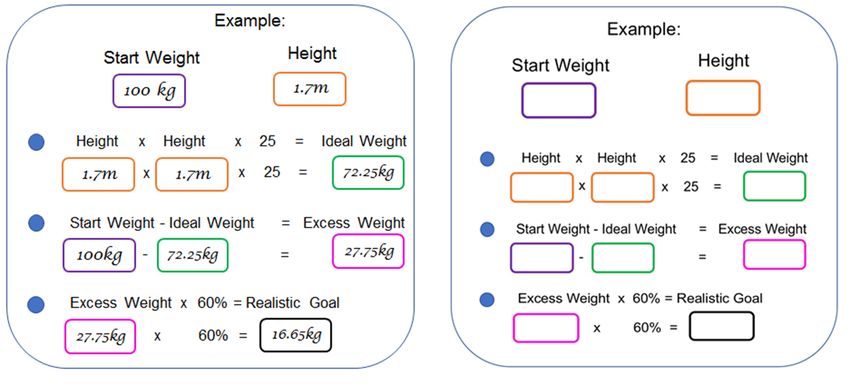
Research shows that on average, you will lose 60% of your excess weight. This
usually happens very quickly. You can lose up to 1 stone (6kg) per month for the
first four months before the weight loss starts to slow down.
In practice, weight loss is affected by age, activity level, dietary discipline and
Basal Metabolic Rate (BMR). Some people lose more weight than expected,
some lose less. It is difficult to predict.
How to Calculate 60% excess body weight loss
0.6 0.6
To convert kg to stones and lbs, multiply by 2.2 and divide by 14.
5My goals This surgery is not just about weight loss. What do you want to achieve and change? Be realistic! 6
Planning and preparation
There are things you can do now which will help you after your surgery
Reading and research
Buy equipment e.g. blender, small food pots, side plate
Stop smoking
Plan your exercise options e.g. investigate local gyms, swimming pools,
classes, home workouts. Don’t wait until after your surgery to get started
Eat mindfully – concentrate on your meal, chew well, no distractions
Consider who will do the cooking for the rest of the family whilst following
the milk and puree diet
Think about how you will cope eating food at work or social events
Build a support network e.g. friends, family, work colleagues, online
forums, local support group
Take any recommended vitamin and mineral supplements. This is usually
a multivitamin and mineral tablet (1 per day) and Vitamin D3 1000IU (1 per
day)
Take all your medication and treatments correctly
Vitamin and mineral tablets
After surgery you will be unable to meet your vitamin and mineral needs with diet
alone. This is because you will only be able to eat very small quantities of food
and you will not produce enough stomach acid for digestion. This means you will
need to take vitamin and mineral tablets for life.
You need:
Multivitamin & Mineral
Calcium
Vitamin D3
Iron
Vitamin B12
Please refer to Vitamin & Minerals for life after bariatric surgery leaflet.
Blood tests
You will have blood tests at least every year. This will check kidney and liver
function, bone health, vitamin and mineral levels.
7Pre-operative diet—milk diet
Why do I need to follow this diet?
This diet shrinks the size of your liver before surgery. This allows the
surgeon better access to your stomach and reduces the risk of damage to
your liver during the operation
This diet starts your weight loss journey
How long do I need to follow the diet?
The length of time you need to follow the diet depends on your BMI and liver
health. It is usually for a maximum of 2 weeks.
Start of milk diet
From midnight, night before surgery Clear fluids e.g. water, black tea,
black coffee, no added sugar
squash
06:30 / 11.30 Nil by mouth
* depends on the time of your operation
What is the risk of not following the diet?
Your surgery will be abandoned if the liver is too large and obscures the
surgeons view of the stomach.
Do you have diabetes?
Please inform your diabetes team that you will only be taking 120g of
carbohydrate per day. Your diabetes team will advise you on any changes to
your diabetes medications and/or adjustments to your dose of insulin/s. If you
take insulin or oral medications that can cause hypos, you need to check your
blood sugar levels at least 4 times per day.
Constipation
The most common side effect of the diet is constipation. We recommend you
take milk of magnesia or Benefiber or Movicol to relieve these symptoms. Please
try not to arrive for surgery constipated!
8Pre-operative diet—milk diet
Every day you must have the following:
4 pints (2 litres) of either semi-skimmed milk cow’s milk, lactose free milk
or soya original. Please note that alternative milks such as oat, almond or
rice milk are not suitable
At least 2 pints (1 litre) of calorie free fluid
1 salty drink e.g. Marmite, Bovril, stock cube or 1 tsp salt in squash
1 multivitamin and mineral tablet e.g. Sanatogen A-Z or Tesco A-Z
No food
Allowed drinks
Tea, coffee or herbal tea
Water
No added sugar squash
No added sugar Crusha or Okcal syrups can be added to milk
Allowed extras
1 sachet or 5 x 115g pots of ready to eat sugar free jelly per day (1 pint)
Chewing gum (maximum 3 pieces per day)
Tips
Keep your milk separate from anyone else's at home
Use sweeteners instead of sugar in tea and coffee
Ensure you have everything you need before you start
Plan your routine for fitting in all of your fluids
Consider how the milk diet may affect your family and what support you
will need e.g. who will do the cooking
Think about how you might cope with following the milk diet at work or
special occasions
Remove all tempting foods from the house as much as possible
This diet is preparation for surgery, not for weight loss.
It should only be used under supervision from your
Dietitian for a maximum of 2 weeks.
Please contact the Dietitian
if you suffer any side effects from this diet.
9What will I eat after surgery?
Textures need to be introduced gradually to allow for healing and your new
stomach pouch to adapt.
Stage 1: pureed consistency (weeks 1-4)
No lumps, smooth like the consistency of a yoghurt
Do not eat and drink more than 2tbsp or 100-200ml at a time.
Blenders or liquidisers and sieves are necessary
Add a liquid to help achieve a smooth food consistency e.g. tomato puree
gravy, stock or milk
Puree the protein component separately from the vegetable or potato to
give you different flavours on your plate
You may not feel up to cooking after your operation. Be prepared by
cooking, blending and freezing foods before your surgery
Freeze in ice cube trays which helps you get familiar with portion sizes
without causing waste
Stage 2: mashed/crunchy consistency (4-8 weeks)
Bridge between pureed foods and normal textures
Practice the eating behaviours that will result in a good long-term weight
loss
If you experience discomfort, try to work out where why - did you eat too
much, eat too fast, or didn’t chew thoroughly enough?
Initially foods will be better tolerated if they are soft and wet. Adding gravy
or sauces can help
The fork test can be used to check the texture. If your fork passes easily
through the food, it is the right texture for stage 2. If you have to force a
fork through it is probably a stage 3 food and best avoided at this stage
Stage 3: normal consistency (8-12 weeks)
It is now safe to start experimenting with different textured foods
There will still be some foods that you cannot tolerate. Bread, pasta, rice
and dry meats are the usual problem foods. Take things slowly. Add one
food at a time
From about 10-12 weeks you can try salads
Try to avoid soft/sloppy food as this will result in overeating
Please experiment carefully to see what you can tolerate. This varies from
person to person. Foods that you could not manage at the beginning will
be tolerated at a later date. Try again 1-2 weeks later
10Weeks 1-4 Weeks 4-8 Weeks 8 +
puree mashed/crunchy normal
Breakfast 2-4 tbsp. Weetabix or ¾ Weetabix 1 Weetabix
Ready Brek Scrambled egg on Any no added sugar
½ slice toast breakfast cereal
4 tbsp. cornflakes ½ slice toast and
poached egg
Lunch 100-200mls soup Baked beans Jacket potato with
with protein Ravioli beans/tuna/cheese/
2-4 tbsp. tinned spa- Omelette with prawns; Salad with
ghetti cheese egg/beans/meat/fish;
½ Jacket potato Sardines on toast;
with tuna or cheese Pitta with cheese and
Chunky soup salad; Wrap with
Cauliflower cheese chicken and salad; ½
toasted sandwich
Dinner A balanced meal of A balanced meal of A balanced meal of
protein, vegetable protein, vegetable protein, vegetable and
and potato. and potato. potato.
1-2 tbsp. meat/fish 4 tbsp. meat/fish Fishcakes with potato
½ -1 tbsp. vegeta- casserole wedges and vegeta-
bles 1 tbsp. soft vegeta- bles
½ -1 tbsp. potato bles Roast meat with pota-
1 tbsp. mashed toes & vegetables
potato Chicken curry & rice
Snacks 2 - 4 tbsp. of yoghurt Soft fruit (no skins) Fruit
Custard (low sugar) Yoghurt Small handful of nuts
Pureed fruit Soft cheese and
Rice pudding (low 1-2 crackers
sugar) Pate and 1-2
Hummus melba toast
Peanut butter Hummus and 1-2
Pate Rice cakes
100mls milky drink
11Eating rules How you eat & drink is just as important as what you eat & drink Speed Eat slowly. A meal should last 20-30 minutes. Shorter than this, you are eating too quickly. Longer than this, you are trying to eat too much food. Eating fast can lead to pain, discomfort and regurgitation. Chew Normally your stomach churns food to break it down for digestion. Now your chewing must do that job. Chew 20 times per bite until smooth with no lumps before swallowing. Do not gulp when swallowing liquid as this will also cause pain. Calm atmosphere Make time for your meals and snacks, create a calm environment with no distractions. Awareness helps you to eat correctly. Take your time to eat as it should be an enjoyable experience and it also encourages feeling full and satisfied. Volume and meal pattern The volume of food and fluid your stomach can tolerate will be considerably reduced. At first, you will only manage about 2 tbsp. or 100-200mls at a time. Try to eat 6 times a day for the first few weeks after surgery. Ensure a regular eating pattern and avoid long periods without food. As the months go by, you will be able to eat more at each meal. It is important to listen to your body and stop eating when you are full. Over-eating can cause you to be sick or feel uncomfortable. This behaviour may result in poor long term weight loss. By 6 months after surgery, you will be able to eat a tea-plate sized portion. It is important that portions do not increase beyond this. At this time, a typical meal pattern would be 3 main meals and 2-3 small snacks a day. Eating well takes careful planning. Be aware of inappropriate snacks creeping in. 12
Protein first

Rapid weight loss can cause loss of muscle mass, weakness and reduced
immune function. Protein is one of the building blocks for every cell in your body
and needs to be the main component of your diet, especially in the early stages.

Make sure you eat your protein food first. Good sources of protein include; fish,
chicken, beef, lamb, pork, eggs, pulses (peas, beans, lentils), nuts, cheese, milk,
yoghurts, fromage frais, soya alternatives and Quorn.

Sugar and dumping syndrome

Dumping syndrome is caused by food moving quickly through the gut. Sugar is
absorbed very quickly and causes a rapid swing in your blood sugar levels. The
symptoms are nausea, vomiting, sweating, dizziness and diarrhoea. If you have
one of these events take a rest and then try to work out what caused it. This will
help prevent it happening again. In order to avoid dumping syndrome avoid high
sugar foods such as chocolates, sweets, cakes, desserts, biscuits and fruit
juices.
There are hidden sugars in lots of foods so it is sensible to check the food label.
As a guide, avoid foods with more than 5g sugar per 100g in the food or fluid.

Fluids

Dehydration can cause low energy levels, headaches and dizziness. Aim for a
minimum of 2 litres per day (8 cups). Try to sip slowly throughout the day.
You will not be able to gulp drinks when thirsty or in a hurry.
Avoid drinking and eating at the same time, you should not drink 30 minutes
before or after food. Alcohol is not recommended during the first year after
surgery because of its high calorie content and gassy drinks will not be tolerated
well. You are likely to feel the effects of alcohol quickly. Drinking alcohol may
impact on you achieving your goals.

 Good options                                      Poor options
 Water                                             High calorie lattes
 Tea or coffee (can add sweetener)                 Sugary flavoured water
 Sugar free squash                                 Alcohol
 Diluted fruit juice (maximum 1 glass per day)     Fizzy drinks
 Milk                                              Sparkling water
 Herbal tea
 Sugar free jelly
 Ice pops made from sugar free squash

                                                                                 13
Be aware Fertility and pregnancy Many obese women don’t ovulate regularly and consider themselves infertile. This can change with weight loss. For this reason female patients should consider what form of contraception they wish to use. The oral contraceptive pill is not be reliable after bypass and we recommend patients use an alternative form of contraception such as a depo injection, barrier methods or a coil. Your GP should be able to advise you appropriately. Pregnancy should be avoided for the first year after surgery. Depression and eating disorders Surgery is challenging. Some people suffer psychologically after the surgery, particularly in dealing with their new body image and emotional relationship with food. People with underlying eating disorders may develop new eating disorders. Please discuss these challenges with your team who can direct you to the best support. Hair loss Surgery and rapid weight loss can result in hair loss 3-6 months after surgery. This usually lasts for around 3 months but it can take some time for your hair to recover. The dietitian will monitor your food intake to ensure you are supporting your hair re-growth. Taking your recommended vitamins is essential, but there is no need to buy any specific supplements for hair re growth. Bowels Your bowel habit can alter after surgery. You may have diarrhoea as you are malabsorbing nutrients and the flow of food through the system is much quicker. You may have constipation if your fluid intake is low, your fibre intake is low, your body is used to requiring laxatives or you are inactive. Please discuss with your team if you have any concerns. 14
Exercise

Exercise will help maintain muscle tone, accelerate weight loss and
improve mental health. Try to start with a small goal e.g. a daily walking
plan. Walking is beneficial as it is a weight bearing exercise and can help
protect your bones from osteoporosis. Over time, you will be able to build
up your stamina and move on to other forms of activity. If you suffer with
joint pain then water-based exercises such as swimming or water
aerobics, which puts less pressure on the joints, may be more suitable.

Weight regain

It is estimated that 15-35% of patients do not achieve satisfactory weight
loss or will regain weight. Conditions like diabetes, sleep apnoea and
high blood pressure which went into remission can become a problem
again. To give yourself the best opportunity to achieve your goals be well
prepared before surgery, attend all appointments and follow the advice of
your bariatric team. This surgery does not “cure” weight issues. It will
always need monitoring and discipline.

                                                                        15
Eating Rules—long term goals
Eat regularly, at least 3 meals a day
Always eat breakfast
Balanced main meals include protein AND carbohydrate AND vegetables/
salad
Protein Vegetables/Salad/Fruit Carbohydrate
Eat first: A portion is a handful: Choose high fibre, low sugar
Meat, fish, milk, Aim for a mixture of options:
cheese, yoghurts, textures and colours. Potatoes, pasta, rice, cou-
egg, Quorn, tofu, cous, bread, crackers
nuts, lentils, beans
Eat slowly. Take 20-30 minutes to eat a meal
Take small bites. Your mouthful should be the size of a 20p piece
Chew really well before swallowing. Chew until smooth with no lumps and
then swallow
Put your spoon down between each mouthful
Stop eating before you feel full. Learn to detect your own signals of “too
much.” Usual signs are a pain in the shoulder or upper chest, nausea or
the production of saliva
Use a small plate to control portion sizes. Smaller cutlery also helps
Do not leave food on a plate to return to it later. Clear it away
Sip fluids slowly rather than taking large mouthfuls
Mindful eating – concentrate on your meal rather than watching television
or working while eating
Avoid simple sugars. Remember honey, jam, sucrose, lactose and
fructose are all forms of sugar
Do not add lots of gravy or sauce to “help food get down.” Your portion
size will grow too large and you can regain weight
Weigh yourself regularly (but no more than once a week)
Be as active as you can every day
Take your vitamin and mineral tablets
Make sure you have a blood test every year
If you are not happy with your weight changes, go back to basics and start
a food diary
16Frequently asked questions
I have a problem being sick after eating. What do I do?
It might take time for you to put the eating rules into practice. If you produce
white froth or regurgitate food consider the following:
Did I eat too quickly?
Did I chew it well enough?
Was it too soon after surgery to have the food I was eating?
Did I eat too much?
If you experience persistent vomiting contact your bariatric team for advice.
I have a problem with nausea?
Make sure your medications have been reviewed by your GP. Do not skip
meals. Eat small amounts 6 times a day.
What can I do if I get constipated?
If you get constipated, first check if you are drinking enough fluids and eating
enough fibre. You can take a laxative if constipation is a problem. For example
Benefiber, Movicol or lactulose, but you must drink enough fluids for the laxatives
to work.
What can I do if I have diarrhoea?
Do you have a bug? Have you recently taken antibiotics? Have you eaten food
high in sugar that gave you dumping syndrome?
If you experience persistent diarrhoea, contact your bariatric team for advice.
Do I have to follow the puree diet for 4 weeks?
Yes. Your gut is healing from the surgery during this stage. It is important to be
confident with each stage before you progress onto the next.
17Can I eat baby food on the puree stage?
No. Baby food does not provide adequate nutrition for adults.
Should I take protein shakes?
No. You should eat your calories, not drink them.
Why haven’t I lost any weight?
Do not weigh yourself every day. Our advice is to wait until your 6 week
appointment with the nurse. In the weeks following your surgery your body is
recovering. You might not lose weight every week. Follow the advice in this
booklet and you will lose weight. Make sure you are eating 6 times a day and
drinking enough fluid.
How much can I eat?
Your portion sizes increase gradually from 2tbsp per meal to a side plate over
the first 6 months. It is important to learn when to stop eating and you should be
guided by signals from your body with this. It can be difficult not to finish
everything on your plate, remember to serve small portions to avoid battling with
food waste. If there is still food on your plate after 20 minutes then you have
probably served too much.
As a general guide, main meals should be the size of a side plate (this is about
the size of your hand span) and include protein, vegetables and starchy
carbohydrates in the proportions shown below.
Vegetables
Protein
Carbohydrates
18Word dictionary
Gastric Stomach
Laparoscopic Keyhole, small cuts
MDT Multidisciplinary Team group of health care
professionals
Pre-op Before your operation
Post-op After your operation
Surgery Operation
GP General Practitioner (Doctor)
Dietitian Health care professional who translates nutrition science to
provide advise about food and treat and prevent nutrition
related problems
Anaesthetist Medical doctor trained to give anaesthetics
Physician Medical doctor qualified to practice medicine and
specialises in diagnosis and medical treatment
Surgeon Medical doctor qualified to practice surgery
Abdomen Belly, part of the body that contains your gut
IBW Ideal Body Weight, healthy weight for your height
EBW Excess Body Weight, any additional weight over
your ideal body weight
BMR Basal Metabolic Rate, energy you burn when resting
Ovulation Part of the female menstrual cycle where an egg is
released in the ovary
U&E Urea & Electrolytes
LFT Liver Function Test
FBC Full Blood Count
PTH Parathyroid Hormone
TBSP Tablespoon (15mls)
19Contact us:
Bariatric Surgery Service
St Richard’s Hospital
Spitalfield Lane
Chichester
West Sussex
PO19 6SE
Tel: 01243 831655
We are committed to making our publications as accessible as
possible. If you need this document in an alternative format, for
example, large print, Braille or a language other than English,
please contact the Communications Office by emailing
communicationsWSHT@wsht.nhs.uk or
speak to a member of the Bariatric Department.
www.westernsussexhospitals.nhs.uk
Department: Bariatric Surgery Service
Issue date: May 2020
Review date: May 2022
Author: Bariatric Dietitians
Version: 2You can also read


