GUIDANCE A GUIDE FOR THE RESTAURANT INDUSTRY - NCRLA COVID-19 Resources
←
→
Page content transcription
If your browser does not render page correctly, please read the page content below
COVID-19

REOPENING
GUIDANCE
A GUIDE FOR THE
RESTAURANT INDUSTRY

PUBLISHED April 22, 2020

For other resources:
RESTAURANT.ORG/COVID19

TO R E S TAU R A N T O P E R ATO R S
GETTING READY TO REOPEN…

The purpose of guidance is just that, to offer
you direction and provide a framework for best
practices as you reopen.

But as the saying goes, the devil is in the details,
and not every restaurant is the same and not every
opening scenario will align. We recognize that not
everyone has access to guidance, and that is where
the National Restaurant Association can provide help.

   • Make sure your person-in-charge has an up-to-
    date ServSafe Food Manager certification. The
    Food and Drug Administration requires every
    facility to have a person in charge on site during
    open hours and also directs that the person in
    charge should have a food manager certification.

   • Provide ServSafe food handler training for your
    workers. They’re your front line; educating them
    protects them, you and your guests.

   • Make technology your friend. Contactless
    payment systems, automated ordering systems,
    mobile ordering apps, website updates and simple
    texts can help you to communicate and conduct
    business with reduced need for close contact. As
    you begin to reopen, keep communicating with
    customers (your hours, menu items, reservations,
    etc.), and help promote your social distancing and
    safety efforts.

   • And some of the best advice comes from the
    Food and Drug Administration, which develops
    the Food Code we all rely on. Its newest guide,
    Best Practices for Retail Food Stores, Restaurants,
    and Food Pick-Up/Delivery Services During the
    COVID-19 Pandemic, was just released. You can
    link to it here.

As we continue to learn more about operating
businesses during the COVID-19 pandemic, it’s
important to share with you the most current direction
and advice from the experts at FDA, the Centers for
Disease Control and Prevention, the Environmental
Protection Agency, and other agencies.          These
documents will continue to reflect those best
practices and will continue to be updated.
T
                                                        he National Restaurant Association partnered
REOPENING GUIDANCE TASK FORCE                           with representatives of the Food and Drug
                                                        Administration, academia, the Conference for
Frank Yiannas,
                                                 Food Protection, Ecolab, public health officials and
Deputy Commissioner, Food Policy
& Response, FDA                                  industry representatives to develop a set of opening and
                                                 operating guidelines to help restaurants return to full
Dr. Mark Moorman,                                operation safely when the time comes.
Director, Office of Food Safety, FDA

Dr. David McSwane,                               This guidance is designed to provide you with a basic
Executive Director, Conference for               summary of recommended practices that can be
Food Protection                                  used to help mitigate exposure to the COVID-19 virus,
Dr. Benjamin Chapman,                            including:
Professor, Food Science, North Carolina
State University                                    Food safety
Dr. Donald Schaffner,
Distinguished Professor, Food Science,              Cleaning and sanitizing
Rutgers University
                                                    Employee health monitoring and personal hygiene
Patrick Guzzle,
Idaho Department of Health, Past Chairman, CFP
                                                    Social distancing
Greg Cocchiarella,
Vice President, Industry Relations, Ecolab       Combine this guidance with your existing policies as
Larry Lynch,                                     well as this new resource from the FDA, Best Practices
Senior Vice President, Science and Industry,     for Retail Food Stores, Restaurants, and Food Pick-Up/
National Restaurant Association                  Delivery Services During the COVID-19 Pandemic.

                       RETURNING                 Armed with information, ServSafe training and the
                                                 recommendations of your local health departments,
                   R E S TAU R A N TS
                                                 you can help secure a safe opening.
                       TO SERVICE

SAFELY
                                                 For the most comprehensive and up-to-date COVID-19
                                                 resources and information for the restaurant industry,
                                                 visit restaurant.org/COVID19.

l 3 l COVID-19 REOPENING GUIDANCE
COVID-19

RESTAURANT
RESPONSE
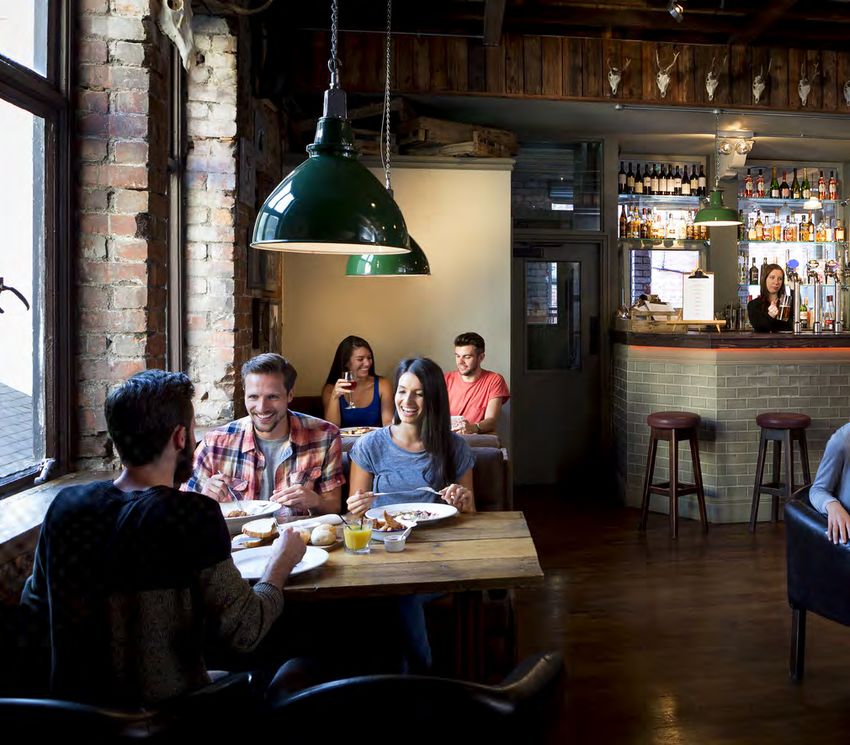
Food safety has always been a priority for the restaurant industry,
for both guests and employees.

The basis of an effective food safety culture is the Food and Drug
Administration Food Code, which for decades has served as the
foundation for restaurant operating procedures as they relate to
safe food handling. The guidance outlined in the Food Code is         FOR MORE THAN
science-based and is designed to reduce and prevent the incidence     30 YEARS, THE
of foodborne illness. Food Code requirements related to sanitation    N AT I O N A L R E S TAU R A N T
and personal hygiene in particular are the most reliable protocols    A S S O C I AT I O N’S S E RV S A F E
available to combat risks related to the spread of COVID-19.          PROGRAM HAS PROVIDED
                                                                      FOOD SAFETY TRAINING
Local, state and federal regulators use the FDA Food Code as a
                                                                      FOR BOTH MANAGERS AND
model to develop or update their own food safety rules and to be
                                                                      FOOD HANDLERS.
consistent with national food regulatory policy.
                                                                      ServSafe certifies food safety
                                                                      managers through an independently
AMONG THE REQUIREMENTS OF                                             developed certification exam, which
THE FOOD CODE THAT APPLY TO                                           follows standards adopted by the
CORONAVIRUS MITIGATION ARE                                            Conference for Food Protection.

       Prohibiting sick employees in the workplace                    The Conference for Food Protection
                                                                      also collaborates with the FDA to
       Strict handwashing practices that include how and
                                                                      develop the Food Code.
       when to wash hands
       Strong procedures and practices to clean and                   THE PURPOSE OF THIS GUIDANCE
       sanitize surfaces                                              IS TO BUILD ON THE ALREADY
       Ensuring the person in charge of a foodservice                 ESTABLISHED BEST PRACTICES
       facility is a certified food safety manager                    AND REQUIREMENTS AVAILABLE
       Ensuring the person in charge is on site at all times          that address specific health and safety
       during operating hours                                         concerns related to the spread of
                                                                      COVID-19, and to put those protocols
                                                                      into practice as state and local officials
                                                                      begin to open communities and
                                                                      businesses.

                                                                      Operators should make use of these
                                                                      guidelines as they relate to their
                                                                      existing policies and procedures and
                                                                      in conjunction with instructions they
                                                                      receive from authorities during their
                                                                      reopening phase-in.

       l 4 l COVID-19 REOPENING GUIDANCE
State and local officials may tailor the application of
                                     opening criteria to local circumstances (e.g., metropolitan
                 REOPENING           areas that have suffered severe COVID outbreaks vs.
                  GUIDANCE           rural and suburban areas where outbreaks have not

      FOR
                                     occurred or have been mild).

                                     To prepare to comply with opening procedures, operators

EMPLOYERS
                                     should update their existing policies and operating
                                     procedures in accordance with the latest FDA, Centers
                                     for Disease Control and Prevention, and Environmental
                                     Protection Agency guidance and in accordance with local
                                     and state officials regarding:

                                        Social distancing and protective equipment

                                        Employee health

                                        Cleaning/sanitizing/disinfecting

    ON FOOD                             Discard all food items that are out of date.

     SAFETY
                                         Where salad bars and buffets are permitted by local/
                                     state officials, they must have sneeze guards in place.
                                     Change, wash and sanitize utensils frequently and place
                                     appropriate barriers in open areas. Alternatively, cafeteria
                                     style (worker served) is permissible with appropriate
                                     barriers in place.

                                        If providing a “grab and go” service, stock coolers to
                                     no more than minimum levels.

                                        Ensure the person in charge is ServSafe certified and
                                     that their certification is up to date, and provide food
                                     handler training to refresh employees.

 l 5 l COVID-19 REOPENING GUIDANCE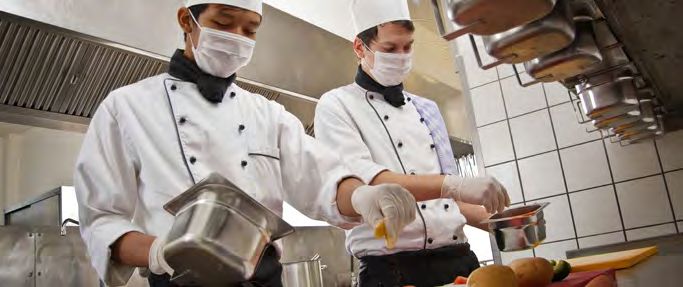
REOPENING
                           GUIDANCE

       FOR
 CLEANING
      AND
SANITIZING
    Thoroughly detail-clean and sanitize entire
facility, especially if it has been closed. Focus on
high-contact areas that would be touched by both
employees and guests. Do not overlook seldom-
touched surfaces. Follow sanitizing material
guidance to ensure it’s at effective sanitizing strength
and to protect surfaces.

    Avoid all food contact surfaces when using
disinfectants.

    Between seatings, clean and sanitize table
condiments, digital ordering devices, check
presenters, self-service areas, tabletops, and
common touch areas. Single-use items should be
discarded. Consider using rolled silverware and
eliminating table presets.

   Remove lemons and unwrapped straws from self-
service drink stations.

    Clean and sanitize reusable menus. If you use
paper menus, discard them after each customer use.
Implement procedures to increase how often
you clean and sanitize surfaces in the back-of-
house. Avoid all food contact surfaces when using
disinfectants.

   Check restrooms regularly and clean and sanitize
them based on frequency of use.

   Make hand sanitizer readily available to guests.
Consider touchless hand sanitizing solutions.

    l 6 l COVID-19 REOPENING GUIDANCE
REOPENING
                               GUIDANCE

                               ON
                               MONITORING
                               EMPLOYEE
                               HEALTH &
                               PERSONAL
                               HYGIENE
                                  Per existing FDA Food Code requirements, employees who are sick
                               should remain at home.

                                   If an employee becomes ill or presents signs of illness, the operator
                               should identify the signs during a pre-work screening and follow the
                               business’s established policies on when the ill employee is allowed to
                               return to work. At a minimum, however, follow CDC guidelines – tell the
                               employee to self-isolate for seven days from the onset of symptoms
                               and be symptom-free for three days without medication.

                                   Taking employees’ temperatures is at the operators’ discretion.
                               The CDC has not mandated taking an employee’s temperature and any
                               operator who chooses to do so should engage health officials first and
                               adopt policies aligned with proper procedures. CDC guidance states
                               the minimum temperature that indicates a fever is 100°F.

                                   Per CDC recommendations, face coverings have been shown to be
                               effective tools to mitigate risk from individuals who show symptoms
                               as well as those who don’t, especially in close environments where it’s
                               hard for people to maintain a three- to six-foot distance. In some states
                               and local jurisdictions, face coverings are required by government
                               officials; some employers require them, too. In all cases, those
                               coverings worn by employees should be kept clean in accordance with
                               CDC guidance. CDC provides overall cleaning guidance here.

                                   Train all employees on the importance of frequent hand washing,
                               the use of hand sanitizers with at least 60% alcohol content, and give
                               them clear instruction to avoid touching hands to face.

l 7 l COVID-19 REOPENING GUIDANCE
REOPENING
GUIDANCE
ON SOCIAL
DISTANCING
Update floor plans for common dining areas, Provide hand sanitizer for guests to use, including
redesigning seating arrangements to ensure at least contactless hand sanitizing stations, and post signs
six feet of separation between table setups. Limit reminding guests about social distancing. Thank them
party size at tables to no more than the established for their patience as you work to ensure their safety.
“maximums approved” as recommended by CDC
or approved by local and state government. Where Try not to allow guests to congregate in waiting
practical, especially in booth seating, physical barriers areas or bar areas. Design a process to ensure guests
are acceptable. Consider a reservations-only business stay separate while waiting to be seated. The process
model or call-ahead seating to better space diners. can include floor markings, outdoor distancing, waiting
in cars, etc. Consider an exit from the facility separate
Any social distancing measures based on square from the entrance. Determine ingress/egress to
footage should take into account service areas as well and from restrooms to establish paths that mitigate
as guest areas. proximity for guests and staff.
Remind third-party delivery drivers and any suppliers Where possible, workstations should be staggered
that you have internal distancing requirements. so employees avoid standing directly opposite one
another or next to each other. Where six feet of
Post signage at the entrance that states that no separation is not possible, consider other options (e.g.,
one with a fever or symptoms of COVID-19 is to be face coverings) and increase the frequency of surface
permitted in the restaurant. cleaning and sanitizing.
Note: Face coverings may be required by government officials and/or
Limit contact between waitstaff and guests. Where restaurant operators to mitigate the distancing gap. If not mandated,
face coverings are recommended by CDC and, when worn, they should
face coverings are not mandated, consider requiring
be cleaned daily according to CDC guidance.
waitstaff to wear face coverings (as recommended by
the CDC) if they have direct contact with guests.
Limit the number of employees allowed
simultaneously in break rooms.
If practical, physical barriers such as partitions or
Plexiglas barriers at registers are acceptable.
With larger staffs, use communication boards
to or digital messaging to convey pre-shift meeting
Use technology solutions where possible to reduce
information.
person-to-person interaction: mobile ordering and menu
tablets; text on arrival for seating; contactless payment
options.
l 8 l COVID-19 REOPENING GUIDANCEFDA is sharing information about best practices to
operate restaurants, retail food stores and associated
BEST
pick-up and delivery services during the COVID-19
pandemic to safeguard workers and consumers.
PRACTICES
This addresses key considerations for how foods
offered can be safely handled and delivered to
• Never touch Ready-to-Eat foods the public. This is not a comprehensive list. FDA
F O hands
with bare R R E TA I L encourages consulting the references and links
provided below (by CDC, FDA, EPA, and OSHA) for
F O Oservice
• Use single D S Tgloves,
O R Edeli
S, more detailed information. This will be updated as
tissue, or suitable utensils
R E S TAU R A N TS FDA receives further information and inquiries.
• Wrap food containers to prevent
& F O O D / P I C K- U P
cross contamination • Managing Employee Health (Including
• FollowD4Esteps
L I V to
ER Y S
food ERVICES
safety Contracted Workers)
Clean,DSeparate,
U R I N GCook,T Hand
E Chill • Personal Hygiene for Employees
• Managing Operations in a Foodservice
C O V I D - 1 9 PA N D E M I C Establishment or Retail Food Store
Summary of Best Practices for Retail Food Stores, Restaurants,
• Managing Food Pick-Up and Delivery
and Food Pick-Up/Delivery Services During the COVID-19 Pandemic
BE HEALTHY, BE CLEAN
• Prepare and •use sanitizers
Employees - Stay home or leave • Wash your hands often with soap • Never touch Ready-to-Eat foods
according to label
and contactinstructions
work if sick; consult doctor if sick,
supervisor
and water for at least 20 seconds
• If soap and water are not available,
with bare hands
• Use single service gloves, deli
• Employers - Instruct sick use a 60% alcohol-based hand tissue, or suitable utensils
• Offer sanitizers andto stay
employees wipeshome and tosend sanitizer per CDC • Wrap food containers to prevent
customers to• home
cleanimmediately if sick
grocery
Employers - Pre-screen employees
• Avoid touching your eyes, nose,
and mouth with unwashed hands
cross contamination
• Follow 4 steps to food safety
cart/basket handles,
temperature andor otherutilize
exposed to COVID-19 for
symptoms
• Wear mask/face covering
per CDC & FDA
Clean, Separate, Cook, and Chill
store personnel to conduct
CLEAN & DISINFECT
cleaning/sanitizing
• Train employees on cleaning • Disinfect high-touch surfaces • Prepare and use sanitizers
and disinfecting procedures, frequently according to label instructions
and protective measures, per • Use EPA-registered disinfectant • Offer sanitizers and wipes to
CDC and FDA customers to clean grocery
• Ensure food containers and
• Have and use cleaning utensils are cleaned and sanitized cart/basket handles, or utilize
products and supplies store personnel to conduct
• Follow protective measures cleaning/sanitizing
SOCIAL DISTANCE
• Shorten customer time in store
by encouraging them
• Help educate to: and
employees • Avoid displays that may • Shorten customer time in store
customers on importance of result in customer gatherings; by encouraging them to:
- Use shopping - Signs
lists
social distancing: discontinue self-serve buffets
and salad bars; discourage
- Use shopping lists
employee gatherings - Order ahead of time, if offered
- Order ahead of messages
- Audio time, if offered
- Consider using every
• Place floor markings and signs • Set up designated pick-up
areas inside or outside retail
to encourage social distancing
• Set up designated pick-up
other check-out lane to
aid in distancing
establishments
areas inside or outside retail
PICK-UP & DELIVERY
establishments
• If offering delivery options: • Encourage customers to use • Establish designated
- Ensure coolers and transport “no touch” deliveries pick-up zones for customers
containers are cleaned and ORDER • Notify customers as the delivery • Offer curb-side pick-up
sanitized
PLACED
is arriving by text message or PICK-UP
- Maintain time and phone call ZONE • Practice social distancing by
offering to place orders in
temperature controls vehicle trunks
- Avoid cross contamination;
for example, wrap food
during transport
• Establish designated
For more information, see Best Practices for Retail Food Stores, Restaurants, and Food Pick-Up/Delivery Services During the COVID-19 Pandemic April 2020
pick-up zones for customers
l 9 l COVID-19 REOPENING GUIDANCE
• Offer curb-side pick-upCOVID-19 REOPENING GUIDANCE A GUIDE FOR THE RESTAURANT INDUSTRY For other resources: RESTAURANT.ORG/COVID19
You can also read


