Hartbeespoort Dam, situated on the border between North West and Gauteng, is one of the oldest and most interesting dams constructed in South ...
←
→
Page content transcription
If your browser does not render page correctly, please read the page content below
SA’s water history 19

                                                                                          Taming
                                                                                         the poort

                                                                                                                                       SA Tourism
       Hartbeespoort Dam, situated on the border between North West and Gauteng, is one of the
         oldest and most interesting dams constructed in South Africa. Lani van Vuuren reports.

I
   t was Boer General Hendrik J              One man’s dream                             The outbreak of the Anglo-Boer War in
   Schoeman who first saw the poten-                                                     October 1899 put a hold on the imple-
   tial for a dam on the Crocodile River,    At the opening ceremony of the dam          mentation of the project, however.
30 km west of Pretoria, in the 1890s. In     on 28 May 1898, Genl Schoeman made
1898, he completed the construction of       a pledge to President Paul Kruger to        When the war ended in 1902, the
a dam on his farm Hartbeespoort, and         build a dam using government funds.         total reconstruction of South Africa
named it Sophia Dam, after his wife.         The purpose of such a project would be      got underway. It was in this same year
                                             to irrigate a few plots of land on which    that the viability of the site for the con-
The dam was of concrete, and was             poor whites could be settled.               struction of the dam was investigated.
about nine metres high. This dam did                                                     Interestingly, original investigations into
not impound any water, but was used          On 1 April 1899, Genl Schoeman wrote        the potential of constructing the Hart-
for the leading out of water and the irri-   a letter in which he stated that he was     beespoort Dam were conducted with
gation of adjacent land. Unfortunately,      willing to sell a portion of his farm for   the view to providing urban water to
the dam was washed away in a flood on        the above-mentioned project. President      Pretoria and Johannesburg, and not for
9 January 1909.                              Kruger reportedly welcomed this idea.       irrigation for settlement purposes.

                                                                                                 The Water Wheel May/June 2008
20 SA’s water history
Work on the river diversion was started
in March 1921 and completed in May of
that year. The first foundation concrete
was placed on 29 July, and by Septem-
ber 1922 the wall was two metres above
the riverbed. By April 1923 the wall was
completed, and only the finishing of
the parapets and crest road remained.
During the construction phase the dam
impounded the floods of 1922/23. The
whole scheme, including the canals, was
completed in 1925.
The dam was filled on 11 March 1925,
The Hartbeespoort Dam’s most
and a maximum flood of 2 700 cusecs
distinguishable feature is the
passed down the spillway on 26 March
miniature Arc de Triomphe on the
Lani van Vuuren
of that year. After completion, 97 farmers
western side of the dam wall.
and 65 lessees made use of the water
from the Hartbeespoort Dam.
Politics intervene costs of the project due to the difficult The west end of the dam wall sports
terrain through which the canals were an unusual feature, an arch built as a
The then Transvaal Irrigation Depart- constructed. Some of the rock forma- replica of the Arc de Triomphe. There
ment investigated the site, and pro- tions on which the dam wall itself was are two inscriptions on the arch. The
posed a 43 m-high gravity dam. The constructed had to be excavated deeper inscription on the eastern side reads
establishment of the Union of South than was thought previously. Dedi in deserto aquas, flumina in invio
Africa in 1910 postponed any further which means ‘I give waters in the wil-
work on the scheme, until 1914. The There were also some gaps in the legisla- derness and rivers in the desert (Isaiah
Hartbeespoort Bill Act was rather sud- tion, which led to litigation regarding the 43:20). The inscription on the western
denly passed in 1914, allowing work on expropriation of land. Lastly, the war led side reads Sine aqua arida ac misera
the project to continue. The estimated to a decrease in State funds for the con- agri cultura which means ‘Without
cost at the time was £605 000. struction of the scheme as funding for water it is arid and miserable in
a number of government departments agriculture’.
A possible reason for the sudden was slashed to pay for the war effort.
flare-up of interest in the Hartbeespoort White and black labour
Dam is the political occurrences of 1913 As a result, work on the dam only started
and 1914, including the miners’ strike in 1916. Two years later progress was One of the main aims of the Hartbee-
and uprisings on the Witwatersrand. It hampered when floods destroyed much spoort Irrigation Scheme was to provide
is said that the government could have of the work. In 1918, government passed employment to soldiers demobilised
passed the project to appease the white the Hartbeespoort Irrigation Scheme after World War One as well as poor
electorate. (Acquisition of Land Act) which author- whites. However, it is reported that the
ised the expropriation of land required for attitude of these groups towards hard
On 16 June 1914, the House of Assembly the construction of the dam. Pressure to labour resulted in a request for permis-
voted for the scheme. Start of construc- complete the project mounted and, as a sion to use blacks, which was granted
tion of the dam and irrigation canals was result, special provision was made in the in 1919.
planned for the end of 1915. However, 1921/22 budget for the scheme. At that
South Africa’s involvement in World War stage, the dam was one of the largest At the peak of construction, some 1 835
One meant that the project was side- schemes implemented in the Transvaal. men were employed at the dam, and
lined once again. 3 500 on the scheme as a whole. The
The dam design was adapted from a more experienced workers were used at
The implementation of the scheme gravity structure to a varying radius arch the dam itself, while others were used
did not go as planned. A number of structure 59 m high. This allowed for on the canals. The workers were accom-
obstacles were in the way of imple- much less cement to be used. In addi- modated on-site in houses, semi-
mentation. Firstly, the Department of tion, the foundation could be completed detached houses and housing blocks
Irrigation was not prepared for the rising in one dry season. with four living quarters. The site also
The Water Wheel May/June 2008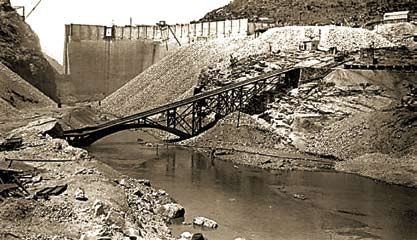
SA’s water history 21

                             had an office block, store, blacksmith,
                             and a small hydropower station.

                             In 1928, the Brits magisterial district was
                             proclaimed. This was as a direct conse-
                             quence of the increased activity in the
                             Hartbeespoort area, and rapid develop-
                             ment that took place under the scheme.

                             Raising the dam wall

                                                                                                                                                                   Civil Engineering Magazine
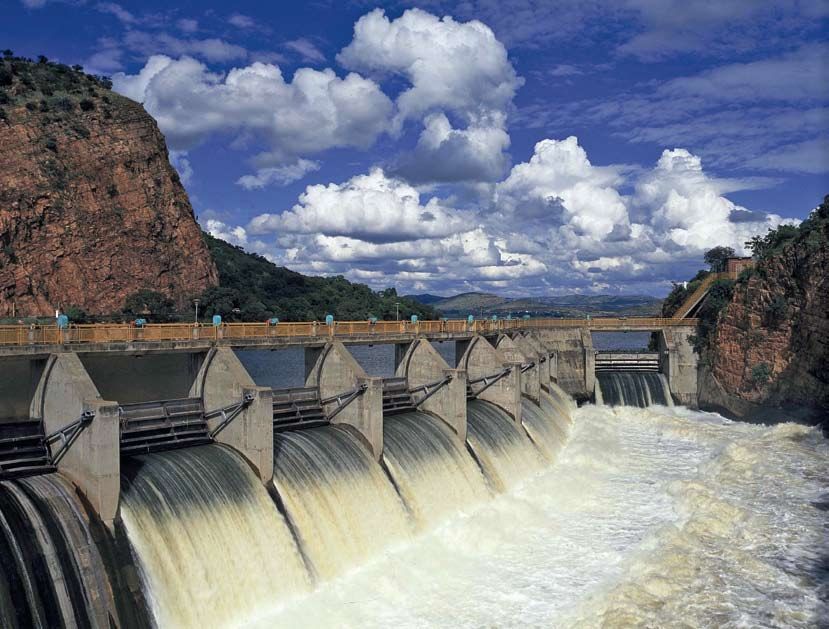
                             In 1964, the Department of Water Affairs
                             proposed that the dam be raised to
                             increase its capacity and to make a
                             larger volume of water available for
                             irrigation purposes. The raising of the
                                                                             Hartbeespoort Dam during construction of the wall.
                             dam was done by means of ten 2,74 m
                             radial crest sluices on the spillway raising
                             the full supply level by 2,4 m. The dam
                             has a crest length of 140 m and a capac-
                             ity of more than 200 million m3. Today,
                             the dam still irrigates almost 14 000 ha
                             of land.

                             The dam has unfortunately become

                                                                                                                                                                   Civil Engineering Magazine
                             famous not for its aesthetics or water
                             storage ability. Rather it is cited as one of
                             the worst examples of eutrophication,
                             resulting from high levels of phosphates
                             and nitrates washing into the dam.              Cable way at Hartbeespoort Dam during the construction of the foundations, 1922.

                             This had had a negative affect on the
                             water quality, the fish life, use of the
                             dam and the environment. Last year, the
                             Department of Water Affairs & Forestry
                             initiated a remediation programme
                             called Harties Metsi a Me (meaning
                             ‘Harties, my water’, which is working
                             towards improving the situation at the
                             dam. Rand Water is the implementing
                             agent for the programme.
                                                                                                                                                                   National Library of SA

                                                                             Completed Hartbeespoort Dam.
Civil Engineering Magazine

                                                                              Sources:
                                                                              Hydropolitical History of South Africa’s International River Basins (WRC Report
                                                                              No: 1220/1/04)
                                                                              Fifty Years of Consulting Engineering in South Africa published by SAACE
                             Completed Hartbeespoort Dam as seen              ‘The Construction of Hartbeespoort Dam’, Civil Engineering, June 2004, Vol 12 No 6
                             from the air.                                    www.dwaf.gov.za

                                                                                                                                  The Water Wheel May/June 2008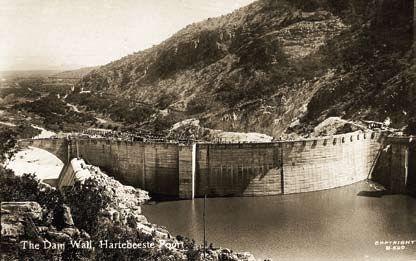
You can also read


