Health-Related Fitness in Adults From Eight European Countries-An Analysis Based on Data From the European Fitness Badge
←
→
Page content transcription
If your browser does not render page correctly, please read the page content below
ORIGINAL RESEARCH
                                                                                                                                                published: 08 January 2021
                                                                                                                                          doi: 10.3389/fphys.2020.615237

                                                Health-Related Fitness in Adults
                                                From Eight European Countries—An
                                                Analysis Based on Data From the
                                                European Fitness Badge
                                                Katja Klemm 1* , Janina Krell-Roesch 1 , Ine Lucia De Clerck 2 , Walter Brehm 3 and
                                                Klaus Boes 1
                                                1
                                                 Institute of Sports and Sports Science, Karlsruhe Institute of Technology, Karlsruhe, Germany, 2 Department of Health and
                                                Care, Artevelde University of Applied Sciences, Ghent, Belgium, 3 Department of Sport Science, University of Bayreuth,
                                                Bayreuth, Germany

                                                Background: There are conflicting reports about the fitness status of European adults,
                                                partly due to the lack of a standardized fitness test battery used across Europe. The
                                                European Fitness Badge (EFB) was developed in 2017 as an online-based tool to assess
                                                the health-related fitness of persons aged ≥ 18 years residing in European countries. We
                                                examined the demographic characteristics and fitness status of persons who completed
                                                the EFB between June 2017 and May 2019.
                           Edited by:
                       Urs Granacher,           Methods: We conducted a multinational study in eight European countries. Participants
     University of Potsdam, Germany             completed the EFB which includes 11 validated motor tests to measure endurance,
                         Reviewed by:           strength, coordination, and flexibility performance, under the supervision of an EFB
                          Oliver Faude,
       University of Basel, Switzerland         instructor in different settings (e.g., sports club sessions, public events). Two different
                           Astrid Zech,         test batteries [test profiles (TPs)] are available to distinguish between less active (TP1)
     Friedrich Schiller University Jena,
                              Germany
                                                and active individuals (TP2). We calculated descriptive statistics and conducted analyses
                          Simon Steib,          of variance to examine sample characteristics and a potential impact of sex, age, body
      Heidelberg University, Germany            mass index (BMI), physical activity, and posture on fitness as assessed by the EFB.
                  *Correspondence:
                           Katja Klemm          Results: The sample included 6,019 adults (68.7% females; mean age 52.7 years; age
                  katja.klemm@kit.edu           range 18–89 years). Participants who completed TP1 were older (TP1: 61.4 years; TP2:
                                                44.2 years; p = 0.00), reported a lower level of physical activity (TP1: 3.8; TP2: 4.0;
                   Specialty section:
         This article was submitted to          p = 0.00), had a higher BMI (TP1: 25.7; TP2: 24.3; p = 0.00) and a higher frequency of
                   Exercise Physiology,         postural abnormalities (TP1: 43%; TP2: 33%; p = 0.00) than TP2 participants. Among
               a section of the journal
               Frontiers in Physiology          3,034 participants who completed TP2, males had higher performance in endurance,
        Received: 10 October 2020               strength, and overall fitness, whereas females performed better in coordination and
      Accepted: 10 December 2020                flexibility tests. In addition, younger age, lower BMI, and higher level of physical activity
       Published: 08 January 2021
                                                engagement were associated with better EFB test performance.
                            Citation:
            Klemm K, Krell-Roesch J,            Conclusion: The EFB can be used to assess the health-related fitness status of
  De Clerck IL, Brehm W and Boes K
                                                individuals aged ≥ 18 years. Our results show that TP1 and TP2 were completed by
        (2021) Health-Related Fitness
      in Adults From Eight European             persons from the respective target groups (i.e., less active vs. active), and also confirm
   Countries—An Analysis Based on               findings from previous studies on potential determinants of fitness such as sex or age.
     Data From the European Fitness
   Badge. Front. Physiol. 11:615237.            Keywords: Europe, motor fitness tests, physical activity, health-enhancing physical activity, health-related
    doi: 10.3389/fphys.2020.615237              fitness, European Fitness Badge

Frontiers in Physiology | www.frontiersin.org                                          1                                         January 2021 | Volume 11 | Article 615237
Klemm et al. Health-Related Fitness in European Adults
INTRODUCTION countries. Additionally, a recent systematic review on the decline
of cardiorespiratory fitness worldwide called for a multinational
Physical inactivity and sedentary behavior are among the main surveillance system to monitor health and fitness trends
risk factors for various non-communicable diseases such as (Lamoureux et al., 2019). Furthermore, research has shown that
cardiovascular diseases or metabolic syndrome (Katzmarzyk, fitness tests are predominantly completed by individuals who are
2010; Thorp et al., 2011; Wen et al., 2011; Lee et al., 2012). These physically active on a regular basis and have a good fitness status
diseases are associated with high economic burden as they often (de Barreto et al., 2013; Finger et al., 2013), thereby highlighting
lead to loss of work force or early retirement (Ding et al., 2016). the need of a test battery that is also appealing to individuals who
Physical inactivity and sedentary behavior are highly prevalent in are physically inactive or have a low fitness status.
Europe, i.e., 46% of Europeans never engage in physical exercise To address these paucities, the EFB1 was developed between
or sport activities and this number has increased over the last 2015 and 2017 and published in 2017. The EFB is a novel and
10 years (European Commission, 2018). One way to potentially innovative tool for the following reasons: (1) It is based on the
impact people’s health-related behavior and motivate them to internationally known HEPA concept (Martin et al., 2006); (2) it
maintain or adopt an active lifestyle is individually tailored addresses the whole adult European population regardless of an
programs such as cardio or aerobic exercise programs. However, a individual’s physical activity level. To this end, the EFB consists
prerequisite for a successful exercise program is a valid diagnosis of two different test profiles (TPs), i.e., one that is suitable for
of the current fitness status of a person (Godino et al., 2014). persons who do not engage in physical activity on a regular
We and others have reported that physical activity engagement basis or who are older (TP1), and one for younger persons or
is associated with fitness levels (Sandvik et al., 1993; Bouchard those who regularly engage in physical activity (TP2) (Klemm
et al., 2012; Tittlbach et al., 2017). For example, in one of et al., 2017a); (3) it includes 11 objective motor tests based
our previous studies based on EFB data, we reported that a on the health-oriented fitness dimensions endurance, strength,
higher physical activity level correlates with a higher fitness level. coordination, and flexibility plus additional measurements for
In addition, based on extreme value comparison, we showed body composition, posture, and stability (Bös et al., 2017); (4)
that individuals with low fitness level had higher probability of handling and storage of data is fully automized through the
being physically inactive than persons with high fitness level EFB online data platform; (5) data are collected, i.e., the test
(Klemm et al., 2020). is administered and evaluated by licensed and educated EFB
Various fitness tests are used in Europe such as the German instructors; (6) it was designed for exercise instructors who
Sports Badge (Deutscher Olympischer Sportbund (DOSB), 2019), administer the test participants of their exercise training groups,
the Austrian Sport and Gymnastic Badge (Bundesministerium during public events or in fitness clubs or companies; and (7)
für Kunst et al., 2020), or the Eurofit test for adults (Oja a first evaluation with regard to acceptance, feasibility, and
and Tuxworth, 1995). However, studies on the fitness of adults psychometric properties of the EFB was carried out in 2016 prior
residing in Europe mostly focused on cardiorespiratory fitness to the publication of the EFB (Klemm et al., 2017b).
and its relationship to NCDs (Hamer and Steptoe, 2009; Ekblom- With regard to these strengths of the EFB, this current study
Bak et al., 2010; Zaccardi et al., 2015) or mortality (Laukkanen has three specific aims: (1) To examine the dissemination of the
et al., 2001; Robsahm et al., 2016; Jensen et al., 2017; Ekblom- EFB by summarizing the demographic characteristics (i.e., age,
Bak et al., 2019). In the last 20 years, only few national studies sex, level of physical activity, BMI, and posture) of persons who
examined the association between fitness status and potential completed the EFB within the first 2 years after its inception and
determinants such as age or sex based on data from scientifically as stratified by country of residence. (2) To examine whether the
proven fitness tests in Europe (Ekblom et al., 2007; Crump EFB reaches the respective target groups (i.e., both less active and
et al., 2016). In addition, the majority was also focused on active persons) by calculating differences in age, level of physical
cardiorespiratory fitness. This is in line with studies from the activity, BMI, and posture abnormalities between participants
United States, where more research regarding physical and who completed TP1 (for less active persons) vs. TP2 (for active
health-related fitness has been carried out in the last decade (Blair persons; content-related validity). (3) To examine whether the
et al., 1995; Lee et al., 1999, 2010; Hamer and Steptoe, 2009). To data collected by the EFB are comparable to what has been
the knowledge of the authors, there is currently no fitness test reported in the literature with regard to a potential impact of
available that comprises all health-relevant fitness dimensions, sex, age, BMI, and physical activity on fitness status among
i.e., endurance, strength, flexibility, and coordination (Caspersen participants who completed TP2.
et al., 1985) and that can be completed by and is accessible Based on results from preliminary studies in various European
to a broad population of adults residing in different European countries (Finger et al., 2013; Eriksen et al., 2016; Klemm et al.,
2017b) and based on the expertise of involved investigators
and results from previous physical activity programs (Pahmeier
Abbreviations: ANOVA, analysis of variance; BMI, body mass index; e.g., for
example; EFB, European Fitness Badge; η2 , eta square; f, females; F, F-value; HEPA, et al., 2012; Bauer and Römer, 2018), we hypothesized that
health-enhancing physical activity; i.e., is to say that; KIT, Karlsruhe Institute of (1) participants who completed the EFB would reside in
Technology; M, mean value; m, males; N, number of participants; N-Ex, Non- various European countries and would have a moderate to
Exercise Questionnaire; no abn., no abnormality in posture test; P, p-value; PAR-Q,
high level of physical activity; (2) participants who completed
Physical Activity Readiness Questionnaire; SD, standard deviation; TP1, test profile
1; TP2, test profile 2; VO2 max, maximal oxygen consumption; WHO, World
1
Health Organization. www.fitness-badge.eu
Frontiers in Physiology | www.frontiersin.org 2 January 2021 | Volume 11 | Article 615237Klemm et al. Health-Related Fitness in European Adults
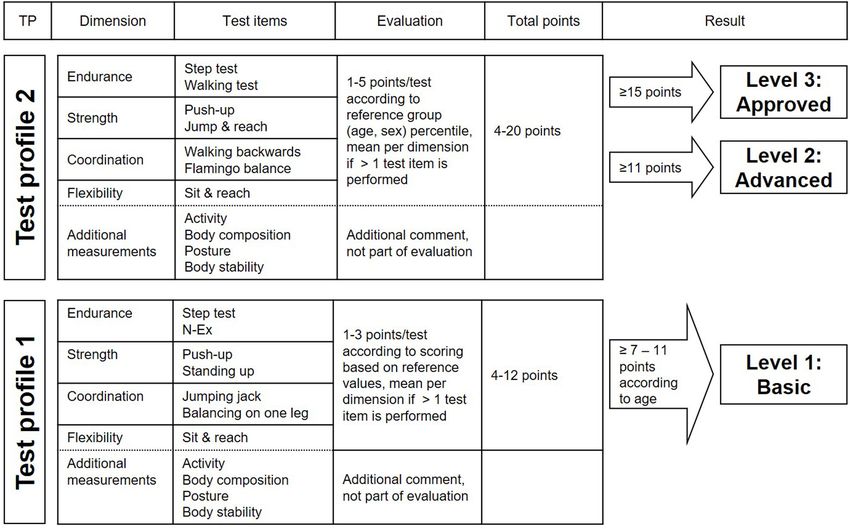
TP1 would be older, less physically active, and had a higher according to the performance and based on validated reference
BMI than participants who completed TP2; and (3) there values (Bös et al., 2017). TP1 was designed in a way that between
would be significant effect of age, sex, BMI, and physical 60 and 80% of test participants should achieve the highest score
activity engagement on fitness performance among participants of 3 points in every test item, regardless of age and sex (exception
who completed TP2. is the sit and reach test, see Klemm et al., 2017a for details). This
decision for the relatively high rates of achievement of the highest
score was based on the goal of the EFB developers to motivate
MATERIALS AND METHODS people who only have a low level of fitness to be physically active
and thereby further improve their fitness.
Study Setting The scores for each of the items are summed up based
The EFB is funded by the European Union (EU) (2015–2019). on the four dimensions of fitness, i.e., endurance, strength,
Sport and Gymnastic organizations as well as scientific partners coordination, and flexibility. If more than one test item is
from ten institutions across eight European countries were performed per dimension, the average value is calculated. In the
involved in the development of the EFB (Austria, Sportunion; next step, the overall test result including all four dimensions
Belgium, Artevelde University of Applied Sciences; Bulgaria, BG is calculated. This value ranges from 4 points (1 point in each
Be Active; Denmark, Danish Gymnastic and Sports Federation; dimension) to 12 points (3 points in each dimension). The
Germany, German Gymnastic Federation, KIT; Slovenia, Sports interpretation of the total score varies by age group and is based
Union Slovenia; Spain, UBAE; Europe wide, International Sports on expert consensus (Bös et al., 2017), i.e., younger people require
and Culture Association). Throughout the entire year, the EFB more points (participants aged ≤ 40 years need ≥ 11 points) than
can be accessed by all interested organizations in Europe. Data older people (participants aged > 70 years need ≥ 7 points) to
are gathered online by these partner institutions. Organizations reach a “basic” level. If a person does not reach the minimum
in participating countries offer completion of the EFB in different number of required points, then they receive a participation
settings such as during sports club training sessions, community certificate with feedback information.
activities, or public events such as the European week of sports, Test profile 2 addresses physically active people and is
according to their abilities and outreach. As the overarching goal considered performance-oriented (e.g., number of fails during
is to make the EFB available to any adult residing in Europe, the balancing on a beam). The test performance is evaluated
only exclusion criteria of the EFB are age < 18 years and one or quantitatively using age- and gender-specific reference values
more items on the PAR-Q that were answered with “yes” (Bös (Bös et al., 2017) in five categories [1–5] according to percentiles.
et al., 2017). The EFB is administered to participants by licensed The point values refer to quintiles: 1 point = percentile
instructors who successfully completed a 1-day EFB instructor rank 0–20, 5 points = percentile rank 81–100. As for TP1,
workshop. After completion of the EFB, each participant receives results from individual tests are combined based on the motor
an individual certificate and additional feedback of seven pages dimensions. Overall values range from 4 points (1 point per
on how to improve his/her fitness by those trained instructors. dimension) to 20 points (5 points per dimension). Based on
Collected data is saved on an online data platform accessible by their test performance, participants that complete TP2 receive an
all EFB instructors via an individualized access code. Data can be “advanced” or “approved” certificate (please refer to Figure 1).
exported to Excel and SPSS through an anonymized output. The If a person does not achieve a minimum of 11 points for
study procedures were approved by the ethics committee of the the “advanced” level, then the person receives a participation
KIT (Tittlbach et al., 2017). Participation in the EFB is voluntary certificate with feedback information.
and all participants provided written informed consent. To measure physical activity, the N-Ex test is included in the
EFB (Jurca et al., 2005). Participants are asked to choose one
Measurements of five descriptions of usual physical activities during a normal
A detailed description of the test items of the EFB has week that best reflects their activity level. The questionnaire
been published elsewhere (Bös et al., 2017; Klemm et al., distinguishes between “house and family care” [1], “low level
2017a). Briefly, the EFB has two TPs and participants are activities like stair climbing” [2], “20–60 min physical activity”
asked to choose one profile based on their level of physical [3], “60–180 min physical activity” [4], and “more than 180 min
activity. The level of physical activity is determined based physical activity” [5]. Physical activity assessed by the N-Ex
on the N-Ex questionnaire that all participants are required reflects physical activities carried out with at least moderate
to complete prior to the testing. Both TPs consist of motor intensity, i.e., with substantial increases in breathing and heart
performance tests to assess endurance, strength, coordination, rate. When answering 1 or 2, the participants receive the
and flexibility. Additional measurements to assess activity, recommendation of completing TP1, when answering 3, 4, or 5,
posture, body height, body weight, and waist circumference it is recommended they undergo TP2.
are included in the EFB as well (please refer to Figure 1). The posture test is an observation test, i.e., the EFB instructor
Before carrying out the EFB, each participant is required to observes the test person during natural standing and determines
complete the PAR-Q. the quality of posture. For the purpose of this research, we used
Test profile 1 was designed for less active or older individuals the following two results from the posture test: no abnormality [1]
and mainly assesses functional performance (e.g., standing up and at least one abnormality [2], such as a forward head bending
with one leg). Scores for each test range from 1 to 3 points or a hollow lower back.
Frontiers in Physiology | www.frontiersin.org 3 January 2021 | Volume 11 | Article 615237Klemm et al. Health-Related Fitness in European Adults
FIGURE 1 | Overview of the EFB test profiles and the according evaluation.
Furthermore, measurements of body weight and height groups is 100 (SD = 10). This allows for a comparison of
were taken to calculate the BMI, and waist circumference performance across fitness variables and between groups. This
was also assessed. calculation could only be done in TP2 participants due to the
availability of quantitative fitness results (i.e., continuous fitness
variables) in this TP.
Statistical Analysis The significance level for all analyses was set at p = 0.05.
Participant demographics (i.e., age, sex, physical activity, BMI, Partial η2 was categorized after Cohen (Cohen, 1992; Bauer
posture) as stratified by country were analyzed and summarized and Römer, 2018) to low (η2 ≥ 0.01), medium (η2 ≥ 0.06), or
using means (M) and SD. high (η2 ≥ 0.14). Statistical analysis was performed using IBM
In a first step, we calculated two-factorial ANOVA to SPSS Version 24.
examine whether there was a difference in age, level of physical
activity, BMI, and posture abnormalities between participants
who completed TP1 vs. TP2. We calculated main effects of
TP, sex, and the interaction effect (TP × sex). Results are RESULTS
displayed using M, SD, and interpreted based on F-values and
p-values for the main and interaction effects, and effect sizes Demographic Breakdown of EFB
(η2 ). Given the large sample size, it is not sufficient to only Participants (Aim 1)
consider p-values. Rather, effect sizes may be more meaningful Table 1 provides an overview of demographic and other pertinent
when interpreting the findings. characteristics of participants stratified by country and EFB TP.
In a second step, we ran one-factorial ANOVA to examine 6,019 adults (68.7% females) aged between 18 and 89 years
whether performance in endurance, strength, coordination, completed the EFB between 1 June 2017 and 31 May 2019. The
flexibility, and overall fitness (all z-transformed variables) mean (SD) age was 52.7 (16.7) years. The largest age group were
differed between groups of participants who completed TP2. those aged 60–69 years (27.4%), followed by participants aged
We created the following groups: sex (males and females), age 50–59 years (17.3%), aged ≥70 (15.9%), 40–49 (15.3%), 18–29
(18–39, 40–59, and >59 years), BMI (normal weight 18.5– (13.1%), and 30–39 (10.9%). 73.6% of all participants reported
24.9, overweight 25.0–27.4, and obese > 27.4), and physical being physically active for at least 1 h per week, 14.7% reported
activity level (180 min per week). Given between 20 and 60 min of physical activity per week, and 11.7%
the z-transformation of fitness variables, the mean for all reported no physical activity engagement in a regular week.
Frontiers in Physiology | www.frontiersin.org 4 January 2021 | Volume 11 | Article 615237Klemm et al. Health-Related Fitness in European Adults
Activity assessed using N-Ex and ranging from 1 to 5 with higher values reflecting higher amount of physical activity; N, number of participants; M, mean value; SD, standard deviation; BMI, body mass index; no abn.,
Participants were from eight different countries, with 41% being
from Denmark, 36.9% from Germany, 11.1% from Slovenia,
(% no abn.)
4.5% from Spain, 3.5% from Belgium, and 3.1% from Austria.
Posture
However, due to low numbers of participants from Bulgaria
88.9
43.5
54.6
53.9
76.4
54.9
67.0
(N = 1) and Czech Republic (N = 2), we did not include the results
from these participants in further analyses (Table 1).
23.65, 3.19
24.36, 3.00
25.37, 4.03
24.51, 4.02
24.01, 3.61
24.49, 3.81
24.32, 3.70
(M, SD)
Differences Between Test Profiles 1 and
BMI
2 (Aim 2)
The differences between TP1 and TP2 are displayed in Table 2.
Overall, 49.6% of participants completed TP1 and 50.4% of
4.10, 0.91
3.25, 1.41
3.87, 1.06
4.73, 0.75
4.21, 0.89
3.81, 1.12
4.04, 1.04
Activity
(M, SD)
EFB test profile 2
participants completed TP2. Participants who completed TP1
were on average 17 years older (TP1: 61.4 years; TP2: 44.2 years;
F = 1804.366, p < 0.001) and reported a slightly lower level of
40.33, 11.81
44.54, 12.79
37.38, 12.84
46.30, 16.34
42.03, 14.60
44.21, 15.12
physical activity (TP1: 3.8; TP2: 4.0; F = 44.574, p < 0.001). There
37.72, 8.32
(M, SD)
Age
was no significant difference between males and females in either
TP1 or TP2 with regard to age (F = 0.037, p = 0.847) or physical
activity (F = 3.224, p = 0.073; Table 2).
TP1 participants also had a higher BMI (TP1: 25.7; TP2: 24.3;
(% female)
F = 151.579, p < 0.001) and a higher frequency of postural
58.8
71.5
57.9
51.0
64.7
63.5
63.2
Sex
abnormalities (TP1: 43%; TP2: 33%; F = 65.854, p < 0.001)
than TP2 participants. There was a significant sex effect on BMI
(F = 175.760, p < 0.001), i.e., males had a higher BMI than females
in both TP1 (males: 26.6; females: 25.4) and TP2 (males: 25.5;
1625
3031
119
193
466
102
526
N
females: 23.7). There was also a significant TP × sex interaction
effect (F = 5.620, p < 0.05), i.e., males had a 1.2 higher BMI in
TP1 and a 1.8 higher BMI in TP2. Finally, there was a significant
sex effect on posture abnormalities (F = 15.658, p < 0.001),
(% no abn.)
i.e., males had higher frequency of postural abnormalities than
Posture
females in both TP1 (males: 48%; females: 41%) and TP2 (males:
72.6
46.7
56.2
28.0
75.2
22.9
56.8
36%; females: 32%; Table 2).
Physical Fitness by Sex, Age, BMI, and
24.26, 3.20
24.43, 2.58
25.56, 4.33
27.28, 5.25
25.42, 4.26
27.33, 4.86
25.66, 4.39
(M, SD)
BMI
Physical Activity (Aim 3)
3,034 participants with a mean age of 44.18 years (63.2% females)
TABLE 1 | Characteristics of study participants by country and EFB test profile.
completed TP2. Within this group, overall, fitness status differed
3.88, 1.14
3.12, 1.38
3.83, 1.11
3.58, 1.52
3.82, 1.14
4.16, 0.84
3.83, 1.14
significantly with regard to sex, age, BMI, and physical activity
Activity
(M, SD)
EFB test profile 1
(please refer to Table 3).
Males had significantly higher performance in endurance
(F = 7.139, p < 0.05), strength (F = 966.464, p < 0.001), and
53.84, 13.88
44.12, 17.32
48.55, 16.18
61.37, 13.44
41.89, 6.67
66.66, 6.92
66.89, 7.12
overall fitness (F = 11.961, p = 0.001) as compared to females.
(M, SD)
Age
In contrast, females perform significantly better in coordination
(F = 0.736, p < 0.001) and flexibility tests (F = 326.706, p < 0.001).
There was also a significant age effect, i.e., participants in the
youngest group (aged 18–39) performed significantly better
(% female)
59.7
66.7
76.9
68.7
65.7
89.3
74.3
across all tests as compared to older participants, with medium
Sex
to high effect sizes (η2 as low as 0.11 for endurance and 0.23 for
overall fitness), except for low effect size for flexibility (η2 = 0.02).
no abnormality in posture test.
Age as compared to sex, BMI, or physical activity also explained
the highest variance in fitness performance. Furthermore, there
1999
2985
166
595
140
67
18
N
was a significant effect of BMI on fitness status, i.e., participants
with a higher BMI (≥27.4) performed significantly worse in
Overall (6019)
all tests. The explained variance is low to medium with the
Country (N)
DEN (2465)
GER (2220)
highest effect sizes for overall fitness (η2 = 0.11) and endurance
AUT (186)
SVN (666)
ESP (268)
BEL (211)
(η2 = 0.12). Finally, participants with a higher physical activity
level had significantly better performance in all fitness tests and
Frontiers in Physiology | www.frontiersin.org 5 January 2021 | Volume 11 | Article 615237Klemm et al. Health-Related Fitness in European Adults
TABLE 2 | Results from two-factorial ANOVA on differences between TP1 and TP2 participants.
N Age (M, SD) Activity (M, SD) BMI (M, SD) Posture (M, SD)
TP1 f 2,141–2,219 61.44, 13.15 3.82, 1.14 25.41, 4.47 0.41, 0.49
m 735–766 61.15, 14.27 3.87, 1.16 26.59, 4.0 0.48, 0.50
Overall 2,877–2,985 61.37, 13.44 3.83, 1.14 25.66, 4.39 0.43, 0.50
TP2 f 1,839–1,918 44.23, 14.58 4.02, 1.02 23.66, 3.59 0.32, 0.47
m 1,022–1,116 44.09, 16.04 4.08, 1.07 25.45, 3.62 0.36, 0.48
Overall 2,861–3,034 44.18, 15.13 4.04, 1.04 24.32, 3.70 0.33, 0.47
FTP (p) 1,804.37 (0.000) 44.57 (0.000) 151.58 (0.000) 65.85 (0.000)
Fsex (p) 0.29 (0.589) 3.22 (0.073) 175.76 (0.000) 15.66 (0.000)
FTP∗sex (p) 0.04 (0.847) 0.05 (0.824) 5.62 (0.018) 1.15 (0.283)
η2 0.27 0.01 0.06 0.01
TP1, test profile 1; TP2, test profile 2; f, females; m, males; N, number of participants; F, F-value; p, p-value; η2 ,
eta square; M, mean value; SD, standard deviation.
Activity assessed using N-Ex and ranging from 1 to 5 with higher values reflecting higher amount of physical activity. N ranges due to different numbers of participants in
analyses for different outcome variables.
TABLE 3 | Results from one-factorial ANOVA on the impact of sex, age, body composition, and physical activity on fitness test performance.
Parameters N Endurance Strength Coordination Flexibility Overall fitness
Sex Female (M, SD) 1,720–1,903 99.62, 9.92 96.22, 7.38 100.63, 9.19 102.39, 8.70 99.49, 9.16
Male (M, SD) 1,004–1,109 100.66, 10.11 106.54, 10.55 98.92, 11.18 95.90, 10.72 100.87, 11.24
F(p) 7.139 (0.008) 966.464 (0.000) 20.736 (0.000) 326.706 (0.000) 11.961 (0.001)
η2 0.00 0.25 0.01 0.10 0.00
Age 18–39 (M, SD) 1,029–1,144 103.30, 9.22 104.94, 10.33 103.22, 6.39 101.23, 9.92 104.78, 8.48
40–59 (M, SD) 1,274–1,384 99.52, 9.52 98.63, 8.23 100.26, 9.40 100.14, 9.42 99.29, 8.62
>59 (M, SD) 421–485 93.35, 9.70 92.37, 7.47 91.68, 13.38 96.70, 11.03 90.46, 9.91
F(p) 176.506 (0.000) 357.151 (0.000) 268.008 (0.000) 35.864 (0.000) 405.195 (0.000)
η2 0.11 0.20 0.15 0.02 0.23
BMI 18.5–24.9 (M, SD) 1,732–1,872 102.35, 9.37 100.62, 9.66 101.67, 8.49 101.52, 9.73 102.24, 9.15
25.0–27.4 (M, SD) 527–577 97.98, 9.41 100.18, 10.05 98.58, 11.25 98.81, 9.87 98.22, 9.61
>27.4 (M, SD) 465–489 93.44, 9.54 98.13, 10.72 95.34, 11.89 96.35, 10.08 93.67, 10.38
F(p) 185.782 (0.000) 11.970 (0.000) 89.904 (0.000) 60.007 (0.000) 162.042 (0.000)
η2 0.12 0.01 0.06 0.04 0.11
Activity 180 min 1,020–1,141 102.84, 9.48 101.93, 10.42 101.31, 8.91 100.99, 9.87 102.72, 9.62
F(p) 80.859 (0.000) 33.627 (0.000) 17.748 (0.000) 14.065 (0.000) 66.217 (0.000)
η2 0.06 0.02 0.01 0.01 0.05
N, number of participants; F, F-value; p, p-value; η2 , eta square; M, mean value; SD, standard deviation. Endurance = estimated VO2 max based on walking or step test;
strength = jump and reach test; coordination = flamingo test; flexibility = sit and reach test; N ranges due to different numbers of participants in analyses for different
outcome variables. Mean and SD values are z-scores.
overall fitness, with effect sizes ranging between 0.01 and 0.05, DISCUSSION
except for medium effect size for endurance (η2 = 0.06; Table 3).
Three groups of TP2 participants, i.e., those in the youngest Within 2 years, more than 6,000 participants residing in
age group between 18–39 years, those with normal BMI of eight different European countries completed the EFB. With
18.5–24.9, and those with an activity level of >180 min per regard to our first research aim, participants who completed
week achieved the best fitness results. That is, on average, their the EFB were, on average, physically active and middle aged.
mean value was >100.00 in all four fitness dimensions and Countries such as Denmark, Germany, and Slovenia appear
overall fitness. Overall, participants in the youngest age group to be more successful in promoting the EFB as reflected
had the highest level of overall fitness (M = 104.78), endurance by higher number of participants in these countries. One
(M = 103.30), and coordination (M = 103.22), females had explanation might be that countries across Europe apply
the higher level of flexibility (M = 102.39), and males had the different strategies in promoting the EFB, e.g., integration in
highest level of strength (M = 106.54) as compared to all other sport organizations, connect the EFB with other projects or
groups (Table 3). cooperation with companies.
Frontiers in Physiology | www.frontiersin.org 6 January 2021 | Volume 11 | Article 615237Klemm et al. Health-Related Fitness in European Adults
In line with our hypothesis for the second research aim, we In the future, we plan to examine whether the EFB can
found that participants who completed TP1 were older, less serve as a tool to enhance motivation of study participants
physically active, had a higher BMI and higher frequency of to initiate, maintain, or enhance engaging in regular
postural abnormalities than participants who completed TP2. physical activity.
This also confirms the initial differentiation of the EFB into Our results should be interpreted in light of the strengths
two TPs, i.e., TP1 was designed for participants who are older and weaknesses of our study. The main strengths of the EFB
and/or less physically active and may thus have a lower fitness are its evidence-based, theoretical background, and the inclusion
status, and TP2 was designed for participants who are younger of validated test items that have been used by our research
and/or more physically active and may thus have a higher group for many years. This also enabled us to compare the
fitness status. However, on average, almost 3/4 of all participants results of EFB participants to normative values that have been
reported being physically active for at least 1 h per week. This developed in the past years and decades (Tittlbach et al.,
indicates that even though we observed a difference between 2017; Klemm et al., 2020). In addition, together with the
the two TPs, the EFB is mainly completed by individuals who involved sports, gymnastic, or fitness organizations from eight
engage in physical activity and that persons who are physically different European countries, we were able to recruit over 6,000
inactive may be less likely to complete the EFB. This problem participants aged ≥ 18 years who completed the EFB within
of participation bias in studies on physical exercise and fitness 2 years after its inception. Another strength of the EFB that also
has been described previously (de Barreto et al., 2013). More distinguishes it from previously published fitness test batteries
research is needed on how to reach inactive or low-active is that it is available online and provides participants with a
participants, and specific activity programs must be invented detailed summary of test results and suggestions on how to
that address the needs of this target group (Cavill et al., 2012; further improve physical fitness. In addition, all data are de-
Kohl et al., 2012). identified and stored in an online database that is available for
In addition, with regard to the third research aim, our researchers per request.
data show that among participants who completed TP2, age, However, several limitations of the study need to be noted.
sex, BMI, and physical activity engagement are significantly The major limitation of this scientific study is the selection and
associated with fitness as assessed by the EFB. In line with recruitment of study participants, the inclusion and exclusion
our hypothesis, males had higher performance in endurance, criteria, and lacking representativeness of the study sample
strength, and overall fitness whereas females performed better which has also been reported in similar previous studies (e.g.,
in tests assessing coordination and flexibility. Participants in the de Barreto et al., 2013). As the EFB was mainly created
youngest age group had significantly better results in all fitness for the practical use within sport, gymnastic, and fitness
tests than older participants. This is also in line with previous organizations in different European countries, participants aged
studies reporting a difference in fitness level in favor of males 18 years and older were included without a standardized
(Eriksen et al., 2016; Schmidt et al., 2017) and younger age recruitment strategy or stratification for criteria which could
groups (Ekblom et al., 2007; Milanović et al., 2013; Schmidt have influenced the physical activity and therefore fitness
et al., 2017). Similarly, normal weight participants performed status (e.g., social background, education or living status,
better than obese participants did, and participants in the higher urban or rural regions). These limitations do not also allow
physical activity group had a better fitness status than participants for creating normative values based on the EFB test results.
in the low physical activity group. Both findings are in line However, it must be noted that the EFB is deliberately designed
with previous research on the association between physical and promoted as a fitness test that can be completed by
fitness and BMI (Farrell et al., 2002; Ross and Katzmarzyk, any adult person residing in Europe. Thus, by design, we
2003; Tittlbach et al., 2017) as well as physical fitness and did not apply a standardized recruitment strategy but rather
physical activity (Blair et al., 1989; Oja, 2001; Eriksen et al., enabled participation of any interested person. In addition,
2016); albeit most of these studies focused on cardiorespiratory participants completed the EFB on different occasions and
fitness only or did not differentiate between various motor in various settings and we do not have information about
dimensions. In addition, most of these studies were conducted response rates or how response rates differed between countries.
in the United States. In addition, this heterogeneity is reflected by the different
In our study, we did not examine the efficacy of the sample sizes in the subgroup comparisons (only one and two
counseling concept that has been developed and is provided participants in Bulgaria and the Czech Republic compared to
to participants after completion of the EFB. As implied in more than 1,000 in Denmark and Germany), and did not
the transtheoretical model (Prochaska and Velicer, 1997) allow us to conduct further analyses, e.g., stratified by country
and the corresponding model of health enhancing physical of residence, by age group, or by activity level. Furthermore,
activity (HEPA) stages (Duan et al., 2013), motivation is an we deliberately tried to be rather inclusive and the only
important factor for regular engagement in and maintenance exclusion criteria for participation in this research were an
of physical activity and similar health-related behaviors age < 18 years and one or more items that were answered
(Klemm et al., 2017a). Research has shown that an individually with “yes” on the PAR-Q. However, the PAR-Q—albeit being
tailored counseling by an educated instructor based on a a validated and often used tool in similar research studies—
person’s fitness status is associated with desired change in does not exclude conditions not related to musculoskeletal
health behaviors such as physical activity (Adams, 2003). or cardiovascular limitations, although they can also influence
Frontiers in Physiology | www.frontiersin.org 7 January 2021 | Volume 11 | Article 615237Klemm et al. Health-Related Fitness in European Adults
physical activity (e.g., mental diseases). Another potential who completed the EFB in eight European countries showed
limitation of the study is seasonal changes which may impact that TP1 and TP2 were completed by persons from the
participants’ self-reported physical activity levels, and we did respective target groups (i.e., less active vs. active), and that
not adjust analyses for this potential confounding variable. fitness is significantly impacted by age, sex, body composition,
However, the fitness test battery is performed indoors and a and level of engagement in physical activity. More research
potential impact of weather or temperature is unlikely. Finally, is needed to confirm these preliminary findings and to also
physical activity was assessed using the self-reported N-Ex examine the potential efficacy of the EFB as a tool of
questionnaire. Even though this is a validated questionnaire, motivation to initiate, maintain, or enhance engagement in
it only provides limited information on physical activity and regular physical activity.
participants are asked to choose one of the five categories
that best describes their physical activity engagement in a
typical week. Future research using the EFB under controlled DATA AVAILABILITY STATEMENT
conditions (i.e., same instructors, similar settings, objectively
measured physical activity, and representative sample, potentially The raw data supporting the conclusions of this article will be
through population-based randomized stratified sampling of made available by the authors, without undue reservation.
community-dwelling persons) is thus needed to confirm our
preliminary results.
Overall, to our knowledge, our study may be one of the ETHICS STATEMENT
first multinational studies that examined the impact of sex,
age, BMI, and physical activity on four dimensions of health- The studies involving human participants were reviewed
related fitness using objective and validated motor tests in adults and approved by Karlsruhe Institute of Technology. The
residing in Europe. While the EFB is a long-term initiative, data patients/participants provided their written informed consent to
collection of the EFB is also still ongoing and in the future, participate in this study.
more detailed and comprehensive evaluation of the physical
activity and fitness status of adults in Europe based on the
EFB will be possible. Furthermore, our long-term goal is to AUTHOR CONTRIBUTIONS
develop a European database of fitness test results based on
the EFB. Taken together, results from EFB research may be KB and WB contributed to all parts of this manuscript,
used for comparisons with other regions (e.g., North America) particularly the introduction and discussion part. JK-R
and may also be of value to politicians and stakeholders to contributed to all parts of the manuscript. ID was part of the
inform development of preventive strategies, initiatives, or plans European Fitness Badge project and contributed to the methods,
specifically targeted to promoting physical activity and health- results, and discussion section. KK was responsible for data
related fitness in Europe. collection and analysis, and drafted the manuscript. All authors
provided critical revision of the manuscript, and read and
approved the final manuscript.
CONCLUSION
The EFB is an objective tool to assess the current fitness FUNDING
status of individuals aged ≥ 18 years and regardless of age,
sex, BMI, or physical activity level. The EFB responds to The “European Fitness Badge” was funded by the EU
the call of many researchers for use of validated tasks that Erasmus + program from 2015 to 2019 (reference numbers:
allow for an estimation of the current fitness status of a 557244-EPP-1-2014-1-DE-SPO-SCP and 590350-EPP-1-2017-1-
person (Watkinson et al., 2010; Godino et al., 2014; Kokkinos DE-SPO-SCP). We acknowledge support by the KIT-Publication
et al., 2017). Results from our analysis of over 6,000 adults Fund of the Karlsruhe Institute of Technology.
REFERENCES Blair, S. N., Kohl, H. W., Barlow, C. E., Paffenbarger, R. S., Gibbons, L. W., and
Macera, C. A. (1995). Changes in Physical Fitness and All-cause Mortality.
Adams, J. (2003). Are activity promotion interventions based on the J. Cardpulm. Rehabil. 15:449.
transtheoretical model effective? A critical review. Br. J. Sports Med. 37, Blair, S. N., Kohl, H. W., Paffenbarger, R. S., Clark, D. G., Cooper, K. H.,
106–114. doi: 10.1136/bjsm.37.2.106 and Gibbons, L. W. (1989). Physical fitness and all-cause mortality: a
Bauer, S., and Römer, K. (2018). Medizinischer Dienst des Spitzenverbandes prospective study of healthy men and women. JAMA 262, 2395–2401. doi:
Bund der Krankenkassen e. V. (MDS). PRÄVENTIONSBERICHT 2018. Berlin. 10.1001/jama.1989.03430170057028
Available online at: https://www.gkv-spitzenverband.de/media/dokumente/ Bös, K., Brehm, W., Klemm, K., Schreck, M., and Pauly, P. (2017). European Fitness
krankenversicherung_1/praevention__selbsthilfe__beratung/praevention/ Badge. Handbook for Instructors. Available online at: https://fitness-badge.eu/
praeventionsbericht/2018_GKV_MDS_Praeventionsbericht.pdf (accessed wp-content/uploads/2017/03/EFB-Instructors-Handbook-EN.pdf (accessed
February 25, 2020). September 20, 2018].
Frontiers in Physiology | www.frontiersin.org 8 January 2021 | Volume 11 | Article 615237Klemm et al. Health-Related Fitness in European Adults Bouchard, C., Blair, S. N., and Haskell, W. L. (2012). Physical activity and health. Jensen, M. T., Holtermann, A., Bay, H., and Gyntelberg, F. (2017). Champaign: Human Kinetics. Cardiorespiratory fitness and death from cancer: a 42-year follow-up Bundesministerium für Kunst, Kultur, and öffentlichen Dienst und Sport (2020). from the Copenhagen Male Study. Br. J. Sports Med. 51, 1364–1369. Das Österreichische Sport- und Turnabzeichen. Available online at: http://www. doi: 10.1136/bjsports-2016-096860 oesta.at/de (accessed May 19, 2020). Jurca, R., Jackson, A. S., LaMonte, M. J., Morrow, J. R., Blair, S. N., Wareham, N. J., Caspersen, C. J., Powell, K. E., and Christenson, G. M. (1985). Physical activity, et al. (2005). Assessing Cardiorespiratory Fitness Without Performing Exercise exercise, and physical fitness: definitions and distinctions for health-related Testing. Am. J. Prev. Med. 29, 185–193. doi: 10.1016/j.amepre.2005.06.004 research. Public Health Rep. 100, 126. Katzmarzyk, P. T. (2010). Physical activity, sedentary behavior, and health: Cavill, N., Foster, C., and Richardson, D. (2012). Can sport reach inactive people? paradigm paralysis or paradigm shift? Diabetes 59, 2717–2725. doi: 10.2337/ A review of literature and practice in the UK. J. Sci. Med. Sport 15:S346. doi: db10-0822 10.1016/j.jsams.2012.11.842 Klemm, K., Brehm, W., and Bös, K. (2017a). The European Fitness Badge as a Cohen J. (1992). A power primer. Psychol. Bull. 112, 155–159. doi: 10.1037//0033- diagnostic instrument for the HEPA concept - development and evaluation. 2909.112.1.155 Leipz Sportwiss Beitr. 58, 83–105. Crump, C., Sundquist, J., Winkleby, M. A., Sieh, W., and Sundquist, K. (2016). Klemm, K., Brehm, W., Schmidt, S., De Clerck, I. L., and Bös, K. (2020). Fit and Physical Fitness among swedish military conscripts and long-term risk of type Healthy in Middle Adulthood – Do Fitness Levels Make a Difference. Cent Eur. 2 diabetes: a cohort study. Ann. Intern. Med. 164, 577–584. doi: 10.7326/M15- J. Sport Sci. Med. 30, 33–46. doi: 10.18276/cej.2020.2-04 2002 Klemm, K., Butzke, M., De Clerck, I., Hoffmann, A., Van Houtte, B., de Barreto, P. S., Ferrandez, A.-M., and Saliba-Serre, B. (2013). Are Older Adults Marschall, M., et al. (2017b). Development and Evaluation of the European Who Volunteer to Participate in an Exercise Study Fitter and Healthier Than Fitness Badge. Nonvolunteers? The Participation Bias of the Study Population. J. Phys. Act Kohl, H. W., Craig, C. L., Lambert, E. V., Inoue, S., Alkandari, J. R., Health 10, 359–367. doi: 10.1123/jpah.10.3.359 Leetongin, G., et al. (2012). The pandemic of physical inactivity: global Deutscher Olympischer Sportbund (DOSB) (2019). Das Deutsche Sportabzeichen. action for public health. Lancet 380, 294–305. doi: 10.1016/S0140-6736(12) Available online at: https://www.deutsches-sportabzeichen.de/ (accessed 60898-8 October 17, 2019). Kokkinos, P., Myers, J., Franklin, B., Narayan, P., Lavie, C. J., and Faselis, C. (2017). Ding, D., Lawson, K. D., Kolbe-Alexander, T. L., Finkelstein, E. A., Katzmarzyk, Cardiorespiratory Fitness and Health Outcomes: A Call to Standardize Fitness P. T., Van Mechelen, W., et al. (2016). The economic burden of physical Categories. Mayo Clin. Proc. 93, 333–336. doi: 10.1016/j.mayocp.2017.10.011 inactivity: a global analysis of major non-communicable diseases. Lancet 388, Lamoureux, N. R., Fitzgerald, J. S., Norton, K. I., Sabato, T., Tremblay, M. S., and 1311–1324. doi: 10.1016/s0140-6736(16)30383-x Tomkinson, G. R. (2019). Temporal Trends in the Cardiorespiratory Fitness of Duan, Y., Brehm, W., Strobl, H., Tittlbach, S., Huang, Z., and Si, G. (2013). 2,525,827 Adults Between 1967 and 2016: A Systematic Review. Sports Med. 49, Steps to and correlates of health-enhancing physical activity in adulthood: an 41–55. doi: 10.1007/s40279-018-1017-y intercultural study between German and Chinese individuals. J. Exerc. Sci. Fit Laukkanen, J. A., Lakka, T. A., Rauramaa, R., Kuhanen, R., Venäläinen, J. M., 11, 63–77. doi: 10.1016/j.jesf.2013.07.001 Salonen, R., et al. (2001). Cardiovascular fitness as a predictor of mortality in Ekblom, B., Engström, L.-M., and Ekblom, Ö. (2007). Secular trends of physical men. Arch. Intern. Med. 161, 825–831. fitness in Swedish adults. Scand J. Med. Sci. Sports 17, 267–273. doi: 10.1111/j. Lee, C. D., Blair, S. N., and Jackson, A. S. (1999). Cardiorespiratory fitness, body 1600-0838.2006.00531.x composition, and all-cause and cardiovascular disease mortality in men. Am. J. Ekblom-Bak, E., Ekblom, B., Söderling, J., Börjesson, M., Blom, V., Kallings, L. V., Clin. Nutr. 69, 373–380. doi: 10.1093/ajcn/69.3.373 et al. (2019). Sex-and age-specific associations between cardiorespiratory fitness, Lee, D., Artero, E. G., Xuemei, S., and Blair, S. N. (2010). Review: Mortality CVD morbidity and all-cause mortality in 266.109 adults. Prev. Med. 127, trends in the general population: the importance of cardiorespiratory fitness. 105799. doi: 10.1016/j.ypmed.2019.105799 J. Psychopharmacol. 24, 27–35. doi: 10.1177/1359786810382057 Ekblom-Bak, E., Hellénius, M.-L., Ekblom, Ö., Engström, L.-M., and Ekblom, B. Lee, I.-M., Shiroma, E. J., Lobelo, F., Puska, P., Blair, S. N., and Katzmarzyk, (2010). Independent associations of physical activity and cardiovascular fitness P. T. (2012). Effect of physical inactivity on major non-communicable diseases with cardiovascular risk in adults. Eur. J. Cardiovasc. Prev. Rehabil. 17, 175–180. worldwide: an analysis of burden of disease and life expectancy. Lancet 380, doi: 10.1097/HJR.0b013e32833254f2 219–229. doi: 10.1016/S0140-6736(12)61031-9 Eriksen, L., Grønbćk, M., Helge, J. W., and Tolstrup, J. S. (2016). Cardiorespiratory Martin, B. W., Kahlmeier, S., Racioppi, F., Berggren, F., Miettinen, M., Oppert, fitness in 16 025 adults aged 18–91 years and associations with physical activity J.-M., et al. (2006). Evidence-based physical activity promotion-HEPA Europe, and sitting time. Scand J. Med. Sci. Sports 26, 1435–1443. doi: 10.1111/sms. the European network for the promotion of health-enhancing physical activity. 12608 J. Public Health 14, 53–57. doi: 10.1007/s10389-006-0029-5 European Commission (2018). Special Eurobarometer 472. Report Sport and Milanović, Z., Pantelić, S., Trajković, N., Sporiš, G., Kostić, R., and James, N. (2013). Physical Activity. Available online at: https://ec.europa.eu/sport/news/2018/ Age-related decrease in physical activity and functional fitness among elderly new-eurobarometer-sport-and-physical-activity_en (accessed March 22, men and women. Clin. Interv. Aging 8, 549–556. doi: 10.2147/CIA.S44112 2018). Oja, P. (2001). Dose response between total volume of physical activity and health Farrell, S. W., Braun, L., Barlow, C. E., Cheng, Y. J., and Blair, S. N. and fitness. Med. Sci. Sports Exerc. 33, S428–S437. (2002). The relation of body mass index, cardiorespiratory fitness, and Oja, P., and Tuxworth, B. (1995). Eurofit for adults: Assessment of health-related all−cause mortality in women. Obes. Res. 10, 417–423. doi: 10.1038/oby. fitness. Strasbourg: Council of Europe. 2002.58 Pahmeier, I., Tiemann, M., and Maatmann, H. (2012). Nutzung, Bewertung Finger, J. D., Krug, S., Gößwald, A., Härtel, S., and Bös, K. (2013). und Qualitätssicherung primärpräventiver Gesundheitssportprogramme. BG Kardiorespiratorische Fitness bei Erwachsenen in Deutschland: Ergebnisse Bewegungsther. Gesundheitssport 28, 22–29. doi: 10.1055/s-0031-1283892 der Studie zur Gesundheit Erwachsener in Deutschland (DEGS1). Prochaska, J. O., and Velicer, W. F. (1997). The transtheoretical model of health Bundesgesundheitsblatt Gesundheitsforschung Gesundheitsschutz 56, 772–778. behavior change. Am. J. Health Promot. 12, 38–48. doi: 10.1007/s00103-013-1672-y Robsahm, T. E., Falk, R. S., Heir, T., Sandvik, L., Vos, L., Erikssen, J. E., et al. Godino, J. G., Watkinson, C., Corder, K., Sutton, S., Griffin, S. J., and van Sluijs, (2016). Measured cardiorespiratory fitness and self-reported physical activity: E. M. (2014). Awareness of physical activity in healthy middle-aged adults: associations with cancer risk and death in a long-term prospective cohort study. a cross-sectional study of associations with sociodemographic, biological, Cancer Med. 5, 2136–2144. doi: 10.1002/cam4.773 behavioural, and psychological factors. BMC Public Health 14:421. doi: 10.1186/ Ross, R., and Katzmarzyk, P. T. (2003). Cardiorespiratory fitness is associated with 1471-2458-14-421 diminished total and abdominal obesity independent of body mass index. Int. J. Hamer, M., and Steptoe, A. (2009). Prospective study of physical fitness, adiposity, Obes. 27, 204–210. doi: 10.1038/sj.ijo.802222 and inflammatory markers in healthy middle-aged men and women. Am. J. Sandvik, L., Erikssen, J., Thaulow, E., Erikssen, G., Mundal, R., and Rodahl, Clin. Nutr. 89, 85–89. doi: 10.3945/ajcn.2008.26779 K. (1993). Physical fitness as a predictor of mortality among healthy, Frontiers in Physiology | www.frontiersin.org 9 January 2021 | Volume 11 | Article 615237
Klemm et al.                                                                                                                           Health-Related Fitness in European Adults

    middle-aged Norwegian men. N. Engl. J. Med. 328, 533–537. doi: 10.1056/                       extended life expectancy: a prospective cohort study. Lancet 378, 1244–1253.
    nejm199302253280803                                                                           doi: 10.1016/s0140-6736(11)60749-6
Schmidt, S., Tittlbach, S., Bös, K., and Woll, A. (2017). Different types of physical          Zaccardi, F., O’Donovan, G., Webb, D. R., Yates, T., Kurl, S., Khunti,
    activity and fitness and health in adults: an 18-year longitudinal study. BioMed.             K., et al. (2015). Cardiorespiratory fitness and risk of type 2 diabetes
    Res. Int. 2017:1785217.                                                                       mellitus: A 23-year cohort study and a meta-analysis of prospective
Thorp, A. A., Owen, N., Neuhaus, M., and Dunstan, D. W. (2011). Sedentary                         studies. Atherosclerosis 243, 131–137. doi: 10.1016/j.atherosclerosis.2015.
    behaviors and subsequent health outcomes in adults: a systematic review of                    09.016
    longitudinal studies, 1996–2011. Am. J. Prev. Med. 41, 207–215. doi: 10.1016/j.
    amepre.2011.05.004                                                                         Conflict of Interest: The authors declare that the research was conducted in the
Tittlbach, S., Jekauc, D., Schmidt, S. C., Woll, A., and Bös, K. (2017). The                   absence of any commercial or financial relationships that could be construed as a
    relationship between physical activity, fitness, physical complaints and BMI in            potential conflict of interest.
    German adults–results of a longitudinal study. Eur. J. Sport Sci. 17, 1090–1099.
    doi: 10.1080/17461391.2017.1347963                                                         Copyright © 2021 Klemm, Krell-Roesch, De Clerck, Brehm and Boes. This is an
Watkinson, C., van Sluijs, E. M., Sutton, S., Hardeman, W., Corder, K., and Griffin,           open-access article distributed under the terms of the Creative Commons Attribution
    S. J. (2010). Overestimation of physical activity level is associated with lower           License (CC BY). The use, distribution or reproduction in other forums is permitted,
    BMI: a cross-sectional analysis. Int. J. Behav. Nutr. Phys. Act 7:68. doi: 10.1186/        provided the original author(s) and the copyright owner(s) are credited and that the
    1479-5868-7-68                                                                             original publication in this journal is cited, in accordance with accepted academic
Wen, C. P., Wai, J. P. M., Tsai, M. K., Yang, Y. C., Cheng, T. Y. D., Lee, M.-C.,              practice. No use, distribution or reproduction is permitted which does not comply
    et al. (2011). Minimum amount of physical activity for reduced mortality and               with these terms.

Frontiers in Physiology | www.frontiersin.org                                             10                                           January 2021 | Volume 11 | Article 615237
You can also read


