How much do we know about countries preparedness to respond to pandemics? Insights from two country-level indices - SDG Index
←
→
Page content transcription
If your browser does not render page correctly, please read the page content below

How much do we know about countries
      preparedness to respond to pandemics?
       Insights from two country-level indices

Guillaume Lafortune1
Sustainable Development Solutions Network (SDSN)

The Covid-19 pandemic is shedding light on the vulnerability of health systems, including in rich
countries, that many thought were best prepared to face epidemics. As of April 16, the country with
the highest number of reported cases and deaths due to Covid-19 is the United-States. This is likely
to continue as the number of reported cases and deaths continue to grow in the United-States. As a
share of the population, besides small city-states, Spain, Belgium, Italy, France and the United
Kingdom report the highest number of deaths per capita. By contrast, countries located closer to
where the disease outbreak started - such as Singapore or South Korea - seem to have managed
more effectively the Covid-19 outbreak. Some of these countries have started to loosen up lockdown
measures.

The situation remains highly unpredictable. Data and statistics on cases and mortality due to Covid-
19 move rapidly. Experts question at times their reliability. Yet, it is already clear that much of what

1Guillaume Lafortune coordinates the SDSN annual Sustainable Development Report which tracks the performance of all
UN member states on the Sustainable Development Goals. Contact: guillaume.lafortune@unsdsn.org. This article
benefited from excellent research assistance from Finn Woelm (SDSN).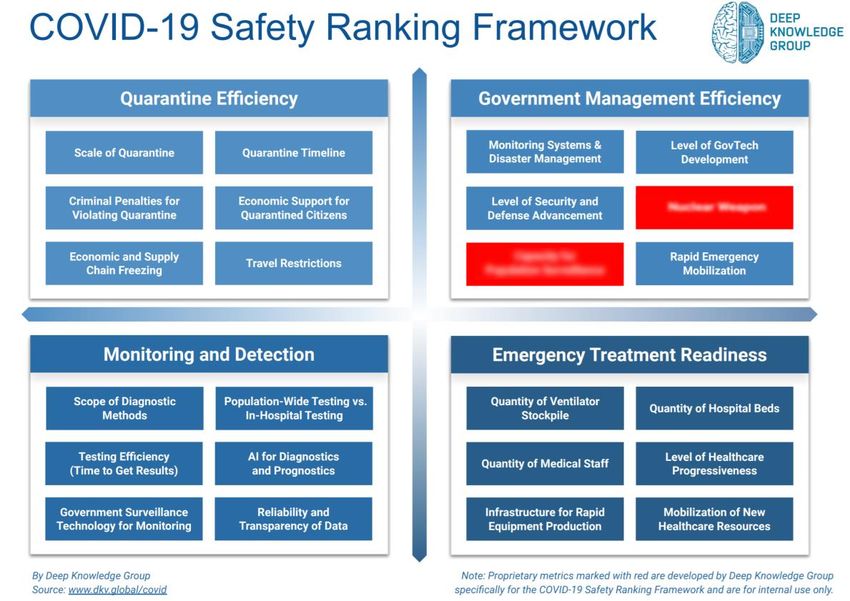
we thought to know about countries’ health systems and their ability to cope with such a major
public health challenge was incomplete or incorrect. This raises important questions on how we
measure countries’ preparedness.

This paper presents a first comparison between two country-level indices that aim to measure
countries’ preparedness to face epidemics. One produced before Covid-19 and one that has recently
been released following the initial outbreaks. The findings on this latter index remain preliminary
and will be updated as the health crisis unfold. These two measures received a lot of media
attention in the past few weeks. The paper aims to highlight potential limitations in pre-Covid-19
measures of health systems’ preparedness and capacities to face epidemics but also to identify other
reasons, non-health related, that might affect the effectiveness of countries responses to disease
outbreaks.

The Covid-19 “reality” check between health care systems’ supposed preparedness and responses

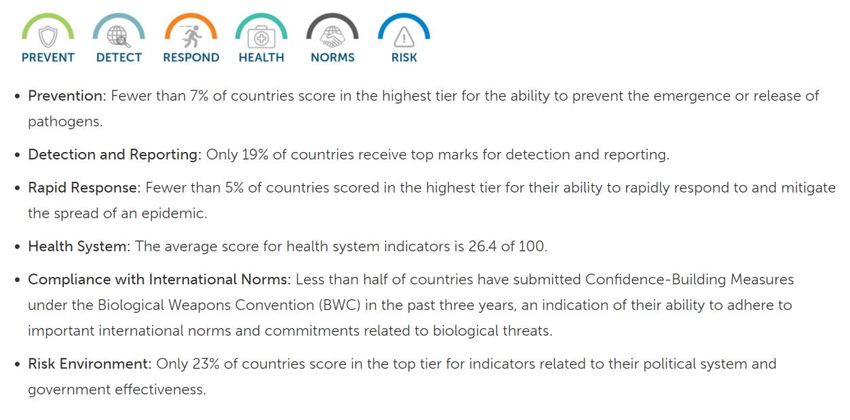
In November 2019, a consortium of organizations2 released the Global Health Security (GHS) Index.
The goal of the GHS is to help understand and measure improvement in global capability to prevent,
detect, and respond to infectious disease threats. It is according to the consortium, and to our
knowledge, the first comprehensive assessment of global health security preparedness. The GHS
covers 195 countries and territories. It is based on a comprehensive framework that comprises 140
questions organized around six categories: Prevention, Detection and reporting, Rapid response,
Health system, Compliance with international norms and risk environment. More details on what
each category aims to capture is available in the supplementary material section. Overall, the United
States, the United Kingdom and the Netherlands topped the global 2019 GHS ranking.

In March 2020, the Deep Knowledge Group (a consortium of profit and non-profit organizations)
released the Covid-19 Safety, Risk and Treatment Efficiency framework and indices. The Indices
cover 150 countries. They use 72 metrics grouped into three indices (Safety, Risk and Treatment
Efficiency) and twelve underlying quadrants. The data is collected from publicly available sources
including World Health Organization, Johns Hopkins University, Worldometers, and the CDC. Many
elements of the methodology and results are proprietary and have not been released publicly. This
makes it impossible to fully assess this new index and its sub-components. The top 40 ranks for the
“Safety” Index are accessible online. The “Safety” Index includes four quadrants: Quarantine
efficiency, Government management efficiency, Monitoring and detection and Emergency
treatment readiness. More details are available in the supplementary material section. Overall,
Israel, Germany and South Korea topped the 2020 Covid-19 Safety Index. The Covid-19 Safety Index
is dynamic; scores and ranks have already evolved since it was launched and will continue to evolve
over time as the health crises unfold.

One would assume that the top performers in the November 2019 GHS Index would also perform
best in terms of responses based on the preliminary results from the Covid-19 Safety Index.
However, looking at 43 countries for which data are available on both indices as of 15 April 20203,
there is no correlation in the GHS ranks and Covid-19 Safety ranks (see figure below). While a few
countries like Australia and South Korea rank well on both indices, the two top performers in the
GHS – the United-Kingdom and United-States – are not in the top 40 performers in the Covid-19
Safety Index. Other OECD countries that ranked well (in the top 20) in the November GHS index such

2 The GHS Index is a project of the Nuclear Threat Initiative (NTI) and the Johns Hopkins Center for Health Security (JHU)
and was developed with The Economist Intelligence Unit (EIU).
3 Imputations on the Covid-19 Index ranks were made for six countries that were not included in the top 40 ranks available

publicly. These are France, Italy, Spain, Sweden, United Kingdom and the United States. A rank of 41 for these six countries
was assumed. These will be updated should we get access to the detailed results.
as France, Spain or Sweden are also not in the top 40 Covid-19 Safety ranks. By contrast, countries
such as Austria, China, Hungary, Israel, Japan, New Zealand, Singapore and the United Arab Emirates
perform better on the Covid-19 Safety Index than what could be “predicted” by their GHS ranks.
Germany performed only 14th on the GHS index while it is ranked 2nd on the Covid-19 Safety Index,
whereas France ranked better than Germany on the GHS index but much worse on the Covid-19
Safety index (not in the top 40).

There is also a very poor relationship between the November GHS ranks & scores and the number of
Covid-19 cases and Covid-19 deaths per capita (fig 3.). In our view, death rate is the useful indicator
of effectiveness. The number of cases reported might simply reflect that a greater portion of the
population are being tested.

Out of the six categories of the GHS, three really capture the health systems capability to respond to
an epidemic outbreak. The three other categories on Prevention, Compliance with international
norms and Risk environment capture more issues that go beyond the preparedness of the health
care system (including behavioural factors). Yet, even when focusing on the GHS categories related
to detection, response, and health preparedness the rank correlation with the Covid-19 Safety Index
remains completely random (fig 4). Surprisingly, there is an inverse relationship between the GHS
ranks on the “Detection” category and the number of Covid-19 tests per capita according to the data
available as of April 16th (fig 5).

Beyond health care system preparedness: The central role of political decisions in shaping the
response to epidemic outbreaks

These results suggest that the November 2019 GHS might have greatly overestimated the
preparedness and capacity of certain health care systems to respond to major epidemics -
particularly those of France, Spain, the United Kingdom and the United States. By contrast, the
preparedness of certain countries, including for instance Germany, Singapore and South Korea,
seems to have been underestimated.
Considering the level of uncertainty, it is too early to draw any final conclusions. There are
uncertainties related to the accuracy of Covid-19 data including on incidence and death rate. Some
countries like China have already started to review the number of covid-19 related deaths upwards,
and in many OECD countries death rates in nursing homes have not been reported accurately yet.
Also, should some countries face a “second wave” of Covid-19 international assessments of
countries’ response and effectiveness in managing the pandemic would evolve.

Besides the degree of uncertainty, technical choices made in constructing these indices and ranks
(including weights given to certain variables or normalization and aggregation techniques) might also
explain some of the discrepancy. The figure above focuses on rank correlations because total scores
on the Covid-19 Safety Index are not available. Score correlation should also be conducted to
provide a more comprehensive picture. The numerous moving pieces should therefore call for
prudence in interpreting these results.

Yet, we highlight below two broad preliminary hypothesis that might explain parts of the
discrepancy between the GHS and the Covid-19 Safety Index and other measures of Covid-19
impacts (including incidence and death rates) at country-level.

    1. Has the GHS framework put too little emphasis on testing and the adaptability of health
       systems (including reserve capacity)?

The GHS is meant to apply to a wide range of health and biological risks: natural, intentional, or
accidental. Still the key messages and the conceptual framework presented in the November 2019
GHS are highly relevant in the Covid-19 context. The key message of the November GHS report was
that most countries are not well prepared to face pandemic threats. The six categories of the GHS
framework prove to be very relevant in the Covid-19 context. Under category 1 (prevention) the GHS
tracks for instance the existence of surveillance systems for zoonotic diseases/pathogens. Category 2
(early detection) tracks the capacities of national laboratory systems and epidemiology workforce
and the existence of electronic reporting surveillance system. Category 3 (rapid response) tracks the
existence of national public health emergency plans and Emergency Operations Centers (EOC) and
whether countries conducted health emergency exercises recently. Category 4 (Health System)
focuses on the capacities of the hospital system (e.g. number of hospital beds) and primary care
system (e.g. number of doctors), on the availability of equipment and on measures of access to care
(UHC, out of pocket expenditure). It also has a specific focus on processes for approving medical
treatments. Category 5 (Norms) and Category 6 (Risk) cover aspects that go much beyond the health
care system preparedness including the adoption of international resolutions, recent political
statements and risk factors in case of an epidemic outbreak (poverty, education, quality of
infrastructure etc.).

The weights assigned to the six categories by the International Expert Panel for the construction of
the overall GHS score and ranks also resonates quite well in the current context. Categories 2 (early
detection) and 3 (rapid response) have the greatest weight (19.2%), higher than the four other
categories (16.7% or less). It is likely that part of the success of Asian countries in dealing with the
Covid-19 crisis can be attributed to massive testing, acute surveillance systems and rapid isolation of
infected patients. This likely helped flattening the epidemic curve and reduced burden on the
hospital system. In fact, in light of the Covid-19 crisis, one could argue that these two categories
could be weighted even higher in the GHS methodology. It is possible for users to adjust the weights
themselves on the GHS website.

Yet, in light of the Covid-19 crisis, there might be elements of effective disease control and
management that might have been overlooked or not adequately captured in the November GHS.
This is highlighted by the comparison of the results obtained by three countries: Germany, South
Korea and the United States.
First, the GHS evaluates primarily what is on paper (rules, regulations, processes, existence of
specific bodies) based on the judgement of people who developed the index. It relies extensively on
binary data (0 or 1) and aggregates altogether 140 data points. The comprehensiveness of the
methodology may hide poor performance on some crucial aspects. On category 4 (health system)
the United-States (73.2) obtains a much better score than Germany (48.2). While the U.S. performs
very poorly on the “Healthcare access” sub-component of the category (measured notably by UHC,
out-of-pocket expenditure), this poor results is offset by a perfect score (100) on other dimensions
notably on “Communications with health workers during a public health emergency” (measured by
two binary questions on the existence of communication systems in place4). On this latter dimension
Germany obtains a straight 0 which considerably affects it overall performance on the category. This
binary score of “all or nothing” based on expert judgement affects greatly the overall results. It is
very doubtful that the German health system was less well prepared than the U.S. system to
respond to the Covid-19 crisis given their huge hospital capacity and medical staff capacity. Also
considering that the U.S. Global Health Security and Biodefense unit — responsible for pandemic
preparedness – was dismantled by the current administration in May 2018.
Second, the GHS indicator set might overlook or not capture well enough elements that proved to be
crucial in the management of the Covid-19 pandemic. We focus on two elements (there might be
others). The first element is the crucial role that testing, surveillance and rapid isolation played in
flattening the epidemic curve to avoid excess pressure on the health care and hospital system. In the
GHS, the United States scores better (98.2) than Germany (84.6) and South Korea (92.1) on category
2 (detection and reporting). The U.S. also scores better on the subcomponent “Capacity to test and
approve new medical countermeasures". Yet, according to the latest data available as of April 16th,
the United-States took much more time than Germany and South Korea to test a significant
proportion of its population (figure below). As of, April 12th the Germans had tested two times mor
people relative to its population size than the U.S.
The GHS methodology focuses notably on laboratory capacities to perform WHO-defined core tests
and on timely procurement systems. The U.S. performs well on both according to the GHS, but in
practice during Covid-19, tests prepared by the U.S. Centers for Disease Control and Prevention
proved faulty and tests other than the CDC’s were approved late (on Feb. 29). It is also likely that
South Korea was able to mobilize faster the private sector to develop and implement test kits,
building on their past experience in dealing with similar epidemics in the past twenty years. These
results suggest that the GHS might have overestimated the U.S. capacity to administer massive tests
for a new virus like Covid-19.
4 The exact questions are: 4.4.1a. Is there a
system in place for public health officials and healthcare workers to communicate
during a public health emergency? and 4.4.1b. Does the system for public health officials and healthcare workers to
communicate during an emergency encompass healthcare workers in both the public and private sector?The other element is related to the availability of equipment to face a pandemic. In the GHS, the
United States obtains a perfect score (100) on the sub-component “Infection control practices and
availability of equipment” whereas Germany and South Korea obtain half of the points only (50). Yet,
Germany and South Korea did not face greater shortages of protective equipment (including masks)
and Germany had a greater number of hospital beds, intensive care beds and ventilators than the
United-States to respond to any peak in demand. Here also, the GHS tracks primarily the existence of
strategic plans for medical equipment probably because of data availability limitations at the global
level. However, this rough dichotomous scoring approach is not precise enough to assess the
availability of key equipment to respond to this specific crisis and the ability to mobilize quickly
additional equipment, like masks and ventilators.
2. The GHS cannot anticipate political decisions and difficult arbitrations
Another interpretation of the poor correlation between pre-Covid-19 measures of preparedness and
new indicators developed during Covid-19, is that certain countries should have been able to
respond in a better way to the Covid-19 health crisis than what they have done as they were, in
theory, better prepared. As highlighted above the GHS did not get it all wrong; and many of the
underlying measures used are highly relevant in the current context. Ultimately, the response and
management of an epidemic does not only depend on health care resources and preparedness only,
but also to a large extent, on the ability of political leaders to mobilize actors and take the correct
decisive actions at the right time.
The decision to shutdown non-essential economic activities to respond to the Covid-19 outbreak
was taken by most political leaders in countries highly affected by the virus; albeit at very different
speed. There is a growing consensus among experts that this a very effective measure to deal with
rapid virus spread but this has huge economic consequences. Most Asian countries, including South
Korea, have adopted, and implemented strict confinement measures at a very early stage. Some
European countries, including France and Germany, have also adopted rapidly similar approaches. In
these cases, health considerations took precedence very early on over any economic considerations.
As highlighted in recent OECD and IMF reports, the economic consequences of lockdowns are huge,
in terms of production and employment loss. It seems that for some of the countries that topped the
GHS ranking – such as the United States and the United Kingdom – the political decision to shutdownthe economy in order to save lives was harder to make and took longer to take effect (or were only implemented in certain States) As many countries start deconfining, this political trade-off between health and the economy will remain delicate to handle considering on one hand the risk of a second-wave and on the other hand the desperate need of many people and industries to restart economic activities. This article argues that the lead pre-Covid-19 measure of countries’ preparedness to face epidemics – the Global Health Security Index - overestimated the level of preparedness of certain countries (including the United Kingdom and United States) and underestimated the preparedness of other countries (including Germany, South Korea and other Asian countries). This can be partly attributed to the limited emphasis in the GHS methodology on testing and the adaptability of health systems (including reserve capacity for strategic medical equipment). At the same time, it is beyond the scope of the GHS to anticipate rapid and decisive political actions which are critical for the effective management of any epidemics. These findings would need to be updated in light of the evolution of the Covid-19 health crisis.
References:

AARP. ‘Chronic Conditions and Increased COVID-19 Risks’, 20 March 2020.
     http://www.aarp.org/health/conditions-treatments/info-2020/chronic-conditions-
     coronavirus.html.
Airport Technology. ‘Covid-19 Is Closing Borders and Attitudes as Globalisation Slows Down’,
     25 March 2020. https://www.airport-technology.com/comment/covid-19-closing-borders-
     globalisation/.
Aljazeera. ‘Germany, Switzerland Help France Deal with COVID-19 Patients’, 26 March 2020.
     https://www.aljazeera.com/news/2020/03/germany-switzerland-france-deal-covid-19-
     patients-200326143043559.html.
Basel Institute on Governance. ‘COVID-19: How Anti-Corruption Tools and Industry
     Collaboration Can Help Us Win the Fight against Illegal Wildlife Trade’, 17 February 2020.
     https://www.baselgovernance.org/blog/covid-19-how-anti-corruption-tools-and-industry-
     collaboration-can-help-us-win-fight-against.
Bird, Brian H., and Jonna A.K. Mazet. ‘Detection of Emerging Zoonotic Pathogens: An Integrated
     One Health Approach’. Annual Review of Animal Biosciences 6, no. 1 (15 February 2018):
     121–39. https://doi.org/10.1146/annurev-animal-030117-014628.
Bloomberg. ‘China’s Economy Suffers Historic Slump Due to Virus Shutdown’. Bloomberg, 16
     March 2020. https://www.bloomberg.com/news/articles/2020-03-16/china-manufacturing-
     and-retail-contract-for-first-time-on-virus.
Business Insider. ‘The Wuhan coronavirus and SARS share 80% of their genetic codes. Here’s
     how the 2 outbreaks compare.’, 5 February 2020. https://www.businessinsider.com/china-
     wuhan-coronavirus-compared-to-sars-2020-1.
CDC. ‘Zoonotic Diseases’, 19 February 2020. https://www.cdc.gov/onehealth/basics/zoonotic-
     diseases.html.
Center for American Progress, and Zoe Willingham. ‘Rural Americans Are Vulnerable to the
     Coronavirus’, 5 March 2020.
     https://www.americanprogress.org/issues/economy/news/2020/03/05/481340/rural-
     communities-vulnerable-coronavirus/.
China.org.cn. ‘China Sends Medical Supplies to Support France’s Coronavirus Fight’, 19 March
     2020. http://www.china.org.cn/world/2020-03/19/content_75832235.htm.
CNN. ‘Covid-19: Why America Has the World’s Most Confirmed Cases’, 27 March 2020.
     https://edition.cnn.com/2020/03/26/opinions/us-most-confirmed-cases-sachs/index.html.
Colombo, Fransesca. ‘Resilient Health Systems: What We Are Learning from the COVID-19
     Crisis’. OECD, 2 April 2020. https://www.oecd-forum.org/users/382555-francesca-
     colombo/posts/64973-resilient-health-systems-what-we-are-learning-from-the-covid-19-
     crisis.
Consultancy. ‘UK and US Mishandle Covid-19 despite Supposed Preparedness’. Consultancy.UK,
     31 March 2020. https://www.consultancy.uk/news/24211/uk-and-us-mishandle-covid-19-
     despite-supposed-preparedness.
Dalglish, Sarah. ‘COVID-19 Gives the Lie to Global Health Expertise’. The Lancet, 26 March
     2020. https://www.thelancet.com/journals/lancet/article/PIIS0140-6736(20)30739-X/fulltext.
Daszak, Peter, Kevin J. Olival, and Hongying Li. ‘A Strategy to Prevent Future Epidemics Similar
     to the 2019-NCoV Outbreak’. Biosafety and Health 2, no. 1 (1 March 2020): 6–8.
     https://doi.org/10.1016/j.bsheal.2020.01.003.
Deep Knowledge Group. ‘COVID-19 | Analytics’. DKV. Accessed 14 April 2020.
     https://www.dkv.global/covid.
.
Dickerson, Desiree. ‘Seven Tips to Manage Your Mental Health and Well-Being during the
COVID-19 Outbreak’. Nature, 26 March 2020. https://doi.org/10.1038/d41586-020-00933-5.
Euler Hermes. ‘Covid-19: Quarantined Economics’, 23 March 2020.
https://www.eulerhermes.com/en_global/economic-research/insights/covid-19-quarantined-
economics.html.
Financial Times. ‘If Covid-19 Is Not Beaten in Africa It Will Return to Haunt Us All’, 25 March
2020. https://www.ft.com/content/c12a09c8-6db6-11ea-89df-41bea055720b.
Financial Times, Steven Bernard, John Burn-Murdoch, and Keith Fray. ‘Coronavirus Tracked:
The Latest Figures as the Pandemic Spreads’, 8 February 2020.
https://www.ft.com/content/a26fbf7e-48f8-11ea-aeb3-955839e06441.
France Diplomatie - Ministry for Europe and Foreign Affairs. ‘Coronavirus COVID-19: G7
Leaders’ Statement’, 16 March 2020. https://www.diplomatie.gouv.fr/en/coming-to-
france/coronavirus-advice-for-visitors-to-france/coronavirus-statements/article/coronavirus-
covid-19-g7-leaders-statement-16-mar-2020.
GPMB. ‘A World at Risk - Annual Report on Global Preparedness for Health Emergencies’,
September 2019.
https://apps.who.int/gpmb/assets/annual_report/GPMB_annualreport_2019.pdf.
Guan, Y., B. J. Zheng, Y. Q. He, X. L. Liu, Z. X. Zhuang, C. L. Cheung, S. W. Luo, et al.
‘Isolation and Characterization of Viruses Related to the SARS Coronavirus from Animals in
Southern China’. Science (New York, N.Y.) 302, no. 5643 (10 October 2003): 276–78.
https://doi.org/10.1126/science.1087139.
Hick, John L., Dan Hanfling, Matthew K. Wynia, and and Andrew T. Pavia. ‘Duty to Plan: Health
Care, Crisis Standards of Care, and Novel Coronavirus SARS-CoV-2’. NAM Perspectives, 5
March 2020. https://doi.org/10.31478/202003b.
Hunger Solutions New York. ‘NY State Updates on Coronavirus and Operation of Federal
Nutrition Assistance Programs’. Hunger Solutions New York (blog), 19 March 2020.
https://hungersolutionsny.org/covid-19/.
IFPRI. ‘How Much Will Global Poverty Increase Because of COVID-19?’, 20 March 2020.
https://www.ifpri.org/blog/how-much-will-global-poverty-increase-because-covid-19.
IHP. ‘UHC in the Age of the Coronavirus’, 3 February 2020.
https://www.internationalhealthpolicies.org/featured-article/uhc-in-the-age-of-the-
coronavirus/.
ILO. ‘Almost 25 Million Jobs Could Be Lost Worldwide as a Result of COVID-19, Says ILO’, 18
March 2020. http://www.ilo.org/global/about-the-ilo/newsroom/news/WCMS_738742/lang--
en/index.htm.
IMF. ‘Confronting the Crisis: Priorities for the Global Economy’, 9 April 2020.
https://www.imf.org/en/News/Articles/2020/04/07/sp040920-SMs2020-Curtain-Raiser.
IMF. ‘Joint Statement World Bank Group and IMF Call to Action on Debt of IDA Countries’, 25
March 2020. https://www.imf.org/en/News/Articles/2020/03/25/pr20103-joint-statement-
world-bank-group-and-imf-call-to-action-on-debt-of-ida-countries.
IMF. ‘Policy Responses to COVID19’, 23 March 2020. https://www.imf.org/en/Topics/imf-and-
covid19/Policy-Responses-to-COVID-19.
IMF Blog. ‘Economic Policies for the COVID-19 War’. IMF Blog (blog), 1 April 2020.
https://blogs.imf.org/2020/04/01/economic-policies-for-the-covid-19-war/.
Institute for Health Metrics and Evaluation. ‘COVID-19’. Institute for Health Metrics and
Evaluation. Accessed 26 March 2020. https://covid19.healthdata.org/projections.
Jones, Kate E., Nikkita G. Patel, Marc A. Levy, Adam Storeygard, Deborah Balk, John L.
Gittleman, and Peter Daszak. ‘Global Trends in Emerging Infectious Diseases’. Nature 451,
no. 7181 (February 2008): 990–93. https://doi.org/10.1038/nature06536.Machalaba, Catherine, Kristine M. Smith, Lina Awada, Kevin Berry, Franck Berthe, Timothy A.
Bouley, Mieghan Bruce, et al. ‘One Health Economics to Confront Disease Threats’.
Transactions of the Royal Society of Tropical Medicine and Hygiene 111, no. 6 (01 2017):
235–37. https://doi.org/10.1093/trstmh/trx039.
Mazars. ‘Mazars Covid-19 Economic Update’, 26 March 2020.
https://www.mazars.co.uk/Home/Services/COVID-19-Your-Business/Covid-19-Mazars-
Economic-Update.
NCBI. ‘Severe Acute Respiratory Syndrome Coronavirus 2 Isolate Wuhan-Hu-1, Complete
Genome’, 18 March 2020. http://www.ncbi.nlm.nih.gov/nuccore/MN908947.3.
News Decoder. ‘How Will the Coronavirus Change the World?’ News Decoder (blog), 23 March
2020. https://news-decoder.com/2020/03/23/coronavirus-change-world/.
NTI, JHU, and EIU. ‘Global Health Security Index’. Nuclear Threat Initiative, Johns Hopkins
Center for Health Security and Economist Intelligence Unit, November 2019.
https://www.ghsindex.org/about/.
OECD. ‘Beyond Containment: Health Systems Responses to COVID-19 in the OECD’, 20 March
2020. https://read.oecd-ilibrary.org/view/?ref=119_119689-
ud5comtf84&Title=Beyond%20Containment:Health%20systems%20responses%20to%20C
OVID-19%20in%20the%20OECD.
OECD. ‘COVID-19 Joint Statement by the Development Assistance Committee (DAC) of the
Organisation for Economic Cooperation and Development (OECD)’, 9 April 2020.
http://www.oecd.org/dac/development-assistance-committee/DAC-Joint-Statement-COVID-
19.pdf.
OECD. ‘Supporting People and Companies to Deal with the Covid-19 Virus:Options for an
Immediate Employment and Social-Policy Response’, 20 March 2020. https://read.oecd-
ilibrary.org/view/?ref=119_119686-
962r78x4do&Title=Supporting%20people%20and%20companies%20to%20deal%20with%2
0the%20Covid-19%20virus.
OECD. ‘Tackling the Coronavirus (COVID-19) Crisis Together: OECD Policy Contributions for
Co-ordinated Action’. Accessed 27 March 2020. https://www.oecd.org/coronavirus/en/.
PBS NewsHour. ‘How Health Care Inequity Could Make the COVID-19 Crisis Worse’, 13 March
2020. https://www.pbs.org/newshour/health/how-health-care-inequity-could-make-the-covid-
19-crisis-worse.
Reuters. ‘Europe Could Face More Drug Shortages as Coronavirus Squeezes Supplies’. Reuters, 5
March 2020. https://www.reuters.com/article/us-health-coronavirus-eu-idUSKBN20S1R2.
Reuters. ‘Germany Would like to Localize Supply Chains, Nationalization Possible, Minister
Says’. Reuters, 13 March 2020. https://www.reuters.com/article/us-health-coronavirus-
germany-pharmaceut-idUSKBN2101BH.
RFI. ‘China Makes Massive Donation of Medical Supplies to Fight Coronavirus in Africa’, 23
March 2020. http://www.rfi.fr/en/international/20200323-china-africa-coronavirus-alibaba-
health-medical-equipment.
RFI. ‘“Not Just a Health Issue”: How Covid-19 Is Quietly Eroding Women’s Rights’, 26 March
2020. http://www.rfi.fr/en/france/20200326-coronavirus-domestic-violence-gender-
perspectives.
Rouquet, Pierre, Jean-Marc Froment, Magdalena Bermejo, Annelisa Kilbourn, William Karesh,
Patricia Reed, Brice Kumulungui, et al. ‘Wild Animal Mortality Monitoring and Human
Ebola Outbreaks, Gabon and Republic of Congo, 2001-2003’. Emerging Infectious Diseases
11, no. 2 (February 2005): 283–90. https://doi.org/10.3201/eid1102.040533.
Smith, Gavin J. D., Dhanasekaran Vijaykrishna, Justin Bahl, Samantha J. Lycett, Michael
Worobey, Oliver G. Pybus, Siu Kit Ma, et al. ‘Origins and Evolutionary Genomics of the2009 Swine-Origin H1N1 Influenza A Epidemic’. Nature 459, no. 7250 (June 2009): 1122–
25. https://doi.org/10.1038/nature08182.
Sumner, Andy, Chris Hoy, and Eduardo Ortiz-Juarez. ‘Estimates of the Impact of COVID-19 on
Global Poverty’. UNU-WIDER, April 2020. https://doi.org/10.35188/UNU-
WIDER/2020/800-9.
The Atlantic. ‘How the Pandemic Will End’. The Atlantic, 25 March 2020.
https://www.theatlantic.com/health/archive/2020/03/how-will-coronavirus-end/608719/.
The Guardian. ‘Around 20% of Global Population under Coronavirus Lockdown’. The Guardian,
24 March 2020, sec. World news. https://www.theguardian.com/world/2020/mar/24/nearly-
20-of-global-population-under-coronavirus-lockdown.
The Interpreter, Sophie Harman, Jacqui True, and Clare Wenham. ‘Why Gender Matters in the
Impact and Recovery from Covid-19’, 20 March 2020. https://www.lowyinstitute.org/the-
interpreter/why-gender-matters-impact-and-recovery-covid-19.
The New York Times. ‘Coronavirus Spurs U.S. Efforts to End China’s Chokehold on Drugs’. The
New York Times, 11 March 2020, sec. Business.
https://www.nytimes.com/2020/03/11/business/economy/coronavirus-china-trump-
drugs.html.
The New York Times, and Sheri Fink. ‘How Prepared Is the U.S. for a Coronavirus Outbreak?’
The New York Times, 29 February 2020, sec. Health.
https://www.nytimes.com/2020/02/29/health/coronavirus-preparation-united-states.html.
The Straits Times. ‘Coronavirus: China Appeals for Medical Supplies to Be Sent from Abroad’, 5
February 2020. https://www.straitstimes.com/asia/east-asia/china-appeals-for-medical-
supplies-to-be-sent-from-abroad.
The Telegraph. ‘The Covid-19 Mental Health Crisis: Expect Depression, Anxiety and Stress
Disorders, Researchers Warn’. The Telegraph, 25 March 2020.
https://www.telegraph.co.uk/global-health/science-and-disease/covid-19-mental-health-crisis-
expect-depression-anxiety-stress/.
Time. ‘America’s Health System Will Likely Make Coronavirus Worse’, 4 March 2020.
https://time.com/5794672/health-insurance-deductibles-coronavirus/.
Today. ‘Want to Help Feed Kids Who Depend on School Meals? Here Are Ways to Give’, 16
March 2020. https://www.today.com/parents/donate-kids-left-hungry-school-coronavirus-
closures-t176066.
Transparency International. ‘The G20 Must Put Human Rights and the Public Interest at the Heart
of Its Response to the COVID-19 Pandemic’, 20 March 2020.
https://www.transparency.org/news/pressrelease/joint_statement_Amnesty_TI_CIVICUS_G2
0_coronavirus.
United Nations. ‘Shared Responsibility, Global Solidarity: Responding to the Socio-Economic
Impacts of COVID-19’, March 2020.
US News & World Report. ‘Coronavirus Could Crush the Poor, Advocates Warn’, 19 March
2020. https://www.usnews.com/news/healthiest-communities/articles/2020-03-
19/coronavirus-could-crush-the-poor-and-homeless-advocates-warn.
Vox. ‘During the Covid-19 Pandemic, Nowhere Is Safe for Homeless People’, 18 March 2020.
https://www.vox.com/2020/3/18/21183812/covid-19-coronavirus-homeless.
Walker, Patrick GT, Charles Whittaker, Oliver Watson, Marc Baguelin, Kylie E C Ainslie,
Sangeeta Bhatia, Adhiratha Boonyasiri, et al. ‘The Global Impact of COVID-19 and
Strategies for Mitigation and Suppression’, 26 March 2020, 19.
Wall Street Journal. ‘Chinese Doctors and Supplies Arrive in Italy’, 18 March 2020.
https://www.wsj.com/articles/chinese-doctors-and-supplies-arrive-in-italy-11584564673.
Washington Post. ‘Scientists Are Unraveling the Chinese Coronavirus with Unprecedented Speed
and Openness’, 24 January 2020.https://www.washingtonpost.com/science/2020/01/24/scientists-are-unraveling-chinese-
coronavirus-with-unprecedented-speed-openness/.
Wenham, Clare, Julia Smith, and Rosemary Morgan. ‘COVID-19: The Gendered Impacts of the
Outbreak’. The Lancet 395, no. 10227 (6 March 2020): 846–48.
https://doi.org/10.1016/S0140-6736(20)30526-2.
World Bank. ‘People, Pathogens and Our Planet - Volume 2 - The Economics of One Health’,
2012.
http://documents.worldbank.org/curated/en/612341468147856529/pdf/691450ESW0whit0D0
ESW120PPPvol120web.pdf.
World Bank Blogs. ‘Coronavirus Highlights the Need to Strengthen Health Systems’, 5 March
2020. https://blogs.worldbank.org/voices/coronavirus-covid19-highlights-need-strengthen-
health-systems.
World Economic Forum. ‘The Vast Economic Toll of the Coronavirus – from IPhones to Solar
Panels to Tourism’, 21 February 2020. https://www.weforum.org/agenda/2020/02/economic-
toll-coronavirus-manufacturing-tourism-china-asia/.
Worldometers. ‘Coronavirus Update (Live): 549,070 Cases and 24,862 Deaths from COVID-19
Virus Outbreak - Worldometer’. Accessed 27 March 2020.
https://www.worldometers.info/coronavirus/.Supplementary material:
Fig 1. Global Health Security Index : Category Scores
Source: NTI, JHU, and EIU. ‘Global Health Security Index’. Nuclear Threat Initiative, Johns Hopkins Center for Health
Security and Economist Intelligence Unit, November 2019. https://www.ghsindex.org/about/.
Fig 2. Deep Knowledge Group Covid-19 Safety Index: Framework
Source: Deep Knowledge Group. ‘COVID-19 | Analytics’. DKV. Accessed 16 April 2020. https://www.dkv.global/covid.Fig 3. Global Health Security (GHS) overall ranks & scores and incidence of and death rate due to Covid-19
GHS overall rank vs Covid-19 cases per capita GHS overall rank vs Covid-19 deaths per capita
6000 450
LUX 400 ESP
BEL
5000
ITA
350
4000 300
Covid-19 deaths, per milion
Covid-19 cases, per milion
ESP
FRA
250
3000 CHE
BEL
ITA
200
IRL GBR
NLD
FRA
2000 LIE
USA 150
CHE
NLD DEU AUT
GBR ISR SWE
LUX
NOR QAT 100
SWE
DNK IRL
1000 EST USA
CAN TUR
SVN
FIN SGP CZE CYP 50 DNK
UAE DEU AUT
LVA HRV
AUS KOR NZL KWT CAN SVNNOR EST LIE
MYS POL GRC
HUN SVK OMN TUR
CZE
THA JPN CHN FIN HUNGRC ISR CYP
0 VNM KOR LVA MYS POLNZLHRV
0 AUS
THA JPNSGP SVKUAE
CHN KWT OMN QAT
0 10 20 30 40 50 60 70 80 90
0 10 20 30 40 50 60 70 80 90
GHS, overall ranks (Nov, 2019) GHS, overall ranks (Nov, 2019)
Source: Global Health Security Index and Worldometer (16/04/2020) Source: Global Health Security Index and Worldometer (16/04/2020)Fig 3 (continued): GHS overall score vs Covid-19 cases per capita Fig 3 (continued): GHS overall score vs Covid-19 deaths per capita
6000 450
LUX 400 ESP
BEL
5000
ITA
350
Covid-19 deaths per milion (16/04/2020)
Covid-19 cases per milion (16/04/2020)
4000 300
ESP
FRA
250
3000 CHE
BEL
ITA
200
IRL GBR
NLD
FRA
2000 LIE
USA 150
CHE
AUT DEU NLD SWE
ISR GBR LUX
QAT NOR 100
SWE
DNK IRL USA
1000 EST
TUR
CAN DNK
CYP UAE CZE SGP SVN
FIN 50 DEU
AUT
HRV NORSVN
KWT NZL LVA LIE EST CAN
OMN SVK GRC
POL
HUN MYS KOR AUS ISR TUR
CZE
HUN FIN
CHN JPN CYP GRC
HRVPOL
0 VNM THA 0 QAT UAE
OMNKWT CHN
SVK NZL SGP JPNMYS
LVA KORTHAAUS
40 50 60 70 80 90 100 40 50 60 70 80 90 100
GHS overall score (Nov,2019) GHS overall score (Nov 2019)
Source: Global Health Security Index and Worldometer (16/04/2020) Source: Global Health Security Index and Worldometer (16/04/2020)Fig 4. GHS ranks by sub-categories vs Covid-19 Safety Index
GHS Detection and Reporting ranks vs Covid-19 Safety Index ranks GHS Rapid Response ranks vs Covid-19 Safety Index
45 45
USA GBR GBR
USA
ESP FRA ESP
FRA ITA
40 ITA SVN 40
LVASWE SWE SVN LVA
SVK SVK
OMN OMN
TUR TUR
35 HRV 35 HRV
IRL IRL
Covid-19 Safety Index, ranks (April, 2020)
Covid-19 Safety Index, ranks (April, 2020)
POL POL
MYS MYS
EST EST
30 GRC 30 GRC
CYP CYP
LIE LIE
QAT QAT
25 CZE 25 CZE
KWT KWT
LUX LUX
FIN FIN
THA THA
20 VNM 20 VNM
BEL BEL
UAE UAE
NOR NOR
NLD NLD
15 DNK 15 DNK
HUN HUN
CAN CAN
AUT AUT
CHE CHE
10 10
JPN JPN
SGP SGP
NZL NZL
5 CHN 5 CHN
AUS AUS
KOR KOR
DEU DEU
ISR ISR
0 0
0 20 40 60 80 100 120 140 160 0 20 40 60 80 100 120 140 160
GHS Detection and Reporting subcategory, rank (Nov, 2019) GHS Rapid Response subcategory, rank (Nov, 2019)
Source: Global Health Security Index and Deep Knowledge Group Source: Global Health Security Index and Deep Knowledge GroupFig 4 (continued): GHS Health System vs Covid-19 Safety Index
45
FRA
USA ESP
SWE ITA
40 SVN
GBR LVA
SVK
OMN
TUR
35 HRV
IRL
Covid-19 Safety Index, ranks (April, 2020)
POL
MYS
EST
30 GRC
CYP
LIE
QAT
25 CZE
KWT
LUX
FIN
THA
20 VNM
BEL
UAE
NOR
NLD
15 DNK
HUN
CAN
AUT
CHE
10
JPN
SGP
NZL
5 CHN
AUS
KOR
DEU
ISR
0
0 20 40 60 80 100 120
GHS Health System subcategory, ranks (Nov, 2019)
Source: Global Health Security Index and Deep Knowledge GroupFig 5. GHS Detection and Reporting ranks vs total Covid-19 tests conducted per capita
90,000
80,000
UAE
70,000
Covid-19 tests, per milion (April, 2020)
60,000
50,000 LUX
40,000
30,000
EST
NOR LIE
CHE
20,000 DEU ITA ISR
IRL SVN QAT
LVA AUT
AUS DNK ESP CYP NZL
CAN SGP CZE
10,000 KOR BEL
NLD FIN
USA SWE GRC
GBR FRA SVK TUR
HRV POL HUN
MYS
THA JPN VNM
0
0 20 40 60 80 100 120 140 160
GHS, Detection and Reporting category, ranks (Nov 2019)
Source: Source: Global Health Security Index and Worldometer (16/04/2020)You can also read


