Impact of Scoring First on Match Outcome in the Chinese Football Super League
←
→
Page content transcription
If your browser does not render page correctly, please read the page content below
ORIGINAL RESEARCH
                                                                                                                                                       published: 28 May 2021
                                                                                                                                             doi: 10.3389/fpsyg.2021.662708

                                                Impact of Scoring First on Match
                                                Outcome in the Chinese Football
                                                Super League
                                                Tianbiao Liu 1,2, Antonio García-de-Alcaraz 3,4*, Hai Wang 1,2, Ping Hu 5 and Qiu Chen 6*
                                                1
                                                 College of P.E. and Sports, Beijing Normal University, Beijing, China, 2 Lab of Performance Analysis and Motor Learning,
                                                Beijing Normal University, Beijing, China, 3 Department of Education, University of Almería, Almería, Spain, 4 LFE Research
                                                Group, Universidad Politécnica de Madrid, Madrid, Spain, 5 Microsoft, Beijing, China, 6 National School of Development,
                                                Peking University, Beijing, China

                                                The aim of this study was to explore the effect of scoring first on match outcomes in the
                                                Chinese Football Super League (CSL). A total of 1,116 matches in which at least one goal
                                                was scored from the 2014 to 2018 seasons were collected. Match outcomes, absolute
                                                goal differences, the minute of the first goal, match locations, and teams’ budgets were
                                                analyzed. A team’s budget was measured in terms of a team’s value at the beginning of
                                                the season, and teams were clustered into two groups (high and low budget with means
                           Edited by:
                       Nimai Parmar,
                                                of 50.77 and 13.77 million dollars, respectively). A descriptive analysis was conducted,
Middlesex University, United Kingdom            and two generalized linear models (a multinomial logit model and a Poisson model;
                      Reviewed by:              p < 0.05) were applied. The results showed a favorable outcome for the team that scored
         Miguel-Angel Gomez-Ruano,
                                                first both in match outcome and goal difference. Regarding the teams that scored first,
     Polytechnic University of Madrid,
                                Spain           66.31% won their matches, 20.70% achieved a draw, and 12.99% lost. Specifically, home
                John William Francis,           teams were more likely to win (13.42%) and less likely to lose (9.52%) or draw (3.90%)
             University of Worcester,
                     United Kingdom
                                                than away teams. Home teams also had a higher likelihood of obtaining a larger goal
                 *Correspondence:
                                                difference. Higher budget teams were more likely to win (14.90%) and less likely to lose
           Antonio García-de-Alcaraz            (9.75%) or draw (5.14%) than low-budget teams. Additionally, for each minute, the team
         antoniogadealse@gmail.com
                                                scores closer to the end of the match, and the average probability of winning increased
                           Qiu Chen
               chenqiusau@163.com               by 0.0028. These findings can guide the strategies of coaches in different match scenarios
                                                according to the match location and the opponent’s quality.
                   Specialty section:
         This article was submitted to          Keywords: team sports, performance analysis, score, match status, situational variables, goal
                Performance Science,
               a section of the journal
               Frontiers in Psychology
                                                INTRODUCTION
        Received: 01 February 2021
           Accepted: 13 April 2021              Football is a time-dependent sport whose result depends on comparing the goals of the two
           Published: 28 May 2021
                                                participating teams at the end of the match (Hughes and Franks, 2004). However, most matches
                            Citation:           ended with no more than three goals (Anderson and Sally, 2013). Therefore, every goal is
 Liu T, García-de-Alcaraz A, Wang H,
                                                critical and influences the course of the game (Ferreira, 2013). In many team sports, scoring
  Hu P and Chen Q (2021) Impact of
  Scoring First on Match Outcome in
                                                first has already been proven to be crucial to the match outcome (Jones, 2009). Moreover,
 the Chinese Football Super League.             when the match approaches the end, the result is nearly determined (Altarriba-Bartés et al.,
          Front. Psychol. 12:662708.            2020). Overall, scoring first has a strong influence on match outcome (Bloomfield et al., 2005).
    doi: 10.3389/fpsyg.2021.662708              Across worldwide football tournaments, scoring first has been shown to be an effective predictor

Frontiers in Psychology | www.frontiersin.org                                           1                                                May 2021 | Volume 12 | Article 662708
Liu et al. Scoring First Impact on Soccer
of the final outcome in the 2018 FIFA (Fédération Internationale knowledge to researchers (Hucaljuk and Rakipović, 2011;
de Football Association) World Cup (71.40%; Vergonis et al., Liu, 2014; Liu et al., 2018).
2019), the six major football tournaments in the world (71.17%; Studies on match analysis in the Chinese Football Super
Leite, 2015), the Greek league in the 2006–2007 (71.43%; League (CSL) have received considerable attention starting a
Armatas et al., 2009b) and 2007–2008 seasons (74.20%; Armatas few years ago because of its fast progress. These research studies
et al., 2009a), and the La Liga (Spanish League) from the focus primarily on key performance indicators (Mao et al., 2016;
2005 to 2010 seasons (79.32%; Molinuevo and Bermejo, 2012). Yang et al., 2018; Gai et al., 2019), the impact of situational
The team that scores first breaks the competitive balance variables (Liu et al., 2019b), the evaluation of performance (Zhou
and forms a new match status. This shift of match status may et al., 2018, 2020), and the application of new technologies (Han
lead to changes in match strategies, tactics, and styles of play et al., 2020) and complex networks (Yu et al., 2020; Zhao and
for each team (Taylor et al., 2008; Lago, 2009; Almeida et al., Zhang, 2020). However, very few researches on the influence
2014) and may even alter players’ psychological states and, of key match events on CSL matches currently exist. Therefore,
hence, influence their performance (Bar-Eli et al., 2006; Leite the present study investigates the impact of the first goal on
and Barreira, 2014). For instance, several studies have found the match outcome (win, draw, and lose) and the goal difference
a greater ball possession time among losing teams (Lago-Peñas (GD) in the Chinese Super League. Thus, three hypotheses are
and Dellal, 2010; Taylor et al., 2010; Ruiz-Ruiz et al., 2013). proposed: (a) scoring first increases a team’s winning probability,
Although scoring first appears to be a key event in winning (b) the first goal occurring later in a match increases a team’s
a match, sometimes the team who scores first loses. The complex winning probability, and (c) the influence of the minute of the
interaction between multiple factors is a plausible reason that first goal and goal difference on the match outcome is also
should be investigated (Garganta, 1997). In this sense, the influenced by situational factors and the team’s budget.
situational variables have been considered. Thus, match location
has been considered to be a strong indicator (Molinuevo and
Bermejo, 2012; Tenga, 2013; Pratas et al., 2016). Home teams MATERIALS AND METHODS
have better technical and tactical performance (Sasaki et al.,
1999; Tucker et al., 2005), especially in attacking-related Data Sources and Reliability
indicators. In the CSL, home field advantage is also reported Technical performance data were collected from the website
(Liu et al., 2019a; Zhou et al., 2019), although its long-term of Champion,1 a leading Chinese sport data company. The
impact fluctuates (Zhou et al. 2020). However, the quality of validity and reliability of the Champdas Master Match Analysis
the opposition is considered a stronger determinant than match System was verified by Gong et al. (2019), who demonstrated
location (Liu et al., 2016). Linked to this team’s ability, team that Aiken’s V averaged 0.84 ± 0.03 and 0.85 ± 0.03 for the
budget is an indicator used to measure the strength of a team. validation of indicators. Moreover, high kappa values (Operator
Team budget has been proven to affect teams’ performance 1: 0.92 and 0.90; Operator 2: 0.91 and 0.88), high intraclass
(Lago-Peñas and Gomez-Lopez, 2014; Lago-Peñas and Sampaio, correlation coefficients (varied from 0.93 to 1.00), and low
2015; Liu et al., 2019b) as richer teams cannot only afford standardized typical errors (varied from 0.01 to 0.34) indicated
the best coaches and players but also provide the best training a high level of intraoperator reliability. The kappa values for
and playing conditions and then adapt differently to new season the interoperator reliability were 0.97 and 0.89.
performance (Lago-Peñas and Gomez-Lopez, 2014). Hence, the Preseason budget data (transfer value) were collected via
higher the budget the teams scoring first have, the greater a website,2 which was previously employed by Liu et al. (2019b).
their winning probabilities (Gómez-Ruano et al., 2013). Moreover, A positive correlation has been shown between the so-called
the influence of the first scoring time or match period on “market values” determined by players’ salaries and the teams’
match performance (García-Rubio et al., 2015; Lago-Peñas ranking (Bryson et al., 2013).
et al., 2016; Ibáñez et al., 2018; Martinez and Gonzalez-Garcia,
2019) was also studied, but these results are still contradictory Samples and Variables
and need further investigation. From the 1,200 matches played in the 2014 to 2018 seasons
In modern sports, statistical and machine learning models in the CSL, a final sample of 1,116 matches in which at least
are increasingly incorporated in the analysis of football games, one goal was scored were observed. The CSL is the highest-
which helps both researchers and practitioners better and more level national football league in China, and it includes 16
deeply understand game performance and its important influencing teams. These teams played in a balanced home and away
events (e.g., goals, scoring, fouls, etc.) and, hence, change the schedule (15 home and 15 away matches for each team
path to success. In particular, regression models (García-Rubio and season).
et al., 2015), classification trees (Lago-Peñas et al., 2016) and The dependent variables (Table 1) that were used were
Cox models (Nevo and Ritov, 2013) were used to evaluate the match outcome (MO) and the absolute goal difference (AGD).
effect of scoring first on match outcomes. Compared with early The independent variables were as follows: time (T), match
studies focusing on frequency, descriptive analysis, and
comparisons (Yiannakos and Armatas, 2006; Armatas et al.,
2009a; Leite, 2015), machine learning models can handle larger http://data.champdas.com
1
datasets and nonlinear relationships and then offer more http://transfermarkt.de
2
Frontiers in Psychology | www.frontiersin.org 2 May 2021 | Volume 12 | Article 662708Liu et al. Scoring First Impact on Soccer
TABLE 1 | Description and categories of the variables. shows the influences of the independent variables related to
scoring first on match outcome.
Variables Description
Additionally, a Poisson regression model was applied to
Outcome at the end of the match. It further investigate the effects of scoring first on the absolute
Match outcome (MO) can end in a draw or in a victory for the goal difference:
local or visiting team
Absolute goal difference (AGD) Goal difference at the end of the match AGDi = β0 + β11Timei ∗ D1 + β12Timei ∗ D2 + β21MLi ∗
Time (in minutes) where the first goal is D1 + β22 MLi ∗ D2 + β31TBi ∗ D1 + β32TBi ∗ D2 +
Time (T)
scored β41OBi ∗ D1 + β42OBi ∗ D2 + µi (2)
Match location (ML) Team playing like local or visiting
Budget of the team scoring first where β0 is the constant term, and μi is the error term for
Team budget (TB)
(budget high or low) this regression model. D1 and D2 are dummy variables indicating
Budget of the opponent to the team whether a first scoring team eventually won the match. D1 =
Opponent budget (OB)
scoring first (budget high or low)
1 if the first team that scored won the match, and D2 = 1 if
the first team that scored did not win the match. Thus, the
TABLE 2 | Description of the game results of the scoring first teams. coefficients of the interaction terms in model (2) show the
impacts of the variables related to scoring first on the absolute
Win Draw Lose Total value of the goal difference, conditional on the match outcome
Match location
for the first scoring team (i.e., either win or not win).
Home
The abovementioned models were estimated using STATA
464 (71.94%) 123 (19.97%) 58 (8.99%) 645
for Windows (version 15.0, Stata Corp., Texas, United States),
Away 276 (58.60%) 108 (22.93%) 87 (18.47%) 471
and the level of significance was set at p < 0.05.
Team Budget
Budget high 191 (76.10%) 42 (16.73%) 18 (7.17%) 251
Budget low 549 (63.47%) 189 (21.85%) 127 (14.68%) 865
Total 740 (66.31%) 231 (20.70%) 145 (12.99%) 1,116 RESULTS
As Table 2 shows, the majority of teams that scored first won
location (ML), team budget (TB), and opponent budget (OB). the games (66.31%), followed by achieving a draw (20.70%) and
In order to avoid estimation bias caused by endogenous variables, losing (12.99%). Regarding the match location, the teams who
TB and OB were measured according to the rank of the scored first and played at home mostly won the matches (71.94%),
preseason budget, considering that the preseason budget has followed by achieving draws (19.97%) and losing (8.99%). On
a great association with the end-of-season ranking in football the other hand, the teams who scored first and played away
(Lago-Peñas and Sampaio, 2015; Liu et al., 2019b). All the won the match in 58.60% of the cases, achieved a draw in
observed criteria were applied to the team that scored first. 22.93% of the cases, and lost in 18.47% of the cases. Additionally,
in terms of the team budget, when high-budget teams scored
Procedure and Statistical Analysis first, they won a higher percentage of their matches (76.10%)
First, after data were collected, they were ordered in specific than low-budget teams (63.47%), whereas low-budget teams drew
spreadsheets, and information about match location, minutes more matches (21.85%) than high-budget teams (16.75%).
when the goal was scored, and team budget was added. The The estimation results of the multinomial logit model are
teams were clustered into two groups in terms of the team’s presented in Table 3. “Lose” was the omitted category (the
budget (high or low budget) using a k-means (Schwartz’s basic outcome) with which the estimated coefficients are
Bayesian) technique. The higher group had a mean budget of compared. The relative risk ratios are also included in this
50.77 million dollars, while the lower group had a mean of table to make the interpretation easier. All estimated parameters
13.77 million dollars. were statistically significant, indicating that the match location
Second, the descriptive statistics (means and standard and team budget were the main factors.
deviations) were calculated for the match outcome (MO) vs. In order to better understand the effects of the selected
match location (ML) and team budget (TB). variables, the marginal effects of changing their values on the
Third, in order to estimate the effects of the minute of the probability of observing the three match outcomes were,
first goal on the match outcome, a multinomial logit regression respectively, calculated. The values of the predicted probabilities
model was adopted. The model can be specified as follows: indicated that the first scoring teams in the sample had the
highest probability of winning (66.31%) and the lowest probability
MOij(win,draw,lose) = α0 j + α1 jTimeij + α2 j MLij +
(12.99%) of losing matches. The probability of a draw was
α3 jTBij + α4 j OBij + εij (1)
20.70%. A statistically significant impact of the time of the
where Yij is a random variable indicating the result of the first goal in the match-on-match outcome was found. The
ith match (j ∈ (1,2,3), where 1 = win, 2 = lose, and 3 = positive signs of its coefficients indicated that the later the
draw), α0j is the constant terms, and εij is the disturbance goal scored, the higher the probabilities of winning or drawing.
terms that are independent and identically distributed following Moreover, the calculated average marginal effect demonstrated
a Gumbel (type 1 extreme value) distribution. The equation that postponing the first goal for 1 min increased the average
Frontiers in Psychology | www.frontiersin.org 3 May 2021 | Volume 12 | Article 662708Liu et al. Scoring First Impact on Soccer
TABLE 3 | Estimation results of the multinomial logit model. TABLE 4 | Maximum likelihood estimation (MLE) results of the Poisson
regression model.
Variables β Coefficient Std. Err. Relative-risk Marginal
ratios effects Variables Coef. Std. Err. Marginal effects
for Pr (AGD >= 1)
Lose Pr = 0.1299
Time of the −0.0022*** Time for the first −0.0044* 0.0012 −0.0012*
first scoring scoring * D1
Match location −0.0952*** Time for the first −0.0289* 0.0034 −0.0084*
Team budget (Base outcome) −0.0975*** scoring * D2
Opponent 0.0647*** Match location * 0.2287* 0.0558 0.0666*
budget D1
Constant Match location * −0.7314* 0.1292 −0.2129*
Win Pr = 0.6631 D2
Time of the 0.0028*** Team budget * D1 0.2704* 0.0581 0.0787*
0.0232*** 0.0049 1.0234
First Scoring Team budget * D2 −0.5874 0.2045 −0.1710
Match location 1.0083*** 0.1910 2.7409 0.1342*** Opponent budget * −0.0352 0.0744 −0.0102
Team budget 1.0534*** 0.2721 2.8674 0.1490*** D1
Opponent −0.0752** Opponent budget * 0.2382 0.1397 0.0693
−0.6568*** 0.2240 0.5185
budget D2
Constant 0.4254 0.1892 1.5303 Constant 0.5149* 0.0567
Draw Pr = 0.2070 N. of Obs. 1,116
Time of the −0.0006 Log −1,463.3526*
0.0155*** 0.0055 1.0156
first scoring pseudolikelihood
Match location 0.5892 ***
0.2170 1.8026 −0.0390 Wald chi2 56.21***
Team budget 0.5501* 0.3072 1.7334 −0.0514*
*
Opponent 0.0106 Significance levels are indicated as p < 0.01.
−0.4748* 0.2588 0.6220
budget
Constant −0.1840 0.2154 0.8319
N. of Obs. 1,116 was scored, the larger the goal difference. Moreover, match
Log likelihood −923.2150***
location positively affected the goal difference. The opposite
LR chi2 81.15***
signs of the two interaction terms of match location and the
The base outcome in this multinomial logit model is “Lose.” “Pr” is the predicted dummies (D1 and D2) indicated that for the teams scoring first
probability calculated at sample mean value. *Significance levels are indicated as who won the match in the end, home teams had a higher
p < 0.1. **Significance levels are indicated as p < 0.05. ***Significance levels are
indicated as p < 0.01.
likelihood of obtaining a final score with a larger goal difference
than visiting teams. Furthermore, for those who did not win
the match, home teams have a higher likelihood of obtaining
probability of winning by 0.0028 while decreasing the probability a final score with a smaller goal difference than visiting teams.
of losing by 0.0022. Match location and the team budget of Besides, among the first scoring teams that won the match,
the first team that scored had a significant influence on game teams with a high budget were more likely to obtain a final
results. If the high budget team scores first playing at home, larger goal difference than those with a low budget.
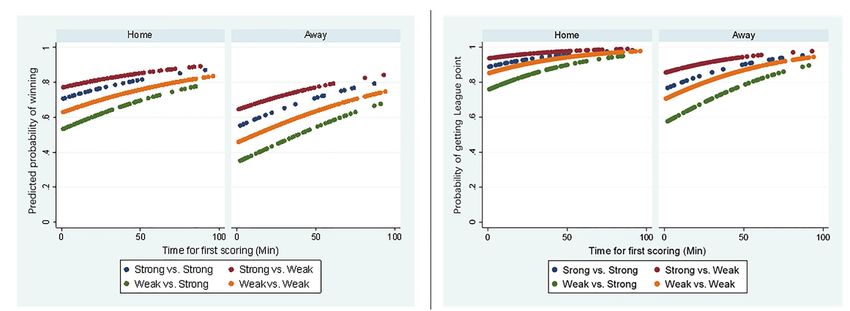
there were greater probabilities of winning or drawing than The predicted probabilities of winning a match and obtaining
losing. Concretely, compared with away teams, home teams league points for the first scoring teams were also graphed.
were approximately 13.42% more likely to win and approximately At a given minute for the first goal, home teams had a higher
9.52 and 3.90% less likely to lose and draw, respectively. High- probability of winning than away teams, while high-budget
budget teams were approximately 14.90% more likely to win teams had a higher probability of winning than low-budget
and approximately 9.75 and 5.14% less likely to lose and draw, teams (Figure 1A). Furthermore, for any team, as the minute
respectively, than low-budget teams. of the first goal moves forward to the end of the match, the
The estimation results of the Poisson regression model are predicted probability of winning increased accordingly.
reported in Table 4. Most estimated coefficients in this model Furthermore, the team scoring first showed a high probability
were statistically significant. To help interpret the parameter (>50%) of obtaining league points (Figure 1B).
estimates of the Poisson regression, the marginal effects of all
dependent variables for the probabilities of having a goal difference
in observed matches were also listed.3 The minute of the first DISCUSSION
goal had negative effects on the absolute value of the goal
difference. For any team scoring first, the earlier the first goal The aim of this study was to explore the effect of the minute of
the first goal on the match outcome. The results found that (a)
The marginal effects of the explanatory variables for the probabilities of zero
3 scoring first has a positive impact on the match outcome in the
goal difference (in other words, the probabilities for the first scoring teams CSL. The teams scoring first have an 87.01% probability of being
drawing) have the same magnitudes but opposite signs. Considering the main unbeaten and a probability of winning five times than of losing
purpose of this paper, the following discussion will focus primarily on the
probabilities of having a goal difference (i.e., the cases when the first scoring
in the league. (b) The time of the first score in a match has a
teams won or lost the match). statistically significant impact on match outcomes. Delaying the first
Frontiers in Psychology | www.frontiersin.org 4 May 2021 | Volume 12 | Article 662708Liu et al. Scoring First Impact on Soccer
A B
FIGURE 1 | Predicted probability of winning a match (A) or getting league points (B).
minute score for 1 min increases the average probability of winning Previous research also found that some of the performance
for the first scoring team by 0.0028. (c) The impact of scoring indicators of teams scoring first are similar to successful teams
first is also affected by the match location (ML) and team budget (Szwarc, 2004). The reason could be that after the first goal is
(TB). Thus, the higher the budget of the team that plays at home, scored, players’ psychological status changes. Compared with their
the greater the probability of winning the match and achieving opponents’ pressure score after conceding a goal, a goal makes
a higher goal difference if its first goal is scored at the beginning them feel relatively at ease in the following periods of the match
of the match. Therefore, the impact of scoring first is affected by and increases their confidence (Theis, 1992). Especially when
contextual factors, such as the match location and team budget. playing at home, home teams enjoy home crowd support (Pratas
The three hypotheses proposed are accepted. et al., 2018), which negatively affects away teams (Wolfson et al.,
The current research states that the influence of scoring the 2005). While scoring first improves a team’s confidence, it also
first goal in CSL was strong. Of all matches with scoring, 66.31% negatively impacts its opponent’s psychology, consequently reducing
of the teams that scored first won their matches. Additionally, in its opponent’s performance in competition (Leite and Barreira, 2014).
all 1,200 matches, 80.92% of the teams that scored first won or The regression model also reveals the following: (1) match
drew at the end of the match. When playing at home, first scoring outcome (win, draw, and loss) is influenced by the time of
teams have an approximately 80% likelihood of obtaining league the first score (time), match location (ML), team budget (TB),
points and an over 50% win probability. When playing on the and opponent budget (OB); and (2) the absolute goal difference
road, these results are over 50% and approximately 40%, respectively. (AGD) is influenced by the time of the first score (time),
This trend of the advantage of scoring first was consistent with match location (ML), and team budget (TB). The later the
previous results on both international and national events. In first goal is made, the clearer the match outcome is determined.
international tournaments (including FIFA World Cup), scoring As stated in the Introduction section, in a low-scoring sport,
first helped teams win over 70% of their matches (Leite, 2015; the first goal is influential in determining the match result
Vergonis et al., 2019). In domestic leagues, scoring first also (Bloomfield et al., 2005; Lago-Peñas et al., 2016). In addition,
increased the probability of winning (71.43–86.15%; Armatas, et al., a case study of Real Betis (a La Liga club) conceding goals
2009a,b; Molinuevo and Bermejo, 2012; Lago-Peñas et al., 2016). reports that the last 15 min is decisive in the balance of goals
In the CSL, the 66.31% probability of winning for teams scoring conceded, and this influence increases if the team is losing
first is less than that of listed tournaments, which is probably (Méndez et al., 2020). Nevo and Ritov (2013, p.175) suggested
because at the event level, high-level tournaments such as the that “if a team is leading or behind by a goal, their next goal
World Cup and UEFA Champions League have stronger teams. is equally likely to be scored. While time passes with no goal
Scoring even one goal in a match between strong teams might being scored, the probability of a goal in the next move is
be decisive, which possibly results in a high advantage of scoring first. [sic] increases.” The current study found that it is partially
This advantage of scoring first was traditionally associated true that the earlier the first goal of the team is, the larger
with tactical, technical, physical, and psychological factors. the absolute goal difference (AGD). However, it depends on
In football matches, those teams scoring first tend to change team strength and where the match is held (match location).
their playing style and strategy after scoring a goal (Bloomfield If a team that has a high budget and plays at home scores
et al., 2005; Taylor et al., 2008). In order to prevent their opponent first, it is very likely to continue scoring and win the match.
from scoring, they usually adopt a more conservative strategy However, if a team that has a low budget and is playing in
(more defensive; Lago-Peñas and Gomez-Lopez, 2014). the road scores first at a very early time, this team may concede
Frontiers in Psychology | www.frontiersin.org 5 May 2021 | Volume 12 | Article 662708Liu et al. Scoring First Impact on Soccer
more goals through the match. These findings are consistent with might have interacted to influence match results, which needs
Pratas et al. (2018) who found that in the Portuguese Premier to be further considered. Future studies are suggested in order
League, a first scoring home team would easily score a second to merge all the contextual variables (especially the quality of
goal according to the first scoring time. For an away team, having the opposition) with the team budget and the main players
an advantage (specifically only one goal) will not naturally lead signed by teams at the beginning of the season.
to a victory because the home team will not give up easily,
especially when the home team is down by only one goal at
halftime (Heuer and Rubner, 2012). Nevertheless, home field CONCLUSIONS AND PRACTICAL
advantage is not the same for all teams (Clarke and Norman, APPLICATIONS
1995). In the Chinese Super League, strong and weak teams have
different home field advantages. A long-term study (Zhou et al., This study demonstrates that there is a strong advantage when
2020) found that strong opponents become continuously difficult a team scores first in the CSL. Even low-budget teams maintain
to beat, which is probably due to their increasing budgets and a high probability of winning (63.47%). For home teams and
the investment of rich CSL clubs. Thus, the home field advantage high-budget teams, they have a very high probability of winning
appears in matches with a balanced quality between teams, whereas a game (home team 71.94% and high-budget team 76.10%) when
unbalanced matches are favorable to the strong team regardless they score first. The time of scoring the first goal has an impact
of the match location (Liu et al., 2019a). In the Spanish women’s on the match outcome, and scoring first at a later stage increases
football professional league, the best teams are also highly effective the win probability. The impact of scoring first is also influenced
regardless of the match location (Ibáñez et al., 2018). As a result, by contextual variables. When low-budget teams or visiting teams
home field advantage is more likely to play a role in “plus value.” score first, they must focus more on their defense, or they may
Applied in previous studies (Lago-Peñas and Gomez-Lopez, be more likely to lose. When high-budget teams or home teams
2014; Lago-Peñas and Sampaio, 2015; Liu et al., 2019b), team score first, they tend to continue to score more. When high-
budget was proven to have a major influence on teams’ performance. budget teams or home teams concede a goal first, especially in
Team budget indicates that rich clubs more easily sign star players the early phase of a match, they still have chance to equalize
and consequently organize a strong team. Good players are good the score and even score many more goals to win. These results
in their physical (e.g., more high-intensity running, etc.; Mohr may help coaches develop proper strategies when facing different
et al., 2003), tactical, and technical skills and their psychological match statuses and different qualities of opposition in terms of
ability against pressure (Lago-Peñas and Sampaio, 2015). These team budget according to the match location.
playing abilities help them adapt to the match situation and
perform well and steadily on the pitch, even when facing a
match status of losing. Moreover, players in successful teams DATA AVAILABILITY STATEMENT
perform more effectively and have higher quality of the tactical
and technical skills rather than the number and quantity (Lago- Publicly available datasets were analyzed in this study. This
Peñas et al., 2010; Yue et al., 2014; Liu et al., 2015). This could data can be found at: http://data.champdas.com.
be the reason that strong teams can usually pull back when
losing in an early stage in the match, and even they are able
to get a big win in the end. However, weak teams need to AUTHOR CONTRIBUTIONS
change their strategies because they are not “strong” enough to
keep their playing style under different situations. Furthermore, TL and QC conceptualized the study. TL, AG-d-A, and QC
Mohr et al. (2003) reported that a reduced amount of high- contributed to the methodology and reviewed and edited the
intensity work toward the end of the match was linked to the manuscript. QC contributed to the software, data collection,
match outcome. Strong teams have better physical conditioning, and visualization. TL wrote and prepared the original draft.
ensuring that they maintain high-quality technical and tactical HW and PH helped in improving this work. All authors
actions (e.g., passing accuracy) and make fewer errors toward contributed to the article and approved the submitted version.
the end of match regardless of whether they are winning or
losing. However, when weak teams are losing, their need for
scoring strengthens their players’ anxiety, resulting in increased FUNDING
offensive action but more errors (García-Rubio et al., 2015). This
could be seized by strong teams, leading to conceding goal(s). This work was supported by the Scientific Research Foundation
Despite these findings, the main limitation of this study is for the Returned Overseas Chinese Scholars, State Education
related to the small number of variables examined, the lack Ministry under a grant (KJZXCJ2015203).
of information about technical-tactical performance indicators
leading to goals, and substitutions or players’ exclusion during
games. Moreover, CSL clubs have increased their budgets and ACKNOWLEDGMENTS
investment in recruiting talented players over these years, but
this had not occurred for every club; and the long-term influence The authors would like to thank Champion Co., Ltd. (Shanghai)
needs to be noticed. Last, team budget and match location whose data helped us to conduct this research.
Frontiers in Psychology | www.frontiersin.org 6 May 2021 | Volume 12 | Article 662708Liu et al. Scoring First Impact on Soccer
REFERENCES Lago, C. (2009). The influence of match location, quality of opposition, and
match status on possession strategies in professional association football.
Almeida, C. H., Ferreira, A. P., and Volossovitch, A. (2014). Effects of match J. Sports Sci. 27, 1463–1469. doi: 10.1080/02640410903131681
location, match status and quality of opposition on regaining possession Lago-Peñas, C., and Dellal, A. (2010). Ball possession strategies in elite soccer
in UEFA champions league. J. Hum. Kinet. 41, 203–214. doi: 10.2478/ according to the evolution of the match-score: the influence of situational
hukin-2014-0048 variables. J. Hum. Kinet. 25, 93–100. doi: 10.2478/v10078-010-0036-z
Altarriba-Bartés, A., Calle, M. L., Susín, A., Gonçalves, B., Vives, M., Sampaio, J., Lago-Peñas, C., and Gomez-Lopez, M. (2014). How important is it to score
et al. (2020). Analysis of the winning probability and the scoring actions a goal? The influence of the scoreline on match performance in elite soccer.
in the American professional soccer championship. [Análisis de la probabilidad Percept. Mot. Skills 119, 774–784. doi: 10.2466/23.27.PMS.119c32z1
de ganar y de las acciones que conducen al gol en la liga americana de Lago-Peñas, C., Gómez-Ruano, M., Megías-Navarro, D., and Pollard, R. (2016).
fútbol profesional]. RICYDE. Rev. Int. cienc. deporte 16, 67–84. doi: 10.5232/ Home advantage in football: examining the effect of scoring first on match
ricyde2020.05906 outcome in the five major European leagues. Int. J. Perform. Anal. Sport
Anderson, C., and Sally, D. (2013). The Numbers Game: Why Everything You Know 16, 411–421. doi: 10.1080/24748668.2016.11868897
About Soccer Is Wrong. London: Penguin Books. Lago-Peñas, C., Lago-Ballesteros, J., Dellal, A., and Gómez, M. (2010). Game-
Armatas, V., Giannakos, A., Skoufas, D., Zangelidis, G., Papadopoulou, S., and related statistics that discriminated winning, drawing and losing teams from
Fragkos, N. (2009a). Goal scoring patterns in Greek top leveled soccer the Spanish soccer league. J. Sports Sci. Med. 9:288.
matches. Citius Altius Fortius 23, 46–51. Lago-Peñas, C., and Sampaio, J. (2015). Just how important is a good season
Armatas, V., Yiannakos, A., Papadopoulou, S., and Skoufas, D. (2009b). Evaluation start? Overall team performance and financial budget of elite soccer clubs.
of goals scored in top ranking soccer matches: Greek “Super League” 2006-07. J. Sports Sci. 33, 1214–1218. doi: 10.1080/02640414.2014.986184
Serb. J. Sports Sci. 3, 39–43. Leite, W. (2015). The influence of the first goal on the final result of the
Bar-Eli, M., Tenenbaum, G., and Geister, S. (2006). Consequences of players' football match. Balt. J, Sport, Health Sci. 3, 29–35. doi: 10.33607/bjshs.v3i98.91
dismissal in professional soccer: a crisis-related analysis of group-size effects. Leite, W., and Barreira, D. (2014). Are the teams sports soccer, futsal and beach
J. Sports Sci. 24, 1083–1094. doi: 10.1080/02640410500432599 soccer similar. Int. J. Sports Sci. Coach. 2014:84. doi: 10.5923/s.sports.201401.11
Bloomfield, J., Polman, R., and O’donoghue, P. (2005). Effects of score-line on Liu, T. (2014). Systematische spielbeobachtung im internationalen leistungsfußball.
team strategies in FA premier league soccer. J. Sports Sci. 23, 192–193. doctoral dissertation. University of Bayreuth.
Bryson, A., Frick, B., and Simmons, R. (2013). The returns to scarce talent: Liu, T., Fournier-Viger, P., and Hohmann, A. (2018). “Using diagnostic analysis
footedness and player remuneration in European soccer. J. Sports Econ. 14, to discover offensive patterns in a football game,” in Recent developments
606–628. doi: 10.1177/1527002511435118 in data science and business analytics. eds. M. Tavana and S. Patnaik (Cham,
Clarke, S. R., and Norman, J. M. (1995). Home ground advantage of individual Switzerland: Springer). 381–386.
clubs in English soccer. J. R. Stat. Soc. Ser. D 44, 509–521. Liu, T., García-De-Alcaraz, A., Zhang, L., and Zhang, Y. (2019a). Exploring
Ferreira, A. P. (2013). “From game momentum to criticality of game situations,” home advantage and quality of opposition interactions in the Chinese Football
in Routledge Handbook of Sports Performance Analysis. eds. T. McGary, Super League. Int. J. Perform. Anal. Sport 19, 289–301. doi:
P. O’Donoghue and J. Sampaio (New York, USA: Routledge), 288–300. 10.1080/24748668.2019.1600907
Gai, Y., Volossovitch, A., Leicht, A. S., and Gómez, M.-Á. (2019). Technical Liu, H., Gomez, M. A., Goncalves, B., and Sampaio, J. (2016). Technical
and physical performances of Chinese Super League soccer players differ performance and match-to-match variation in elite football teams. J. Sports
according to their playing status and position. Int. J. Perform. Anal. Sport Sci. 34, 509–518. doi: 10.1080/02640414.2015.1117121
19, 878–892. doi: 10.1080/24748668.2019.1669356 Liu, H., Gomez, M. A., Lago-Penas, C., and Sampaio, J. (2015). Match statistics
García-Rubio, J., Gómez, M. Á., Lago-Peñas, C., and Ibáñez, J. S. (2015). Effect related to winning in the group stage of 2014 Brazil FIFA World Cup.
of match venue, scoring first and quality of opposition on match outcome J. Sports Sci. 33, 1205–1213. doi: 10.1080/02640414.2015.1022578
in the UEFA Champions League. Int. J. Perform. Anal. Sport 15, 527–539. Liu, T., Ma, C., Zhang, D., Liu, J., and Bai, X. (2019b). Research on the
doi: 10.1080/24748668.2015.11868811 correlation between team performance & season-end ranking and season-
Garganta, J. (1997). Modelação tática do jogo de futebol: estudo da organização start club budget in Chinese Football Super League. J. Capital Inst. Phys.
da fase ofensiva em equipes de alto rendimento. Porto: University of Porto Educ. 31, 511–516. doi: 10.14036/j.cnki.cn11-4513.2019.06.007
Thesis in Portuguese. Mao, L., Peng, Z., Liu, H., and Gómez, M.-A. (2016). Identifying keys to win
Gómez-Ruano, M., Carlos, L.-P., and Pollard, R. (2013). “Situational variables,” in the Chinese professional soccer league. Int. J. Perform. Anal. Sport 16,
in Routledge Handbook of Sports Performance Analysis. 1st Edn. eds. 935–947. doi: 10.1080/24748668.2016.11868940
T. McGarry, P. O’Donoghue, J. Sampaio and A. J. de Eira Sampaio (London, Martinez, F. D., and Gonzalez-Garcia, H. (2019). Effect of scoring first and
UK: Routledge). match period in football world cup and Uefa Euro. Eur. J. Hum. Mov. 42,
Gong, B., Cui, Y., Gai, Y., Yi, Q., and Gomez, M. A. (2019). The validity and 123–137.
reliability of live football match statistics from champdas master match Méndez, R. D. A., González-Jurado, J. A., and Otero-Saborido, F. M. (2020).
analysis system. Front. Psychol. 10:1339. doi: 10.3389/fpsyg.2019.01339 Análisis observacional de goles recibidos por el Real Betis en La Liga:
Han, B., Chen, Q., Lago-Penas, C., Wang, C., and Liu, T. (2020). The influence estudio de caso. Retos: nuevas tendencias en educación física, deporte y
of the video assistant referee on the Chinese Super League. Int. J. Sports recreación. 355–362.
Sci. Coach. 15, 662–668. doi: 10.1177/1747954120938984 Mohr, M., Krustrup, P., and Bangsbo, J. (2003). Match performance of high-
Heuer, A., and Rubner, O. (2012). How does the past of a soccer match standard soccer players with special reference to development of fatigue.
influence its future? Concepts and statistical analysis. PLoS One 7:e47678. J. Sports Sci. 21, 519–528. doi: 10.1080/0264041031000071182
doi: 10.1371/journal.pone.0047678 Molinuevo, J. S., and Bermejo, J. P. (2012). El efecto de marcar primero y la
Hucaljuk, J., and Rakipović, A. (2011). “Predicting football scores using machine ventaja de jugar en casa en la liga de fútbol y en la liga de fútbol sala de
learning techniques.” in 2011 Proceedings of the 34th International Convention España. Rev. de Psicol. del Dep. 21, 301–308.
MIPRO; May 23–27, 2011; (New York; IEEE), 1623–1627. Nevo, D., and Ritov, Y. A. (2013). Around the goal: examining the effect of
Hughes, M., and Franks, I. M. (2004). Notational Analysis of Sport: Systems the first goal on the second goal in soccer using survival analysis methods.
for Better Coaching and Performance in Sport. 2nd Edn. London: Routledge. J. Quant. Anal. Sport. 9, 165–177. doi: 10.1515/jqas-2012-0004
Ibáñez, S. J., Pérez-Goye, J. A., Courel-Ibáñez, J., and García-Rubio, J. (2018). Pratas, J. M., Volossovitch, A., and Carita, A. I. (2016). The effect of performance
The impact of scoring first on match outcome in women’s professional football. indicators on the time the first goal is scored in football matches. Int. J.
Int. J. Perform. Anal. Sport 18, 318–326. doi: 10.1080/24748668.2018.1475197 Perform. Anal. Sport 16, 347–354. doi: 10.1080/24748668.2016.11868891
Jones, B. M. (2009). Scoring first and home advantage in the NHL. Int. J. Pratas, J. M., Volossovitch, A., and Carita, A. I. (2018). Analysis of scoring
Perform. Anal. Sport 9, 320–331. doi: 10.1080/24748668.2009. sequences in matches of the Portuguese premier league. J. Hum. Kinet. 64,
11868489 255–263. doi: 10.1515/hukin-2017-0199
Frontiers in Psychology | www.frontiersin.org 7 May 2021 | Volume 12 | Article 662708Liu et al. Scoring First Impact on Soccer Ruiz-Ruiz, C., Fradua, L., Fernández-GarcÍa, Á., and Zubillaga, A. (2013). Yiannakos, A., and Armatas, V. (2006). Evaluation of the goal scoring patterns Analysis of entries into the penalty area as a performance indicator in in European championship in Portugal 2004. Int. J. Perform. Anal. Sport 6, soccer. Eur. J. Sport Sci. 13, 241–248. doi: 10.1080/17461391.2011. 178–188. doi: 10.1080/24748668.2006.11868366 606834 Yu, Q., Gai, Y., Gong, B., Gómez, M.-Á., and Cui, Y. (2020). Using passing Sasaki, Y., Nevill, A., and Reilly, T. (1999). Home advantage: a case study of network measures to determine the performance difference between foreign Ipswich town football club during the 1996–97 season. J. Sports Sci. 17: 831. and domestic outfielder players in Chinese Football Super League. Int. J. Szwarc, A. (2004). Effectiveness of Brazilian and German teams and the teams Sports Sci. Coach. 15, 398–404. doi: 10.1177/1747954120905726 defeated by them during the 17th Fifa World Cup. Kinesiol. Int. J. Fundam. Yue, Z., Broich, H., and Mester, J. (2014). Statistical analysis for the soccer Appl. Kinesiol. 36, 83–89. matches of the first Bundesliga. Int. J. Sports Sci. Coach. 9, 553–560. doi: Taylor, B. J., Mellalieu, D. S., James, N., and Barter, P. (2010). Situation variable 10.1260/1747-9541.9.3.553 effects and tactical performance in professional association football. Int. J. Zhao, Y., and Zhang, H. (2020). Eigenvalues make the difference – A network Perform. Anal. Sport 10, 255–269. doi: 10.1080/24748668.2010.11868520 analysis of the Chinese Super League. Int. J. Sports Sci. Coach. 15, 184–194. Taylor, J. B., Mellalieu, S. D., James, N., and Shearer, D. A. (2008). The influence doi: 10.1177/1747954120908822 of match location, quality of opposition, and match status on technical Zhou, C., Gómez, M.-Á., and Lorenzo, A. (2020). The evolution of physical performance in professional association football. J. Sports Sci. 26, 885–895. and technical performance parameters in the Chinese Soccer Super League. doi: 10.1080/02640410701836887 Biol. Sport 37:139. doi: 10.5114/biolsport.2020.93039 Tenga, A. (2013). “First goal and home advantage at different levels of play Zhou, C., Hopkins, W. G., Mao, W., Calvo, A. L., and Liu, H. (2019). Match in professional soccer,” in Performance Analysis of Sport IX. eds. D. M. performance of soccer teams in the Chinese Super League-effects of situational Peters and P. O’Donoghue (New York: Routledge), 71–75. and environmental factors. Int. J. Environ. Res. Public Health 16:4238. doi: Theis, R. (1992). “Analyse von Torerfolgen im mittleren und unteren 10.3390/ijerph16214238 Amateurbereich im Fußball,” in Analyse und Beobachtung in Training und Zhou, C., Zhang, S., Lorenzo Calvo, A., and Cui, Y. (2018). Chinese soccer association Wettkampf. eds. W. Kuhn and W. Schmidt (Sankt Augustin: Academia Verlag), super league, 2012–2017: key performance indicators in balance games. Int. J. 173–174. Perform. Anal. Sport 18, 645–656. doi: 10.1080/24748668.2018.1509254 Tucker, W., Mellalieu, D. S., James, N., and Taylor, B. J. (2005). Game location effects in professional soccer: a case study. Int. J. Perform. Anal. Sport 5, Conflict of Interest: PH was employed by company Microsoft, Beijing. 23–35. doi: 10.1080/24748668.2005.11868325 Vergonis, A., Michailidis, Y., Mikikis, D., Semaltianou, E., Mavrommatis, G., The remaining authors declare that the research was conducted in the absence Christoulas, K., et al. (2019). Technical and tactical analysis of goal scoring of any commercial or financial relationships that could be construed as a potential patterns in the 2018 Fifa World Cup in Russia. FU Phys. Ed. Sport 17, conflict of interest. 181–193. doi: 10.22190/fupes190612019v Wolfson, S., Wakelin, D., and Lewis, M. (2005). Football supporters' perceptions Copyright © 2021 Liu, García-de-Alcaraz, Wang, Hu and Chen. This is an open- of their role in the home advantage. J. Sports Sci. 23, 365–374. doi: access article distributed under the terms of the Creative Commons Attribution 10.1080/02640410400021567 License (CC BY). The use, distribution or reproduction in other forums is permitted, Yang, G., Leicht, A. S., Lago, C., and Gómez, M.-Á. (2018). Key team physical provided the original author(s) and the copyright owner(s) are credited and that and technical performance indicators indicative of team quality in the soccer the original publication in this journal is cited, in accordance with accepted academic Chinese super league. Res. Sports Med. 26, 158–167. doi: 10.1080/15438627. practice. No use, distribution or reproduction is permitted which does not comply 2018.1431539 with these terms. Frontiers in Psychology | www.frontiersin.org 8 May 2021 | Volume 12 | Article 662708
You can also read


