Implementing RPA for Clearing with UEL - Webinar July 2021 - Equantiis
←
→
Page content transcription
If your browser does not render page correctly, please read the page content below
Implementing
RPA for Clearing
with UEL

Webinar
July 2021
Our Speakers

                    Janine Chasmer
                    Executive Consultant,
                    Product Manager, Equantiis

                    Alistair Sergeant
Alistair Sergeant                                Donald McLeod
CEO, Equantiis                                   Director of Change and
                                                 Transformation, UEL
Context

Reimagine the nature of higher
education
To deliver true student-centric services
Adopt a digital approach across the whole organisation
that empowers efficient operations and the joined-up
student experience every institution aspires to achieve

Many parts of your organisation are lagging way
behind on this digital journey
Your People, Processes and Technologies are simply not
joined up and are holding you back..

This Session

Focuses on the challenges of the rapid shift
to a digital-first model and what you can do
to maximise the potential aligning your
student experience and digital technology

The good news is
• Many tools and techniques you can use to join up the student journey
  without having to embark on major change programmes and complex
  IT projects.
• Definite shift in recent years away from big, long lead time IT
  transformation projects to smaller scale, “quick win” solutions

Addressing the Challenges

The modern HE institution must have a well-defined digital strategy
Offering a connected digital experience with both staff and students is a
challenge – there’s no ‘one size fits all’ approach

Common and consistent challenges across the sector:

•   Student Expectations
•   Legacy Systems and Siloed Data
•   The Pace of Digital Change
•   Staying Relevant

Taking a Digital-First Approach?

  The Digital
  Maturity        Evolution                 Transition                Transformation
  Journey

                Change happens             Change through             Organisation wide
                  organically              digital projects                change

                      Analogue by Design                      Digital by Design
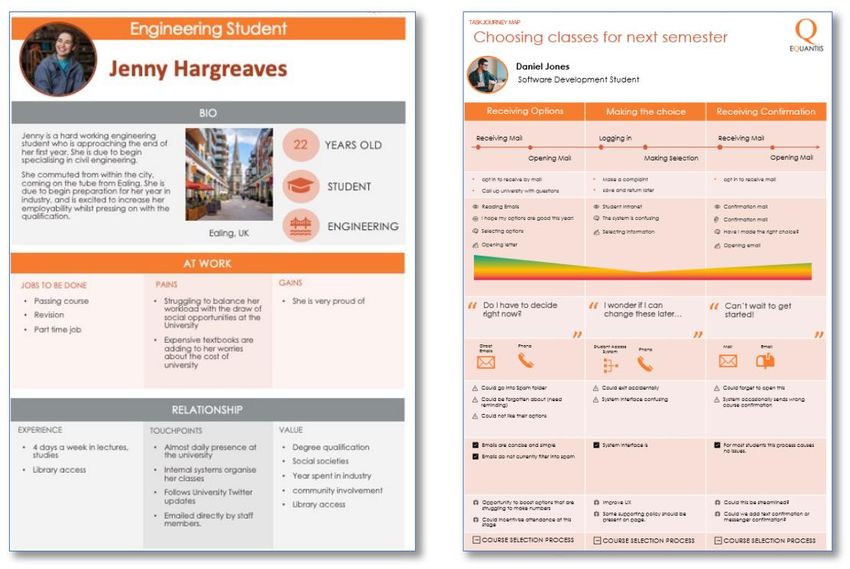
The External View: Student Experience Mapping A practical approach to align stakeholders and departments around a shared vision • Enables focus on Personas who represent key demographics – potential and existing • Identifies the needs and aspirations of your applicants and students • Highlights the touchpoints of interaction with your institution • Identifies barriers or pitfalls • Identifies where the experience is good, and students are engaged • Pinpoints the opportunities to achieving digital transition
The External View

Student Experience Mapping

  Prompt to Register                                            Completing Registration
                             Enrolling
 Read email notification:                                       Confirmation of choices received:
                             Make selection:
 “What do I need to do?”                                        “Great, I know I’m registered –
                             “What can I choose? I can’t find
                                                                but do I need to do anything
                             what I need”
                                                                else?”
                             Make a payment:                    “Do I get a new student card?”
                             “Has my loan come through yet?”
The Internal View: Business Process Discovery
A key part of the optimisation
Admissions Registry Student Services Student Finance Marketing Graduates & Alumni
approach is to engineer business
processes to become more efficient
and support a better student
experience 8 11 12 13 14 13
Business Business Business Business Business Business
Processes Processes Processes Processes Processes Processes
The potential improvements can be
estimated as operational efficiency
savings as an average percentage Process Opportunities Process Opportunities Process Opportunities Process Opportunities Process Opportunities Process Opportunities
and can be shown in two parts: 31% 52% 46% 30% 49% 13%
Process opportunity
Technology opportunity Automation Opportunities Automation Opportunities Automation Opportunities Automation Opportunities Automation Opportunities Automation Opportunities
34% 45% 46% 22% 54% 12%Joining up the Student Experience
By looking at the external Student
Business
Experience and the Internal Processes
Process
you can quickly gain an understanding of Improvement
the right approach to improve the
student experience as well as internal Student
operational efficiencies Experience
Mapping
Student
Experience Intelligent
Improvement Automation
Strategy
Business
Process
Discovery
Technology
Alignment &
ChangeWhat is Intelligent Automation? Intelligent Automation fast tracks your digital transformation: • The main component is RPA • RPA stands for Robotic Process Automation • RPA is a computer programme (called a bot) that mimics a human performing a repetitive rule-based task • It can work across functions and software applications, and it can make decisions • It is simple to deploy and does not required complicated IT integrations to work Just like a human it can: Benefits: • Log into systems • Faster and more accurate • Open emails and attachments • Better student experience • Monitor folders for new files • Improved efficiency • Perform queries • Increased compliance • Extract and process data • Happier and more productive employees • Edit and move files • Copy and paste text • Fill in forms • Follow if/then rules • Maintain records
RPA Example: Invoice Processing

  Monitor a                         Enter data
 folder for a    Read     Extract      into         Email
 new invoice    Invoice    Data      Finance     Confirmation
    (PDF)                            System

Intelligent Automation
What makes RPA a Success? • Have related projects on the radar as they may affect them • Product ownership • Invest staff time into the project • Change management on the radar
Case Study: University of East London

   With Donald McLeod, Director of Change and Transformation (Digital) at
                        University of East London
UEL Success Story • UEL Transformation • Pain points • Resolving the issues • Implementation • Human Investment • Changes/improvements
Niico in action
Example HE Processes That Can Be Automated

                                 Processing
     Managing                     student
                                                             Assessing            Processing         Responding to
    prospective                  enrolment
                                                            scholarships       student transfers   student transcript
   student offer               including data
                                                           and bursaries         and changes           requests
      letters                   capture and
                                confirmation

Intelligent Automation works best supporting any of the following scenarios:

     Manual
    Repetitive               High Transaction            Multiple Systems
                                                                               Structured Data
   Rules-based                   Volumes                 & Data Sources
    Processes
In Summary • As society continues to rethink the value of post-secondary education, accelerated by the changes from COVID-19, institutions are responding by emphasising their value via increasingly joined up, flexible ways to prepare students for the workplace. • It’s critical that your digital capabilities are unified and are focused to help your institution rethink and achieve this direction. • As a large institution, key to make digital transitions efficiently and effectively, operating with a lean business approach where pivoting and responding to change is easier • Technology such as artificial intelligence, intelligent automation, blockchain and advanced analytics can all change the way in which services are delivered to students. • The most successful institutions have implemented a unified view of their organisations capabilities that aligns initiatives, investments, and strategy in order to compete and engage the student to achieve their best possible potential.
Thank you
Call
020 3376 7447
Email
hello@equantiis.com
Visit
www.equantiis.com

199 Bishopsgate,
London, EC2M 3TY
Company Reg No: 08554997
You can also read


