Influence of a University Tobacco-Free Policy on the Attitudes, Perceptions of Compliance, and Policy Benefit Among the University Students: A ...
←
→
Page content transcription
If your browser does not render page correctly, please read the page content below
---------------------
                                                                                                                                  International Journal of Public Health
                                                                                                                                                                  ORIGINAL ARTICLE
                                                                                                                                                                published: 29 April 2021
                                                                                                                                                         doi: 10.3389/ijph.2021.614602

                                                        Influence of a University
                                                        Tobacco-Free Policy on the Attitudes,
                                                        Perceptions of Compliance, and Policy
                                                        Benefit Among the University
                                                        Students: A Pre-Post Investigation
                                                        Monique Chaaya 1, Dina Farran 1, Dahlia Saab 2, Mahmoud Al-Hindi 3, Maya Romani 4,
                                                        Mary Khairallah 5 and Rima Nakkash 1*
                                                        1
                                                          Faculty of Health Sciences, American University of Beirut, Beirut, Lebanon, 2Faculty of Medicine, American University of Beirut,
                                                        Beirut, Lebanon, 3Department of Mechanical Engineering, Maroun Semaan Faculty of Engineering and Architecture, American
                                                        University of Beirut, Beirut, Lebanon, 4Department of Family Medicine, American University of Beirut Medical Center, Beirut,
                                                        Lebanon, 5Human Resources Department, American University of Beirut, Beirut, Lebanon

                                                        Objective: To evaluate the effectiveness of a university tobacco-free policy by examining
                                                        differences in students’ attitudes, perceptions of compliance and policy benefits, after one
                                                        year of the policy’s implementation.
                                                        Methods: Cross-sectional studies were undertaken to collect data pre- and 1 year post-
                                                        policy implementation. The two samples were selected using stratified random sampling.
                                                        Results: The prevalence of smoking decreased from 26% pre-policy implementation to
                                                        21% 1 year after (p  0.035). The proportion of smokers who thought the policy had
                                                        contributed to a reduction in smoking frequency increased from 10% to 70% (p < 0.001).
                                                        Smokers’ support for the policy rose from 42 to 58% (p  0.007).
                                                        Conclusion: Against the background of a strongly pro-tobacco environment in Lebanon,
                            Edited by:
                           Milo Puhan,                  it is possible to create a positive change in the mindset of smokers at the levels of the
      University of Zurich, Switzerland                 education and smoking cessation and more efforts should be expended to bring it about.
                  *Correspondence:                      Keywords: tobacco-free policy, university, students, attitude, smoking behavior
                       Rima Nakkash
                    rn06@aub.edu.lb

         Received: 06 October 2020                      INTRODUCTION
        Accepted: 11 February 2021
           Published: 29 April 2021                     Tobacco use is a major contributor to a multitude of diseases, including atherosclerotic
                              Citation:
                                                        cardiovascular disease, lung cancer, asthma and chronic obstructive pulmonary disease (COPD)
         Chaaya M, Farran D, Saab D,                    [1]. These tobacco-related illnesses are not only associated with daily tobacco use or a lifetime of
  Al-Hindi M, Romani M, Khairallah M                    smoking, but also affect people exposed to secondhand smoke (SHS) who are as susceptible to the
 and Nakkash R (2021) Influence of a                     health risks of tobacco dependence as smokers [2]. Although tobacco use is declining worldwide, it
University Tobacco-Free Policy on the                   increased in Africa and the Eastern Mediterranean Region over the last decade [3].
Attitudes, Perceptions of Compliance,
                                                           Although Lebanon ratified the WHO Framework Convention on Tobacco Control in 2005, the
         and Policy Benefit Among the
            University Students: A Pre-
                                                        government did not adopt a tobacco control policy until 2011. Law 174 bans smoking in public
                     Post Investigation.                places, on public transport, at workplaces and outdoors at schools, universities, and health and sports
        Int J Public Health 66:614602.                  facilities. However, the law was enforced inconsistently, or not at all, reflecting the absence of political
       doi: 10.3389/ijph.2021.614602                    will for tobacco control and opposition from allies of the tobacco industry in the government [4]. In

Int J Public Health | Owned by SSPH+ | Published by Frontiers                                    1                                              April 2021 | Volume 66 | Article 614602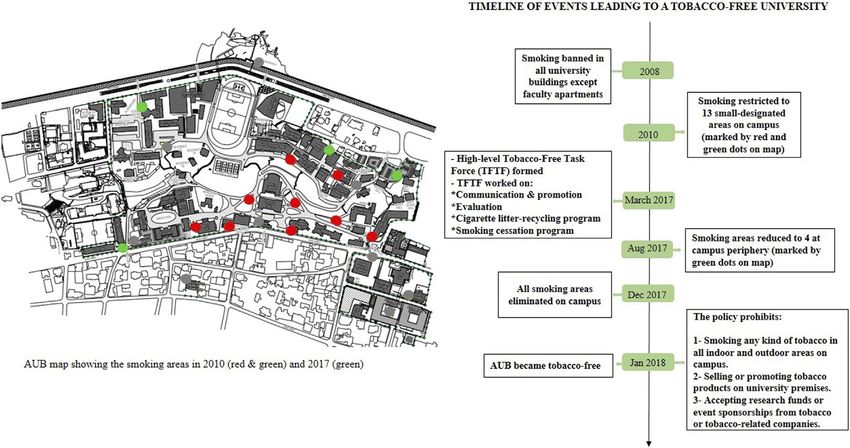
Chaaya et al.                                                                                                                 Tobacco-Free Policy Evaluation

 FIGURE 1 | Timeline of events leading to a tobacco-free university (Lebanon, 2008-2018)

2015, the WHO estimated cigarette smoking prevalence in                            ban, showed that smoking prevalence decreased from 9.5% before
Lebanon stood at 32% among males aged 18 and over, and                             implementation to 7% 3 years after the ban [11]. Lupton and
21% among females aged 18 and over [5].                                            Townsend found in their systematic review and meta-analysis
   In a cross-sectional survey assessing students’ attitudes                       that 59% of college students supported smoke-free policies and
towards a tobacco ban at a private university in Lebanon                           that the support increased with policy implementation [15].
(AUB), Chaaya et al. reported that 25% of participants started                         The number of universities in the Middle East going tobacco-
smoking after joining the university [6]. Smoking prevalence                       free is lower than elsewhere around the world, and no published
among university students in the Middle East is relatively high                    studies have yet evaluated their effectiveness in the region [16].
with males showing higher rates than females. A cross-sectional                    The American University of Beirut (AUB), one of the largest
study carried out at Aleppo University in Syria showed that 31%                    universities in Lebanon, started its tobacco-free policy initiative in
of male and 7% of female students were regular smokers [7].                        the year 2000 by banning smoking in all university buildings
Similarly, a pilot study at University of Jordan reported that                     except faculty and staff apartments. In 2008, smoking was
smoking prevalence among college students was 27% [8]. In Saudi                    restricted to a number of confined designated areas. In March
Arabia, a systematic review and meta-analysis of tobacco                           2017, a high-level task force was assigned by the president of the
prevalence among college students estimated the rate to be                         university to work toward the adoption of a tobacco-free policy
17% (26% in males and 5% in females) [9].                                          and plan for implementation, enforcement, and evaluation [17].
   Recently, there has been a surge in the adoption of tobacco                     The task force developed an initial plan to reduce the number of
control policies at universities. Evaluations of these policies show               designated areas from 13 throughout the campus to 4 at the
a correlation between how comprehensive the policy is and its                      peripheries, before the removal of all designated areas several
success in decreasing smoking behavior [10–12]. A complete ban                     months later. AUB implemented its tobacco-free policy in
of tobacco use in universities was shown to be associated with                     January 2018, and succeeded in enforcing it despite the
lower self-reported intentions to smoke and a reduction in pro-                    contextual challenges. It was the first Lebanese university to
smoking attitudes, smoking frequency, and exposures to second                      implement Law 174 banning smoking in all educational
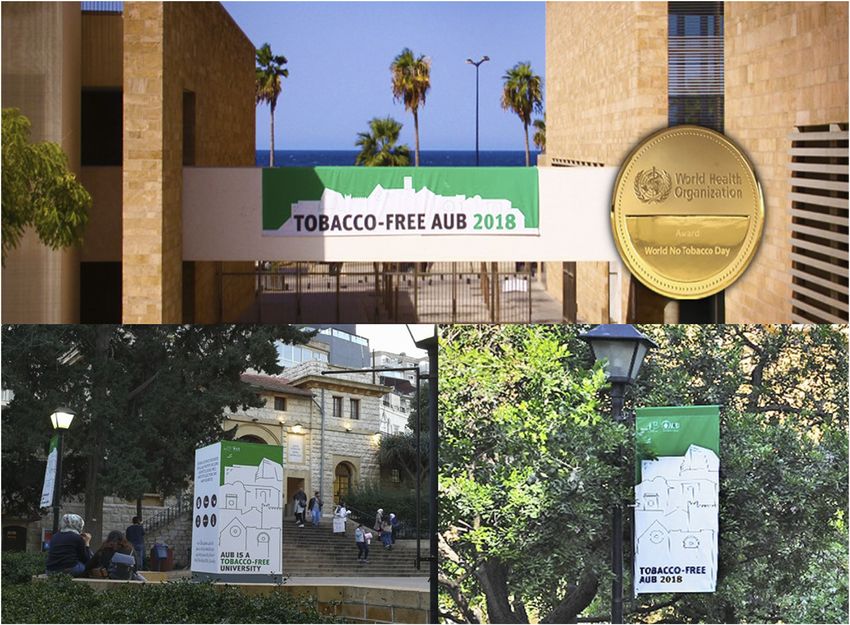
hand smoke [10–14]. Seo et al. reported that, 1 year post-                         institutions (Figures 1, 2).
implementation of a smoke-free policy at a college in Indiana,                         In this manuscript, we report on the evaluation of the AUB
undergraduates’ smoking prevalence was significantly lower than                     tobacco-free policy by comparing independent samples of
before the policy (16.5%–12.8%) [12]. They also noted that the                     students pre- and 1 year post-policy implementation.
perception of peers’ compliance increased after implementation.                    Specifically, the study examined: 1) changes in students’
Another cross-sectional study, evaluating students’ attitudes,                     attitudes, perceptions of policy benefits and perceptions of
beliefs and smoking behavior over 4 years following a tobacco                      compliance among smokers and non-smokers 1 year post-

Int J Public Health | Owned by SSPH+ | Published by Frontiers                  2                                      April 2021 | Volume 66 | Article 614602
Chaaya et al.                                                                                                         Tobacco-Free Policy Evaluation

 FIGURE 2 | Communication of the tobacco-free policy.

policy implementation; 2) changes in smokers’ attitudes,                    students in the fall term of each academic year was obtained from
perceptions of policy benefits and perceptions of compliance                 the Office of Student Affairs. A sample of graduate and
1 year post-policy implementation; 3) changes in smokers’                   undergraduate courses was randomly selected by the statistician
behavior one year post-policy implementation. The evaluation                at the Office of the Registrar based on stratified cluster sampling,
of AUB tobacco-free policy was funded by the university                     with faculties being the stratification variable to ensure
presidents’ initiative.                                                     representation of all students. Professors of the selected courses
                                                                            were contacted by email to seek their approval for data collection
                                                                            from students during class time. The main reason for refusals in
METHODS                                                                     both periods was the timing of the data collection which coincided
                                                                            with the last few sessions of the term. The courses for which data
The Institutional Review Board at AUB approved the research                 collection was approved were visited by two research team members
protocol. Participants were guaranteed anonymity.                           and all students present were asked to complete the survey. The
                                                                            sample sizes reached pre- and 1 year post-implementation of the
Participants                                                                policy were 809 and 615 students respectively, with an overall
Two cross-sectional surveys were conducted: the first prior to               response rate of 37 and 28%. The distribution of the final sample in
implementation of the tobacco-free policy (November 2017) and               both surveys was comparable to the AUB student population in
the second 1 year post-policy implementation (November 2018).               terms of gender, level, and Faculty (Data not shown).
The process of data collection among students took around two
weeks in both years. The targeted sample size at each data collection       Survey and Data Collection
time was 2,172 students, which approximately equaled 23% of the             A self-administered paper-and-pencil survey was designed to
total number of students in each year (9,143 and 9,404 in AY17/18           collect data within 5–7 min. Participation was voluntary and
and 18/19 respectively). A list of the core courses attended by the         no identifiable data were collected. The survey instrument

Int J Public Health | Owned by SSPH+ | Published by Frontiers           3                                     April 2021 | Volume 66 | Article 614602
Chaaya et al. Tobacco-Free Policy Evaluation
TABLE 1 | Students’ characteristics pre- and 1-year post-policy implementation.
Pre-implementation Post-implementation p value
N 809 615
Female 451 (56.0) 340 (55.4) 0.849
Age [mean(SD)] 20.38 (3.13) 20.68 (2.90) 0.069
Smoking status
Never 550 (70.7) 469 (76.3)
Daily 94 (12.1) 62 (10.1)
Former 26 (3.3) 17 (2.8)
Occasional 108 (13.9) 67 (10.9)
Smokers (daily and occasional) 202 (26.0) 129 (21.0) 0.035
collected data on demographics (gender, age, marital status, class, RESULTS
faculty, and place of residence), students’ attitudes toward the
tobacco-free policy, their perceptions of compliance, their Overall, 809 completed the questionnaire in the first cross-
perceptions of the policy benefits, and their smoking behavior. sectional study (pre-tobacco-free policy implementation) and
Students were asked to indicate the extent to which they 615 in the second study (post-tobacco-free policy
supported the policy, whether they thought policy should have implementation). The mean age of students was 20 years in
exceptions, whether it created a healthy environment, promoted both samples; the proportion of females was 56% in the first
quit attempts had an affect on the neighborhood. Responses were survey and 55% in the second. (Table 1). The distribution of
reported on a 3-point Likert scale (“large extent,” “some extent” students by faculties was similar in both years (data not shown).
and “not at all,” with a “not sure” option). Students were also The majority of students reported that they had never smoked
asked to what extent they believed that the policy resulted in a (71 pre- and 76% 1-year post-policy implementation). The
reduction in students’ smoking frequency and a reduction in the proportion of former smokers was the smallest category in
rate of student absences. Responses were reported on a 4-point both years, not exceeding 4%. Almost 14% of students
Likert scale (“not a benefit,” “minor benefit,” “moderate benefit” identified themselves as occasional smokers before policy
and “major benefit,” with a “don’t know” option). In addition, implementation compared to 11% 1 year after (Table 1). After
questions on smoking status, smoking history, quit attempts and combining the “daily” and “occasional” categories, the proportion
change in smoking behavior following implementation of the of smokers showed a statistically significant decrease from 26%
tobacco-free policy were included in the survey instrument. pre-to 21% (p 0.035) 1-year post-policy implementation.
Data Analysis Attitude Toward the Tobacco-Free Policy
Univariate analyses were done to describe basic demographic and Smokers and non-smokers’ attitudes toward the tobacco-free
smoking characteristics. To examine differences in attitudes, policy were compared pre- and 1 year post-implementation
compliance and smoking behavior of students pre- and post- (Table 2). Overall, the difference in attitude was statistically
policy implementation, bivariate analyses by year and smoking significant with non-smokers showing more positivity and
status were performed. χ 2 tests were computed to determine the support at both time points (Table 2).
statistically significant differences, identified at a p value < 0.05. Smokers’ attitudes before and after policy implementation were
Smoking status, initially grouped into four categories (never compared. It was notable that the proportion of smokers supporting
smoked, daily, former and occasional smoker) was the policy statistically significantly increased by 16%, from 42 pre-to
dichotomized into smokers (daily and occasional smokers) and 58% at 1-year post-implementation (p 0.007). However, a higher
non-smokers (never smoked and former smoker). The Likert scale proportion of smokers believed that the policy had negatively
responses for the questions related to attitudes, compliance, and affected the neighborhood and the difference was statistically
perceived benefits, were collapsed to two categories. For responses significant (< 0.001) (Table 3). The negative effect that the
to the attitude questions, “large extent” and “some extent” were policy had on the neighborhood was perceived as littering and
considered as “Yes,” while “not at all” and “not sure” were crowding at university entrances. Students expressed these concerns
considered as “No.” For perception of compliance and benefits: in informal discussions as well as in the university student
“minor benefit,” “moderate benefit” and “major benefit” were newsletter. Among non-smokers, more support was expressed at
considered as “Yes,” while “not a benefit” and “don’t know” 1-year follow up (p 0.003) and a significantly lower proportion
were considered as “No.” The analysis aimed, first, to compare believed that the policy should have exceptions (p < 0.001).
attitudes, compliance and perceived benefits among smokers and
non-smokers pre- and 1 year post-policy implementation and,
second, to study the change in smokers’ attitudes, compliance, Perceived Benefits of the Tobacco-Free
perceived benefits and smoking behavior 1 year after policy Policy
implementation. Samples pre- and 1 year post-policy The difference in reported perceived benefits between non-
implementation were independent. smokers and smokers 1 year after implementation of the
Int J Public Health | Owned by SSPH+ | Published by Frontiers 4 April 2021 | Volume 66 | Article 614602Chaaya et al. Tobacco-Free Policy Evaluation
TABLE 2 | Nonsmokers’ and Smokers’ attitude and perception of policy benefits pre- and 1 year post-implementation.
Pre-implementation Post-implementation p value
Non-smokers Smokers p value Non-smokers Smokers
n 576 202 486 129
Attitude toward the policy
Support the policy 485 (84.2) 85 (42.3)Chaaya et al. Tobacco-Free Policy Evaluation
TABLE 4 | Students’ smoking behavior pre- and 1-year post-policy implementation.
Pre- implementation Post-implementation p value
n 94 62
Started smoking after joining 25 (27.2) 13 (21.3) 0.528
Thinking of quitting in the next 6 months 53 (58.2) 43 (69.4) 0.22
Consider joining the smoking cessation program 35 (37.6) 25 (40.3) 0.866
Joined the smoking cessation program NA 5 (8.1) —
Decreased their off-campus smoking behavior NA 7 (11.3) —
Note: Percentages may not precisely reflect the figures as there were few missing values. Percentages in this table represent regular smokers only (excluding the occasional smokers).
enforced or implemented. The prevalence of daily smoking (12% behavior, which is consistent with a study showing that legislative
pre-implementation and 10% 1-year later) was lower than smoking bans in public places influence social norms related to
reported in other cross-sectional studies on tobacco use in smoking and thus encourage people to adopt similar restrictions at
private Lebanese universities (18–19%), although it was similar home [25]. A small number of smokers joined the smoking
to a study conducted at AUB in 2008 [6, 18, 19]. cessation program and data on whether their quit attempts were
The proportion of occasional smokers in both surveys was higher successful is not available. Previous studies reported that policies
than that of daily smokers, which is a concern, given the evidence coupled with smoking cessation programs led to increased
that occasional smoking can lead to daily smoking [20]. As for the treatment-seeking behavior and quit attempts [26, 27]. A study
decrease in smoking prevalence 1-year post policy implementation done by Hahn et al. found that 16 months after the implementation
(26–21%), it was consistent with other studies evaluating changes in of the policy, 9% of the smokers who used the smoking cessation
smoking prevalence following complete tobacco bans [11, 12]. In program reported they had quit smoking [26]. However, according
college campuses partially banning tobacco, it was found that to Moran, students considering themselves social or occasional
permitting smoking in designated areas was associated with a smokers were less likely to participate in such programs and quit, as
higher rate of smoking, owing to the fact that the interaction in they did not consider themselves addicted to cigarette smoking [28].
such places increased the perceived rewards of being a smoker and This study has some limitations that deserve discussion. Firstly,
led to an increased frequency of visits [10, 21, 22]. its cross-sectional nature precludes any causal association between
The proportion of smokers supporting the tobacco-free policy the tobacco-free policy and smoking behavior. Secondly, it relies on
significantly increased 1 year after the implementation, while non- self-reporting, which may introduce response bias, while using a
smokers showed a favorable attitude toward the policy in both self-administered questionnaire with clearly constructed questions
years. These results are in-line with other studies showing that a would minimize information bias and ensure confidentiality and
majority of students, including smokers, support tobacco control privacy. Thirdly, it covers only one university, so the findings may
policies and they tend to show more support after policy not be generalizable to the entire Lebanese college student
implementation [11, 12, 23]. Smokers, however, still prefer to community. Fourthly, selection bias due to non-response is a
have designated smoking areas on campus, while non-smokers major concern in cross-sectional studies. Because many
think there should be no exceptions to the policy. This difference is professors did not allow us to do data collection during their
attributable to the fact that smokers sometimes question the value class time, we were not able to reach the sample size originally
of banning tobacco in outdoor areas, believing that they have a targeted. Still, in our study, the response rate is comparable to that
right to smoke in open spaces and it is not harmful for others [24]. reported in similar studies [27, 29, 30], and the distribution of those
On the other hand, the proportion of smokers believing the policy who responded was not significantly different from the original
reduced the frequency smoking significantly increased at 1 year population, as noted in the methods section. Finally, we would like
follow up, which is in line with many previous studies [10–12]. to note that in our context occasional smokers don’t consider
Smoking behavior was assessed after 1 year of the themselves as smokers (we defined occasional smokers as those
implementation of the policy through changes in off-campus smoking less than one cigarette per day), thus we did not opt to ask
smoking behavior and intentions to quit or join smoking them about their quit attempts and intentions to quit. However,
cessation programs. In this study, occasional smokers were not exclusion of occasional smokers may be seen as insufficient in
asked about quitting behavior, as it was previously reported that providing evidence on the decrease of smoking initiation after
most occasional smokers do not consider themselves addicted to joining AUB.
tobacco and are less likely to report quitting or joining a cessation The study also has some noteworthy strength. It is the first in
program [28]. Results showed that fewer students started smoking the Middle East to assess changes in students’ attitudes,
after joining AUB in 2018 and that a higher proportion of smokers perceptions and smoking behavior following the
are thinking of quitting within the next 6 months compared to the implementation of a tobacco-free policy. The large sample size
pre-policy implementation. However, the differences were not in both rounds gave the study sufficient power to detect changes
statistically significant, which may be attributed to the social after implementation of the policy. In addition, the sampling
norms associated with smoking in Lebanon or to the fact that a frame included students from all faculties and levels, ensuring
year is a relatively short period to change a behavior. In addition, representativeness. Finally, this study could set the stage for
one in ten smokers reported a decrease in their off-campus smoking similar research in the region.
Int J Public Health | Owned by SSPH+ | Published by Frontiers 6 April 2021 | Volume 66 | Article 614602Chaaya et al. Tobacco-Free Policy Evaluation
The AUB tobacco-free policy represents a remarkable form ETHICS STATEMENT
of compliance and enforcement of national tobacco control
legislation. This study assesses changes in students’ attitudes, The studies involving human participants were reviewed and
perceptions and smoking behavior 1 year after the transition of approved by the Institutional Review Board at AUB. The patients/
their university campus from partially to wholly tobacco-free. participants provided their written informed consent to
Overall, attitudes toward the policy and perception of its participate in this study.
benefits improved among smokers 1 year after
implementation. As for smoking behavior, a drop in
smoking rate was noted. AUTHOR CONTRIBUTIONS
Knowing that smoking prevalence is increasing among college
students, great efforts should be expended at both the educational All authors came up with the original idea. MC was responsible
level and on cessation programs to ensure a positive change in for the study design and statistical analyses. DF, RN, and MC
smokers’ mindsets. College years are critical to protect this age were responsible for the preparation of the manuscript. All
group, to educate young adults about the adverse effects of authors contributed to the interpretation of results and also
smoking and more importantly to provide them with read and approved the final manuscript.
supportive, smoke-free environments and access to cessation
support when needed. As other Lebanese and Arab
universities adopt tobacco-free policies, more research should FUNDING
be done in this field to develop generalizable conclusions about
the effectiveness of tobacco control policies in countries known This project was funded by AUB.
for their pro-smoking environment.
CONFLICT OF INTEREST
DATA AVAILABILITY STATEMENT
The authors declare that the research was conducted in the
The raw data supporting the conclusions of this article will be absence of any commercial or financial relationships that
made available by the authors, without undue reservation. could be construed as a potential conflict of interest.
10. Fallin A, Roditis M, and Glantz SA. Association of campus tobacco policies
REFERENCES with secondhand smoke exposure, intention to smoke on campus, and
attitudes about outdoor smoking restrictions. Am J Public Health (2015).
1. Courtney R. The health consequences of smoking-50 years of progress: a report 105(6):1098–100. doi:10.2105/ajph.2014.302251
of the surgeon general, 2014 Us department of health and human services 11. Lechner WV, Meier E, Miller MB, Wiener JL, and Fils-Aime Y. Changes in
atlanta, ga: department of health and human services, centers for disease control smoking prevalence, attitudes, and beliefs over 4 years following a campus-
and prevention, national center for. Drug Alcohol Rev (2015). 34(6):694–5. wide anti-tobacco intervention. J Am Coll Health (2012). 60(7):505–11. doi:10.
doi:10.1111/dar.12309 1080/07448481.2012.681816
2. Centers for Disease Control and Prevention. Best practices for comprehensive 12. Seo D, Macy J, Torabi M, and Middlestadt S. The effect of a smoke-free campus
tobacco control programs. National Center for Chronic Disease Prevention and policy on college students’ smoking behaviors and attitudes. Prev Med (2011).
Health Promotion (2014). https://www.cdc.gov/tobacco/stateandcommunity/ 53(4-5):347–52. doi:10.1016/j.ypmed.2011.07.015
best_practices/pdfs/2014/comprehensive.pdf (Accessed August 5, 2020). 13. Bennett B, Deiner M, and Pokhrel P. College anti-smoking policies and student
3. World Health Organization. Prevalence of tobacco smoking (2016). https://www. smoking behavior: a review of the literature. Tob Induc Dis (2017). 15(1).
who.int/gho/tobacco/use/en/ (Accessed August 5, 2020). doi:10.1186/s12971-017-0117-z
4. Nakkash RT, Torossian L, El Hajj, T, Khalil, J, and Afifi, RA. The passage of 14. Murphy-Hoefer R, Griffith R, Pederson LL, Crossett L, Iyer SR, and Hiller MD.
tobacco control law 174 in Lebanon: reflections on the problem, policies and A review of interventions to reduce tobacco use in colleges and universities.
politics. Health Policy Plan (2018). 33(5):633–44. doi:10.1093/heapol/czy023 Am J Prev Med (2005). 28(2):188–200. doi:10.1016/j.amepre.2004.10.015
5. World Health Organization. WHO report on the global tobacco epidemic (2019). 15. Lupton JR, and Townsend JL. A systematic review and meta-analysis of the
https://www.who.int/tobacco/surveillance/policy/country_profile/lbn.pdf acceptability and effectiveness of university smoke-free policies. J Am Coll
(Accessed August 5, 2020). Health (2015). 63(4):238–47. doi:10.1080/07448481.2015.1015029
6. Chaaya M, Alameddine M, Nakkash R, Afifi RA, Khalil J, and Nahhas G. 16. Smoke-Free and Tobacco-Free U.S. Tribal colleges and universities. American
Students’ attitude and smoking behaviour following the implementation of a nonsmokers’ rights foundation (2019). https://no-smoke.org/wp-content/
university smoke-free policy: a cross-sectional study. BMJ Open (2013). 3(4): uploads/pdf/smokefreecollegesuniversities.pdf (Accessed August 5, 2020).
e002100. doi:10.1136/bmjopen-2012-002100 17. Khuri F. A very personal war. Cancer (2019).
7. Maziak W, Hammal F, Rastam S, Asfar T, Eissenberg T, Bachir ME, et al. . 18. Tamim H, Terro A, Kassem H, Tarek A, Khamis TA, Hay MMA, et al. .
Characteristics of cigarette smoking and quitting among university students in Tobacco use by university students, Lebanon, 2001. Addiction (2003). 98(7):
Syria. Prev Med (2004). 39(2):330–6. doi:10.1016/j.ypmed.2004.01.024 933–9. doi:10.1046/j.1360-0443.2003.00413.x
8. Asfar HN, Barnes MD, Cole EC, Wells P, and Finnigan C. Current smoking 19. Ghazi E, Melhem, N, Mansour, C, Maalouf, W, Saliba, S, and Chami, A. Use and
practices among Jordanian college students: a pilot study. Int Q Community abuse of licit and illicit substances: prevalence and risk factors among students in
Health Educ (2009). 29(1):89–100. doi:10.2190/iq.29.1.g Lebanon. Eur Addict Res (2000). 6(4):189–97. doi:10.1159/000052045
9. Alotaibi S, Alsuliman M, and Durgampudi P. Smoking tobacco prevalence 20. Kenford SL, Wetter DW, Welsch SK, Smith SS, Fiore MC, and Baker TB.
among college students in the Kingdom of Saudi Arabia: systematic review and Progression of college-age cigarette samplers: what influences outcome.
meta-analysis. Tob Induc Dis (2019). 17. doi:10.18332/tid/105843 Addict Behaviors (2005). 30(2):285–94. doi:10.1016/j.addbeh.2004.05.017
Int J Public Health | Owned by SSPH+ | Published by Frontiers 7 April 2021 | Volume 66 | Article 614602Chaaya et al. Tobacco-Free Policy Evaluation
21. Borders T, Xu K, Bacchi D, Cohen L, and SoRelle-Miner D. College campus 27. Butler KM, Rayens MK, Hahn EJ, Adkins SM, and Staten RR. Smoke-free
smoking policies and programs and students’ smoking behaviors. BMC Public policy and alcohol use among undergraduate college students. Public Health
Health (2005). 5(1). doi:10.1186/1471-2458-5-74 Nurs (2011). 29(3):256–65. doi:10.1111/j.1525-1446.2011.01000.x
22. Lochbihler SL, Miller DA, and Etcheverry PE. Extending animal models to 28. Moran S. Social smoking among US college students. Pediatrics (2004). 114(4):
explore social rewards associated with designated smoking areas on college 1028–34. doi:10.1542/peds.2003-0558-l
campuses. J Am Coll Health (2014). 62(3):145–52. doi:10.1080/07448481.2013. 29. Burns S, Hart E, Jancey J, Hallett J, Crawford G, and Portsmouth L. A cross
865624 sectional evaluation of a total smoking ban at a large Australian university.
23. Rigotti NA. Students’ opinion of tobacco control policies recommended for US BMC Res Notes (2016). 9(1):288. doi:10.1186/s13104-016-2090-7
colleges: a national survey. Tob Control (2003). 12(3):251–6. doi:10.1136/tc.12. 30. Burns S, Jancey J, Bowser N, Comfort J, Crawford G, Hallett J, et al. Moving
3.251 forward: a cross sectional baseline study of staff and student attitudes towards a
24. Loukas A, Garcia MR, and Gottlieb NH. Texas college students’ opinions of totally smoke free university campus. BMC Public Health (2013). 13(1):738.
No-smoking policies, secondhand smoke, and smoking in public places. J Am doi:10.1186/1471-2458-13-738
Coll Health (2006). 55(1):27–32. doi:10.3200/jach.55.1.27-32
25. Monson E, and Arsenault N. Effects of enactment of legislative (public) Copyright © 2021 Chaaya, Farran, Saab, Al-Hindi, Romani, Khairallah and
smoking bans on voluntary home smoking restrictions: a review. Nictob Nakkash. This is an open-access article distributed under the terms of the
(2016). 19(2):141–8. doi:10.1093/ntr/ntw171 Creative Commons Attribution License (CC BY). The use, distribution or
26. Hahn EJ, Fallin A, Darville A, Kercsmar SE, McCann M, and Record RA. reproduction in other forums is permitted, provided the original author(s) and
The three ts of adopting tobacco-free policies on college campuses. Nurs the copyright owner(s) are credited and that the original publication in this journal is
Clin North America (2012). 47(1):109–17. doi:10.1016/j.cnur.2011. cited, in accordance with accepted academic practice. No use, distribution or
11.002 reproduction is permitted which does not comply with these terms.
Int J Public Health | Owned by SSPH+ | Published by Frontiers 8 April 2021 | Volume 66 | Article 614602You can also read


