Information about 2020 - KOREAN HOMELAND EDUCATION - auskec
←
→
Page content transcription
If your browser does not render page correctly, please read the page content below
Information about
                                               2020
                                 KOREAN HOMELAND
                                        EDUCATION
                                                                  KOREAN
                                                                HOMELAND
                                                                EDUCATION

       ‣ Fostering overseas Koreans as the next-generation global talents
     ‣ A practical and customized education program for overseas Koreans

Choose the Korean education program for overseas Koreans (K-HED)!

        Host                          Supervisor
Education
for leader
in the
global age
Institution of Korean Culture&Education in Kongju National University
National Institute for
                                                                      Kongju National University
         International Education
  is a national institute under the Ministry of Education         is a university that fosters secondary school teachers.
established to exchange and to cooperate on international      The University established the Institution of Korean Culture &
              education of overseas Koreans.                   Education specializing in the education of overseas Koreans.
   It administers the planning, selection, management,                    The Institution is in charge of operating
      and evaluation of domestic education programs               (classes and students) domestic education programs
                   of overseas Koreans.                                             for overseas Koreans.

What is the Korean education program for overseas Koreans?
‘Korean Homeland Education (K-HED)’ is an education program for overseas Koreans made to cultivate the ethnic identity of
overseas Koreans and help next-generation overseas Koreans to grow into global talents.This program comprises the Korean
language, Korean culture, and Korean history classes, as well as field learning. K-HED is the only long-term education program
for overseas Koreans in the nation that provides career guidance and a network of overseas Koreans.

What are features of Korean Homeland Education?

                                                                                  Graduate
      New      Graduate                                               College
 relationships                                                       entrance     Son Kseniya((Uzbekistan, graduate student at
                Ji-Hee Lee(Japan)                                                 Hankuk University of Foreign Studies)

“  I chose and loved this program over other Korean
language schools because I can meet overseas Koreans             “  I was worried when I first came to Korea because I didn’t speak
                                                                 Korean as freely as Russian. I had a chance to attend a university
from around the world. It was a pleasant memory to               in Korea and explore career through the partnership program.

                                                ”
meet and share conversations with diverse people.                I studied hard and entered Hankuk University of Foreign Studies
                                                                 as a graduate student this year.
                                                                                                 ”

    Korean      Graduate                                           Training of    Graduate
     ethnic                                                          future
    identity    Hyesimryeong Jeong(Japan)                            talents      Gi-Yeon Lee (U.S., student at Harvard University)

“ The K-HED program was a trip to my history. I was
able to learn how my ancestors lived and visited                 “ I think we have something to do now. Korea made such a
                                                                 program to help us become global talents active in international
the hometown of my parents to find my forgotten                  society. Let’s work together to share Korea with the world. We

    ”
root.                                                            can all become honorary ambassadors of Korea sharing the
                                                                 great culture of Korea after returning to our country.
                                                                                                                          ”
                                                                                                                                    3
2020 Program Information

1. Recruitment Information

                           University Entrance
                           Preparation Course                                 Understanding Korea Course                                 Special Vacation Course
     Item         (Focus on Entrance, Focus on Korean
                               Language)

                       Spring                    Fall              Spring         Summer             Fall             Winter            Summer                    Winter

                      ’20. 4. 7.              ’20. 9. 8.           ’20. 4. 7.      ’20. 7. 1.     ’20. 9. 8.         ’20. 12. 1.         ’20. 8. 6.              ’21. 1. 11.
  Education
   Period              ~ 8. 24.              ~ ’21. 1. 28           ~ 5. 28.        ~ 8. 24.      ~ 10. 29.         ~ ’21. 1. 28.         ~ 8. 24.                ~ 1. 28.
                       5 months                5 months            2 months        2 months        2 months           2 months            3 weeks                  3 weeks

 Application         ’20. 1. 20.             ’20. 6. 22.          ’20. 1. 20.     ’20. 4. 20.    ’20. 6. 22.         ’20. 9. 21.        ’20. 4. 20.              ’20. 9. 21.
   Period             ~ 2. 26.                 ~ 7. 21.            ~ 2. 26.         ~ 5. 19.       ~ 7. 21.           ~ 10. 20.           ~ 5. 19.                ~ 10. 20.

                      3,475,000Korean won       5 months                        1,390,000Korean won      2 months                        646,000Korean won       3 weeks

                   Tuition         Lodging           Meal             Tuition              Lodging                   Meal             Tuition         Lodging           Meal

    Expenses     1,150,000         750,000       1,575,000           460,000               300,000               630,000            300,000           126,000        220,000

                  * Expenses are based on dormitory life and group meal of all admitted students.
                  * If the number of days in the dormitory is exceeded, lodging and meal expenses are increased.
                  * If a student fails to complete the program because of withdrawal or dropout, the expenses will be returned in accordance with the internal guidelines.

                  [University Entrance Preparation Course] Overseas Koreans who completed 12 years of formal education in the respective
                  nation (or equivalent educational background) and was recommended by the head of a diplomatic agency
                   - Focus on Entrance: Students who are aiming to enter a Korean university
    Qualifi        - Focus on Koran Language: Students who are aiming for high level of proficiency in Korean
    cations
                  [Understanding Korea Course] Overseas Koreans who graduated elementary school or higher in the respective nation (or
                  equivalent educational background) and was recommended by the head of a diplomatic agency
                  [Special Vacation Course] Overseas Koreans aged 15 years or above recommended by the head of a diplomatic agency

  Entrance
  Ceremony           ’20. 4. 7.(Tue)        ’20. 9. 8.(Tue)      ’20. 4. 7.(Tue) ’20.7.1.(Wed) ’20. 9. 8.(Tue) ’20. 12. 1.(Tue)         ’20. 8. 6.(Thu)       ’21. 1. 11.(Mon)

                  ①Application Form (Prescribed) ②Study Plan (Prescribed) ③Graduation Certificate (Expectant) for Highest Level of Education
 Documents        ④Transcript for Highest Level of Education
 Submitted        ⑤Certificate of Overseas Korean ⑥Photocopy of Passport ⑦Certificate of Descendant or Family of Independence Patriot (if
                  applicable) ⑧Proof of Scholarship (if applicable)

 Application      Diplomatic offices of Korea in the nation of residence (Embassy / Consulate General), Korean Education Institute
  Form and
 Reception        ※ In the case of Japan, the application can be submitted to the Korean Residents Union in Japan.

※ Students who want long-term participation may choose two or more courses.

4
2. Education Contents

         University Entrance Preparation Course, Focus on Entrance
                                                         Education goals
               To foster the Korean ethnic identity and global leadership, To improve the Korean language
                                     proficiency and increase the scholastic aptitude

                                                               Subjects
          Common subjects (5 days a week, 18 hours): Opening and operation of four subjects including
                  Korean Language, Korean Culture, Korean History, and Global Citizen Education
         Optional subjects (4 days a week, 10 hours): Operation of Advanced Korean Language to increase
                                     the scholastic ability for university learning

      Increased Korean language                      Understanding of Korean
                                                                                                         Schooling guidance
        proficiency for university                  history and culture to foster
                                                                                                        for career exploration
       (graduate school) learning                        the ethnic identity

        Item                                        University Entrance Preparation Course (Focus on Entrance)

   Education goals      To foster the Korean ethnic identity and global leadership, To improve the Korean language proficiency
                        and increase the scholastic aptitude
                        ●   Korean Language: Basic communication ability and Korean language for university
   Common subjects
                        ●   Korean Culture: Theory of food, clothing, and shelter in Korea, learning the Korean culture by experiencing
                                            Korean society
    (5 days a week,     ●   Korean History: Understanding the Korean history through theme exploration and field trips to ancient
       18 hours)                            palaces and museums
                        ●   Global Citizen Education: Values of global citizens such as human rights, diversity, environment, and peace
                                                                      Advanced Korean Language
  Optional subjects
   (4 days a week,      ●   Korean language lecture to increase the scholastic ability for university (graduate school)
      10 hours)         ●   Preparation for university (graduate school) learning (Korean language for university, including interview, writing
                            cover letter, and conversation)
                        ●   Program-related activities: Korean language contest, field trip, cultural experience
                        ●   After-school clubs: Learning, cultural experience, sports, volunteer
                        ●   Festivals: Korean community play, Halloween festival
  Special programs      ●   Exchanges with local community: Exchange with residents, regional cultural festival
                        ●   Exchanges with Korean students: Mentoring of undergraduates in the University of Education, participation in
                            university festival, language and cultural exchange with middle and high school students
                        ●   University entrance activities: Cover letter writing contest, university visiting report contest
                        ●   University (graduate school) entrance programs: Guidance on Korean university (graduate school) entrance,
                            education on basic major subjects, mentoring of senior undergraduates (graduate students)
  Entrance programs     ●   Advanced Korean language camp: Reading university textbooks, writing (June, November)
                        ●   Career and employment camp: Education on CV, cover letter, interview, special career lecture (June, November)
                        ●   Partnership programs: University entrance presentation, campus tour
 Partnership programs   ●   Auditing of liberal arts lectures
                        ●   Experience and special lecture on major department

                                                                                                                                                  5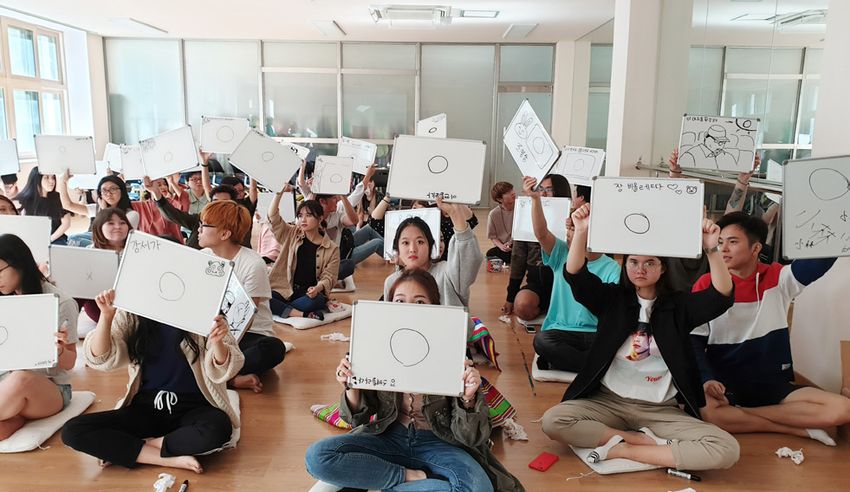
University Entrance Preparation Course, Focus on Korean Language

                                                          Education goals
                  To foster the Korean ethnic identity and global leadership, To develop the practical Korean
                                          language proficiency for various situations

                                                                 Subjects
            Common subjects (5 days a week, 18 hours): Opening and operation of four subjects including
                    Korean Language, Korean Culture, Korean History, and Global Citizen Education
           Optional subjects (4 days a week, 10 hours): Operation of Advanced Korean Language to increase
                                       the practical Korean language proficiency

        Increased Korean language                      Understanding of Korean                           Schooling guidance
           proficiency for various                    history and culture to foster
                  situations                               the ethnic identity                          for career exploration

           Item                                  University Entrance Preparation Course (Focus on Korean Language)

                           To foster the Korean ethnic identity and global leadership, To improve the advanced Korean language
     Education goals       proficiency
                           ●   Korean Language: Basic communication ability and Korean language for conversations
    Common subjects
                           ●   Korean Culture: Overall understanding of Korean society and culture through practice
     (5 days a week,
                           ●   Korean History: Understanding the Korean history through audiovisual data and field trips
        18 hours)
                           ●   Global Citizen Education: Values of global citizens such as human rights, diversity, environment, and peace

                                                                       Advanced Korean Language
     Optional subjects
      (4 days a week,      ●   Practical Korean language used in business, tourism, and interpretation
         10 hours)         ●   Grammar, essay, debate
                           ●   Preparation for the Test of Proficiency in Korean (TOPIK)
                           ●   Program-related activities: Korean language contest, field trip, cultural experience
                           ●   After-school clubs: Learning, cultural experience, sports, volunteer
                           ●   Festivals: Korean community play, Halloween festival
    Special programs       ●   Exchanges with local community: Exchange with residents, regional cultural festival
                           ●   Exchanges with Korean students: Mentoring of undergraduates in the University of Education, participation in
                               university festival, language and cultural exchange with middle and high school students
                           ●   University entrance activities: Cover letter writing contest, university visiting report contest

                           ●   Employment support programs: Visiting companies, job training support
    Entrance programs      ●   Advanced Korean language camp: Reading media articles and practical writing (June, November)
                           ●   Career and employment camp: Education on CV, cover letter, interview, special career lecture (June, November)

                           ●   Partnership programs: University entrance presentation, campus tour
Partnership programs       ●   Auditing of liberal arts lectures
                           ●   Experience and special lecture on major department

6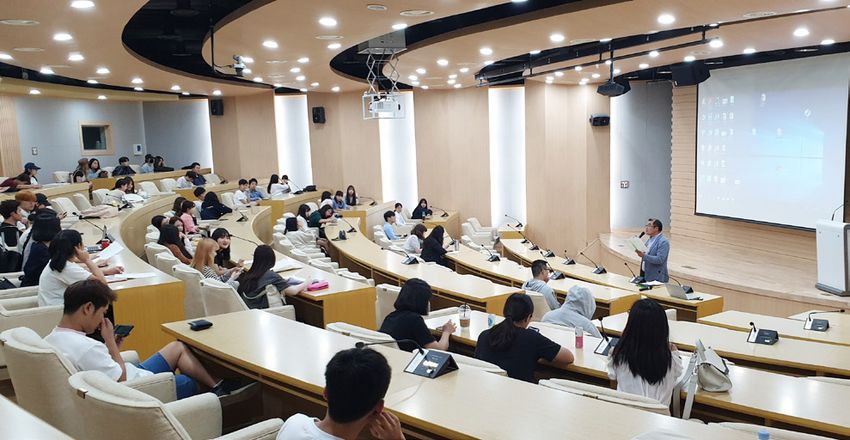
Understanding Korea Course

                                                      Education goals
                     To foster the Korean ethnic identity and global leadership, To develop the
                                           Korean language proficiency

                                                            Subjects
         Common subjects (5 days a week, 18 hours): Opening and operation of four subjects including
                Korean Language, Korean Culture, Korean History, and Global Citizen Education
          Optional subjects (4 days a week, 10 hours): Operation of optional subjects for each course
                         (Advanced Korean Language, Advanced History and Culture)

   Increased Korean communication                 Understanding of Korean                          Exchange with Korean
     to increase understanding of the            history and culture to foster                 students and residents to form
               home country                           the ethnic identity                         a sense of ethnic kinship

       Item                                                       Understanding Korea Course

     교육목표             To foster the Korean ethnic identity and global leadership, To improve the Korean language proficiency

                      ●   Korean Language: Improved Korean language and communication by focusing on conversations
 Common subjects
                      ●   Korean Culture: Overall understanding of Korean society and culture through practice
  (5 days a week,
                      ●   Korean History: Understanding the Korean history through audiovisual data and field trips
     18 hours)
                      ●   Global Citizen Education: Values of global citizens such as human rights, diversity, environment, and peace

                                    Advanced Korean Language                                      Advanced History and Culture
 Optional subjects    ●   Korean language lecture to improve Korean                 ●   Understanding Korean society and culture
  (4 days a week,         language proficiency                                      ●   Experience-centered cultural learning
     10 hours)        ●   Practical Korean language used in business,
                                                                                        (Korean painting, calligraphy, Taekgyeon, Samulnori,
                          tourism, and interpretation
                                                                                        K-POP)
                      ●   Daily Korean language, literature lecture
                      ●   Program-related activities: Korean language contest, field trip, cultural experience, UCC contest
 Special programs     ●   After-school clubs: Learning, cultural experience, sports, volunteer
                      ●   Festivals: Korean community play, Halloween festival

                      ●   Exchanges with local community: Exchange with residents, regional cultural festival
                      ●   Exchanges with Korean students: Volunteer of Korean undergraduates, participation in university festival,
Exchange programs
                          language and cultural exchange with middle and high school students
                      ●   Partnership programs with Korean agencies and organizations: Available to aspiring students

                                                                                                                                               7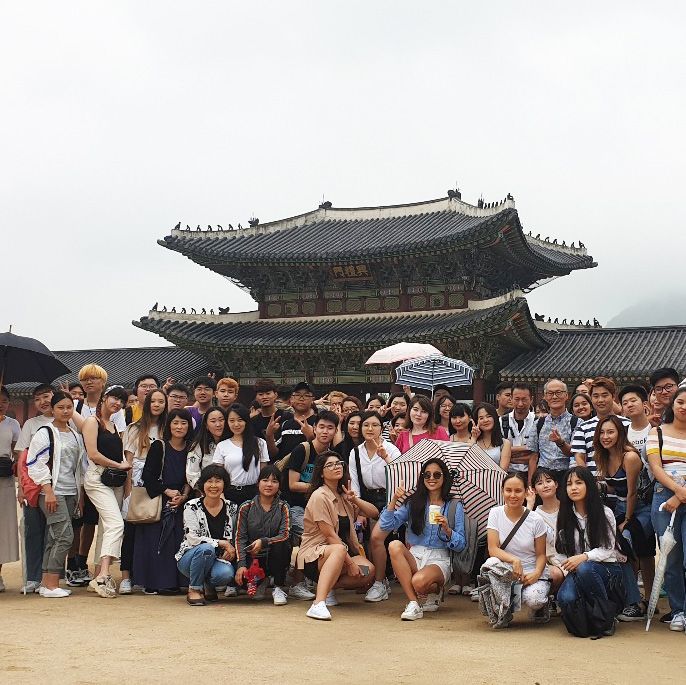
Special Vacation Course

                                                              Education goals
                                        To foster the Korean ethnic identity and global leadership

                                                                    Subjects
                  Three periods in the morning: Opening and operation of three subjects including Korean
                                    Language, Korean History, and Global Citizen Education
               Four periods in the afternoon: Cultural experience on different topics and exchange with Korean
                                                          students

          Korean language, culture, and                Formation of a global network                      Exchange with Korean
          history experience to increase                   of overseas Koreans                          students to form a sense of
        understanding of the home country                    around the globe                                 ethnic kinship

             Item                                                            Special Vacation Course

          교육목표                To understand the home country, To foster the Korean ethnic identity and global leadership

      Required subjects       ●   Korean Language: Basic communication ability and practical Korean language focused on conversations
    (1st~3rd periods in the   ●   Korean History: Understanding the Korean history through audiovisual data and field trips
          morning)            ●   Global Citizen Education: Values of global citizens such as human rights, diversity, environment, and peace

  Cultural experience         ●   Cultural experience in a variety of fields
(4th~7th periods in the       ●   Traditional music (folk songs, Samulnori), traditional handicraft (ceramics, Korean paper art), K-POP, Korean food
       afternoon)             ●   Exchange and experience with Korean undergraduates

                              ●   Field learning, Korean ethnic recreation
      Special programs
                              ●   After-school learning guidance of undergraduate teaching assistant (TA)

                              ●   Exchanges with local community: Exchange with residents, regional cultural festival
     Exchange programs        ●   Exchanges with Korean students: Volunteer of Korean undergraduates, participation in global language and
                                  cultural exchange

8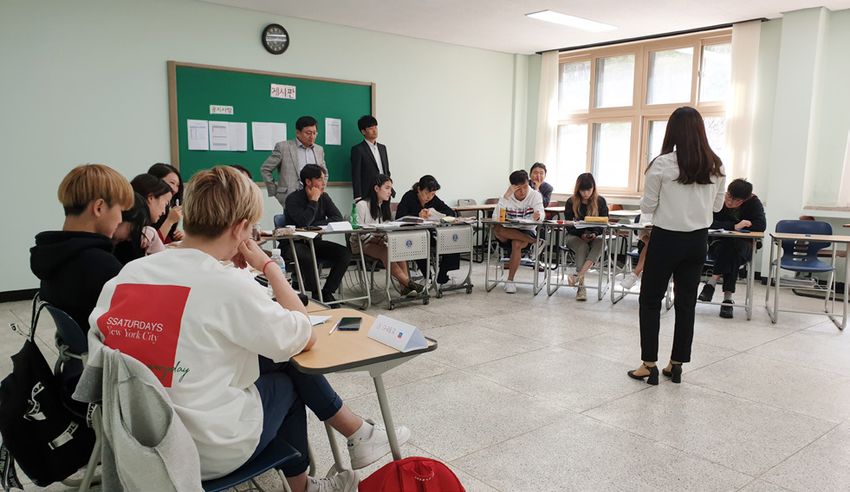
Application and Entrance Procedures
1. How to Apply
Application form Download the application form from the website.
①Application Form (Prescribed) ②Study Plan (Prescribed) ③Graduation Certificate (Expectant) for Highest Level of
Submission of
Education ④Transcript for Highest Level of Education ⑤Certificate of Overseas Korean ⑥Photocopy of Passport
documents
⑦Certificate of Descendant or Family of Independence Patriot (if applicable) ⑧Proof of Scholarship (if applicable)
Received at a diplomatic office in the country of residence or Korean Education Institute
Receipt of application
* Contact each diplomatic office for the method of receipt.
2. Entrance Procedure
Screening of - Time: Within 2 weeks after closing of application
application documents - Details: Screening the application form and submitted documents to determine admission
- Time: Within 2 weeks after closing of application
Entrance approval - Details: Sending the admission letter based on the document screening result
(via the diplomatic office or individually)
- Overseas Koreans with foreign nationality can request visa through the diplomatic office.
- University Entrance Preparation Course: General training visa (D-4) or overseas Korean visa (F-4)
Visa request - Understanding Korea or Special Vacation Course: General training visa (D-4) or short-term visit visa (C-3)
※ A student who is in a country that signed the visa waiver accords with Korea or has already acquired visa for training can participate
without issuing a separate visa.
- Accepted students shall inform the entry schedule to the Admission Officer of Kongju National University
(date and time of entry, flight name, airport (terminal) of arrival).
Preparation for entry
- You may apply for the airport pickup service (time of request is to be announced).
※ The entry date is limited to the registration period. If you wish to come earlier, you must inform it to the Admission Officer.
- Upon arrival at the airport on the day of entry, students will be guided by the pickup employee to Kongju
National University and enter the dormitory.
Entry
- If you want to register individually, you must inform it to the Admission Officer in advance.
※ Make sure to contact Kongju National University if you fail to meet the pickup employee.
Admission Officer (Kongju National University, Institution of Korean Culture & Education)
TEL +82)41-850-6031 ㅣ FAX +82)41-850-6039 ㅣ E-mail hansaram@kongju.ac.kr
9
Special Benefits
1. Scholarships
Scholarship of National Institute for
International Education
Targets: Overseas Koreans who applied for a domestic education program for overseas
Koreans and was recommended by a diplomatic office
National
Selection criteria: Deliberated and selected by the ‘Scholarship Committee’ based on intent,
scholarship potential for development, family background, and descendant of an
independence patriot
Financing: The tuition fee for the program (one course) and 70% of the round-trip air fare
Number of beneficiaries: 310 persons per year
※ In the case of a descendant of an independence patriot, the scholarship finances the tuition fee for the program (one course) and
100% of the round-trip air fare
Number of scholarship recipients according to period
※ 1st term 1.20. (Mon)~2.19. (Wed), 2nd term 4.20. (Mon)~5.19. (Tue), 3rd term 6.22. (Mon)~7.21. (Tue), 4th term 9.21. (Mon)~10.20. (Tue)
Number of Recipients in Each Term (Persons)
Course Season Education Period
1st Term 2nd Term 3rd Term 4th Term
University Entrance Spring 4.7.~8.24. ○(25/15)*
Preparation Course
(5 months) Fall 9.8.~’21.1.28. ○(25/15)*
Spring 4.7.~5.28. ○(10)
Understanding Summer 7.1.~8.24. ○(30)
Korea Course
(2 months) Fall 9.8.~10.29. ○(10)
Winter 12.1.~’21.1.28. ○(30)
Special Vacation Course Summer 8.6.~8.24. ○(60)
(3 weeks) Winter ’21.1.11.~1.28. ○(60)
* Focus on Entrance / Focus on Korean Language
※ The number of scholarship recipients is subject to change according to scholarship application and selection status of each period.
Scholarship of Kongju National University
Type Selection Criteria Details of Support Recipients
Overseas Koreans who are recommended by the head of an
Scholarship of Kongju Differential financing of the About 20
education institute or Korean organization and have difficult
National University tuition fee and lodging expense persons
family background, selected by Kongju National University
Scholarship for Scholarship for student models selected as honorary Differentiated according to About 10
Publicity ambassadors for online publicity on the school blog and SNS performance persons
※ The national scholarship is cancelled if you fail to complete the course. Scholarships can be cancelled if you receive a disciplinary action for violating a school rule. In this case,
you will be asked to return the scholarship.
102. Application for Korean University (Graduate School)
●
Entrance information and counseling for students who are willing to enter a Korean university (graduate school)
●
Entrance presentation and entrance application for Korean university (graduate school): Personalized guidance to
prepare for application documents, cover letter, and interview according to the application type (overseas Korean
/ international student)
●
Support on major subjects (major subjects needed for University entrance: Mathematics, sciences)
●
Auditing of liberal arts lectures at universities and joint projects with undergraduate mentors
●
Special lecture on career and major understanding
●
Mentoring of senior undergraduates (graduate students)
●
Entrance and career camp
※ Out of 112 students who wanted to enter university (graduate school) in 2013~2019, 108 students were admitted to a
Korean university (graduate school).
3. Operation of Partner Universities
Benefits for entering partner universities ㅣ S
tudents who enter a partner university after completing the K-HED can
receive benefits such as recognition of academic credits, recognition of Korean
language subject, and scholarship for overseas Koreans.
Recognition of academic credits Recognition of Korean language subject Scholarship for overseas Koreans
Recognition of academic credits for Korean Recognition of the Korean language subject
Provision of scholarship to overseas Koreans
language, Korean history, and Korean culture of the K-HED program as the Korean
who completed the K-HED program
subjects of the K-HED program language subject of international students
Cooperation on education programs ㅣ Promotion of joint programs with partner universities such as exchange with students
of partner universities, special department experience, and entrance and career
guidance
Exchange with undergraduates Experience of major department Visiting of universities
・Auditing of liberal arts lectures ・
Experience of medical department ・
Entrance presentation and campus tour
・Joint projects with undergraduate ・Experience of humanities, sciences,
・
Special lecture to understand major
mentors and engineering department
※ Special partnership programs are operated by Jeju National University, Kyunghee University, and Kongju National University in 2019.
11Current status of partners
No. Name of University No. Name of University
1 Kongju National University 10 Kyunghee University
2 Gangneung-Wonju National University 11 Daegu University
3 Kangwon National University 12 Cyber Hankuk University of Foreign Studies
4 Gyeongsang National University 13 Sookmyung Women’s University
5 Kunsan National University 14 Graduate School, Inje University
6 University of Seoul 15 Handong Global University
7 Incheon National University 16 Korea University
8 Jeju National University 17 Konyang University
9 Keimyung University 18
※ Please contact the officer of each partner university for details. Contact information and details of each partner university are available on the website of National Institute for
International Education (https://www.niied.go.kr) and Kongju National University, Institution of Korean Culture & Education (https://www.hansaram.or.kr).
※ More partner universities will be added in 2020.
Counseling and Contact
Kongju National University, Institution of Korean Culture & Education
A d d r e s s ㅣ Postal code) 314-712. Kongju National University, Ongnyong Campus,
753, Ugeumti-ro (Ongnyong-dong), Gongju-si, Chungcheongnam-do
T E L ㅣ +82-41-850-6031 (available in Japanese, Chinese, English, and Russian)
F A X ㅣ +82-41-850-6039
E - m a i l ㅣ hansaram@kongju.ac.kr (Kongju National University, Institution of Korean Culture & Education)
W e b s i t e ㅣ http://www.niied.go.kr (National Institute for International Education)
http://www.hansaram.or.kr (Kongju National University, Institution of Korean Culture & Education)
Instagram ㅣ https://www.instagram.com/khed_khed1/
Facebook ㅣ https://www.facebook.com/knuhansaram/
Y o u t u b e ㅣ https://www.youtube.com/user/KNUhansaram
12Application Form: 2020 Korean Homeland Education (K-HED)
Application Form: KOREAN HOMELAND EDUCATION(K-HED)
※ How to fill out: □ Indicate your choice with a check (∨) mark.
Korean Date of Birth yyyy / mm / dd
Sex □ Male □ Female
Name English Photo
(as shown in your
passport) Telephone Number 3.5 × 4.5 ㎝
(Include Country Code)
Country of Birth Mobile phone Number
Nationality Passport Number
Occupation Address
Korean
E-mail Language □ Advanced □ Intermediate □ Beginner
Fluency
□ Spring: 2020.04.07. ~ 2020.08.24. (5 months)
□ University Entrance Preparation Course (Focus on Entrance)
□ Fall: 2020.09.08. ~ 2021.01.28. (5 months)
□ Spring: 2020.04.07. ~ 2020.08.24. (5 months)
□ University Entrance Preparation Course (Focus on Korean Language)
□ Fall: 2020.09.08. ~ 2021.01.28. (5 months)
□ Spring : 2020.04.07. ~ 2020.05.28. (2 months)
Type of Course □ Summer: 2020.07.01. ~ 2020.08.24. (2 months)
□ Understanding Korea Course
□ Fall: 2020.09.08. ~ 2020.10.29. (2 months)
□ Winter: 2020.12.01. ~ 2021.01.28. (2 months)
□ Summer: 2020.08.06. ~ 2020.08.24. (3 weeks)
□ Special Vacation Course
□ Winter: 2021.01.11. ~ 2021.01.28. (3 weeks)
Duration Name of School
yyyy / mm ~ yyyy / mm Elementary School
yyyy / mm ~ yyyy / mm Middle School
Academic
Record yyyy / mm ~ yyyy / mm High School
yyyy / mm ~ yyyy / mm University
yyyy / mm ~ yyyy / mm Graduate School
Contact Name Relationship Telephone No. Descendant of Name of Pateriot Relationship
Independence
Person in Patriot (If
Korea Applicable)
I apply to this program with my legal guardian’s signature, and I certify that the information contained in this application form is complete and accurate.
20 . . .
year Month Day
Applicant's Name Signature
Guardian's Name Signature
I recommend the above person to be admitted in the educational program of your institute.
20 . . .
year Month Day
Official Stamp
Korean Ambassador / Consul-General
For the president of the National Institute of International Education
※ This application form may be photocopied and used in multiple copies.
※ If above mentioned information is not accurate, it may be sufficient cause for terminating your enrollment.Study Plan for 2020 Korean Homeland Education (K-HED)
Name Nationality
Country of Residence Date of Birth
□ University Entrance Preparation Course: Focus on Entrance (□Spring, □Fall)
□ University Entrance Preparation Course: Focus on Korean Language (□Spring, □Fall)
Course(s) Applied For
□ Understanding Korea Course (□Spring, □Summer, □Fall, □Winter)
□ Special Vacation Course (□Summer, □Winter)
University (desired) and major (if applicable): _____________University ___________Major
Others
※This information is required for applicants of the University Entrance Preparation Course (Focus on Entrance).
① Motive and study plan
: Describe your understanding of the home country and motive for learning.
② Future plan after completion of education
: Describe your university or graduate school plan, employment plan, future contribution to society of overseas Koreans, and plan to improve
the relationship between the home country and country of residence.
※ The Study Plan should be written in Korean. However, in the event this is not possible, English, Japanese, Chinese or Russian may be used.
※ This Study Plan will be used to select students and scholarship recipients. Attach any evidential documents to support your plan.Institution of Korean Culture&Education in Kongju National University
KOREAN HOMELAND
EDUCATION
Address Postal code) 314-712. Kongju National University, Ongnyong Campus, 753,
Ugeumti-ro (Ongnyong-dong), Gongju-si, Chungcheongnam-do
TEL +82-41-850-6031 (available in Japanese, Chinese, English, and Russian)
FAX +82-41-850-6039
E-mail hansaram@kongju.ac.kr (Kongju National University, Institution of Korean Culture & Education)
Website http://www.niied.go.kr (National Institute for International Education)
http://www.hansaram.or.kr (Kongju National University, Institution of Korean Culture & Education)
Instagram https://www.instagram.com/khed_khed1/
Facebook https://www.facebook.com/knuhansaram/
Youtube https://www.youtube.com/user/KNUhansaramYou can also read


