Information for New and
Prospective Students in
ETF Open University
   20 21
←
→
Page content transcription
If your browser does not render page correctly, please read the page content below

Information for New and Prospective Students in ETF Open University 20 21

Information for New and Prospective Students in

             ETF Open University

               Academic Year 2020–2021
                 Version: 22 June 2020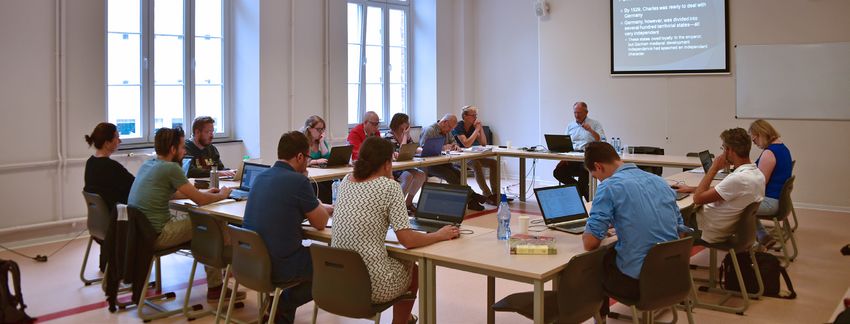
Content

  1.1    Specializations......................................................................................................................3
  1.2    Part-time Programme .........................................................................................................3
  1.3    Model Tracks ........................................................................................................................3
  1.4    Summer Colloquia ..............................................................................................................4
  1.5    Prerequisites .........................................................................................................................4
  1.6    Languages of Instruction and Communication ..............................................................4
  1.7    Exams and Examination Periods ......................................................................................4
  1.8    Study Progress Monitoring ................................................................................................5
  1.9    Turabian ................................................................................................................................6
  1.10   Annual Course Registration ..............................................................................................6

  2.1    Blended Learning ................................................................................................................8
  2.2    ETF Virtual Campus ...........................................................................................................8
  2.3    Course Syllabi ......................................................................................................................9

  3.1    Training Days.....................................................................................................................10
  3.2    Accommodation ................................................................................................................10
  3.3    Lunch...................................................................................................................................10
  3.4    Dinner .................................................................................................................................11
  3.5    Reception ............................................................................................................................11
  3.6    Library .................................................................................................................................11
  3.7    Study Guide .......................................................................................................................11
  3.8    Tuition fees .........................................................................................................................12
  3.9    Communication .................................................................................................................12

Appendix A: Overview model tracks
Appendix B: Prerequisites OU Bachelor (Bible & Theology)
Appendix C: Calculation Tuition Fees

                                                                     2
Information for New and Prospective Students in
                      ETF Open University (ETF OU)

Dear student,
Welcome to ETF Leuven! It is our hope that you will have a wonderful time of growth during
your studies. Here is some information for you to become familiar with ETF Leuven and our
Open University Programme.

      General Information
1.1      Specializations
         In general, our study programmes have three specializations: Bible & Theology, Church
         & Pastoral Ministries, and Religious Studies & Education. Within ETF OU, however, the
         possibilities are more limited. To date, we can only offer the specialization Bible &
         Theology in the full bachelor’s programme. However, students who are eligible for an
         abridged bachelor’s programme due to their previous education can choose between
         Bible & Theology and Church & Pastoral Ministries. In the master’s programme (as well
         as in the preparatory and linking programme) we offer both Bible & Theology and
         Church & Pastoral Ministries.

1.2      Part-time Programme
         ETF OU is deliberately set up as a part-time programme. Compared to our regular,
         residential programme the number of courses offered per academic year is more
         limited. The study load for OU students following the model track (see below) is about
         30 ECTS credits1 per year which amounts to studying half-time. Depending on the
         courses offered, students can enrol for more than 30 ECTS credits per year. Less is also
         possible, the minimum amount being 15 ECTS credits. Thus, within ETF OU, each
         student can decide on his or her pace of study.

1.3      Model Tracks
         As indicated above, the ETF OU programme is structured according “model tracks”
         of about 30 ECTS credits per year. Students following these tracks can complete the
         bachelor’s programme (180 ECTS credits in total) within six years and the master’s
         programme (120 ECTS credits in total) within four years.

1   European Credit Transfer and Accumulation System (ECTS) credits are a standard means for comparing the
    volume of learning based on the defined learning outcomes and their associated workload for higher education
    across the European Union and other collaborating European countries. At ETF Leuven, one ECTS credit equals
    a workload of 25–30 hours.

                                                       3
Most courses of the bachelor’s and master’s programme are offered only every other
year. However, there are some courses which take place on an annual basis.
An overview of the model tracks is found in Appendix A.
1.4 Summer Colloquia
Within ETF OU, both the bachelor’s and the master’s programme include three elective
courses, each of which is 5 ECTS credits.2 These electives are chosen from the various
Summer Colloquium (SC) courses offered each year. An SC course consists of
preparatory assignments as well as an intensive study week towards the end of
August on our campus in Leuven. For more information on upcoming SC courses, see
our website (www.etf.edu).
1.5 Prerequisites
Many advanced courses presuppose knowledge and skills acquired in more basic
courses. Therefore, students have to successfully complete the basic courses first
before they can be admitted to the advanced courses. Such conditions for admission,
called “prerequisites”, are mentioned in the course descriptions found in the “Study
Guide”3 as well as in the OU Syllabi. When selecting their courses at the beginning of
the year/semester, students should take these prerequisites into account. In cases of
doubt, preference should be given to courses that function as prerequisites to other
courses. A complete overview of these prerequisites can be found in Appendix B.
1.6 Languages of Instruction and Communication
In general, the language of instruction used in the bachelor’s programme is Dutch,
while English is used in the master’s programme. However, there are a number of
exceptions which concern bachelor’s courses which are also part of the preparatory
and/or linking programme. Here, the language used in classes will be English to make
sure that all students are able to follow. For the same reason, communication via the
ETF Virtual Campus (forums, announcements) will be in English. Still, bachelor’s
students enrolled in these courses are allowed to write their assignments in Dutch and
a Dutch syllabus will be available in addition to the English one.
In exceptional cases, normal bachelor’s courses will be in English if the teacher is not
able to communicate in Dutch.
For all general communication that concerns both bachelor’s and master’s students
English will be used. Also, the chapel services on Friday mornings will be in English.
1.7 Exams and Examination Periods
Within ETF OU, various forms of examination are used. The most common forms are
paper assignments, but there are also oral and written exams, forum interactions etc.
With the exception of SC courses, students have two opportunities per academic year
2 The preparatory and linking programme usually do not include elective courses.
3 The Study Guide can be downloaded from the ETF Leuven website: https://www.etf.edu/downloads/.
4to complete any given course. The first opportunity is scheduled in the examination
period which follows the semester in which the course was completed. The second
opportunity is scheduled for the re-examination period at the end of the academic
year.
Any course you were not able to complete during the first examination period can still
be completed during the re-examination period. Any partial grades you earned during
the first examination period will remain valid throughout the academic year.
Example: Suppose the assessment of a course consists of 3 parts (a paper, an
assignment, and an oral exam) and you completed only the paper during the first
examination period. Then you can still complete the assignment and the oral exam
during the re-examination period and successfully complete the course.
Partial grades will not remain valid after the end of an academic year. Wherever the
assessment method in the re-examination period differs from the assessment method
in the first examination period, this is explicitly mentioned in the syllabus.
Students do not have to sign up for the examinations of the first examination period.
They are signed-up automatically. For re-examinations, however, students have to
officially sign up via the registration form which is available on the ETF Virtual
Campus (Ad Valvas ETF Open University > Forms). Registration is possible in the
week after the proclamation (publication of grades) of the second semester. The
academic secretariat will send an invitation together with the grade sheets. If you do
not register (on time), you lose the right to take part in the re-examinations.
1.8 Study Progress Monitoring
During the deliberations following the re-examination period, ETF Leuven’s
examination committee takes some time to discuss the study progress of each
individual student. In line with article 22 of the “Examination Regulations” (see Study
Guide), the committee can issue an official “warning” for students who have obtained
less than 50% of the stp of their year contract, or who still have not completed courses
after four exam moments. At the end of the academic year following the warning, the
Examination Committee can decline enrolment for the next academic year.
These measures of study progress monitoring have been established with a view to
ensuring steady progress and helping students to earn their diploma within
reasonable timespans. Accordingly, “warnings” should not be interpreted as a form of
punishment. Instead, they are meant to encourage students to re-dedicate themselves
to their study. It should also be noted that the committee does not automatically issue
official “warnings” or decline enrolment in each case in which the conditions apply.
These measures are taken only after a careful consideration of the individual student’s
situation. Therefore, students are advised to inform the committee (through the OU
coordinator) about any issues which impeded their progress considerably.
51.9 Turabian
At ETF Leuven, “Turabian Style” is the standard for correct reference and formatting
of papers and theses. More information will be provided in the bachelor’s course
Studie- en onderzoeksmethoden (SOM) as well as the master’s course Theological and
Sociological Research Methods (TSRM). New students are strongly encouraged to enrol
in the course SOM in the first year of their studies. For more information about
“Turabian Style” and on how to write good papers, go to the ETF Virtual Campus: Ad
Valvas ETF Open University > Documents > Study, Research and Writing Skills.
1.10 Annual Course Registration
Students enrolled in our study programmes do not have to formally renew their
enrolment every year. Normally, they remain enrolled until the completion of their
programme or until they withdraw from it. Nevertheless, there are some important
steps that need to be taken by every student before the beginning of each academic
year.
1) If you have not done so already, put all OU training days in your agenda. You
can find all dates in our academic calendar on the ETF Virtual Campus (Ad Valvas
ETF Open University).
2) Download the most recent version of the model track overview from the ETF
Virtual Campus (Ad Valvas ETF Open University > Documents > Information) in
order to see which courses will be offered.
3) Think carefully about your plans for the upcoming academic year. How much
time will you be able to devote to your study. If you have at least 20 hours per
week throughout the year, then you can choose to follow the model track of 30
ECTS credits. Most students have to spend at least 40 minutes/week for every
ECTS credit included in their year contract. Based on your possibilities, you can do
the maths yourself. There is a minimum of three courses or roughly 15 ECTS
credits. When making your plans, please also take into account that there are
prerequisites for a number of courses (see above).
4) If you are unsure about your study planning, you can always contact the OU
coordinator for advice (contact details at the end of this brochure).
5) Sent your full list of chosen courses to the OU coordinator. This should be done
as soon as possible but no later than two weeks before the opening of the
academic year. Please include all courses you would like to follow in the whole
academic year. Your choice for second semester courses may be provisional. You
can still change it in the course of the first semester (deadline see academic
calendar).
6) On the first training day, please go to the Academic Secretariat to sign your study
contract and pick up your student card.
67
Educational Concept
2.1      Blended Learning
         The name for the educational concept used within ETF OU is “blended learning”. As
         the word “blended” suggests, this concept combines two elements.
              •   First, there is the element of independent self-study. ETF OU courses are set
                  up in such a way that most of the work (like studying textbooks and articles or
                  writing paper assignments) can easily be done from home or wherever the
                  student decides to study. In order to facilitate this self-study, ETF Leuven
                  makes use of an online learning platform called “ETF Virtual Campus”.
              •   The second element consists in the training days at our campus in Leuven,
                  where students meet their teachers as well as fellow students. In line with our
                  motto fides quaerens intellectum (faith seeking understanding), these training
                  days begin with a morning devotion in the chapel (Fridays) or in a classroom
                  (Saturdays). Afterwards, students attend classes, enjoy coffee and lunch
                  breaks, or spend some time in our library. There are two OU training days per
                  semester, one towards the beginning and one towards the end. These training
                  days are scheduled on Fridays (bachelor’s, linking, and preparatory
                  programme) and Saturdays (master’s programme). In addition to the training
                  days, students are expected to travel to Leuven for two other purposes, namely
                  to take oral or written exams4 and to attend the Summer Colloquium (see
                  above).

2.2      ETF Virtual Campus
         The online learning platform “ETF Virtual Campus” (VC) is the most important means
         of communication for OU students. In the various webrooms on the VC, they find all
         the necessary information regarding the programme in general as well as with respect
         to individual courses. The webroom “Ad Valvas Open University” is the most
         important place for general information and documents. Through this webroom,
         announcements will be published by the administration. Students get notified via
         email whenever a new announcement has been published.5
         The course-related webrooms all share a similar design and setup, providing the
         students with the following features:
              •   View/download the course syllabus including the learning path;
              •   View/download resources necessary for the course, such as articles, audio or
                  video lectures, template documents etc.;

4   Less than half of the bachelor’s courses end with oral and/or written exams. In the master’s programme almost
    all courses are assessed through paper assignments.
5   Email notifications will be sent from chamilo@etf.edu. To avoid missing important information, students should
    make sure that emails sent from this address will not be classified and deleted as spam massages by their email
    providers and/or mail applications.

                                                        8
• Submit paper assignments;
• View feedback from the teacher(s);
• Pose a question to the teacher(s);
• Interact with fellow students;
• Read the announcements sent by the teacher(s).
2.3 Course Syllabi
For each course, the teacher prepares a “Syllabus”, which is a document containing
information about the course in question. In addition to more technical details and the
course description, each OU Syllabus includes a “Learning Path”. The Learning Path
is a detailed description of all the necessary steps a student has to take in order to
successfully complete the course. These steps frequently include readings, paper
assignments, or participation in forum discussions. Teachers also provide deadlines6
for these various steps as well as some information about the content of the class hours
scheduled on the training days. In addition to that, Syllabi generally contain
information about the way in which the teacher(s) will provide feedback to the
assignments, about methods of assessment, and about required and recommended
literature.
6 Please note the difference between “recommended” and “strict” deadlines. Strict deadlines have to be respected
in order to be able to pass the course. Recommended deadlines are suggestions from the teacher leading to
the best learning experience.
9Practical information
3.1 Training Days
OU training days begin with a brief morning devotion and a few minutes of
announcements and Q&A. After this opening session, classes begin. The schedules of
the training days are published on the ETF Virtual Campus (Ad Valvas Open
University) well in advance. Students are expected to attend the class sessions of those
courses for which they are enrolled. If you are not able to attend classes due to
unavoidable circumstances (e.g. health issues), students should inform their
professor(s) and the OU coordinator as soon as possible.
Most classes take place in one of the LCCS classrooms on the first floor of our peda
building. Schedules are hanging at the entrance of the LCCS corridor as well as on the
doors of the individual classrooms.
3.2 Accommodation
For students who have to travel long distances, ETF Leuven provides the possibility
to stay overnight on campus in one of our LCCS guestrooms. The price for a single
room is
€ 38,00; for a double room € 49,00 (in case you share this room with another student,
€ 24,50 each). If there are enough registrations, breakfast will be served for € 5,00 per
person. To book a guestroom, please send an email to our hospitality manager
(hospitality@lccs.eu) no later than two weeks before your stay. It is also possible to
book a guestroom for all the contact days at once. Cancellation is possible until two
weeks in advance without any costs. Note: There are only a limited number of
guestrooms available (first come, first serve).
3.3 Lunch
There are lunch breaks on every training day. Students can either bring their own food
or order lunch from ETF Leuven. This lunch costs € 7,50 and includes two sandwiches
(various toppings), fruit, water or orange juice. In addition to that, coffee and tea will
be provided. For logistical reasons, ETF Leuven can only provide lunch if there are
more than 6 registrations. You do not have to pay cash. An invoice will be sent to you
afterwards.
The deadline for registrations is always Monday, 5 pm before each OU training day.
You can register by filling in the form on the ETF Virtual Campus (Ad Valvas ETF
Open University). For further questions about the lunch, diet/allergies please contact
our hospitality manager (hospitality@lccs.eu).
103.4 Dinner
ETF Leuven does not provide dinner, but anyone staying in one of our guestrooms can
freely use the kitchen on the fifth floor and prepare his/her own food. The dining hall
on the first floor is also available for guests. Here are some suggestions in case you
would like to have food delivered or if you would like to eat out:
- Café Tabor – delicious spaghetti, croque monsieur etc.
- Frituur ‘t Friethuisje – nice, typically Belgian fries
- T' dagelijks broodje – Pizza, pasta, sandwiches etc. (free delivery from 10€)
- Many possibilities in Leuven’s city centre.
3.5 Reception
On OU training days, the reception has the following opening hours:
• Fridays: 08:30–16:30;
• Saturdays: 08.30–14.00.
3.6 Library
As an OU student, you can of course make use of our library. Your student card
functions also as library card (bar code on the back side). Please scan the card as you
enter the library and present it whenever you want to borrow books. OU students can
borrow a maximum of 20 items. The loan period is 15 weeks.
Upon enrolment in our programme, you will automatically receive an email with
information about how to access your account on our library’s website
(https://library.etf.edu/). There, you can see a list of all the items you have checked out
and renew them, if necessary.
OU students have the special privilege of reserving books ahead of training days. You
can find the instructions for this procedure on the ETF Virtual Campus in the webroom
“Library” webroom (section “Information). It is important to take note of the library
regulations which you can also find in the same webroom. For more information, on
how to make copies and scans, fees and fines, borrowing exceptions, etc. please visit
the library website. Opening hours depend on the availability of student workers. See
the Library’s Schedule for more and up-to-date information regarding opening hours.
3.7 Study Guide
Every year, ETF Leuven publishes an extensive “Study Guide” which is available in
PDF format from the download section of our website. OU students should be aware
of this document even if not all the information in it does apply to them in the same
way as it does to full-time, residential students.7 After all, the Study Guide contains
the Education and Examination Regulations as well as the Academic Calendar. As a student
you are responsible for knowing the regulations stated in these documents.
7 For instance, OU Syllabi sometimes deviate from the course descriptions in the Study Guide.
113.8 Tuition fees
Information about tuition fees for OU students can be found in the Study Guide,
Education regulations art. 17 and in chapters 5.5 and 5.6. Towards the beginning of
each academic year, after your course registration has been completed, you will
receive an invoice from our bookkeeping department (bo@etf.edu). An overview of
the tuition fees can be found in Appendix C.
3.9 Communication
For any communication regarding the content of your courses, please make use of the
question forums in the respective webrooms. The forums have the advantage that any
question has to be answered only once, because the teacher’s reaction is accessible to
all students at once. Email is to be used only for questions that are strictly personal or
concern individual issues. For administrative questions (such as programmes, grading
lists, etc.) you can contact our two academic secretaries (as@etf.edu): Elsie Wilms and
Johan Jacobse. Their office is located on the fourth floor of the academic building
(Office 416). The coordinator of ETF Open University is Matthias Mangold
(matthias.mangold@etf.edu). You can find him in office 503 on the fifth floor.
Elsie Wilms Johan Jacobse Matthias Mangold
12Appendix A: Overview model tracks
Bachelor’s Programme (180 ECTS)
Bible & Theology
Model Track 2021-2022; 2023-2024; 2025-2026 etc. Model Track 2020-2021; 2022-2023; 2024-2025 etc.
Bachelor 1 Bachelor 1
Year-long course: Introduction to Biblical Hebrew (IHEB) (7)* Year-long course: Introduction to New Testament Greek (IGR) (7)*
Year-long course: Study & Research Methods (SOM) (4)*
Semester A Semester B Semester A Semester B
Introduction to the Old Testament (OOT) (4) Introduction to Historical Theology (OHT) (4) Introduction to Practical Theology (OPT) (4) Introduction to Religious Studies and
Introduction to the New Testament (ONT) (4) History of Western Philosophy (GWW) (3) Christian Spirituality (CS) (3) Missiology (OGM) (4)
Introduction to Systematic Theology (OST) (4) Hermeneutics (HERM) (3)
Introduction to Exegetical Methods (IMBE) (4)
Bachelor 2 Bachelor 2
Summer: Summer Colloquium (SC) (5) Summer: Summer Colloquium (SC) (5)
Semester A Semester B Semester A Semester B
Systematic Theology 1 (ST1) (4) Christian Ethics & Moral Philosophy (CEM) (4) Philosophy of Science (WF) (4) Church History of the Netherlands (KGN) (3)
Old Testament 1 (OT1) (4) Ecclesiology and Ecumenism (EOE) (5) New Testament 2 (NT2) (4) Old Testament in Context (OTC) (4)
Greek Seminar 1 (SEMGR1) (3) New Testament in Context (NTC) (4) Historical Theology 2 (HT2) (4) Interdisciplinary Course (IC) (4)
Greek Seminar 3 (SEMGR3) (3)* Hebrew Seminar 1 (SEMHEB1) (3) Hebrew Seminar 3 (SEMHEB3) (3)*
Bachelor 3 Bachelor 3
Year-long course: Internship (12)* Year-long course: Internship (12)*
Year-long course: Thesis (8)* Year-long course: Thesis (8)*
Summer: Summer Colloquium (SC) (5)
Semester A Semester B Semester A Semester B
New Testament 1 (NT1) (4) Seminar in Systematic Theology (SEMST) (4)** Seminar in Historical Theology (SEMHT) (4)** Seminar in Religion & Spirituality (SEMRS) (4)
Historical Theology 1 (HT1) (4) Old Testament 2 (OT2) (4)
Seminar in Biblical Studies (SEMBW) (4) Systematic Theology 2 (ST2) (4)
Hebrew Seminar 2 (SEMHEB2) (3) Greek Seminar 2 (SEMGR2) (3)
* SOM, IHEB, IGR, SEMHEB3, SEMGR3, Internship, and Thesis are offered on an annual basis. The language of instruction used in the classes of language courses
is Dutch. Students who are not proficient in Dutch will be tutored separately in English.
** In the course of their studies, students choose either Seminar in Systematic Theology or Seminar in Historical Theology.
13Master’s Programme (120 ECTS)
Bible & Theology | Church & Pastoral Ministries
Courses Offered 2021-2022; 2023-2024; 2025-2026 etc.
Year-long course: Thesis (25)
Year-long course: Thesis Colloquium (TC) (5)
Summer: Summer Colloquium (5)*
Semester A Semester B
Common Courses Common Courses
Old Testament Exegetical Methods (OTEM) (5) Postmodernism, Philosophical Hermeneutics and Theology (PPHT) (5)
New Testament Exegetical Methods (NTEM) (5)
Theological and Sociological Research Methods (TSRM) (5)**
Bible & Theology Church & Pastoral Ministries Bible & Theology Church & Pastoral Ministries
The European Reformations (ER) (5) Issues in Pastoral Theology (ISPT) (5) Ecumenical Dialogue in the 21st Century (ED21) (5) Ecumenical Dialogue in the 21st Century (ED21) (5)
Approaches to Old Testament Study (AOTS) (5) Advanced Liturgy (ALIT) (5)
New Testament Theology (NTT) (5) Advanced Pastoral Care and Psychology (APCP) (5)
Philosophy of Christian Education (PHCE) (5)
Courses Offered 2020-2021; 2022-2023; 2024-2025 etc.
Year-long course: Thesis (25)
Year-long course: Thesis Colloquium (TC) (5)
Summer: Summer Colloquium (5)*
Year-long course: Field Study Project (FSP) (5) (Only for Church & Pastoral Ministries)
Semester A Semester B
Common Courses Common courses
History of Christian Doctrine (HCD) (5) Models of Christian Leadership (MCL) (5)
Church in a Multi-Religious Society (CMRS) (5)
Theological and Sociological Research Methods (TSRM) (5)**
Bible & Theology Church & Pastoral Ministries Bible & Theology Church & Pastoral Ministries
Contemporary Issues in Christian Ethics (CICE) (5) Contemporary Issues in Christian Ethics (CICE) (5)
Old Testament Theology (OTT) (5) Advanced Homiletics (AHOM) (5)
Approaches to New Testament Study (ANTS) (5)
Medieval & Post-Reformation Scholasticism (MPRS) (5)
* In the course of their studies, master’s students have to complete three Summer Colloquium courses.
** TSRM is offered on an annual basis.
14Preparatory Programme
Bible & Theology (63 ECTS) | Church & Pastoral Ministries (60 ECTS)
Courses Offered 2021-2022; 2023-2024; 2025-2026 etc.
Common Course
Year-long course: Introduction to Biblical Hebrew (IHEB) (7)*
Introduction to New Testament Greek (IGR) (7)*
Semester A Semester B
Common Courses Common Courses
Introduction to Old Testament Studies (OOT) (4) Christian Ethics and Moral Philosophy (CEM) (4)
Introduction to Systematic Theology (OST) (4) Introduction to Historical Theology (OHT) (4)
Introduction to New Testament Studies (ONT) (4)
Church & Pastoral Ministries Bible & Theology Church & Pastoral Ministries Bible & Theology
Sociology of Religion (GST) (3) Hebrew Seminar 2 (SEMHEB2) (3) Hebrew Seminar 3 (SEMHEB3) (3)*
Greek Seminar 1 (SEMGR1) (3) Greek Seminar 3 (SEMGR3) (3)*
Courses Offered 2020-2021; 2022-2023; 2024-2025 etc.
Common Course
Year-long course: Introduction to Biblical Hebrew (IHEB) (7)*
Introduction to New Testament Greek (IGR) (7)*
Semester A Semester B
Common Courses Common Courses
Philosophy of Science (WF) (4) Hermeneutics (HERM) (3)
Introduction to Exegetical Methods (IMBE) (4)
Church & Pastoral Ministries Bible & Theology Church & Pastoral Ministries Bible & Theology
Introduction to Practical Theology (OPT) (4) Hebrew Seminar 1 (SEMHEB1) (3) Introduction to Religious Studies and Hebrew Seminar 3 (SEMHEB3) (3)*
Greek Seminar 2 (SEMGR2) (3) Missiology (OGM) (4) Greek Seminar 3 (SEMGR3) (3)*
Seminar in Practical Theology (SEMPT) (4)
* IHEB, IGR, SEMHEB3, and SEMGR3 are offered on an annual basis. The language of instruction used in the classes of language courses is Dutch. Students who
are not proficient in Dutch will be tutored separately in English.
15Linking Programme
Bible & Theology (47 ECTS) // Church & Pastoral Ministries (45 ECTS)
Courses Offered 2021-2022; 2023-2024; 2025-2026 etc.
Common Courses
Year-long course: Introduction to Biblical Hebrew (IHEB) (7)*
Introduction to New Testament Greek (IGR) (7)*
Semester A Semester B
Common Course Common Course
Christian Ethics and Moral Philosophy (CEM) (4) **
Church & Pastoral Ministries Bible & Theology Church & Pastoral Ministries Bible & Theology
Sociology of Religion (GST) (3) Seminar in Biblical Studies (SEMBW) (4) Seminar in Systematic Theology (SEMST) (4) Seminar in Systematic Theology (SEMST) (4)***
Hebrew Seminar 2 (SEMHEB2) (3) Hebrew Seminar 3 (SEMHEB3) (3)*
Greek Seminar 1 (SEMGR1) (3) Greek Seminar 3 (SEMGR3) (3)*
Courses Offered 2020-2021; 2022-2023; 2024-2025 etc.
Common Course
Year-long course: Introduction to Biblical Hebrew (IHEB) (7)*
Introduction to New Testament Greek (IGR) (7)*
Church & Pastoral Ministries
Year-long course: Paper (5)*
Semester A Semester B
Common Course Common Course
Philosophy of Science (WF) (4)** Hermeneutics (HERM) (3)
Church & Pastoral Ministries Bible & Theology Church & Pastoral Ministries Bible & Theology
Seminar in Historical Theology (SEMHT) (4) Seminar in Historical Theology (SEMHT) (4)*** Seminar in Practical Theology (SEMPT) (4) Hebrew Seminar 3 (SEMHEB3) (3)*
Hebrew Seminar 1 (SEMHEB1) (3) Greek Seminar 3 (SEMGR3) (3)*
Greek Seminar 2 (SEMGR2) (3)
* IHEB, IGR, SEMHEB3, SEMGR3, and PAPER are offered on an annual basis. The language of instruction used in the classes of language courses is Dutch. Students
who are not proficient in Dutch will be tutored separately in English.
** In the course of their studies, students with the specialization Bible & Theology choose either Philosophy of Science or Christian Ethics and Moral Philosophy.
*** In the course of their studies, students with the specialization Bible & Theology choose either Seminar in Systematic Theology or Seminar in Historical Theology.
16Appendix B: Prerequisites OU Bachelor (Bible & Theology)
Biblical Studies
BA1
IHEB7 OOT4 IMBE4 HERM3 SOM4 ONT4 IGR7
SEMHEB13 SEMGR13
BA2
OTC4 OT14 NT24 NTC4
SEMHEB23 OR OR SEMGR23
OR OR OR
BA3
SEMHEB33 OT24 SEMBW4 NT14 SEMGR33
Systematic Theology Historical Theology Other
BA1
OST4 SOM4 GWW3 OHT4 OPT4 CS3 OGM4
BA2
WF4 CEM4 ST14 EOE5 KGN3 HT24 IC4 SC5 x3
OR OR
BA3
SEMST4 ST24 SEMHT4 HT14 SEMRS4 SCRIPTIE8 STAGE12
student chooses
superscript number = ECTS credits. | colour = academic year (red = odd-numbered / blue = even-numbered) + semester distribution | arrows = prerequisites
17Appendix C: Calculation Tuition Fees
ETF Open University 2020–2021
ETF Leuven’s system for calculating the annual tuition fees for ETF Open University basically distinguishes
three groups of students, depending on their nationality: (1) Belgians, (2) nationals of EEA countries8 and
Switzerland, and (3) nationals of other countries. Belgian students are further differentiated by their
scholarship status (“scholarship student”, “almost scholarship student”, and “student without a
scholarship” from the Flemish Community).
A. Students with an annual contract of 35 ECTS credits or fewer
Students whose annual contract comprises 35 ECTS credits or less pay a fixed basic amount + a variable
amount (depending on nationality) per ECTS credit. The figures are displayed in the chart below.
Belgian
EEA* + CH Other
scholarship almost scholarship without scholarship
111,90 € 245,20 € 245,20 € 245,20 € 245,20 €
+ + + +
4,30 € per credit 11,70 € per credit 23,90 € per credit 101,60 € per credit
Example:
OU students following the model track of 30 ECTS credits pay the following tuition fees for the
Academic Year 2020–2021:
Belgian
EEA* + CH Other
scholarship almost scholarship without scholarship
245,20 € 245,20 € 245,20 € 245,20 €
111,90 € + 30 x 4,30 € + 30 x 11,70 € + 30 x 23,90 € + 30 x 101,60 €
= 374,20 € = 596,20 € = 962,20 € = 3293,20 €
B. Students with an annual contract of more than 35 ECTS credits
Students whose annual contract comprises more than 35 ECTS credits pay a fixed amount depending
on their nationality. The figures are displayed in the chart below.
Belgian
EEA* + CH Other
scholarship almost scholarship without scholarship
111,90 € 503,20 € 947,20 € 1.680,00 € 6.340,00 €
8 The countries of the European Economic Area (EEA) include Austria, Bulgaria, Croatia, Cyprus, Czech Republic,
Denmark, Estonia, Finland, France, Germany, Greece, Hungary, Iceland, Ireland, Italy, Latvia, Liechtenstein, Lithuania,
Luxemburg, Malta, Netherlands, Norway, Poland, Portugal, Romania, Slovakia, Slovenia, Spain, Sweden.
18You can also read


