Inspire and achieve success through opportunities for all - Yeppoon State High ...
←
→
Page content transcription
If your browser does not render page correctly, please read the page content below
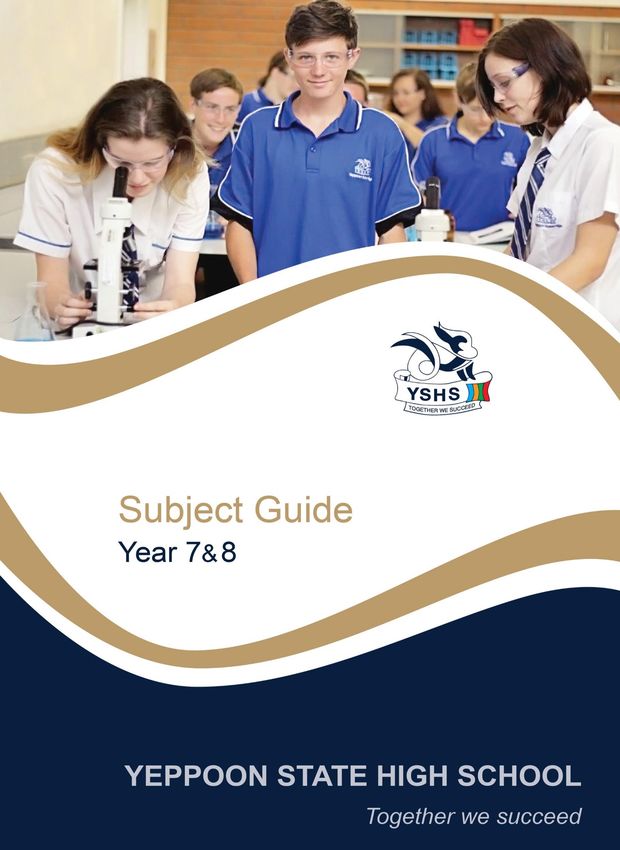
Inspire and achieve success through opportunities for all.
              Yeppoon SHS –Together we Succeed
                                                             1|Page
Yeppoon State High School | Year 7 & 8 Subject Guide

Principal’s Welcome

Dear parents and carers

Thank you for choosing our school for your child’s secondary education. At Yeppoon State High School, we have
established expectations which support every child’s improvement, be that academic, social or emotional.

These expectations are known as our “STARS”:

We recognise the importance of an effective transition between primary school and high school. As such, our school
provides a broad range of experiences to enable informed choices as each student progresses into each phase of
learning; junior, middle and senior secondary.

 Regards

 James O’Neill

 Principal

                                       Yeppoon SHS –Together we Succeed
                                                                                                       2|Page
Yeppoon State High School | Year 7 & 8 Subject Guide

                                                                     Table of Contents
Principal’s Welcome ......................................................................................................................................................... 2
At Yeppoon State High School ......................................................................................................................................... 5
   Expectations are created by: ........................................................................................................................................ 5
   Relationships are created by:........................................................................................................................................ 5
   High quality teaching is created by: .............................................................................................................................. 5
Subject Offerings .............................................................................................................................................................. 6
Course Organisation in Year 7 & 8 ................................................................................................................................... 7
Core Subjects .................................................................................................................................................................... 8
   ENGLISH ........................................................................................................................................................................ 8
   SCIENCE ....................................................................................................................................................................... 10
   HISTORY ...................................................................................................................................................................... 12
   GEOGRAPHY ................................................................................................................................................................ 14
   MATHEMATICS ............................................................................................................................................................ 16
   HEALTH AND PHYSICAL EDUCATION........................................................................................................................... 18
   JAPANESE .................................................................................................................................................................... 20
   GERMAN...................................................................................................................................................................... 21
Rotational Subjects in Year 7 & 8 .................................................................................................................................. 22
   AGRICULTURAL SCIENCE ............................................................................................................................................. 22
   INDUSTRIAL TECHNOLOGY AND DESIGN .................................................................................................................... 23
   DIGITAL TECHNOLOGIES ............................................................................................................................................. 24
   DRAMA ........................................................................................................................................................................ 25
   ECONOMICS AND BUSINESS ....................................................................................................................................... 26
   FOOD STUDIES ............................................................................................................................................................ 27
   MUSIC.......................................................................................................................................................................... 28
   MEDIA ......................................................................................................................................................................... 29
   VISUAL ART.................................................................................................................................................................. 30
Excellence Subjects .......................................................................................................................................................... 31
   Music Excellence ......................................................................................................................................................... 31
   Japanese Excellence .................................................................................................................................................... 31
Enrichment Subject .......................................................................................................................................................... 31
   Instrumental Music ..................................................................................................................................................... 31

                                                             Yeppoon SHS –Together we Succeed
                                                                                                                                                                    3|Page
Yeppoon State High School | Year 7 & 8 Subject Guide
Management and Support Structure
EXECUTIVE
Principal .................................................................................................................... Mr James O’Neill
Deputy Principal Year 7-8 ......................................................................................... Mr Dylan Kussrow
Deputy Principal Year 9-10 ...................................................................................... Mr Patrick Coe
Deputy Principal Year 11-12 ..................................................................................... Ms Dani Pozzetti
Deputy Principal Diversity and Inclusion ................................................................. Mrs Kerri Wellspring
Business Services Manager....................................................................................... Mrs Grace Linaogo
HEADS OF DEPARTMENT
The Arts ..................................................................................................................... Ms Peta McAllister
Business & Information Technology ........................................................................ Mrs Sandra Byrt
English ...................................................................................................................... Mr Shane Dwyer
Health & Physical Education .................................................................................... Mr Ben Parker
Technologies ............................................................................................................. Ms Amanda Cole
Dean of Junior Secondary (Years 7 and 8) ............................................................... Mrs Lisa Whitworth
Dean of Middle Secondary (Years 9 and 10) ............................................................ Mrs Phebe Chelepy
Dean of Senior Secondary (Years 11 and 12) ........................................................... Ms Rhianna Titmarsh
Mathematics ............................................................................................................. Mr Dan Gardner
Science ...................................................................................................................... Mrs Caledonia Yore
Senior Schooling ....................................................................................................... Mr Brian Fisher
Social Sciences & Languages..................................................................................... Ms Melissa Lindsay-Park
SUPPORT STAFF
Guidance Officer (Years 7-9)..................................................................................... Ms Peta Thomas
Guidance Officer (Years 10-12) ................................................................................ Mrs Lisa Ramsay
International Student Program Coordinator ........................................................... Mrs Sarah Croft
International Homestay Coordinator ....................................................................... Mrs Kylie Johnstone
School Chaplain......................................................................................................... Mr Pat Eastwood
School Nurse ............................................................................................................. Mrs Loretta Green
School Transitions Officer......................................................................................... Mrs Heather Sanders
Youth Support Coordinator ...................................................................................... Mrs Kerrie McDonald
Youth Support Coordinator ...................................................................................... Mrs Jillian Jeffries
Link and Launch Officer ............................................................................................ Mrs Deb Heron
Yeppoon SHS –Together we Succeed
4|PageYeppoon State High School | Year 7 & 8 Subject Guide
At Yeppoon State High School
Expectations are created by:
• Engaging students in a developmental program of authentic and real-life learning experiences
• Preparing students for the structural, social and cultural changes brought about by the Primary to Secondary
school transition
• Being familiar with Yeppoon State High School setting
• Providing wide and varied subject choices where students are expected to investigate and plan while continuing
to develop reading, writing and arithmetic skills
This might be demonstrated through:
• Project-based real life learning which has been developed through collaborative planning and community
involvement
• Problem-based real life learning
• Effective profiling of primary students, linking this to the high school setting
• Students playing an active role in leadership at the school, for example, the Student Parliament
• Students working towards developing individual learning pathways that will lead to an exit strategy from the school
• Teachers modelling excellence and quality
Relationships are created by:
• Students knowing about the school before they arrive e.g. Transition days
• Students and teachers working together on longer-term and deeper relationships
This might be demonstrated by:
• Effectively profiling primary students and making strong links with the high school setting
• Ensuring teachers have fewer students and therefore have more time to develop better relationships
• Students spending more time in collaborative learning in the same classroom
• A pastoral care program that leads students to become well-rounded, resilient citizens
High quality teaching is created by:
• Providing more time for each student so that students develop skills and knowledge at greater depth
• The delivery of clearly-explained tasks and assessment processes
• Using motivational content presented, wherever possible, in a real world context
• Designing student learning around what is relevant and useful to the learner
• A dedicated teaching staff willing to support students to lift achievement
Yeppoon SHS –Together we Succeed
5|PageYeppoon State High School | Year 7 & 8 Subject Guide
Subject Offerings
At Yeppoon SHS we focus on collaboratively working to improve student engagement and to optimise student
potential. Strategies have been developed to help students enjoy school which in turn means they will learn more
effectively.
Our Yeppoon SHS core values of Spirit, teamwork, accountability, respect and safety are at the core of our
expectations required to optimise student learning and student outcomes. It is well documented that a student who
feels they are valued in the school and feels a part of the school community will engage more in their learning.
Yeppoon State High School offers quality access to the Australian Curriculum through a focus on connection,
extension, and expansion of the skill-set required to be a 21st Century Learner. Featuring Core and Rotational
subjects, students are given multiple opportunities to show what they know and can do by exploring subjects that
allow them to use not only their skills in literacy and numeracy, but critical thinking, physical and artistic skills that
enable them to have an opportunity to shine. In the following pages, you will find a brief description of the subjects
offered to students. Subject offerings are arranged in pathways to give a continuous learning journey through the
Junior Secondary School years.
The mandated subjects include English, Health and Physical Education, Languages – Japanese, Mathematics, Science,
and History. Along with these, students will experience a range of subjects across all the Key Learning Areas during
Year 7 and 8 as listed below. Students will take part in a rotational process where they will experience each of these
subjects throughout the year.
Please take the time to read the following pages to learn about our subject offerings.
Yeppoon SHS –Together we Succeed
6|PageYeppoon State High School | Year 7 & 8 Subject Guide
Course Organisation in Year 7 & 8
COMPULSORY SUBJECTS
English
Geography
Health and Physical Education (HPE)
History
Languages – Japanese / German
Mathematics
Science
ROTATIONAL SUBJECTS
Agricultural Science
Design & Industrial Technologies (Manual Arts)
Digital Technologies
Drama
Economics and Business
Food Studies
Media
Music
Visual Art
EXTENSION SUBJECTS
Japanese Excellence
Music Excellence
Netball
Rugby League
Yeppoon SHS –Together we Succeed
7|PageYeppoon State High School | Year 7 & 8 Subject Guide
Core Subjects
ENGLISH ENG
Core Subject
Brief Description of Subject
Yeppoon State High School’s Year 7 and 8 English program is designed to provide a smooth transition for students
entering secondary school. Throughout the year, students will be encouraged to read widely and enjoy language in
its many forms.
English classes will provide students with many opportunities to further traditional communication skills: reading,
listening, speaking and viewing. Students will begin the learning process so they can become discerning readers and
producers in a modern, linked world of instant communication. Teachers will be continually consolidating many
aspects of grammar, punctuation and spelling and challenge each student to work to their potential.
Our new national curriculum has major threads running through each year of the junior program. They include: an
awareness of Asian cultures, the oral traditions of Australia’s indigenous cultures, 21st Century technology and
sustainability. Our course constantly promotes higher order thinking such as justification, evaluating, analysing,
synthesising and seeing things from another’s perspective.
Brief Course Assessment/Outline
Year 7 Year 8
Course Outline: Creative response to literary texts Course Outline: Conversations about issues in
Assessment: texts
Written — imaginative written response Assessment:
TERM 1 Seen task/supervised Spoken — persuasive spoken response
400-500 words 3-5 mins
Analysis of an advertising campaign that is for
the public good.
Course Outline: Conversations about issues in Course Outline: Conversations about concepts
texts in texts
Assessment: Assessment:
Spoken — persuasive spoken response Written
TERM 2 3-4 mins 500-700 words
Analysis of the way a narrative device(s) is
used in two texts from various times
Course Outline: Conversations about concepts in Course Outline: Creative response to literary
texts texts
Assessment: Assessment:
TERM 3 Written response for a public audience Written — imaginative written response
400-500 words Seen task/supervised
500-600 words
Course Outline: Critical responses to literary texts Course Outline: Critical responses to literary
Assessment: texts
EXAM Assessment:
Written — analytical written response EXAM
TERM 4 Unseen task Written — analytical written response
Unseen task
The Literary Exam
Yeppoon SHS –Together we Succeed
8|PageYeppoon State High School | Year 7 & 8 Subject Guide
It is expected that students complete at least 20 minutes English homework three times per week.
Homework This will include tasks set by the teacher, spelling from the Student Planner and wide reading.
Excursions / There are no set excursions for this subject, however, they may occur from time to time.
Camps
Future Pathways
Year 9 English
Yeppoon SHS –Together we Succeed
9|PageYeppoon State High School | Year 7 & 8 Subject Guide
SCIENCE SCI
Core Subject
Brief Description of Subject
Science develops students’ curiosity and sense of wonder as they gain skills in working in a scientific way and use
those skills to explain, predict and model their understandings of the physical and living worlds.
The Junior Science pathways lead to the many senior subjects needed for employment in and enjoyment of our
rapidly changing scientific and technological world.
Throughout the course students examine how scientific knowledge changes as new evidence becomes available and
is re-interpreted by scientists. They engage in investigations related to the unit and build up their scientific
knowledge for future science studies.
The units are based on the National Curriculum and include:
• Chemistry – water, mixtures and particles (yr7) - materials, their construction, reactions and interactions (yr8)
• Earth – eclipses, seasons, other phenomena affecting our lives and productivity (yr7) dynamic nature of the rock
cycle, forces involved, minerals: uses and abuses (yr8)
• Physics – Forces affecting an object’s motion (yr7) energy transformations, conservation and renewables (yr8)
• Biology – classifying organisms, food chains and webs, ecosystems and conservation (yr7) investigating cells,
microscopes and reproduction (yr8)
Brief Course Assessment/Outline
Year 7 Year 8
Course Outline: Change to an object’s motion is Course Outline: Properties of the different
caused by unbalanced forces, including Earth’s states of matter can be explained in terms of
gravitational attraction, acting on the object. the motion and arrangement of particles.
Assessment: 1 x Examination Differences between elements, compounds
TERM 1 and mixtures can be described at a particle
level. Chemical change involves substances
reacting to form new substances
Assessment: 1 x Examination
Course Outline: Mixtures, including solutions, Course Outline: Energy appears in different
contain a combination of pure substances that can forms, including movement (kinetic energy),
be separated using a range of techniques. heat and potential energy, and energy
Assessment: 1 x Student Experiment transformations and transfers cause change
1 x Research Investigation within systems
Assessment: 1 x Examination
1 x Research Investigation
TERM 2
Yeppoon SHS –Together we Succeed
10 | P a g eYeppoon State High School | Year 7 & 8 Subject Guide
Course Outline: Predictable phenomena on Earth, Course Outline: Cells are the basic units of
including seasons and eclipses, are caused by the living things; they have specialised structures
relative positions of the sun, Earth and the moon. and functions (ACSSU149). Multi-cellular
Assessment: 1 x Examination organisms contain systems of organs
1 x Research Investigation carrying out specialised functions that enable
TERM 3
them to survive and reproduce
Assessment: 1 x Examination
1 x Research Investigation
Course Outline: Classification of living organisms Course Outline: Sedimentary, igneous and
and Interactions between organisms, including the metamorphic rocks contain minerals and are
effects of human activities can be represented by formed by processes that occur within Earth
TERM 4 food chains and food webs over a variety of timescales
Assessment: 1 x Examination Assessment: 1 x Examination
Criteria
Homework is given after each lesson to reinforce what was learned in the lesson, to prepare for the
next lesson (safety and pre-reading) or to research and construct assignments. Homework is usually
Homework
due the following lesson.
There are no set excursions for this subject, however, they may occur from time to time.
Excursions
/ Camps
Future Pathways
Year 9 Science
Yeppoon SHS –Together we Succeed
11 | P a g eYeppoon State High School | Year 7 & 8 Subject Guide
HISTORY HIS
Core Subject
Brief Description of Subject
History is a disciplined process of inquiry into the past that develops students' curiosity and imagination. Awareness
of history is an essential characteristic of any society. It promotes the understanding of societies, events, movements
and developments that have shaped humanity from earliest times. It helps students appreciate how the world and its
people have changed, as well as the significant continuities that exist to the present day.
Units studied during the course in Year 7 include:
Depth Study 1: Investigating the Ancient Past
Students will inquire into the ancient past and the role archaeology has played in helping us understand ancient
cultures. They will explore the various ways that historians and archaeologists interpret historical evidence of
Australia’s indigenous past.
Depth Study 2: Ancient Egypt
Students examine daily life in Ancient Egypt. They will explore Egyptian funerary rites as well as the rise of the Queen
Hatshepsut.
Units studied during the course in Year 8 include:
Depth Study 1: Shogunate Japan
Students will inquire into the way of life in Shogunate Japan, the Tokugawa Shogun’s use of natural resources, the
closing of Japan’s borders to the West (Sakoku) and reasons why Shogunate Japan fell into decline.
Depth Study 2: Spanish Conquest
Students will investigate pre-Columbian life in the Americas, the impact of the Spanish conquest on the Aztecs and the
longer term effects of colonisation.
Brief Course Assessment/Outline
Year 7 Year 8
Course Outline: Investigating the ancient Course Outline: Shogunate Japan
Past Students inquire into the structure of Shogunate
Students inquire into the processes of Japan and decisions made by the Shogunate to
archaeologists and historians and focus on introduce sustainable forestry and limit contact
theories surrounding Australia’s megafauna with outsiders.
extinction, and the significance of the Keppel
Islands to our community. Assessment:
TERM 1 1 x Examination
Assessment:
1 x Portfolio
Yeppoon SHS –Together we Succeed
12 | P a g eYeppoon State High School | Year 7 & 8 Subject Guide
Course Outline: Ancient Egypt Course Outline: Spanish Conquest of the
Students examine the daily lives of Ancient Americas
Egyptians from different social classes, Students investigate the causes of Spanish
Egypt’s contact with its neighbours and their colonialism and the short and long term effects
religious beliefs and practices, including their contact with the Aztecs had. Students
TERM 2 funerary practices such as mummification. specifically analyse how different values and
beliefs lead to conflict between the two cultures.
Assessment:
1 x Portfolio Assessment:
1 x Research Project
Questions and Research
Understandings
Criteria Analysis of Sources
Communication
Knowledge
Across the Semester students will be required to do a variety of the following:
• Preparation and completion of assignments
Homework • Practice paragraphs
• Vocabulary exercises
• Revision and study for tests
Excursions / Nil at present.
Camps
Future Pathways
Year 9 History
Yeppoon SHS –Together we Succeed
13 | P a g eYeppoon State High School | Year 7 & 8 Subject Guide
GEOGRAPHY GEG
Core Subject
Brief Description of Subject
Geography allows students to inquire into the interrelationships between human agency and the environment –
natural and built, via different lenses including urbanisation and population growth; sustainability; weather and
climate.
Units studied during the course in Year 7 include:
Depth Study 1: Water in the World
Students examine the different ways humans interact with and make use of water, an essential element for life on
earth.
Depth Study 2: Place and Liveability
Students examine the role employment opportunities, access to health services and education, infrastructure and
recreation play in helping people make decisions about where to live.
Units studied during the course in Year 8 include:
Depth Study 1: Landscapes and Landforms
Students examine Earth’s natural landscapes and landforms and the different ways different groups of humans make
use of natural geographical features.
Depth Study 2: Changing Nations
Students examine urbanisation and how governments plan both short and long term to accommodate the needs of
growing populations.
Brief Course Assessment/Outline
Year 7 Year 8
Course Outline: Water in the World Course Outline: Landscapes and Landforms
Students study the forms of water, the Students inquire into the geomorphological
different sources of water humans have processes and climatic conditions that lead to the
access to and also the natural conditions that development of distinctive landscapes such as
lead to hydrological hazards such as floods, deserts and forests; and landforms such as
tsunamis and cyclones. canyons and stacks.
TERM 3 Assessment: Assessment:
1 x Examination 1 x Portfolio
Yeppoon SHS –Together we Succeed
14 | P a g eYeppoon State High School | Year 7 & 8 Subject Guide
Course Outline: Place and Liveability Course Outline: Changing Nations
Students examine the reasons why people Students analyse their family’s personal migration
choose to live where they do and focus on history before undertaking an urban development
the different lifestyle opportunities offered project for the hypothetical town, Happy Valley,
in a metropolitan area, compared to a which is experiencing a surge in population
TERM 4 smaller regional town like Emu Park. growth.
Assessment: Assessment:
1 x Research Project 1 x Research Project
Questions and Research
Interpret and Analyse
Criteria Communication
Knowledge
Across the Semester students will be required to do a variety of the following:
• Preparation and completion of assignments
Homework • Practice paragraphs
• Vocabulary exercises
• Revision and study for tests
Year 7 – Liveability study on township of Emu Park
Excursions /
Camps
Future Pathways
Year 9 Nil
Yeppoon SHS –Together we Succeed
15 | P a g eYeppoon State High School | Year 7 & 8 Subject Guide
MATHEMATICS MAT
Core Subject
Brief Description of Subject
The curriculum framework for the junior school aims to be part of an effective transition for P-12 Curriculum
Framework. The three content strands of the Australian Curriculum are: Number and Algebra, Measurement and
Geometry, and Statistics and Probability.
The four proficiency strands are: Understanding, Fluency, Problem Solving and Reasoning.
Curriculum development is on-going with teachers working in teams to adopt and adapt the planning that has been
provided by Education Queensland through the Curriculum into Classroom materials. Each team has leaders who
coordinate the implementation across several subject areas, including assessment.
Prominent features of the mathematics curriculum in the junior school are:
1. Student-centered learning
2. Acquisition and integration of knowledge
3. Strong emphasis on the application of higher-order thinking
4. Effective use of technology across the curriculum
5. High, but manageable, expectations
6. Culture of respect and enthusiasm for learning
Teachers work closely together to provide learning activities that occur both within and outside the classroom. The
junior school also offers extension and enrichment programs to provide more challenging learning experiences for
students.
Brief Course Assessment/Outline
Year 7 Year 8
Course Outline: Introduction to Algebra and Course Outline: Percentage, Fraction and
the Cartesian plane Probability
Assessment: Assessment:
2 x 60min written examinations 1 x 60min written examinations
1 x problem solving and modelling task
TERM 1
Yeppoon SHS –Together we Succeed
16 | P a g eYeppoon State High School | Year 7 & 8 Subject Guide
Course Outline: Decimals, fractions & best Course Outline: Algebra & Measurement
buys (unit pricing)
Assessment:
Assessment: 1 x 120min examination (2 parts)
1 x problem solving and modelling task
TERM 2
Course Outline: Multiplication of integers & Course Outline: Data and linear relationships
Data
Assessment:
Assessment: 1 x written examination
1 x 60min written examination 1 x problem solving and modelling task
TERM 3 1 x problem solving and modelling task
Course Outline: Geometry & Measurement Course Outline: Geometry & Measurement
Assessment: Assessment:
1 x written examination 1 x written examination (2 parts)
TERM 4
Understanding, Fluency, Problem Solving & Reasoning
Criteria
Regular homework and study is essential for successful completion of Year 7 and 8 Mathematics.
Generally, homework is a consolidation of what was learned in class that day and is given to
Homework reinforce the lesson, prepare for the next lesson or to research and construct assignments. It is
usually due the following lesson.
The school is an active annual participant in both the Maths Teams Challenge (contested in Year
Excursions / Levels and generally held in Rockhampton) and the Australian Maths Competition.
Camps
Future Pathways
Year 9 Maths or Math Extension
(B or A level in year 8
pre-requisite)
Yeppoon SHS –Together we Succeed
17 | P a g eYeppoon State High School | Year 7 & 8 Subject Guide
HEALTH AND PHYSICAL EDUCATION HPE
Core Subject
Brief Description of Subject
Health and Physical Education reflects the dynamic and multi-dimensional nature of health and recognises the
significance of physical activity in the lives of contemporary Australians.
HPE students use their interests in and experiences of health and physical activity issues to explore how the dimensions
of health are dynamic, interrelated and interdependent. They develop the knowledge, skills, processes and dispositions
to promote health and wellbeing, actively engage in physical activity and enhance personal development. They recognise
that capabilities in health, movement and personal development can provide career opportunities and improve quality
of life.
Students have the option of selecting a Netball or Rugby League specific class when undertaking HPE. All theoretical units
are the same as core HPE but practical lessons are specific to either Netball or Rugby League.
Brief Course Assessment/Outline
Year 7 Year 8
Course Outline: Who Am I? Course Outline: Positive Choices
Students explore who they are, values and In this unit, students investigate strategies and
beliefs, and how their identity has been practices that enhance their own, others’ and
influenced by factors such as relationships and community health, safety and wellbeing. Students
the media. Students examine the benefits of explore the benefits of physical activity and the
diversity and the impact of culture, gender, difference between social fitness, health fitness and
personality, ability and social inclusion on skill fitness. They use various methods to assess their
wellbeing during adolescence. In this unit, fitness levels and create a plan to improve their
students apply personal and social skills to fitness. Students participate in physical activities
TERM 1 establish and maintain respectful relationships that develop health-related and skill-related fitness
that promote fair play and inclusivity in games components. Physical activities include, but are not
and sports. All learning will be through a range limited to: soccer and touch football.
of physical activities within the games sense
categories of: net/court, invasion, striking and Assessment:
target. Written Folio/Journal
Physical Performance
Assessment:
Written Folio/Journal
Physical Performance
Course Outline: Tactical Play Course Outline: Understanding & enhancing
Students analyse movement strategies in movement
gameplay to evaluate team performance. Students investigate and apply movement concepts
Students apply movement concepts and and select strategies to achieve movement and
refine strategies to suit different movement fitness outcomes. They understand basic
situations. In their own performances, they biomechanical principles and how this knowledge
compose and perform movement sequences can inform decisions to enhance performance.
TERM 2 to demonstrate control and accuracy. All Physical activities may include: badminton and
learning will be through a range of physical athletics.
activities within the games sense categories
of: net/court, invasion, striking and target. Assessment:
Written Examination
Assessment: Physical Performance
Written Folio
Physical Performance
Yeppoon SHS –Together we Succeed
18 | P a g eYeppoon State High School | Year 7 & 8 Subject Guide
N/A N/A
TERM 3
N/A N/A
TERM 4
Investigating
Criteria Performance
Homework tasks are set every week to reinforce concepts from the content area focus. Additionally,
students are encouraged to develop fitness levels and physical skills in their own time. Written
Homework homework tasks would generally require 30-60 minutes per week.
N/A
Excursions /
Camps
Future Pathways
Year 9 HPE
HPE Extension
Yeppoon SHS –Together we Succeed
19 | P a g eYeppoon State High School | Year 7 & 8 Subject Guide
JAPANESE JAP
Core Subject
Brief Description of Subject
One great thing about learning a second language, is that students find out about the differences between their lives
and those of people living in another country. Knowing other languages increases the choices students can make in the
future, including travelling around the world, perhaps even living and working overseas. Studying a second language
gives students an edge in the competitive fields of diplomacy, business and tourism, and will broaden their horizons in
today’s international scene. The study of languages can expand students’ world view and broaden their future
opportunities.
Once students have studied one language, they can more easily learn another. In fact, learning another language helps
in their study of English. The majority of YSHS students will study Japanese for a semester in Year 7 and 8, with the
option of then carrying Japanese through Middle and Senior Schooling.
Brief Course Assessment/Outline
Year 7 Year 8
Course Outline: Manga and Anime Course Outline: Can I take your order?
Students will learn how to describe manga Students explore Japanese cuisine and etiquette
characters in Japanese, using the words for and learn how to take and place orders using
body part, colours and adjectives relating culturally appropriate manners.
TERM 1 / 3 to personality.
Assessment: Assessment:
1 x Writing 1 x Speaking
1 x Listening 1 x Listening
Course Outline: Mukashi Mukashi Course Outline: Samurai Spirit
Students explore traditional folk tales from Students explore traditional Japanese sporting
Japan and other countries. They will and cultural activities. Students will be able to ask
compare and contrast Japanese folk tales about and tell personal information including
TERM 2 / 4 with stories from Western countries before abilities in a culturally appropriate way.
creating their own folk tale in Japanese and Assessment:
presenting their story to the class. 1 x Reading
Assessment: 1 x Writing
1 x Speaking
Socialising
Intercultural understanding
Criteria
Language systems
Creating and information
Across the Semester students will be required to do a variety of the following:
• Preparation and completion of assignments
Homework • Research cultural aspects of Japan
• Learning new vocabulary and script
• Revision and study for tests
Students who study Japanese from Year 9 onwards, will have the opportunity to take part in an
Excursions / annual excursion to a Japanese restaurant. Students could also take part in the Japan trip and
Camp related programs.
Future Pathways
Year 9 Japanese
Yeppoon SHS –Together we Succeed
20 | P a g eYeppoon State High School | Year 7 & 8 Subject Guide
GERMAN GER
Core Subject
Brief Description of Subject
German is designed for students performing below NMS on NAPLAN and engages students in Languages learning by
emphasising cultural curiosity and tolerance, together with the four macro skills of Languages learning - reading, writing,
speaking and listening.
We offer one junior class of German per semester, in Year 7 and 8 only.
Brief Course Assessment/Outline
Year 7 Year 8
Course Outline: A day in the life of a Course Outline: Sport and Hobbies
German Teenager In this unit, students will examine the different
Students will learn how the experiences, sports and hobbies that are popular in Germany.
schooling and daily routines of German Students will use the theme of sports and hobbies
students differ from Australian students. to express ideas around like and dislikes and
TERM 1 / 3 They will learn basic greetings, personality traits.
introductions, counting and time. Assessment:
1 x Reading
Assessment: 1 x Writing
1 x Speaking
1 x Listening
Course Outline: German Culture and Course Outline: German Folk Tales
Festivals In this unit, students will be studying German and
Students will explore how German cultural English folk tales. Students will create their own
TERM 2 / 4 traditions and history are tied to its festivals version of a folk tale in German.
and celebrations.
Assessment: Assessment:
1 x Writing 1 x Speaking
Socialising
Intercultural understanding
Criteria Language systems
Creating and information
Across the Semester students will be required to do a variety of the following:
• Preparation and completion of assignments
Homework • Research cultural aspects of Germany
• Learning new vocabulary and script
• Revision and study for tests
Excursions / Nil available.
Camps
Future Pathways
Year 9 Nil
Yeppoon SHS –Together we Succeed
21 | P a g eYeppoon State High School | Year 7 & 8 Subject Guide
Rotational Subjects in Year 7 & 8
AGRICULTURAL SCIENCE AGS
Rotational Subject
Brief Description of Subject
Agriculture studies provides students with a wide range of supportive learning experiences where individual ideas
are valued and encouraged. Students develop knowledge and skills in environmentally sustainable practices aligned
to industry standards and agricultural enterprises. A range of practical orientated activities allows students to
participate in the planning, design, production and evaluation of real world scenarios. Students experience a range
of practical activities including livestock nutrition and live weight monitoring, animal husbandry, livestock handling
techniques, plant production, agricultural tools and equipment, aquaponics, infrastructure management and
fencing.
Brief Course Assessment/Outline
Course Outline Assessment Summary
Students investigate methods of growing fresh
produce (plant and animal). Students explain
factors that influence the design of
Term 1 environments to meet present and future Design portfolio – plant based
needs, as well as explain how the features of
technologies impact on designed solutions in a
technologies context. They create design ideas,
make considered decisions and communicate
to different audiences using a range of
Term 2 technologies and graphical representation Design portfolio - poultry
techniques.
Criteria
Homework will reflect the theory components of the subject and aligns to project components.
Homework
Excursions / Possible opportunities for local excursions and competitions may arise over the course.
Camps
Future Pathways
Year 9 Agricultural Science
Yeppoon SHS –Together we Succeed
22 | P a g eYeppoon State High School | Year 7 & 8 Subject Guide
INDUSTRIAL TECHNOLOGY AND DESIGN ITD
Rotational Subject
Brief Description of Subject
In Industrial Technology and Design, students have the opportunity to design and produce products in both woodwork
and metalwork environments. They investigate and select from a range of technologies, including materials, systems,
components, tools and equipment.
Student identify the sequences and steps involved in design tasks. They develop plans to manage design tasks, including
safe and responsible use of materials and tools, and apply management plans to successfully complete design
challenges. Students establish safety procedures that minimise risk and manage a project with safety and efficiency in
mind when making designed solutions.
They use a range of technologies to communicate, including a variety of graphical representation techniques. In
addition, they use a range of symbols and technical terms to produce written documentation and concept drawings.
Products manufactured include a spinning top and LED light.
Brief Course Assessment / Outline
Course Outline Assessment Summary
Examining WHS in workshop Practical Demonstration: Spinning Top
Term 1
Applying woodworking techniques Written Exam: Workshop Procedures
Examining WHS in workshop
Term 2 Practical Demonstration: LED Light
Applying metalworking techniques
Criteria Knowledge & Understanding, Processes & Production Skills
Homework Workbook Activities & Assessment
Excursions /
n/a
Camps
Future Pathways
Year 9 Woodwork
Metalwork
Graphics
Yeppoon SHS –Together we Succeed
23 | P a g eYeppoon State High School | Year 7 & 8 Subject Guide
DIGITAL TECHNOLOGIES DIG
Rotational Subject
Brief Description of Subject
Learning in Digital Technologies focuses on further developing opportunities to create a range of digital solutions, such
as interactive web applications or programmable multimedia assets or simulations of relationships between objects
in the real world.
In Year 7 and 8, students analyse the properties of networked systems and their suitability and use for the transmission
of data types. They acquire, analyse, validate and evaluate various types of data, and appreciate the complexities of
storing and transmitting that data in digital systems.
Students will also:
• Develop integrated skills in keyboarding, Microsoft Word, PowerPoint and e-mail
• Develop programming skills in Scratch
• Understand themes including copyright and piracy
• Develop advanced internet search skills
• Use technology safely and ethically
Brief Course Assessment/Outline
Course Outline Assessment Summary
TERM 1 Computer Fundamentals Exam
TERM 2 Introductory Programming Exam & Project
Criteria
Homework requirements in DIG will vary depending upon assignment tasks, practical work and class
Homework work. Students will be expected to complete set homework and use their diaries to record due
dates.
Opportunities for local excursions and competitions may arise over the Term course.
Excursions /
Camps
Future Pathways
Year 9 Digital Technologies
Yeppoon SHS –Together we Succeed
24 | P a g eYeppoon State High School | Year 7 & 8 Subject Guide
DRAMA DRA
Rotational Subject
Brief Description of Subject
Students explore a range of texts with a specific focus on the transformation of story into script. Students will learn
how to read texts, write and perform texts. Students will investigate the purpose and importance of drama while
exploring a variety of cultural contexts.
Storytelling is an essential element of all cultures. Students will explore a range of myths and legends through the style
of Physical Theatre. They will create a short performance of a chosen myth for an audience.
Students will have the opportunity to watch and respond to a professional live production as part of their studies.
Brief Course Assessment/Outline
Course Outline Assessment Summary
Stagecraft Making – Improvisation and small-group performance
• Develop improvisation skills and Responding – Journal and elements of drama
introduction to elements of drama analysis
• Experiment with scripts that are
TERM 1
written for teens and rehearse for
presentation
• Analyse and evaluate work of self
and others
Urban Myths and Legends Making – Devising and Performance
• Explore a range of texts with a specific
focus on the transformation of story
into script, read, write & perform
texts.
• Investigate purpose & importance of
TERM 2
drama while exploring traditional and
contemporary storytelling
• Learn non-Western drama forms,
including stage combat
• Devise theatre using the body as
primary tool of communication
Making includes learning about and using knowledge, skills, techniques, processes, materials and
technologies to explore Arts practices and make artworks that communicate ideas and intentions.
Criteria
Responding includes exploring, responding to, analysing and interpreting artworks.
Homework is a written reflection of what was learned in class that day and is given to prepare for the
next lesson. Students may also be required to prepare for the next lesson or to research and construct
Homework
assignments.
View live theatre performance
Excursions /
Camps
Future Pathways
Year 9 Drama
Yeppoon SHS –Together we Succeed
25 | P a g eYeppoon State High School | Year 7 & 8 Subject Guide
ECONOMICS AND BUSINESS ECB
Rotational Subject
Brief Description of Subject
The Year 7 and 8 Business and Economics curriculum gives students the opportunity to explore what it means to be a
consumer, a worker and a producer in the market. Students explore the characteristics of successful businesses and
consider how entrepreneurial behaviour contributes to business success. Setting goals and planning to achieve these
goals are vital for individual and business success, and students consider approaches to planning in different contexts,
while also considering different ways to derive an income. The emphasis in Year 7 and 8 is on personal, community,
national or regional issues or events, with opportunities for concepts to also be considered in the global context where
appropriate.
Brief Course Assessment/Outline
Course Outline Assessment Summary
Through the Civics and Citizenship curriculum, in Make a Difference Project
Years 7 and 8 students develop knowledge and This assessment task will give you the opportunity
understanding of Australia’s political system, to work as a team to make a difference in an
with particular emphasis on freedoms, identified area of the community. Your difference
representative democracy and the role of the could be within the school, for the environment or
TERM 1 constitution. They develop an understanding of through a local charity or support group.
the key features of Australia’s legal system and
the different sources of law used in Australia.
Students also learn about the diversity of
Australian society and the importance of a
national identity.
The Year 7 and 8 Business and Economics Shark Tank Business Project
curriculum gives students the opportunity to This task requires you to investigate a business
explore what it means to be a consumer, a concept and present it for development in
worker and a producer in the market. Students Yeppoon. You are required to prepare a short
explore the characteristics of successful presentation of your business idea to a group of
businesses and consider how entrepreneurial people you are hoping will invest in your business.
TERM 2 behaviour contributes to business success.
Setting goals and planning to achieve these goals
are vital for individual and business success, and
students consider approaches to planning in
different contexts, while also considering
different ways to derive an income.
Criteria
Homework requirements in Business and Economics will vary depending upon assignment tasks,
Homework practical work and class work. Students will be expected to complete weekly homework.
Excursions / Opportunities for local excursions and competitions may arise over the term course.
Competitions
Future Pathways
Year 9 Business
Yeppoon SHS –Together we Succeed
26 | P a g eYeppoon State High School | Year 7 & 8 Subject Guide
FOOD STUDIES FDS
Rotational Subject
Brief Description of Subject
In Food Studies, students have the opportunity to create designed solutions in the context of food specialisations,
while designing and producing products, services and environments.
Students will investigate and select from a range of technologies, including materials, systems, components, tools
and equipment. They use creativity, innovation and enterprise skills with increasing independence and
collaboration. They evaluate design solutions, while using a range of technologies to communicate.
Students develop plans to manage design tasks, including safe and responsible use of materials and tools, and apply
management plans to successfully complete design tasks. Students establish safety procedures that minimise risk
and manage a project with safety and efficiency in mind when making designed solutions.
More specifically, Food Studies is based on the wellbeing of individuals within the broader structure of family and
community. Students develop an understanding of the importance of healthy eating, while exploring a range of
culinary skills. They are empowered to think critically and creatively to solve contemporary problems.
Brief Course Assessment/Outline
Course Outline Assessment Summary
• Examining WHS in kitchen
Written Exam: Food Safety & Hygiene
TERM 1 • Exploring healthy eating
Practical Performance: Spicy Pork Noodles
• Applying culinary techniques
• Examining WHS in kitchen
Investigation: Planning Small Events
TERM 2 • Exploring healthy eating
Practical Performance: Coconut Jam Drops
• Applying culinary techniques
Criteria Knowledge & Understanding, Processes & Production Skills
Homework Workbook Activities & Assessment
Excursions /
n/a
Camps
Future Pathways
Year 9 Food Studies
Yeppoon SHS –Together we Succeed
27 | P a g eYeppoon State High School | Year 7 & 8 Subject Guide
MUSIC MUS
Rotational Subject
Brief Description of Subject
Students learn the elements of music, through a theoretical and practical study into popular music. Throughout this
unit, students will learn an instrument, and respond to professional musicians performances.
Students identify and analyse how the elements of music are used in different styles and apply this knowledge in their
performances and compositions. They evaluate musical choices they and others from different cultures, times and
places make to communicate meaning as performers and composers.
Students manipulate the elements of music and stylistic conventions to compose music. They interpret, rehearse and
perform songs and instrumental pieces in unison and in parts, demonstrating technical and expressive skills. They use
aural skills, music terminology and symbols to recognise, memorise and notate features, such as melodic patterns in
music they perform and compose.
Course Outline Assessment Summary
Fascinating Rhythm Making – Composition and Performance
• Students experiment with basic music
elements and learn simple Responding – Musicology Exam
compositional techniques
• Develop skills in playing an instrument
TERM 1 – ukulele and perform a short song
showing technical skill
• Analyse how the musical elements
have been structured to create
meaning
Making includes learning about and using knowledge, skills, techniques, processes, materials and
technologies to explore Arts practices and make artworks that communicate ideas and intentions.
Criteria Responding includes exploring, responding to, analysing and interpreting artworks.
Homework involves revising concepts learned in the lesson, completion of workbooks if incomplete
during class time and completion of assessment.
Homework
Excursions /
Camps
Future Pathways
Year 9 Music
Yeppoon SHS –Together we Succeed
28 | P a g eYeppoon State High School | Year 7 & 8 Subject Guide
MEDIA MED
Rotational Subject
Brief Description of Subject
Students are bombarded with hundreds, perhaps thousands of images every day. From their phones, computers, TV's
and tablets. To the more traditional forms within magazines, newspapers and billboards. The ability to analyse,
interpret and harness this information forms the basis for this course.
Brief Course Assessment/Outline
Course Outline Assessment Summary
Behind the Lens Making – 2 minute Western Style Shootout
• Develop and refine media production (Storyboarded, filmed, edited and scored by students)
skills to shape the technical and
symbolic elements of images, sounds Responding – Workbook which analyses basic
and text for a specific purpose and elements and principles of moviemaking.
meaning
TERM 1 • Plan, structure and design media
artworks that engage audiences
• Analyse how technical and symbolic
elements are used in media artworks
to create representations influenced
by story, genre, values and points of
view of particular audiences
Making includes learning about and using knowledge, skills, techniques, processes, materials and
technologies to explore Arts practices and make artworks that communicate ideas and intentions.
Criteria Responding includes exploring, responding to, analysing and interpreting artworks.
Homework involves revising concepts learned in the lesson, completion of workbooks if incomplete
during class time and completion of assessment.
Homework
Excursions /
Camps
Future Pathways
Year 9 Media Arts
Yeppoon SHS –Together we Succeed
29 | P a g eYeppoon State High School | Year 7 & 8 Subject Guide
VISUAL ART ART
Elective Subject
Brief Description of Subject
Students will explore the five elements of Visual Arts: Line, Colour, Shape, Tone and Texture. They will be making art
using a variety of mediums and techniques, creating Aboriginal Australian art, responding to an artist's work and
reflecting on how they work and present their art.
Students will also create a digital art unit that explores local Indigenous history and dreamtime stories through clay-
mation. Students will also be provided the opportunity to work together in groups to achieve tasks within set time-
frames.
Brief Course Assessment/Outline
Course Outline Assessment Summary
The World of Art Responding - Analytical paragraph
• Introduction to the elements of art
• Experiment with different mediums Making – Folio
and the elements of art
• Analyse and evaluate professional
TERM 1 artworks
• Create Sculpture and mono-prints
• Reflect on own art and aesthetic
choices
The Dreaming Making: 2D, 3D & 4D recreation of dreamtime story
• Exploring Indigenous dreamtime
stories and communication through Responding: analysis and reflection tasks in journal
the digital art form of Claymation. booklet
TERM 2
• Experiment with art elements and
technology
• Analyse and evaluate artist choices
in own and others’ work
Making includes learning about and using knowledge, skills, techniques, processes, materials and
technologies to explore Arts practices and make artworks that communicate ideas and intentions.
Criteria Responding includes exploring, responding to, analysing and interpreting artworks.
Homework involves revising concepts learned in the lesson, completion of workbooks if incomplete
during class time and completion of assessment.
Homework
Excursions /
Camps
Future Pathways
Year 9 Visual Art
Yeppoon SHS –Together we Succeed
30 | P a g eYou can also read


