King County Pandemic and Racism Community Advisory Group
←
→
Page content transcription
If your browser does not render page correctly, please read the page content below
King County Pandemic and Racism Community Advisory Group
 January 7th          10:30 am – 12 pm
Agenda
Welcome, Kimberly Meck                                                                         10:30 – 10:35
Public Health Update: COVID19 Vaccinations Updates and Implementation Planning.                10:35 – 11:30
Matias Valenzuela, Francesca Holme, Ingrid Ulrey, Naisha Williams, Araceli Gallegos
• Intro to COVID vaccine – Matias
• Implementation of COVID vaccine to date: state and local activities, and “Phase 1a”—
   Francesca
• Next steps in COVID vaccine implementation: guidance on “Phase 1b” – Ingrid
     • Group discussion Update on collaboration with BIPOC communities -- Naisha and Araceli
     • Breakout discussions on myths, questions and concerns
     • Group discussion - Naisha

PARCAG Survey – Kimberly Meck                                                                         11:35
Purpose and Review dates of Survey
    • Discussion: One thing you feel and or think PARCAG has made progress on and or
        improved in 2020?

Meeting Close & Next Steps                                                                            11:55
Participation guidelines – creating inclusive conversations
•   Be present – bring your full attention to the process and listen deeply.
•   Try on new ideas and perspectives – remember, “try on” is not the same as “take on.”
•   It’s OK to disagree – avoid discounting or judging the beliefs and views of others.
•   Check out assumptions – do not assume you know what is meant by a particular
    communication, especially when it triggers you
•   Step up, step back - if you are a person who shares easily, leave space for others to
    step into. If you are a person who doesn’t speak often, consider stepping forward and
    sharing your wisdom.
•   Practice both/and thinking - making room for more than one idea at a time means
    appreciating and valuing multiple realities.
•   Intent is different than impact – both are important. It is also important to own our
    ability to have a negative impact in another person’s life despite our best intention.

    Based on guidelines by Laurin Mayeno and Elena Featherston, 2006, adapted from VISIONS, Inc

                                                                                                  2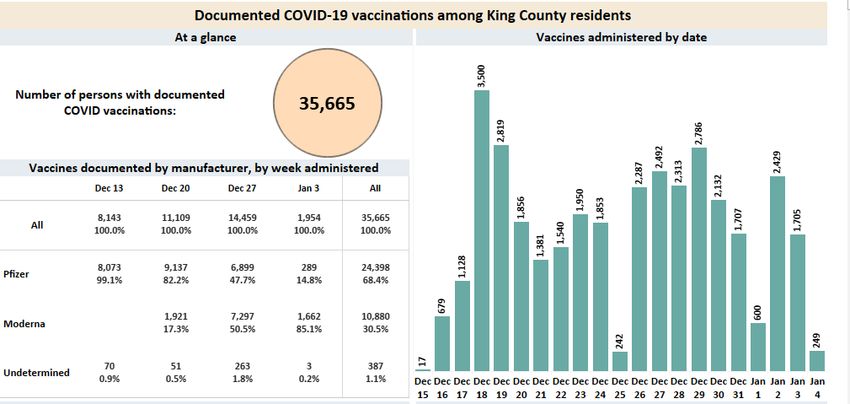
Public Health Update: COVID19 Vaccinations Updates
and Implementation Planning.
Matias Valenzuela
Francesca Holme
Ingrid Ulrey
Naisha Williams
Araceli Gallegos
3Where do we stand today in King County?
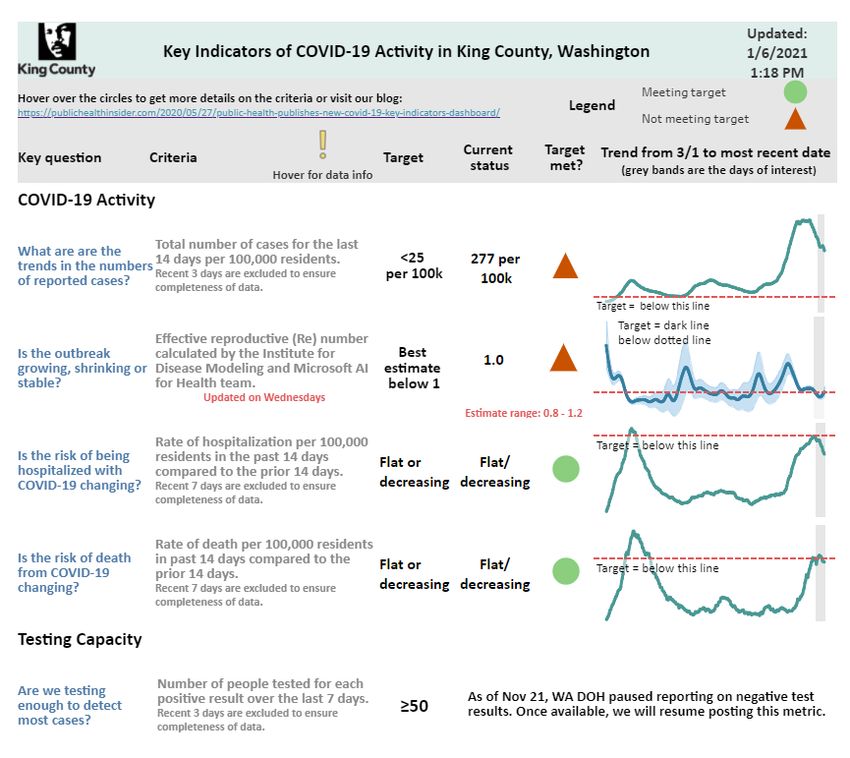
• Cases are very high. The 14-day incidence rate is over
250/100K; our goal is less than 25/100K. Hospitalizations are
also increasing to the highest level since April.
• Avoid gathering indoors, wear masks, increase ventilation, stay
six feet apart, get tested at the first sign of illness or close
contact of a known case. It’s more important than ever.
• BIPOC communities continue to experience disproportionate
impacts of COVID-19.
• The most common presumed exposures include household
transmission, community & social gatherings, and non-health-
care workplaces.
• Vaccine is starting to arrive in King County. Workers at high risk
in health care settings and long-term care facilities are
prioritized in this initial vaccine roll out.
• New testing sites are being added regularly. New sites in
Enumclaw and Bellevue have recently come online. See all COVID-19 data dashboards at www.kingcounty.gov/covid/data
4COVID-19 Vaccine Updates January 7, 2021
Public Health Seattle King County’s goal is to quickly, efficiently and equitably vaccinate
as many King County residents as possible in order to suppress the spread of COVID-19
and get the pandemic under control. This means delivering two doses of vaccine to
about 1.26 million people, starting with those at highest risk.

 Limited quantities of vaccine in King County
     Pfizer BioNtech Vaccine and Moderna Vaccine – approved for Emergency Use
     Authorization by FDA and recommended for people age 16 and above.

     As of 1/5/21, 107,925 doses have arrived in KC.

     There are 1.8 million adults living in KC.

     There are about 150,000 people in the first-to-receive vaccine group identified by the
     State Department of Health.
State vs. Local Role
State Dept of Health - lead entity PHSKC – local coordination
• Enroll providers • Work with partners to develop
• Prioritization / allocation operational plans to reach priority
populations
• Distribution - ship vaccine
• Identify and address gaps, ex) set
• Verification/voucher system up vaccination clinics as needed
• Reporting system, PrepMod • Locally tailored public information
• Public information campaign • Community and BIPOC relationships
and trust buildingState Dept of Health - Final Phase 1a Guidance
PHASE 1 Guidance
• High-risk workers in health care settings (clinical judgment should be
applied to identify who is at greatest risk using the guidance below)
• High-risk first responders (clinical judgment should be applied to identify
who is at greatest risk using the guidance below)
• Residents and staff of nursing homes, assisted living facilities and other
community-based, congregate living settings where most individuals over 65
years of age are receiving care, supervision, or assistance
https://www.doh.wa.gov/Portals/1/Documents/1600/coronavirus/VaccineAllocationPhase1A.pdfKing County: Phase 1a Vaccination as of 1/5/21
Even as we continue with Phase 1a, we are
planning for Phase 1b: older adults, and essential
workers.
State guidance issued Jan. 6 for Phase 1b
• 1b1 (Tier 1)
    • All people 70 years and older
    • People 50 years and older who live in multigenerational households

• 1b2 (Tier 2)
    • High-risk critical workers 50 years and older who work in congregate settings:
    • Agriculture; food processing; grocery stores; K-12 (teachers and school staff); child care; corrections,
       prisons, jails, or detention facilities (staff); public transit; fire; law enforcement

• 1b3 (Tier 3)
    • People 16 years or older with 2 or more co-morbidities or underlying condition

• 1b4 (Tier 4)
    • High-risk critical workers in congregate settings under 50 years old
    • People, staff, and volunteers of all ages in congregate living settings:
    • Correctional facilities; group homes for people with disabilities; shelters for people experiencing
       homelessness
State guidance graphic: 1a and 1b
Key Issues / Considerations for Phase 1b
  • There will be many challenges in early weeks of the 1a launch. Brace for this to be messy:
      • Dues to the federal funding cliff, PH has a fraction of the staff needed to pull off this huge and
        complex and endeavor.

      • Initial allocation of doses is limited, and the timeline will depend on supply chain.

      • Vaccine hesitancy among 1b groups may be significant.

      • Post-dose, some people will have COVID/Flulike symptoms will need sick leave, impacting essential
        businesses.

      • Verification and tracking systems are not yet ready. How to identify and verify eligibility for this
        group?

  • The hope is that this process will smooth out over time as the supply chain widens and more
    providers receive doses, key systems come on-line and as more people are get vaccinated
    without ill effects.
Discussion questions: Phase 1b
PARCAG Member Survey
Kimberly Meck
Review Purpose of PARCAG Survey
Dates and Review for PARCAG Survey
Discussion
Discuss one thing you feel and or think PARCAG has made
progress on and or improved in 2020?
16For Reference: COVID-19 Updates & Resources Pandemic and Racism Community Advisory Group staff contacts: Aselefech Evans asevans@kingcounty.gov LaToya Durham latoya.durham@kingcounty.gov Kirsten Wysen kirsten.wysen@kingcounty.gov Matias Valenzuela matias.valenzuela@kingcounty.gov
Ways to stay connected
Weekly Covid-19 webinar for Spanish-speaking community
•   A conversation between community members and Public Health-Seattle & King
    County. Facilitated by Giselle Zapata-Garcia and Penny Lara.
•   Every Tuesday, 5:30 – 6:30 PM
•   For more info follow https://www.facebook.com/CondadodeKing
•   Join Zoom Meeting
       https://kingcounty.zoom.us/j/95001879122
       Meeting ID: 950 0187 9122
       One tap mobile
       +12532158782,,95001879122# US (Tacoma)
       +13462487799,,95001879122# US (Houston)

Looking for a speaker about COVID-19, including about vaccines?
•   Speaker’s Bureau - Contact Steve Stamper –
    steve.stamper@kingcounty.gov
•   Where possible please give us 48 hours notice of webinar presentations
•   More at: https://www.kingcounty.gov/depts/health/covid-
    19/support/presentation-requests.aspx

                                                                                20
Ways to stay connected
Community Partners Call
• Every other Monday 4:00 – 4:45 p.m.
• Email phpartnerships@kingcounty.gov to receive Zoom call-in information
• Hosted by the Community Mitigation Group’s Community and Faith-based Task Force
COVID-19 Homelessness Response
• Email covidhomelessnessresponse@kingcounty.gov to be added to list serve and get information on
calls, webinars, and resources.
• Visit www.kingcounty.gov/hch for up-to-date information
City of Seattle Department of Neighborhoods COVID-19 Community Webinars
• Visit: https://frontporch.seattle.gov/2020/03/24/get-connected-to-our-weekly-covid-19-
community-webinars/
21Important Resources to Stay Informed on COVID-19
Subscribe to Public Health's website: www.kingcounty.gov/covid
Subscribe to the Public Health blog: www.publichealthinsider.com
Anti-stigma resources: www.kingcounty.gov/ncov/anti-stigma
King County COVID-19 data dashboards: www.kingcounty.gov/covid/data
Information on face coverings: www.kingcounty.gov/masks
King County face coverings distribution program: www.kingcounty.gov/maskdistribution
Information about COVID-19 testing: www.kingcounty.gov/covid/testing
Follow us on social media @KCPubHealth Facebook, Insta, and Twitter
Healthier Here COVID-19 Resource Hub: www.healthierhere.org/covid
WA State Dept of Health: www.doh.wa.gov/Emergencies/Coronavirus
WA State: https://www.coronavirus.wa.gov/
22Potential future agenda topics for PARCAG TOPIC Vaccine planning Contact tracing Epidemiology, aerosol, COVID disease Antibody testing Schools/child care Disability access issues Work sessions to capture & document lessons learned from early phases of pandemic in order to improve/not repeat going forward Advocacy re: addressing racism in health care system Seroprevalence study design--lengthy survey, text heavy, lack of language access Update on "The Race Gap" in King County, Black health and well-being data from Marguerite Ro
You can also read


