Knowledge, attitude and perception of oral diseases presenting to general medicine practitioners.
←
→
Page content transcription
If your browser does not render page correctly, please read the page content below

P. Deeksheetha et al /J. Pharm. Sci. & Res. Vol. 11(6), 2019, 2133-2138

          Knowledge, attitude and perception of oral diseases
            presenting to general medicine practitioners.
                                            P. Deeksheetha, Dr. Pavithra Priyadhashoni
                                                 Saveetha Dental College, Chennai -77

Abstract
Aim is to assess the frequency and type of oral conditions presenting to General practitioners, and to document if a second opinion for
the presenting dental condition is sought.

The main objective of the study is to quantify the frequency and type of oral conditions presenting to general practitioners.

Dentofacial pain is a common presentation in general practice, and more than 50% of cases arise from dental related pathology.
Dentists are well equipped and trained to deal with most of the common presentations of dental pain. Furthermore, less common and
atypical dentofacial pain presentations are adequately dealt by dental specialists in the area of oral medicine and oral maxillofacial
surgery. However, not all people with dental pain present to the dentist and or dental specialists. General practitioners are often the
first point of contact for advise and management in cases of dental related pain; reasons for presentation to the General Practitioners,
rather than the dentist. However, for various reasons, GPs may not be well equipped for management of dentofacial pain.

                      INTRODUCTION                                     problems, absence of management guidelines, poor
Oral diseases, conditions, and orofacial trauma, are widely            localisation of dento facial pain and poor communication
prevalent and costly to treat; yet they are preventable.               and collaboration with the GPs and dentists. [5].
Most of the oral conditions have an insidious onset, and               Many patients with oral symptoms present initially to their
are chronic and asymptomatic in nature until they have                 general practitioner (GP) with a variety of problems,
progressed to an advanced stage. Also there are several                ranging from simple benign disease to premalignant or
systemic diseases with oral manifestations many of which               malignant conditions. Early recognition and diagnosis of
manifest earlier than their systemic counterparts. This                this disease spectrum is of paramount importance in the
makes the routine oral examination an extremely                        successful treatment, and directly affects prognosis of the
important and a viable area for the early detection and the            disease condition[6]. The primary care clinician who deals
treatment of the variety of oral and systemic diseases[1].             with oral pathology must therefore be in a position to
The first contact for most of the patients is usually with the         identify all suspicious lesions and to seek specialist advice
general medical practitioner. Inspection of the oral cavity            as quickly as possible when unsure, while also referring to
by the doctor has been accepted as a part of the physical              the most appropriate discipline. [7]. The purpose of this
examination for over a century, and if it is done on a                 article is to assess the awareness of the common oral
routine basis it can considerably reduce the morbidity and             diseases and to create awareness of the prevailing dental
mortality which result from oral diseases. [2].                        conditions among medical practitioners, techniques for
Dentofacial pain is a common presentation in general                   better diagnosis, and appropriate management protocols
practice, and more than 50% of cases arise from dental                 for different dental conditions.
related pathology. Dentists are well equipped and trained
to deal with most of the common presentations of dental                               MATERIALS AND METHODS
pain. Furthermore, less common and atypical dentofacial                A questionnaire study was carried out among 129 general
pain presentations are adequately dealt by dental                      physicians in districts of Coimbatore and Chennai using an
specialists in the area of oral medicine and oral                      online survey tool. The questionnaire was designed with
maxillofacial surgery[3]. However, not all people with                 simplicity in mind. There was a high number of responses,
dental pain present to the dentist and or dental specialists.          the response rate may also have been influenced by the
General practitioners are often the first point of contact for         fact that many medical practitioners consider this to be a
advise and management in cases of dental related pain;                 relevant subject. The questionnaire consisted of questions
reasons for presentation to the General Practitioners, rather          which enquired about the frequency and type of
than the dentist include non classic presentation of dento             commonly seen oral conditions. Questions were asked
facial pain, lack of coordinated after hours dental care,              specifically about benign and malignant disease, and
poor patient education, patients’ prescription of their GP             dental or denture-related problems. And if an appropriate
as the primary coordinator of integrated total care and                second opinion was sought for those conditions. The
financial considerations.[4].       However, for various               doctors spent an average of 5 minutes to finish the survey.
reasons, GPs may not be well equipped for managing                     The study’s limitation is that, the participant had to rely on
dento facial pain these include; minimal dental education              his/her memory to recall accurately their recent experience
in medical schools, inconsistent exposure to dental                    about the subject.

                                                                                                                                2133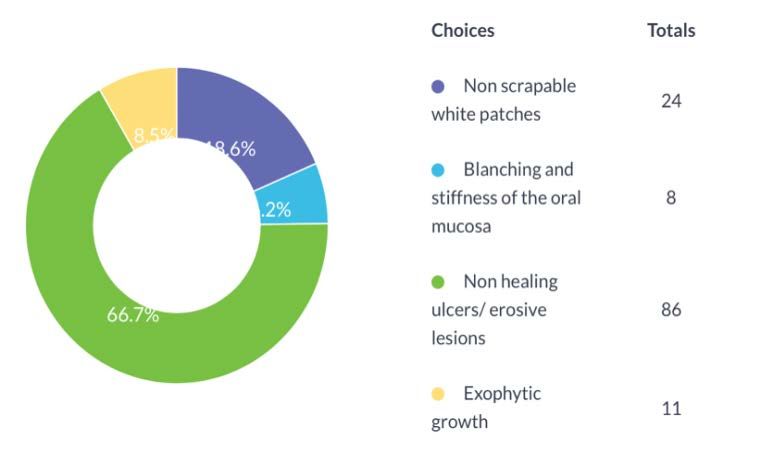
P. Deeksheetha et al /J. Pharm. Sci. & Res. Vol. 11(6), 2019, 2133-2138

              QUESTIONNAIRE                                        10)   Ludwig’s angina is a life threatening condition of
1) What do you think are the factors for Dental                    A)    Cardiovascular system
   Caries?                                                         B)    Dental space infection
A) Smoking                                                         C)    Respiratory system
B) Brushing once daily or less than once daily                     D)    Venous Disease
C) Using tooth powder
D) Frequent snacking and frequent food intake.                     11) What is an another life threading condition that
                                                                       can occur due to untreated dental condition?
2) What do you think are the factors for periodontal               A) Cavernous thrombosis
   and gingival diseases?                                          B) Hodgkin’s lymphoma
A) Plaque and calculus                                             C) Myelofibrosis
B) Smoking                                                         D) Brain tumours
C) Overhanging restorations
D) Smoking                                                         12) Periodontal Disease is a risk factor and is
                                                                       commonly associated with
3) Do you think scaling has adverse effects on the                     A) Diabetes
   teeth?                                                              B) Peptic ulcer
A) Thinning of tooth                                                   C) Asthma
B) Increase in interdental space                                       D) Myocardial infarction
C) Increase in tooth mobility
D) Causes sensitivity of the teeth.                                13) Systemic complications arising due to dental
                                                                       disease
4) How often do you advise your patients to visit the              A) Necrotising fasciitis
   dentist?                                                        B) Diabetes
A) Once in 6 months                                                C) Leukoderma
B) Once in a year                                                  D) White patches
C) Once in 2-5 years
D) Only if pain arises                                             14) Certain Anti- hypertensives can cause gingival
                                                                       enlargements
5) How often do you see patients with any oral                     A) Agree
   symptoms and conditions in a week                               B) Disagree
A) Frequently (> 5 in a week)
B) Occasionally ( 2-5 in a week)                                   15) According to you, what type of changes in the
C) Rarely (less than 2 in a week)                                      oral cavity would you associate with progression
                                                                       towards oral cancer or other pre malignant
6) How often do you manage patients with dental                        conditions ?
   problems or conditions?                                         A) Non scrappable white patches
A) Frequently (>5 in a week)                                       B) Blanching and stiffness of the oral mucosa
B) Occasionally (2-5 in a week)                                    C) Non healing ulcers/ erosive lesions
C) Rarely (less than 2 in a week)                                  D) Exophytic growth
D) Never
                                                                   16) There is a connection between General and oral
7)   How do you treat a patient with dental abscess?                   health. Do you agree?
A)   Prescribe antibiotics and painkillers                         A) Yes
B)   Refer to the dentist                                          B) No
C)   Ignore
                                                                   17) Are you aware of Sjögren’s syndrome?
8) Do you think pregnancy women need dental                        A) Yes
   check up?                                                       B) No
A) Yes
B) No                                                              18) If yes, what are the affected regions in the
                                                                       Sjögren’s syndrome?
9) Paedriatic patients must visit the dentist regularly.           A) Salivary and tear glands
A) Agree                                                           B) Adrenal gland
B) Disagree                                                        C) Pituitary gland
                                                                   D) Lymph nodes

                                                                                                                  2134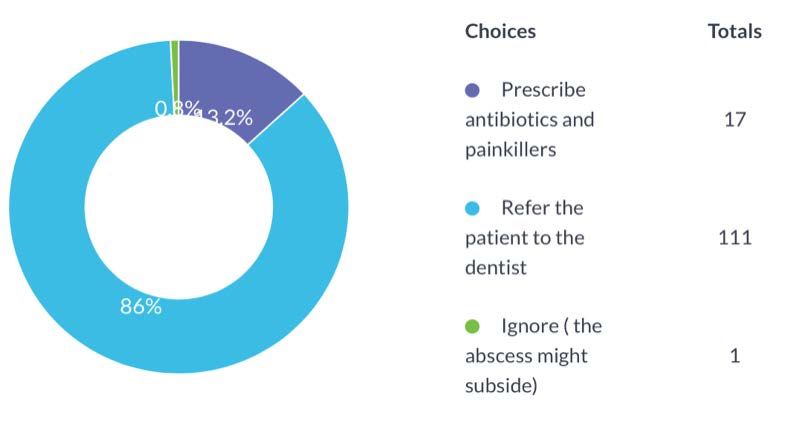
P. Deeksheetha et al /J. Pharm. Sci. & Res. Vol. 11(6), 2019, 2133-2138

    19) Do you think HIV has oral manifestations?                                                 Graph: 2
    A) Yes
    B) No

    20) If yes, what is the most common type of
        condition that can be appreciated
    A) Fungal infections (candidiasis)
    B) Viral infections
    C) Bacterial infections
    D) Gingivitis/ periodontitis

    21) Systemic conditions        with     the   most    oral
        manifestations                                                        Causes for gingivitis and periodontitis
    A) Cardiovascular
    B) Renal                                                                                 Graph: 3
    C) Gastrointestinal
    D) Respiratory

                        RESULTS
                        Table: 1
Questions             Yes                   No
Do you think
pregnant women
                      115                   14
need dental check
ups?
Paediatric patients
must visit the dentist 121                  8                                  Adverse effects of scaling on teeth
regularly
                                                                                             Graph: 4
Certain anti-
hypertensives cause
                      116                   13
gingival
enlargements
There is a
connection between
                      127                   2
General and oral
health
Aware of Sjögren’s
                      119                   10
syndrome
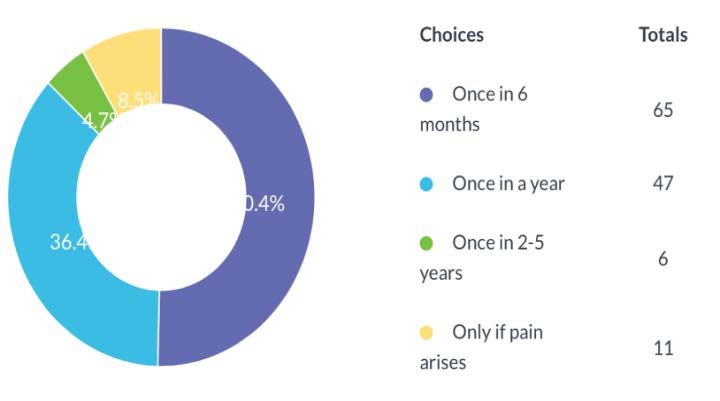
Do you think HIV                                                             Advising the patient to visit the dentist
has oral              126                   3
manifestations?                                                                              Graph: 5

                             Graph: 1

                                                                       Frequency of patients visiting with oral conditions
                 Causes for dental caries

                                                                                                                         2135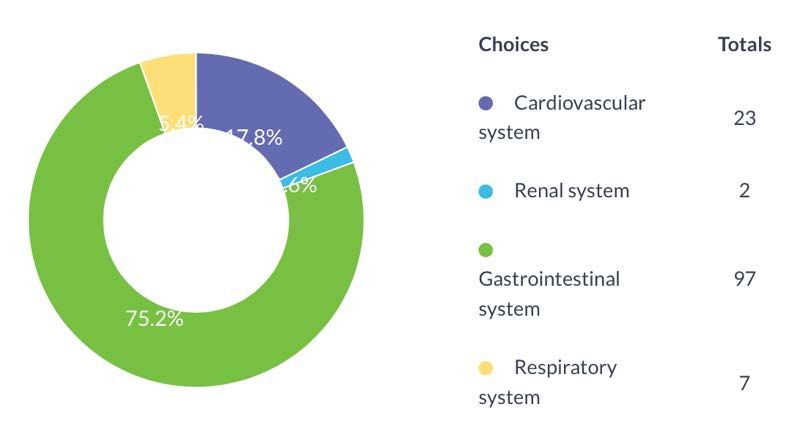
P. Deeksheetha et al /J. Pharm. Sci. & Res. Vol. 11(6), 2019, 2133-2138

                 Graph: 6                                                            Graph: 10

                                                             Periodontal disease commonly associated with dental
Management of patients with oral conditions                                        condition

                 Graph: 7                                                            Graph: 11

                                                                  Systemic complication due to dental disease
Management of patient with dental abscess
                                                                                     Graph: 12
                 Graph: 8

Ludwig’s angina is life threatening condition
                                                                  Changes associated with cancer progression
                 Graph: 9
                                                                                     Graph: 13

 Life threatening condition due to untreated
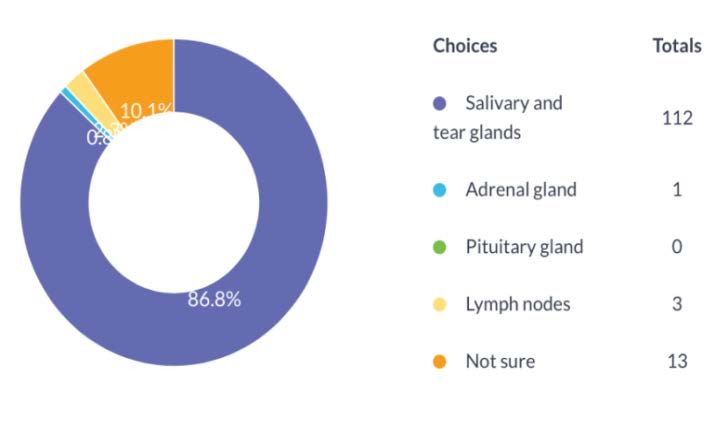
                                                                     Affected region in Sjögren’s syndrome

                                                                                                             2136
P. Deeksheetha et al /J. Pharm. Sci. & Res. Vol. 11(6), 2019, 2133-2138

                       Graph: 14                                 plaque and calculus were the causative factor for
                                                                 periodontal and gingival diseases. [10,11,12].
                                                                 Majority of the doctors considered in the present study
                                                                 agreed that pregnant women need dental checkups, which
                                                                 was similar to the results obtained by Dr. Rajesh et al.
                                                                 Doctors should be encouraged to refer pregnant patients
                                                                 for oral health examination. [13]. A multidisciplinary team
                                                                 that includes the Family Physician, Obstetricians and
                                                                 Dental practitioner should assume an active role in
                                                                 providing health education to pregnant women which
                                                                 can significantly decrease the possibility of oral
                                                                 diseases. Oral health education can be included in the
                                                                 medical curriculum to emphasize a positive attitude
            Common HIV oral manifestation                        towards oral health[14].
                                                                 95% of the doctors answered correctly that cavernous
                       Graph: 15                                 sinus thrombosis is a life threatening condition arising due
                                                                 to untreated dental condition, which was similar to the
                                                                 study conducted in Kanpur city. 28% saw patients
                                                                 presenting with dental conditions frequently (>5 in a
                                                                 week), while about 38% of the doctors had patients
                                                                 presenting with oral conditions occasionally(2-5 in a
                                                                 week), while in a study done by MC Bater et al,
                                                                 46%reported that they saw between two and five patients
                                                                 with oral and dental problems every week, with a
                                                                 further14% reporting seeing more than five patients on a
                                                                 weekly basis.[15].
                                                                 78% of the doctors were confident that diabetes is
                                                                 associated with periodontitis, in a study done by kumar et
                                                                 al, 100% agreed that there exists some sort of relationship
   Systemic condition with the most oral manifestation           between diabetes and periodontal health, of which only
                                                                 43.2% were aware of the bidirectional relationship and the
                        DISCUSSION                               remaining 56.4% reported diabetes as a risk factor of
The mouth and face are highly accessible parts of the            periodontitis. [16].
body, sensitive to and able to reflect changes occurring         Dental students, receive a significant education in general
internally. The mouth is the major portal of entry to the        medicine, general pathology and general surgery along
body and is equipped with formidable mechanisms for              with other basic science subjects, while on the other hand,
sensing the environment and defending against toxins             medical students receive only minimal theoretical and
or invading pathogens.         Poor oral conditions may          practical knowledge about oral conditions. A study by
adversely affect general health and certain medical              Anderson et al, has demonstrated that medical
conditions may have a negative impact on oral health.            practitioners are more likely to prescribe antibiotics for
[8]. The relationship between oral and general health has        acute dental abscess than dentists, according to this study,
been increasingly recognised during the past two decades.        86% felt that referral of the patient to a dentist is the more
[9]. This cross sectional study was conducted to assess the      appropriate way to treat a dental abscess than to prescribe
dental knowledge, attitude and awareness of different            antibiotics and painkillers, which was about 13%. Only
medical practitioners of Chennai and Coimbatore.                 1% of the participants answered that the abscess can be
The results of the study shows that medical practitioners        ignored and that it will subside. According to the study
had good dental knowledge. 83 doctors (64%) agreed that          done by Srinidhi et al, 79% of the doctors correctly
the most common cause of dental caries was frequent food         identified that Ludwig’s angina is a dental space infection
intake and snacking, while other studies done by Vishal          while according to this study, the result obtained was
Malhotra et al, Mehrotra V et al, MC Bater, Warren               about 73%. 78% of the doctors correctly identified that
jones, S Srinidhi, Navin Anand Ingle et al, Chandra J,           periodontal disease is commonly associated with diabetes.
Chandu et al, Naidu S et al, Radha et al, Patil et al,           87% of the doctors correctly answered the affected regions
showed that 90% of doctors knew that frequent sugar              in Sjögren’s syndrome are the salivary and tear glands.
intake and frequent snacking led to dental caries. The           75% chose that the systemic conditions with the most oral
present study showed that 71 (55%) of the medical                manifestations is the endocrine system.
practitioners were aware that plaque and calculus was the
causative factor for periodontitis and gingivitis, while                               CONCLUSION
Vishal Malhotra et al, Mehrotra V et al, MC Bater,               From this study it can be concluded that the medical
Warren jones, S Srinidhi, Navin Anand Ingle et al,               practitioners, were well aware about most of the dental
Chandra J, Chandu et al, Naidu S et al, Radha et al, Patil       conditions, along with the various oral manifestations of
et al, had found that 80% of the doctors were aware that

                                                                                                                     2137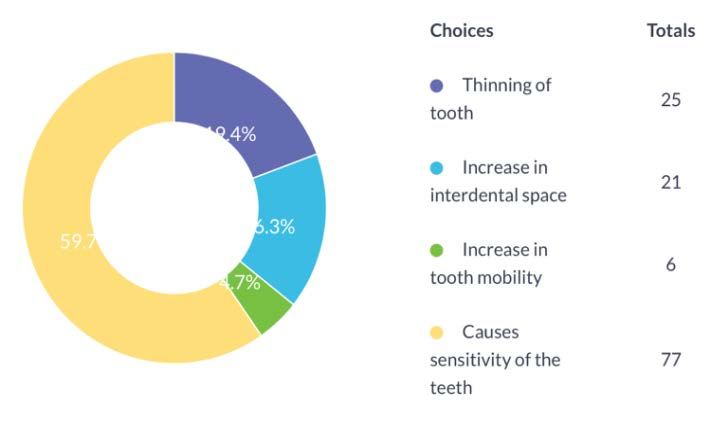
P. Deeksheetha et al /J. Pharm. Sci. & Res. Vol. 11(6), 2019, 2133-2138

systemic diseases, and life threatening conditions arising               4)    Chandra J, Chandu GN, Prashant GM (2006) Dental awareness
                                                                               and attitudes of medical practitioners of Davangere city. Journal
due to untreated dental conditions. It is essential that the
                                                                               of Indian Association of Public Health Dentistry 8: 38-43.
medical practitioners keep their knowledge updated with                  5)    Naidu S, Rafeek RN, Singh R, Maharaj K (2008) Oral and dental
time and get actively involved in oral health, as mouth is                     conditions presenting to medical practitioners in Trinidad and
the mirror of the body. This can be achieved by                                Tobago. Int Dent J 58: 194-198.
                                                                         6)    Radha G, ShaikHyder Ali KH, Pushpanjali K (2008) Knowledge
conducting new seminars for the newly graduated doctors,
                                                                               and attitude and practice of oral health among nursing staff and
and by regular examination of the oral cavity by the                           nursing students of Bangalore city. Journal of Indian Association
medical practitioners, during the patients’ general                            of Public Health Dentistry 11: 17-21.
examination. A multidisciplinary team that includes the                  7)    Assesment of oral health knowledge, attitude and practice
                                                                               behaviour among Obstetricians- a questionnaire study.
Family Physician, Obstetricians and Dental practitioner
                                                                         8)    Patil AV. Awareness of oral health among medical practitioners in
should assume an active role in providing health                               Sangamner City-A cross-sectional survey. International Journal of
education to pregnant women which can significantly                            Clinical Dental Science. 2010.
decrease the possibility of oral diseases. Oral health                   9)    Long RG, Hlousek L, Doyle JL (1998) Oral manifestations of
                                                                               systemic diseases. Mt Sinai J Med 65: 309-315.
education can be included in the medical curriculum to
                                                                         10)   Cheraskin E (1958) Oral manifestations of systemic diseases. J Natl
emphasise a positive attitude towards oral health.                             Med Assoc 50: 241-247.
                                                                         11)   Epstein JB (1980) The mouth: a window on systemic disease. Can
                          REFERENCES                                           Fam Physician 26: 953-957.
1)   Mehrotra V, Garg K, Sharma P, Sajid Z, Singh R (2015) A             12)   2000 Surgeon General’s report on oral health in America, NIDCR.
     Study Based on Dental Awareness, Knowledge and Attitudes            13)   Oral health knowledge, attitude, and practice of patients visiting a
     among the Medical Practitioners in and Around Kanpur City                 private hospital in Chennai, R. Pradeep Kumar, Shristi Nadar, IOSR
     (India). J Interdiscipl Med Dent Sci 3: 183.                              Journal of Dental and Medical Sciences (IOSR-JDMS), Issue 6
2)   MC Bater, Warren jones, A survey of oral and dental disease               Ver. V (Jun. 2015), PP 12-15.
     presenting         to      general       medical   practitioners,   14)   Eve line KL Wong, Eli Schwartz (1993) Knowledge and attitudes
     QualityinPrimaryCare2005;13:139–42.                                       towards dental care among newly graduated medical doctors.
3)   S Srinidhi, Navin        Anand Ingle, Preetha Elizebeth Chaly,      15)   Ramirez JH, Arce R, Contreras A (2010) Why must physicians
     Chandrasekhara Reddy, Dental Awareness and Attitudes among                know about oral diseases? Teach Learn Med 22: 148-155.
     Medical Practitioners in Chennai, J Oral Health Comm Dent           16)   Patil AV(2010) Awareness of oral health among medical
     2011;5(2)73-78.                                                           practitioners in Sangamner city-A cross sectional survey.

                                                                                                                                       2138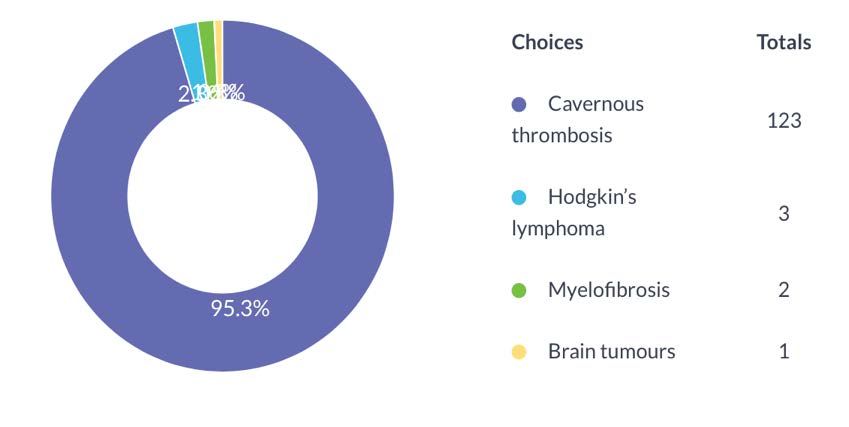

You can also read


