Kunsthaus Bregenz - Program 2021
←
→
Page content transcription
If your browser does not render page correctly, please read the page content below
Kunsthaus Bregenz

Program 2021
English
Insights into the Moment
     A Foreword by Director
     Thomas D. Trummer

     In fall 2020 Elisabeth Bronfen, the Zurich-based cultural studies
     academic, was a guest at Kunsthaus Bregenz. The occasion was
     her recently published book Angesteckt (Infected) — a cultural and
     historical foray through film and literary history. Bronfen sheds
     light on depictions of the pandemic, demonstrating how viruses,
     vampires, and epidemics have pervaded cultural history. In doing
     so, she turns to Hans Blumenberg, who in his well-known book
     Work on Myth (1985) asked why people tell each other stories. The
     answer Blumenberg himself provided was: “Stories are told for
     a reason. In the most harmless but not insignificant case: to pass
     time. But otherwise and more seriously: to eliminate fear.”
          The exhibition Bunny Rogers that opened in January 2020 was
     one such story. It was the representation of individual death, a
     spatial requiem on four floors. A lawn had been laid for it, glow
     worms were iridescent, and water dripped in a shower room clad
     with thousands of tiles. The lockdown forced the exhibition to
     close in the middle of March 2020. The lawn withered, the shower
     heads remained dry, death found entry — into all the news.

03   KUB Program 2021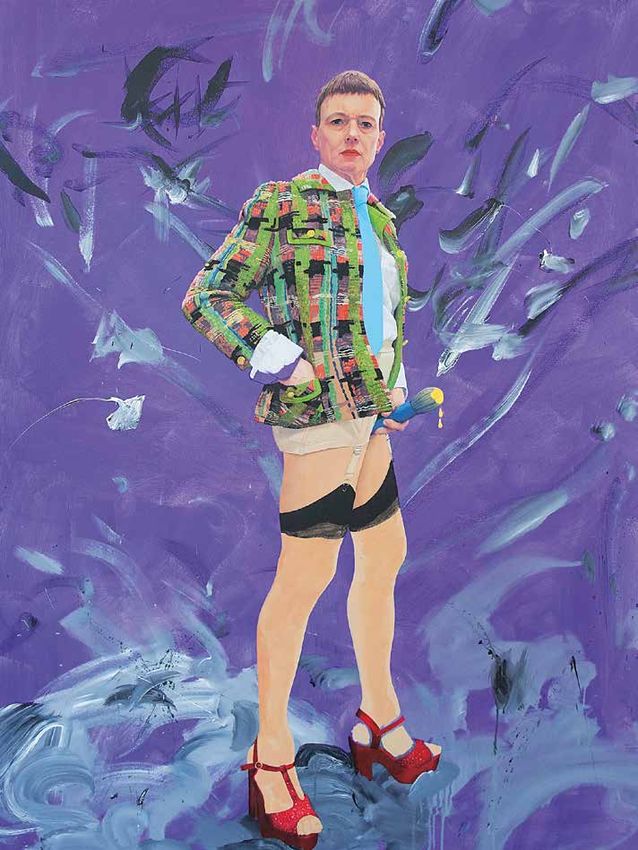
Kunsthaus Bregenz reopened on June 5 with a special exhibition.
     Unprecedented Times put works on display that had been created
     during the quarantine. It was an unusual project directly depicting a
     precarious moment. The project comprised a number of prominent
     artists, including Helen Cammock, William Kentridge, Annette Mes-
     sager, and Marianna Simnett. This initiative by KUB — acting quickly
     and spontaneously — was rewarded. Not only were visitors enthusi-
     astic about the exhibition, but the media response was extraordi-
     nary, with The New York Times dedicating a comprehensive article
     to it. But even more important than the international success was
     the local response. Visitors demonstrated themselves to be more
     receptive and attentive, the experience of the crisis making any en-
     counter with the voices of art all the more valuable and precious.
          Exhibitions in Bregenz are distinctive and unique. Not just because
     of KUB’s singular spaces, the addressing of current issues is no less
     important. Such questions not only include the pandemic and issues
     of coexistence, but also political responsibility, as well as debates
     around gender, together with issues concerning environmental
     awareness and dangers to the climate.
          All such considerations have but one objective: to consolidate
     Kunsthaus Bregenz as a place of the present — an art institution
     providing insights into the moment.

     2021
     Kunsthaus Bregenz is looking forward to 2021. The exhibition by
     Jakob Lena Knebl and Ashley Hans Scheirl will probably be opening in
     December 2020. The artists’ approach is playful, shrill, and lascivious.
     Their media include painting, photography, sculpture, and design,
     which are interwoven in scenery-like installations. Visitors to KUB
     will be able to experience an ice sea, a replica of the famous painting by
     Caspar David Friedrich, a walk-in witches’ sabbath, stagings of the
     self, floor paintings, advertising pillars, cyborg personas, and much
     more. As has so often been the case, the building is being transformed
     into stages that can be entered, creating unique spatial experiences.
     In the basement at KUB, and to complement the main exhibition,
     we are presenting, for the first time in Austria, the work of the pho-
     tographer Marcel Bascoulard.

04   KUB Program 2021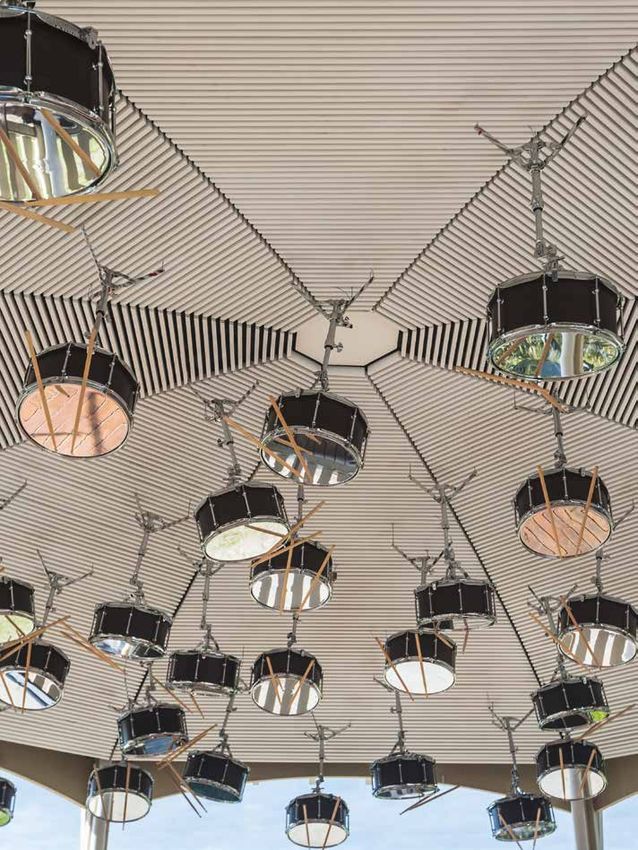
The first solo exhibition by Pamela Rosenkranz in Austria will follow
     in spring 2021. Rosenkranz represented Switzerland at the 2015
     Venice Biennial. The artist addresses the biological and chemical
     foundations of objects and commodities. She works with scents, earth
     and light, bacteria and parasites. Such existences below the human
     threshold of perception have been the subject of intellectual discourses
     in recent years. The virus too is an invisible presence. Rosenkranz
     formulates her artistic research as indelible but tranquil zones. These
     are spatially extensive, yet intimate experiences that are ideally
     suited to Kunsthaus Bregenz. A new acquisition by Lois Weinberger
     is being presented as an addendum to the main exhibition in the
     basement at KUB, which likewise confronts nature, chemistry, and
     the environment.

     The 2021 summer exhibition is dedicated to Anri Sala. Originally
     planned for 2020, the exhibition was postponed for a year. It will
     be taking place to coincide with the Bregenz Festival. In collaboration
     with the festival, Kunsthaus Bregenz will also be bringing the opera
     Wind to the stage in 2021 in a world premiere. Sala likewise engages
     with the phenomena of music. Pieces of music become protagonists
     in his films, the exhibition is a visual-acoustic experience within space,
     an experience that is as immersive as it is technically elaborate.

     Otobong Nkanga addresses the complex and shifting relationship
     between humans, land, and corresponding structures of repair.
     She traces the vestiges of trade in raw materials and how goods and
     people circulate the world in different ways and on different premises.
     By weaving together various mediums such as installation, tapestry,
     and storytelling, Nkanga’s work spans the temporality and subter-
     ranean effects of regimes acting on living beings. Especially in a
     time of climate urgencies and crises, such an exhibition is of great
     importance.

05   KUB Program 2021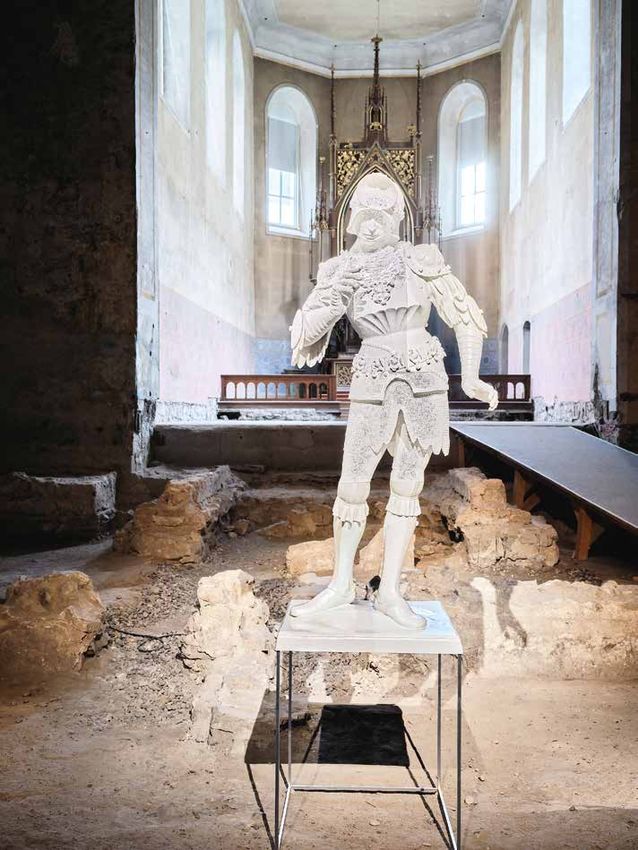
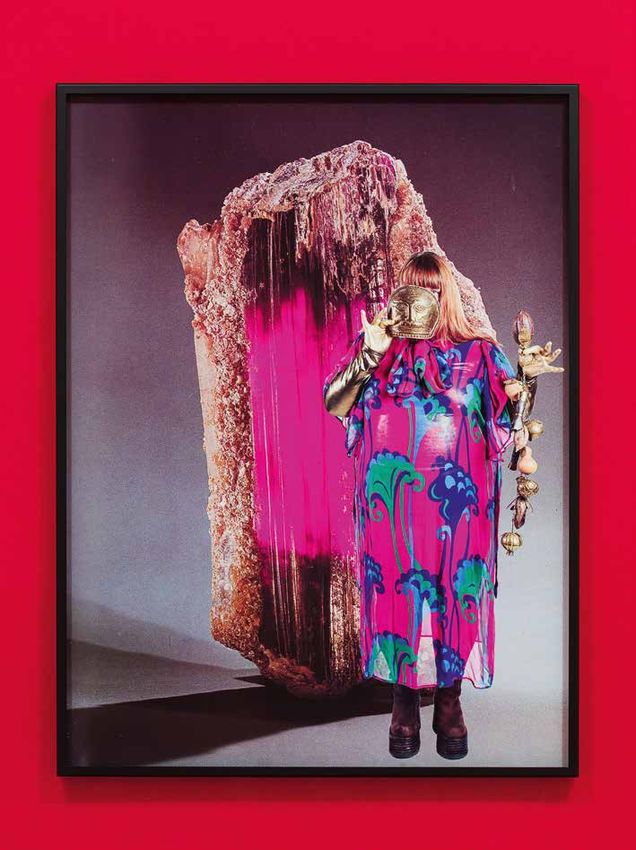
Jakob Lena Knebl
Contemporary
Witchcraft, 2017
Photo: Georg Petermichl
© Jakob Lena Knebl,
Bildrecht, Vienna, 2020
Pamela Rosenkranz
Infection, 2017
Installation view,
Slight Agitation 2/4,
Fondazione Prada,
Milan
Photo: Delfino
Sisto Legnani and
Marco Cappelletti
Courtesy of the
artist and Fondazione
Prada, Milan
© Pamela Rosenkranz
Anri Sala
AS YOU GO, 2019
13-channel HD video
and 22-channel
discrete sound installa-
tion, color, 39:24 min.
Installation view
Castello di Rivoli, 2019
Photo: Antonio Maniscalco
Courtesy of the artist
© Anri Sala
Otobong Nkanga
Wetin You Go Do?, 2015
Installation view
13th Biennial, Lyon
Photo: Blaise Adilon
Courtesy of the artist
© Otobong Nkanga
KUB 2021.01
Jakob Lena Knebl &
Ashley Hans Scheirl
Seasonal Greetings
12 | 12 | 2020 — 14 | 03 | 2021

KUB 2021.02
Pamela Rosenkranz
27 | 03 — 04 | 07 | 2021

KUB 2021.03
Anri Sala
17 | 07 — 10 | 10 | 2021

KUB 2021.04
Otobong Nkanga
23 | 10 | 2021 — 09 | 01 | 2022
KUB Basement
Marcel Bascoulard
16 | 01 — 14 | 03 | 2021

KUB Basement
Lois Weinberger
17 | 04 — 04 | 07 | 2021
Ashley Hans Scheirl
Neoliberal Surrealist
(Neoliberale_r
Surrealist_in), 2019
Photo: Matthias
Bildstein
Courtesy of the artist
and Galerie CRONE,
Berlin / Vienna
© Ashley Hans Scheirl

                         KUB 2021.01
                         Jakob Lena Knebl &
                         Ashley Hans Scheirl
                         12 | 12 | 2020 — 14 | 03 | 2021
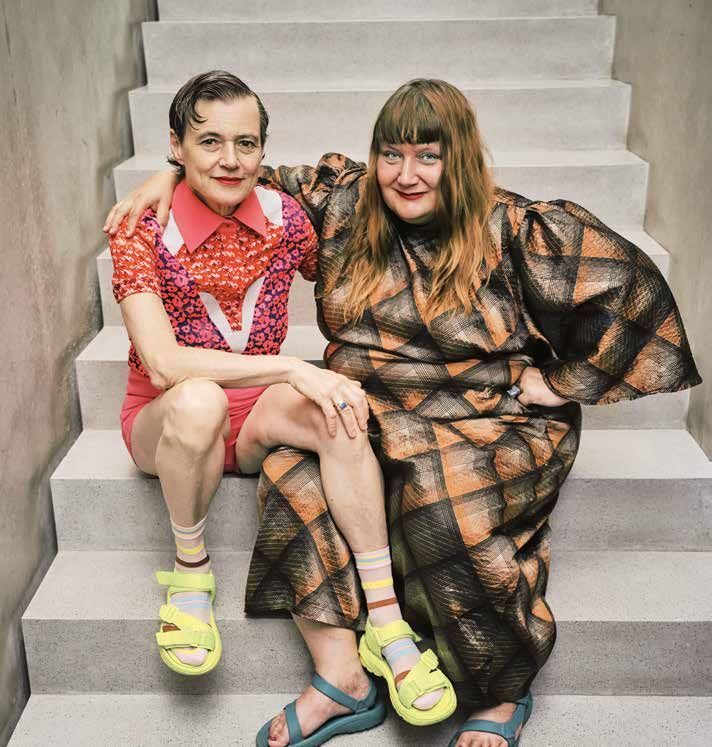
Extended The artist duo Jakob Lena Knebl and Ashley Hans Scheirl are a couple
Opening:
both privately and artistically, feminist and queer. At Kunsthaus
Friday,
December 11, 2020, Bregenz, the artists based in Vienna are staging two floors together
3 — 8 pm and one each on their own. At a photographic session at Kunsthaus
Bregenz, they presented themselves in differing poses, sometimes
colorful and frivolous, sometimes distinguished and thoughtful, and
then again lascivious and provocative — never without style or without
humor, in a manner comparable to the British artist duo Gilbert &
George. The camera is a co-protagonist, the changing of roles and
genres is more than an attitude, it is the work itself. Serious reflection,
scenes, and the obscene collide unchecked.
Ashley Hans Scheirl exhibits spatially extensive stages. Paintings
on the floor are carried out employing violent gesture, drawings on
the wall and text resembling slogans. Scheirl’s work includes golden
penises and dolls dangling from the wall, red catwalks and curtains,
sophisticated bachelor machines, sensuality, surreal elements, sus-
penders and suspenseful shame, allusions to Klimt, and the glamor of
the 1970s. The transgender artist Scheirl began his career making
avant-garde films, Dandy Dust from 1998 since obtaining cult-status.
Scheirl who later became known for performance, has been teaching
contextual painting at the Academy of Fine Arts in Vienna since
2006. She is currently addressing issues of the limits of genre, con-
ventional morally strict attitudes, and the assignment of gender, in
expansive paintings.
Jakob Lena Knebl’s art is no less garish and shrill. She is interested
in design, and in particular the design of furniture and the extrava-
gances of fashion. She portrays herself in staged photographs, the
selfie becoming a farcical métier, the doll a paradigm, and desire her
subject matter. Knebl uproots artistic identity employing mimicry and
pose. She paints herself as a Chippendale sofa or becomes a full-body
Mondrian. She is also active as a curator, re-presenting museum
collections, for example those of mumok in Vienna and Kunsthaus
Zürich, and reinterpreting the works in a surprising manner by
adding accessories or items of clothing. She names such appropria-
tions “co-agency.”
13 KUB Program 2021Jakob Lena Knebl Ruth Anne, 2020 Photo: kunst-dokumentation, Courtesy of the artist © Jakob Lena Knebl, Bildrecht, Vienna, 2020
Ashley Hans Scheirl
Selbstporträt mit
Pinsel, 2018
Courtesy of the artist
and Kunsthaus Bregenz
© Ashley Hans Scheirl
Scheirl and Knebl in
Kunsthaus Bregenz, 2020
Photo: Miro Kuzmanovic

Ashley Hans Scheirl (born in 1956 in Salzburg) lives and works in        Jakob Lena Knebl (born in 1970 in Baden near Vienna as Martina
Vienna, where he has been professor of contextual painting at the        Egger) lives and works in Vienna. She studied textual sculpture under
Academy of Fine Arts since 2006. Ashley Hans Scheirl, aka. Angela        Heimo Zobernig at the Academy of Fine Arts and fashion under Raf
Scheirl and Hans Angela Scheirl, is a transgender painter as well as a   Simons at the University of Applied Arts, both in Vienna. She is, in
conceptual, mixed-media, performance, body art, and video artist.        addition, a Senior Artist at the Academy of Fine Arts in Vienna. Several
Scheirl studied at the Academy of Fine Arts in Vienna, and subse-        years ago she replaced her given name with the first names of her grand-
quently at Central Saint Martins College of Art and Design in London.    parents, in the spirit of her play on identity and gender, giving herself
In 2017 she participated in documenta 14 in Athens and Kassel with       the surname Knebl. In 2017 she showed a selection of the collection
a series of surrealist paintings.                                        at mumok in Vienna under the title Oh… Jakob Lena Knebl und die
                                                                         mumok Sammlung. Further solo exhibitions include ones at Kunst-
Both artists work individually as well as together and are represent-    museum Lentos, Linz (2020), Belmazc Gallery, London (2019), and the
ing Austria as a duo at the Venice Biennial in 2022.                     Loevenbruck Gallery, Paris (2019).
Marcel Bascoulard
Untitled, 1971
Courtesy of Jelitzka
Collection, Vienna
KUB Basement
Marcel Bascoulard
16 | 01 — 14 | 03 | 2021Extended He was in actual fact a draftsman of finely detailed landscapes,
Opening:
but in the 1940s Marcel Bascoulard began photographing himself
Friday,
January 15, 2021, in women’s clothes. The photographs show him in mostly floor-
5 — 8 pm length skirts made of silky, shiny fabrics. The style of both the elab-
orate clothes, that he largely sewed himself, and the hairstyles
are influenced by 19th century fashion. Marcel Bascoulard, whose
astounding work is still little known, presents himself in photogenic
yet simple poses. He invariably directs his gaze towards the viewer.
He holds his left arm bent in front of his body, in his right hand a
mysterious, not completely recognizable object, perhaps a knife
or a short hatchet? They are mute self-portraits marked by loneli-
ness and sorrow. Even as an older man, Bascoulard continued this
touching series.
Courtesy of
Sammlung
Kunsthaus Bregenz is pleased to be presenting a selection of
Jelitzka, Wien this extraordinary work for the first time in Austria.
18 KUB Program 2021Pamela Rosenkranz
Anemine (Detail), 2016
Installation view, Miguel
Abreu Gallery, New York
Photo: Marc Asekhame
Courtesy of the artist
© Pamela Rosenkranz
KUB 2021.02
Pamela Rosenkranz
27 | 03 — 04 | 07 | 2021Extended “What makes us feel the way we feel?”, asks Pamela Rosenkranz.
Opening:
“What influence do scientific findings have on what being human
Friday,
March 26, 2021, means to us, and what influence do neurosciences have on our
3 — 8 pm understanding of identity?” Sometimes blue dominates, the ultra-
marine employed by Yves Klein — a shade of oceanic depth — in
addition, Rosenkranz also employs a delicate, soft pink, as well as
a luminous green. The walls are monochrome, a viscous light emitted
from LED lighting. The floor is reflective, it glitters like water per-
meated by the color of skin. Colors and objects are not representa-
tions, neither are they depictions of subjective imaginings or pure
contemplation. Derived rather from scientific knowledge, they are
illustrations of chemical constellations. The works always evoke
human skin, the permeable organic boundary between the internal
and external.
In 2015 Pamela Rosenkranz conceived the Swiss pavilion for the
Venice Biennial. The diffuse mint green and baby pink colors were
joined by a dull female voice and a slightly musty smell, the cause of
which remained concealed. The spaces did not display anything that
was recognizable as art, the emptiness referring visitors back to
individual perceptions and their own experiences. Yet any sensory
certainty remained questionable. The smell was actually synthetically
produced musk which, depending on intensity, can be perceived as
either attractive or repulsive. Rosenkranz experiments with phar-
maceuticals, colors and materials, and their effect on the senses, on
the human condition and perceptions. What influence do synthetic
substances have on our life? What is the relation between sexuality
and silicone? Rosenkranz conducts research on a molecular level.
Since 2009 she has been filling commercial mineral water bottles
with tinted silicone. The colors are derived from the different shades
of human skin, the pink reflecting a Eurocentric clientele. The ideal
of Modernism is an illusion, humanism remains questionable, genes
and tissues are likewise contaminated.
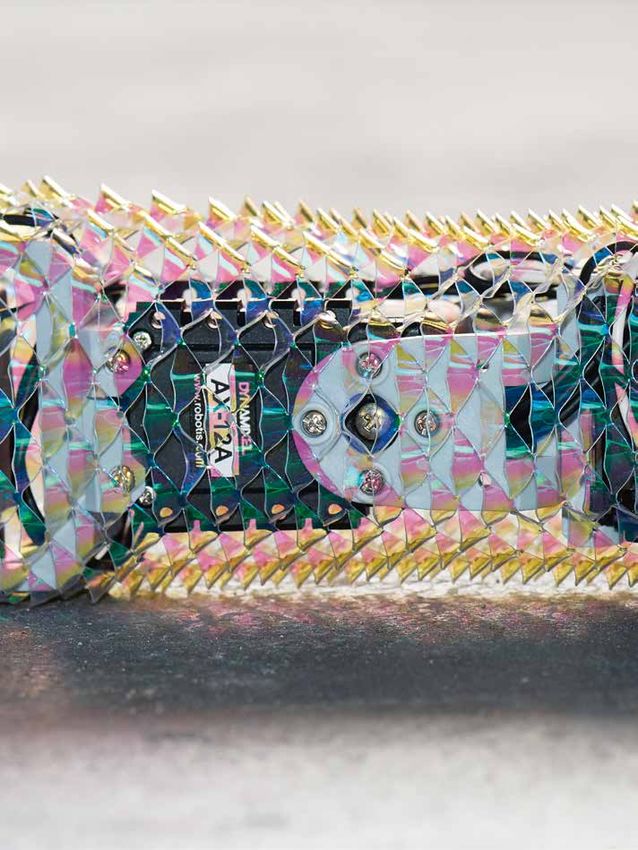
For Sharjah Biennial 14 in 2019, Pamela Rosenkranz constructed
a robotic snake that wended its way through the hot sand in the inner
courtyard of a building surrounded by arcades, the organic and real
being once and for all replaced by the mechanical and invented.
The emptiness and harmonious simplicity of the spaces at Kunsthaus
Bregenz will doubtlessly be unusually responsive to the ideas in
Rosenkranz’s work. However, notions of authentic experience,
the point of departure for the architect, are questioned by Pamela
Rosenkranz’s research on the micro-level of the senses.
20 KUB Program 2021Pamela Rosenkranz Alien Culture, 2017 Installation view, GAMeC, Bergamo Photo: Marc Asekhame Courtesy of the artist © Pamela Rosenkranz
Pamela Rosenkranz
Healer (Waters), 2019
Installation view, IF THE
SNAKE, Okayama Art
Summit, Okayama
Photo: Marc Asekhame
Courtesy of the artist
© Pamela Rosenkranz
Photo: Marc Asekhame

                       Pamela Rosenkranz (born in 1979 in Sils Maria, Switzerland) lives and
                       works in Zurich and Zug. In 2004 she graduated with a Master of Fine
                       Arts from Bern University of the Arts; she also studied comparative
                       literature at the University of Zurich. While she was still a student
                       she was already receiving a great deal of international attention. Her
                       most recent exhibitions include: Alien Culture, GAMeC Bergamo (2017),
                       IF THE SNAKE, Okayama Art Summit, Okayama, Japan (2019), Là où
                       les eaux se mêlent at the 15th Biennale de Lyon (2019), Leaving the
                       Echo Chamber, 14th Sharjah Biennial (2019), and Slight Agitation 2/4:
                       Pamela Rosenkranz, at Fondazione Prada, Milan (2017). In 2015 she
                       represented Switzerland at the Venice Biennial.

          23           KUB Program 2021
Lois Weinberger
Unkrautgemeinschaften
Europas, 1971 (Detail)
Photo: Alicia Olmos
Ochoa
KUB Basement
Lois Weinberger
17 | 04 — 04 | 07 | 2021Extended In 1971 a large Swiss pharmaceutical concern published the portfolio
Opening:
Unkrautgemeinschaften Europas that included texts in seven lan-
Friday,
April 16, 2021, guages. The portfolio contains photographs of plants, which are
5 — 8 pm listed under their Latin names. While such names are usually used
for botanical identification, here the actual context is the control of
such plants, for which the group produces the chemical eradicants
that are presented in the appendix. Lois Weinberger, who died dur-
ing the lockdown in spring 2020, exhibited the portfolio as a ready-
made. The photographs resemble still lifes in the tradition of Albrecht
Dürer’s Piece of Turf. They also demonstrate Weinberger’s lifelong
interest in ruderal vegetation, locations that have been so pro-
foundly changed by humans that none of the original plant varieties
are able to grow there any longer. In view of calls for “ecological art”
and public expectations of the pharmaceutical industry, Weinberg-
er’s work remains highly topical.
25 KUB Program 2021Anri Sala
No Window No Cry
(Luigi Cosenza, La
Fabbrica Olivetti,
Pozzuoli), 2015
Photo: Luciano Romano
Courtesy of the artist
and Alexander Tut-
sek-Stiftung, Munich
© Anri Sala
KUB 2021.03
Anri Sala
17 | 07 — 10 | 10 | 2021Extended Anri Sala is engaged with the interplay between sound and moving
Opening:
images, between hearing and seeing. His preferred medium of ex-
Friday,
July 16, 2021, pression is film. In contrast to conventional cinema, however, neither
3 — 8 pm narrative nor actors are involved. Instead, his scripts develop from
careful listening. The cinematic arises from the musical and not vice
versa, as is the convention. As a result, Sala is able to create intense
acoustic attentiveness among his audience.
If and Only If (2018) is one of Sala’s most impressive works.
It documents a snail crawling along a viola bow while an elegy by
Igor Stravinsky is being played. The snail determines the tempo,
the violist slowing and accelerating his playing in response to
the movement of the snail. It is the animal’s activity that governs
both the music and its perception. The function of instruments is
frequently the focus of Sala’s work. For example, he lets a group of
snare drums perform, but without percussionists. Instead, the self-
playing instruments hang from the ceiling like bizarrely animated
stalactites. In other works, historical rollers used for the creating of
patterns on hand-made wallpaper are employed as a hurdy-gurdy
from which musical tones are kindled.
Sala also incorporates elements of film, such as camera perspec-
tives and close-ups, and the choreography of playing in his work.
The exhibition space likewise enters into Sala’s considerations,
where different perceptual conditions prevail than in a concert hall.
Kunsthaus Bregenz’s auratic presence and particular acoustics
provide the perfect environment for Anri Sala’s art.
27 KUB Program 2021Anri Sala If and Only If, 2018 Single channel HD video and discrete 4.0 surround sound installation, color 9:47 min. Courtesy of the artist, Marian Goodman Gallery, New York | Paris and Galerie Chantal Crousel, Paris © Anri Sala
Anri Sala
The Last Resort, 2017
42-channel sound
installation including
38 altered snare drums,
58:28 min.
Photo: Peter Greig
Courtesy of the artist,
Marian Goodman Gallery,
New York | Paris
and Esther Schipper,
Berlin © Anri Sala
Anri Sala (born in 1974 in Tirana, Albania) studied in
                            Tirana, Paris, and Tourcoing. He has been awarded
                            numerous prizes, including the Vincent Award (2014).
                            Sala has participated in many group exhibitions and
                            biennales such as the 12th Havana Biennial (2015), as
                            France’s representative at the 55th Biennale di Venezia
                            (2013), the 9th Gwangju Biennale (2012), dOCUMENTA (13)
                            (2012), the 29th São Paulo Biennial (2010), and the 2nd
                            Moscow Biennale of Contemporary Art (2007). He has
                            already been exhibited at Kunsthaus Bregenz in the group
                            exhibition Remind ... in 2003. Solo exhibitions have in-
                            cluded ones at Centro Botín, Santander (2020), Castello
                            di Rivoli, Turin (2019), Marian Goodman Gallery, London
                            (2019) and New York (2018), Fundación JUMEX, Mexico
                            City (2017), New Museum, New York (2016), Haus der
                            Kunst, Munich (2015), and Serpentine Gallery, London
                            (2011). Anri Sala lives and works in Berlin.

Photo: © Jutta Benzenberg
Otobong Nkanga
From Where I Stand,
2015 — 2020
Installation view
Middlesbrough
Institute of Modern Art,
Middlesbrough
Photo: Jason Hynes
Courtesy of the artist
© Otobong Nkanga
KUB 2021.04
Otobong Nkanga
23 | 10 | 2021 — 09 | 01 | 2022Extended Otobong Nkanga’s artistic practice encompasses tapestries, drawings,
Opening:
photographs, installations, videos, and performances. She addresses
Friday,
October 22, 2021, the sustainability of resources, the movement of goods, and the
3 — 8 pm significance and consequences of land grabs. In her work, she relates
the identity and colonial history of a region to experiences of the
corporeal. In Nkanga’s performances, experiences of history become
physical, while the interdependencies of land, inhabitants, and natural
resources are revealed in her works on paper.
Some of her apparently gentle imagery resembles large-scale
tapestries, yet others evoke scientific illustrations. She depicts people
and figurines schematically and without a head: according to Nkanga,
the head contains too much information. She prefers representa-
tions of gestures and actions. ‘To understand’, she says, ‘means to
make connections’.
Nkanga illustrates the scars inflicted on landscapes in her
works, the routes of resources, and the damage caused by systems
of extractions and exploitation. Nkanga understands the notion of
‘land’ as a geological and discursive formation that extends beyond
soil, mapped territories, and earth. In her project Carved to Flow
(2017 — ongoing), she created O8 Black Stone soap made from oils
and butters sourced from Greece, North and West Africa and the
Middle East: regions that have historically provided the world with
their resources despite existing crises, unbridled extraction, and
mismanagement.
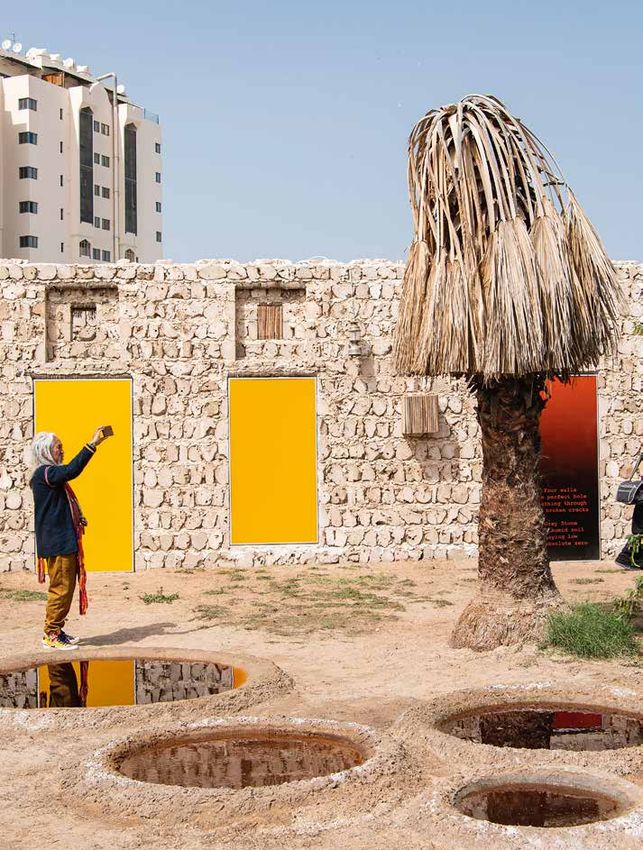
For the 14th Sharjah Biennial 2019 Nkanga created a poetic
landscape that reveals its beauty, fragility, scars and potential. In the
courtyard she constructed a large-scale, site-specific installation
consisting of several large, crater-like pits filled with salty water.
Light boxes, in sunset hues, line the garden walls and a multi-
channel sound installation gives voice to a dead palm tree which
Nkanga imagines has succumbed to an addiction to salt water. This
installation won the Sharjah Biennial Prize.
32 KUB Program 2021Otobong Nkanga (with Emeka Ogboh) Aging Ruins Dreaming Only to Recall the Hard Chisel from the Past, 2019 Installation view 14th Sharjah Biennial Photo: Sharjah Art Foundation Courtesy of the artists © Otobong Nkanga, Emeka Ogboh
Otobong Nkanga
Wetin You Go Do?, 2015
Installation view Tate
Modern, London
Courtesy of the artist
© Otobong Nkanga
Otobong Nkanga (born in 1974 in Kano, Nigeria) is a visual
                          and performance artist, who today lives in Antwerp,
                          Belgium. She studied at the Rijksakademie van beeldende
                          kunsten in Amsterdam, and in 2013 she was awarded a
                          scholarship from the DAAD Artists-in-Berlin Program. In
                          2015 Nkanga won the highly endowed Yanghyun Prize,
                          in 2019 was recipient of the Peter Weiss Prize from the
                          City of Bochum and she was awarded the special Mention
                          Award at the 58th International Art Exhibition of the
                          Venice Biennial. Her work examines social and topo-
                          graphical changes in the post-colonial world. She subjects
                          natural resources, both their use as well as their ideal and
                          potential value, to cultural analysis, frequently employ-
                          ing the body and language. Her work has been shown at
                          the Gropius Bau, Berlin (2020), Tate St. Ives (2019/2020),
                          Museum of Contemporary Art, Chicago (2018) and M HKA,
                          Museum of Contemporary Art, Antwerp (2015). She has
                          participated in several large international shows, includ-
                          ing 58th Venice Biennial (2019), documenta 14 in Kassel
                          (2017), Biennale of Sydney (2016), Berlin Biennale (2014),
                          and the Sharjah Biennial (2019 and 2013).

Photo: © Wim van Dongen
KUB Project 2021
Roman Signer
Installation am Bielbach
Bielerhöhe, Montafon,
from June 2021
Installation am Bielbach is a joint project between Kunsthaus Bregenz
and illwerke vkw AG, which was begun two years ago. The Swiss
sculptor Roman Signer pursues an expanded concept of sculpture
that embraces both time and the transformations resulting from
physical effects. In his art, Signer addresses elementary processes,
notions of power transmission, and ones of energy storage and
generation. The collaboration with power company illwerke vkw is
therefore ideal.
An elegant wit and humorous, playful twists inform his artistic
experiments. For Bielerhöhe, Signer has developed a work for the
south side of the reservoir. A stream that flows under a bridge into
the lake will be dammed and fed back into the lake as an arched
fountain across the path. The stream creates an arch of water that is
simultaneously, in turn, a bridge. The absurd manipulation — a water
jet becoming an architectural element, and a liquid element a static
structure and thus a sculpture — is typical of Signer’s work. Here too,
the artist is working with experimental arrangements, in which
force discharges and aggregate transformations occur. The project
will be taking place in spring 2021 in accordance with environmental
protection regulations.
36 KUB Program 2021Roman Signer (born 1938, in Appenzell, Switzerland) is a sculptor,
draftsman, action artist, conceptual artist, and filmmaker. He
lives and works in St. Gallen. The trained structural engineering
draftsman studied at Lucerne School of Applied Arts and the Academy
of Fine Arts in Warsaw. Since the 1970s his works have been shown
in numerous exhibitions in galleries and museums in both Switzer-
land and abroad. Roman Signer has been recognized as one of the
most significant European contemporary artists working today, since
participating in documenta 8 in Kassel (1987), Skulptur Projekte
Münster (1997), as well as the Venice Biennial (1999).
37 KUB Program 2021KUB Collection Showcase 2021
The König-Lebschik Collection
26 | 06 — 29 | 08 | 2021
Extended Thomas König and his late wife Erika Lebschik collected original
Opening:
prints by international artists for almost forty years. Born in
Friday,
June 25, 2021, Vorarlberg and long-time resident of Vienna, the collector maintains
3 — 8 pm good contacts with both galleries and artists. The extensive König-
Lebschik Collection covers the entire range of printmaking, from
woodcuts, silkscreen prints, etchings, and lithographs, via artist
portfolios and posters, to books with limited edition prints.
One of the focuses of the collection is on international and
Austrian contemporary art and their pioneering names, including
such well-known artists as Pierre Alechinsky, Iris Andraschek,
Karel Appel, Max Bill, Alexander Calder, Eduardo Chillida, Gunter
Damisch, VALIE EXPORT, Bruno Gironcoli, Franz Graf, Martha Jun-
gwirth, Maria Lassnig, Joan Miró, Arnulf Rainer, Daniel Spoerri,
Mark Toberg, Günther Uecker, Antoni Tàpies, and Franz West. The
approximately 3,000 objects are now being presented as a gift to
Kunsthaus Bregenz.
Next Page: A representative selection of the König-Lebschik Collection
Original prints of
the König-Lebschik is being exhibited in summer 2021 at the KUB Collection Showcase in
Collection the Post Office building in Bregenz for the first time.
38 KUB Program 2021Thomas König Photo: Angela Lamprecht
KUB Summer Open Air Concert
Cari Cari in September 2020
Photo: Alicia Olmos Ochoa

                              KUB 2021
                              KUB Summer — Open Air

                              The KUB Summer Open Air has become an integral part of public life
                              in Bregenz. We are very pleased that we will be able to continue
                              the cinema season in 2021 despite the difficult conditions that such
                              events continue to face. What distinguishes our summer cinema
                              program is that all the films are being personally selected by artists
                              exhibiting at KUB in 2021. Let yourself become immersed in the in-
                              spiring cinematic worlds of Jakob Lena Knebl, Ashley Hans Scheirl,
                              Pamela Rosenkranz, Anri Sala, and Otobong Nkanga, when the KUB
                              square declares: let the film roll!

           41                 KUB Program 2021
KUB 2021
Billboards
The Billboards along Seestrasse in Bregenz are an integral part
of the program at Kunsthaus Bregenz. They expand the respective
exhibitions at KUB into public space. In 2021 six billboards by Jakob
Lena Knebl, Pamela Rosenkranz, Anri Sala, and Otobong Nkanga will
be making the public aware of the exhibitions at Kunsthaus Bregenz.
42 KUB Program 2021Kunsthaus Bregenz
Review of the Year 2020
43 KUB Program 2021KUB 2020
Review of the Year
2020 was an extraordinary year, and not least for art and therefore
Kunsthaus Bregenz. To quote the title of the KUB special exhibition
following the lockdown — they were indeed Unprecedented Times.
The first exhibition in 2020 was dedicated to the US artist Bunny
Rogers. Her exhibition Kind Kingdom impressed with expansive in-
stallations that staged the subject of death and thoughts of death,
memory, solidarity, and mortality. A shower room was tiled, a lawn
was laid, and LED fireflies flickered in the darkened foyer in front of
a burial mound. The exhibition recorded more than 7,300 visitors until
its premature closure because of the coronavirus on March 13, 2020.
Even after the lockdown, the work KUNSTHAUS by the Vorarlberg
artist Anne Marie Jehle, who died in 2000, remained on the lakeside
façade of the Zumthor building as a sign that was extensively visible
to the outside world. The KUB façade project was developed in
collaboration with the Anne Marie Jehle Foundation, Vaduz. The
limited edition T-shirt that was made available on the occasion of
the project became a big hit in terms of sales.
The team at Kunsthaus Bregenz reacted quickly and capably to
the change in circumstances during the period of closure. The strong
online presence built up over many years could be used in a targeted
manner: at kunsthaus-bregenz.at and on social networks, under
the newly developed KUB Digital section, a changing focus on con-
tent was updated almost daily, including photos and videos from the
history of KUB, online workshops by the outreach team, as well as
looks behind the scenes. The objective of all these digital activities
was to strengthen KUB’s presence and continue the conversation,
even during the period when the institution was closed due to the
coronavirus. For example, the exhibition Bunny Rogers — Kind
Kingdom, which was closed ahead of schedule, was documented by
publishing exclusive photographs online showing the transforma-
tions that the installations, which were no longer accessible to the
public, were undergoing.
44 KUB Review of the Year 2020In addition, new types of programming were introduced: the eight-
part bilingual video series KUB Architektur Shortcuts with Markus
Unterkircher, the technical director of Vorarlberg’s cultural institu-
tions, proved to be popular even with international audiences. In the
newly developed podcast series KUB Sonic Views, director Thomas
D. Trummer has been looking at works from the history of art from
the perspective of the pandemic. More than 50 episodes are cur-
rently available online. A publication based on the series is already
being planned.
Kunsthaus Bregenz was able to further extend its pioneering
position in the international art world with its first exhibition fol-
lowing the closure. On June 5, the exhibition Unprecedented Times
opened, initially with reduced opening times from Thursdays to Sun-
days, until July 1. Helen Cammock, William Kentridge, Annette Mes-
sager, Rabih Mroué, Markus Schinwald, Marianna Simnett, and Ania
Soliman all presented works that were created either during the co-
rona pandemic or in fact presaged the crisis. Kunsthaus Bregenz, in
presenting Unprecedented Times, was the only institution in Europe
that exhibited current pieces of work by seven of the most significant
contemporary artists addressing the corona crisis. This response
to unpredictable, unprecedented times attracted great international
attention. Both media and visitor interest was enormous. It received
positive coverage across all the regional as well as international
media, including an extensive article in The New York Times. Over
14,000 visitors came to see the special exhibition. These extremely
good attendance figures, when considering the relatively short run
of the exhibition and the travel restrictions still in force during the
summer, can also be attributed to the ambitious event and outreach
program that had been adapted to the circumstances. Successful
new types of programming, developed in collaboration with such
various partners as the Bregenz Festival and the Franz Michael Felder
Archive, contributed to the positive response and the strong public
presence of KUB. By the end of 2020, around 168 guided tours for
adults, 122 items in the program aimed at children and young people,
and over 63 other events will have taken place. Consequently the
diverse event and outreach program is comparable to that of 2019,
despite the four-month compulsory complete break due to the
coronavirus and compliance with strict regulations for the organiz-
ing of events.
45 KUB Review of the Year 2020Since September 12, Kunsthaus Bregenz has been dedicated to the
work of Peter Fischli. The wide-ranging and intellectual oeuvre of
the great Swiss artist has been met with great public interest. Until
its premature closure because of the coronavirus on November 2,
5,600 visitors have seen Fischli’s humorously subtle works. Initially,
the exhibition was planned to be on display until November 29.
During the same period, the collaboration with Johanniterkirche
Feldkirch was revived. Since September 26, the sculpture Standbild
by Oliver Laric is being presented there. Around 2,000 visitors have
seen this impressive work by the Berlin-based artist, which has also
been purchased for the KUB collection, until its premature closure on
November 1 in the spaces of the historic church in Feldkirch. Presuma-
bly from December 1, Laric’s sculpture will again be open to the public.
Even if the Peter Fischli exhibition has had to come to an early
end, the team at KUB remained active. To coincide with the 2020 US
election, the video piece Perfect Leader has being screened in the
display window of the KUB Café Bar from November 2.
46 KUB Review of the Year 2020Photo: Alicia Olmos Ochoa Max Almy Perfect Leader, 1983 Video, 4:11 min., color, sound Courtesy of Electronic Arts Intermix (EAI), New York
KUB’s 2020 summer program offered open-air cinema and music on
     Karl Tizian Platz. Under the motto “The Artists’ Choice,” the favorite
     films of artists’ exhibiting in 2020/21 were shown on the big screen.
     With cocktails and snacks from the KUB Café Bar, the open-air cinema
     enjoyed great popularity while complying with all the necessary
     coronavirus regulations, and enriched the life of the town during
     July and August. The open-air summer concluded with the Austrian
     indie rock duo Cari Cari playing on the outdoor stage in front of KUB.
         Scholarly publications which, similarly to the limited editions
     especially developed for KUB, are created in close cooperation with
     the artists, complete the range of activities offered by Kunsthaus
     Bregenz. Worldwide sales, supported by a well-received web shop,
     strengthen the institution’s international standing.
         By the end of 2020, a total of around 32,000 visitors will have
     seen the exhibitions at KUB. When taking into account the four-
     month closure due to the coronavirus, and the resulting travel
     restrictions effecting KUB’s international audience, the very good
     visitor numbers are comparable to those of 2019.
         The Federal State of Vorarlberg contributed € 2.82 million; income
     generated by the institution itself amounted to € 0.5 million. The
     Austrian state’s fund for the acquisition of art contributed € 36,500.

48   KUB Review of the Year 2020
The KUB Year 2020 in Figures
Total number of visitors
* 40,000 2020 (including a 4-month closure)
53,645 2019
48,310 2018
77,237 2017
Visitors
1,286 Raphaela Vogel (from January 1 to 6)
7,328 Bunny Rogers (from January 18 to March 13)
14,202 Unprecedented Times
5,602 Peter Fischli (until November 1)
* ca. 3,000 Jakob Lena Knebl & Ashley Hans Scheirl (through December 31)
2,000 Oliver Laric — Standbild in der Johanniterkirche Feldkirch (until November 1)
Events and Guided Tours
(including a 4-month closure)
* 186 Guided tours for adults
* 122 Program items for children and young people (workshops, guided tours, etc.)
* 63 Additional events
€ 2,822,000 Contribution by the federal state in 2020
ca. € 500,000 Income generated by KUB in 2020 (about 35 % less than the previous year)
€ 36,500 The Austrian state’s fund for the acquisition of art
27.7 Full-time equivalent employees
* estimated projection
49 KUB Review of the Year 2020Photos: Markus Tretter (top left) Miro Kuzmanovic (bottom)
KUB 2020
     Media Coverage

     “The show in Bregenz — a real event!”, it was not just on the TV channel
     ZDF’s aspekte that Bunny Rogers, the first exhibition of 2020, attracted
     attention, both regional and international media interest was
     enormous. “Poetry of transience,” is how 3sat, another TV channel,
     described the stage-like installations, a “sensual experience,” wrote
     Lisa Kammann from the newspaper NEUE Vorarlberger Tageszeitung.
     The Austrian broadcaster ORF carried reports on two of its programs,
     ZIB and Kulturmontag. The artist “reflects on the finite with astonishing
     restraint [...] and without the slightest hint of the over-melodramatic
     or kitsch,” according to Alexandra Wach in the German broadsheet
     FAZ, and Christa Dietrich, in the regional Vorarlberger Nachrichten news-
     paper, was full of praise: “Bunny Rogers has transformed KUB into a
     Gesamtkunstwerk.”

51   KUB Review of the Year 2020
Despite the temporary closure of Kunsthaus Bregenz from mid-March,
the institution continued its presence in the media thanks to numer-
ous activities. KUB director Thomas D. Trummer spoke on the Ö1
radio series Kunst im Kopf and Kulturjournal on Radio Vorarlberg,
and authored columns in Die Presse and artmagazine.cc. Such news-
papers as NEUE Vorarlberger Tageszeitung, Vorarlberger Nachrichten,
Schwäbische Zeitung, and Der Standard carried regular coverage.
The timely reopening at the beginning of June with the group exhibi-
tion Unprecedented Times was met with extraordinarily positive
media interest on TV and radio as well as in print, both regionally
and internationally. An admiring article dedicated to the exhibition
in The New York Times stated: “This exhibition seems to ask us not
only to reflect in real time, but also to take this fraught moment as a
point of departure.” And Almuth Spiegler confirmed in Die Presse:
“KUB director Thomas D. Trummer has achieved a spontaneous coup
with the first corona art exhibition featuring renowned artists.”
Reviews were published in such differing media as NEUE Vorarlberger
Tageszeitung, Kultur, Blättle, and ORF. The broadcasters Arte and
SWR reported: “It can be literally heard in the expansive spaces of
Kunsthaus Bregenz, this cry of the international art scene in reporting
back from isolation.” “The exhibition is a ‘great aid to living through
these times.’ [...] Art that increases the potential for reflection
really helps.” (Christa Dietrich, Vorarlberger Nachrichten), and “also,
KUB is exactly the right place for such an exhibition.” (Antje Merke,
Schwäbische Zeitung).
Peter Fischli’s solo exhibition received extensive international
attention in the spring when it was announced, and again during
the fall when it opened. The exhibition has been much discussed,
frequently controversially, including in many Swiss newspapers such
as NZZ, St. Galler Tageszeitung, and Tagesanzeiger. “Simultaneously
banal and magical,” said Ariane Grabher in Kultur. “[...] and with quite
a bit of humor,” stated Brigitte Kompatscher in NEUE Vorarlberger
Tageszeitung. “Hierarchies are being reversed, expectations under-
mined,” commented Ivona Jelčić, critically but appreciatively in Der
Standard. Arte pointedly stated: “Peter Fischli is playing with us.”
In accordance with the measures to contain the corona pandemic,
Kunsthaus Bregenz was closed once more from November 3 to 30,
2020. Even if the Peter Fischli exhibition has had to come to an early
end, the team at KUB remained active. To coincide with the 2020
US election, the video piece Perfect Leader has being screened in the
display window of the KUB Café Bar from November 2. “[…] quite
appropriate,” stated Christa Dietrich in Vorarlberger Nachrichten.
52 KUB Review of the Year 2020As of November 4, 2020
Instagram
14.000 subscriptions
+ 63 % compared to 2019
YouTube
249.500 clicks
Facebook
9.000 subscriptions
#kunsthausbregenz
7.200 posts
KUB 2020
KUB Digital & Online Media
At the beginning of the year, Kunsthaus Bregenz had already reached
the landmark of 10,000 subscribers on Instagram, one of the most
important social media channels for staying in contact with both
the regional and international art scene. Employing striking images,
our account presented portraits of the artists, images of the current
KUB exhibition, reports on what was going on behind the scenes,
events, guided tours, and the latest news from the institution. In
addition, products from the KUB shop, such as T-shirts for the Anne
Marie Jehle façade project, find their online outlet here. Events, an-
nouncements, and media reports are posted promptly on Facebook.
After KUB was closed at short notice for the first time in mid-March,
the strong online presence that has been built up over many years
was used in a targeted manner to keep visitors up-to-date and make
existing content visible. At kunsthaus-bregenz.at and on social media,
the recently developed KUB Digital tag was updated almost daily
to focus on changing content, such as photographs and videos from
the history of KUB, online workshops by the outreach team, and
looks behind the scenes. The objective of all Kunsthaus Bregenz’s
digital activities is to strengthen its presence and continue the
53 KUB Review of the Year 2020All digital initiatives meet the standards of ex-
cellence that likewise distinguish KUB as a brand.
Kunsthaus Bregenz is a byword for exhibitions
of the highest quality in one of the most beautiful
exhibition venues in the world. Thomas D. Trummer
conversation, even during the period when KUB was closed due to
the coronavirus. For example, the exhibition Bunny Rogers — Kind
Kingdom, which was closed ahead of schedule, was documented by
publishing exclusive photographs online showing the transforma-
tions that the installations, which were no longer accessible to the
public, were undergoing.
In addition, new types of content were being continually pro-
duced: the eight-part video series KUB Architektur Shortcuts accom-
panies Markus Unterkircher, the technical director of Vorarlberg’s
cultural institutions, through Peter Zumthor’s building, showing de-
tails and places that are not normally made accessible to the public.
Dubbed into English, the weekly uploaded episodes are also able to
reach an international audience. The first episode went online just
two weeks after KUB was closed. Additional episodes, KUB Insights,
focused in November on the limited editions and the collection.
In the new podcast series KUB Sonic Views, KUB director Thomas D.
Trummer has, since April, been looking at works of art and art
history from a perspective shaped by the corona crisis. More than
50 episodes are currently available on YouTube and kunsthaus-
bregenz.at, with more to follow. Due to the second lockdown in
November, events like an anticipaded talk between Bice Curiger and
Peter Fischli took place online to reach the audience. KUB’s online
outlets, including the KUB newsletter with over 2,000 subscribers,
will remain a central information and communication tool for both
regional and international audiences.
54 KUB Review of the Year 2020KUB 2020
Outreach & Events
Depending on the exhibition, the KUB outreach team develops tailor-
made formats for a wide variety of interest groups. The outreach
program makes art both tangible and understandable.
For every exhibition, the KUB outreach team produces accom-
panying films that include interviews with the respective artists,
bringing the content closer to visitors. The Entdecker (Explorer) — a
free leaflet for children — conveys the works of art in a playful way
that enables young visitors to be creative themselves.
Happy Friday is an event taking place on the first Friday of the
month. With free all-day admission and short guided tours, visitors
can find out everything there is to know about the artists and the
exhibition. Afterwards participants are invited to a discussion and
for a glass of sparkling wine in the KUB Café Bar. At Art meets
Language, English skills can be refreshed during a guided tour with
native speaker Chris Thomas.
The subject matter of the exhibition by Bunny Rogers — grief and
youth culture in American high schools — served as an inspiration
for new formats: The Vorarlberg regional theater’s youth club 16+
used the stage-like installations for a moving performance. At a
55 KUB Review of the Year 2020crowded poetry slam, slammers developed enthralling contributions.
The American artist concluded the events herself, at a reading she
read poems she had written while preparing for her exhibition in
Bregenz. During the lockdown, the outreach department published
online workshops, on KUB Digital and social media, with handicraft
suggestions for children. An interactive web tour through the unique
architecture of Kunsthaus Bregenz is currently being produced and
will go online shortly.
The reopening of Kunsthaus Bregenz with the exhibition Unprece-
dented Times was enthusiastically received during an extended
opening, despite numerous restrictions. All the events as well as
the daily free introduction to the exhibition by members of the KUB
team were eagerly attended. The full-day, two-week children’s
summer workshop was completely booked out.
There was also an ambitious accompanying program planned
for the exhibition by Peter Fischli. Academic Annegret Braun spoke
about seeking and finding happiness, Mirjam Steinbock discussed
with guests from a wide variety of professions a question that is
currently particularly topical: how do we work today? A new series
of talks was also started with artists whose works have been re-
cently acquired for the KUB Collection.
Due to the early end of the exhibition on November 1, 2020, as a
measure to contain the corona pandemic, all events planned for this
Photos next page:
Miro Kuzmanovic period had to be canceled, including the much anticipated discussion
Eva Sutter with Peter Fischli and Swiss artist Kaspar Müller. The talk between
(top row left)
Alicia Olmos Ochoa
Bice Curiger, Peter Fischli and KUB director Thomas D. Trummer took
(top row right) place online.
56 KUB Review of the Year 2020KUB 2020
Summer Program
Open Air Cinema & Concert
Once again this year, a wide-ranging film program attracted numer-
ous visitors to the open air cinema on Karl Tizian Platz during mild
summer evenings. Chosen by the artists currently showing at KUB,
the selection of films left nothing to be desired, from a silent film
classic via gangster drama and psychological thriller to documentary
and artist films, all genres were represented.
Anri Sala kicked off the film season in a cheerful manner with
City Lights (1931) by Charlie Chaplin. The documentary Heaven
Adores You (2014) tells the moving life story of the musician Eliott
Smith through to his untimely death. In the thriller Requiem for a
Dream (2000), the audience followed the tragic cases of four drug
addicts and their broken dreams. Both films provided deep insights
into subject matter occupying the artist Bunny Rogers.
From a large selection of films by Dora Budor, two films made it
into the program. The drama Neighboring Sounds (2012) accompanies
the fictional residents of a block of flats in Recife, Brazil, whose
everyday life is gradually transformed after the arrival of a private
security company. In the Chinese drama Ash is Purest White (2018),
its main protagonist Zhao Qiao fights for love and justice.
The Point of Least Resistance (1981) and The Way Things Go (1987)
by artist duo Fischli/Weiss provided a foretaste of Peter Fischli’s
solo exhibition in the fall. The musical highlight was the Austrian
indie rock duo CariCari who shook the square in front of KUB in
September. Sold out within a very short time and thanks to vigilant
visitors, the concert was the best proof that partying and dancing
Photos next page:
are possible at a distance, for which we would like to thank all
Alicia Olmos Ochoa visitors to KUB!
58 KUB Review of the Year 2020KUB 2020
Publications
Kunsthaus Bregenz publishes catalogues in close collaboration with
artists as well as renowned graphic designers. The graphic design
of the catalogues accompanying the exhibitions reflects both the
subject matter and visual language of the respective artists, so that
each catalogue not only provides documentation, but also becomes
part of the work and an extension of the exhibition. Conceived to
be bilingual, the publications are intended for sale at KUB as well as
for worldwide distribution.
The publication for the exhibition by Ed Atkins presents a wealth
of visual material. Various aspects of Atkins’ works are examined in
three essays and an interview with the artist.
The installations by Raphaela Vogel which were presented at
KUB are documented in large-format photographs in the catalogue
to accompany the exhibition. Various essays, including ones by Die-
drich Diederichsen and Thomas D. Trummer, expound on Vogel’s
filmic and sculptural work.
The design of the book Bunny Rogers — Kind Kingdom is a unique
continuation of the work’s defining ambivalence located between
poetry and mourning, which essays by Elisabeth Bronfen, Thomas
Macho, and Thomas D. Trummer address in particular. Poems that
Bunny Rogers authored during preparations for the exhibition in
Bregenz are being published here for the first time.
Considerations of selected works from art history, initially pub-
lished online as KUB Sonic Views, in which Thomas D. Trummer ad-
dresses the precarious sense of life during the corona crisis, have
been compiled in a richly illustrated book.
In addition, a KUB diary is being published for the first time. The
design of the pocket diary for 2021 adopts the aesthetics of Kunsthaus
Bregenz and includes photographs of the building’s architecture
together with highlights from recent exhibitions.
In 2021 publications are being planned to accompany exhibitions
by Jakob Lena Knebl and Ashley Hans Scheirl, Pamela Rosenkranz,
Anri Sala, and Otobong Nkanga.
For the Peter Fischli exhibition, an artist’s catalogue book largely
conceived by Fischli himself and including numerous essays is being
published.
60 KUB Review of the Year 2020Ed Atkins German | English Raphaela Vogel German | English Bunny Rogers German | English
Edited by Thomas Hardcover, Edited by Thomas Softcover, Kind Kingdom Hardcover, linen with
D. Trummer, 13 × 15.7 cm, D. Trummer, 24 × 30 cm, Edited by wrap-around band,
published by 576 pages published by 224 pages Thomas D. Trummer, 19 × 28 cm, 224 pages
Kunsthaus Bregenz Date of publication: Kunsthaus Bregenz Date of publication: published by Illustrations:
Essays by Helen January 2020 Essays by Diedrich December 2019 Kunsthaus Bregenz 86, all color
Marten, Thomas Price: € 32 Diederichsen, Price: € 42 Essays by Elisabeth Date of publication:
Oberender, and Distributor: Verlag Oriane Durand, Distributor: Verlag Bronfen, Thomas September 2020
Steven Zultanski, an der Buchhandlung Thomas D. Trummer, der Buchhandlung Macho, and Thomas Price: € 42
interview between Walther König, and Vera Palme Walther König, D. Trummer, an Distributor: Verlag
Ed Atkins and Cologne Graphic design: Cologne interview between der Buchhandlung
Thomas D. Trummer Studio Marie Lusa Thomas D. Trummer Walther König,
Graphic design: and Bunny Rogers; Cologne
HIT Studio poems by
Bunny Rogers
Graphic design:
Stefan Gassner
Diary 2021 Thomas D. Trummer
Published by Bilder in der
Kunsthaus Bregenz Pandemie
Graphic design: Published by
Stefan Gassner Kunsthaus Bregenz
Bilder in der
German | English Graphic design:
Pandemie
Hardcover: ap- Stefan Gassner
Thomas D. Trummer
prox.17.8 × 11 cm, German
approx. 128 pages Softcover,
Date of publication: approx. 12 × 19 cm,
November 2020 Kunsthaus Bregenz approx. 256 pages
Price: approx. € 20 Date of publication:
December 2020
Price: approx. € 20
61 KUB Review of the Year 2020Bunny Rogers
“Awareness Brick”
Gift Basket, 2020
Limited edition
of 10 copies
€ 3,000 — 5,900
incl. 10 % VAT, excluding
packaging and shipping,
custom duties
Photos: Markus Tretter
KUB 2020
Limited Editions
Exclusive special editions for Kunsthaus Bregenz are a result of
close collaboration with artists and their production processes.
Developed together with the artists and from within the context of
their exhibitions, the works are published by KUB as limited edi-
tions, making them particularly attractive to collectors of contem-
porary art. In 2020 limited editions were published to accompany
the exhibitions by Raphaela Vogel and Bunny Rogers. Peter Fischli
has meanwhile conceived a series of unique originals for KUB.
The piece for KUB by Raphaela Vogel, In festen Händen V, is a
limited edition of small sculptures. The filigree lion makes reference
to works in her exhibition Bellend bin ich aufgewacht, 2019 at KUB.
For her KUB limited edition Gift Baskets, Bunny Rogers adopted
the American custom of mourning baskets whose contents are put
together personally. The individually conceived baskets by Bunny
Rogers representing the subject matter of the exhibition Kind King-
dom are a symbol of loving mourning and remembrance.
The series of unique originals that Peter Fischli created for Kunst-
haus Bregenz display amorphous forms made of paper, which are
laminated onto white supports. The series of Papierarbeiten was
created in spring 2020 in preparation for the exhibition in Bregenz.
62 KUB Review of the Year 2020Peter Fischli
Papierarbeiten,
large, 2020
Paper in a Plexiglas
frame, 42 × 51 cm
12 unique
originals, signed
€ 4,800
Peter Fischli
Papierarbeiten,
small, 2020
Paper in a Plexiglas
frame, 36 × 50 cm
12 unique originals,
signed
€ 4,200
Raphaela Vogel
In festen Händen V, 2020
Polyurethane elastomer,
30 × 20 × 20 cm
Limited edition of 25
copies, including
certificate, signed
and numbered
€ 2,400
Markus Schinwald
Ohne Titel, 2009
Carbon print,
50 × 120 cm
Limited edition of
30 copies, signed
and numbered
€ 2,500 *
*incl. 10 % VAT, excluding
packaging and shipping,
custom dutiesPhotos:
Markus Tretter
KUB 2020 Alicia Olmos Ochoa
(3. row)
BillboardsKUB 2020
Behind the Scenes
Cosima von Bonin, Ute Denkenberger carefully unwraps the oversized purple plush
Moritz von Oswald
bunny with floppy ears. Usually it is wrapped in a Tyvek cloth in a
THE BONIN / OSWALD
EMPIRE’S NOTHING custom-made wooden box, now it is being carefully examined for
#04 (CVB’S PURPLE KIKOY shipping. The loan request comes from Kunstmuseum Ravensburg
SLOTH RABBIT ON PINK
TABLE & MVO’S KIKOY
for the exhibition Auszeit. Von Pausen und Momenten des Aufbruchs.
SONG), 2010 Cosima von Bonin’s “exhausted rabbit” (Purple Kikoy Sloth Rabbit,
From the KUB exhibition
2010) is particularly popular with exhibition venues and is one of the
The Fatigue Empire, 2010
works most lent from Kunsthaus Bregenz’s collection. It travels on
average once a year.
65 KUB Review of the Year 2020You can also read


