Laptop Learning Program 2019 - GLENUNGA INTERNATIONAL HIGH SCHOOL International Mindedness - Glenunga International High ...
←
→
Page content transcription
If your browser does not render page correctly, please read the page content below
GLENUNGA INTERNATIONAL HIGH SCHOOL
Harmony
International Mindedness

                                                             Laptop
                                                           Learning
                                                           Program
                                                               2019

                           Department for Education and
                           Child Development T/A South
                           Australian Government Schools
                           CRICOS Provider No. 00018A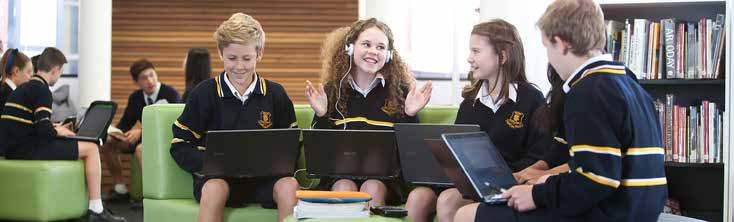
2019 Year 8 Laptop Learning Program

Parents/Caregivers please note:
We advise that you do not purchase a laptop for your son / daughter from an external provider because
licensing arrangements prevent the school from providing access to software and resources on non-
school devices. Participation in the school Laptop Learning Program supports all relevant access.

Equipping all students with their own laptop is essential to the school’s vision of delivering 21st century
learning in all subject areas. Laptop technology enables teachers to personalise learning to a student’s
level of readiness and to provide anywhere anytime access to a rich array of resources. It enables stu-
dents to collaborate in and out of school, to learn at their own pace, interact with class mates and
teachers outside the classroom, access course material as required, interact with experts and students in
other places in real time, and get faster feedback. Students tell us that they have a perception of more
teacher time focussed on them when they are involved in a technology-based learning environment.

Why has this model of laptop learning been chosen?
• It is more equitable and in keeping with our school value of harmony: it eliminates the competition
  that younger students often feel when their peers are using more expensive devices.
• It is more efficient for students when they are following teacher instruction and when they are work-
  ing collaboratively together in groups.
• Activities can be monitored because every computer is fitted with tracking and filtering.
• It provides students with an 8 hour battery because recharging of devices is not possible at school.

What does a laptop program do to the relationship between student and teacher?
You may wonder if the use of technology diminishes the role of teachers. Our experience has been ex-
actly the opposite: teachers use technology to personalise learning; to support students who need accel-
erating or those who have missed lessons; abstract concepts are able to be more clearly demonstrated;
teachers monitor students’ work more precisely; and they are able to spend more time supporting and
challenging every student to achieve their personal best.

What is involved in the Laptop Learning Package?
PLEASE NOTE: Final details of the 2019 laptop program will be available in September 2018. We will
send you an updated description of the laptop’s specifications and cost. However the 2018 laptop speci-
fications (see next page) can be used as a guide.

                                                                                                          1
VISION AND RATIONALE                                                 The ‘asynchronous’ (anywhere/anytime/any level) nature of
Our aim is for all students to have access to technology that        personalised learning is a key feature that is well supported
enables them to learn effectively anywhere, anytime, and             by an online learning environment. Online platforms such as
at any level. Technology offers opportunities to personalise         MOODLE and GOOGLE Classroom enable teachers to create
learning for students; in effect, allowing them the flexibility to   personalised learning environments for students.
take their learning to a deeper level or to move at a different
pace as well as more choice in the work they do. Feedback
from students is that they want to work collaboratively
sharing ideas and interacting with their peers, both at home
and at school. Students have also said that technology helps
to personalise their learning because they can connect with
their teacher one to one when they need it.
Some early research (Newhouse CP 2008; McWilliam E 2009;
Brosson R 2008) has shown that students who use computers:

    • Learned to explore and represent information
      dynamically and in different forms
    • Became more socially aware and confident
    • Were able to communicate effectively about complex
      processes
    • Became self-motivated independent learners
    • Mastered content quickly and shared their
      understanding spontaneously                                    Whilst MOODLE is used as a platform for curriculum delivery
    • Gained the ability to work collaboratively                     the school uses Daymap as an online portal for communication
    • Developed a positive orientation towards the future            between students, parents and teachers. Daymap is used for
                                                                     lesson timetables, attendance and homework. Students use
PERSONALISED AND ‘FLIPPED’ LEARNING                                  Daymap through their laptops to assist with their personal
The concept of personalised learning requires a rethink              organization in place of paper diaries. In addition Daymap
of schooling. The image of a traditional classroom with a            communicates key assessment deadlines, test results and
teacher at the front as the font of all knowledge needs to be        end of term reports. Parents are provided with a unique log
balanced by other forms of learning as part of the transition        in to the Glenunga Daymap portal so that they can access
from 20th to 21st century learning. A personalised learning          information relevant to their student’s work, attendance and
environment values the needs, interests and learning styles          progress.
of the student as well as the curriculum requirements as part        Teachers and students also use the innovative educational
of the partnership between teachers and students.                    features offered by Google, such as Google Docs, Google
                                                                     Classroom, Google Drive and Google Apps for Education.

                                                                     LAPTOP USE
                                                                     The Laptop Learning Program is a partnership between
                                                                     the school, family and student. Students are coached and
                                                                     expected to use the laptops responsibly. We understand
                                                                     family concerns about accessing inappropriate material,
                                                                     cyber bullying and time spent gaming and on Facebook.
                                                                     Guidelines for use of the laptop are:
                                                                     1. Only to be used during a dedicated time frame at home
                                                                          and for students to have non-screen time prior
                                                                     2. Only to be used in a public area of the house where
                                                                          parents can easily supervise. Not to be taken into the
                                                                          bedroom.
                                                                     3. Regular checks of the machine by the parent.
                                                                     4. Open discussions about the balance of ‘consumption
                                                                          versus creation’ in terms of laptop usage.
                                                                     Our students have learnt to use the machine in ways
Technology is making it possible for learning to occur in            that minimise damage, ensure that they do not access
different ways. Glenunga teachers are using strategies like          inappropriate material nor use the computer to adversely
“flipping the classroom” to improve learning for students.           affect the well being of another person inside or outside
This means that teachers are using vodcasts and podcasts             school. (See Cyber Safety section). Behavioural consequences
to enable students to access learning at home that prepares          apply to students who do not use the laptop responsibly
them for the complex thinking required in their next lesson.         whether it occurs in school or out of school. Any illegal
They are also able to use these resources to review the              behaviour is reported to the Police.
learning from the day’s lessons.                                     Printer drivers have been installed to ensure students have

2
access to printing at the school. Families with their own           of the school’s software licensing arrangement. To do this
printers need to install and manage their own printing system.      the final ownership payment can be deferred. However
The school cannot produce an image that will encompass              families need to take note that because the warranty period
the vast range of printers that students will have at home.         expires after three years, they need to take all responsibility
To facilitate this, all students have administrative permissions    for repairs and maintenance which may include battery
to their own devices. If the school detects any misuse of a         replacement.
laptop, or if a request is received from a parent, this level of
                                                                    Use of Non Recommended Laptops
access can be removed.
                                                                    If a student chooses to bring their own laptop to school it
                                                                    must have an 8 hour battery as external power sources are
                                                                    not permitted. The school will provide a monitored internet
                                                                    connection. Access cannot be given to school licensed
                                                                    software nor the school network which includes printing.
                                                                    Students with private laptops will not be able to receive
                                                                    the full support level that IT Services are able to provide.
                                                                    E-subscription keys that allow access to online resources will
                                                                    be issued by applying to the Learning Hub staff.

                                                                    PARTICIPATION AGREEMENT
                                                                    Families sign an agreement indicating their acceptance of the
                                                                    terms of their student’s participation in the Laptop Learning
                                                                    Program. The agreement covers a range of areas including:
                                                                       •     Procurement and disposal.
                                                                       •     Commitment to pay
2019 OWNERSHIP MODEL
                                                                       •     Acceptable use.
Families pay for the laptop by instalment over three years.
When families make the final payment to cover the cost of              •     Cyber safety.
the machine or when the student leaves the school, the                 •     Family responsibilities.
laptop will be re-imaged for continued use by the family. This         •     Non school applications and files.
purchasing model means:                                                •     Transfer of ownership.
   • Software licensing is covered by DECD agreements.              The following pages provide further information about these
   • The family does not have to pay for the manufacturer’s         areas.
      three year warranty.
   • Students have a consistent brand and model that is             EARLY RETURN POLICY
      imaged to connect efficiently to our school’s wireless        If the student leaves the school before the end of the
      network and this makes it more effective for teachers         agreement families may purchase the computer by paying
      and students to work together.                                the balance of the required payments for ownership of
   • Students are provided with a high security combination         the laptop. At this point the licensing arrangements will no
      lock and a padded carry bag.                                  longer apply so all software licensed to the school will need
                                                                    to be removed and a basic image supplied to the family.
   • Purchases are at whole of government rates.
   • Access to quick turn around manufacturer’s repairs
      and a ‘hotswap’ loan machine.

Where students enrol after the school year has commenced
the Finance Office will create alternative payment
arrangements.
Families pay the majority of the cost of the laptop in the first
twelve months of this agreement. The final payment will
occur in the third year of the life of the laptop.
The 2019 payment schedule has been drafted as follows: $400
initial deposit in December 2018 followed by a $400 payment
in March 2019, $550 payment in September 2019 and the
balance of $5 as a final payment to transfer ownership from         If the student leaves the school during Term 1 of the
the school to the family, upon leaving GIHS                         agreement and does not wish to complete the purchase,
                                                                    a pro rata refund will be paid to the family subject to the
The HP Laptop comes with a three year manufacturer’s                condition of the computer on its return. The school will not
warranty arrangement which covers faults in the machine.            refund contributions after Term 2.
Please note: it does not cover damage caused by accidents or
natural wear. It is not insurance. At the conclusion of the three
year warranty period students are encouraged to continue
using the laptop in Years 11 and 12 so as to take advantage

                                                                                                                                  3
CARE AND RESPECT (LOSS, DAMAGE, THEFT)                            computer. Bags provide limited protection for the laptop so
WARRANTY AND INSURANCE                                            it will need to be handled with care to prevent damage. It
The laptop computers are covered by a standard three year         is important that other items are not placed on top of the
manufacturer’s warranty that covers hardware failure. The         laptop. It is not advisable to move the laptop around when it
school’s IT Services assess and oversee all laptop warranty       is switched on and it needs to be switched off before putting
claims in collaboration with the manufacturer’s local agency.     it away in the bag to prolong battery life and prevent over
The three year warranty does not cover damage caused              heating. Direct sunlight and heat also need to be avoided.
by dropping a laptop such as a broken screen, removal of          Moisture and fluids are very bad for laptops so water bottles
keyboard keys or water damage. Families are encouraged to         need to be kept away from the laptop when it is stored in a
make enquiries about extensions to their existing Home and        backpack. Screens can break very easily so they need to be
Contents insurance policies to cover accidental damage and        treated gently.
theft. It is important that parents and/or caregivers provide
                                                                  During the school day when the computers are not being
strong guidance about appropriate care and handling of the
                                                                  used (eg lunchtime, during PE), the device needs to be
laptop. The school cannot pay for ‘accidental’ damage.
                                                                  securely stored in the student’s locker. The computer must be
                                                                  properly powered off to preserve battery life and to prevent
                                                                  heat build up.
                                                                  Outside of school students will need to keep their laptop
                                                                  in their back packs in a laptop bag and to never leave their
                                                                  bags unattended. Students are advised not to remove their
                                                                  laptops from their bags in public environments that may be
                                                                  unsafe (eg in the city or a shopping centre).
                                                                  If a lost laptop is found, students need to take it to The
                                                                  Learning Hub immediately for identification and return to
                                                                  the student.

                                                                  POWER AND BATTERIES
                                                                  The laptops have been fitted with 8 hour batteries to ensure
                                                                  that students can run the machine throughout the length
                                                                  of the school day. Students are required to recharge their
                                                                  batteries at home each night so that the machine is ready
If a laptop is damaged students bring the device to IT Services   when they come to school each morning. Modern battery
located in The Learning Hub where its condition will be           technology has improved greatly over recent years, however,
assessed. If the damage is due to hardware failure the school     batteries have a finite life. It is recommended that families
will organize for the device to be repaired under warranty        purchase a new battery after 3 years of normal usage.
arrangements. If the damage is seen as the result of an           Students will not be permitted to recharge batteries at
accident IT Services will request a quote for repairs from the    school and cannot bring power supplies from home to
manufacturer, which will be communicated to families as a         charge their laptop batteries at school due to safety and
written quote. Once family approval is granted the repairs        security requirements. To support students in the short term,
will go ahead and Finance will invoice the family. Whilst         monitored charging stations are set up in the Learning Hub.
the repairs are undertaken the students will be provided
with a “hot swap” loan machine. In most cases repairs are         Behavioural procedures have been put in place for students
conducted promptly. Behaviour consequences will apply             who come to lessons with a flat battery. In the first instance
to students if damage is seen to be due to irresponsible or       students will be able to borrow a loan laptop from The
repeated behaviour.                                               Learning Hub on a short term basis, to be returned at the
                                                                  end of the school day. If a student comes to lessons a second
The school does not have the funding to cover the insurance       time with a flat battery, or without a laptop, this action will
of these laptops. Families are encouraged to seek advice
from their insurance providers regarding insurance cover.
If the laptop is lost, stolen, or damaged through student
negligence then the family will be invoiced to replace or
repair the laptop.
All students in the Laptop Learning Program are provided
with a high security padlock to secure laptops in assigned
school lockers during breaks and when the laptop is not
required. Padlocks are a combination style lock and are
supplied with a five year warranty. The school will have a
master key override in case of emergency.
Another essential security item is a laptop bag which is
provided in the laptop purchasing arrangement. All students
use the padded laptop bag to carry and store their laptop

4
be seen as failing to be prepared for lessons. Consequences
will be applied through the subject teacher and/or Sub
School Leader. Students can leave their laptops at IT Services
for a ‘top up’ charge during the day if they see the charge is
diminishing.

SOFTWARE
Each computer will have a standardised custom software
image configured for use on the school network. The image
will contain operating software, antivirus software, Microsoft
software and many other applications that students will use
in their various subjects. The laptops will run a 64 bit profile
with Windows 10 and Microsoft Office 2016 Enterprise
software package. The school will also provide students
with access to additional software (such as the 2018 Adobe
Creative Cloud Suite) for installation as required by their
subject choices. This software is covered by the school’s own
licensing agreements and must not be distributed or deleted.        a quota allocated on a term basis according to their year level.
Families sign a Software Users Agreement when the student           Students can purchase additional printing quota if required.
is issued with a laptop.
                                                                    Students are expected to use the school’s internet facilities
In some cases families access the internet at home through a        responsibly. This means respecting copyright laws and not
USB “dongle”. Students are supplied administrative privileges       illegally downloading materials. Large files like videos can
to their devices to facilitate installation and configuration of    quickly use up the student’s quota. If students exceed their
these devices.                                                      quota or breach the download rules then they will have
                                                                    their access restricted and behaviour consequences will be
BACKUP AND STORAGE
                                                                    applied.
Students need to backup important work. It is recommended
that backups occur in at least three locations - a copy on the
                                                                    Students are able to monitor their printing and internet use
laptop itself, a copy on an external USB drive, and a copy in
                                                                    to assist in their self management of available resources.
the GIHS Google Drive or network drive. Portable USB drives
can be restricted by the laptop carry case and cause damage
                                                                    NETWORKS AND NETWORK SECURITY
to the case, the drive, or the laptop itself. Portable drives and
                                                                    GIHS’s network policy will enable students to switch to home/
other devices need to be stored outside of the laptop carry
                                                                    private wireless networks for internet use only when outside
case and not be left connected during transport. Students
                                                                    of the school environment. Use of personal hot-spots and
need to back up and store digital files on external drives
                                                                    other technology to circumvent the school’s security systems
while working on their laptops to reduce their risk of loss
                                                                    will result in behaviour consequences. ‘Ad hoc’ networks
by generating multiple copies of their data. Further to this,
                                                                    (standalone wireless networks between two or more laptops)
for added security, students are also urged to backup their
                                                                    are not permitted at school.
laptops on a hard drive which is kept at home.
                                                                    Students are not allowed to connect their laptops to the
                                                                    cabled network unless permission is given by a supervising
Carrying the backup drive with the laptop is not recommended.
                                                                    teacher or IT Services.
Loss of the device increases the risk of irretrievable school
work.
                                                                    Any attempts at network penetration (i.e. “Hacking”) are a
                                                                    criminal offence and will be reported to the Police. Our school
                                                                    deploys a variety of security technologies (such as firewalls,
                                                                    anti-virus, intrusion detection systems, and regular active
                                                                    and passive audits) to ensure early detection and provide
                                                                    safe, accessible learning for students.

                                                                    Students who engage in activities that can be used to gain
                                                                    access to information or services beyond their permitted
                                                                    access such as ‘sniffing’, tampering or ‘capping’ that can
                                                                    impact other students will be referred to their Sub School
                                                                    Leader for appropriate consequences.

                                                                    VIRUS PROTECTION
                                                                    Anti-virus software (Endpoint Protection) and monitoring
                                                                    software are loaded through the initial imaging process.
                                                                    Updates of this software will be scheduled at various times. If
PRINTING AND INTERNET
                                                                    a student machine attempts to connect to the school network
Students are allocated internet quota on a daily basis
                                                                    and is found to have a virus the laptop will automatically be
consistent with their year level’s expected usage. Printing has

                                                                                                                                       5
“cleaned”. If the virus scanning software is unable to clean the
    virus then the infected file will be deleted. Hence the need to
    ensure all work is ‘backed-up’.
    Students should ensure that anti-virus software is kept up to
    date on their devices and regularly check for viruses. Students
    need to be vigilant in protecting their machine from virus
    attack.

    RESPONSIBLE DIGITAL CITIZENSHIP
    The school aims to develop in students an understanding of
    what it means to be a responsible citizen in the digital age.
    We educate students about the positive aspects of digital
    technology and how to use it effectively. Students undertake

    a school program designed to support them to understand
    the responsible use of technology and how to stay safe
    when using technology. We also inform students what to do
    if they are on the receiving end of cyber bullying or receive
    inappropriate messages over the internet. At the same time
    we make students aware of their ethical, social and legal
    responsibilities.

    Cyber bullying uses technology as a means of victimising
    others. It is the inappropriate use of an internet service or
    mobile technologies such as: emails, chat room discussion
    groups, social networking sites, instant messaging, web
    pages or SMS to make another person feel uncomfortable.

    If a student behaves online in a manner that threatens the
    wellbeing of a member of the school community, even if this
    occurs offsite and/or out of school hours, the Principal has
    the authority to suspend or exclude the student. If there is
    reasonable suspicion that a crime has been committed, the
    device will be confiscated and it will be reported to the Police.
    Students would also have their access to their school laptop
    restricted. Please note devices confiscated by the Police are
    not returned.

    The Department for Education has developed a policy and
    guidelines for appropriate use of social media for school
    communities. Information for parents can be accessed at:
    http://www.saasso.asn.au/wp-content/uploads/2012/11/
    Decd-Social-Media.pdf

    Further information and support for families can be accessed
    from the Federal Government’s CyberSmart initiative at:
    http://www.cybersmart.gov.au/

6
APPROPRIATE USE OF THE LAPTOP                                      •   Avoid using inappropriate or offensive language in
These guidelines must be followed to ensure appropriate use            files, folders or class work.
of the computer.
                                                                   •   Manage internet and printing responsibly. Students
                                                                       are advised to check the size of the file before they
1.   Students must take the laptop to all lessons unless the
                                                                       download it.
     teacher has requested otherwise. Teaching and learning
     programs make use of the laptop to benefit students’          •   Avoid modifying or deleting files or folders that
     learning: to assist in inquiry, collaboration and new ways        have been installed by the school on the machine’s
     of demonstrating knowledge. While using the laptop                hard disk or on the network.
     during lessons students will be on-task as directed by
                                                                   •   Avoid bringing to school games or other materials
     their teacher.
                                                                       that could be viewed by others as offensive.
2.   Off-task behaviour such as gaming during class time will
                                                                   •   Understand that taking photographs of individuals
     result in the teacher applying consequences in line with
                                                                       and placing these images on the Internet or in the
     the school’s Behaviour Management Policy.
                                                                       public forum without their express permission
3.   The use of the laptop is on the understanding that students       is a form of harassment. Students should avoid
     follow teacher instructions and access applications and           this behaviour or consequences will apply. If the
     files in safe and ethical ways. Students must not disrupt         student is under age then images are also subject to
     the smooth running of any school IT systems nor attempt           Child Protection Legislation. This means taking and/
     to gain unauthorised access to any system. Students need          or sharing inappropriate images of students under
     to be aware that the school’s behaviour management                the age of 18 (sexting) is against the law and will be
     processes extend outside of school hours and off site.            reported to the Police.
4.   The school reserves the right to monitor the content          •   Avoid using laptop (or mobile phones) with cameras
     of student laptops and may conduct live monitoring of             in change rooms or toilets and be aware that it is
     activity of the laptop. Any images or material on privately       good practice to cover the webcam when it is not in
     owned equipment/devices, such as a mobile phone or                use even in the privacy of their own room.
     USB/portable drive must be appropriate to the school
     environment. Students are required to allow school
     staff and parents/caregivers to perform checks when
     requested and may have “Parental Control” enabled by
     the school at the school’s discretion.
5.   Consequences for inappropriate use will be in accordance
     with our Behaviour Management Policy and may include
     managed privileges at the discretion of Learning Area
     Leaders, Sub School Leaders or Executive Leaders.
     Where a student is suspected of an electronic crime, this
     will be reported to the Police.
6.   Teachers and parents/caregivers may recommend
     students for “Parental Control” where a student will
     have limited privileges and be unable to install software.
     These limited privileges may include websites, times of
     day, software, mail and chat. All students on “Parental
     Control” will have their screens monitored while at
     school and all activity on the laptop will be recorded in
     log files.
7.   Students need to ensure that the laptop is fully charged
     at home and used appropriately during the day so that
     the power charge remains useable for classroom learning
     until the end of the last lesson.
8.   Students need to:
      •   Avoid engaging in cyber bullying of students and/or
          teachers.
      •   Avoid accessing sites containing violent, racist,
          sexist, pornographic or offensive images or language
          or where there is culturally offensive material. If a
          student finds they have inadvertently accessed such
          a site they need to seek help from their teacher or
          IT Services.
      •   Understand that storing and/or transferring sexually
          explicit images also contravenes federal and state
          laws. Police will be contacted if this occurs.
                                                                                                                          7
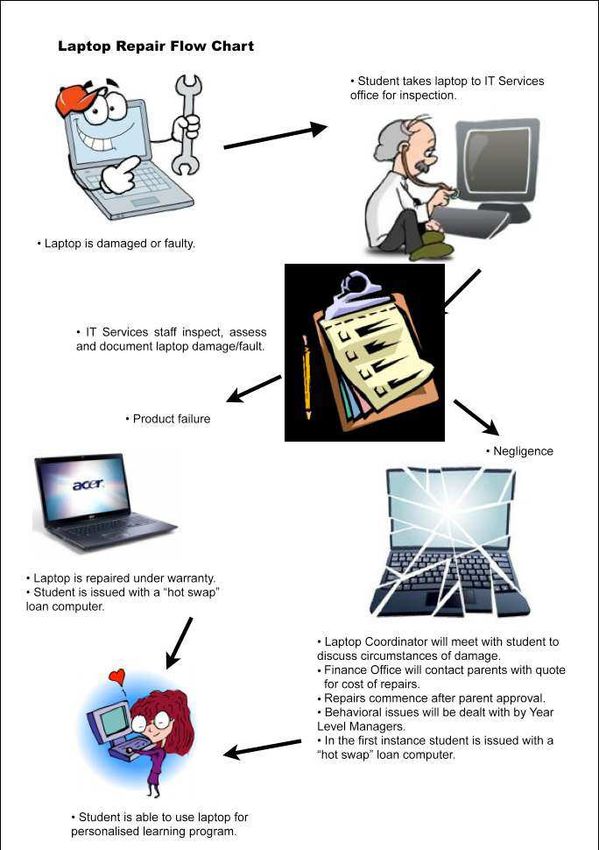
LaptopRepair
Laptop RepairFlow
FlowChart
Chart
Faulty/Damaged Laptop
Laptop Repair Flow Chart
Laptop Repair Flow Chart
Laptop Repair Flow Chart • Student takes laptop to IT Services
in theLearning Hub for inspection.
• Laptop is damaged.
d
• IT Services staff inspect, assess
and document
laptop damage/fault.
• Product failure.
• Negligence
• Laptop is repaired under warranty.
• Student is issued with a “hot swap”
loan computer
• Laptop
Coordinator will meet with student
to discuss circumstances of damage.
•
Finance Office will contact parents with a
quote for cost of repairs.
• Repairs commence after parent approval.
• Behavioural issues will be dealt with by
Sub School Leaders.
• In the first instance student is issued with
• Student is able to use laptop a “hot swap” loan computer.
for personalised learning program.
8
FREQUENTLY ASKED QUESTIONS                                           •   How long will the battery last between charges?
• Can students bring their own laptops from home?                        The laptops are specially configured with longlife batteries
   The 1:1 Laptop Learning Program is designed for all                   to ensure that students can use it all day at school without
   students to be working from identical devices using a                 the need to recharge. It is important that initial battery
   common operating system with a uniform suite of school                conditioning instructions are closely followed to get the
   licensed software. These devices (hardware and software)              best life out of these batteries.
   are fully supported by the school’s IT Services staff.
                                                                     •   Can students install their own computer games and other
   Teachers are provided with training that is specifically
                                                                         personal software?
   directed towards the utilization of the school’s designated
   common platform. This is a policy that was formulated by              Installation of software needs to be compatible with the
   the school’s Governing Council after extensive consultation           supplied Windows operating system. Software installed
   with families who were concerned that a range of machines             without advice from IT Services may have unknown impact
   would promote competition between students. This policy               on the stability and security of the student device and
   also serves to ensure that students are able to access                so it is advisable for students to check with IT Services
   the full range of technology at the school, such as our               prior to installation. Students are provided administrative
   interactive screens, file services, internet link, and printing       permissions to their laptops and are expected to maintain
   environment. For these reasons all students need to                   their own devices. In the event a student laptop has a fault,
   participate in the school’s Laptop Learning Program.                  IT Services will erase and re-install the school “base” image
                                                                         to ensure that a consistent environment is available to each
•   What if a family chooses not to participate in the Laptop            student.
    Learning Program?
    Students will be able to access a school imaged laptop on        •   What software is installed on the laptops?
    a daily basis from The Learning Hub. Special provisions              The basic student image consists of Windows 10 64-bit
    can be made on an individual basis depending on family               Enterprise Edition, Office 2016, supporting software, and
    circumstances.                                                       security software. Students will also be able to access an
                                                                         internal Software Centre (or App Store) to install additional
•   Can a student bring their own laptop computer to school?             software specific to their Learning Area or year level. This
    If a student chooses to bring their own laptop to school             trimmed down approach grants each student greater
    it must have an 8 hour battery as external power sources             control and ownership of their laptop. Students can apply
    are not permitted. The school will provide a monitored               to have Adobe Creative Suite applications installed on
    internet connection. Access cannot be given to school                their school issued laptops under the school’s licensing
    licensed software nor the school network which includes              agreement.
    printing and students will not be able to receive the full
    support level from IT services. E-subscription keys that         •   What system is put in place for virus protection?
    allow access to online resources will be issued by applying          Virus protection is provided by Microsoft’s “System Center
    to the Learning Hub staff.                                           Endpoint Protection” program, or SCEP for short. Following
                                                                         the practice of Defence in Depth, SCEP is only the first line
•   What if I can get a better deal for the same or similar device       of defence in securing student devices.
    at my local electrical megastore?
    The school has a direct relationship with Department for         •   Do the laptops get system and software updates?
    Education approved suppliers. This enables us to negotiate           Yes. Microsoft Updates are automatically downloaded to
    an ultra-low price for large volume of units at a time,              each computer. Students will be automatically prompted
    directly from the manufacturer. Taking into consideration            to perform their software updates, which they may defer
    the installed software, full 3 year warranty, extended               for up to two days. Updates to software installed through
    battery, and technical support, it is highly unlikely that           the Software Centre will be automatic and scheduled to not
    families could match school pricing even on run-out or so            conflict with student use.and scheduled to not conflict with
    called ‘specials’.                                                   student use.

                                                                                                                                   9
LAPTOP LEARNING PROGRAM
Laptop Package - $1395 GST Free**
Extended warranty - $188 [to be paid with deposit, if required]
**(Subject to currency fluctuations & confirming unit price)
HP EliteBook 1040 G4 (14”)
• Intel® Core i5-7200U 1040 G4
• 8GB RAM
• 128GB SSD
• 6 Cell 45 WHr Long Life Battery
• 802.11n Capable Wireless
• Bluetooth
• Webcam Integrated 720p
• Windows 10
• 14” Hardsided Case
Carry Bag and High Security Padlock
Licence fee covered for access to all school software (at school & home)
Deposit: Monday 15 October - Monday 3 December 2018 $400 deposit to
secure order plus $188 Extended Warranty (If required).
Instalment Plan
March 2019 $450
September 2019 $540
Upon leaving or at end of life $5
Upfront Payment
February 2019 $990
Upon leaving or at end of life $5
Please note: in order for the licensing fees for software to be covered by the school,
ownership of the laptop is not transferred until the very end of the three year period or
receipt of final payment.
Any queries please email our Innovative Learning Technologies Leader Darren Macolino at
darren.macolino@gihs.sa.edu or our Deputy Principal Jeremy Cogan at jeremy.cogan@gihs.
sa.edu.au.
*This is as per machine used in 2018. We expect costing to be similar for a
comparable machine in 2019. More details to be provided before the end of 2018.
10NOTES
11You can also read


