Use of blended learning during #FeesMustFall 2016 - University of Pretoria case study - Siyaphumelela
←
→
Page content transcription
If your browser does not render page correctly, please read the page content below
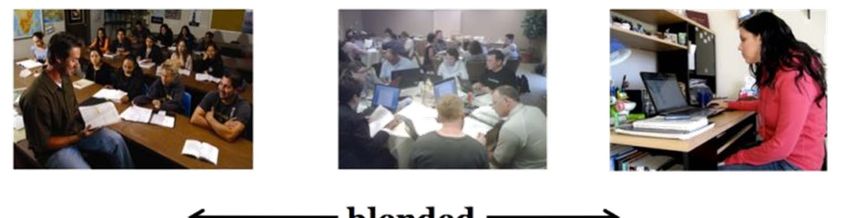
Use of blended learning
during #FeesMustFall 2016
University of Pretoria case study

Detken Scheepers, D Kriel, L Nagel, G Pretorius,
A Smart, M Thukane

 1 June 2018
 Support for this research was provided by a grant from Carnegie
 Corporation of New York
University of Pretoria
Research intensive residential university
Blended Learning - 20 years
Blackboard = Learning Management System (clickUP)
2014: Hybrid Learning: expand online component in each
module
Dept for Education Innovation
Education Consultants (EC) & Instructional Designer/s
(ID) per Faculty
Training to lecturers
Orientation to students in use of clickUP
E-support office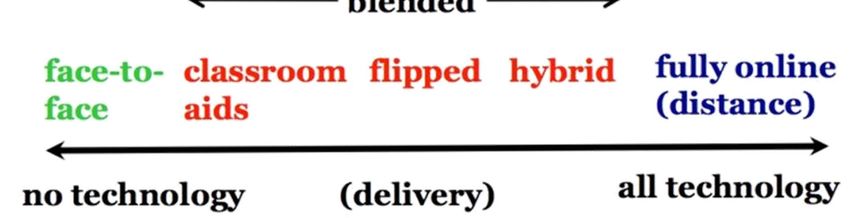
Education technology continuum

http://www.tonybates.ca/tag/blended‐learning/
clickUP(Blackboard) use 2015
           %Modules with clickUP activity/Faculty 2015
120
                      98                           95
100   90                                 91
                                                         83
 80                             77

 60         54

 40

 20

  0

                             2015
Count Course Item Type/Faculty 2015

                                                                                                  17 900
20 000
18 000
         15 008

                                               14 948
16 000
14 000
12 000

                                                                    9 399
10 000
 8 000

                                                                                   4 064
 6 000
                                 2 662
                  2 209

 4 000

                                                                                                                        1 696
                                                          1 543

                                                                                                             1 387
                                                                             838
                                                        676
 2 000
                          433

                                                                            392

                                                                                                                     199
                                                                                                           182
                                         126

                                                                                           73
                                         48

                                                                                                                     38
                                                                                           29
    0
            2015                   2015           2015                2015           2015            2015             2015
             EBIT               Education         EMS             Humanities          Law             NAS            Theology
                                           Content                Assessment               Tool
Supporting students with Hybrid learning Academic Information Management Module/s Free Wi-Fi across all campuses 6257 Computers in computer labs, departmental Labs, libraries & residences Discounted hardware: Student Laptop Inititiative Free software packages: Gmail Google Products Office 365
clickUP use: Student expectations, 2013
          Role of LMS to achieve academic success?
  70.0%                                                                       63.1%

  60.0%

  50.0%
                                                                                      41.2%
                                                                                  37.8%
  40.0%
                                                                         29.0%
                                                                     27.2%
  30.0%                                                          23.7%
                                                    17.9%16.5%
  20.0%
              8.2% 6.6%                        8.9%
  10.0%                              6.5% 4.9%
           2.3%            2.4%
                        0.3% 1.8% 1.8%
   0.0%
          Did not use Not at all      Not very Moderately  Very               Extremely
          in the past important      important important important            important
              year
            University of Pretoria     All non‐US institutions        All institutions
UP closed (2 week
Timeline                                          UP closed              recess)
                                                  7 days                 26 Sept – 10 Oct
                                                  22‐26 Feb              11 Oct – end 2016:
                   UP closed       UP closed
                                                  Violent clash          6 weeks:
                   6 days          9 days
                                                  between Afriforum      Alternative to on
                   21‐26 Oct       12‐20 Jan,
                                                  EFFSC‐UP, SASCO,       campus lectures –
                                   Police action
                                                                         online
 Cultural          26 Oct 8 hour   Sign agreement PYA
                                                  Adapt schedules        Residences open
 supremacy &       occupation      to end
 marginalisation   of CSC          outsourcing    2019 No Afrikaans
 SASCO                                                                       #FeesMustFall
                   Sign memo
                                                                                 2016
                                   #Outsourcing     #Afrikaans
#TuksSoWhite                         MustFall        MustFall
                   #FeesMustFall
                     National
                                                                                 Sept/Oct
                                                                                   2016
                                        Jan            Feb
                                       2016           2016
                                                                 29 Feb onwards:
     April          October                                  Very strict access control
     2015            2015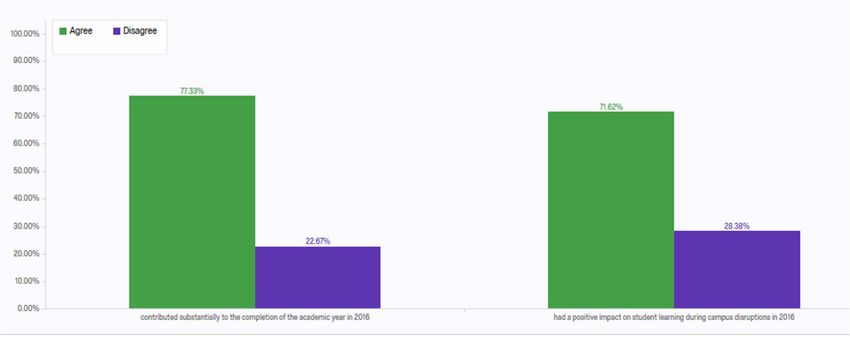
Research question
How has educational technology, including ‘blended/ hybrid
learning’, been deployed during the #feesmustfall campus
disruptions at the Universities of Pretoria and what has been
the impact from the perspectives of students, academic staff,
instructional designers and other stakeholders?

Research design Ubora Research Solutions A sequential mixed-methods research Lecturers, students and instructional designers from the Faculties of Economic and Management Sciences (EMS) Education Engineering, Built Environment and IT (EBIT) Humanities Law Natural and Agricultural Sciences (NAS) and Theology
Data collection

Students                                     Lecturers
Semistructured                                Semistructured
 focus groups        • 33 students              Interviews         • 20 lecturers
  Sept 2016                                     Oct 2016
                 Surveys                                       Surveys
              Oct 2017      • 3304                                        • 181
                                                           Nov 2017,
                            • participants                                  participants
                                                           Jan 2018
                           Thematic                                      Thematic
                            analysis                                      analysis
                             (0pen)                                        (0pen)
                           Descriptive                                   Descriptive
                              stats                                         stats
Data collection Instructional designers (ID): Semi-structured individual interviews 8 IDs. Learning Analytics Reports on clickUP activity 2015, 2016, 2017
10.00%
                                                    15.00%
                                                             20.00%
                                                                         25.00%
                                                                                  30.00%

                     0.00%
                               5.00%
                                                                      20.25%
                                                                            24.52%

                                         7.36%
                                         7.39%

                                                   11.66%
                                                                      21.05%

                                               9.82%
                              2.40%
                                                                                           Faculty representation

n=163
         Lecturers
                                                        14.72%
                                                   11.75%

         Students
n=2060
                                   4.91%
                                        6.56%

                                                                             24.54%
                                                                            25.06%

                             1.23%
                             0.39%

                                       5.52%
                             0.88%
Academic year
(3.47%) (1.01%) (3.18%)
(35.78%) (35.68%)
(20.88%)
n=2074Lecturing experience at a tertiary level in 2016?
3.11%Activity Theory
Outcome:
Impact 2017
Tools Continue Complete Tools
2016 Keep
research
successfully funding
output
Lecturer Student
Object Object
Rules Community Division Division Community Rules
of labour of labourRules that changed
Sept 2015 - Sept 2016:
Full closure for few days
Required only rescheduling of activities
Final exam postponed by a week
Lecturers got used to “Business as usual with a bit of discomfort”
UP closed UP closed
UP closed 9 days 7 days
6 days
#Afrikaans
#Outsourcing
#TuksSoWhite MustFall
#FeesMustFall MustFall
National
Jan Feb
April 2016 2016
October
2015 2015Preparations: Jan-Sept 2016
EMS faculty Jan 2016: 2 training sessions Alternatives to contact
lectures
Instructional designers: Creating Digital Lectures course
Presented 2x in Aug: 44 lecturers (End Aug)
2 x Sept (DHET grant):
65 lecturers end Nov.
Fully online self-help version available Sept 2016
Departmental training sessions
Individual training #FeesMust
Fall 2016
#Afrikaans
MustFall
Feb
2016#FeesMust
Rules that changed Fall 2016
11 October 2016: alternatives to on-campus lectures
All lecture and study material available online
No general access to campus for students
Residences remained open
Lecturers still on campus
25.52% student
respondents never
entered campus
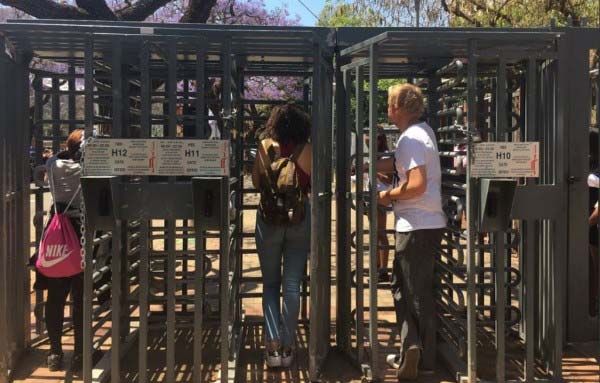
again in 2016Access to campus Lecture halls Practical laboratories Library study space Tutor classes Computer laboratories UP W-Fi
Shift in one day

http://www.tonybates.ca/tag/blended‐learning/
Tools
       Computer access                       Internet access
       • Own (89%)                           • Mobile data (36.81%)
       • Only Mobile (5.97%)                 • Home internet (33.15%)
       • Where I stay (5.33%)                • Residence Wi‐Fi (9.54%)
       • Internet café (3.44%)               • Wi‐Fi @ shops/restaurants (6.28%)
       • On campus (2.71%)                   • Tshwane Wi‐Fi (4.4%)
       • Borrowed (2.68%)                    • UP Wi‐Fi off campus (3.5%)
                                             • UP Wi‐Fi on campus (3.27%)
                                             • Wi‐Fi in commune (3.05%)
                Subject
           • STUDENT                            Object                         Outcome
          • LECTURER                                 • Finish learning second
                                                       semester content
                                                     • Complete research projects

Rules: Access
                                 Community                Division of labour
• No classes
• All lecture and           • Parents, Family & Friends    • Finding a computer
  study material            • Tshwane community            • Buying data
  available online              • Businesses               • Travel to campus
• 3 000 students /              • Schools                  • Organise access to
  day on campus                 • Libraries                  campus
                            • Data providers               • Own data from home
                            • UP: Labs, 3G Cards
Contradictions/Tensions with access
40% of students moved out of Pretoria and could not make use of
access support provided by UP
Some of my students definitely had internet access problems, that I usually do
not worry about, as they have internet access on campus. (Lecturer EBIT_1)
Organising campus access was time consuming
I think it was a disgrace that masters and PhD students were not given "staff"
access to campus.This wasted many valuable hours as supervisors were
scrambling to try to organise access to campus every single day. (Lecturer NAS_1)
Lecturers did not receive the same support with regard to internet
access:
... there was nothing provided to help lecturers with data costs when
exams were scheduled outside office hours. (Lecturer Humanities_1)Contradictions with access
Students did not collect 3G cards
UP did make special provision for students to collect 3G cards from campus
gates but I expect many students who live far away from campus did not
make use of this for the following reasons (i) expensive to travel to UP (ii)
support protest action so do not want to be seen at UP (iii) scared to come to
UP due to protest action (iv) do not have computer or device to make use of
free 3G (v) did not consider the last lecture section to be necessary as they
did most of course already (vi) too lazy/unmotivated to make the effort (vii) did
not consider the course to be important enough as its not their main major
(Lecturer NAS_2)Assessment
Teaching
Communication &
LearningTools
• clickUP Announcements(175,5) • Departmental online portal
• E‐mail(154,8) • Telephone
• WhatsApp(64,23) • SMS
• Bb Collaborate(52,11) • Skype
• clickUP Discussions(37,9) • Announcements on fence
• Facebook (6,6)
Subject Object
• LECTURER Outcome
• Guide students through
• STUDENT learning
• Administrative information
• Information
• Feedback on learning
Rules:
Communication Community Division of labour
• Few institutional messages • Faculties • Emails
• Within Faculties & Departments • Departments • Online presence
• Within modules: • All alone • Expect immediate answers
• Dependent on lecturer • Students • Sent off e‐mails to lecturers
• No class announcements • Lecturers • Created WhatsApp groups
• Peers • Students overwhelmedStudent perceptions about electronic
communications received from lecturers:
All my lecturers Some of my lecturers None of my lecturers n=2069
Are trying their Are concerned Only wanted to Did not really
best to support about my communicate care to
my learning learning and administrative communicate
and success in want to support information, at all
whatever way me to succeed but did not
they can convey any
concern for the
studentsQuotes about communication LECTURER: ....Students were extremely unsure. This created loads of mails which I felt obliged to answer in a short time. .....There were many students that could not come to organized lectures or hand in assignments. This created even more mails. (Lecturer NAS_3) STUDENT: We were overwhelmed with Click-Up notifications that at one point I missed a semester test because of writing down the wrong date. This one event caused a major stress in my life which I felt was not my fault. (Student EMS_1st year_1)
Contradictions/Tensions Communication from “Top” disrupted plans made on lower levels Not all lecturers communicated well Some only communicated administrative information Students communicated via email, while lecturers required communication in discussion boards. Lecturers inboxes flooded: students received no feedback Students overwhelmed by messages. Students focused on communication from clickUP: some missed important messages
• clickUP‐ (91%; 2.67%)
PPTs, Narrated PPTs, Videos, YouTube
• Turnitin (61.65%; 2.26%)
Tools • Google Docs (20%, 2.64%)
• Google Drive (24%, 2.58%)
• Limited contact: Off campus classes, Boot camps
for small groups, Individual contact
Subject
• LECTURER Object Outcome
• Finish teaching second
semester content
• Complete research projects
Rules: T&L
Community Division of labour
• No classes
• All lecture and • (Students) • Content development
study material • Peers • Admin load
available online • Admin staff • Online presence
• 3 000 students / • IDs • Motivator
day on campus • ECs • Research
• Security• clickUP
PPTs, Narrated PPTs, Videos, YouTube
• Turnitin
Tools • Google Docs
• Google Drive
• Limited contact: Off campus classes, Boot camps
for small groups, Individual contact
Subject
• STUDENT Object Outcome
• Finish learning second
semester content
• Complete research projects
Rules: T&L
Community Division of labour
• No classes
• All lecture and • Lecturers (29.89%) • Self study
study material • Family & Friends (45.59%) • Online presence
available online • Peers • Motivator of peers
• 3 000 students / • WhatsApp (30%) • Research
day on campus • Study groups (16%)
• Tutor (3.6%)
• Professional tutor (1.93%)Software used to aid teaching in 2016
OfficeMix PPT without PPT with YouTube videos YouTube Voice recordings
narration narration Created myself/ video links to
my colleagues existing
material
Only before Only during Always Not applicable
disruptions disruptionsLearning Analytics: Multimedia
Count of Multimedia Content Item Types per Faculty
2015 ‐2016
250
209
205
200
169
134
150
122
103
102
100
86
85
74
65
61
54
51
48
45
43
43
42
50
32
29
27
23
23
19
16
14
7
7
6
6
5
3
2
2
2
0
2015 2016 2015 2016 2015 2016 2015 2016 2015 2016 2015 2016 2015 2016
EBIT Education EMS Humanities Law NAS Theology
Audio Image Video YouTubePreparedness of students & lecturers to
use clickUP or other online tools
1.97
Not applicable, did not use online tools
3.38
22.37
Not really prepared/Unprepared
Not prepared at all: I did not know how to
use the tools at all and it negatively
9.33
impacted on my learning and performance.
Mostly prepared: While some of the online
51.97
tools were new to me, I could find out how
33.84
to use them
Fully prepared: No surprises in the use of 23.68
any of the tools 53.45
0 10 20 30 40 50 60
n=153 Lecturer % Student % n=2787Lecturers prepared to adapt to crisis?
I anticipated possible disruptions and planned the complete course
accordingly. Students were pro‐actively informed of our strategy. I
appointed a class captain to coordinate efforts. (Lecturer NAS_4)
we were prepared so our use of available technology was just a bit more
than usual (Lecturer EMS_1)
VS
Unfortunately the exec did not anticipate the disruption, even though
there were many signs. As a result, we (staff and students) were expected
to be reactive and could not plan properly for the use of digital
technology. (Lecturer Humanities_2)Students prepared to adapt to crisis?
For a student going from a learning environment with little self discipline
where there are in most cases another chance to try and succeed to an
environment where succeeding is based mainly on self discipline is a big
jump. (Lecturer NAS_3)
Many students struggle because they can't manage their own time and
rely on contact sessions to force them to stay up to date. (Lecturer EBIT_2)
It requires much more responsibility from them [which, I argue, they are
NOT prepared to do, or at least not used to do]. (Lecturer EBIT_3 )How did your lecturers contribute toward
your PLANNING of your learning during
disruption? (Use the sliders to indicate to what extent each applies, also click for
"not at all")
Uploaded Scheduled Sent Provided Provided Provided
timetable/ work in Announcements dates in online printed
schedule tasks to pace my clickUP Study guide Study
learning Calendar guide
No modules Some modules Most modules All modulesLecturers’ support to students’ studies
Available for Assured Provided Presented Covered
calls from students could additional limited nr of sufficient
students access tutors material to classes on content
to discuss electronically or help students campus before
problems off campus complete shutdown
assignments,
e.g. data for
writing
reportsLecturers’ support to students’ studies
...some lecturers, instead of
completing the module online just
wrote off the remaining work that
needed be covered. A very easy
solution for the exam, although not a
particular advantageous solution to
our future in practice. (Student Law_3rd
year_1 )
Presented Omitted part Presented Provided
limited nr of of the content study “boot material on
classes off camps” before Flashdrives
campus examsLecturers’ support to students’ studies I had "consultations" on whatsapp with my students. (Lecturer EBIT_4 ) ...we motivated to the deans office to allow access for experiments to continue, for students to access computer and other facilities necessary for their research/studies. In other cases I held student meetings office campus, most often at my home. (Lecturer NAS_5) My students were also a particularly determined and self‐sufficient group who adapted well to the changes, and used a great deal of initiative in forming Whatsapp groups and organising sessions in coffee shops off‐campus (Lecturer EMS_2)
Students’ reasons for success n=2084
             1800

             1600         1570
                                                                                                        the vulnerability of my
                                                                                                        situation messed with my
             1400
                                                                                                        head sometimes. But my
                                                                                                        lecturers were all very brave.
             1200
                                                                                                        I could go on if they did.
                                                                                                        (Student_EBIT 1st year)
             1000                              950
AXIS TITLE

              800

                                                                    627                  623                    619
              600

              400

              200
                                                                                                                               122

                0
                                        The support of my                         The caring attitude     The support from
                    I decided to keep                           The mode of
                                        family and friends                         of at least one of      my fellow class
                     going no matter                         learning suited me                                               Other
                                         motivated me to                             my lecturers         mates motivated
                           what                                     well
                                            continue                                motivated me           me to continue
Contradictions/Tensions (Teaching & Learning) Contact classes seen as corner stone of teaching by both students & lecturers Students prepared for use of online tools, BUT not prepared for stronger reliance on self-study Majority of lecturers less prepared to use tools No feedback loop for lecturers to see if students understand work they created for online study. Those that they employ are not well used by students – more of a problem in modules where blended learning was not properly used before closure. No/limited feedback for students to correct misconception Some practical work not finished Despite huge efforts to create online material, some students did not access it
Tools
Semester assessments Final Examinations
• Online MCQ (25.24%, 9.71%) • Online MCQ (10.75%, 4.3%)
• Online assignments (75%, 3.68%) • Online assignments (12.5%, 10.42%)
• Online typed semester test (18.75%, • Online typed semester test (12.5%,
7.29%) 10.42%)
• On campus assessment (46.36% of
students)
• Changed strategies
Subject
• LECTURER Object Outcome
• Complete second semester
assessment & examinations
• Complete research projects
Rules:
Assessment Community Division of labour
• Different in • clickUP Help site (47) • Change assessment
faculties, • Peers (38) • Admin load
departments • Google (22) • Online presence
• ECs (19) • Research
• IDs (15)
• Admin staff (14)
• ITS (7)Tools
Semester assessments Final Examinations
• Online MCQ • Online MCQ
• Online assignments • Online assignments
• Online typed semester test • Online typed semester test
• On campus assessment
(46.36% of students)
Subject
• STUDENTS Object Outcome
• Pass second semester
assessment & examinations
(with distinction)
• Complete research projects
Rules:
Assessment Community Division of labour
• Different in • Lecturers • Learn new technologies
faculties, • IDs • Changed assessment
departments • (Peers) • Online presence
• ((Online) resources) • Research
• (Text books)
• Admin staff
• InvigilatorsRules that changed
Faculties to determine own assessment strategies, entrance to exam
Law: mostly online assessments (almost none before)
EMS:
No electronic assessments unless students had exposure to it
before hand
Exam entrance to all students
Only use year mark if it will benefit student
Entrance to supplementary exams depend on pass rates of
modules
EBIT: All examinations contact, same rules as always
Humanities: None prescribed
NAS: Most exams on campus, some online
Education: Submit electronically/hand in hard copyStudents’ preparedness for types of online assessment?
Fully prepared: 642
Familiar assessment 27.34%
Somewhat prepared:
Some not familiar, could 879
deal using instructions 37.44%
Somewhat prepared: 519
Some not familiar, 22.10%
and I struggled
Not prepared, 186
Could not manage 7.92%
Not applicable 122
5.20%
n=2348Suitability and fairness of assessment: (Students)
EMS Education EBIT Humanities Law NAS Theology
n=2319
Totally Mostly Somewhat suitable: Not very suitable: Not at all suitable:
suitable: suitable: Fair in SOME fair in only a FEW Fair in NONE of
Fair in all my Fair in MOST modules modules my modules
modules modulesChanges to assessment strategies
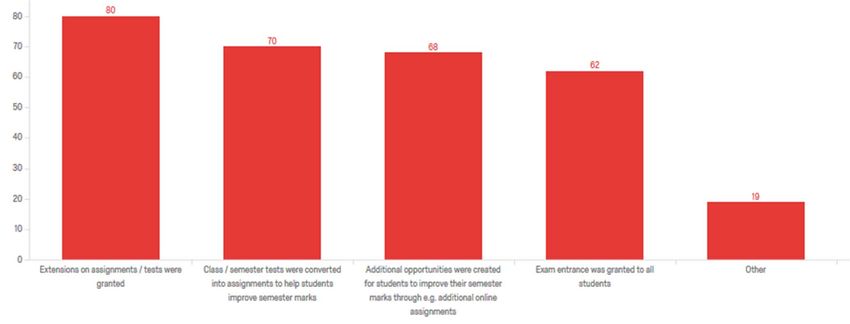
• open book tests to be
done from home using
what ever resources
they had available
• hand in assignments at
80 points off‐campus
70 68 • Submit via
62 clickUP/email/whatsapp
19
Extension on Converted Additional Exam entrance Other
Assignments/tests tests into opportunities to to all students
granted Assignments improve
semester mark,
e.g extra
assignmentsChanges to assessment strategies
17 16
6
Marking standards Increased nr of Final score
were lowered attempts for calculated on exam
assignments/tests onlyContradictions/Tensions (Assessments)
Very short time frames between some tests and examinations
Students welcomed assignments in stead of exams, learnt more through
the process than in exams.
The fact of the matter is that certain law modules should by tested by means of
practical assignments and not tests, where only our ability to parrot the work is
tested. I therefore enjoy the hybrid system in that it forced the law faculty to
actually approach the testing of certain modules in a practical sense.
(Student_Law_3rd year_1)
40% of students who did online tests struggled with connection problems
30% of students struggled/could not manage different way of assessmentContradictions/Tensions (Assessments)
Dishonesty of students with online assessment
It allows students to form groups and cheat by sharing answers to exams and
assignments which Turnitin is seemingly unable to address or lecturers simply do not
want to suspend dishonest students. (Student_Law_2nd year)
Almost half of the students indicated that suitability & fairness of
assessment was questionable
Concern that there might have been a drop in standardsStudent emotions
Unsafe/Afraid
(72.97%) Frustration
Experienced (86.82%)
physical danger
Routine
(46.54%)
disrupted
(82.44%)
Victimized
(52%) More nervous
than usual
My future is at (82.12%)
Overwhelmed
risk (81.85%)
(76%)
Value of my
education? Anxious
Demotivated (74.94%) (80.51%)
(76%)
More stressed Uncertain
(78.32%) (78.49%)Student emotions
Socially isolated
(55.74%)
Disconnected
(61.77%)
Proud –
Freedom – own
overcame
pace (60.72%)
obstacles
(61.57%)
Determined to
succeed
(61.36%)Anger
I felt angry that I could not get the most out of my education because I was
unable to attend lectures. (Student Humanities_3rd year)
Anger towards how genuine problems became politicized by the student
council and the blatant disrespect that some of the protestors had for their
lecturers and academia (Student NAS_2nd year_1)
Anger at the fact that a hand full of students were able to bring campus to a
standstill to further their own agendas regardless of what the majority of
students felt. (Student NAS_3rd year_1)
I was incredibly frustrated towards the students who caused the disruptions ....
I am also a poor student and I have to fight really hard to gain finances for my
studies but you don't see me throwing tantrums like a child. I actually want an
education badly enough that I will pay whatever I have to and work however I
hard is neccessary to get there. I even work two part-time jobs in attempt to
pay for my studies because I have a single mother who is barely keeping head
above water and a non-existent father. (Student Education_1st year)
Angry, because the university only cares more about its image and its
buildings than its students. (Student NAS_2nd year_2)Fear
Terrified to be in an on campus residence with a bomb thrown at a window close
to mine. (Student Humanities_2nd year_1)
We were caught in the auditorium by protestors, who through rocks and water
bottles. That effected me severely. (Student NAS_ 3rd year_2)
I was evacuated out of a building and into a mob with no help or sense or scurity
from surrounding guards. (Student NAS_2nd year_3)
Distrust of fellow students as well as UP staff members. I still feel this way.
(Student EBIT_4th year)
‐‐‐‐‐‐‐‐‐‐‐‐‐‐‐‐
I felt scared at times at a place (the university) where I always felt safe and secure
(Lecturer EMS_3)
I had a traumatic experience in a computer lab where thugs (students?) burst into
my lecture and disrupted the class. One female student was hit in the process.
(Lecturer EBIT_ 3)Loss
I felt disadvantaged as the marks needed for honours were taken from
second semester and were not of a high enough standard and no
consideration for the disruptions were taken.(Student Education_3rd year)
It was a bit frustating to have paid the fees for lectures that I then could not
attend. I understand why the disruptions occured, but I feel robbed of part
of my education. (Student Humanities_3rd year)
-------------------------
In general many students crave the individual contact. They can go to
UNISA if they want to do hybrid learning (online and group meetings).
Some students communicated to me via e-mail that they feel that they
have been "robbed" of lecturer-student interaction which in turn was
deemed unfair. Many students wanted to be on the campus. A handful of
students disrupted the whole organisation, its staff and most important its
clients (the students). (Lecturer Humanities_3)Financial Loss
I was frustrated as I had just moved into Hatfield Studios for the purpose of
being closer to campus. Then campus shut down and I wasted a lot of
money paying to stay there, a lot of time moving in and out and did not feel
very safe in that area of town. I understand it is not the university's fault
that Hatfield Studios chose to shut down over the campus shut down but I
had to relocate to another dwelling and paid for at least one months rent at
Hatfield Studios when I could not stay there and it is due to the campus
disruptions.(Student NAS 1st year)
I left my job to study and felt that my money was going to be wasted
(Student Humanities 1st year_1)
I have to repeat modules and get a job to pay for them. (Student NAS 2nd
year_4)Voices in support of campaign
I felt there was a greater movement that needed attending to. This
institution needs to understand that free education is a must, it was
confusing yes, but if needs be I would go through it again because people
are suffering here and they are not getting help because unfortunately the
university proprieties money over the well being of its students. (Student
Humanities 2nd year_2)
I was in complete support of the shutdown so I felt no concern, shame or
loss of faith when the disruptions occurred (Student EMS 1st year_2)
I felt happy that everything was getting postponed but as the strikes did not
end i realised that we might have to all extend a year of our lives. So i then
became uncertain and such. Right now i want to finish my degree, so I and
many others do not support striking right now. Those that are striking just
want exams pushed up. (Student EBIT 2nd year_1)
I felt proud to be at tuks and the way they handeled everything (Student Law
3rd year_2)Outcome:
Impact 2017
Tools Continue Complete Tools
2016 Keep
research
successfully funding
output
Lecturer Student
Object Object
Rules Community Division Division Community Rules
of labour of labourPerceptions of Blended/Hybrid Learning
A blended / hybrid mode of learning means:
A structured blend of classroom
lectures/ contact learning sessions and
71.17
online learning
Replacement of classroom lectures /
29.84
contact learning sessions with online
0.61
activities
Classroom lectures / contact learning
62.66
sessions combined with some online
26.99
learning components
7.5
I don't know
0
0 10 20 30 40 50 60 70 80
Students Lecturers
(n=3281) (n=164)Lecturers believe that blended/hybrid teaching methods:
Agree Disagree n=151
Contributed substantially to the Had a positive impact on
completion of the academic student learning during
year in 2016 campus disruptions in 2016Students’ view on use of technology during
campus closure
1400 1323
1200
1000
800 758
800 730
Axis Title
600
403
400
291
200
60 60
0
Benefited Did not
Had
me in benefit
limited Did not Did not
only a few me
use benefit benefit
Was modules Assisted because Helped to
because I me at all me at all
essential because me to technolog keep me
could as I could as I could
to me the keep on y could motivated
only not get not get
passing lecturers track and not to
access a access to access to
the in the pass my replace continue
computer a a
semester others modules campus studying
/internet computer computer
modules activities
on /internet /internet
did not in
occasion
use it… importa…Change in perception of blended/hybrid teaching
and learning
20.00%
Yes, I perceive it more negatively now 3.11%
42.58%
Yes, I perceive it more positively now 39.13%
37.42%
No, my perception has remained the same 57.76%
0 0.1 0.2 0.3 0.4 0.5 0.6 0.7
Students Lecturers
(n=2330) (n=162)Preference for blended/hybrid learning
at UP
32.07
Disliked the use of blended/ hybrid
16.88
learning at UP
67.93
Liked the use of blended/ hybrid
83.13
learning at UP
0 10 20 30 40 50 60 70 80 90
Students Lecturers
(n=2323) (n=161)Why lecturers like/dislike hybrid learning
LIKE: DISLIKE:
• Adds value to courses • Should not be seen as a replacement
• Made the completion of the academic for contact face to face teaching
year possible • Concern over IT infrastructure
• More control over course organization, • Feeling ill‐equipped for hybrid learning
submission of assignments and • Not suitable for large groups of students
assessments. • Very heavy burden on lecturers for an
• Student engagement: peers and the aspect that does not matter for
subject matter. Shy students also performance appraisals.
respond more readily online. • It does not support very necessary
• Tutorials and existing online material modes of learning and engagement
can supplement and at times replace with skill and knowledge certain
one to one demonstrations. disciplinesWhy students like/dislike hybrid learning LIKE: DISLIKE: • Indiv learning ‐ own time & pace • Prefer face to face interactions/classes • Ease and convenience • Lecturers did not use tech as required • Prefer online assessments‐ authentic • Felt cheated: Not the same quality • Independence of place • Not suited for subject • Availability of course content • Made it more difficult to study • Suits tech age • Difficulty accessing the Internet • Helps when campus disrupted • Marks dropped / fail module • Enhances learning • Was not what was paid for • Variety • Not a replacement • Like it but with face to face contact • Not prepared for it • Guidance • Class, test & exam preparation • Saves time, travel costs
Effect of campus disruptions on
  Undergraduate /Honours teaching practice
A disaster: considerable content not covered
and I could not teach outside of a classroom,               5.49%
     with dire results for most students

                                       Other                   7.79%

             No effect, classes not disrupted                            15.38%

   Large effect: considerable content not
  covered & many students could not cope                                     18.13%
       with this content on their own
Moderate effect: some module content not
 covered & some students struggled to                                         18.68%
           assimilate this work

  Some effect, some content not covered,I
                                                                                                    34.62%
found ways to support students in learning it

                                   (n=183)      0.00%   5.00% 10.00% 15.00% 20.00% 25.00% 30.00% 35.00% 40.00%
Impact on coursework Masters’
Block sessions,
lectures, campus 12 %
meetings had to 9
be cancelled
Block sessions,
lectures, campus 38.67 %
meetings were 29
moved off campus
Closure did not
coincide with block 32 %
meeting dates & did 24
not disrupt
programme
17.33 %
Other
13
(n=76)Impact on Masters or Doctoral students
23.43%
41 20.57%
36 16.57%
29 12.57%
22
4%
7
Some impact, but No Moderate impact, Large impact, It was a
their progress was impact few students 12.57%
many / most disaster: the
not affected struggled with 22
students students could
access to resources struggled with not continue
and their progress access to with their
was affected resources and studies and a
their progress significant
was significantly number of
affected students had
(n=176) to add a year
to their studiesImpact on research and postgraduate studies
The missed content and drop in standard has made the 2017 year so much
nd
harder that I don't know if I will get into honours (Student NAS 2 year_5)
... no way that I could do research and be a good lecturer. It influenced my career
considerably. I am still young and this is the time that good academic output is
crucial in my career, especially for me to be seen as a competitive researcher
outside South Africa. (Lecturer NAS_3)
a number of students have left the country to pursue further degrees. This
effectively "robs" the country of their expertise as less than 80% of such students
are likely to return. It also robs my research program ... (Lecturer NAS_5)Impact of campus disruption on students’ studies
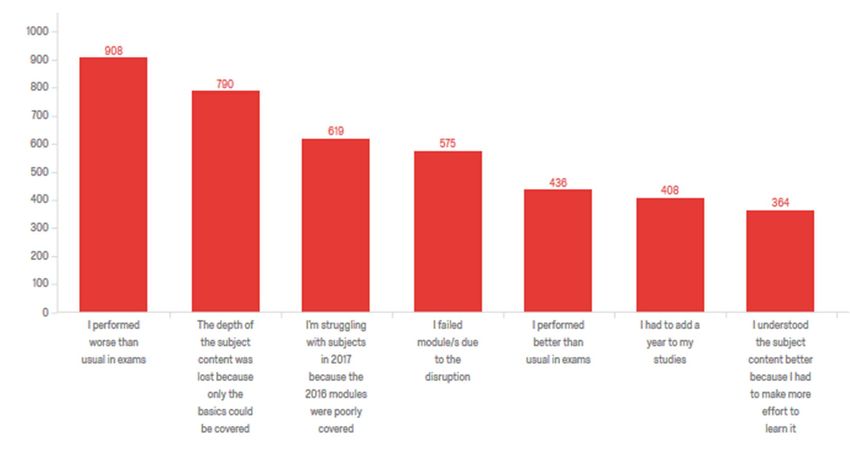
908
790
619
575
436 408
364
Performed Depth of I am I failed I I had to I understood
worse than subject struggling in module/s performed add a year the subject
usual content subjects in due to the better than to my content
was lost 2017 disruption usual in studies better
because because the exams because I
only basics 2016 had to make
could be modules more effort
covered were poorly to learn it
coveredImpact of campus disruption on students’ studies
278 262
192
69 66 51
It had no I am I had to drop I lost a Other I had to
impact on repeating module(s) bursary change my
my studies a year degree /
courseOther impacts of campus closure
All the negative feelings made it near impossible to focus and study, hence
there is some gaps in the knowledge that I need for 2017, not because of bad
lecturers/lectures or study material, but because of emotional stress that
influenced my ability to study and retain information. (Student BVSc 3rd year)
• It cost me a lot of money in data ...(73,14% Bought additional data; 40.57%
bought 2 Gig or more) (Student Education 3rd year)
This year's tutors are sub par for the modules that were presented last year
this time...(Student EBIT 1st year_2)
nd
Anxiety attacks (Student EMS 2 year)
nd
I got academically excluded (Student NAS 2 year_1)
Lecturer: I believe a BSc or BSc Hons from UP (via NAS) which includes the
2016 academic year is of a lower standard. (Lecturer NAS_1)Impact continued...
I paid R45 000 to be a part time student instead of a full time student. No
compensation... I felt absolutely let down as a student. The way Tuks handled
the situation in such a pathetic manner. I cannot wait to get away from Tuks
and take absolutely no pride in graduating from the institution. (Student EBIT 2nd
year_2)
That I am a HUGE failure towards my parents, whom is paying for my studies.
I felt stupid and dumb for not passing most of my modules. I was at a point
where I wanted to move out of the house (I couldn't face my parents after I
failed) and I wanted to start working, something like being a waiter. (Student
Humanities 1st year_2)Impact continued...
I did better when I had to do assignments instead of exams. I felt I learnt more
nd
than I would in exams. (Student Education 2 year)
I had more time to study because I did not have to travel to campus each day
and most of my lecturers had put up videos on youtube to explain the work,
nd
thus I could review it over and over until I understood. (Student NAS 2 year_2)
I did not obtain Distinctions for one or two modules, which affected my
nd
average mark thus I could not qualify for the fees discount ... (Student Theology 2
year)
Our pass rate in 2016 was also fine but the number of distinctions awarded
dropped substantially... The reduction in the number of distinctions is also a
concern as it suggests that while weaker students managed well and perhaps
even benefited from the provision of clear notes and power points that could
be revised repeatedly, the best students lost out on the enrichment provided
by informal digressions, the reading of recommended books that are often
better suited to undergraduate needs than more specialised journal articles
and the stimulus provided by taking part in face-to-face discussion and
argument (Lecturer Humanities_4)New skills • I ....am still using some of the applications that I would never have used if it was not for the disruptions. (Lecturer EMS_4) • ...at the end it pushed me out of my comfort zone and I got to learn new skills. (Lecturer NAS_6) • ...my boundaries was stretched. ... i have grown as an educator to set up questions that cannot be googled.(Lecturer Health Sciences_1) • Dit was ons redding! Ek is trots op alle dosente en studente by UP wat gesorg het dat studente die jaar kon voltooi. Dit sal ook die redding van alle universiteite wees in die toekoms. (Lecturer Humanities_5)
Growth in % clickUP modules/ faculty 2015-2017
120

               97   98 96 100                        99 99
                                                             95         98        98
100
      90 93                             89      91                89                   91
                                                                             83
80                              77 78

60

40

20

 0
        EBIT          EMS       Humanities           Law          NAS        Theology
                                 2015    2016    2017
Institutional impact
Better attendance of e-learning training
• 720 staff members attended e-learning priority and other courses in 2017.
• “Creating Digital Lectures” introduced as a priority
• 3 scheduled
• + 5 extra sessions:
• 3 paid from DHET grant;
• one paid by NAS;
• one paid by Dean of Mamelodi
• 135 lecturers attended during 2017
• New “Turnitin Grading & Feedback” course
• 3 sessions
• 31 attendees in 2017.LA: Growth in content tool use / Faculty
2015-2017
25 000
20 000
15 000
10 000
5 000
0
2015
2016
2017
2015
2016
2017
2015
2016
2017
2015
2016
2017
2015
2016
2017
2015
2016
2017
2015
2016
2017
EBIT Education EMS Humanities Law NAS Theology
ContentLA: Growth in assessment tool use / faculty
2015-2017
Total Count of Course Item Types per Faculty
2015 ‐2017
3 500
3 000
2 500
2 000
1 500
1 000
500
0
2015
2016
2017
2015
2016
2017
2015
2016
2017
2015
2016
2017
2015
2016
2017
2015
2016
2017
2015
2016
2017
EBIT Education EMS Humanities Law NAS Theology
Assessment ToolTurnitin growth: 2008-2017
Recommendations

• Use Systems Thinking when making institutional decisions
• Coordinate communication & communicate earlier
• Blended/Hybrid learning
      • Introduce one definition of learning with technology at an institution
           and its implications
       •   Adhere to the basics of education, e.g. constructive alignment
       •   Ensure clear integration of contact and online components as
           matter of routine
       •   Professional development of lecturing staff is key to success in
           blended/hybrid learning
       •   Prepare students to use technology before online components are
           increased
       •   Use more student centered approaches as part of general teaching
           and learning to prepare students for more online work
       • Clarify value of online learning components to students
Limitations of the study
Sampling was problematic: students not directly related to interviews of
lecturers.
UP cannot be seen as homogenous case, neither can any Faculty or
Department, as Blended learning is implemented based on individual lecturers’
choices.
The researchers who wrote up the study, were not part of the data collection,
and thus not involved during conceptualisation and operationalisation of the
study.
The time lapse between events and data gathering
Time frame (end of year, examination) that data collection took place was
problematic as not many lecturers & students were available
Most 2016 final year students left UP by the time the interviews/surveys were
conducted.Acknowledgements
Dennis Kriel Lynette Nagel Gaby Pretorius
Alastair Smart Mpho Thukane Dolf JordaanThank You
You can also read


