London Social Prescribing - Resource pack Covid-19 Vaccinations Responding to vaccine hesitancy - Healthy London Partnership
←
→
Page content transcription
If your browser does not render page correctly, please read the page content below
London Social
Prescribing
Resource pack

Covid-19 Vaccinations
Responding to vaccine hesitancy

Next review date: 1st April 2021 - the latest version will be available here
Role of Social Prescribing Link Workers                   03
Covid-19 Vaccines                                         05
Differences between Covid-19 Vaccines                     08
What to expect after the Covid-19 Vaccine                 10
Vaccination appointments                                  12
How people access the vaccine                             15
Vaccine hesitancy                                         18
Key concerns and communicating with your communities      22
BAME and Religious communities                            25
Women of child bearing age, pregnancy and breastfeeding   28
Other vulnerable or at risk groups                        30
Further support                                           31
Top Tips                                                  33
FAQs & Key messages                                       34
Further Reading                                           39
Full Links and References in Resource Pack                42
Role of Social Prescribing Link Workers
    Purpose of pack                                            many other reasons. It’s important to understand that
    A vaccine to prevent COVID-19 is likely to be the          people will have their point of view and it may take
    most effective way to control the pandemic.                time to talk through their concerns. Using Motivational
    Scientists across the world have worked to develop         Interviewing techniques, listening skills and sharing
    vaccines which have then been rigorously tested for        factual information about Covid-19 and the vaccine
    safety and efficacy.                                       may help to encourage people and offer reassurance.

    Those with a role in delivering/supporting                 We appreciate all that you are doing to support the
    the COVID-19 vaccine programme need to be                  people in your communities, and hope you find this
    knowledgeable, confident and competent in                  pack useful –
    order to promote confidence in the vaccination
    programme and deliver the vaccine safely.
                                                               Thank you
    The purpose of this pack is to ensure you have all the
    resources and information you need to hand, acting
    as a ‘go to guide’ to support you when talking with
    patients who are eligible for a Covid-19 vaccination but
    are showing signs of hesitancy.

    People may be concerned about or refusing the vaccine
    due to worries, fears, unclear about messages or for

3
Role of Social Prescribing Link Workers
    A GP Standard Operating Procedure (Guidance)            roll-out is through supporting in waiting areas, picking
    has been developed by NHS England for general           up referrals, and helping GP’s proactively identify people
    practices. It outlines the general role of Social       at risk of not receiving a vaccination they are eligible
    Prescribing Link Workers (SPLWs) in the pandemic        for. SPLWs should discuss their role with their associated
    response (see page 13).                                 PCN in order to ascertain if they are required to support
                                                            vaccine efforts and how they can add most value.
    Guidance and standard operating procedures -
    General practice in the context of coronavirus          Further information on the role of SPLWs in the
    (Covid-19)                                              vaccination and COVID response

    The National Social Prescribing team have written a     If you do not currently receive the newsletter or have
    more detailed summary of your role (SPLW) and what      access to the Social Prescribing Collaboration
    additional support may be required from you, with       Platform – a network for news, resources and
    the Covid-19 vaccination roll out in the national       discussion; please email england.socialprescribing@
    Social Prescribing Newsletter.                          nhs.net to join.

    Vaccination roll-out
    SPLWs may be required by their Primary Care Network
    (PCN) to support COVID-19 vaccination roll-out. The
    most appropriate way for SPLWs to support the vaccine

4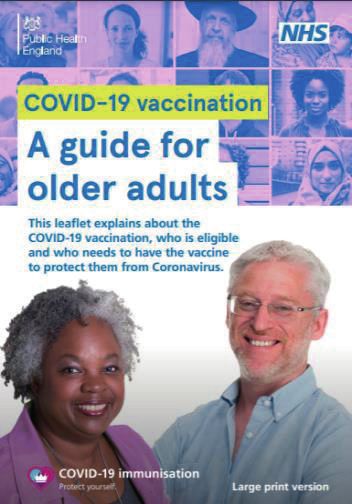
Covid-19 Vaccines
    National Covid-19 vaccination                            These vaccines will not be routinely offered to children
    programme                                                and young people under the age of 16 years old*.
    Public Health England (PHE) have produced a range of
    resources, including an NHS Staff Comms Toolkit,         How long does the vaccine take to
    posters, videos and other media to help reinforce        become effective?
    and support messaging about the Covid-19 vaccine.        The MHRA have said these vaccines are
    It’s free to register and download or order any of the   highly effective, but to get full protection people
    resources. Although some of the information references   need to come back for the second dose – this
    communications to staff, it can also be useful when      is really important.
    engaging with your patients too.
                                                             To ensure as many people are vaccinated as quickly as
    What vaccines are available                              possible, the second dose of both the AstraZeneca/
    for COVID-19?                                            Oxford and the Pfizer/BioNTech vaccine should be
    There are three COVID-19 vaccines:                       scheduled up to 12 weeks apart (Moderna
    • Pfizer/BioNTech                                        currently a 4-week window).
    • AstraZeneca/Oxford                                     *This information has been extracted from the British Society
    • Moderna (Available in Spring 2021)                     for Immunology’s A guide to vaccinations for Covid-19 -
                                                             where does this refer to?
    All vaccines have been shown to be safe and offer high
    levels of protection, they have been given regulatory
    approval by the Medicines and Healthcare products
    Regulatory Agency (MHRA) following tests on
    safety and efficacy.

5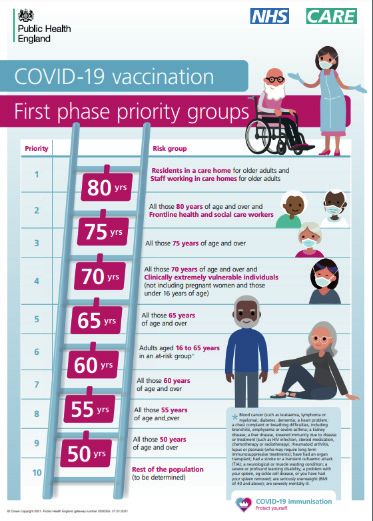
Covid-19 Vaccines
    How effective is the COVID-19 vaccine?                    Can the vaccine affect people
    Full protection kicks in around a week or two after       with allergies?
    that second dose, which is why it’s also important that   People with history of a severe allergy to the
    when people do get invited, they act on that and get      ingredients of the vaccines should not be vaccinated.
    themselves booked in as soon as possible.
                                                              Checking for allergies is a routine part of the
    Can the vaccine give you the                              process before giving any vaccine or new
    Covid-19 infection?                                       medicine. Having these conversations – as well as
    No, none of the vaccines contain the actual Covid-        being able to deal with allergic reactions in the rare
    19 virus (SARS-CoV-2), they are synthetic ingredients     case they do happen, is a central part of training for
    that have been designed to replicate the virus.           vaccinators. But these are new vaccines and
                                                              so the NHS and the MHRA are being extra vigilant
    You cannot catch COVID-19 from the vaccine but            and responding quickly to ensure everyone across
    it is possible to have caught COVID-19 and not            the NHS is totally clear on these requirements.
    realise you have the symptoms until after your
    vaccination appointment.

    Although a mild fever can occur within a day or two of
    vaccination, if individuals have any other COVID-19
    symptoms or their fever lasts longer; they should
    stay at home and arrange to have a test.

6
Covid-19 Vaccines
    Can you give COVID-19 to anyone
    if you have had the vaccine?
    The vaccine cannot give you the COVID-19 virus, and
    a full course will reduce peoples chance of becoming
    seriously ill. We do not yet know whether it will stop
    individuals from catching and passing (transferring) on
    the virus, but we do expect it to reduce this risk.

    It is still important to follow social distancing
    guidance in local areas to protect family, friends
    and the community.

7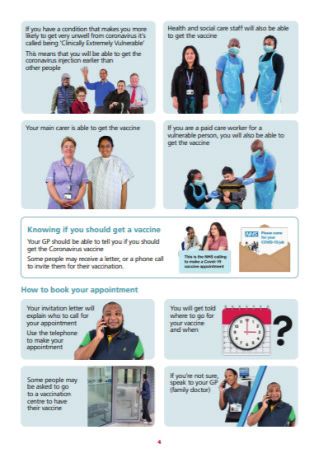
Differences between
    Differences between Covid-19 Vaccines
    What is in the vaccines and how                               • When the vaccine is given, our cells at the site of
    do they work?                                                     injection take up the mRNA and make the SARS-
    All of the following vaccines DO NOT contain                      CoV-2 protein. The body then destroys the mRNA.
    the actual Covid-19 virus (SARS-CoV-2), they are              •   The SARS-CoV-2 protein produced is then
    synthetic ingredients* that have been designed                    recognised by the immune system and
    to replicate the virus.                                           triggers a specific response.
                                                                  •   This response builds immune memory so that
    The vaccines work by making a protein from the virus that         your immune system is ready to quickly fight off
    is important for creating protection. The protein works in        SARS-CoV-2 in the future and prevent you from
    the same way they do for other vaccines by stimulating            getting sick with COVID-19.
    the immune system to make antibodies and cells to fight
                                                                  *There is no material of foetal or animal (No pork, beef or
    the infection. This immune memory builds up in your           gelatine) origin in either vaccine
    body after receiving two doses of the vaccine.

    Pfizer/BioNTech and Moderna
    • This vaccine is an mRNA vaccine which
        contains a segment of the SARS-CoV-2 virus
        genetic material (not actual virus) that codes
        for a specific protein from the virus, which is
        the spike protein on the surface of the virus.
    •   The genetic material tells the cells to
        make proteins.

                                                            Bromley by Bow Centre

8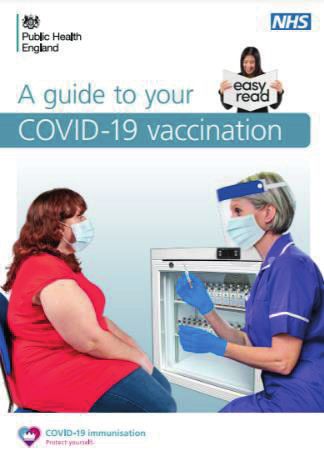
Differences between Covid-19 Vaccines
                     Differences between Covid-19 Vaccines
         AstraZeneca/Oxford                                                       the cell can make the SARS-CoV-2 protein.
                                                                AstraZeneca/Oxford
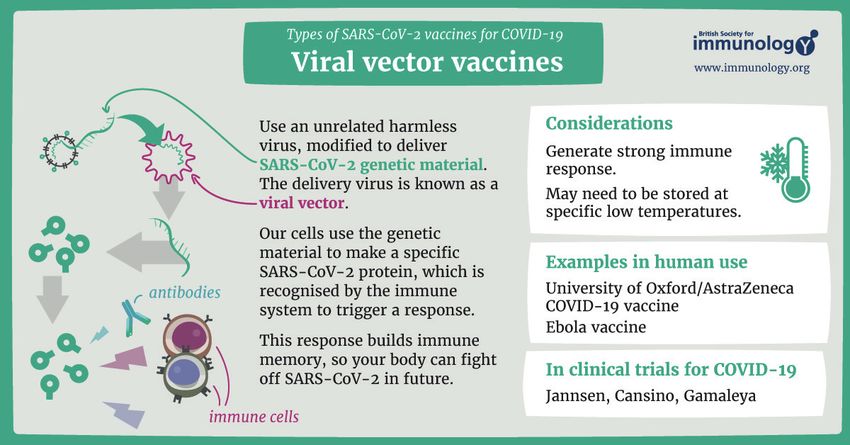
         •   This vaccine is a viral vector vaccine which • This vaccine       • The     viral vector from the vaccine is
                                                                                  is a viral vector vaccine which uses an unrelated and harmless virus
             uses an unrelated and harmless virus which has which has been        subsequently
                                                                                      modified to actdestroyed
                                                                                                       as a delivery  by   the body.
                                                                                                                        system   to carry the SARS-CoV-2 virus
             been modified to act as a delivery system to           genetic    • The protein produced is then recognised by the
                                                                             material   (not  actual virus).
                                                                • The genetic material is a segment of SARS-CoV-2 DNA that codes for the specific spike
             carry the SARS-CoV-2 virus genetic material                          immune system and triggers a specific response.
                                                                    protein from the SARS-CoV-2 virus.
             (not actual virus).                                • The delivery • virus
                                                                                  This isresponse
                                                                                           known as builds     immune
                                                                                                      a viral vector.      memory
                                                                                                                      In this vaccine,so
                                                                                                                                       thethat
                                                                                                                                           viral your
                                                                                                                                                 vector is a weakened
         •   The genetic material is a segment of SARS-CoV-2 chimpanzee immune     adenovirus    (vaccineiscarrier),
                                                                                               system        readywhich     normallyfight
                                                                                                                      to quickly     causes   the common cold in
                                                                                                                                            off
                                                                    chimpanzees and has been changed so it cannot grow in humans.
             DNA that codes for the specific spike protein from                   SARS-CoV-2 in the future and prevent you from
                                                                • When the vaccine is given, our cells at the site of injection take up the viral vector and the
             the SARS-CoV-2 virus.                                  SARS-CoV-2getting         sick with
                                                                                   genetic material        COVID-19.
                                                                                                     is delivered  so the cell can make the SARS-CoV-2 protein.
                                                                •   The  viral vector  from  the vaccine  is subsequently     destroyed by the body.
         •   The delivery virus is known as a viral vector. In this
                                                                • The protein produced is then recognised by the immune system and triggers a specific
             vaccine, the viral vector is a weakened chimpanzee     response.This immune memory builds up in your body after
             adenovirus (vaccine carrier), which normally causes• This responsereceiving     two doses
                                                                                    builds immune    memory ofsothe
                                                                                                                  thatvaccines.
                                                                                                                        your immune system is ready to quickly
                                                                    fight off SARS-CoV-2 in the future and prevent you from getting sick with COVID-19.
             the common cold in chimpanzees and has been
             changed so it cannot grow in humans.
         •   When the vaccine is given, our cells at the site
             of injection take up the viral vector and the
             SARS-CoV-2 genetic material is delivered so

         The information on pages x-xx has been extracted
         from the British Society for Immunology’s A guide
         to vaccinations for Covid-19 (See pages 22-31 for
         full details).

   9                                                                  This immune memory builds up in your body after receiving two doses of the vaccines.
Centre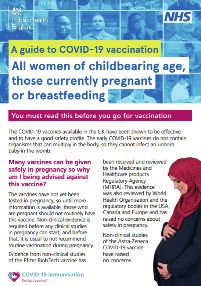
What to expect after the Covid-19 Vaccine
     What are the side effects                             paracetamol (follow the advice in the packaging)
     Like all medicines, vaccines can cause side           to help make them feel better.
     effects. Most of these are mild and short-term,
                                                           These symptoms normally last less than a week.
     and not everyone gets them. The side effects are
     the same for people of all demographics.
                                                           If symptoms seem to get worse or if individuals are
                                                           concerned, they should call NHS 111. If individuals do
     Very common side effects include:
                                                           seek advice from a doctor or nurse, they should inform
     • having a painful, heavy feeling and                 them about their vaccination (show the vaccination
       tenderness in the arm where you had                 card) so that they can assess the individual properly.
       your injection. This tends to be worst
       around 1 to 2 days after the vaccine                How long will the vaccine
     • feeling tired                                       be effective for?
     • headache                                            The vaccines are expected to work for at least a
                                                           year – if not longer. This will be constantly monitored.
     • general aches, or mild flu like symptoms
                                                           Full and further information about what to expect after
     Although feeling feverish is not uncommon for
                                                           the Covid-19 vaccine is available on the government
     2 to 3 days, a high temperature is unusual and may
                                                           website and PHE resource centre.
     indicate someone has COVID-19 or another infection.
     An uncommon side effect is swelling of the glands.
     Individuals can rest and take the normal dose of

10
What to expect after the Covid-19 Vaccine
Can people choose the vaccine Do people have to continue social
they want? distancing after each vaccine dose?
People are not able to choose which vaccine they Individuals must continue to follow the government
have but should be reassured that whatever vaccine guidelines for social distancing after each vaccine dose.
they are given; it is safe and worth their while.
People should be able to resume physical activities
There are concerns about the difference in effectiveness at home that are normal for them if they feel well. If
rates between each vaccine; however as mentioned their arm is particularly sore, they may find heavy lifting
previously, all vaccines have been shown to be safe and difficult. If they feel unwell or very tired, they should
offer high levels of protection, they have been given rest and avoid operating machinery or driving.
regulatory approval by the Medicines and Healthcare
products Regulatory Agency (MHRA) following tests To protect yourself and your family, friends and
on safety and efficacy. colleagues you still need to:
• practice social distancing
Following the clinical trials all vaccines were effective • wear a face mask
in preventing people getting sick with COVID-19. • wash your hands carefully and frequently
Importantly, no one who received the vaccine suffered • follow the current guidance and Lockdown guidelines
severe disease; the vaccine prevents the most severe
cases of COVID-19. (see further information here)
Reporting suspected side effects
People should report suspected side
effects of vaccines and medicines online
through the Yellow Card scheme or
by downloading the Yellow Card app.
11Vaccination appointments
The NHS Covid-19 Vaccination appointment without needing a letter, provided they
Booking Service are registered with a GP (so records can be matched).
The national NHS Covid-19 Vaccination Booking Service
went live in advance of booking letters arriving from As more centres go live and supplies of the vaccine
Saturday 9 January 2021. The NHS service will continue allow, the NHS intend to open more Vaccination
to send out letters for eligible people to book their Centres and offer vaccines to the next priority groups.
vaccine appointment*. In line with the process already in place for other
vaccination services, the NHS will contact people
They can do this in two ways: when it is their turn to book their vaccine.
• Booking online at www.nhs.uk/
covid-vaccination The letter that people will receive also explains that
• Phoning 119. people may have also been contacted by their GP
services and if they have, make it clear that they can
How it will work choose to book through their GP services or through
The NHS will write to eligible people (based on the Joint the national booking service. It will not be possible for
Committee on Vaccination and Immunisation cohorts people to use the NHS Covid-19 Vaccination Booking
(JCVI) offering them to book through this service. Service if they haven’t received an invitation letter or
get a vaccine at a Vaccination Centre or Community
Letters were initially sent to people aged 80 and over Pharmacy without an appointment.
who live in reasonable travelling distance of the active
locations. People aged 70 and over or on the Shielded
Patients List (clinically extremely vulnerable) are now
able to use the National Booking System to book an
12 Covid-19 vaccination consent forms are available on the government website.Vaccination a
Vaccination appointments
Here is an up to date list of Covid-19 vaccination
first phase priority groups; which includes the Risk
Groups and Clinical conditions list.
You can download the PHE poster of the Covid-19
vaccination – First phase priority groups here.
Local teams and the National Immunisations
Management Service are making follow up calls and
sending reminder letters to people who have been
contacted but not yet booked an appointment.
People currently unwell with Covid-19 and
experiencing Covid-19 symptoms should not receive
a vaccine until they have recovered and around four
weeks after onset of symptoms or four weeks from the
first positive test in those who are asymptomatic.
If antibodies have already been made to the virus
following natural infection, receiving COVID-19 vaccine
would be expected to boost any pre-existing antibodies.
For further information click here.
Bromley by Bow Centre
13Vaccination appointments
The NHS encourages anyone who isn’t registered with
a GP, to do so; no proof of address or immigration status
is needed. If people have never registered with a GP or
haven’t been to a GP for a number of years, we would
recommend speaking with your local practice about
registering. Register with a GP.
A record card will be provided to every person who
has had their first vaccination. This must be taken to the
next appointment for their second vaccine which will be
between 3 and 12 weeks later. It is important to have both
doses of the same vaccine to give you the best protection.
Please note: The current approach only
applies to people aged 70 and over and
clinically extremely vulnerable.
When the time comes to start vaccinating other
priority groups, this will be by invitation only so
that we can manage the supplies of vaccines
available in the fairest possible way.
People will not be able to book their second
vaccine they will be contacted by the NHS.
14 See further FAQs in the Covid-19 programme comms pack pages 31-45.How people access the vaccine
What if people can’t get to the Why do other people have to
Vaccination Centre? wait for the Covid-19 vaccine?
People who are housebound will be contacted by People most at risk from the complications of
their GP services about alternative ways to get COVID-19 are being offered the vaccine first.
vaccinated. People can also wait until more locations
closer to where they live become available. The NHS An independent group of experts has recommended
will follow up with people that haven’t booked their that the NHS first offers these vaccines to those at
appointment, as a reminder. highest risk of catching the disease and of suffering
serious complications or dying from COVID-19. This
Ensure you know where your local and neighbouring includes older adults in care homes and frontline health
boroughs vaccination sites are located. This will be and social care workers.
useful to keep to hand, just in case one of your clients/
patients are unable to travel far. Live vaccination When more vaccines become available, they will be
sites can be found here. offered to other people at risk as soon as possible. For
more information visit the government website or
Find out what transport support is available for your PHE resource centre.
patients, if they require assistance.
15How people access the vaccine
Call and text scams – help patients
to avoid fraud
There have been a small number of reports of We are aware that some people are receiving suspicious
people being targeted by scams related to the calls and text messages offering the COVID-19 vaccination.
vaccine via various such as WhatsApp, email etc.
Coronavirus vaccines are only available on the
The NHS England communications team have been NHS. You can be contacted by the NHS, your
working nationally with law enforcement agencies employer, or a GP surgery local to you, to receive
and other Government departments to understand your vaccine. Remember, the vaccine is free of
the scale of the problem and developed joint charge. At no point will you be asked to pay.
messages in response.
Local organisations are encouraged to use the
• The NHS will never ask you for your bank
account or card details.
messaging on the right, graphics and other
assets are expected to be developed shortly: • The NHS will never ask you for your PIN
or banking password.
• The NHS will never arrive unannounced at your
home to administer the vaccine.
• The NHS will never ask you to prove your identity
by sending copies of personal documents such as
your passport, driving licence, bills or pay slips.
16How people access the vaccine
If you receive a call you believe to be fraudulent, hang Spotting fake news – What is fake
up. If you believe you have been the victim of fraud news and how can you identify it?
or identity theft you should report this directly to The BBC have created this video how fake news can
Action Fraud on 0300 123 2040. Where the victim sometimes very closely mimic real news. This video
is vulnerable, and particularly if you are worried that takes a look at where fake stories come from and how
someone has or might come to your house, report they travel.
it to the Police online or by calling 101.
To keep updated on the number of Covid-19
There have also been reports of patients who have been vaccinations provided by NHS England, you can
invited by text message not trusting that the message find weekly publications of this data here.
is legitimate. If your organisation is using text messages
to invite patients in, we highly recommend that these
messages include personal information to build trust,
for example beginning with the sentence:
This is a message for [name], date of birth
[DOB], from [organisation name].
17Vaccine Hesitancy
What is vaccine hesitancy? Conversations with clients/patients
• A delay in acceptance or refusal of vaccines, People will be receiving information about the Covid-19
despite availability of vaccination services vaccine from various sources; such as social media
• Complex and context specific, varying platforms (Facebook, Twitter, Instagram, WhatsApp
across time, place and vaccine etc.), Community Groups (i.e. Faith/Support groups)
• Is influenced by factors Family Members and friends etc.
such as complacency,
convenience and Complacency If you are supporting a patient who is hesitant of or
confidence. Low perceived risk of vaccine- refusing a vaccination; it’s important to find out what
preventable diseases. Other life/
health issues are a greater priority. they feel about the vaccine. Explore their worries
World Health “I do not see why the vaccination and concerns, and identify where they have got their
Organisation is necessary” information from, and what their fears may be. For
“Why are vaccines necessary example they could have a needle phobia, or at
for everyone?” present, they may feel they have other pressing
priorities at home, work or with family,
and their current practices of social
Convenience distancing are enough.
Confidence Barriers related to
Low levels of trust in vaccines, geographic accessibility,
in the delivery system, and in availability, affordability, and
health authorities acceptability of services
“I do not think vaccines are safe” “I really wanted the
“Am I going to get sick after vaccination, but I was unable
getting a vaccine?” to afford the cost of travel”
18Vaccine Hesitancy
It’s important to listen to their reasons for not wanting
the vaccine and be non-judgemental about their Common questions
response. We can’t dismiss peoples thoughts and
“I am worried about catching the virus from the
feelings, as this is what they currently believe. vaccine”
Having questions about vaccines is very normal –
It is not possible to catch the virus from the vaccine
and it’s ok to be hesitant.
as we only inject a small protein/part of the virus
and never the whole virus.
Providing factual information will support
“I am worried about side effects”
conversations with individuals and will help them to
make an informed decision about the vaccine. Signpost It is normal to feel out of sorts after vaccination. You
people to the most up to date information and facts may get redness, swelling or a fever however these are
from PHE and NHS England (NHSE), the Government all evidence that your immune system is working well
website or their local authority and other resources against the vaccine and generating memory.
throughout this pack. “Why do some people get disease even after
. vaccination?”
Although vaccines work well, there is still a small chance
that you can get the disease. However, if this is the case
the disease tends to be less severe.
19Vaccine Hesitancy
The NHS have provided a short script to support staff “Some people do have side effects but in almost
when making follow up conversations with patients all cases these are really mild and go away within
who have not yet come forward for whatever reason a day or two”
for their vaccination but are eligible.
“Most importantly, they can keep you safe from
Intro getting seriously ill if you get coronavirus – it’s the
“I understand completely – we know some people best way we have of keeping you safe and getting
have concerns and need more information” back to being able to do the things you want to do”
“I might be able to answer some of the questions “We’re working really hard to make sure that it’s as safe
you have, can I talk to you about it for a little while?” as possible when you come to a vaccination service too
– all the staff will be wearing PPE, surfaces are being
Safety disinfected regularly and social distancing will be in place”
“These vaccines have a really good safety record –
we wouldn’t be able to give them if they didn’t” “There is no evidence at all that the vaccine makes
you infertile” (Only mention when relevant)
“They were tested on thousands of people of
different ages, ethnic backgrounds and with different
health conditions before being approved, and have
now been given to 11 million people like you in
England alone”
20Vaccine Hesitancy
Ingredients Don’t need it
“Neither vaccine has any ingredients from “There are thousands of people in hospital at the
animals or human” moment who probably thought that Covid wouldn’t
affect them much too – the average age of people in
“The Oxford/AstraZeneca contains a tiny amount intensive care is 60 but people much younger have
of ethanol but this is true of lots of things – they been seriously ill and died too”
don’t contain any more than a banana or slice of
bread does – and scholars have been clear that “Just because you’ve had Covid doesn’t mean you
this is permissible” (Only mention when relevant) can’t get it again, and the next time it could affect you
worse. The vaccine is the only way to get a high level
“Leaders from all the faiths have said that the of protection and keep yourself and others safe”
vaccines are a good thing and people shouldn’t
hesitate to get them”
“Scholars have been clear that injections don’t
invalidate the fast so you don’t need to worry if
your second dose is during Ramadan”
(Only mention when relevant)
21Key concerns and communicating
with your communities
Some of the key concerns people have, including Do I need it? – a small number of people don’t think
NHS staff, are summarised below, with some coronavirus poses enough of a risk to them, and so they
examples of how your organisation and you can don’t need a vaccine. Vaccinating organisations can
help counteract them: help in this by being clear in invitations why staff and
patients are in a priority group.
Safety concerns – this includes worries over side
effects, the general safety of vaccines, and the Will it work? – a smaller number of people are not
ingredients used. Your organisation can help in this convinced that the vaccine will be effective. As above,
by sharing the content developed by PHE and others all organisations can help in this by sharing the content
on your social media and internal channels, and developed by PHE and others through your staff-facing
ensuring key staff are equipped with the information channels and with key internal influencers.
they need to reassure colleagues and patients
about the safety of the vaccine.
The British Society for Immunology have
Not being first – some people who are unsure say they also created a range of resources to help
want to wait until others have had the vaccine first. engage and inform the public about the
Vaccinating organisations can help in this by sharing the immunology of Covid-19 – Connect on
stories of those who have already been vaccinated on Coronavirus: public engagement resources
social media and internally.
22Key concerns and communicating
with your communities
The table below is a summary of the key concerns of commonly
hesitant groups and which messages should be highlighted in
communications to which groups. This information comes from
insight gathered by PHE and Multicultural Marketing Consultancy.
Key things to highlight in
Community Key Concern(s)
communications
Details on who was involved
Black African / Caribbean General mistrust, intentions of in clinical trials
the vaccine, side effects Clarity on side effects and safety
Muslim Ingredients of the vaccine Clarity on ingredients
Details on MHRA approval
Polish General mistrust, intentions of Details on how the vaccine
the vaccine was developed so quickly
Ingredients in the vaccine and Clarity on ingredients
Ultra Orthodox Jewish
permissible by religion Support from faith leaders
23cating Key with your communities
concerns and communicating
with
Diagram 1. is taken your
from a paper communities
prepared by the ethnicity sub-group of the Scientific
Advisory Group for Emergencies (SAGE).
Figure 1. is taken from the paper
‘Factors influencing COVID-19
vaccine uptake among minority
ethnic groups 17.12.20’ prepared
by the ethnicity subgroup of the
Scientific Advisory Group for
Emergencies (SAGE).
Click here for further reading.
Figure 1: Willingness to be vaccinated in the UK Household Longitudinal Study by ethnic group
Factors influencing COVID-19 vaccine uptake among minority ethnic groups 17.12.20 - Paper
24
prepared by the ethnicity sub-group of the Scientific Advisory Group for Emergencies (SAGE)BAME and Religious communities
Considerations for communicating • London Colney Islamic Centre have created a video
with Black, Asian and Minority Ethnic to address key misconceptions regarding Covid-19
communities about the vaccine and the vaccines. Three points from an Islamic
The key messages about the vaccine are the same for perspective are also covered.
all. However, some communities may have specific • Fasting and covid-19 vaccinations analysis
concerns which should be taken into consideration from Islamic scholars says that injections for non-
when delivering messages about the vaccine. nutritional purposes do not invalidate the fast.
• The Conference of European Rabbis
The Health Service Journal (HSJ) have published an Recommending Covid-19 vaccines
article about the reasons for covid hesitancy in black • Board of Deputies of British Jews –
communities which provides an insight in to why Advocacy for the community
people may be reluctant based on previous history and • The Catholic Church – Update on Covid-19
experiences. and Vaccination
• The Church of England – Covid-19 Vaccines
Religious organisations have released position update December 2020
statements to their communities and created dedicated • The Inter Faith Network – Faith Communities and
pages on their websites to provide guidance about the Covid – Responding together at a time of need
current vaccines for eligible/at-risk individuals:
• The British Islamic Medical Association Pfizer/
BioNTech Covid-19 and Oxford-AstraZeneca
25BAME and Religious communities
Translated resources Vaccine information videos in
The following information is currently available in community languages
Albanian, Arabic, Bengali, Chinese, Farsi, Gujarati, NHS doctors, nurses and other frontline staff have
Hindi, Kurdish, Nepali, Punjabi, Polish, Romanian, come forward to help reassure communities that
Somali, Spanish, Tagalog, Turkish and Urdu. COVID-19 vaccines are safe, effective and have been
independently tested to the highest standards.
• Guide for healthcare workers In a series of short videos, they explain how the vaccine
• COVID-19 vaccination: guide for older adults is given, and give clear evidence that the vaccines work
• What to expect after your COVID-19 vaccination and are safe. It is hoped that the videos will be shared
• Why you are being asked to wait among friends, families, faith and community groups
• Women of childbearing age, currently via WhatsApp, text message and on social media.
pregnant or breastfeeding
There is a section on Commslink in FutureNHS
Race Equality Foundation – have written and audio Collaboration Platform, which includes social media
translated materials of the guidance on coronavirus and assets designed for communicating with BAME audiences
other information to support those with dementia, their including, infographics, quote cards and video.
families and carers. The materials have been translated
into the following languages: Arabic, Bengali, Chinese,
Gujarati, Kurdish, Punjabi, Portuguese, Polish, Somali and
Urdu – Covid-19 translated materials and resources
26BAME and Religious communities
South Asian Health Foundation have put together
some resources and links in South Asian Languages to
follow for advice during the Coronavirus Pandemic.
BAME celebrities call out vaccine misinformation
Doctors of the World have also created Covid-19
guidance translated in over 60 languages.
27Women of child bearing age,
pregnancy and breastfeeding
There are concerns about the possible effects from The JCVI has recognised that the potential benefits
the Covid-19 vaccines on fertility, harm to women of vaccination are particularly important for some
during pregnancy or who are breastfeeding. pregnant women. This includes those who are at very
high risk of catching the infection or those with clinical
Fertility conditions that put them at high risk of suffering
The Royal College of Obstetricians and Gynaecologists serious. complications from COVID-19.
and Royal College of Midwives have released a
statement “to reassure people that there is no evidence In these circumstances, you should discuss
to suggest that Covid-19 vaccines will affect fertility. vaccination with your doctor or nurse, and you
Claims of any effect of Coivd-19 vaccinations on fertility may feel that it is better to go ahead and receive
is speculative and not supported by data…” you can the protection from the vaccine.
find the full statement here.
Pregnancy
The vaccines have not yet been tested in pregnancy,
so until more information is available, those who are
pregnant should not routinely have this vaccine.
Non-clinical evidence is required before any clinical studies
in pregnancy can start, and before that, it is usual to not
recommend routine vaccination during pregnancy.
28Women of child bearing age,
pregnancy and breastfeeding
Breastfeeding • If you are pregnant but think you are at high risk,
There is no data on the safety of COVID-19 vaccines you should discuss having or completing
in breastfeeding or on the breastfed infant. Despite vaccination with your doctor or nurse.
this, COVID-19 vaccines are not thought to be a • If you have had the first dose and then become
risk to the breastfeeding infant, and the benefits pregnant you should delay the second dose until
of breast-feeding are well known. Because of this, after the pregnancy is over (unless you are at high risk)
the JCVI has recommended that the vaccine
can be received whilst breastfeeding. This is in line Although the vaccine has not been tested in
with recommendations in the USA and from the pregnancy, people may decide that the known risks
World Health Organisation. from COVID-19 are so clear that they wish to go ahead
with vaccination. There is no advice to avoid pregnancy
What this means for women after COVID-19 vaccination. If women are breastfeeding,
in these groups they may decide to wait until they have finished
Here are the key points for patients to consider: breastfeeding and then have the vaccination.
• If you are pregnant you should not be
vaccinated unless you are at high risk – you can
be vaccinated after your pregnancy is over
29 For further information and resources click hereOther vulnerable or at risk groups
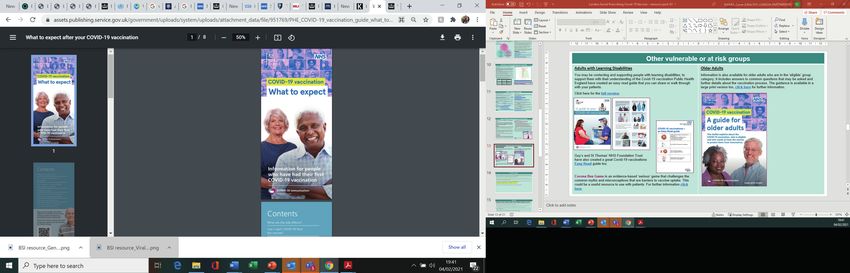
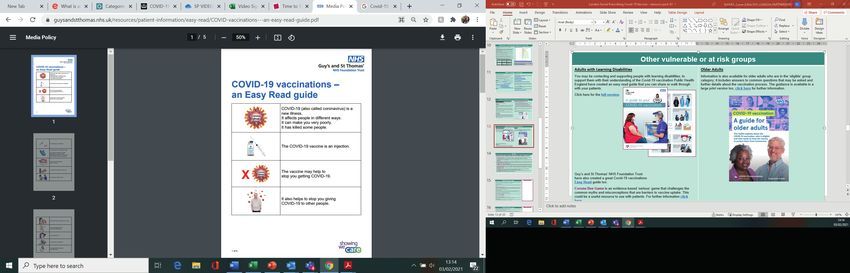
Adults with Learning Disabilities that may be asked and further details about the
You may be contacting and supporting people with vaccination process. The guidance is available in a large
learning disabilities; to support them with their print version too, click here for further information.
understanding of the Covid-19 vaccination PHE
have created an easy read guide that you can Guidance on shielding
share or walk through with your patients. The clinically extremely vulnerable will get priority
access to vaccinations against COVID-19 before the
Click here for the full version. general population and in line with the priority
ordering set by the JCVI. Read the guidance on
Guy’s and St Thomas’ NHS Foundation Trust shielding and protecting people who are clinically
have also created a great Covid-19 vaccinations extremely vulnerable from Covid-19 here.
Easy Read guide too.
Finding my NHS Number
Corona Bee Game is an evidence-based ‘serious’ AN NHS number is not necessarily required for booking
game that challenges the common myths and appointments however would be useful. People can find
misconceptions that are barriers to vaccine uptake. their number on the NHS App or via the website click here.
This could be a useful resource to use with
patients. For further information click here.
Older Adults
Information is also available for older adults
who are in the ‘eligible’ group category;
it includes answers to common questions
30Further support
There may be more activity happening in your Bereavement support
local area than you realise! Many sectors and People may be needing bereavement support, especially
organisations have recruited (including volunteers) if they have a loved one or acquaintance who is
or redeployed staff to support the efforts of the dying/has died from Covid-19. There are services and
Covid-19 vaccination programme; and equally information available you can connect people to:
created information and guidance to support
specific groups and cases to ensure people have Hospice UK: Caring for your dying relative
the facts they need. at home with Covid-19
NHS: Bereavement advice and support during coronavirus
Covid-19 Vaccine Community Thrive London: Support after sudden bereavement
Champion / Connector Schemes during the Covid-19 pandemic - Toolkit
Volunteer programmes have been established in Department of Health & Social Care - Guidance for
boroughs across the country; one example is the funerals: Covid-19: guidance for arranging or
Covid-19 Health Champions programme in Newham. attending a funeral during the coronavirus pandemic
At a Loss.org: Grieving Alone & Together:
The roles are wide ranging and there may be more Responding to the loss of your loved one
to add to this list! Make contact your local Health during the Covid-19 pandemic
Watch to find out how they may be involved with
supporting local communities too.
31Further support
Support for people with
Long Term Conditions Stroke or Transient Ischaemic Attack (TIA) –
Charities and groups established to support people Stroke Association
with long term conditions will have created guidance Sickle cell disease – Sickle Cell Society
and fact sheets for people who are living with a long Severe mental health illness – Rethink Mental Illness
term condition, see below a list of examples that are in Seriously overweight (BMI 40 and above) –
line with the up to date list of Covid-19 vaccination Public Health England
first phase priority groups; which includes the Risk
Group and Clinical conditions list. Other conditions*
Cystic Fibrosis – Cystic Fibrosis Trust
Asthma – Asthma UK Multiple sclerosis – MS Society
Cancer – Macmillan COPD – British Lung Foundation
Diabetes – Diabetes UK
*Please add additional conditions and organisations as you need; there
Heart problem – British Heart Foundation may be local charities that also offer guidance and support.
Kidney disease – Kidney Care UK
Liver disease – British Liver Trust
HIV – National Aids Trust
Muscular Dystrophy – Muscular Dystrophy UK
Neurological conditions – Brain and Spine Foundation
Rheumatoid arthritis, Lupus or Psoriasis – (who may
require long term immunosuppressive treatments
Specialist Pharmacy Service)
32Top tips
To support your conversations with patients, it might own time. Sometimes people need more time to
be helpful to run through the following list of ‘Top reflect and decide once they have more knowledge.
Tips’ that can help you prepare in advance of an
6. Have information to hand; create your own pack of
appointment / call, or when you’re supporting at a
resources that will make you feel prepared. You may
vaccination centre / GP practice; there are also tips
need to relay a lot of information to people about
about ensuring you are supported too!
the vaccination process, or need to know where
1. Develop your confidence; it may feel like a big vaccination sites are etc. Your local area may also have
responsibility to support people through the covid-19 vaccine community champions or connector
vaccination process. Reading through this pack and schemes you can link in with, these may be managed
the resources available to you, will leave you well by your local authority or voluntary and community
equipped to start these conversations. services (VCS).
2. Use Motivational Interviewing techniques; ask simple 7. Take the opportunity to get to know people such
and non-judgemental questions “How do you feel as your colleagues and patients, you’ll have a great
about the Covid-19 vaccination?” opportunity when stewarding at vaccination sites.
Think about how you may be able to generate Social
3. Explore peoples worries and concerns; appreciate that
Prescribing referrals when at vaccine sites (covid-19
these are their feelings and fears. Talk through the
safe ways of distributing leaflets, GDPR safe ways of
possible causes.
recording referrals on paper etc).
4. Help find solutions; what is stopping them from
8. Keep connected; ensure to keep in contact with
attending an appointment? Help to find ways
your peer support group, manager and/or supervisor.
around what the issues may be i.e. transport, family
Maintaining communications with your colleagues
pressures, fear of needles etc.
and peers is important, don’t struggle – reach out.
5. Planting the seed – introduce information; if
9. Talk through your own concerns; if you are worried
people continue to be hesitant, provide them with
about the vaccine or experience similar challenges to
information and resources they can return to in their
those of your patients, speak to your GP for further
information and reassurance.
33FAQ’s & Key messages
Below is a combined list of frequently asked Are there any side effects?
questions and key messages. This list may evolve over For these vaccines, like lots of others, the MHRA have
time and you might want to start adding your own identified that some people from all demographics might
experiences to this too; no question is a silly question feel slightly unwell, but they report that no significant
and often more than one person will be thinking it! side effects have been observed in the millions of people
who have now been vaccinated.
How does the vaccine work?
The vaccine works by making a protein from the virus All patients from all demographics will be provided with
that is important for creating protection. The protein information on the vaccine they have received, how to
works in the same way they do for other vaccines by look out for any side effects, and what to do if they do
stimulating the immune system to make antibodies and occur, including reporting them to the MHRA.
cells to fight the infection.
Are there any materials of human or
Is the NHS confident the vaccine is safe? animal origin in the vaccine?
Yes. The NHS will not offer any Covid-19 vaccinations No. There is no material of foetal or animal (No pork,
to the public until independent experts have signed off beef or gelatine) origin in any of the vaccines. A
that it is safe to do so. The Medicines and Healthcare detailed review of the vaccines and their ingredients are
products Regulatory Agency (MHRA), the official published on the MHRA’s website.
UK regulator, have said these vaccines are safe and
highly effective, and we have full confidence in their
expert judgement and processes. As with any medicine,
vaccines are highly regulated products.
34 For further FAQs check out Public Health England’s NHS Staff Comms ToolkitFAQ’s & Key messages
Are there microchips in the vaccine? of protection after two weeks – 89% for the Pfizer/
No, the vaccines do not contain microchips or BioNTech vaccine and 74% for the Oxford/AstraZeneca
any other nano-particles. vaccine.
Can people pick what vaccine What happens if a person has the
they want? first jab but not the second?
No. Any vaccines that the NHS will provide will have Both vaccines have been authorised on the basis of two
been approved because they pass the MHRA’s tests doses because the evidence from the clinical trials
on safety and efficacy, so people should be reassured shows that this gives the maximum level of protection.
that whatever vaccine they get, it is safe and worth
their while. The evidence doesn’t show any risk to not having the
second dose other than not being as protected as
Can I get one privately? you otherwise would be. We would urge everyone to
No. Vaccinations are only available through the show up for both of their appointments for their own
NHS. You can be contacted by the NHS, your employer, protection as well as to ensure we don’t waste
or a GP surgery local to you, to receive your vaccine. vaccines or the time of NHS staff.
Remember, the vaccine is free of charge.
Why are you postponing second doses?
The UK Chief Medical Officers have agreed a longer
timeframe between first and second doses so that more
people can get their first dose quickly, and because the
evidence shows that one dose still offers a high level
35 For further FAQs check out Public Health England’s NHS Staff Comms ToolkitFAQ’s & Key messages
Can you give Covid-19 to anyone There is no evidence either of the vaccines will
if you have the vaccine? work differently in different ethnic groups.
The vaccine cannot give you COVID-19 infection,
and a full course will reduce your chance of becoming Were the vaccines tested on
seriously ill. We do not yet know whether it will stop high-risk groups?
you from catching and passing on the virus, but we do For both vaccines trial participants included a range
expect it to reduce this risk. So, it is still important to of those from various ages, immune-compromised
follow the guidance in your local area to protect those and those with underlying health conditions, and both
around you. found the efficacy of the vaccine translates through
all the subgroups.
Were the trial participants reflective
of a multi-ethnic population? How long will my vaccine
The Public Assessment Reports contain all the scientific be effective for?
information about the trials and information on trial We expect these vaccines to work for at least a year –
participants. if not longer. This will be constantly monitored.
For the Pfizer trial, participants included 9.6% black/ Are there any groups that shouldn’t have the vaccine?
African, 26.1% Hispanic/Latino and 3.4% Asian. People with history of a severe allergy to the
ingredients of the vaccines should
For the Oxford/AstraZeneca vaccine 10.1% of trial not be vaccinated.
recipients were Black and 3.5% Asian.
36 For further FAQs check out Public Health England’s NHS Staff Comms ToolkitFAQ’s & Key messages
The MHRA have updated their guidance to say that sure the space is safe for visitors and staff, most vaccination
pregnant women and those who are breastfeeding can centres in the first day or days may open slightly later.
have the vaccine but should discuss it with a clinician to
ensure that the benefits outweigh any potential risks. What if people can’t get to the
Vaccination Centre?
Are there different vaccines for People who are housebound will be contacted by their GP
different age groups? services about alternative ways to get vaccinated. People
No, the vaccines will be made available for people can also wait until more locations closer to where they live
over the age of 16 years old; and will be administered become available. The NHS will follow up with people that
to people in line with the up-to-date list of Covid-19 haven’t booked their appointment, as a reminder.
vaccination first phase priority groups; which includes
the Risk Group and Clinical conditions list. Can staff receive a vaccination
Yes, to minimise waste, vaccination sites have also been
Do vulnerable people travel to get ensuring unfilled appointments are used to vaccinate
the vaccine or does it come to them? healthcare workers who have been identified at highest
We are planning a mixed approach to ensuring that risk of serious illness from Covid-19. Increased supply
people who are eligible can get the vaccine safely. For care means that vaccination can also now immediately be
home residents and those who can’t leave home, this will expanded for frontline health and social care workers,
involve roving community teams coming to them. including those working in primary care, independent
providers and voluntary organisations
What time will the opening hours of like hospices.
vaccination centres be?
Standard opening times for vaccination centres will be 8am
– 8pm, seven days a week. To test the system and make
37 For further FAQs check out Public Health England’s NHS Staff Comms ToolkitMy notes and key messages 38
Further Reading
     If you want to read through other resources in           Health Education England
     addition to the NHS England and Public Health            Covid-19 Vaccination – An e-learning resource
     England guidance and information; you may want to        designed to support the training of the health and
     check out the following organisations and websites:      care workforce involved in delivering the Covid-19
                                                              vaccination programme.
     The British Society for Immunology
     The British Society for Immunology and the Academy       Joint Committee on Vaccination and Immunisation
     of Medical Sciences (AMS) have rapidly convened an       (JCVI) – The JCVI advises UK health departments on
     expert group to collate and review what is currently     immunisation.
     known about the immunology of COVID-19, and to
     identify immunology research priorities in response to   Department of Health and Social Care
     the COVID-19 outbreak.                                   Statement from the UK Chief Medical Officers on the
                                                              prioritisation of first doses of COVID-19 vaccines
     Celebrate Vaccines is the British Society for
     Immunology’s campaign to champion the critical role      Royal College of Nursing
     of vaccination and vaccine research in advancing         Covid-19 and vaccination FAQs
     global health. Our goal is to use the expert voice of
     the immunology community to strengthen public            London School of Hygiene & Tropical Medicine
     understanding of vaccines, supporting everyone to        Vaccine FAQs
     make informed decisions about vaccination.

39
Further Reading
University of Oxford and commissioners provides a helpful framework
Vaccine Knowledge Project to identify practical action to systematically address
health inequalities in the vaccination roll out and
Vaccine Confident Project communications strategy.
Vaccine Confidence Project and videos
Inclusion Health Groups
Anxiety UK You can have an impact on health by ensuring that your
Needle and Injection Phobia booklet relationship with individuals from inclusion health groups
is appropriate to allow you to provide the necessary
Doctors of the world support read through Inclusion Health: Applying
Translated health information – Covid-19 guidance ‘All Our Health’ the for more information.
available in over 60 languages
NHS England & Improvement
Covid-19 vaccination programme –
Primary Care Guidance
Public Health England
Addressing health inequalities – Health Equity
Assessment Tool (HEAT) in conjunction with Health
equity audit guide for screening providers
40To all who read and use
this resource pack…
“We value your time and appreciate your support to ensure people within your
community feel confident and understand the vaccine programme”
To all who have supported the
creation of this resource pack…
“Thank you for sharing and connecting us to the valuable resources and
programme teams that helped to shape this document”
Created by Cerrie Baines, Healthy London Partnership – for further information about this pack please email hlp.socialprescribing@nhs.netFull Links & References in Resource Pack
If you have problems with accessing any of the PAGE 8
hyperlinks in this pack, please use full links below: https://www.pfizer.co.uk/behind-science-what-mrna-vaccine
PAGE 9
PAGE 4 https://www.gavi.org/vaccineswork/what-are-viral-vector-based-vaccines-
https://www.england.nhs.uk/coronavirus/publication/managing- and-how-could-they-be-used-against-covid-19
coronavirus-covid-19-in-general-practice-sop/ https://www.research.ox.ac.uk/Article/2020-07-19-the-oxford-covid-19-
https://future.nhs.uk/socialprescribing/ vaccine
view?objectId=90305157#90305157 https://www.immunology.org/sites/default/files/BSI resource_A guide to
https://future.nhs.uk/socialprescribing/grouphome vaccinations for COVID19.pdf
PAGE 5 PAGE 10
https://coronavirusresources.phe.gov.uk/covid-19-vaccine/resources/ https://www.gov.uk/government/publications/covid-19-vaccination-what-to-
https://coronavirusresources.phe.gov.uk/covid-19-vaccine/resources/nhs- expect-after-vaccination/what-to-expect-after-your-covid-19-vaccination
staff-comms-toolkit/ https://assets.publishing.service.gov.uk/government/uploads/system/uploads/
https://www.gov.uk/government/publications/regulatory-approval-of- attachment_data/file/951769/PHE_COVID-19_vaccination_guide_what_to_
pfizer-biontech-vaccine-for-covid-19 expect_after_your_vaccination_English_v2.pdf
https://www.gov.uk/government/publications/regulatory-approval-of-covid- PAGE 11
19-vaccine-astrazeneca https://www.immunology.org/sites/default/files/BSI resource_A guide to
vaccinations for COVID19.pdf
https://www.gov.uk/government/publications/regulatory-approval-of-covid-
19-vaccine-moderna/information-for-uk-recipients-on-covid-19-vaccine- https://www.gov.uk/coronavirus
moderna
https://www.immunology.org/sites/default/files/BSI resource_A guide to
vaccinations for COVID19.pdf
42Full Links & References in Resource Pack
https://www.gov.uk/government/publications/england-lockdown- PAGE 15
stay-at-home-posters https://www.england.nhs.uk/coronavirus/publication/vaccination-sites/
https://coronavirus-yellowcard.mhra.gov.uk/ https://www.gov.uk/government/publications/covid-19-vaccination-why-
PAGE 12 you-are-being-asked-to-wait
http://www.nhs.uk/covid-vaccination https://assets.publishing.service.gov.uk/government/uploads/system/uploads/
https://www.gov.uk/government/collections/covid-19-vaccination- attachment_data/file/951774/PHE_COVID-19_vaccination_guide_why_do_I_
programme#leaflets-and-posters have_to_wait_English_v2.pdf
PAGE 13 PAGE 17
https://www.gov.uk/government/publications/covid-19-vaccination-care- https://www.actionfraud.police.uk/covid19
home-and-healthcare-settings-posters/covid-19-vaccination-first-phase- https://www.bbc.co.uk/news/av/technology-46149888
priority-groups https://www.england.nhs.uk/statistics/statistical-work-areas/covid-19-vaccinations/
https://assets.publishing.service.gov.uk/government/uploads/system/ PAGE 18
uploads/attachment_data/file/956104/PHE_COVID_vaccination_priority_ https://www.euro.who.int/__data/assets/pdf_file/0004/329647/Vaccines-and-trust.PDF
poster.pdf
https://www.guysandstthomas.nhs.uk/resources/patient-information/all-patients/
https://assets.publishing.service.gov.uk/government/uploads/system/ overcoming-your-fear-of-needles.pdf
uploads/attachment_data/file/965177/COVID-19_vaccination_
PAGE 22
programme_guidance_for_healthcare_workers_26_February_2021_
https://www.immunology.org/coronavirus/connect-coronavirus-public-
v3.4.pdf
engagement-resources
https://www.nhs.uk/nhs-services/gps/how-to-register-with-a-gp-surgery/
PAGE 14
https://www.publichealth.hscni.net/publications/covid-19-vaccination-
record-card
https://coronavirusresources.phe.gov.uk/covid-19-vaccine/resources/nhs-
staff-comms-toolkit/
43You can also read


