Marie Skłodowska-Curie Actions - under Horizon Europe Introduction - European Commission
←
→
Page content transcription
If your browser does not render page correctly, please read the page content below
Marie Skłodowska-
Curie Actions
under Horizon Europe

Introduction

European Commission
Directorate-General for Education, Youth,
Sport and Culture
Unit C2. Marie Skłodowska-Curie Actions
The MSCA under Horizon Europe

                Pillar 1                                                Pillar 2                                    Pillar 3
                Excellent Science                                       Global Challenges and                       Innovative Europe
                                                                        European Industrial
                                                                        Competitiveness
                                                                    • Health
       European Research Council                                    • Culture, Creativity and               European Innovation Council
                                                                      Inclusive Society

                                                         Clusters
                                                                    • Civil Security for Society                European innovation
         Marie Skłodowska-Curie                                     • Digital, Industry and Space                   ecosystems
                 Actions                                            • Climate, Energy and Mobility
                                                                    • Food, Bioeconomy, Natural
                                                                      Resources, Agriculture and           European Institute of Innovation
                                                                      Environment                                and Technology
          Research Infrastructures
                                                                        Joint Research Centre

                       Widening Participation and Strengthening the European Research Area

          Widening participation and spreading excellence                             Reforming and Enhancing the European R&I system

The information in this presentation is preliminary and subject to the adoption of the work programme
Key figures (2014-2020)
+65,000
37%
Researchers, 6.2 billion €
Researchers
including Under
from outside
25,000 PhD Horizon 2020
of the EU
candidates
+1,000 +4,500 42%
Doctoral Companies Female
programmes supported researchers
The information in this presentation is preliminary and subject to the adoption of the work programmeIntroduction to the MSCA
• EU’s reference programme for doctoral and
postdoctoral training, contributing to:
• A highly skilled research-based human capital able to detect and
tackle upcoming challenges, communicate scientific evidence to
policy-makers and the public, and work across disciplines
• Provide researchers with skills needed in the labour market, to
innovate and to convert knowledge and ideas into products and
services for economic and social benefit
• Develop excellent doctoral programmes enhancing the global
attractiveness and visibility of institutions involved in them
• Promote the EU’s global attractiveness for talents
• Budget under Horizon Europe: 6.6€ billion
• Geographic coverage
The information in this presentation is preliminary and subject to the adoption of the work programmeKey features
Researchers’
Excellent research International,
training, skills and
in all domains cross-sectoral &
career
(bottom-up interdisciplinary
development (all
approach) mobility
stages of career)
Structuring impact
Attractive working Strong
on organisations
and employment collaboration with
through excellent
conditions industry and SMEs
programmes
The information in this presentation is preliminary and subject to the adoption of the work programmePolicy background, principles and priorities • Contribution to the European Research Area (ERA) and European Education Area (EEA) • Contribution to the EU external policy objectives • Committed to the European Charter for Researchers and the Code of Conduct for the Recruitment of Researchers + Innovative Doctoral Training Principles • Underlying Principles: Open Science, Responsible Research & Innovation • New publishing platform and open peer review: https://open-research-europe.ec.europa.eu/ The information in this presentation is preliminary and subject to the adoption of the work programme
Principles and novelties

• Streamlined actions, clearer identity
• Simpler rules, harmonised conditions
• Demand management to maintain high quality
• Reinforced synergies within Horizon Europe and with
  other EU funding programmes
• New guidelines on supervision to ensure that
  researchers are adequately supervised
• Towards “greener MSCA” to promote sustainable
  behaviors and policies, support policy and decision
  making, through MSCA Green Charter, Green Deal
  thematic clustering events…

The information in this presentation is preliminary and subject to the adoption of the work programme
More gender-friendly and inclusive MSCA
• Horizon 2020: 41% of female fellows (from 38% in RISE to
44% in ITN)
• In line with the Charter and Code, all MSCA projects are
encouraged to embrace diversity
• In the interest of non-discrimination and equal
opportunities:
Family allowances will be accessible to all, even if their parental status
changes during the duration of the project
Long-term leave allowance in case of the researchers’ leave, including
maternity, paternity, parental, sick or special leave
Broader definition of family to ensure full access to these allowances
(recognised LGBTI+ couples)
The information in this presentation is preliminary and subject to the adoption of the work programmeAcademia-non academia collaboration
• Encourage inter-sectoral exposure through incentives
• With the aim to develop transferable skills (e.g.
innovation, entrepreneurship) leading to improved
employability and career prospects within and
outside academia
• Incentives:
Industrial Doctorates: max 540 person-months instead of 360 for
standard doctoral networks; academic and non-academic organisations
jointly supervising can be in the same country
Postdoctoral Fellowships: incentive: additional 6 months for
placements in the non-academic sector at the end of the project
The information in this presentation is preliminary and subject to the adoption of the work programmeThe Actions
Doctoral
Networks Postdoctoral
Staff Exchanges
Doctoral
Fellowships
Support for research
programmes in and Support to excellent and innovation staff
outside academia postdoctoral exchanges
incl. joint & industrial researchers
doctorates
COFUND MSCA and
Co-funding doctoral
Citizens
and postdoctoral Public outreach
programmes events (Night)
The information in this presentation is preliminary and subject to the adoption of the work programmeMarie Skłodowska- Curie Actions under Horizon Europe Doctoral Networks European Commission Directorate-General for Education, Youth, Sport and Culture Unit C2. Marie Skłodowska-Curie Actions
Doctoral Networks
• Multi-beneficiary Action to set up doctoral programmes,
including
Industrial Doctorates: Training in academia and industry, Joint
supervision
Joint Doctorates: Joint collaborations leading to a joint/multiple doctoral
degree, Joint selection and supervision; pre-agreement for joint degrees
required
• Respond to well-identified needs in various R&I areas
(bottom-up), expose the researchers to the academic and
non-academic sectors, and offer training in research-
related, as well as competences relevant for innovation
and long-term employability
• Focus on research and transferable skills, (inter-
sectoral secondments), career development plan,
supervision, internationalisation/attractiveness
The information in this presentation is preliminary and subject to the adoption of the work programmeDoctoral Networks: eligibility/organisations
• Who applies?
Consortia of universities, research institutions and research
infrastructures, businesses including SMEs, and other socio-economic
actors
At least three independent legal entities, each established in a different
MS or AC; minimum of 1 beneficiary from a MS (on top of this minimum,
any entity from any third country can join; no minimum for associated
partners)
• All beneficiaries must recruit at least one doctoral
candidate. They are required to host at their premises
and supervise recruited researchers, or use associated
partners linked to them to do so
• Not more than 40.0% of the EU contribution may be
allocated to beneficiaries in the same country or to a
single international organisation.
The information in this presentation is preliminary and subject to the adoption of the work programmeBeneficiaries/Associated Partners
Beneficiaries Associated Partners
Academic/Non-academic
Signatories of the Grant
Agreement
Recruitment of
researchers
Training and/or hosting of
seconded researchers
Participation in
Supervisory Board
Directly claim costs
The information in this presentation is preliminary and subject to the adoption of the work programmeDoctoral Networks: eligibility/researchers • Supported researchers must be doctoral candidates (not already in possession of a doctoral degree at the date of recruitment) • Researchers must be enrolled in a doctoral programme, in at least 1 EU Member State/Associated Country (at least 2 for Joint Doctorates) • Any nationality • Mobility rule: must not have resided or carried out main activity in the country of the recruiting beneficiary for more than 12 months immediately before their recruitment date The information in this presentation is preliminary and subject to the adoption of the work programme
Doctoral Networks
• Size
Up to 360 person-months (standard) + 180 additional person-months
for joint or industrial doctorates (incentive)
• Duration
Programme: max. 48 months
Fellowship: between 3 and 36 months
Secondments: worldwide, up to 1/3 of the fellowship duration
Industrial doctorates: 50% in the non-academic sector; academic and
non-academic organisations jointly supervising can be in the same
country
• Calls
2021: 22 June - 16 Nov (tentative); 402.95M€
2022: 3 May - 15 Nov (tentative); 427.28M€
Resubmission restrictions applying as of 2022 for applications
receiving a score below 80%
The information in this presentation is preliminary and subject to the adoption of the work programmeDoctoral Networks: Unit contributions
Institutional unit
Contributions for recruited researchers
contributions
Per person-month
Per person-month
Long-term Special Research,
Family Management
Living Mobility leave needs training and
allowance and indirect
allowance allowance allowance allowance networking
(if applicable) contribution
(if applicable) (if applicable) contribution
EUR 4 000 Requested
x unit1
EUR 3 400 EUR 600 EUR 660 % covered x EUR 1 600 EUR 1 200
by the (1/number of
beneficiary months)
The information in this presentation is preliminary and subject to the adoption of the work programmeDoctoral Networks: award criteria
Quality and efficiency
Excellence Impact
of the implementation
Quality and pertinence of Contribution to structuring doctoral training
Quality and effectiveness of the
the project’s research and at European level and strengthening work plan, assessment of risks,
innovation objectives European innovation capacity and appropriateness of the effort
assigned to work packages
Soundness of the Credibility of the measures to enhance the Quality, capacity and role of each
proposed methodology career perspectives of researchers and participant, including hosting
contribution to their skills development arrangements and extent to which
the consortium as a whole brings
together the necessary expertise
Quality and credibility of Suitability and quality of the measures to
the training programme maximise expected outcomes and impacts,
as set out in the dissemination and
exploitation plan, including communication
activities
Quality of the supervision The magnitude and importance of the
project’s contribution to the expected
scientific, societal and economic impacts
50% 30% 20%
The information in this presentation is preliminary and subject to the adoption of the work programmeMarie Skłodowska- Curie Actions under Horizon Europe Staff Exchanges European Commission Directorate-General for Education, Youth, Sport and Culture Unit C2. Marie Skłodowska-Curie Actions
MSCA Staff Exchanges

                                  International, inter-sectoral and interdisciplinary
                                  mobility of R&I staff (“secondments”)

                                         Knowledge transfer between participating
  Main                                   organisations
objectives
                                         Collaboration between the academic and
                                         non-academic sectors (including SMEs)

                                  Cooperation across the globe

The information in this presentation is preliminary and subject to the adoption of the work programme
MSCA Staff Exchanges
Ideas
Transferable Employability converted into
Outcome for skills &
competences
& career
prospects
products,
processes &
services
staff members
Networking
International
and
exposure
communication
Outcome for I3
Transfer of
R&I capacity
organisations knowledge collaborative
networks
The information in this presentation is preliminary and subject to the adoption of the work programmeMSCA Staff Exchanges
Implementation of a joint R&I project by
seconding and/or hosting eligible staff members
Three dimensions of mobility: inter-sectoral,
international and interdisciplinary
Activities
Networking activities, organisation of
workshops and conferences
New skills acquisition and career development
perspectives
The information in this presentation is preliminary and subject to the adoption of the work programmeMSCA Staff Exchanges
Participating organisations
Consortium of at least 3
legal entities in 3 different
countries, 2 of which in a
different EU Member State
or HE Associated Country
If organisations from the
same sector (academic or
non-academic), there
must be at least 1
organisation from a non-
associated Third Country
The information in this presentation is preliminary and subject to the adoption of the work programmeMSCA Staff Exchanges
Any type of staff
contributing to R&I activities Each staff member is
seconded for a period of
(researchers, administrative 1 to 12 months (may be
staff, managerial staff, split into several stays)
technical staff)
Researchers at any career Staff needs to be
Seconded stage (from doctoral devoted full-time to the
candidates to postdoctoral action during the
staff members researchers) secondment
Actively engaged in research
After the secondment,
and/or innovation activities for
staff should return to
at least 1 month prior at the their sending institution
sending institution
The information in this presentation is preliminary and subject to the adoption of the work programmeMSCA Staff Exchanges
• Duration
4 years for project implementation
Maximum 360 person-months per project (novelty)
Secondments: 1-12 months per staff
Interdisciplinary secondments in the same sector possible within Europe
(max 1/3 of project’s person-months) (novelty)
• Calls
2021: 7 Oct 2021 – 9 March 2022 (tentative); 72.5 M€
2022: 6 Oct 2022 – 8 March 2023 (tentative); 77.5 M€
The information in this presentation is preliminary and subject to the adoption of the work programmeMSCA Staff Exchanges
Contributions for seconded
Institutional unit contributions
staff members
Per person-month
Per person-month
Special needs Research,
Management
Top-up allowance training and
and indirect
allowance networking
(if applicable) contribution
contribution
Requested unit1
x
EUR 2 300 EUR 1 300 EUR 1 000
(1/number of
months)
Top-up allowance: travel, accommodation and
subsistence costs Participating organisations
are expected to continue
Research, training and networking contribution:
paying the salary of the staff
training, transfer of knowledge, networking activities and
during the secondment
research expenses
Management and indirect contribution: beneficiary’s
additional costs
The information in this presentation is preliminary and subject to the adoption of the work programmeMSCA Staff Exchanges
Quality and efficiency
Excellence Impact
of the implementation
Quality and pertinence of the Developing new and lasting research Quality and effectiveness of the
project’s research and innovation collaborations, achieving transfer of knowledge work plan, assessment of risks,
objectives (and the extent to which between participating organisations and and appropriateness of the effort
they are ambitious, and go beyond contributing to improving research and innovation assigned to work packages
the state of the art) potential at the European and global level
Soundness of the proposed Credibility of the measures to enhance the career Quality, capacity and role of each
methodology (including i3 perspectives of staff members and contribution to participant, including hosting
approaches, consideration of the their skills development arrangements and extent to
gender dimension and other diversity which the consortium as a whole
aspects, and the quality of open brings together the necessary
science practices) expertise
Quality of the proposed interaction Suitability and quality of the measures to
between the participating maximise expected outcomes and impacts, as
organisations in light of the set out in the dissemination and exploitation plan,
research and innovation objectives including communication activities
The magnitude and importance of the project’s
contribution to the expected scientific, societal
and economic impacts
50% 30% 20%
The information in this presentation is preliminary and subject to the adoption of the work programmeMSCA Staff Exchanges
Tips and tricks
Follow available Highlight the EU
Closely follow the call guidelines dimension
requirements
Use the structure provided Show that your proposal
Be in line with the action’s in the template and addresses EU policy
objectives and expected address all the evaluation priorities and/or societal
outcomes criteria challenges
Sustainability of
Get a second opinion
collaboration
Have your proposal proof- Contact your NCP
Describe the benefits of
read by a colleague and
cooperation and how they
pre-screened by your NCP
can go beyond this project
The information in this presentation is preliminary and subject to the adoption of the work programmeMarie Skłodowska- Curie Actions under Horizon Europe MSCA COFUND European Commission Directorate-General for Education, Youth, Sport and Culture Unit C2. Marie Skłodowska-Curie Actions
MSCA COFUND
• Mono-beneficiary action to co-fund new or existing
national, regional, institutional schemes for doctoral
training and postdoctoral fellowships
• Focus
Spread best practices of the MSCA by promoting high
standards in the recruitment process and excellent working
conditions
Introduce sustainable structuring effects, by promoting
excellent and sustainable research training, international, inter-
sectoral and interdisciplinary cooperation and mobility
Encourage synergies with Cohesion policy funds as well as the
Recovery and Resilience Facility. Programmes could focus on
specific disciplines, notably when based on RIS3.
The information in this presentation is preliminary and subject to the adoption of the work programmeMSCA COFUND
• Target groups
Doctoral candidates, i.e. researchers without a doctoral
degree at the deadline of the co-funded programme's call;
mandatory enrolment in a doctoral programme
Postdoctoral researchers, i.e. researchers with a doctoral
degree at the deadline of the co-funded programme's call
• Who applies?
Single legal entity established in an EU Member State or HE
Associated country.
A minimum of three researchers must be recruited.
• Career Development Plan
To be jointly established by the supervisor and each recruited
researcher upon recruitment. Revised (and updated where
needed) within 18 months
The information in this presentation is preliminary and subject to the adoption of the work programmeMSCA COFUND
• Co-funding
Max 10 M€ per beneficiary per call (unchanged)
The EU contribution covers minimum remuneration (70% living +
mobility allowance) and can be used more flexibly
• Duration
Programme: max. 60 months (unchanged)
Fellowship: min 3 months
Secondments: up to 1/3 of the fellowship duration
• Introduction of an MSCA Cofund Seal of Excellence for
applications scoring ≥ 85%
• Calls:
2021: 12 Oct 2021 – 10 Feb 2022 (tentative); 89 M€
2022: 11 Oct 2022 – 9 Feb 2023 (tentative); 95 M€
The information in this presentation is preliminary and subject to the adoption of the work programmeMSCA COFUND – Unit contributions
Contributions for recruited researchers and institutional
contributions
Per person-month
Long-term leave Special needs
COFUND allowance allowance allowance
(if applicable) (if applicable)
EUR 2 800
Requested unit1
Doctoral x
EUR 2 800 x
Programmes % covered by the
(1/number of months)
beneficiary
EUR 3 980
Requested unit1
Postdoctoral x
EUR 3 980 x
Programmes % covered by the
(1/number of months)
beneficiary
Minimum remuneration applies:
EUR 2 800 for Doctoral researcher, EUR 3 980 for Postdoctoral researcher
The information in this presentation is preliminary and subject to the adoption of the work programmeMSCA COFUND – Award criteria
Quality and efficiency
Excellence Impact
of the implementation
Quality and novelty of the selection / recruitment Strengthening human resources Quality and effectiveness of the
process for the researchers (transparency, good practices at institutional, work plan, management
composition and organisation of selection regional, national or international level, structures, assessment of risks
committees, evaluation criteria, equal opportunities, in particular through aligning the and appropriateness of the effort
the gender dimension and other diversity aspects) practices of participating organisations assigned to work packages
and quality and attractiveness of the appointment with the principles set out by the EU for
conditions, including competitiveness of the human resources development in
salary for the standards of the hosting countries research and innovation
Quality and novelty of the research options offered Credibility of the proposed measures Quality and capacity of the host
by the programme in terms of science, to enhance the career perspectives institution(s) and participating
interdisciplinarity, inter-sectorality and level of and employability of researchers and organisations (where
transnational mobility. Quality of open science contribution to their skills appropriate), including hosting
practices development arrangements and extent to which
Quality, novelty and pertinence of the research Suitability and quality of the measures they bring together the necessary
training programme (including transferable skills, to maximise the expected outcomes expertise to successfully
inter/multidisciplinary, inter-sectoral and gender as and impacts, as set out in the implement the research training
well as other diversity aspects) dissemination and exploitation plan, programme
including communication activities
Quality, novelty and pertinence of the supervision,
career guidance and career development
arrangements
50% 30% 20%
The information in this presentation is preliminary and subject to the adoption of the work programmeMarie Skłodowska- Curie Actions under Horizon Europe Postdoctoral Fellowships European Commission Directorate-General for Education, Youth, Sport and Culture Unit C2. Marie Skłodowska-Curie Actions
MSCA Postdoctoral Fellowships
• Main Objectives:
Foster excellence through implementation of research project
Enhance the creative and innovative potential of researchers
holding a PhD (training on transferable skills & career
development)
Focus on i3 (international, inter-sectoral, interdisciplinary) mobility
Bridges and exposure to the non-academic sector
• Research areas:
All scientific fields
Including Euratom areas (indicative amount EUR 1 million
annually) within existing scientific panels - novelty
The information in this presentation is preliminary and subject to the adoption of the work programmeMSCA Postdoctoral Fellowships
• Activities:
Mono-beneficiary action to support post-doctoral research
and careers with:
• European Postdoctoral Fellowships: coming to Europe
from any country in the world or moving within Europe
No separate panels – mainstreamed incentives– novelty
• Global Postdoctoral Fellowships outside EU Member
States and Horizon Europe AC.
* Widening activities: “ERA Fellowships” will be aligned with the MSCA
Postdoctoral Fellowships call
The information in this presentation is preliminary and subject to the adoption of the work programmeMSCA Postdoctoral Fellowships
• Who applies? Participating Organisations* :
Legal entity in an EU Member State or HE Associated country
• Recruited Researchers- Target Groups:
any nationality (Global Fellowships: nationals or long-term residents of
MS or HE AC) *
in possession of PhD at the call deadline – novelty
up to 8 years research experience after PhD (with exceptions= career
breaks, work outside research, research outside Europe for
reintegrating researchers) – novelty
mobility rule: not resided /main activity in the country of the beneficiary
(or host organization for GF) more than 12 in the 36 months before call
deadline
• *Specific eligibility criteria for PFs supported by Euratom:
Organisation: legal entity established in an EU Member State or
Euratom AC
Researcher: nationals or long-term residents of an EU Member State
or a Euratom AC
The information in this presentation is preliminary and subject to the adoption of the work programmeMSCA Postdoctoral Fellowships
• Duration
European Fellowships: 12-24 months
Global Fellowships: 24-36 months (12-24 outgoing phase &
12 months mandatory return phase in Europe)
• Secondments worldwide up to 1/3 of the fellowship duration–
(novelty: worldwide secondments)
• Optional additional placement of up to 6 months in a non-
academic European organization (novelty)
at the end of the fellowship applicable to both European and Global PF
• Calls
2021: 22 June – 12 Oct (tentative); 242 M€ [+indicative EUR 1 million for
Euratom]
2022: 13 Apr – 14 Sept (tentative); 257 M€ [+indicative EUR 1 million for
Euratom]
Resubmission restrictions applying as of 2022 for applications receiving
a score below 70%
The information in this presentation is preliminary and subject to the adoption of the work programmeMSCA Postdoctoral Fellowships * A country correction coefficient applies to the living allowance in order to ensure equal treatment and purchasing power parity for all researchers The information in this presentation is preliminary and subject to the adoption of the work programme
MSCA Postdoctoral Fellowships
                                                                                                           Quality and efficiency
                  Excellence                                               Impact
                                                                                                           of the implementation
Quality and pertinence of the project’s research         Credibility of the measures to                    Quality and effectiveness of the
and innovation objectives (and the extent to             enhance the career perspectives                   work plan, assessment of risks
which they are ambitious, and go beyond the              and employability of the researcher               and appropriateness of the effort
state of the art)                                        and contribution to his/her skills                assigned to work packages
                                                         development
Soundness of the proposed methodology                    Suitability and quality of the measures           Quality and capacity of the host
(including interdisciplinary approaches,                 to maximise expected outcomes and                 institutions and participating
consideration of the gender dimension and other          impacts, as set out in the                        organisations, including hosting
diversity aspects if relevant for the research           dissemination and exploitation plan,              arrangements
project, and the quality of open science                 including communication activities
practices)
Quality of the supervision, training and of the          The magnitude and importance of the
two-way transfer of knowledge between the                project’s contribution to the expected
researcher and the host                                  scientific, societal and
Quality and appropriateness of the researcher’s          economic impacts
professional experience, competences and
skills

                       50%                                                   30%                                        20%

   The information in this presentation is preliminary and subject to the adoption of the work programme
Marie Skłodowska- Curie Actions under Horizon Europe MSCA and Citizens European Commission Directorate-General for Education, Youth, Sport and Culture Unit C2. Marie Skłodowska-Curie Actions
MSCA and Citizens
• Coordination and Support Action to bring research and
researchers closer to the public at large, through the
organisation of the European Researchers’ Night
• Target group: general public, pupils, families, students
• Focus:
Enhance engagement with citizens on R&I
Increase awareness among the general public of the
importance and benefits of R&I and its concrete impact
on citizens’ daily life
Raise young people's interest for research and science
Improves researchers’ communication skills and
competences
The information in this presentation is preliminary and subject to the adoption of the work programmeThe European Researchers’ Night • Every year, on the last Friday of September (events can last up to two days) • A Europe-wide public and media event for the promotion of research careers, in particular focused on young people and their families • In 2022-2023, focus on Horizon Europe Missions The information in this presentation is preliminary and subject to the adoption of the work programme
The European Researchers’ Night
• Who applies?
One or more legal entities established in an EU Member State or
HE Associated country
• EU contribution
Lump-sum contributions
Contribution estimated between 50-150k€ per annual edition of
the European Researchers’ Night
• Duration
The call 2022 covers two successive editions (2022-2023)
Applicants encouraged to submit proposals covering two successive
editions (2022/2023) of the NIGHT
• Call
2021: 22 Jun – 7 Oct (tentative); 15 M€
The information in this presentation is preliminary and subject to the adoption of the work programmeMSCA and Citizens - Award Criteria
Coordination and support actions (CSA)
Clarity and pertinence of the Credibility of the pathways to Quality and effectiveness of the work plan,
project’s objectives. achieve the expected assessment of risks, and appropriateness of the
outcomes and impacts effort assigned to work packages, and the
Quality of the proposed
specified in the work resources overall.
coordination and/or support
programme, and the likely scale
measures including soundness Capacity and role of each participant, and extent to
and significance of the
of methodology. which the consortium as a whole brings together
contributions due to the project. the necessary expertise.
Suitability and quality of the
measures to maximise
expected outcomes and
impacts, as set out in the
dissemination and exploitation
plan, including communication
activities.
The information in this presentation is preliminary and subject to the adoption of the work programmeMarie Skłodowska- Curie Actions under Horizon Europe Cross-action novelties European Commission Directorate-General for Education, Youth, Sport and Culture Unit C2. Marie Skłodowska-Curie Actions
Family allowance

                                                                                                (i) marriage
                                                                                    (ii) relationship with equivalent
  Mobility-related costs of                                                       status to marriage (under the law
                                                                                  of the country or region in which
  researchers with family                                                         this relationship was formalised)
         obligations                                                               (iii) dependent children who are
                                                                                  actually being maintained by the
                                                                                                researcher

                                                                              Due if the
                                                                           researcher has
                                                                             or acquires
                       EUR                  EUR                                 family
                                                                             obligations
                       500
                                            660                              during the
                                                                                action

The information in this presentation is preliminary and subject to the adoption of the work programme
Long-term leave allowance
What does it cover?
• personnel costs incurred by the beneficiaries in case of researchers’ leave,
including maternity, paternity, parental, sick or special leave.
% of long-term
leave allowance number of months
long-term leave incurred by the (i.e. duration of the
allowance (i.e. beneficiary beneficiary’s
living allowance + (i.e. costs incurred payment
mobility allowance) by the beneficiary / obligations for the
long-term leave leave)
allowance)
! For absences longer than 30 consecutive days.
The information in this presentation is preliminary and subject to the adoption of the work programmeSpecial needs allowance
What does it cover?
• Additional costs for the acquisition of special needs items and services for fellows
with disabilities, e.g. assistance by third persons, adaptation of work environment,
additional travel or transportation costs.
The items or services must not have been covered from another source (e.g. social
! security or health insurance)
For whom?
• MSCA fellows with disabilities, whose long-term physical, mental, intellectual or
sensory impairments are certified by a competent national authority and of such
nature that their participation in the action would not be possible without the
special needs items or services.
EUR EUR EUR EUR EUR EUR EUR EUR EUR EUR
3 000 4 500 6 000 9 500 13 000 18 500 27 500 35 500 47 500 60 000
Beneficiaries shall claim the closest lower rate per researcher/staff member compared
! to the estimated actual costs of his/her special needs.
The information in this presentation is preliminary and subject to the adoption of the work programmeAcademic and non-academic sectors
Academic sector
public or private higher
education
establishments
public or private non-
profit research
organisations Non-academic
sector
International European
Research Organisations any socio-
economic actor not
included in the
academic sector
The information in this presentation is preliminary and subject to the adoption of the work programmeGender Equality Plans
Corporate eligibility criterion in Horizon Europe (not specific to MSCA)
Applicable to public bodies, research organisations and higher
education establishments from EU Member States and Horizon
Europe Associated Countries
Minimum process-related requirements for publication, dedicated
resources, data collection & monitoring, and training
Transition/grace period before full enforcement for calls with
deadlines in 2022
The information in this presentation is preliminary and subject to the adoption of the work programmeMarie Skłodowska- Curie Actions under Horizon Europe Applying to the next calls European Commission Directorate-General for Education, Youth, Sport and Culture
Call calendar

Year                 Action                        Estimated opening*                           Estimated deadline*

            Doctoral Networks                            22 June 2021                             16 November 2021
               Postdoctoral
                                                         22 June 2021                               12 October 2021
               Fellowships
2021         Staff Exchanges                            7 October 2021                                  9 March 2022
                COFUND                                 12 October 2021                             10 February 2022
           MSCA and Citizens
                                                         22 June 2021                                   7 October 2021
           (covers 2 editions)
           Doctoral Networks                               3 May 2022                             15 November 2022
              Postdoctoral
                                                         13 April 2022                            14 September 2022
              Fellowships
2022        Staff Exchanges                             6 October 2022                                  8 March 2023
                   COFUND                              11 October 2022                              9 February 2023
           MSCA and Citizens                                            No call foreseen in 2022
*Dates to be confirmed with the adoption of the Work Programme

The information in this presentation is preliminary and subject to the adoption of the work programme
Funding opportunities
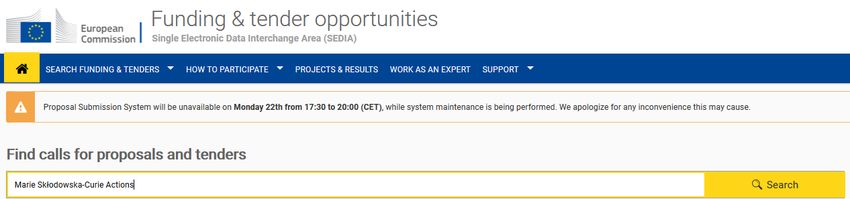
• All calls are published on the Funding and Tender
Opportunities Portal
• Applications are submitted through the portal:
Find your call
Sign in to the portal and register your organisation (get a PIC
number)
Find partners
Apply
The information in this presentation is preliminary and subject to the adoption of the work programmeKey resources and guidance
• Check all guidance documents:
Guide for applicants: overview of rules, financial aspects, etc.
MSCA Work Programme and annexes
Proposal templates
Model Grant Agreements
Online manual on how to submit an application
Frequently Asked Questions
• Ask for advice to your MSCA National Contact Point
(list available on Funding and Tenders Portal)
• Submit specific queries to the Research Enquiry
Service (funding, validation of participants, etc.)
The information in this presentation is preliminary and subject to the adoption of the work programmeDedicated information sessions
• Check with your NCP to find out about the next
information sessions in your country
• Check the Funding and Tenders Portal and social media
to find out about the next webinars organised by the
European Commission services
24th March: Webinar “How to prepare a successful proposal
in Horizon Europe”
• Other partners organise dedicated sessions for individual
researchers (Euraxess, Marie Curie Alumni Association,
etc.)
The information in this presentation is preliminary and subject to the adoption of the work programmeJob offers for individual researchers
• Look for PhD and postdoctorate
opportunities on EURAXESS / Job portals
• https://euraxess.ec.europa.eu/
• Ask for advice to your MSCA National
Contact Point
• Check the project’s requirements and
apply to your institution of interest
The information in this presentation is preliminary and subject to the adoption of the work programmeYou can also read


