Master Planning and Space Architecture for a Moon Village
←
→
Page content transcription
If your browser does not render page correctly, please read the page content below

International Astronautical Congress

70th International Astronautical Congress (IAC), Washington, DC 21-25 October 2019.

                         Master Planning and Space Architecture for a Moon Village

Daniel Inocente 1 (corresponding author), Colin Koop 1, Georgi I. Petrov 1, Jeffrey A. Hoffman 2, Valentina Sumini 3, Dr. Advenit Makaya
4, Marlies Arnhof 4, Hanna Lakk 4, Brigitte Lamaze 5, Dr. Aidan Cowley 5, David Binns 5, Markus Landgraf 6, Piero Messina 6, Claudie
Haigneré 6

1. Skidmore Owings & Merrill (SOM), New York, USA
2. Massachusetts Institute of Technology (MIT), Cambridge, USA
3. MIT Media Lab, Responsive Environments, Cambridge, USA
4. European Space Agency (ESA), Noordwijk, Netherlands
5. European Space Agency, Cologne, Germany
6. European Space Agency, Paris, France

                                                                 Abstract

Skidmore, Owings & Merrill (SOM), in partnership with the European Space Agency (ESA) and faculty of Aerospace and
Architecture at the Massachusetts Institute of Technology (MIT), is working on space architecture and master planning
strategies for the first full-time human settlement on the Moon. One aspect of ESA’s space exploration efforts in Low
Earth Orbit, the Moon and Mars is to aim at “developing new concepts for international exploration activities, encom-
passing novel cooperation opportunities open to all nations and industrial actors.” To support this goal, the partnership
envisions future missions to the lunar surface that will be driven by cooperation and sustainable planning strategies.
The “Moon Village” idea, first presented by ESA Director General Johann-Dietrich Wörner, is a vision for an open archi-
tecture based on global cooperation among multiple nations and multiple partners combining their various expertise
for the common objective of enabling long-term exploration of the lunar surface.

Fundamental to achieving this goal will be the establishment of an infrastructure on the Moon, relying on a myriad of ar-
chitectures and surface system capabilities. As part of this larger effort, an alignment with NASA’s 2018 Strategic Plan
to “extend human presence deeper into space and to the Moon for sustainable long-term exploration and utilization”
provides an essential paradigm for holistic thinking about humanity's future in space. Advancement of new and emerg-
ing capabilities supported by commercial expertise, transferring proven technologies toward addressing challenges in
space will result in the construction of an early outpost for safe, flexible and efficient human exploration. Achieving this
initial goal would produce operational experience for the planning and extensive development of an eventual sustain-
able and permanent lunar ecosystem that will support a variety of human activities for scientific exploration, industrial
development and commercial initiatives. The “Moon Village” aims to demonstrate the potential of an international
private-public partnership to advance human space exploration through cross-disciplinary cooperation.

This paper presents a holistic approach to planning lunar development, centered on the need for singular surface hab-
itation units, designed as adaptive multi-functional modules that will enable and support versatile surface operations.
Multi-functional structural concepts, optimized for performance, safety, and utility, leverage emerging technologies
including a combination of structural pressurized vessels, regolith structures for radiation shielding, and adaptive in-
frastructure planning strategies. Located on the edge of Shackleton crater near the lunar south pole, the development
maximizes In-Situ Resource Utilization by proximity to presumed ice deposits and solar energy potential, using high
elevation locations with long periods of continuous solar irradiation. Phasing strategies are explored for evaluating the
evolutionary steps of the settlement to anticipate future ISRU-based experimental and construction activities. Only by
expanding on the capabilities and the cooperation of both commercial and government entities can we truly address
large and micro scale-architectural systems for human settlements beyond Earth.

Keywords: Space Architecture, Habitation, ISRU, Master Planning, Moon, Structures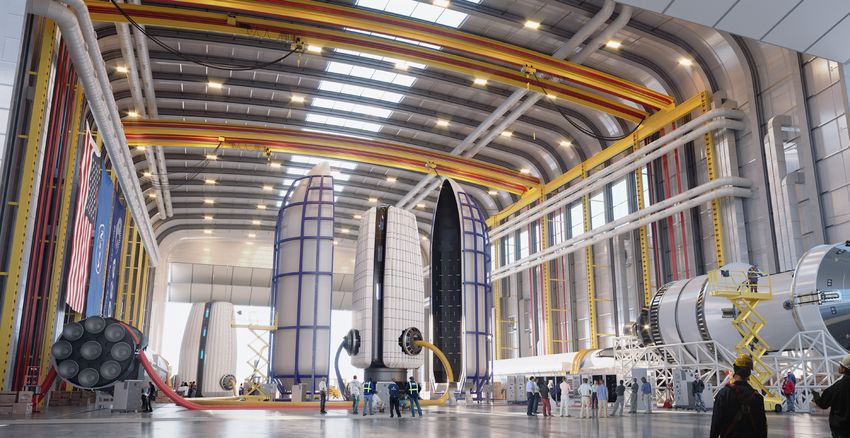
International Astronautical Congress

70th International Astronautical Congress (IAC), Washington, DC 21-25 October 2019.

Introduction                                                            settlement.

In 2015, the Director General of the European Space                     Site Selection and Masterplan
Agency (ESA), Johann-Dietrich Wörner, introduced
the concept of the “Moon Village” [1,2]. Inspired by                    After half a dozen robotic missions in the past decade,
the unparalleled level of cooperation in creating the                   we are now fairly certain that both poles of the Moon
International Space Station (ISS), the Moon Village                     hold large amounts of water and other volatiles in their
extends this paradigm to deep space activities. The                     permanently shaded craters [3,4]. While the nature and
initiative envisions a model of growth where many players               distribution of these resources is not yet determined, the
combine resources to deploy a common infrastructure on                  frozen volatiles hold tremendous industrial and scientific
the Moon that can then support a wide range of activities               opportunity as a local source of fuel, commodities, and
and missions. The vision has sparked a renewed interest                 development. The evidence points to the fact that the
and mobilized commercial and government energies                        current conditions at the poles have existed for a very
toward returning humans to the Moon and establishing a                  long time and thus is a treasure trove of stored samples
permanent settlement.                                                   from the early solar system until the present day. This
                                                                        combination of resources and scientific interest has made
In this spirit, Skidmore, Owings & Merrill (SOM) has                    the poles a logical target for early human exploration.
partnered with the ESA and faculty of the Massachusetts
Institute of Technology (MIT) Department of Aeronautics                 A permanently inhabited Moon Village will be humanity’s
and Astronautics and Media Lab to design a permanent                    first effort in establishing an off-world society. Historically,
human settlement located at the lunar south polar                       the initial act of setting up a new settlement has very long-
region. This project is a platform allowing us to build on              lasting effect on the resulting society. Setting up the plan
the knowledge and technologies developed for space                      for the physical reality of the settlement will play a role
applications—challenging both space and terrestrial                     just as important as the social setup and governance of
architectures to consider the relationships between                     the Moon Village.
human activities and the resources which support them,
and developing architectural solutions for the Moon that                The primary requirements for the design of a settlement
will in turn advance thinking about terrestrial concerns.               on an extra-planetary surface are safety, efficiency, and
Solving how a human settlement might evolve in the                      capacity for growth. Safety requires that there be several
extreme conditions of space enables more intelligent                    interconnected and individually pressurized elements.
methodologies and promises to directly impact how we                    In case of an accidental loss of pressure, a fire, or other
approach challenges on Earth. Conditions unique to the                  failure, there must be at least two means of egress from
lunar environment, such as reduced gravity, extreme                     every module. Furthermore, the loss of any one space
thermal differentials, high-energy solar exposure, cosmic               must not cut off functioning portions of the settlement
radiation, high velocity micrometeorite impact, abrasive-               from each other. Efficiency is dictated by the shortage
electrostatic regolith, zero atmosphere and constrained                 of labor, materials, and energy associated with the
human living spaces, must be accounted for in the                       great distance from Earth. Expandability requires that
architectural design of an integrated settlement (see                   the pattern of development be easily repeatable and
Figure 1).                                                              expandable without compromising the qualities of the
                                                                        structures that have already been completed.
The partnership is grounded on the free exchange of
expertise and ideas to generate novel concepts which                    In order to establish the organizational principles of the
are supported by the creative, scientific and engineering               masterplan, the team has drawn inspiration from the rich
capabilities of each partner. ESA is providing expertise                literature on urban planning and design. The precedents
from its various research and engineering facilities                    that were reviewed included grid plans such as Roman
including ESTEC, the European Astronaut Centre, and ESA                 military camps, Spanish cities in Latin America laid out
HQ. Retired NASA Astronaut Jeffrey Hoffman, on the MIT                  according to the “Law of the Indies,” and the American
Aero/Astro faculty, brings human spaceflight experience                 Public Land Survey System, as well as radial plans such
to the team. Together with SOM’s extensive expertise                    as the Garden City design by the English writer Ebenezer
in architecture, structural and civil engineering, urban                Howard [5].
planning, sustainable design, and digital design, we will
bring real-world scenarios that maximize the potential                  The model best suited for the irregular terrain at the lunar
of the proposed holistic paradigm for a future lunar                    south pole while meeting the above criteria is the Linear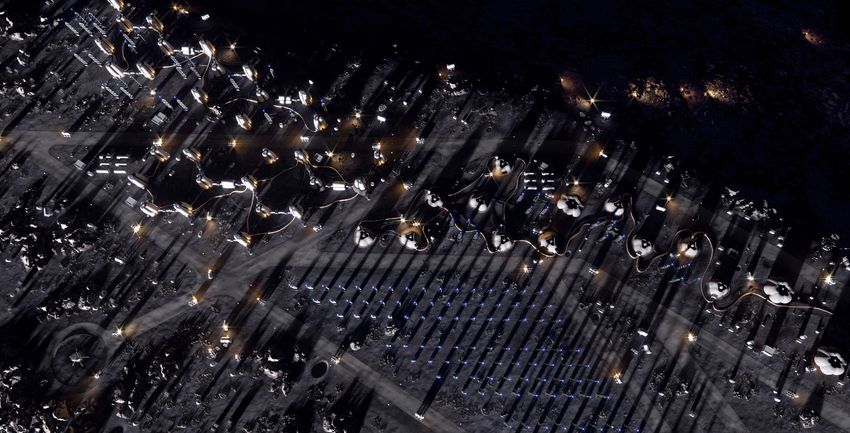
International Astronautical Congress

70th International Astronautical Congress (IAC), Washington, DC 21-25 October 2019.

Figure 1. View of Earth rise from the rim of Shackleton Crater.

Figure 2. Master Plan view of Moon Village development.
International Astronautical Congress

70th International Astronautical Congress (IAC), Washington, DC 21-25 October 2019.

City, a planning idea first enunciated by the Spanish                   during the Apollo project. The LM provided space for
planner Arturo Soria and popularized by the Swiss                       two astronauts for several days with a habitable volume
architect Le Corbusier [6]. Arranging the pressurized                   of 6.6 m3, using the Saturn V as launch vehicle [8]. A
elements in two parallel bands that are connected                       planetary architecture needs interfaces with transport
at regular intervals best achieves the goals of safety,                 and landing vehicles, as well as EVA access determined
efficiency and expandability. The external zones of the                 by the elevation of module interior entrance levels as
Moon Village can then also parallel the development. This               well as surface mobility unit requirements. The size,
linear development has the additional benefit of being                  design and configuration of the modules determine a
flexible and easily adaptable to the terrain at the rim of              variety of utilization and operational effects, such as
Shackleton Crater [7].                                                  interior habitable volume and its spatial and functional
                                                                        optimization.
We propose to locate the Moon Village along the rim
of Shackleton Crater near the South Pole. The layout                    Parameters
of the settlement will align with the rim of the crater in
four parallel bands of development (see Figure 2). The                  The mission parameters of the concept are characterized
Habitation Band will be comprised of the pressurized                    by a series of missions in which the architecture is
habitats and will be located on the side closest to the                 incrementally improved through additional capabilities
crater. A second band, called the Infrastructure Band,                  and mission durations. The main habitat we envision will
will be comprised of spaces that will hold all the external             be a Class 2 prefabricated structure as defined by Cohen
support equipment. A third band, named the Activities                   [9,10]. An evolutionary model to support the addition of
Band, will be reserved as a staging area for the various                increased activity and industry can only be strategically
stakeholders of the Moon Village. The energy generation                 organized by adaptive methods which are informed
and transportation activities will be located in a zone away            by integrating the physical mission parameters and
from the crater wall [7].                                               future surface development strategies into the design
                                                                        approach. The parametric relationship between the crew,
Besides the physical infrastructure to keep lunar                       systems, and interfaces provides a useful framework for a
inhabitants alive, every settlement also requires physical              successful infrastructure that can support any reasonable
symbols that give the Moon Village an identity and a sense              crew size and duration within the safety and performance
of poetry. On the south pole, the Earth will be visible just            considerations requirements.
above the horizon. To celebrate this view, we propose to
leave a portion of the rim in the direction of the Earth from           The SOM-designed vertical habitat known as One
the Moon Village as an undisturbed preserve that will                   Moon was developed with an emphasis on technology
remain free of human impact [7]. Thus, from the habitats,               development goals including structures, environmental
there will always be a view of the Earth hanging above the              protection, crew systems, deployment, and human
sweeping arch of the crater rim in the far distance and a               interfaces. In addition to these goals, we incorporated
piece of undisturbed lunar surface in the near distance.                considerations for requirements such as environmental
                                                                        control and life support systems, power, thermal and
Habitat Design                                                          extravehicular activities. Together, these systems
                                                                        are meant to function as an integrated habitable unit
Extra-terrestrial surface habitats are constrained in                   designed to support and facilitate the crew’s activities.
terms of module design, dimensions and orientations to                  We include in the anticipated design considerations
comply with the selected launch vehicle, orbital assembly               lunar activities that are critical to the advancement
(if required) and transfer, landing strategy and surface                of establishing a permanent base and settlement.
transportation and deployment. Transportation payload                   Activities on the Moon will include both human and
envelope and mass limitations are major drivers of critical             robotic exploration science which is meant to gather
design requirements. While it is necessary to define                    information about geologic conditions and resource
a mission scenario and functional goals for a habitat,                  availability. Lunar resource development will provide
the operational features such as level of technological                 knowledge and experience on how to use resources in
integration and safety will determine performance and                   the lunar environment to produce oxygen, hydrogen,
hardware requirements.                                                  metals and various products from ice water deposits,
                                                                        regolith, and solar energy. Experiments leading up to this
So far, the only extra-terrestrial surface habitat that                 will require intensive field work which would benefit from
has been built and deployed is the Lunar Module (LM)                    habitation modules and strategies that increase safety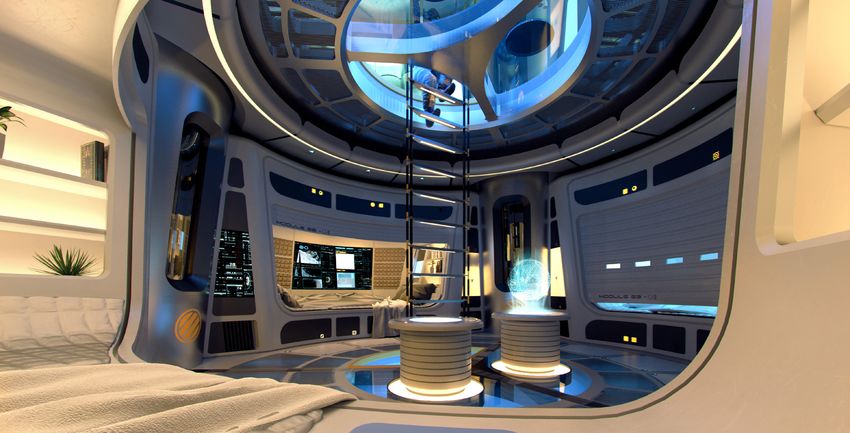
International Astronautical Congress

70th International Astronautical Congress (IAC), Washington, DC 21-25 October 2019.

and performance, since frequent extravehicular activity                 and assembled during encapsulation. This vehicle has a
missions would be required.                                             payload capacity to LEO of 63,800 kg (140,660 lb) and a
                                                                        dynamic volume of about 145 m3. The New Glenn offers
Testing operational and surface technologies will                       a fairing that is 21.9 meters tall and 7 meters in diameter,
be primarily driven through crew-centered and                           which results in a usable volume of 450 m3, twice that of
teleoperated methods. Crew-centered control of                          any launch vehicle currently in operation. It is designed to
activities will be conducted by astronauts using                        deliver a payload of 45,000 kg (99,000 lb) to LEO and is
augmented teleoperation. The architecture for these                     projected to begin launching payloads beginning in 2021.
future activities will be determined by the duration,                   In September 2019, SpaceX’s Elon Musk revealed the first
location, and centralization of mission operations. It                  prototype of Starship MK1. The spacecraft has a diameter
will take a lot of equipment to enable experimentation                  of 9 meters and height of 50 meters will have the capacity
leading to large scale development and the necessity                    to carry more than 100 metric tons (220,000 lb) to Earth
of infrastructural elements such as high data rate                      orbit.
communication equipment, large solar panel arrays,
navigation relays, microwave power beam systems. Most                   Reusability in space transportation will enable large
of this equipment is cargo that can be delivered ahead                  payloads such as One Moon to be delivered affordably
of long-term human missions. Additionally, pressurized                  to the lunar surface with cargo and crew (see Figure 3).
crew vehicles, teleoperated robotic rovers and surface                  These reusable systems are all capable of carrying large
manipulation systems would need to be delivered to                      payloads to LEO from where fuelled delivery vehicles will
facilitate assembly and construction of equipment. The                  carry the first support and habitable systems to the Moon.
solution to transporting this much mass lies in reusable
transportation that can eventually be refuelled, perhaps                Table 1. Flight Systems
eventually by taking advantage of the resources available
on the Moon.

Preconstructed habitats are a necessary part of building
a base methodically and sustainably. Our designs and
approach focus on the pre-emplacement of habitats that
eventually lead to the construction of larger occupiable
structures but first allow crew to access the most
critical sites. These habitats need to be designed within
transportation limits and should be fully functional when
they are delivered to the mission site.

The transportation system limits the mass and scale of
a habitation system for performance and cost reasons
which are primary drivers for the selection of reusable
systems currently available and under development (as                   Vertical Habitat
shown in Table 1). For more than 40 years after the Apollo
program, the price of launch to orbit has been estimated                The pressurized habitats are being designed as
to be about $10,000 per kilogram ($10 million per metric                deployable multi-purpose modules. The first habitats
ton). Comparing this price to what SpaceX has been able                 will have to house multiple functions in one module.
to achieve with reusable rockets at about $2,000                        Subsequent iterations can be specialised for crew
per kilogram, we see a clear advantage in reusability. We               accommodations, scientific laboratories, food production,
investigated the dynamic volume, mass and dimensional                   working, and touristic use. The diversity in functions
limits of a variety of current and planned reusable                     underlines a fundamental need to remain flexible and
transportation systems, including SpaceX’s Falcon                       develop an adaptable architecture.
Heavy, Blue Origin’s New Glenn launch vehicle, and the
SpaceX Starship currently under development. We then                    The habitats will be comprised of a pressurized volume
studied each fairing's dynamic volume and dimensional                   with numerous integrated systems including docking
limits. The Falcon Heavy fairing is 13.1 meters tall and 5.2            capability, environmental control and life support system
meters in diameter, made of an aluminium honeycomb                      (ECLSS), logistics management, radiation mitigation, fire
core with carbon-fibre face sheets fabricated in two shells             safety, crew health equipment, scientific workstations and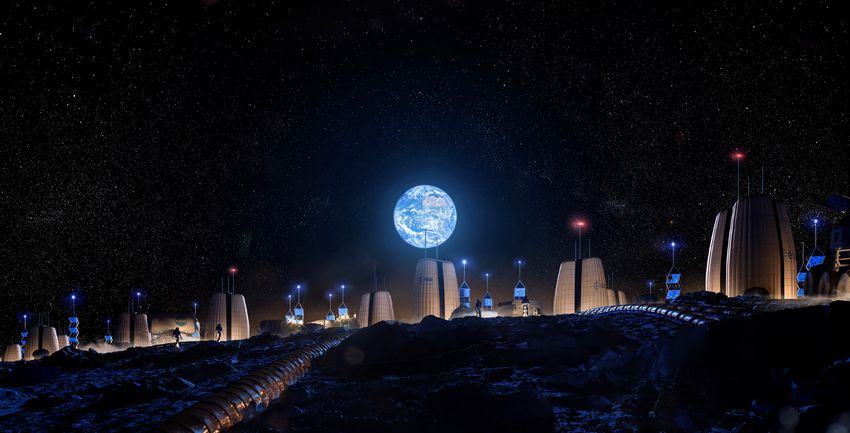
International Astronautical Congress

70th International Astronautical Congress (IAC), Washington, DC 21-25 October 2019.

Figure 3. Pre-flight view. The vertical habitat packaged before launch.

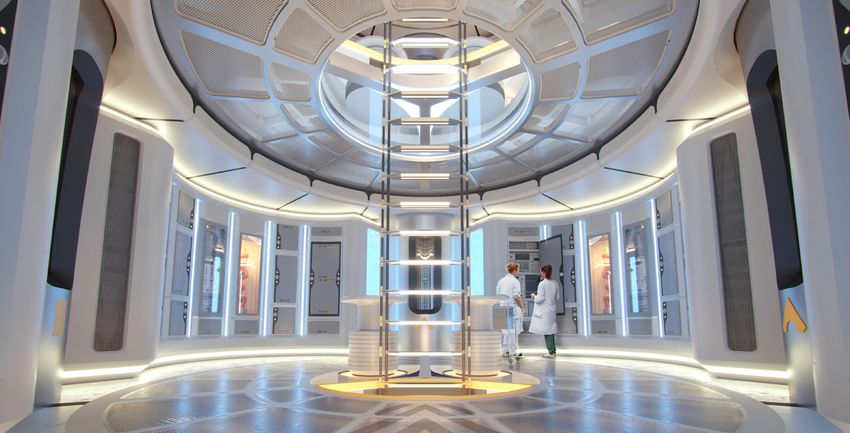
Figure 4. Habitat interior view. Working space and labs.
International Astronautical Congress

70th International Astronautical Congress (IAC), Washington, DC 21-25 October 2019.

robotic control station. It will sustain a crew of four to six.         payload limits including those of the Falcon Heavy, New
With an interoperable interface, the modules will have a                Glenn, and Starship. Following NASA’s STD 3001 Space
docking system that can link to a rover or to pressurized               Flight Human-System Standard, we identified safety,
connectors linking to other habitats.                                   technical, and performance constraints at an early
                                                                        stage. This technical guide provided an understanding
Several important NASA reports, such as the Synthesis                   of human capabilities, limitations, and functions while
Group Report [11], identified inflatable structures as                  also incorporating architectural standards to maximize
an enabling technology that would allow lighter weight                  performance and the human experience.
structures at a lower cost. NASA has been experimenting
with pneumatic or inflatable structures, which resist                   The structural designs for the habitat include a
tensile forces due to internal pressure with flexible                   hybrid system composed of two key elements: the
membranes, since the 1960s. Their main benefit is to                    rigid composite frame and inflatable structural shell.
reduce mass and to be folded and compacted in smaller                   The rigid structural frame consists of three columns
volumes during launch and transport to the target                       (1200mm x 400mm) which are connected at the
location. Other key features are reduced loads while                    base and top. The composite floor system to support
landing on the Moon or Mars and shorter manufacturing                   gravity loads spans between the perimeter columns
time [12].                                                              and cantilevers out between them. In contrast to other
                                                                        inflatable designs, which centralize the structure and
The inflatable modules require a frame of rigid elements                mechanical systems, this system liberates the central
that hold the internal structure together during the                    area, providing large double-height volumes between
large dynamic loads of launch, transfer, and landing                    levels for increased mobility, programming, visibility,
[13]. These rigid elements then serve as the attachment                 and flexible transportation of equipment. The perimeter
points of the inflatable membrane. Most past designs                    columns also include windows at each level for visibility
starting with NASA’s TransHab, place the rigid elements                 and are refined geometrically for structural performance
in a central core [14,15]. This configuration efficiently               during pressurization of the inflatable shell. The structural
packs the structure and the mechanical systems in a                     columns articulate those loads as concave geometry. Due
central location; however it leaves an awkward doughnut-                to the increased complexity of operations and programs,
shaped space for the humans to inhabit and does not                     the advantage of a perimeter structural system is to
easily permit windows to be placed along the perimeter                  completely free the interior space, offering an adaptable
structure. Here we propose an alternative configuration                 spatial configuration (see Figure 4). Located around
of a composite rigid frame and deployable membrane.                     the vertical structural elements are mechanical shafts
The rigid elements are pushed out to the perimeter with                 supplying water, oxygen, power and communication
the goal of leaving a unified central space that is more                lines throughout the habitat. The mechanical system
flexible for human use and better experientially and                    is supported by the security of a high-performance
psychologically. Moreover, the presence of transparent                  structure while also part of a continuous loop of shafts
elements in the rigid frame will reduce psycho-social                   bringing these systems to every level and space. The
stressors of living inside a confined environment for a long            inflatable shell is designed as a multi-layer system which
term [16]. Stressors for human spaceflight associated                   includes a Nomex protection shield, a Vectran structural
with habitability, confinement, and isolation can lead                  shell, Combitherm, Nextel with insulation foam interlayers,
to degraded performance, feelings of claustrophobia,                    exterior protection shielding and micro-meteoroid and
and lack of motivation [17]. The ducts and chases                       orbital debris shielding protection. This entire assembly
for the ECLSS and electrical systems are paired with                    is attached directly to the columns, with the structural
the structural elements to create pillars of combined                   shell woven directly into the columns to provide increased
structure and mechanical systems.                                       continuity in structure. The inflatable pressure vessel
                                                                        Vectran restraint layer allows the habitat to incorporate
Providing increased volume to accommodate a crew                        a complex geometry that interfaces with rigid structures
of 4 for long-term missions of up to 500 days plus                      such as airlock tunnels. Similar technology has already
contingency days presents us with the challenge of                      been tested by NASA with strength exceeding 9,000 lbs
designing an integrated habitat that can fit within the                 for every 1-inch-wide strap.
payload volumetric and mass constraints of current and
near-term transportation technologies. To achieve this, we              Additionally, our habitat incorporates radiation protection
devised a parametric methodology using computational                    elements designed to provide passive radiation shielding
design technologies which allowed us to test varying                    from environmental radiation for the crew. We are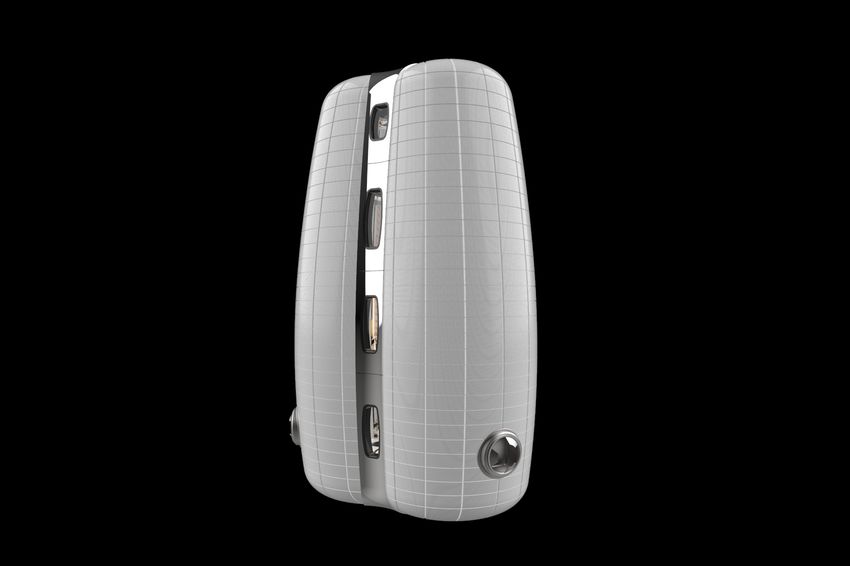
12 11 10 9 8 7 6 5 4 3 2 1
M
L International Astronautical Congress VI
M
70th International Astronautical Congress (IAC), Washington, DC 21-25 October 2019. MO
OWNE
K Eur
ESA
24 r
CS
753
Fran
C1 ARCHI
J
C C2
Ski
14 W
1
A-350 AIRLOCK EVA TUNNEL
CONSU
I
3
AIRLOCK TUNNEL
Con
2 Con
AIRLOCK ADAPTER
1
1
A-250 CONSU
B3 C3
Con
Con
H WARD ROOM & 3 RADIATION SHIELDING
COMMAND CONTROL CAVITY
CONSU
1
Con
2 2
2 Con
R
45
1 00 A-203 WINDOW FRAME
A-300 3
CONSU
1
Con
G Con
SUIT EVA &
STORAGE STRUCTURAL FRAME
CONSU
1 AIRLOCK TUNNEL 1 Con
A-251 B2 1 A-203 A-202 1 A A-200
EL. +1.85 M EL. +1.35 M ACCESS FLOOR
Con
INFLATABLE SHELL
CONSU
F Con
Con
1 KEYPL
3 ISPR UNIT
A-202
COMPOSITE PANEL
2
2 2
TUNNEL STAIR
1 (2) TREADS @250MM
(2) RISERS @ 150MM
E MECH PANEL CHECS & EXERCISE
12 11 10 9 8 7 AIR RETURN 6 5 4 3 2 1
3
B1 A1 M
SEAL
L 1
VI
2 AIRLOCK TUNNEL M
3
D
MO
OWNE
K Eur
B A2 ESA
24 r
CS
753
C
Fran
A-2
1
A3
1 0
C1 ARCHI
NO.
J
LEVEL 1
1 SCALE: 1 : 25 C C2
DRAWI
Ski
B FL
14 W
CONSU
I DRAWI
A
3
2 4 Con
Con
A 47° 1 SHELL REINFORCED
1 5
SEAM
A-250
20° CONSU
B3 C3
6 Con
Con
°
20
H KITCHEN PREPARATION RADIATION SHIELDING
& COMMON UTILITY CAVITY
CONSU
7
8
Con
2 Con
7
20°
A-203 WINDOW FRAME
8
CONSU
6
Con
G Con
WORKSTATIONS
STRUCTURAL FRAME
5 CONSU
1 1 Con
A-251 B2 1 A-203 A-202 1 A A-200 Con
4
INFLATABLE SHELL
CONSU
F Con
3
Con
KEYPL
1 ISPR UNIT
A-202
20°
2
2
1
2
E EXPERIMENTAL LAB
20 & MEDICAL
°
3
B1 A1
SEAL
20°
8 4
7 5
6
D
B A2
C
A-2
1
A3
1 0
NO.
LEVEL 2
1 SCALE: 1 : 25
DRAWI
B FL
Figure 5. Plans. 1st and 2nd levels.
DRAWI
A
A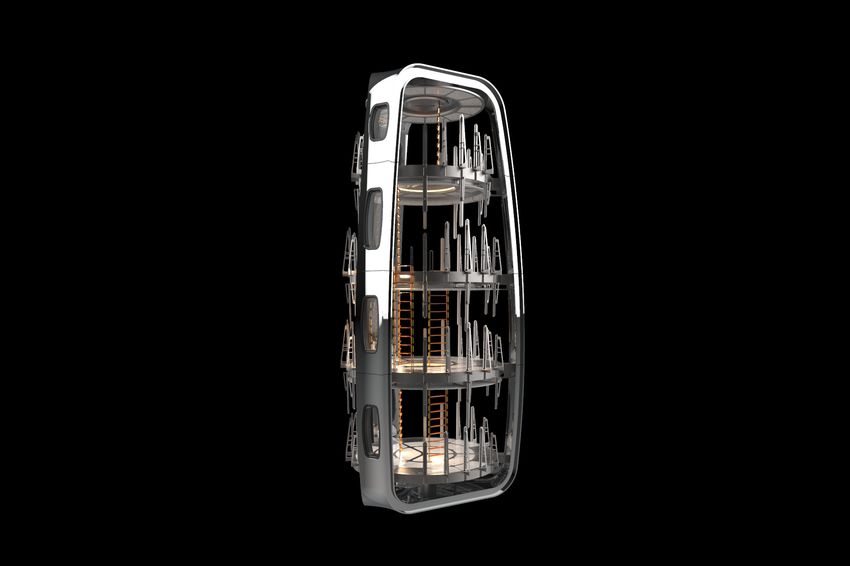
12 11 10 9 8 7 6 5 4 3 2 1
M
L International Astronautical Congress VI
M
70th International Astronautical Congress (IAC), Washington, DC 21-25 October 2019. MO
OWNE
K Eur
ESA
24 r
CS
753
Fran
C1 ARCHI
J
C C2
Ski
14 W
CONSU
I
Con
Con
SHELL REINFORCED
1 SEAM
A-250 1 CONSU
CREW QUARTERS
B3 C3
Con
Con
H MECHANICAL ZONE
CONSU
2
Con
2 Con
A-203 WINDOW FRAME
CONSU
2 Con
G Con
STRUCTURAL FRAME
CONSU
CREW QUARTERS
1 1 Con
A-251 B2 1 A-203 A-202 1 A A-200 Con
INFLATABLE SHELL
CONSU
F Con
1 Con
KEYPL
RADIATION SHIELDING
A-202
LINER
2
1
E
12 11 10 9 8 7 6 5 4 3 2 1
B1 A1 M
SEAL
L
2 HYGIENE
VI
M
D
MO
OWNE
K Eur
B A2 ESA
24 r
CS
753
C
Fran
A-2
1
A3
1 0
C1 ARCHI
NO.
J
LEVEL 3
1 SCALE: 1 : 25 C C2
DRAWI
Ski
B FL
14 W
CONSU
I DRAWI
A
Con
Con
A SHELL REINFORCED
1 SEAM
A-250 CONSU
B3 C3
Con
Con
H MECHANICAL ZONE
HYDROPONICS CONSU
Con
2 Con
A-203 WINDOW FRAME
CONSU
Con
G Con
STRUCTURAL FRAME
CONSU
1 FOOD PRODUCTION 1 Con
A-251 B2 1 A-203 A-202 1 A A-200 Con
INFLATABLE SHELL
CONSU
F Con
Con
KEYPL
RADIATION SHIELDING
A-202
LINER
2
E LABS
B1 A1
SEAL
D
B A2
C
A-2
1
A3
1 0
NO.
LEVEL 4
1 SCALE: 1 : 25
DRAWI
B FL
Figure 6. Plans. 2nd and 3rd levels.
DRAWI
A
AInternational Astronautical Congress
70th International Astronautical Congress (IAC), Washington, DC 21-25 October 2019.
leveraging the life support system as suggested by ESA stacked units and divided units. This provides multiple
to provide radiation protection in the form of water- and opportunities for living conditions that are centralized and
hydrogen-rich materials. The protection would be located offer increased radiation shielding by jacketing the crew
and attached to the inner layers of the inflatable shell and quarters with water. The fourth level includes hydroponic
include a liner with non-potable water. This system would laboratories, experimental food production and other
need to provide enough radiation protection to achieve experimental labs. These additional programmatic
the allowable limits for one year of exposure on the lunar elements provide the crew with an ability to supplement
surface. The increased wall thickness to accommodate food needs and study biological systems.
the water protection becomes an integral part of the life
support system and is maintained by the mechanical It is important to emphasize radiation protection in the
shafts located along the primary structural columns. design, as it includes any system designed to protect the
crew of environmental radiation and monitor that these
The architectural and structural relationships between systems are working properly. Radiation protection is
rigid elements and composite enclosure also allows for primarily located at the enclosure including predictive
multiple configurations to be tailored for specialized measuring technologies for identifying solar particle
functions. The plans below show the internal layout events. The radiation protection shell technology in
of a habitat that will be part of the early phase of the the design is a key architectural driver which offers
Moon Village, thus is has all of the spaces necessary to advantages for increased volume and reduced mass. The
house a crew of four. As the settlement grows and more ongoing work in this area will result in advanced methods
infrastructure is added, it is foreseen that the individual of providing this feature by taking advantage of ISRU
modules can become specialized. For example, the early resources and regolith-based structures.
modules can be converted to habitation-only elements
and the science functions can be re-housed in a dedicated Life Support
laboratory space [17].
Selecting the most optimal life support systems
The design team has focused closely at the habitation, is imperative to support future human activities.
radiation protection and thermal systems which are Considering as a starting point a crew of four for long-
affected to a large extent by the design of a high- term missions up to 500 days, any sustainable approach
performance enclosure system. The habitation interface will be based on an appropriate closed-loop strategy
is responsible for accommodating the crew and their for life support, to increase the usage level of resources,
working, living and sleeping activities. This includes whether produced in-situ or not.
storage, the layout of programmed areas, food supplies,
clothing management systems, fire suppressant, hygiene At an early stage of a Moon settlement with regular
systems, housekeeping, workstations and other human rotations of a crew of only four, one may not consider
related functions. Principles driving these sub-systems yet accomodating the on-site production of a significant
are derived from the human factors standards to part of the crew daily diet (typically 20% or more in
adequately incorporate known constraints and limitations. mass). However, air revitalization, water-loop closure
and potentially production of a food complement would
One Moon includes four levels with varying areas and be fully relevant. In that case, the ultimate waste/loss
volumes at each level, a result of the enclosures geometry in oxygen and water could be compensated by the
and articulated structure. The ground level houses all EVA processing of in-situ available water resources.
support and teleoperation stations for the crew to prepare
and monitor surface activities (see Figure 5). Additionally, Water, among the various metabolic consumables needed
this level interfaces with connection adapters built into by humans, is by far the heaviest part of the daily bill:
the shell. We also include a wardroom & command control about 3 kg/day/crewmember as a minimum, and one may
function. The second level includes workstations, kitchen expect higher demand linked to hygiene and household-
preparation, experimental laboratories and the medical related uses [19]. Oxygen and food follow, representing
station. All functions on the second level are contained each about 1kg/day/crewmember. Waste water is mainly
within customized payload rack systems that include composed of habitat condensates, water used for hygienic
a variety of features such as compartments, working and household purposes—all together the so-called “grey
surfaces, translation aids, lighting and storage areas. The waters” and urine.
third level is designed for crew quarters and hygiene (see
Figure 6). The crew accommodations come in two types: These various Life Support functions and associatedInternational Astronautical Congress
70th International Astronautical Congress (IAC), Washington, DC 21-25 October 2019.
technologies are deeply investigated by space agencies floor area, privacy, intelligent interfaces and increased
and their contractors and partners. At ESA, the visionary degrees of freedom throughout the habitat spaces (see
approach lies in the controlled ecological concept Figure 9). One Moon has a net habitable volume of up
of MELiSSA (Micro-Ecological Life Support System to 390 cubic meters and a habitable area of up to 104
Alternative) (see Figure 7). square meters (see Figure 10). Each program makes use
of deployed volumes by placing all integral rack systems
at the perimeter up against the inflated structural shell.
This projection of the program is what allows the central
spaces to be free of obstruction. The centralized zone
is important for a variety of factors, including better
control of ambient lighting conditions, air movement and
efficient recycling system locations, higher degrees of
communication and collaboration, promoting physical
movement, and high visibility of working surfaces. Our
approach to designing habitats goes beyond technical
requirements, infusing methodology with architectural
principles and technologies across disciplines to arrive at
a solution distinct from those emerging in the established
field of habitat design.
We aim to produce a highly integrated system that
minimizes mass and maximizes structural and systems
performance, with the potential for adaptation as future
surface operations evolve. We are now in the final stages
of schematic design with the goal to begin testing and
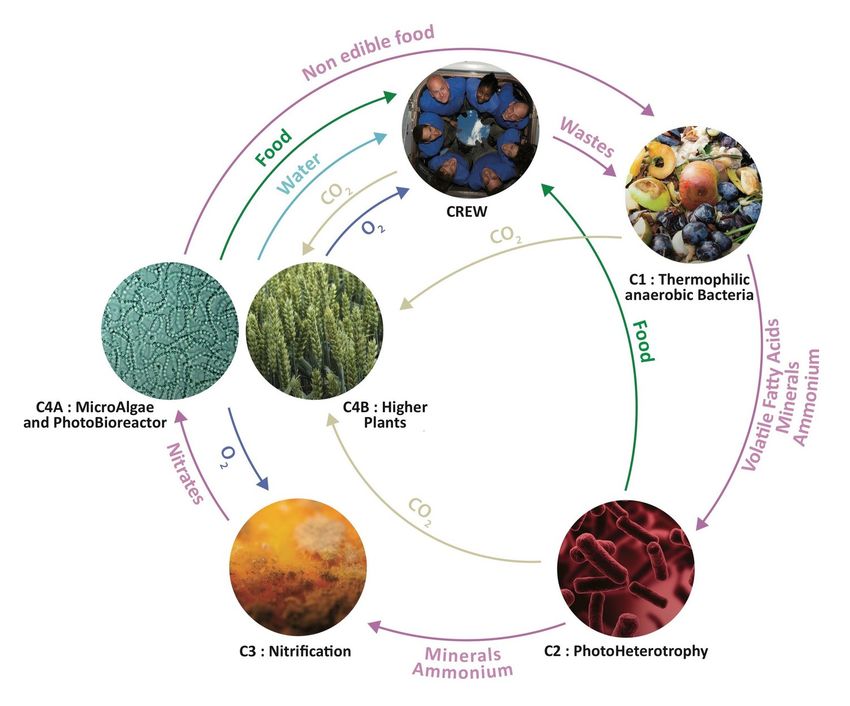
Figure 7. A schematic representation of the MELiSSA building certain elements for validation in 2020 in
loop (courtesy of the MELiSSA Foundation) partnership with ESA and other potential contributions.
Ensuring human performance and incorporating
From this fully closed loop approach, specific Life Support considerations to optimize various human capabilities is
strategies and Life Support Systems architecture can be fundamental to providing an architectural solution which
tailored to a given human exploration scenario, e.g. a considers human integration at both the system level and
Moon settlement, as described above (see Figure 7). individually. Human operation on the lunar environment
will be a difficult challenge for any individual, no matter
In the present context, when air revitalisation and how well trained, and designing for activities that involve
water-loop closure are the main drivers, it makes sense humans will need to meet human factors, habitability,
to envisage a smart combination of water treatment and environmental health standards provided by space
technologies (membrane-based filtration, nitrification) agencies. A holistic approach to designing for human
integrated with a photosynthetic reactor. And if the considerations has been optimized by looking closely at
photosynthetic reactor is colonised by a cyano-bacteria a series of concepts of operations captured in varying
like Limnospira Indica (previously known as Arthospira schedules which are determined for each phase of the
Platensis, commercially available as Spirulina), a Moon Village development. The concept of operations
food complement, with a high protein content, can be for lunar activities informs the design of the habitat by
produced and incorporated in the crew diet: a first allowing spaces and functions to remain flexible while not
step towards closure of carbon and nitrogen loops, on compromising the health and safety of all crew members.
top of oxygen and hydrogen ones. The modularity of the For example, NASA’s STD-3001, Human Centered Design
proposed technologies will be an additional flexibility to Process states “Effective human-centered design starts
accommodate them in the multi-functional structural and with a clear definition of human activities, which flows
infrastructure concepts proposed here. down from the concept of operations and anticipated
scenarios, to more specific analyses of tasks and to
Human Factors & Support Systems even more specific questions of allocation of roles and
responsibilities between the human and systems (where
Human performance factors are of key importance in our the term “systems” refers to machines or automated
design which places an emphasis on volume, lighting, systems)”. This is a philosophy which we try to enhanceInternational Astronautical Congress
70th International Astronautical Congress (IAC), Washington, DC 21-25 October 2019.
though our parametric design methodologies [20]. means that an architectural array of solar panels much
be designed with a vertical configuration and placed at
Characterizing the physical requirements which embody altitudes where the surrounding topography does not
this philosophy in design means identifying the interfaces cast shadows on the solar arrays. The potential energy
between humans and systems which control and utilize capture could provide power to habitats, mobility, robotic
the necessary resources for the activities defined by equipment, and ISRU operations.
each phase. A key factor is intelligent interfaces which
can be accessed independently and are centralized, There are also permanently shaded regions at the poles,
providing full control and visibility. The architectural deep inside the existing craters where water-ice exists
design places an emphasis on this by distributing the from comet depositions. Surveys of the polar regions
interfaces and systems at the perimeter and giving all provide enough evidence to support the idea that enough
crew members direct line of sight at any given moment water in the form of ice exists to support future human
for any occupied level. The solution also places a major activities [22]. Lunar rocks are made up of minerals and
emphasis on increased volume necessary for the crew glasses. Exposed rocks on the lunar surface are covered
to perform complex mission tasks and simultaneous with impact craters whose diameters range from more
activities for collaboration. Volume is also necessary for than 1000 km to less than 1 μm. The impacting objects
longer duration missions, which place increased stress on range from asteroids tens of kilometres in diameter to
behavioural health and degrees of freedom. Another key particles of cosmic dust a few hundred angstroms across,
concern are the illumination levels to support the variety a range higher than 12 orders of magnitude. The effects on
of intricate crew tasks. The level of detail associated bedrock have resulted in excavation of craters, followed by
with crew operations for scientific and engineering tasks shattering, pulverization, melting, mixing, and dispersal of
requires well-calibrated lighting conditions with the ability the original coherent bedrock to various locations in and
to provide immediate visibility of essential equipment around the cratered regions. The process of lunar regolith
and control systems. We investigated a series of design formation can be divided roughly into two phases. The
strategies that integrate lighting for emergency, circadian first phase is after some bedrock is exposed and regolith
entrainment, health, level of control, and circulation. Key is thin (less than a few centimetres), when impacts can
lighting features are embedded within the architectural still penetrate the regolith and excavate bedrock. The
surfaces to supply essential and augmented lighting second phase is reached when thickness of the regolith
conditions. Additionally, we integrated a wide range of has increased to the point that impacts only disturb and
requirements including configuration of equipment, mix the regolith already present, increasing thickness over
translation paths, hatches, restraints, and mobility aids, time.
windows, and collaborative environmental considerations.
An assessment and surveying of local building materials
Resource Development begins first with characterization and then a functional
approach. There will need to be a classification of
The polar regions of the Moon have been identified as materials that can naturally support design features
optimal locations for harnessing the power of the Sun such as tensile reinforcement, high- strength building
for longer durations than at any other location. Studies foundations, and radiation shielding. After this
by the Goldstone Solar System Radar (GSSR) group classification is established, equipment would need to be
at the Jet Propulsion Laboratory using digital elevation designed and engineered for handling, beneficiation and
models of the lunar south pole indicate high levels of extraction of necessary elements (such as aluminium
illumination near Shackleton Crater. The analysis looked or titanium). By identifying types of products and
at various sites showing that the best sites are on the rim cataloguing their uses and performance metrics, a wide
of Shackleton Crater and specifically along the western range of architectural possibilities can be achieved.
ridge where three sites have a multiyear average solar Concurrently with industrial extraction processes and
illumination between 90 and 97% and visibility of the architectural design, it will be possible to to enable
entire Earth about 51% of each month. These sites on the optimization and life cycle analysis for extracting natural
western ridge also have 100% solar power generation resources and processing them for oxygen and water
capacity for 85 to 91% of the year. [21]. Using this study extraction [23], construction and manufacturing needs
and ephemeris data we were able to identify potential [24]. These construction needs would manifest in the
sites for large scale development requiring the highest form of disciplines that are directly linked to functional
potential for energy, communications and resource elements.
development. Harnessing this near-continuous sunlightInternational Astronautical Congress
70th International Astronautical Congress (IAC), Washington, DC 21-25 October 2019.
Table 2. ISRU Disciplines for Construction elements would be contained in a repository organized
into products and parts for each discipline (architecture,
engineering, civil and operations) for modification
and coordination efforts. A data management system
for construction would allow logistical management,
improvements and workarounds to take effect at various
stages in the process. Computational tools are of key
interest and mature methods which have been proven in
the architecture, engineering and construction industry in
highly complex building scenarios and would be essential
in solving engineering challenges where teleoperations
would play a major role.
Regolith-based additive manufacturing in a reduced
gravity environment allows us to push the limits of
structural performance using new material processes.
In this case additive manufacturing techniques can be
applied together with digital design methods to produce
unconventional structural solutions. These solutions are
then calibrated for efficiency using analytical methods
such as finite element analysis, topology optimization
and energy deposition simulation. By leveraging these
analytical methods and a single digital design model,
The goal would be to enable a technical assessment and the engineering and safety factors can be addressed
ranking of mineral processing options and requirements, using analysis to target adequate material densities for
which could then be compared to anticipated structural loads and radiation shielding. Some of the
performance characteristics for constructed materials. analytical methods would include finite element analysis
Extraction of lunar surface material can be viewed as a and topology optimization. These methods simulate
component of an integrated solution that can address the effects of real-world forces, loads, temperatures,
multiple goals and deliver architectural solutions to velocities, displacements, pressures and structural
some of the most challenging environmental constraints properties. Bringing a high level of external information
while also developing methods for future planetary into the initial design stages would lead to minimized
construction paradigms. redundancies and the discovery of potential solutions not
readily available using conventional design approaches.
Computational design provides a unique platform for Using customized analytical tools globally and locally for
the development, integration, and implementation of designed elements would yield strategies for making the
lunar surface habitats. A detailed survey of the local manufacturing and fabrication process more efficient.
terrain would be conducted to produce a highly detailed Understanding the limitations of regolith materials using
model for design and verification. A detailed digital computationally intensive processes allows us to push
analogue of the local area would provide the design and the limits of manufacturing in a constrained environment.
engineering methodology with a tool for extensive civil Although the analytical techniques proposed here may be
planning (excavation, levelling, collecting, constructing). unfamiliar to aeronautical engineers, they are similar to
During the integration process, the physical parameters the methodologies and tools currently in use for state-of-
and constraints associated with environmental the-art architectural design as practiced at SOM.
conditions would be directly associated with a design to
manufacturing method, where designed elements are We proposed multiple shell type structures that prioritize
optimized per function (berms, support pads, roads, safety, functionality and performance. Shell structures are
structural reinforcement, shelters, etc.) to reduce cost, meant to be used for multiple purposes such as servicing
increase performance and optimize construction time. large equipment and working in a protected environment
This would be an iterative procedure making use of that shields from high exposure to radiation. The shells
parametric and digital automation at varying scales for are designed with a minimum of 500mm wall that is
primary, secondary and tertiary structural and functional constructed from processed regolith and sintered using
elements. Finally, the implementation of designed additive manufacturing with direct energy depositionInternational Astronautical Congress 70th International Astronautical Congress (IAC), Washington, DC 21-25 October 2019. techniques. The largest shell structures would span approximately 30 meters, allowing vehicular and storage equipment to be securely stored. Preliminary studies of these shell structures resulted in occupiable volumes of up to 1,815 m3. To economize material and energy, the shells vary in width from 1000mm to 500mm, with larger thicknesses at the base. Smaller shells would need to be designed for shielded, enclosed and pressurized conditions. Preliminary studies of these smaller shells span approximately 20 meters and include heights of up to 9.8 meters. Results have produced occupiable volumes of about 1,500 m3. In-situ construction can be utilized to produce a wide range of functional architectures that advance surface construction capabilities and produce solutions to multiple uses for a large-scale development (see Figure 11). Each shell structure is designed using finite element analysis and optimization methods. The possibilities for constructing highly functional shell structures using techniques which will be advanced on the Moon are already being tested in terrestrial applications and will pave the way for even larger surface construction techniques on extraplanetary surfaces. Figure 9. Habitat interior view. Crew quarters.
International Astronautical Congress
70th International Astronautical Congress (IAC), Washington, DC 21-25 October 2019.
DESIGN ELEMENTS
VOLUME BY ZONE
59.10 M3
BERTHING
STRUCTURAL STEEL BULKHEAD
61.98 M3
RECREATION
172.20 M3
WORKSPACE
40.12 M3
EXERCISE
30.43 M3
HYGIENE
STRUCTURAL STEEL COLUMN
24.70 M3
MULTI-PURPOSE STORAGE
DEPLOYABLE FLOOR SYSTEM
AREAS
180.35 M2 104.22 M2
DEPLOYABLE BEAMS
GROSS AREA HABITABLE AREA
SYSTEM VOLUMES
MECHANICAL ACCESS PANEL
133.56 M3
STRUCTURE
73.58 M3
A
CIRCULATION
C3
A1
58.42 M3
WALLS
COMPOSITE FLOOR PANELS
44.20 M3
1
7
8
2
C2
A2
6
3
STORAGE COMPARTMENTS
4
5
4
5
ACCESS LADDER COMPOSITE STRUCTURAL SHELL
3
6
2
7
3
C1
A3
8
1
# OF CELLS
STRUCTURAL WINDOWS
30
47°
# OF HORIZONTAL SECTIONS
8
8
1
C
B
20°
20°
7
2
# OF VERTICAL SECTIONS
STEEL STRUCTURAL BASE
6
3
°
20
°
5
4
20
20°
20°
240
# OF PANELS
B3
B1
B2
Figure 10. Habitat system calculations. Axonometric.
Figure 11. Moon Village development & ISRU construction. Aerial View.International Astronautical Congress
70th International Astronautical Congress (IAC), Washington, DC 21-25 October 2019.
References International Conference on Environmental Systems (ICES),
Rome, Italy, 11-14 July 2005.
[1] Wörner, J., ESA Director General Jan Wörner Meets the
Press, International Astronautical Federation Global Networking [14] Adams, C.M. “TransHab Schematic Design Phase-
Forum, 66th International Astronautical Congress, 13 October Design Evaluation and Trade Study: Human Factors, Ergonomics
2015. and Anthropometry.” Lockheed Martin Space Mission Systems
and Services Report LMSMSS-32618, Houston, TX, Oct. 1997.
[2] Sherwood, Brent (2016 July). “Space Architecture for
MoonVillage” (ICES-2016-049). 46th International Conference [15] Kennedy, Kriss, “Lessons from TransHab: An Architects
on Environmental Systems (ICES), Vienna, Austria, 10-14 July Experience” AIAA Space Architecture Symposium, 10-11 October
2016. 2002, Houston, Texas, AIAA 2002-6105.
[3] Nozette, S., et al., “The Clementine bistatic radar [16] Haines, Richard, “Windows: Their Importance and
experiment”, Science, 274, No. 5292, 1495-1498, Nov. 1996. Function in Confining Environments”, Ch.31 in From Antarctica
to Outer Space: Life in Isolation and Confinement. Harrison, A.,
[4] Crotts, Arlin. “Water on The Moon, I. Historical Clearwater, McKay. Ed, Springer. 1991.
Overview”, Astronomical Review, 6:7, 4-20, DOI:
10.1080/21672857.2011.11519687 [17] Sherwood, B., “Module Architecture for In Situ
Space Laboratories,” AIAA 2010-6048, Proceedings of 40th
[5] Close Clark, B 2003, ‘Ebenezer Howard and the International Conference on Environmental Systems, Barcelona,
marriage of town and country’, Archives of Organizational and July 2010.
Environmental Literature, vol. 16, no. 1, pp. 87–97
[18] NASA “NASA Space Flight Human System Standard”,
[6] Curtis, William, Modern Architecture Since 1900 3rd ed. Volume 2: Human Factors, Habitability, and Environmental
Prentice Hall, 1996. ISBN 013-232273-0. Health, Feb. 2015.
[7] Petrov, Georgi I., Daniel Inocente, Max Haney, Neil [19] Life Support Baseline Values and Assumptions
Katz, Colin Koop, Advenit Makaya, Marlies Arnhof, Hanna Lakk Document, NASA/TP-2015-218570/Rev1, January 2018
, Aidan Cowley, Claudie Haignere, Piero Messina, Valentina
Sumini, Jeffrey A. Hoffman, “Moon Village Reference Masterplan [20] Stroud, K., Pickett, L., Tillman, B., NASA Human
and Habitat Design” ICES 2019-280, Proceedings of the 49th Integration Design Handbook (HIDH): Revitalization of Space-
International Conference on Environmental Systems (ICES), Related Human Factors, Environmental, and Habitability Data
Boston, MA, 07-14 July 2019. and Design Guidance, NASA, 2008.
[8] Stoff, Joshua. (2004) Building Moonships: The [21] Li, Shuai, et al. “Direct evidence of surface exposed
Grumman Lunar Module. ISBN 0-7385-3586-9 water ice in the lunar polar regions.” Proceedings of the National
Academy of Sciences 115.36 (2018): 8907-8912.
[9] Cohen, Marc, and Kriss J. Kennedy, “Habitats and
Surface Construction Technology and Development [22] Schlüter, Lukas, and Cowley Aidan. “Review of
Roadmap,” Presented to the AIAA Structures Technical Techniques for In-Situ Oxygen Extraction on the Moon.”
Committee, September 4, 1997, Hampton, VA. Planetary and Space Science (2019): 104753.
[10] Cohen, M. M., and Benaroya, H., “Lunar-Base [23] Naser, M.Z., “Extraterrestrial construction materials”,
Structures,” Out of This World: The New Field of Space Progress in Materials Science Volume 105, August 2019, 100577
Architecture, edited by A. S. Howe and B. Sherwood, AIAA,
Reston, VA, 2009, Chapter 15, pp. 179–204.
[11] Stafford P. Thomas, “America at the Threshold: Report
of the Synthesis Group on Americas Space Exploration Initiative,
1 June 1991
[12] Sumini, V., Mueller, C., “Structural Challenges for Space
Architecture”, Structure Magazine, Dec. 2017, pp. 42.
[13] Adams, Constance, and Georgi Petrov. “Variants on the
TransHab Paradigm (2): The Surface Endoskeletal
Inflatable Module (SEIM)” (SAE 2005-01-2847). 35thYou can also read


