"MEDICAL MARIJUANA": WHAT IS THE THERAPEUTIC VALUE? - John F. Kelly MGH Psychiatry Grand Rounds
←
→
Page content transcription
If your browser does not render page correctly, please read the page content below
“MEDICAL MARIJUANA”:
WHAT IS THE THERAPEUTIC
VALUE?
John F. Kelly
MGH Psychiatry Grand Rounds
September 12, 2013
Outline
• For what conditions might MJ/THC be beneficial?

• What are the current THC-based treatment options?

• What do we know from research how effective current THC-based and
 smoked MJ options are for commonly targeted medical conditions?
  • Anti-nausea(cancer/AIDS)/appetite (cancer)
  • Spasticity (multiple sclerosis)
  • Pain (neuropathy)

• What are some of the risks associated with (smoked) “medical
 marijuana”?

• What happens to MJ use rates in states that have implemented medical
 marijuana laws?
For which conditions might marijuana/THC
    have a therapeutic benefit?

   Up to 259 conditions including:
    • Alzheimer’s disease                                     • Glaucoma
    • Anorexia                                                • Migraines
    • HIV/AIDS                                                • Multiple Sclerosis
    • Arthritis                                               • Nausea
    • Cachexia                                                • Pain
    • Cancer                                                  • Spasticity
    • Crohn’s Disease                                         • Wasting Syndrome
    • Epilepsy

ProCon.org: http://medicalmarijuana.procon.org/view.resource.php?resourceID=000884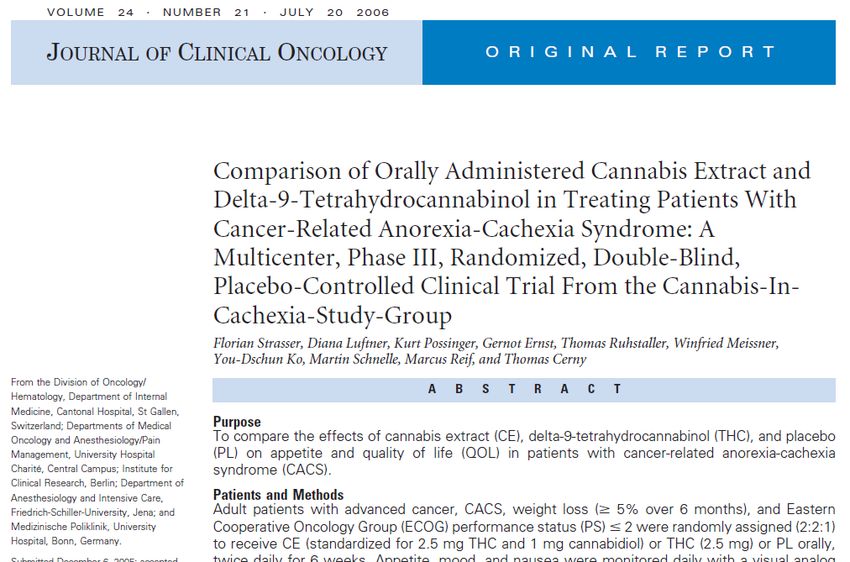
THC Administration & FDA Approved THC-
    based medications
                                                                      Approved
 Compound             Administration             FDA Status                                        Purposes
                                                                      Locations

 Dronabinol           Oral capsule              FDA-approved          USA,               Nausea & vomiting related
 (Marinol)                                      (1985)                Germany            to cancer chemotherapy
                                                                                         and wasting associated
                                                                                         with AIDS

 Nabilone             Oral capsule              FDA-approved          USA,               Nausea & vomiting related
 (Cesamet)                                      (1985)                Canada,            to cancer chemotherapy
                                                *Marketed in the      UK, Mexico
                                                US in 2006

 Nabiximols           Oromucosal                Almost FDA-           Canada,            Multiple sclerosis
 (Sativex)            spray                     approved;             UK, other          spasticity, cancer pain,
                                                late-stage            European           neuropathic pain
                                                clinical trials       countries

Marijuana Site Reclamation and Restoration Cost Analysis.” U.S. Department of Interior, National Park Service. December 9,
2010 (unpublished data). http://www.whitehouse.gov/ondcp/frequently-asked-questions-and-facts-about-marijuana#difference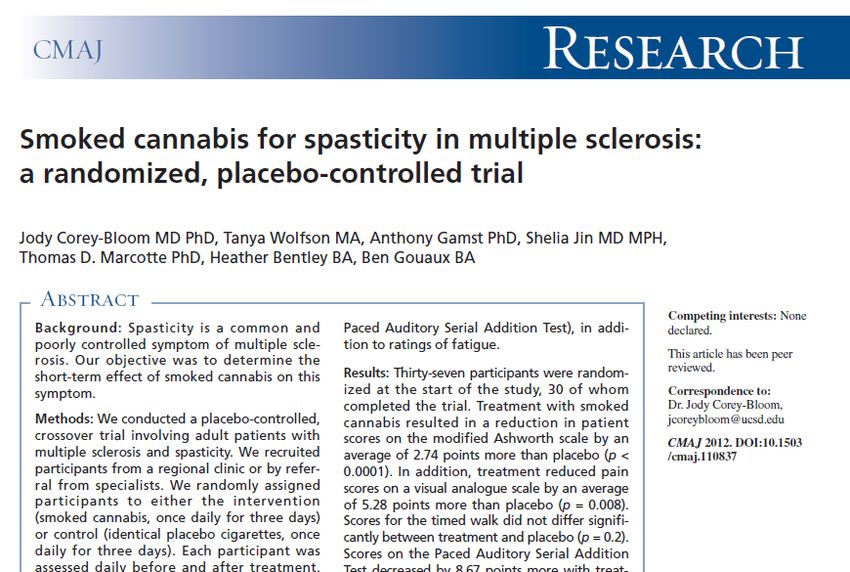
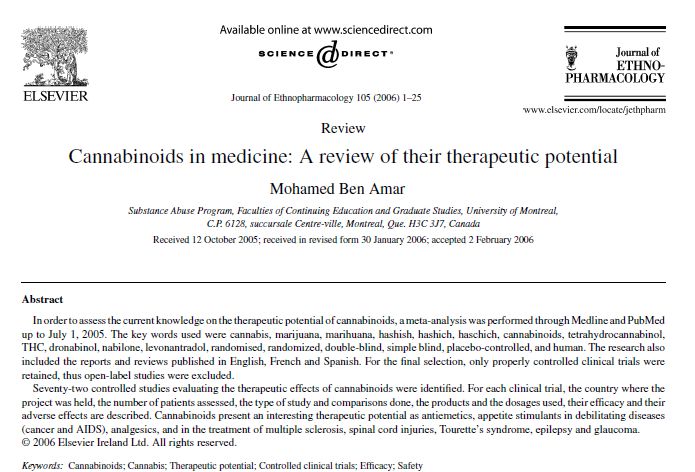
Controlled studies evaluating the therapeutic effect of
    THC by administration type
                          30

                          25
      Number of studies

                          20

                          15
                                                                                       Smoked
                          10
                                                                                       Oral
                           5
                                                                                       Other (Oromucosal/Sublingual
                           0                                                           Spray, IM, IV, Eye Drops)

Ben Amar, M. (2006). Cannabinoids in medicine: A review of their therapeutic potential. Journal of ethnopharmacology, 105(1), 1-
25.
Anti-nausea/emetic and appetite
effects
(Oral THC in cancer patients)
Anti-emetic effect
      of oral THC vs.
    standard treatment
•   Sample: 73 patients with
    neoplasms and
    inadequately controlled
    nausea and vomiting

•   Design: Randomized,
    double-blind, crossover
    trial

•   Intervention: Oral THC
    vs. prochlorperazine
    before and after
    chemotherapy

•   Follow-up: 3 randomly
    assigned one-day courses

•   Outcomes: Patient
    preference in ameliorating
    nausea & vomiting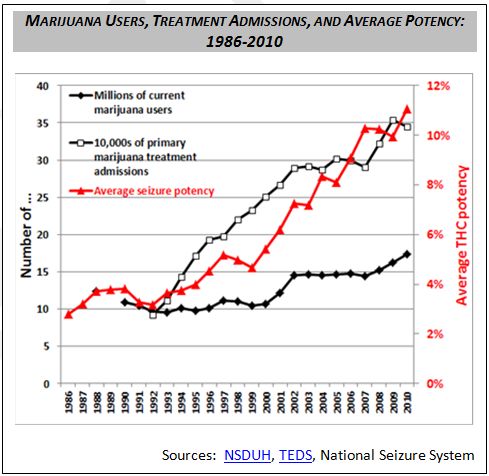
Effectiveness of THC
      compared to                                                     Patient Preference for Anti-Emetic
      prochlorperazine for                                                          Agent
      treating nausea and
                                                                 25       p=0.005
      vomiting
                                                                                                    THC
                                                                                                    Prochlorperazine
                                                                 20
   Of the 25 who
                                                                                                    No Preference

                                            Number of patients
   expressed
   preference, 20
   preferred THC to                                              15
   prochlorperazin;
   (degree of
   preference for                                                10
   either antiemetic
   not dependent
   on class of
   emetic activity                                                5
   related to
   patient’s
   chemotherapy);                                                 0
   increased                                                             Total      Class A      Class B       Class C
   appetite
                                                                        Emetic Activity of Chemotherapeutic Agent

Sallan, S. E., Cronin, C., Zelen, M., & Zinberg, N. E. (1980). Antiemetics in patients receiving chemotherapy for cancer: a
randomized comparison of delta-9-tetrahydrocannabinol and prochlorperazine. New England Journal of Medicine, 302(3), 135-138.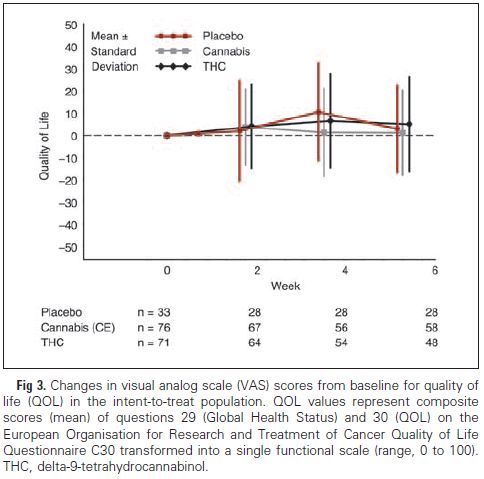
Appetite & Quality of
          Life:
 Efficacy of oral THC
      vs. placebo
 •   Sample: 243 advanced
     cancer patients
     experiencing involuntary,
     unexplained weight loss

 •   Design: Randomized,
     placebo-controlled trial

 •   Intervention: Compared
     3 conditions: Oral
     cannabis extract (2.5mg
     THC & 1mg CBD; similar
     to nabiximols [Sativex])
     vs. THC (2.5mg; similar
     to dronabinol [Marinol])
     vs. placebo

 •   Follow-up: 6-weeks

 •   Outcomes: Appetite
     stimulation, Quality of Life
Efficacy of orally-administered cannabis extract for
appetite stimulation and quality of life for patients with
cancer
Strasser, F., Luftner, D., Possinger, K., Ernst, G., Ruhstaller, T., Meissner, W., ... & Cerny, T. (2006). Comparison of orally
administered cannabis extract and delta-9-tetrahydrocannabinol in treating patients with cancer-related anorexia-cachexia
syndrome: a multicenter, phase III, randomized, double-blind, placebo-controlled clinical trial from the Cannabis-In-Cachexia-
Study-Group.Journal of Clinical Oncology, 24(21), 3394-3400.• So, cancer pts may prefer THC-based medicine for anti- nausea, may stimulate appetite • Effects may be moderated by cancer stage and may not stimulate appetite among more advance cancer patients
Spasticity
(oral spray THC in MS patients)
Safety and
     efficacy of
     nabiximols

•   3 randomized, placebo-
    controlled, double-blind,
    parallel-group studies

•   n=666 (363 randomized
    to nabiximols) patients
    with MS and spasticity

•   Outcome: spasticity

•   Adverse events were
    recorded

Wade, D. T., Collin, C., Stott, C., & Duncombe, P. (2010). Meta-analysis of the efficacy and safety of Sativex (nabiximols), on
spasticity in people with multiple sclerosis. Multiple Sclerosis, 16(6), 707-714.
MS Spasticity:
Efficacy of
THC/CBD spray vs.
placebo
• Sample: 572 MS patients
with spasticity
• Design: Randomized,
placebo-controlled trial
• Intervention: Nabiximols
(2.7 mg THC + 2.5 mg
CBD) oromucosal spray
vs. placebo
• Follow-up: 12 weeks
• Outcome: Change in
spasticity from baselineEfficacy of oral spray nabiximols for MS patients with
spasticity
Novotna, A., Mares, J., Ratcliffe, S., Novakova, I., Vachova, M., Zapletalova, O., ... & Davies, P. (2011). A randomized,
double‐blind, placebo‐controlled, parallel‐group, enriched‐design study of nabiximols*(Sativex®), as add‐on therapy, in subjects
with refractory spasticity caused by multiple sclerosis. European Journal of Neurology, 18(9), 1122-1131.Spasticity (Smoked THC in MS patients)
MS Spasticity:
    Efficacy of smoked
     THC vs. placebo

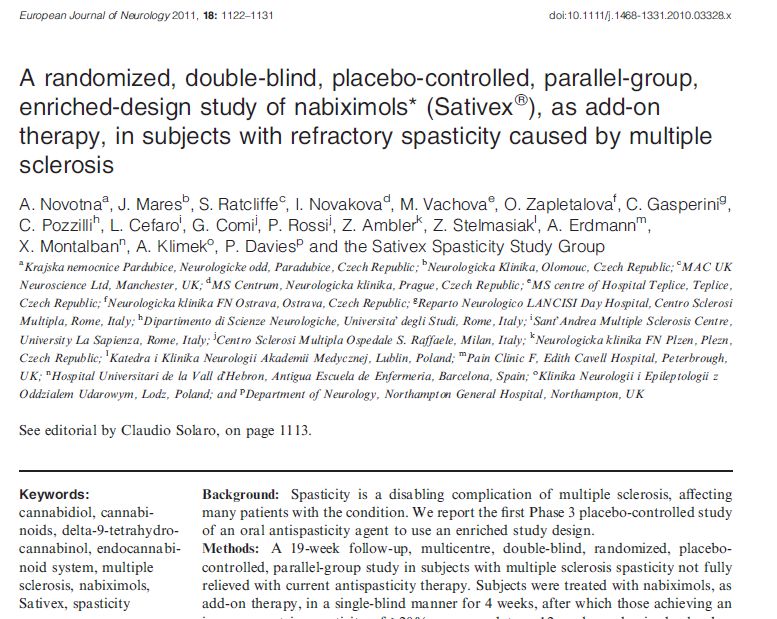
•    Sample: 30 MS patients
     with spasticity

•    Design: Randomized,
     double-blind, placebo-
     controlled crossover trial

•    Intervention: 800mg 4%
     THC cigarettes vs placebo

•    Follow-up: 6 assessments

•    Outcome: Change in
     spasticity
Efficacy of smoked THC for MS patients
with spasticity
Corey-Bloom, J., Wolfson, T., Gamst, A., Jin, S., Marcotte, T. D., Bentley, H., & Gouaux, B. (2012). Smoked cannabis for
spasticity in multiple sclerosis: a randomized, placebo-controlled trial. Canadian Medical Association Journal, 184(10), 1143-1150.Issues with blinding in medical marijuana RCTs
More than 50%
of studies are
considered at
high risk for
unblinding
The use of cannabis and rapidly acting cannabinoids pose considerable challenges
for blinding, as the psychoactive effects are expected to be quickly discernible to
study participants, particularly those who have been previous users of such products.
Lutge, E. E., Gray, A., & Siegfried, N. (2013). The medical use of cannabis for reducing morbidity and mortality in patients with
HIV/AIDS. status and date: New, published in, (4).Neuropathic Pain (Oral spray THC in diabetic patients)
Comparative effectiveness of pharmacological
    treatments for pain

                                                                                                       Nabixomols
                                                                                                      (Sativex) least
                                                                                                    effective for pain
                                                                                                    reduction among
                                                                                                     individuals with
                                                                                                   diabetic peripheral
                                                                                                        neuropathy

Snedecor, S. J., Sudharshan, L., Cappelleri, J. C., Sadosky, A., Mehta, S., & Botteman, M. (2013). Systematic Review and
Meta‐Analysis of Pharmacological Therapies for Painful Diabetic Peripheral Neuropathy. Pain Practice.
Pain:
Efficacy of smoked
cannabis vs. placebo
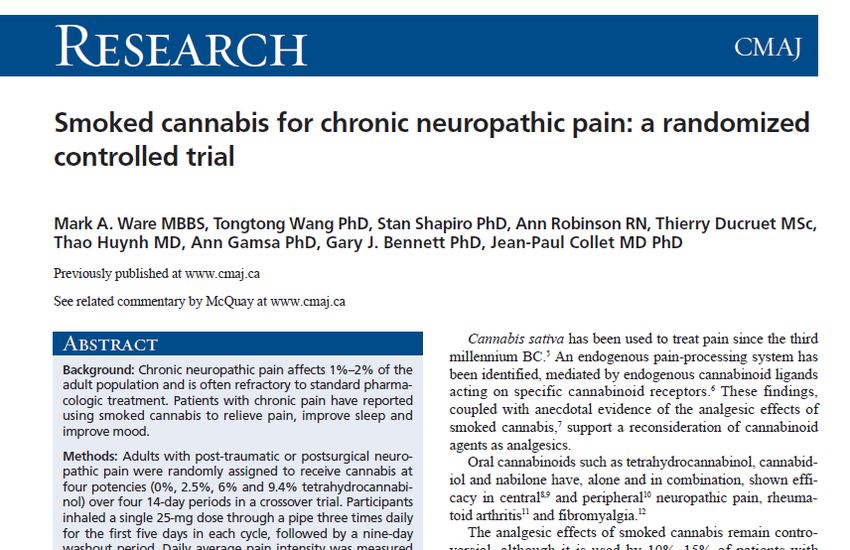
• Sample: 23 adults with
neuropathic pain
• Design: Randomized,
placebo-controlled,
crossover trial
• Intervention: Four doses of
THC 0.0, 2.5, 6.0 or
9.4%THC administered
using a single-smoke
inhalation 3 times per day
• Follow-up: 8-weeks
• Outcome: Change in
average daily painEfficacy of smoked THC for chronic neuropathic pain
p = 0.023
8
7
6
Pain Score†
5
4
Average Daily Pain
Highest Daily Pain
3
Lowest Daily Pain
2
1
0
0.00% 2.50% 6.00% 9.40%
THC Potency
†Pain was scored on a scale from 0 (no pain) to 11 (worst possible pain)
Ware, M. A., Wang, T., Shapiro, S., Robinson, A., Ducruet, T., Huynh, T., ... & Collet, J. P. (2010). Smoked cannabis for chronic
neuropathic pain: a randomized controlled trial. Canadian Medical Association Journal, 182(14), E694-E701.Pain:
Efficacy of smoked
THC vs. placebo
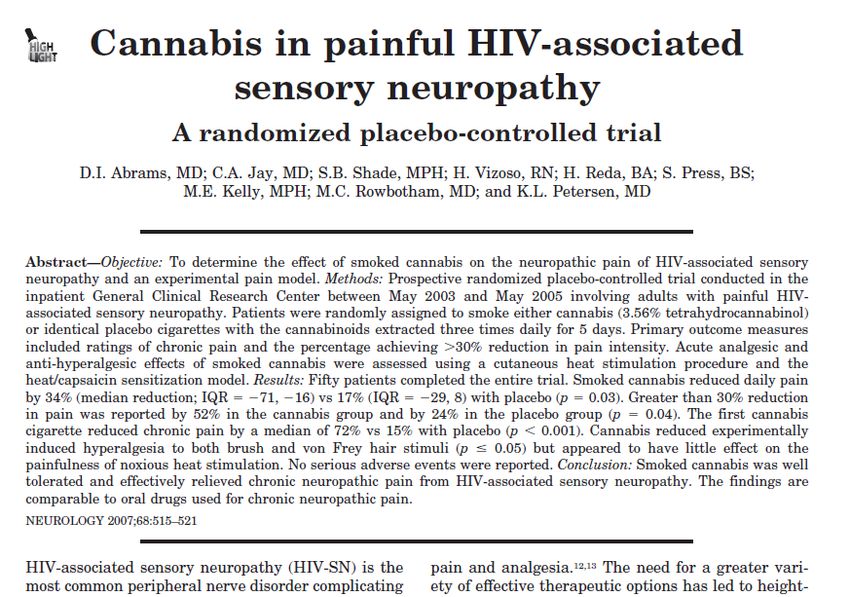
• Sample: 55 patients with
HIV-associated sensory
neuropathy
• Design: Randomized,
double-blind, placebo-
controlled trial
• Intervention: 900 mg
3.56% THC cigarettes vs
placebo
• Follow-up: 3 weeks
• Outcome: Neuropathic
painEfficacy of THC for HIV-positive patients
with neuropathic pain
Significant benefit
in reducing pain
during active
treatment phase,
lasting up to 8
days after
stopping smoking
Abrams, D. I., Jay, C. A., Shade, S. B., Vizoso, H., Reda, H., Press, S., ... & Petersen, K. L. (2007). Cannabis in painful HIV-
associated sensory neuropathy A randomized placebo-controlled trial. Neurology, 68(7), 515-521.So, oral spray THC (Sativex) may help reduce spasticity in MS patients, but be unhelpful with chronic pain among diabetic pts with peripheral neuropathic pain Unclear whether smoked THC may help in this population Smoked THC may help reduce experience of chronic among certain clinical populations (e.g., HIV pts)
The controversy regarding medical
marijuana

1. Health risks of smoked marijuana

2. Addictiveness of marijuana

3. Influence on youth drug use
Health risks of FEV1/FVC ratio
Health risks of                                         Cervix
 smoked
                                                         Breast
 marijuana
“There is very little
evidence that smoking                                  Prostate
marijuana as a means of

                                  Cancer Site
taking it represents a
significant health                                   Melanoma
risk…there have been no                                                                                     Women
reported cases of lung                                                                                      Men
cancer or emphysema. I                                    Lung
suspect that a day’s
breathing in any city with
poor air quality poses more                          Colorectal
of a threat than inhaling a
day’s dose – which for
many ailments is just a                         Tobacco-related
portion of a joint – of
marijuana.”
                                                       All sites
-- Lester Grinspoon, MD
Emeritus Professor of                                              0.0   0.5         1.0        1.5   2.0
Psychiatry                                       RR of cancer incidence comparing MJ users to non-users
Harvard Medical School
                              Adjusting for sociodemographic factors, alcohol and tobacco use
                              Sidney, S., Quesenberry Jr, C. P., Friedman, G. D., & Tekawa, I. S. (1997). Marijuana use
                              and cancer incidence (California, United States). Cancer Causes & Control, 8(5), 722-728.
40
% marijuana dependence (lifetime)
Addictiveness 35
of marijuana 30
25
“Adolescents, especially
troubled ones, and people
with psychiatric disorders 20
(including substance
abuse) appear more likely
than the general 15
population to become
dependent on marijuana… 10
Some controlled
substances that are
approved medications 5
produce dependence after
long-term use; this,
however, is a normal part 0
of patient management Ever users of Marijuana users Daily marijuana
and does not generally marijuana who start using in users
present undue risk to the their teens
patient”
Anthony, J.; Warner, L.A.; and Kessler, R.C. Comparative epidemiology of dependence on tobacco, alcohol, controlled
-- Institute of Medicine substances, and inhalants: Basic findings from the National Comorbidity Survey. Exp Clin Psychopharmacol 2:244–
268, 1994;
Hall, W.; and Degenhardt, L. Adverse health effects of non-medical cannabis use. Lancet 374:1383–1391, 2009;
Hall, W. The adverse health effects of cannabis use: What are they, and what are their implications for policy? Int J of
Drug Policy 20:458–466, 2009Health
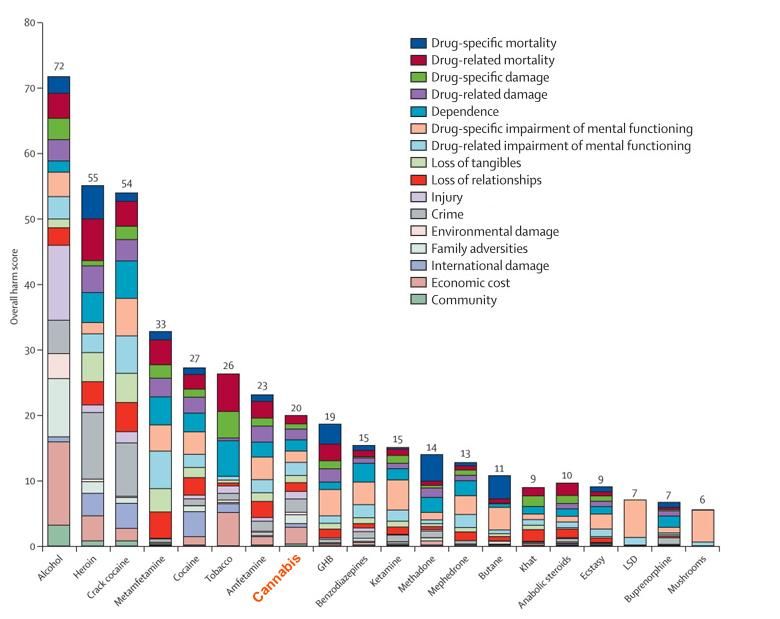
(and societal) risks
of smoked
marijuana
20 drugs ranked by
overall harm along
16 criteria
Nutt, D. J., King, L. A., & Phillips, L. D. (2010). Drug harms in the UK: a multicriteria
decision analysis. The Lancet, 376(9752), 1558-1565.Influence on
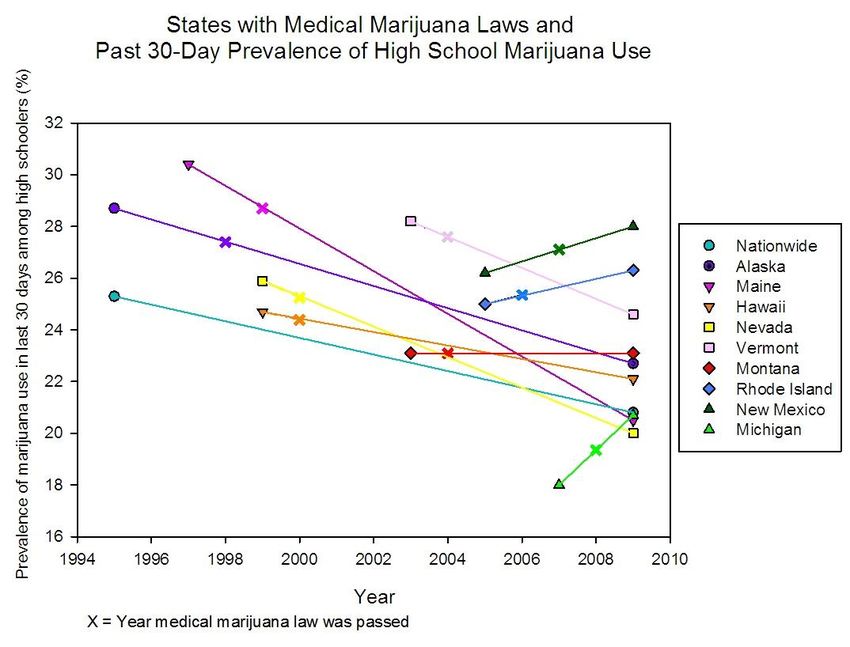
youth drug use
“While it is not possible
with existing data to
determine conclusively
that state medical
marijuana laws caused
the documented declines
in adolescent marijuana
use, the overwhelming
downward trend strongly
suggests that the effect of
state medical marijuana
laws on teen marijuana
use has been either
neutral or positive,
discouraging youthful
experimentation with the
drug.”
-- Mitch Earlywine, SUNY
Albany;
Karen O’Keeffe, Marijuana
Policy Project
O’Keeffe & Earlywine (2011). Marijuana use by young people: The impact of state medical
marijuana laws. Marijuana Policy Project .Influence on
youth drug use
“By characterizing the use
of illegal drugs as quasi-
legal, state-sanctioned,
Saturday afternoon fun,
legalizers destabilize the
societal norm that drug
use is dangerous. They
undercut the goals of
stopping the initiation of
drug use to prevent
addiction.... Children
entering drug abuse
treatment routinely report
that they heard that 'pot is
medicine' and, therefore,
believed it to be good for
them.”
-- Andrea Barthwell
Former Deputy Director
White House Office of
National Drug Control
Policy (ONDCP)
Anderson, Hansen & Reesse (2012). Medical Marijuana laws and teen marijuana use.
University of Washington.
http://depts.washington.edu/phenom/docs/Anderson_Hansen_Rees_2012.pdf• THC confers therapeutic benefit
• FDA-approved medications addressing nausea in AIDS/cancer
• May not be as effective as other pharm. agents for chronic pain
• Some evidence of both oral THC-based meds and smoked MJ,
Conclusions relative to placebo, alleviating spasticity among MS patients
• Levels of THC and CBD (and other cannabinols) likely differ between
different batches of MJ used across studies, making generalizability
about potential benefit difficult; dosing regimen also differs/differs from
the way it may be smoked for medical reasons in the real world
• Lack of trials comparing smoked MJ to oral/spray THC for any ailment
• Thus, it is currently unclear whether the benefits of smoked MJ (net of
smoking-related risks) is greater than oral/other FDA-approved THC-
based medications, and for which specific medical conditions
• Physician recommendations for smoked MJ for any medical purpose
lacks clear systematic empirical basis
• Somewhat unclear also is the relationship between state medical MJ
implementation and its potential effect on changing
perceptions/attitudes and increasing MJ use, especially among
teens/young peopleYou can also read


