MEMBRANE ENHANCED CHEMICAL AND BIOCHEMICAL PROCESSES
←
→
Page content transcription
If your browser does not render page correctly, please read the page content below
ROYAL SOCIETY OF CHEMISTRY SYMPOSIUM 2019
                                                                                         RE SOURCING OUR RESOURCES
                                                                                         REDUCING ENVIRONMENTAL IMPACT

          MEMBRANE ENHANCED CHEMICAL AND BIOCHEMICAL PROCESSES
            The effect of nanomodification of membrane surface on process efficiencies

Flemish Institute of
Technological Research
NASA Goddard Institute for Space Studies - http://data.giss.nasa.gov/gistemp/graphs/

                    World population
           10
Billions

            8
            6
            4
            2
            0
             1500        1700          1900   2100
                                Year

Flemish Institute of
Technological Research
                                                                                                                                            2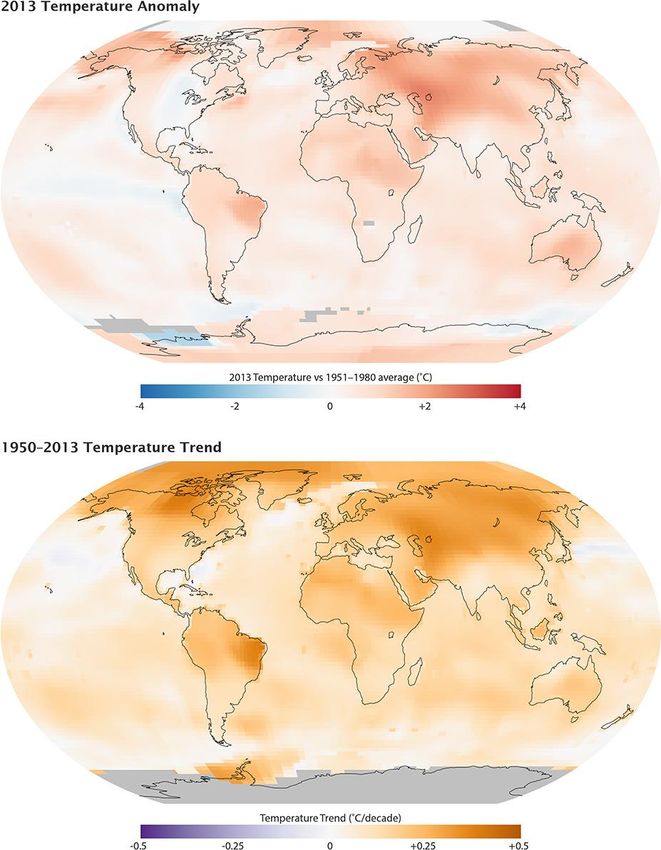
SUSTAINABLE
                                       CHEMISTRY

          PROCESS INTENSIFICATION

         Since 2015 : 1284 publications and 1244 patents
      400
      350
      300
      250
      200
      150
      100
                         Patents                   Publications
       50
        0
                  2015    2016                        2017                           2018

Flemish Institute of
                            Web of science 2019/05/15;
Technological Research      Google scholar 2019/05/15
                            Nature 532 (7600), 435-438
                            Oak Ridge National Laboratory. Materials for Separation Technologies: Energy and Emission Reduction Opportunities (2005).
                                                                                                                                                        3
SUSTAINABLE
                          CHEMISTRY

          MEMBRANE TECHNOLOGY
         Membrane technology is today an additional tool for process chemist, offering alternative and
         more efficient solutions to existing challenges.

                                                                                  Integrated membrane reactor

Flemish Institute of
Technological Research
                                                                                                                4
SUSTAINABLE
CHEMISTRY
CHEMICAL PROCESSES REQUIRING HIGH DILUTION
Proof of Concept: Peptide Cyclisation
Benifits
Yield: 71% 95%
Conversion: 84% 100%
Product purity
Solvent use: -85%
PMI : 1700 300
Production price
Flemish Institute of
Technological Research
5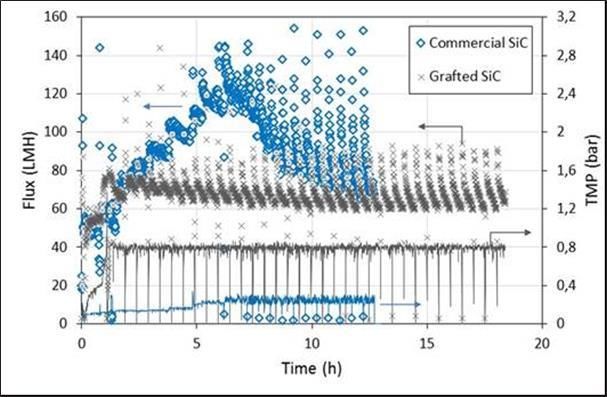
SUSTAINABLE
CHEMISTRY
CHEMICAL PROCESSES REQUIRING HIGH DILUTION
solution 1 mixer tank
open chain Head to tail
peptide (1) in
AcOH
N2
cyclisation
P-1 gas
reaction PMI : 45%
reagent reaction/
in separation
solvent vessel
V-1
V-2
membrane P-2
solution 1 mixer/reaction
tank
solution 2
open chain reaction
peptide (1) in reagent
AcOH in
solvent N2 Metathesis
P-1
cyclisation
gas
separation
vessel
V-1 PMI : 75%
V-2
membrane P-2
Flemish Institute of
Technological Research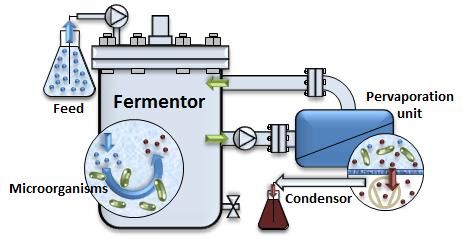
SUSTAINABLE
CHEMISTRY
RE USE AND RECYCLE OF VALUABLE HOMOGENEOUS CATALYSTS
Ru Catalyst : Pre-catalyst :
EtOOC COOEt
EtOOC COOEt
0.01 mol % catalyst
+ C28H45Cl2OPRu
Reaction :
Acetone 600.6
C31 H 38Cl2N 2ORu C54H69Cl2N2PRu C50 H47 ClN4 O3 Ru
HG-I 626.63 949.09 888.46
M2 M41
C13H20O4 C11H16O4
240.29 212.24 N N
N N
N N
DEDAM Cl
Cl
Ru
P Ru Cl O
Cl Ru
Cl Cl N
Ru
Cl P
O Cy Cy
Solvent: DCM, Toluene, Acetone Cy
+
O
O NO
-
Peformance on Funmem membrane + benchmark :
Membrane Permeability Catalyst retention Product retention
Funmem® 6 lm-2h-1bar-1 87 % 35 % N
0,9 nm TiO2 0.3 lm-2h-1bar-1 96 % 60 % Cl
Ru
Polymeric OSN 0.8 lm-2h-1bar-1 91 % 97 % N O
N N N N
Cl Cl
Ru Ru +
Cl
P Cl O N -
O
Cl
Ru
Cl
C 22H 28Cl2N 2Ru C36 H39 ClN4 O3 R
C22 H28 Cl2 N2Ru
Flemish Institute of C 19 H35 Cl2PRu
492.45 492.45 712.25
466.43
Technological Research
SUSTAINABLE
                                                   CHEMISTRY

        RE USE AND RECYCLE OF VALUABLE HOMOGENEOUS CATALYSTS
        Off-line processing                                                           At-line processing                                    On-line processing

                                                                    P2
        N2
                                                                                                                                                                                                     P2
                               Feed tank                                                                                              N2
        gas
                               (B)                                                                                                    gas
                                                                                                                                                                Feed tank
                                                                     Diafiltration                                                              Catalyst        (B)
                                                                                                                                                in                                          coupling
                                                                     tank (A)
                                                                                                                                                solvent                                     partners & Diafiltration
                                                                                                                                                                                            base in    tank (A)
                                                                                                                                                                                            solvent

                                                                                                                                                                                                     V-2

                                                                    V-1
                         P1                                                                                                                                                                           V-1
                                           Membrane unit                                                                                                   P1               Membrane unit

                                                            With all processing methods rejection of Pd species > 99 %
                                                           Reaction Pd content (ppm)             Membrane            Pd in product (ppm)
                                                                                               1 nm C8 – TiO2                67
                                                                      8700                       0.9 nm TiO2                 7
                                                                                            0.9 nm C8H4F13 – TiO2            6
                                                                                            0.9 nm C8H4F13 – TiO2*           3
16/01/2018                                           *PEPPSI catalyst , other CX-31
©VITO – Not for distribution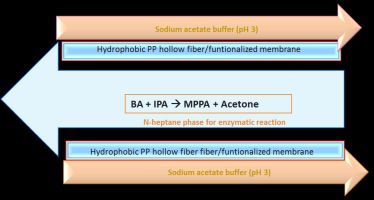
SUSTAINABLE
                              CHEMISTRY

          INCREASING CATALYST TON

           Catalyst performance in (semi)continuous reaction

          Tail in catalyst designed for rejection and impedes cluster formation

Flemish Institute of
Technological Research
                                                                                  9
SUSTAINABLE
CHEMISTRY
INCREASING CATALYST TON
Literature example Membrane assisted Membrane assisted
(commercial catalysts) (tailed catalysts)
Yield (%) 93 Yield (%) 92 Yield (%) 88
Substrate –catalyst ratio 50 Substrate –catalyst ratio 100 Substrate –catalyst ratio 2000
Pre-catalyst load (ppm) 20000 Pre-catalyst load (ppm) 10000 Pre-catalyst load (ppm) 500
Catalyst retention (24°C) / Catalyst retention (24°C) 50 Catalyst retention (24°C) 96
Av. Process permeance (Lm-2h- Av. Process permeance (Lm-2h- Av. Process permeance (Lm-2h-
/ 1bar-1) 6 1
1bar-1) 1bar-1)
Isolated product metal Isolated product metal Isolated product metal
/ / 16
contamination (ppm) contamination (ppm) contamination (ppm)
Mass intensity (reaction) /
Mass intensity (reaction) / Mass intensity (reaction) 51
Mass intensity (reaction &
Mass intensity (reaction & 780 Mass intensity (reaction &
500 product isolation 167
product isolation product isolation
solvent Ethanol
solvent 1,4-dioxane solvent Ethanol
(Partially)
Organometallics Not recovered Organometallics Organometallics Recovered
recovered
Flemish Institute of
Technological Research
10SUSTAINABLE
CHEMISTRY
CONTINUOUS FERMENTATION PROCESSES
Challenges in traditional Integration with Benefits
fermentation pervaporation
Product toxicity: Integration of 2,5 x production increase
▪ Low product concentrations ▪ Organophilic pervaporation and by removal of product
▪ Low productivity ▪ two-stage clostridial fermentation inhibition
→ High purification costs ▪ using a membrane-based in situ product
→ High waste water volumes recovery technique (ISPR) Fermentor cost ↓
→ Energy-intensive separation → Continuous, selective product withdrawal
→ Cost of substrate from reaction medium
Water footprint -50%
Steam consumption -50%
Applicable to batch &
continuous processes
Production price -10%
Flemish Institute of
Technological ResearchBIOCHEMISTRY
ENZYMATIC SYNTHESIS OF CHIRAL AMINES
Chiral amines in enantiopure forms are important chemical building blocks in pharmaceutical and agrochemical industries
+ +
Benzyl acetone isopropyl amine (S-)1-methyl-3-phenylpropylamine Acetone
(BA) (IPA) (S)-MPPA
Background
• Chemical synthesis of chiral amines still remains a challenge because it
requires high chemo-, regio-, diastereo-, and enantio-control
• ω-transaminase is a promising catalyst which produces chiral amines
with exquisite enantioselectivity
Limits in aqueous phase:
• Low substrate solubility (BA): only 1,48 g/L (or 10 mM) Results
• Severe product inhibition by (S)-MPPA Higher substrate conversion
Targets:
Co-extraction of substrate amine (IPA) solved with NF
• To establish the enzymatic reaction in solvent phase (n-heptane in
preliminary tests) to increase substrate concentration Next steps
• In-situ product recovery by MPPA extraction into an aqueous phase Increase the specific productivity
by use of a membrane contactor using an aqueous phase as NF optimization
extractant
Strategies to retain the donor amine selectively in the
Flemish Institute of reactor
Technological ResearchSUSTAINABLE
CHEMISTRY
PRODUCT & RAW MATERIALS RECOVERY
Assessment
@ 20.000m³/year
▪ Product / raw materials in waste stream
UF RO
▪ Inhibiting biological waste water plant TEA
feasibility
▪ End-of-pipe treatment required insight ▪ CAPEX : 453 kEUR
▪ OPEX: 46 kEUR/year
▪ Return: 437 kEUR/year
▪ In-process membrane technology 1. 2. 3. 4. 5. 6.
Technology Pilot Implementation
Lab test Pilot long Pilot
advice batch duration continuous
on-site
raw material IMPACT
product
Recovery/year No waste treatment cost
process UF RO ▪ 33.3 ton product (3 EUR/kg)
process water ▪ 105 ton raw material
Production process water/year Pay back time ~1 year
▪ 14.450 m³ (1.5 EUR/m³)
Flemish Institute of
Technological ResearchSUSTAINABLE
CHEMISTRY
PRODUCT & RAW MATERIALS RECOVERY
Assessment Collaboration
Challenge with
Screening tubular membranes
Rinsing water ▪ Test assistance
▪ Contains high concentration of detergent ▪ Pilot PCI available
UF
PCI pilot
▪ External treatment → high incineration cost
Time-lapse 2 years
tests
NF
Testing RO
Lab testing
SUCCESS
Industrial
implementation
IMPACT
▪ Reuse detergent stream
▪ Reuse waste water
Flemish Institute of ▪ No waste incineration cost
Technological ResearchSUSTAINABLE
CHEMISTRY
WW TREATMENT
Fouling solution : 18h filtration in cross-flow, recovery 50% + use 100ppm de-oiler
real foam - produced water (NL)
~700 ppm oil
Foulants :
oil droplets in O/W emulsions
Oil content in the permeate
MGR 100 ppm de-oiler 21 ppm
MGR no de-oiler 66 ppm
Flemish Institute of Native no de-oiler 250 ppm
Technological ResearchWE PROVIDE SOLUTIONS
WORLDWIDE
34 NATIONALITIES 227 SCIENTIFIC PUBLICATIONS
91 PHD’S AND
POSTDOCS
MORE THAN 400 PATENTS
> €170 MILLION 76
TURNOVER FLEMISH
24 NEW SME’S
PATENTS
EVERY YEAR
Experts
Projects 784 EMPLOYEES
Experts and Projects
SUSTAINABLE ENTREPRENEURIAL INSPIRING CREATIVE
Flemish Institute of
Technological ResearchMarzio Monagheddu Ph.D
Business & Relationship Development
Kreuzlingen, Switzerland
Separation and Conversion Technologies
VITO NV | Boeretang 200 | 2400 Mol
Direct. +32 14 33 69 83 | Mobile: +32 499 77 40 29
17/05/2019 Mail: marzio.monagheddu@vito.be
©VITO – Not for distribution 17You can also read


