Milton Keynes Homelessness Partnership Strategic Review - 18 December 2017 - Citizens:mk
←
→
Page content transcription
If your browser does not render page correctly, please read the page content below
Milton Keynes Homelessness Partnership Strategic Review – December 2017

      Milton Keynes Homelessness Partnership
                             Strategic Review

                              18 December 2017

                                                                          1
Milton Keynes Homelessness Partnership Strategic Review – December 2017
1. Aims of strategic review
The Council in Milton Keynes has allocated £205,000 for a Partnership of the voluntary sector and
MK Council to work on addressing homelessness and its causes, which is defined to include mental
health issues. The Partnership (MKHP) has performed a significant amount of preparatory work
which needs pulling together for review.
The aim of the review is to produce a report for interim review by the steering group on 5 December
2017 and presentation at the full partnership meeting on 12 January 2018 outlining the following:
• Taking the original chart of identified needs in the Homelessness Gap Analysis Map
• Combine it with the solutions already identified and the project work underway
• Identify what has happened and list as achievements
• Identify the solution and rationale behind them
• Ball-park costings for each solution
• Providing a road map
• Proposed revised terms of reference for the Homelessness Partnership and in particular
the council’s role as a member of the group
Milton Keynes context
Homelessness has become an increasing issue in the City over the last couple of years. The annual
number of households accepted as being homeless and in priority need more than doubled from 370
in 2006 to 789 by March 2016. The current annual rate represents 7.4 presentations per 1,000, 3
times higher than the equivalent 2.5 per 1,000 for England.
Private sector rents in Milton Keynes in 2015-16 were higher than both the national average and
comparator areas (1). The primary reason for becoming homeless is the end of assured tenancies in
private rented accommodation. There are a number of underlying causes for homelessness including
lack of supply of affordable housing, rising rents, no savings for a deposit and rent payable in
advance, loss of local support networks.
In June 2017, it was reported that there were 801 households in temporary accommodation with a
total of 1,326 children. In September 2017, there were estimated to be 130 rough sleepers. These
numbers are just the tip of the iceberg as they do not take into consideration those who are sofa
surfers or living in unsuitable or overcrowded housing. The affordable housing need in 2016 was
estimated at 2,802 households including 1,219 households in unsuitable housing mainly due to
overcrowding. YMCA was approached for help by over 1,000 people in the last year.
MK Council Priority
MK Council has highlighted homelessness as one of its top priorities and has recently developed
Homelessness and Rough Sleeper Reduction Strategies. The Council priorities with regard to
homelessness include:
• Raising awareness of Council’s powers and provision – cultural shift towards helping
people find housing solutions
• Prioritising homeless prevention support services
• Reviewing letting policy to address availability of housing
• Improving process for moving people on from temporary to permanent accommodation
• Preventing homeless applicants from parental family home with exception of violent
situations
2Milton Keynes Homelessness Partnership Strategic Review – December 2017
• Providing access to training and education opportunities
• Reviewing how MKC deals with people living in tents & development of policy for basic
accommodation and sanitary facilities for this group
• One Stop shop service development
• Developing & implementing rough sleeper action plan
• Creating additional facilities to provide emergency shelter
Executive Summary
In the face of escalating need, MKHP has made some progress on its key priorities of increasing
emergency accommodation (from 15 beds up to potentially 76 beds) and securing premises at the
Old Bus Station for the set up of a One Stop Shop to provide support services.
MKHP has also been successful in getting a grant to put in place a rough sleeper intervention service
for 2 years to help to address the immediate needs of rough sleepers.
MKHP has reviewed its ways of working and agreed that changes are needed to work more
effectively together given the large number of partnership members with differing agendas.
A detailed gap analysis identified gaps in emergency supported accommodation, temporary
accommodation for over 35s and the supply / access to affordable homes as well as representation
of some key support service providers and housing providers.
In order to address the long-term issue of sustainable homes, it is recommended that MKHP’s focus
widen from managing homelessness to ending homelessness by:
• engaging housing providers
• championing joined up working
• promoting sustainable tenancy models
3Milton Keynes Homelessness Partnership Strategic Review – December 2017
2. Review of existing plan
Vision
Being clear on what ambition we are all working towards is the first step required before defining
our strategy and objectives. Some examples of alternative vision statements are provided below:
1. Single unified approach to all Homelessness across the Council and wider City; or
2. Work together to eliminate homelessness in Milton Keynes; or
3. Significantly reduce rough sleeping by 2020
4. Sustainable Homes for All
Given recognition of the need to widen the aims of MKHP to a longer term vision of ending
homelessness by providing sustainable homes. It is recommended that the vision statement which
best reflects this is “Sustainable Homes for All”.
Strategy
MKHP’s strategy is currently defined by its statement of purpose:
“Developing a partnership to lead and co-ordinate services for non-statutory homeless people
including advice, information and assistance – bringing together help and support into a ‘one-stop
shop’ style of delivery.”
The strategy statement is focussed on a joined-up approach to support services.
Our strategy should set out how we are going to deliver the vision and has therefore been revised
for consistency with the new proposed vision: “Shifting the focus from managing homelessness to
ending homelessness by wider engagement and a joined-up approach to provide a clear pathway to
sustainable housing.”
Review of Existing Objectives
MKHP’s initial objectives were designed to be more tactical in order to achieve quick wins. A review
of progress to date for each of these objectives is set out in Appendix 1.
Further to the review of the current objectives and gap analysis, two additional objectives have been
identified.
2.3.1 One Stop Shop
A key objective of MKHP is to establish a one stop shop style service to assist all those at risk of
homelessness and support those in crisis. This objective is not sufficiently addressed by the existing
objectives regarding emergency support or accommodation. Recommend a specific objective
regarding the One Stop Shop service is agreed.
2.3.2 Moving on process – sustainable homes
There is risk of temporary accommodation being full and unavailable for emergency short term
shelter if a moving on process and pathways to sustainable housing are not addressed. Recommend
a specific objective regarding sustainable homes is agreed.
4Milton Keynes Homelessness Partnership Strategic Review – December 2017
3. Revised Objectives
Proposed new terms of reference
A revised set of longer term strategic objectives are proposed under which will sit a set of specific
prioritised options to deliver the strategy.
Vision - Sustainable Homes for All
Strategy - Shifting the focus from managing homelessness to ending homelessness by wider
engagement and a joined-up approach to provide a clear pathway to sustainable housing.
MKHP’s role - To champion a joined-up approach, facilitate engagement of relevant organisations
and hold MK Council to account for delivery of commitments and targets set in its housing,
homelessness and rough sleeper strategies.
Strategic objectives
Emergency accommodation - Explore options for the provision of emergency short-term shelter for
those in crisis and requiring immediate support. Aiming for no second night out with sufficient
emergency accommodation and support in place to prevent rough sleeping by 2020.
Temporary accommodation - Explore and agree priority options for the increased provision of
suitable temporary accommodation by December 2018. Hold MKC to account for achieving targets
to provide temporary accommodation within [x] days of being identified as homeless.
Sustainable homes - Engage housing providers in the Partnership with the aim of increasing the
supply and access of affordable homes. Hold MKC to account for its commitments to deliver the
appropriate mix and supply of homes needed to reduce the moving on process from homeless to
permanent home from [x] days to [y] days with personal support to sustain tenancies.
One stop shop - Bring together help and support into a ‘one-stop shop’ style of delivery. Agree and
implement joined up ways of working to co-ordinate services for homeless people including advice,
information and assistance by 31 December 2018
Support services - Explore options for the provision of emergency support for those without
accommodation including sanitary facilities and an outreach assessment service. Ongoing review of
supply and demand for homelessness support services and agree roadmap to fill gaps in service
provision annually in September.
Annual strategic priorities
As well as setting out the vision, strategy and high-level objectives to deliver the strategy in the
medium term (3 – 5 years), there is a need to agree annual strategic priorities with clear action plans
for implementation each year. Each strategic priority should be allocated to a named person or sub
group that has the necessary expertise and capacity to take responsibility for implementation within
an agreed timescale and budget.
As part of the strategic review, MKHP’s initial gap analysis has been further developed summarising:
• what is needed
• identifying the services and accommodation already provided
• highlighting the gaps in homelessness provision
5Milton Keynes Homelessness Partnership Strategic Review – December 2017
Once all the gaps have been identified and agreed, the aim is to prioritise options to fill the gaps and
estimate ball park costs and timing for delivery. Highlights of the gap analysis are summarised below.
See Appendices 2 – 5 for more details.
3.2.1 Emergency accommodation gap analysis – Appendix 2
A review of accommodation provision highlighted gaps in emergency accommodation for those in
need of professional support.
3.2.2 Temporary accommodation gap analysis – Appendix 2
In June 2017, it was reported that there were 801 households in temporary accommodation with a
total of 1,326 children. There is a need to reduce the cost of temporary accommodation and
increase the supply of temporary housing in the short term due to a shortage of social housing.
A review of accommodation provision also highlighted a need for additional temporary
accommodation for those over 35.
6Milton Keynes Homelessness Partnership Strategic Review – December 2017
3.2.3 Support services – Appendix 3
A review of support services highlighted gaps in joined-up working and support for those leaving
hospital, help with dogs, education & training and mental health provision. The review also
identified some key service providers that are not currently part of MKHP particularly money and
employment advice, some mental health services, emotional support and furniture provision.
3.2.4 One Stop Shop gap analysis – Appendix 4
A One Stop Shop facility is under development at the Old Bus Station. The biggest challenges for
delivery of the One Stop Shop is support service take up of the Old Bus Station facility and lack of
access for those in need. Under the current terms of the lease, the One Stop Shop will not be able to
provide some of the services or access needed, particularly for rough sleepers, as it is not permitted
to allow drop ins. The lack of drop in appears to be a barrier to usage for many organisations.
3.2.5 Sustainable homes – Appendix 5
The review identified the need to engage more widely with housing providers and consider options
to increase the supply and access to social housing and the private rented sector. This is needed to
move people on from temporary accommodation e.g. from YMCA to permanent housing to free up
temporary bed spaces and provide a clear path to sustainable housing.
A joined-up approach to housing advice and money support between MK Council, Housing
Associations and the voluntary sector is also recommended to support sustainable tenancies.
7Milton Keynes Homelessness Partnership Strategic Review – December 2017
Road Map
The strategic review of objectives, priorities and gap analysis has led to a clear set of options to
consider for development as key priorities. The aim of these options is to work towards delivery of
the strategy of “shifting the focus from managing homelessness to ending homelessness by wider
engagement and a joined-up approach to provide a clear pathway to sustainable housing”.
Options to be considered and agreed on as annual strategic priorities for 2018 are summarised in a
Road Map below.
Immediate priority for implementation
Further consideration required
Not viable / longer term
Partnership
Options Priority Estimated Timing Next steps Action owner
costs
Partnership High Low Feb Presentation to steering Gamiel Yafai
arrangements 2018 group on options to CA:MK with
formalise partnership support from
constitution Sarah
Crowhurst
Allocation of High Low Jan Agree named leaders and Steering
priorities to sub 2018 sub groups for priority 2018 group
groups options
Annual costed High Low Jan Proposal to be agreed and Sarah
proposal to 2018 presented for consideration Crowhurst
deliver strategic by Cabinet
priorities
Grant Medium Low March Application criteria, Sarah
application 2018 assessment and Crowhurst
process prioritisation
Monitor and High Low March Proposed KPIs to monitor on Sarah
review progress 2018 an annual basis taking into Crowhurst
a/c research of successful
outcomes of models in other
areas
Hold MKC to High Low March Review MKC housing & Sarah
account for 2018 homelessness strategies for Crowhurst
targets & key targets to be monitored
commitments
Develop a Medium Low Sept Set out a charter for Steering
homelessness 2018 organisations working group
charter together to tackle
homelessness in MK to sign
up to
Promotion of High Low Sept Publicity campaign for work Steering
strategy 2018 of MKHP – first issue of group
annual review leaflet
8Milton Keynes Homelessness Partnership Strategic Review – December 2017
Emergency and temporary accommodation
Options Priority Estimated Timing Next steps Action owner
costs
Night stop High Low June 2018 Agree scheme & Simon Green,
develop publicity YMCA
Supported Medium Low Dec 2018 Agree scheme & Simon Green,
lodging scheme develop publicity to YMCA
identify host families
Wet shelter Low High Sept 2018 Review demand for Bev Syme,
wet shelter from Open Door
rough sleeping service
information
Modular High Medium – First 70 units have planning Eleanor
housing – Your MK Council phase by permission. Develop Nickless, MKC
MK to develop [date] pipeline of further
units
Encourage Medium Low March Agree list of charities Gamiel Yafai
homeless 2018 e.g. Emmaus and CA:MK with
charities to make contact. Talk support from
move to MK with MKDP about land Sarah
/ property availability Crowhurst
Empty buildings Medium Medium March Identify sites and Eleanor
back into use 2018 estimate conversion Nickless, MKC
costs & best use
Micro homes Medium Medium June 2018 Identify sites and cost Eleanor
to develop, life span Nickless, MKC
Interim use of Medium Low December Identify sites with Eleanor
sheltered 2018 availability and Nickless, MKC
accommodation estimate conversion
costs & best use
9Milton Keynes Homelessness Partnership Strategic Review – December 2017
Sustainable homes
Options Priority Estimated Timing Next steps Action owner
costs
Engagement of High Low March Agree list of housing Sarah
housing 2018 providers to approach. Crowhurst to
providers Arrange meeting to work with
present partnership MKC Housing
objectives and need to
work together
Review social High Low Feb 2018 Work with housing Sarah
housing providers & MKC Crowhurst
eligibility housing strategy team
criteria to understand existing
model of housing
allocation
Review housing High Low Feb 2018 Review Plan:MK & Sarah
mix for planned Housing Strategy Crowhurst
affordable
homes
Promotion of High Low Feb 2018 Encourage landlord Eleanor
private rented representation at Nickless, MKC
schemes MKHP and agree
publicity
Shared High High Dec 2017 Consultation response Simon Green,
accommodation to Plan:MK submitted YMCA
by YMCA
Lodging Medium Low Feb 2018 Further research on Sarah
schemes options Crowhurst
Social Medium Medium – Feb 2018 Further research on Sarah
enterprise expansion of existing models Crowhurst
investment existing
models?
Community led Low Medium – TBD Follow up on feedback To be
housing funding from CA:MK Nov 2017 allocated
available? workshop
Housing First High Medium – Feb 2018 Opportunities to scale Sarah
opportunities grants up YMCA model for Crowhurst
available? supported
accommodation for
over 35s
Joined up High Low Feb 2018 Engagement of money Gamiel Yafei
housing advice advice providers in CA:MK
and debt MKHP
management
Accessing High Low Feb 2018 Identify opportunities Eleanor
government to apply for Nickless, MKC
grants for government funding
development
10Milton Keynes Homelessness Partnership Strategic Review – December 2017
One stop shop
Options Priority Estimated Timing Next steps Action owner
costs
Joined up High Low Feb 2018 Outline process for Sarah
working and sharing and Crowhurst
information management of
sharing information
One access High Low March Brief MKC housing Eleanor
point for 2018 team on services Nickless
signposting to available and new
services approach to joined up
working
Joined up High Medium - Feb 2018 Outline process for Richard
assessment and employee management of Wightman
referrals assessment and WNS
referrals from Buszy
Directory of High Medium – March Collate information for Sarah
services and set up costs 2018 website and directory Crowhurst
accommodation and publish
providers
Support services
Options Priority Estimated Timing Next steps Action owner
costs
Review supply High Low Feb 2018 Agree roadmap to fill Sarah
and demand for gaps Crowhurst
services e.g.
waiting lists
Wider High Low Feb 2018 Agree additional Sarah
engagement of service providers to Crowhurst
service invite to MKHP
providers
Joined up High Low March Outline process for Sarah
homeless 2018 priority services to Crowhurst
prevention identify and support
services those at risk of
homelessness
11Milton Keynes Homelessness Partnership Strategic Review – December 2017
4. Working Together
There is a need to provide clarity on working and delivery arrangements of the Partnership to
project manage delivery of clear strategic objectives and priorities.
The most common theme from the Partnership review was that due to the size of the membership
of the Partnership, it is difficult to effectively deliver the objectives. It was suggested that smaller
groups need to be set up to focus on progressing the priority objectives. The following changes to
working arrangements were agreed.
• MKHP steering group to meet monthly to progress the objectives of the Partnership –
Council to support this work
• Full partnership meetings quarterly to sign off Steering Group recommendations
• Formal partnership arrangements to be put in place with clear leadership
Partnership Members - Roles & Priorities
A consultation and review of MKHP identified the need to provide clarity on the roles of the
organisations and their aims. MKHP questionnaire responses to the question “what could be
improved?” highlighted:
• Co-ordinate multi agency response
• Understand partner’s responsibilities
• Clear planning and outcomes
• More Councillors attending – Council as partners not facilitators?
• Project management and strategic direction required to provide clarity and focus
• Reduced team size
• Share ideas and improve homeless services
• Combined service with joined up approach
• Less statistics / paper work and more practical solutions
• Decision making powers
A review of roles and organisations priorities will aid strategic fit with delivery of strategic objectives
and help to identify members of each focus group.
The core members of MKHP as represented at the Steering Group are CA:MK, MK Council, YMCA,
Open Door, Winter Night Shelter and The Bus Shelter MK. The steering group will focus on driving
outcomes for the priority objectives with sign off given by the full partnership. Both the full group
and smaller focus groups need clear leadership and chairing to focus on agreeing actions to deliver
the priority objectives.
MKHP Steering Group
• Gamiel Yafai – CA:MK
• Eleanor Nickless – MKC Housing
• Simon Green – YMCA Chief Executive
• Bev Syme – Open Door
• Richard Wightman – Chair of Winter Night Shelter
• Pam Williams – Chair of The Bus Shelter MK
12Milton Keynes Homelessness Partnership Strategic Review – December 2017
Recommendations on working together
It is recommended that representatives from the following services commissioned by MK Council are
also part of the Steering Group:
• Look Ahead
• Salvation Army
• Street Outreach – Kings Arms
Each organisation to provide details of what they can offer in terms of resources, connections,
accommodation and services as well as time to devote to leading or being part of a small group to
deliver 2018 priority actions. To be added to the Partner Organisation table in Appendix 6.
Invitations to the full partnership are by organisation; steering group and focus groups invitations
are by name (not organisation) so that the right people with right expertise, decision making powers
and resources are present.
Role of MKC – partner but not lead partner i.e. on equal footing but not driving the partnership
13Milton Keynes Homelessness Partnership Strategic Review – December 2017
5. Resources
December 2016 costed proposal
The costed proposal summarised below and approved by Cabinet in December 2016, detailing how
best to support the aims of supporting non-statutory homeless people was resourced through a
£200k one-off pressure in the 2017/18 budget (Cabinet decision of 7 February 2017) [and will be
rolled over to 2018/19. MKC – to confirm]. Provision for any additional funding and ongoing costs
will need to be made in the 2018/19 budget through the current MKC budget-setting process.
Dec 2016 - Recommendation Required Est cost Spend to date
Additional accommodation and Estimate of 10 £75,000 £0
support for individuals over the bed spaces MKC have committed to
age of 35 and with low-level required, and 2 fund 30 beds from the
support needs. support staff Council budget for Winter
2017/18
Implementation of an outreach A link-worker £75,000 £0 – funded from rough
service, working from the day scheme type sleeper grant (1)
centre provision – 2
workers
Open Door charity support and 2 days £50,000 £0
drop-in service extended from 3 additional drop Discussions ongoing
to 5 days a week in support
Make general public aware of Publicity £1,000 £0
service provision campaign set up
costs
Formal partnership arrangements Legal costs £1,000 £0
for the MK Homelessness
Partnership to be put in place
Ongoing Partnership running £3,000 £3,000
costs
Total initial costs identified £205,000 £3,000
Less spend to date -£3,000
Less committed Strategic review -£4,000 Est £2,100
Balance To be £198,000
reallocated
(1) The DCLG Rough Sleeper Grant Funding amounts to £624k. The project is led by Luton
Borough Council, who will account for this income and expenditure.
The homelessness One-Stop Shop at the Old Bus Station is estimated to require expenditure of £25k
per year for 3 years in running costs. The funding has been extended from 2.5 to 3 years due to term
of the lease. This funding will be provided from a separate MK Council budget.
MKHP has committed to £4k for the strategic review. There is therefore approx. £198k still available
to spend from the above budget. This funding should be seen as a starting point to facilitate
partnership working and not as a fixed sum that limits strategic ambition.
14Milton Keynes Homelessness Partnership Strategic Review – December 2017
Costed proposal to deliver 2018 priorities
An assessment of the estimated costs of the following priorities will prepared for review at the
February 2018 steering group meeting:
• partnership set up & promotion
• ongoing review and monitoring of progress
• directory of services and accommodation
• wider engagement & joined up working
• research on accommodation priority options
• review of supply and demand for services
Further work and discussion on accommodation options and the gaps arising from a more detailed
review of supply and demand for services will take place by March 2018. A recommendation about
the allocation of the balance of funds will be made to the full Partnership meeting in April 2018.
Grant applications
Alongside the accommodation research and services review, it is proposed that MKHP run a grant
application process whereby partner organisations submit requests for project funding. Application
criteria would include evidence of need and fit with MKHP’s strategic objectives with an emphasis on
how the funding will aid joined up working.
This process will enable MKHP to assess and prioritise funding of a wider range of projects that will
best deliver the strategy.
If agreed, a grant application form will be circulated by 19 January 2018 with an application deadline
of 16 February for review and decision at the March 2018 steering group meeting.
15Milton Keynes Homelessness Partnership Strategic Review – December 2017
6. Conclusion
Strategy development
The steering group recommends adoption of the new vision, strategy and objectives.
The steering group will take responsibility for overseeing delivery of the agreed 2018 priority options
and further research required to assess additional options to pursue and review gaps to fill.
Working together
Joined up working is crucial to delivery of a number of the strategic priorities. Partnership members
are asked to commit to work together towards our shared vision.
Each partner organisation is requested to provide details of what they can offer in terms of
resources, connections, accommodation and services as well as time to devote to leading or being
part of a small group to deliver 2018 priority actions.
Resources
The steering group will review an initial proposal of estimated costs for set up, promotion, further
accommodation research and services review at its February 2018 meeting.
Further work will take place by March 2018 regarding the allocation of the balance of funds for
priority accommodation and support services. A recommendation will be made to the next full
partnership meeting in April 2018.
The steering group recommends a grant application process is put in place to assess and prioritise
funding of a wider range of projects that will best deliver the strategy.
16Milton Keynes Homelessness Partnership Strategic Review – December 2017
APPENDIX 1 - Review of existing objectives
Objective: Develop a Homelessness Charter that will set out how all organisations will work
together to tackle non - statutory homelessness in MK.
Progress to date
The Manchester Homelessness Charter is included as an example in MK Council documents.
This includes engagement of the wider business community similar to the Fair-Trade scheme
whereby qualifying status is awarded for meeting specified criteria.
Next steps
Included in the Road Map for delivery in September 2018
Objective: Undertake a gap analysis of the provision to meet the needs of non-statutory
homeless people.
Progress to date
A high-level gap analysis map was presented to MK Council in December 2016.
Next steps
This paper includes a detailed gap analysis including a directory of existing providers of
services and temporary accommodation in Appendices 2 – 5.
Ongoing monitoring and review will be required to identify changes in need and any new
gaps in provision emerging.
Objective: Develop a costed proposal for consideration by the Cabinet in December 2016
detailing how best to support the aims of supporting non-statutory homeless people.
Progress to date
An initial costed proposal of £205,000 was presented to MK Council in December 2016 as
shown in Section 5 - Resources.
This has now been superseded by a combination of funding secured from elsewhere (e.g.
Rough Sleeping Grant) and new spend agreed subsequent to the proposal e.g. Old Bus
Station running costs.
Next steps
To agree a new costed proposal to deliver the proposed priority options at the April 2018 full
partnership meeting.
Objective: Explore options for the provision of emergency support for those without
accommodation including sanitary facilities and an outreach assessment service.
Progress to date
A successful bid was made for a DCLG Rough Sleeper Grant Funding in partnership with
Bedford, Central Bedfordshire and Luton councils. A rough sleeper outreach service
including mental health crisis intervention workers is now in operation for 2 years as a result
of this funding.
MK Council has developed a draft rough sleeping reduction strategy which recommends a
partnership approach.
The Winter Night shelter bid has been agreed for a 3 year lease of the Old Bus Station as a
homelessness hub (one-stop shop), to provide a reception and assessment centre for the
17Milton Keynes Homelessness Partnership Strategic Review – December 2017
Winter Night Shelter as well as a range of facilities and support services for homeless people
including sanitary facilities and lockers.
Next steps
A list of existing service providers is included in the Gap Analysis – Appendix 3.
MKHP has agreed that sanitary facilities are defined as laundry, showers, food, bedding and
clothes. This is not a universally accepted approach as there are concerns that this level of
provision may entrench rough sleeping.
The Old Bus Station will have laundry facilities and showers. MK Foodbank will distribute
food one afternoon a week and MK Storehouse will provide clothing parcels to be stored on
site and given out. [Gap in bedding – tbc]
Discussions are underway about provision of an outreach assessment service at the Old Bus
Station by the rough sleeper intervention project. This may be limited by the clause in the
lease which prevents drop in.
Consultation on MK Council’s rough sleeping reduction strategy is underway. This strategy
has been reviewed as part of developing MKHP’s strategy and objectives.
A plan for delivery of support services to the homeless from the Old Bus Station is being
developed. Richard Wightman from WNS and Donna Elliott from RCT have e-mailed those
interested in using the facility and will outline how it will be used by organisations. See One
Stop Shop Gap Analysis in Appendix 4.
The Road Map includes options for a support services directory and more joined up working.
Objective: Explore options for the provision of emergency short-term shelter for those in crisis
and requiring immediate support.
Progress to date
In addition to the 15 beds already provided by the Winter Night Shelter, new emergency
accommodation of up to 61 beds is to be provided by a combination of the Winter Night
Shelter (15), The Bus Shelter MK (up to 16) and MK Council (30). As part of the
redevelopment of the YMCA, up to 50 extra units (196 in total) will be made available from
May 2019 for homeless young people in emergency situations. Further temporary
accommodation for those over the age of 35 has been identified as a need in the gap
analysis.
Next steps
A sub-group of the Partnership (Steering group) is currently developing a specification for
the commissioning of additional emergency accommodation for those over the age of 35.
A list of emergency accommodation providers and number of bed spaces available is
included in the gap analysis – see Appendix 2.
The Road Map identifies further options for temporary homeless people such as the Night
Stop and Supported Lodging schemes.
Objective: Research successful outcomes of models in other areas
Progress to date
MKC has recommended that MKHP obtain charitable status in order to qualify for other
charity and Government funding – “Refugees Welcome MK” quoted as a model.
18Milton Keynes Homelessness Partnership Strategic Review – December 2017
Next steps
As part of this review, a Homeless Partnership in Bath has been identified as a successful
model. A summary of the Bath Homeless Partnership is included in Appendix 7. A key
difference between MKHP and Bath’s approach is the involvement of housing providers in
the partnership. There are numerous local housing associations, developers as well as a
private landlord’s forum in Milton Keynes.
The majority of housing associations allocate their properties through Milton Keynes
Council. MKC Housing Options lists the following Housing Associations on its website:
a2dominion Accent Nene Affinity Sutton Aragon
BPHA CDS Derment living Genesis
Guinness Habinteg Hastoe Home group
Hyde Jephson Midland Heart Orbit Housing
Paradigm Places for People Riversmead Viridian
It is recommended that housing providers are engaged in MKHP as part of working together
to provide sustainable homes.
Objective: Monitor and review the progress of the Partnership
Progress to date
A review of MKHP’s progress took place in September 2017. A summary of this review is
included in Section 4 - Working Together.
Next steps
Agree new working & delivery arrangements proposed in this paper.
To agree a new set of terms of reference for MKHP including a vision, strategy, strategic
objectives and 2018 priorities as proposed in this paper.
Design & implement ongoing review process to ensure delivery of strategy in a timely and
cost-efficient manner as included in the Road Map.
19Milton Keynes Homelessness Partnership Strategic Review – December 2017
APPENDIX 2 - Emergency & temporary accommodation gap analysis
Emergency accommodation
In September 2017, Council figures showed 130 rough sleepers on the streets. The council’s rough
sleeper reduction strategy notes the following types of rough sleepers:
Category Description
Lifestyle A People happy with their situation, e.g. a male who travels the country but
predominantly bases himself in MK during Autumn and Winter.
Lifestyle B Where alcohol and substance misuse make rough sleeping a lifestyle
choice. Unwilling and / or unable to engage with appropriate agencies to
work with their addictions.
Conditional Individuals who by day appear to be sleeping rough but do have access to
shelter via family, friends or own tenancy, etc during the night.
Migrant Individuals who have jobs but either not earning minimum wage or
workers enough hours to pay for accommodation.
Beggars Increase in begging activity across Central MK. The majority of people
arrested for begging do have accommodation / tenancies.
Travelling A small number of individuals who travel by train to MK to capitalise on
beggars commuter’s kindness in the Station Square area.
It is estimated that approximately 65 of these rough sleeper needs can be met by volunteer
accommodation such as WNS whereas an estimate of 65 have more complex needs that require
professional support and care. Emergency temporary accommodation for those with low level needs
of 56 beds will provided this winter by WNS, The Bus Shelter MK and MK Council. This leaves a
smaller gap of 9 emergency beds. Whereas only 20 professionally supported beds will be provided
by MK Council leaving a larger gap of approx. 45 beds in supported accommodation for those with
high level complex support needs that require professional care.
Additionally, YMCA has 23 beds currently available on an emergency basis for under 25s. YMCA’s
total provision of 146 beds will be expanding to 196 beds for under 35s from May 2019.
Accommodation for those over the age of 35 with low level support needs is currently being
reviewed by a sub group of MKHP.
Emergency accommodation options
One option for further provision is a scheme called Nightstop which provides emergency overnight
accommodation for young homeless people who are facing the night on the streets or sleeping in
unsafe places. Communities and charities currently run Nightstops in 33 locations around the UK.
Nightstop relies on community hosting to provide a safe, welcoming place for young people in crisis.
Volunteer hosts, ordinary members of the community, open their homes to young people aged from
16 to 25 years, offering a private spare room, hot meal, shower, laundry facilities and a listening ear.
Another scheme called Supported Lodgings offers temporary accommodation for young people
leaving care or facing homelessness in a number of areas across the UK. A Supported Lodgings
provider offers a safe, supportive and friendly home environment for a period of 8 weeks up to 2
years for young people that find the transition to independent living especially difficult.
A further emergency option for those with higher support needs is the provision of a wet shelter.
20Milton Keynes Homelessness Partnership Strategic Review – December 2017
Temporary accommodation
In June 2017, it was reported that there were 801 households in temporary accommodation with a
total of 1,326 children.
Temporary accommodation provision has been more readily available to MKC with nightly let
accommodation at a more affordable cost. This is due to MKC increasing supply locally by entering in
to lease agreements and increasing the supply in ‘Secure Lets’ accommodation. The converted use of
one of MKC’s sheltered housing schemes has provided additional provision and further
consideration is being given by MKC to similar models.
Temporary accommodation options
There is still a need to increase the supply of local temporary housing in the short term due to a
shortage of social housing and private rental. Options for consideration are summarised below.
• YourMK – new build and modular home programme to provide an additional 300
temporary homes of all tenures and bedroom sizes
• Encourage homeless charities to set up and invest in MK e.g. Emmaus type scheme and
Amicus Trust both in Bedfordshire
• Empty buildings brought back into use – review number of empty buildings that could be
readily converted
• Explore micro homes concept
Gap Analysis – Emergency & Temporary Accommodation
Gaps in data below to be provided by MK Council
What is already provided? Number of beds available Cost to council
Temporary accommodation –
statutory duty
MKC – Unity House, Luton 29 studio flats £30 a night
32 one-bedroom units £36 a night
49 two-bedroom flats £44 a night
MKC – Orchard House, Green Lane, 29 flats
Wolverton
Orbit – Cambridge St Hostel 16 flats
Salvation Army – Springfield House 16 flats MKC contract preferred
16-24 yrs old – Young parents and supplier
mothers to be
Salvation Army Fishermead Center – 20 beds MKC contract preferred
over 25 years old supplier
Look Ahead 58 people – [support only or MKC contract preferred
support and beds?] supplier
Other - secure lets [MKC to provide]
Total no. of statutory temporary 801 households in June 2017
homes available
B&B – emergency stat. temporary Reduced to [4%] of
accommodation households. MKC to confirm
To be developed - modular housing 1 scheme of 70 units at [Approx. £50,000] per
of up to 300 homes on sites owned Fishermead granted planning dwelling
by MKDP permission
21Milton Keynes Homelessness Partnership Strategic Review – December 2017
What is already provided? Number of beds available Cost to council
Temporary accommodation – non-
statutory duty
Under 35 - temporary
Under 35 - YMCA 23 short term beds
123 beds – studio / flats for
long term accommodation
Total no. of temporary beds 146 beds
available for under 35s
Estimated no. of beds needed
Gap required 50 more beds to be delivered
in May 2019 by YMCA
expansion
Over 35 – temporary
Emmaus – Village Carlton 20 miles 42 beds – how many available Largest homelessness
from MK to MK? provider in the Bedford
Borough
Total no. of temporary beds
available for over 35s
Estimated no. of beds needed
Gap required
Emergency – low support needs
Winter Night Shelter 30 beds early Dec to mid
March
MK Bus Shelter project 16 beds
MK Council – new provision 10 beds in Luton
Total no. of emergency beds 56 beds
Estimated no. of beds needed 65 rough sleepers at Sept
2017
Gap required 9 beds
Emergency – high support needs
MK Council – new provision 20 supported beds in MK
Total no. of emergency supported 20 beds
beds
Estimated no. of supported beds 65 rough sleepers at Sept
needed 2017
Gap required 45 beds
Other temporary accommodation
Not eligible for UK benefits Sanctuary – host family for
immigrants
No local connection
Wet shelter for alcoholics
22Milton Keynes Homelessness Partnership Strategic Review – December 2017
APPENDIX 3 - Gap Analysis - Support Services
The high-level gap analysis identified a wide range of support services provided by churches,
foodbanks and other charities but noted gaps in rough sleeper’s outreach work and mental health
services. A Rough Sleepers outreach service is now in place for 2 years as a result of a successful
grant application.
A detailed review of support services highlights gaps in joined-up working and support for those
leaving hospital, help with dogs, education & training and mental health provision. The review also
identified a number of key service providers that are not currently part of MKHP particularly money
and employment advice, some mental health services and furniture providers.
A review of how services work together is recommended to ensure the following:
• Rapid assessment and intervention service to identify and provide a range of pathways
to prevent people spending a night on the street.
• Joined up approach to promoting services available and sharing information
• Sign posting to other relevant support services from a single user access point
• Public space protection order - taking action if needed, once all other avenues have
been attempted, against anti-social behaviour associated with rough sleeping including
begging
• An understanding of the demand and supply of each of the services to assess whether
existing services meet the needs of those at risk.
• Where gaps have been identified, a prioritisation process is required to agree which
services to fund first.
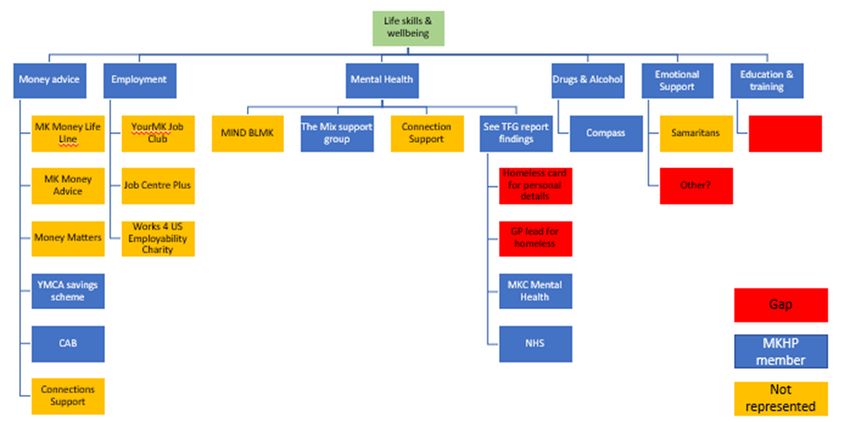
The tables and charts below provide details of service providers and gaps identified in service
provision and MKHP representation.
What is needed? Organisation Gaps
Advice & information
Housing
Deposit bond scheme MKC Housing Options - MKC
Discretionary Housing Payment
Clear housing MK Housing Options – social housing, Landlords forum, housing
pathways private rented associations and developers not
part of MKHP
Support to manage & Connections Support Not represented in MKHP
sustain tenancies
Welfare benefits & CAB
housing advice
Contact information Library Not represented in MKHP
and internet access
General advice Shelter – homelessness National Charity
CA:MK – MK charities
Joined up approach
Early identification of Integrated approach to info sharing
those at risk – and weekly support visits between
personalised support MKC, NHS, Police and Voluntary
plans sector
23Milton Keynes Homelessness Partnership Strategic Review – December 2017
Directory of providers Not currently available
of accommodation
and services
Targeted services
Young mothers MKC Adult social care joint
commissioning team
Single people MKC Adult social care joint
commissioning team
Ex armed forces SSAFA – welfare advice - National National Charity
personnel charity – no local MK branch
The Royal British Legion - Meets in Not represented in MKHP
Tuesdays monthly
Leaving prison & New Leaf Not represented in MKHP
youth offenders
P3 Probation services
Leaving hospital Connections Support 6 mth project
– no longer running see Task &
Finish Group Mental Health report
Domestic violence MK Act
Help with dogs The Bus Shelter MK will be able to
cater for rough sleepers' pet dogs
Senior Citizens Age UK
24Milton Keynes Homelessness Partnership Strategic Review – December 2017
Day centre / rough
sleepers outreach
What is needed? Organisation Gaps
Rough sleepers DCLG Rough Sleeper Grant funding for 2 Provision to follow current 2 year
outreach including years programme
mental health crisis Led by Kings Arms Project
intervention workers
Showers Christ the Cornerstone Church
Buszy – under development
Laundry Facilities Buszy – under development
Community Safety Thames Valley Police
MKC Community Safety
Other street support Street Pastors
Peoples Assembly
Amazing CMK Business Improvement
District
Reconnect to support National charities – Samaritans and Gap in providers of emotional
networks British Red Cross support
One Stop Shop Buszy – under development
Drop in centre Open Door – 3 days a week Extend service to 5 days a week.
Drop in not allowed under terms of
bus station lease.
Severe weather When temperature drops to below zero
emergency protocol for more than 3 consecutive nights.
Cost to council of Hostels, B&Bs and
hotels
25Milton Keynes Homelessness Partnership Strategic Review – December 2017
Life skills services
What is needed? Organisation Gaps
Money advice MK Money Lifeline - Debt Advice, free Under represented in MKHP – only
confidential money advice YMCA and CAB in the partnership
MK Money Advice, New Life Church MK
Money matters, Grace Church MK
CAB & Connections Support Partnership
Savings scheme for YMCA - Step out residents savings
deposit and rent in scheme
advance
Work prep training - www.yourmk.co.uk/your-job-club Not represented in MKHP
CV writing & job clubs
Emotional support Samaritans Not represented in MKHP
Education & training Not represented in MKHP
Employment Job centre plus Not represented in MKHP
Works 4 US – employability charity
Mental health advice Connection support Not represented in MKHP
MIND BLMK Not represented in MKHP
MKC Mental Health See TFG findings e.g. homeless card
for personal details, GP lead for
The Mix Support Group homeless
Health & wellbeing NHS
Drug & alcohol advice Compass
Centre at 33-37 Farthing Grove, MK
26Milton Keynes Homelessness Partnership Strategic Review – December 2017
Provisions
What is needed? Organisation Gaps
Food MK Foodbank – 12 sites across MK Fare share scheme?
MK Soup Run Not represented in MKHP
Clothing and bedding Re-use Community Project Not represented in MKHP
MK Storehouse
Help our Homeless
Christ the Cornerstone Church
Furniture Re-use Community Project Not represented in MKHP
27Milton Keynes Homelessness Partnership Strategic Review – December 2017
APPENDIX 4 - Gap Analysis - One Stop Shop
The Winter Night Shelter (WNS) is working in partnership with Milton Keynes Development
Partnership (MKDP) and Milton Keynes Council to regenerate the Old Bus Station with the aim of
utilising the building to provide a 'one stop shop' for the vulnerable, homeless and in need.
Following extensive consultation in conjunction with MKDP, a new agreement has been signed
between WNS and MKDP for the use of the Old Bus Station in Central Milton Keynes. WNS has
appointed The Ridgeway Community Trust (RCT) as a managing agent to run the Old Bus Station.
The aim is for many of the support services in Appendix 3 to be provided over the next 3 years at the
One Stop Shop service in the Old Bus Station. The Bus Station project managed by Donna Elliott
plans to provide the following:
• Connect charities and groups under ‘one roof’ in Milton Keynes; a visible, engaging, and
listening service, working in partnership with local people to shape services, and
promote community unity.
• Community Centre that provides resources and high-quality services that prevent and
support the homeless.
• Early preventative measures and infrastructure to support and maintain the recently
rehomed.
• Clear pathways back to secure housing.
• Young people life skills, preparation for adult life
• Work preparation training, assistance with CV writing and interview preparation
• Money Advice facility to enable user to manage their money more effectively and offer
debt advice,
• A longer-term aspiration to provide assistance with rented housing
The biggest challenges for delivery of the One Stop Shop model are support service take up of the
Old Bus Station facility and lack of access for those in need. Under the current terms of the lease, the
One Stop Shop will not be able to provide some of the services or access needed, particularly for
rough sleepers, as it is not permitted to allow drop ins.
Where we are to date
The facility is currently being refurbished with the aim of it being ready to offer support services in
early 2018. One stop shop facility at the Old Bus Station is to be branded as Unity Park Station. Unity
Park Station will be initially used by a number of different organisations who will book out a weekly
time slot and let themselves in / lock up the Old Bus Station. Use of the facility is free for those who
are meetings the needs of vulnerable people.
Discussions are underway with a number of partner organisations who provide niche services and
are interested in utilising the Old Bus Station facility. Outline discussions have taken place and in
some cases, partners have already agreed to provide services including:
• MK Money Lifeline (Money Advice services) – ad hoc basis
• MK Food Bank (food and provisions service)
• Open Door (Day-time homeless support and services)
• MK Storehouse (Clothing provision) – to provide packs of clothes for distribution
• Citizens Advice Bureau (Advice services) – likely to use the facility
• British Red Cross (vulnerable migrant service)
28Milton Keynes Homelessness Partnership Strategic Review – December 2017
• Post-traumatic stress counselling for vulnerable migrants
• Sanctuary Hosting – migrants to be hosted in MK homes
• The Bus Shelter MK – An overnight facility for the homeless – to be discussed once bus
shelter running
• Young adult mental health social services – to be organised
• Kings Arms Rough Sleeper project – in discussions
• Fire Services – potentially interested in running health and safety courses
What we would ideally like to provide
Once the facility is up and running with sufficient users, the aim would be to put in place a
Community Centre manager providing more regular opening hours and oversight of joined up
working.
Unity Park Station would then be able to become a Community Centre and provide access for those
who are homeless or at risk of becoming homeless to be assessed and sign posted to the service that
most meets their needs. For this to be achieved, it will be crucial that key organisations prioritise
joined up working and provide volunteers to offer services at the Old Bus Station.
Under the current terms of the MKDP lease drop in services are not permitted. As a result of this, a
number of services needed to support rough sleepers cannot be provided. The restriction on a drop-
in style set up appears to be a significant barrier to usage for many organisations.
29Milton Keynes Homelessness Partnership Strategic Review – December 2017
APPENDIX 5 - Moving on process – sustainable homes
Another key factor for consideration is options to improve the speed of the moving on process from
temporary accommodation and the sustainability of tenancies to prevent homelessness. Without a
focus on the ultimate goal of sustainable homes, it is likely that ever increasing amounts of
temporary accommodation will be required.
There are approximately 130 rough sleepers (September 2017) and 800 households in temporary
accommodation (June 2017) as a result of the existing lack of supply and access to affordable
housing. The number of homeless has more than doubled in the last 10 years and will continue to
rise unless action is taken to address the shortage of affordable homes for those on the lowest
incomes and benefits.
The strategic review identified the need to engage more widely with housing providers and consider
options to increase the supply and access to social housing and the private rented sector. This is
needed to move people on from temporary accommodation e.g. from YMCA to permanent housing
to free up temporary bed spaces and provide a clear path to sustainable housing.
A joined-up approach to housing advice and money support between MK Council, Housing
Associations and the voluntary sector is also recommended to support sustainable tenancies.
A summary of the options to increase the supply and access to sustainable homes is below.
Social Housing
MKC’s supply of homes for those in need of social housing, both Council owned and Housing
Association, is decreasing. The supply of family sized social housing has fallen from 1,244 homes in
2012/13 to 388 homes in 2016/17. Restrictions on building new social housing mean that it is
necessary to consider alternative solutions to move people on from temporary housing.
Options for consideration are:
• MKC acquisition and development of existing properties for rent at sub market level
• Development of supported social housing. Access to government funding may be available
following the Housing First programmes announced in the Autumn Budget 2017 to be
piloted in three areas in England.
• Review of eligibility criteria for social housing. Aim to remove barriers to social housing
eligibility with the appropriate support put in place e.g. financial eligibility, local connection,
rent arrears, anti-social behaviour, criminal convictions.
• Include representation from housing associations in MKHP to encourage joined up working
between homelessness support services and housing providers.
New build
MK rate of development from 2001 to 2011 was more than double that in England (18% vs 8.3%)
with 15,500 new dwellings built increasing MK housing from 86,500 to 102,000. Milton Keynes
continues to be a growing city with 26,500 new dwellings forecast to be needed in next 15 years
including 8,200 or 31% affordable dwellings (1). This provides an opportunity to work with housing
developers to ensure that sufficient affordable homes are built and made available to those on the
lowest incomes and within Local Housing Allowance (LHA) rates.
The current MK Supplementary Planning Document (SPD) for affordable housing requires developers
to include 30% affordable housing on their new build sites with 25% of homes being made available
30Milton Keynes Homelessness Partnership Strategic Review – December 2017
at 80% of the market rate and 5% at social rent levels. These targets are not being delivered with a
shortfall of 877 affordable homes vs 30% target in the last 10 years. Options to consider include:
• A review of the eligibility and financial affordability criteria to ensure that those on the
lowest incomes and housing benefit are able to access these new homes.
• A review of the mix of houses, flats and shared accommodation to be provided to ensure
they match the projected needs of families, single people and under 35s with the planned
introduction of the shared accommodation rate from 2019.
• Include representation from developers in MKHP to encourage joined up working between
homelessness support services and house builders and housing associations. Homes and
Communities Agency Tenancy Standard requires registered housing providers to co-operate
with local authorities; helping Councils to meet their homelessness duties.
Private rented sector
Landlords can be reluctant to let properties to homeless people and those in receipt of housing
benefits. A number of schemes are already in place to try and improve access to the private rented
sector, these include:
MKC Homebond – properties agreed prior to April 2013. Life time deposit bond and guarantee to
cover rent arrears and malicious damage
MKC Homes in Partnership (HIP) - Shorthold tenancy. Life time deposit guarantee, intensive support
for first 12 months
MKC Enhanced private sector leasing (PSL) - Long term lease. 10% premium over LHA rates, fully
managed by MKC including rent and repairs
Options to improve access to private rented accommodation include:
• MKHP helping the Council to proactively promote the existing schemes to increase the
number of private landlords working with the Council.
• Additional incentives to help to identify more landlords that are willing to accept tenants on
housing benefit e.g. rent insurance scheme, longer term assured tenancies.
• Include representation from the Private Landlords Forum in MKHP to share ideas, address
concerns and promote the work of the Partnership to other landlords.
• Review the condition of private rental properties to secure sustainable homes not just
somewhere to unsuitable to live.
• Joined up support and access to provisions such as food and furniture to manage tenancies
and reduce the risk of escalating financial difficulties that lead to arrears.
Other options
There a number of other options to provide additional sustainable homes as summarised below:
• Lodging scheme matching those seeking with those letting rooms
• Social enterprise investment, for example partnerships with social rented schemes such as
Green Pastures
• Shared accommodation e.g. review of the policy approach to homes of multiple occupation
• Government Funded options - Home Building Fund for Community Led Housing projects
• Housing Growth Partnership - social impact investor backed by Lloyds Bank and the Homes
& Communities Agency to help address housing affordability by providing support to the
regional residential development community to increase the number of new homes built
31You can also read


