My First Day A RIF GUIDE FOR COMMUNITY COORDINATORS
←
→
Page content transcription
If your browser does not render page correctly, please read the page content below
My First Day
 A RIF GUIDE FOR COMMUNITY COORDINATORS
 Themes: Animals, Growth and Development, 		                 Authors and
		Families                                                   Illustrators:
Book Brief: How do newborn animals spend their 		            Steve Jenkins
		 first day on the planet? Read to                          and Robin Page
		            find out!

                            TIME TO READ!
                            Before reading: Have any of the children ever been around newborns or very young
                            babies? How good are babies at taking care of themselves? Explain that some animals
                            can live on their own right away, but some animals rely on their families to take care
                            of them while they grow up.

 RELATED ACTIVITIES
OTTER NONSENSE                                               Make your own cut-paper picture! Cut out pieces of
(AGES 5-12)                                                  construction paper and glue them onto white paper
                                                             in the shape of an animal. Use more paper to give
Materials: paper, markers or crayons
                                                             your animal a face. Color in the background with
Watch this video about an otter mom who finds a              crayons or markers.
creative way to take care of her pup: www.youtube.
com/watch?v=o0OyhHeelyo. Baby otters can float               MY FIRST DAY
but not swim, so their moms have to watch them               (AGES 5-9)
constantly. Design a playground/water park for baby
otters. What kinds of things do otters like to do?           Materials: paper, pencils or
What would keep a pup happy and safe while Mom               pens, markers or crayons
is away? Draw your design                                    What was your first day
and share it with the group.                                 of school like? What about
                                                             your first day in a new
CUT-PAPER CRITTERS                                           city? Your first day as a
(AGES 5-12)                                                  big brother or sister? Write
                                                             a story or draw a picture or
Materials: construction
                                                             comic strip about a first day
paper, white paper,
                                                             you’ve experienced. What
scissors, glue, crayons
                                                             happened? Were you afraid?
or markers
                                                             Happy? Display your story
The illustrations in this                                    or picture on a wall or bulletin board.
book are cut-paper.

 ADDITIONAL RESOURCES
OTHER BOOKS BY THESE AUTHORS
Sisters and Brothers (2012)
Time to Sleep (2011)
What Do You Do with a Tail like This? (2008)
My First Day
 A RIF GUIDE FOR EDUCATORS
 Themes: Animals, Growth and Development, 		                Authors and
		Families                                                  Illustrators:
Book Brief: How do newborn animals spend their 		           Steve Jenkins and
		 first day on the planet? Read to                         Robin Page
		 find out!                                                Content Connections:
                                                            Science, Social Studies, Health

                          TIME TO READ!
                          BEFORE WE READ,                   Prior Knowledge: Do any of the students have
                          LET’S LOOK AT…                    younger siblings? Do they remember their siblings’
                                                            first days? How much does a newborn human rely
                          The Cover: Have students          on its parents? Explain that some animals can take
                          make predictions about the        care of themselves right away, but other animals—
                          book based on the cover.          like humans—need a lot more help from their
What animal is in the picture? What does the subtitle       families.
mean? Is this book fiction or nonfiction?
                                                            Vocabulary: hatched, trotted, herd, underbrush
The Pictures: Flip through the pictures. Do students
see any animals they recognize? What do most of             Purpose for Reading: As we read, make
the pictures have in common? With whom are the              comparisons. What do the different
animals?                                                    animals have in common?

 WHILE WE READ
MONITORING COMPREHENSION                                    u Where does
                                                              it live?
For each animal, ask:
                                                            u Does it need help
u What kind of animal is this?                                from its parents?
u Is it born or hatched from an egg?

 LET’S THINK ABOUT
                              Our Purpose: Which animals need the most help from their parents? What do
                              those animals all have in common? Which animals need the least help?
                              Extending Our Thinking: Make a chart on the board showing all the different
                              classifications of animals in the book (e.g., mammal, bird, amphibian, etc.). Do the
                              animals in each class spend the same amount of time with their parents? What
                              other groupings or categories can students think of to explain why some animals
                              need more help than others? Why would some animals need to be self-sufficient
                              almost immediately?

NOTE TO EDUCATORS
u Extension Activities for Educators also available.
u Vocabulary Scaffolding Sheet also available.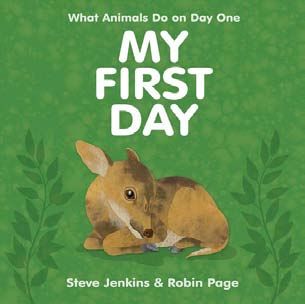
My First Day
 A RIF GUIDE FOR PARENTS AND FAMILIES
 Themes: Animals, Growth and Development, 		            Authors and
		Families                                              Illustrators:
Book Brief: How do newborn animals spend their 		       Steve Jenkins
		 first day on the planet? Read to                     and Robin Page
		            find out!

                          TIME TO READ!
                          Before reading, build         Which one needed more help from its parents?
                          background: Tell your child
                                                        After reading, ask questions:
                          about the day they were
                          born, or about a different    u Which baby animal needed the most help from
                          first day you’ve shared         its parents?
                          together.                     u Which animal needed the least help?
While reading, make connections: Has your child         u How did the parents help?
ever seen a baby animal? What about a baby human?       u Which animals live near you?

 RELATED ACTIVITIES
A FROG IN YOUR THROAT                                   A ZEBRA BY ITS STRIPES
Ingredients: green apple, green grapes, toothpicks      Materials: paper, paint, pencil,
                                                        popsicle sticks, scissors
Cut a green apple into thick wedges. Cut a thin slice
lengthwise into the peel of one apple wedge to make     A mother zebra can recognize
the frog’s mouth. Lay the wedge flat on its side. Cut   her baby by its stripes. Make
a grape in half widthwise. Using toothpicks, attach     a zebra with its own unique
the grape halves to the flat top of the wedge to make   pattern! Draw or trace the
the frog’s eyes. Yum!                                   outline of a zebra on paper.
                                                        Dip one long, skinny edge of the
CUT-PAPER CRITTERS                                      popsicle stick in paint and press it
                                                        onto the zebra to make a stripe.
Materials: construction paper, white paper, scissors,   Repeat. Use different colors,
glue, crayons or markers                                if desired. Cut out your zebra.
The illustrations in this book are cut-paper. Make
your own cut-paper picture! Cut out pieces of           TECHNOLOGY LINK
construction paper and glue them onto white paper
                                                        Watch this video about an otter mom who finds a
in the shape of an animal. Use more paper to give
                                                        creative way to take care of her pup: www.youtube.
your animal a face. Color in the background with
                                                        com/watch?v=o0OyhHeelyo.
crayons or markers.

 ADDITIONAL RESOURCES
OTHER BOOKS BY THESE AUTHORS
Sisters and Brothers (2012)
Time to Sleep (2011)
What Do You Do with a Tail like This? (2008)
My First Day
A RIF VOCABULARY SCAFFOLD

blend in: to look the
same as the things
around you

                            piggyback: riding
doze: to sleep; to
                            on someone’s back
take a short nap
                            or shoulders

drift: to move              snuggle: to sit or lie
slowly through              close to someone or
the air or water            something; to cuddle

                            speckled: dotted;
heap: a pile; a bunch       spotted; covered
of something                in bits or spots of
                            different colors

memorize: to                trot: to walk like a
learn; to know;             horse; to run slowly
to remember                 and steadily

paddle: to swim; to
move through water
using your hands,
feet, or a special stick
My First Day
 RIF EXTENSION ACTIVITIES FOR EDUCATORS
STEAM-THEMED: Science, Technology, Engineering, Art, Math

SCIENCE, ART                                            ENGINEERING,
BLENDING IN                                             SCIENCE,
                                                        TECHNOLOGY, ART
Materials: paper, markers or crayons
                                                        OTTER NONSENSE
Several animals in this book use camouflage to blend
in with their habitats. Research to find 3-5 animals    Materials: paper, markers or crayons
that use camouflage.                                    Watch this video about an otter mom who finds a
Draw a picture of each                                  creative way to take care of her pup: www.youtube.
animal blending into                                    com/watch?v=o0OyhHeelyo. Baby otters can float
its surroundings.                                       but not swim, so their moms have to watch them
Label each picture                                      constantly. Design a play area/water park for baby
with the name of the                                    otters. What habitat does an otter need? What kinds
animal and where it                                     of things do otters like to do? What would keep a pup
lives.                                                  happy and safe while Mom is away? Draw your design
                                                        and share it with the class.
SCIENCE,
TECHNOLOGY                                              ART
WHAT A STINKER                                          CUT-PAPER CRITTERS
Parent bugs protect their                               Materials: construction paper, white paper, scissors,
babies by giving off a nasty                            glue, crayons or markers
smell to scare away attackers. What other bugs use
                                                        The illustrations in this
chemical defenses? Research to find 3-5 examples.
                                                        book are cut-paper. Have
Share your findings in a PowerPoint. For each bug,
                                                        students make their own
give its name, a picture, and a description of how it
                                                        cut-paper pictures. They
protects itself from other animals.
                                                        should cut out pieces of
                                                        construction paper and
TECHNOLOGY                                              glue them onto white
CRITTER CAMS                                            paper in the shape of
                                                        an animal. Let them
Watch baby animals live! Check out the kitten cam       use more paper to
(http://animal.discovery.com/tv-shows/too-cute/         give the animal a face,
games-more/kitten-cam.htm) and the puppy cam            then color in the background
(www.apl.tv/puppies.htm). How do kittens and            with crayons or markers.
puppies spend their first days? Make a chart to
compare the
two.                                                    MATH
                                                        FIRST DAY MATH
                                                        There are 24 hours in a day. Pick one of the animals
                                                        in the book and make a timeline of its first day, hour
                                                        by hour. What does the animal do? Sleep? Eat? Play?
                                                        After you’ve drawn your timeline, make a pie graph to
                                                        show how many hours your animal
                                                        spends doing each activity.

You can also read


