National Risk Assessment 2019 Overview of Strategic Risks - Prepared by the Department of the Taoiseach gov.ie
←
→
Page content transcription
If your browser does not render page correctly, please read the page content below

National Risk Assessment
2019
Overview of Strategic Risks

Prepared by the Department of the Taoiseach
gov.ie

                                              1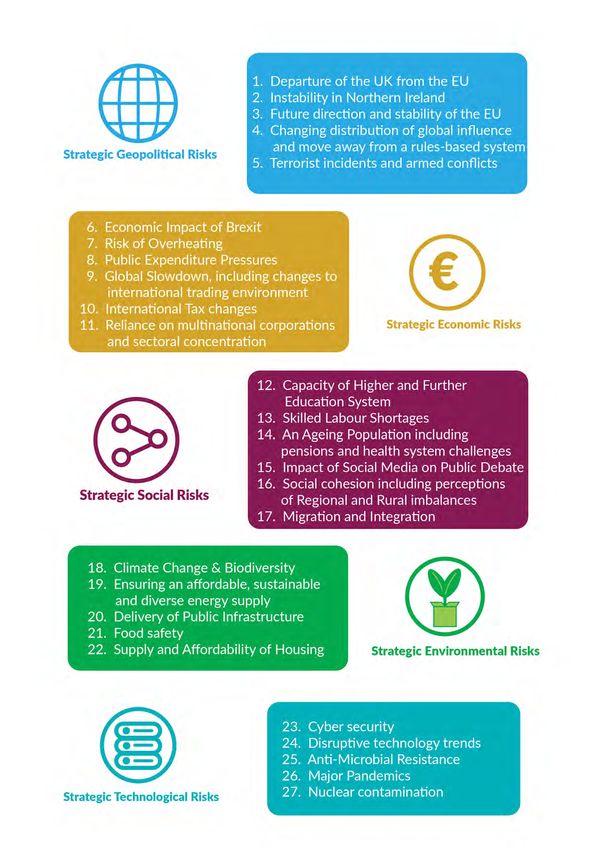
National Risk Assessment 2019
Overview of Strategic Risks

gov.ie
National Risk Assessment – Overview of Strategic Risks 2019

                Foreword                                                                                 6

              1. Introduction 2019                                                                       8

              1.1.    Overview of the National Risk Assessment Process                                   9
              1.2.    Table of Risks 2019                                                               11
              1.3.    Overview of Strategic Risks                                                       12

              2. Geopolitical Risks           						                                                    17

              2.1.    Departure of the UK from the EU                                                        18
              2.2.    Instability in Northern Ireland                                                   20
              2.3.    Future direction and stability of the EU                                          23
              2.4.    Changing distribution of global influence and move away from                      24
                           a rules-based system
              2.5.    Terrorist incidents and armed conflicts                                           24

              3. Economic Risks                                                                         26

              3.0.    Introduction                                                                      27
              3.1.    Economic Impact of Brexit                                                         27
              3.2.    Risk of Overheating                                                               29
              3.3.    Public Expenditure Pressures                                                      30
              3.4.    Global Slowdown, including changes to international trading environment           31
              3.5.    International tax changes                                                         33
              3.6.    Reliance on multinational corporations and sectoral concentration                 34

              4. Social Risks                                                                           37

              4.1.    Capacity of Higher and Further Education System                                   38
              4.2.    Skilled Labour Shortages                                                          39
              4.3.    An Ageing Population including pensions and health system challenges              40
              4.4.    Impact of Social Media on Public Debate                                           42
              4.5.    Social cohesion including Perceptions of Rural and Regional Imbalances            44
              4.6.    Migration and integration                                                         46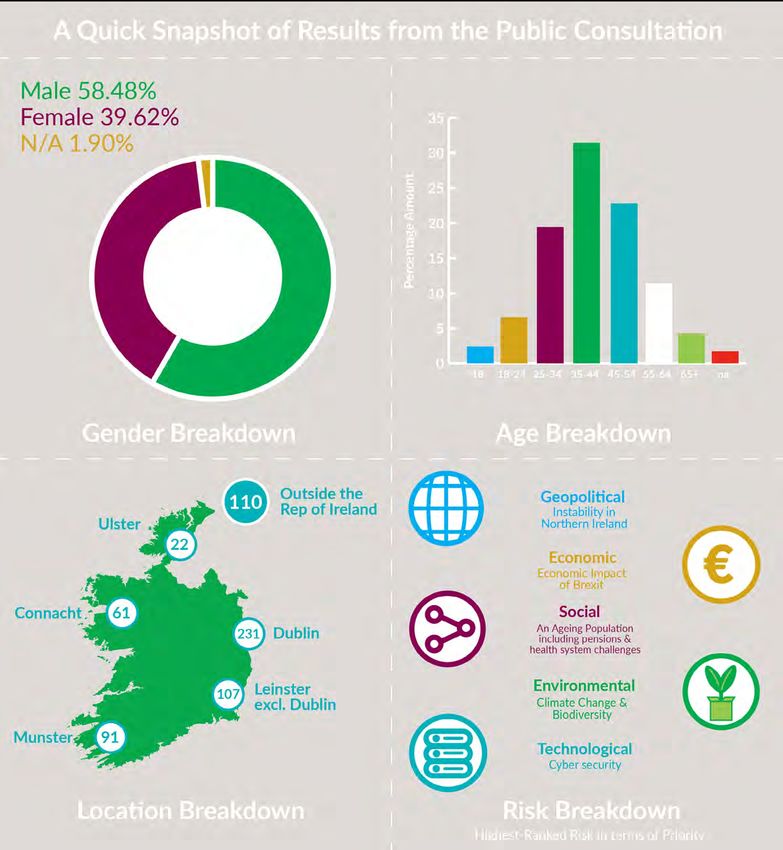
National Risk Assessment – Overview of Strategic Risks 2019

                 5. Environmental Risks                                                 50

                 5.1.   Climate Change & Biodiversity                                   51
                 5.2.   Ensuring an affordable, sustainable and diverse energy supply   52
                 5.3.   Delivery of Public Infrastructure                               53
                 5.4.   Food safety                                                     55
                 5.5.   Supply and Affordability of Housing                             56

                 6. Technological Risks                                                 58

                 6.1.   Cyber Security                                                  59
                 6.2.   Disruptive technology trends                                    61
                 6.3.   Anti-Microbial Resistance                                       63
                 6.4.   Major Pandemics                                                 64
                 6.5.   Nuclear contamination                                           64

                   Annex 1 Government Task Force on Emergency Planning –                66
                               National Risk Assessment for Ireland 2017
                   Annex 2 Ireland’s Changing Demographics and related risks            67
                   Annex 3 Snapshot of results from public consultation                 78
                   Annex 4 National Risk Assessment Public Consultation –               79
                               groups/individuals that made a submission
                   Annex 5 National Risk Assessment Public Consultation –               80
                               risks highlighted by respondents
National Risk Assessment – Overview of Strategic Risks 2019

           Foreword

           The great American poet, Maya Angelou believed that we should always be ‘hoping
           for the best, prepared for the worst, and unsurprised by anything in between’.  The
           National Risk Assessment serves a vital function in helping us to do exactly that.

           As we know, the economy continues to perform well, but we are not complacent
           or taking that for granted.  The next twelve months will see us face challenges of
           significant scale and impact, including those emerging from Brexit and Climate
           Change.  Internationally, we see continued trade tensions and the emergence of
           a global economic slowdown.  Domestically, we want to continue to ensure our
           public finances are robust and sustainable, so we can respond to the risks identified
           here.  The scale and potential impact of these risks underlines how important it is
           that we are aware of every possible problem, and the National Risk Assessment:
           Overview of Strategic Risks enables us to face these risks head on.

           The National Risk Assessment ensures that all voices are heard across the
           nation.  In this way we avoid repeating the mistakes of the past, by taking into
           consideration the concerns and views of businesses, academics and researchers,
           civil society groups, and members of the public, as well as the public sector. The
           ultimate goal is to avoid “group think” when it comes to recognising and discussing
           risks at an early stage.

           This year, I am delighted to see over 650 submissions through the public
           consultation, a substantial increase on the number received last year, and a strong
           endorsement of the value of the National Risk Assessment. In particular, it was
           noteworthy that Climate Change & Biodiversity emerged as the most important
           priority for respondents.

           As we publish the Report for the sixth year, it is important to note how the risks
           identified have developed and evolved.  There is a constantly changing risk
           backdrop.   For example, this year we have included a ‘Capacity in Higher and
           Further Education System’ risk, as well as discussing the risks around perceived
           rural and regional imbalances.

           Some risks have increased in significance since last year’s report including the
           Brexit risks in both the Geopolitical and Economic categories, ‘Climate Change &
           Biodiversity’ and ‘Cyber Security’. These risks are ongoing and evolving, and the
           changes here reflect this.  All of the risks identified are monitored to ensure we can
           respond effectively to every challenge that arises.

                                                                                                6
National Risk Assessment – Overview of Strategic Risks 2019
The 2019 National Risk Assessment provides an important context for
Departments and Agencies to develop the necessary mitigating actions, as
appropriate. So, it is right that we promote discussion and awareness of the most
important strategic risks facing Ireland. Continuing to be vigilant of the risks facing
our country will help us to make better-informed decisions on how to prepare for
them.
Leo Varadkar
Taoiseach
July 2019
71. Introduction 2019
National Risk Assessment – Overview of Strategic Risks 2019

		1.1.                Overview of the National Risk Assessment Process
		            1.2.    List of Risks 2019
		            1.3.    Overview of Strategic Risks

           1.1. Overview of the National                     Bank of Ireland with respect to financial
           Risk Assessment Process                           and macro-prudential risks; and the work
                                                             of the Government Task Force (GTF) on
           The National Risk Assessment (NRA) pro-           Emergency Planning, supported by the
           vides an opportunity for the identification,      Office of Emergency Planning (OEP), who
           discussion and consideration of risks facing      produce a National Risk Assessment for
           Ireland over the short, medium and long           Ireland centred on risks relating to potential
           term. Since the NRA was first published in        civil emergencies at national level  which is
           2014, the annual Report has served as an          conducted in the context of the Strategic
           important indicator of national-level risks,      Emergency Management National Struc-
           and has called attention to various risks that    tures and Framework approved by Gov-
           subsequently became major issues for Irish        ernment in 2017 and Ireland’s reporting
           society, including Brexit, and risks around       commitments under the EU Civil Protection
           housing supply, and cybersecurity.                Mechanism. In addition, a National Security
                                                             Analysis Centre (NSAC) is being established
           The National Risk Assessment plays an             by the Government as part of the imple-
           important part in the early identification of     mentation of the report of the Commission
           potentially significant risks that Ireland may    on the Future of Policing in Ireland. The
           face. It is vital to learn from the mistakes of   NSAC will bring the various agencies rele-
           the past, and this exercise was introduced        vant to national security together to pool
           to ensure that we, as a Government and as         expertise and information, so as to produce
           a wider society, encourage and participate        a comprehensive picture of the threats to

                                                                                                              Introduction 2019
           in these necessary horizon-scanning discus-       the State and develop an integrated nation-
           sions to ensure that we identify risks early      al security strategy.
           and can robustly prepare for them. While
           not intended to replicate or displace the         The Departments and agencies involved in
           detailed risk management that is already          these risk management exercises also feed
           conducted within government departments           in to this National Risk Assessment process,
           and agencies, the National Risk Assessment        thereby ensuring coherence and alignment
           does aim to provide a systematic overview         with other elements of the overall risk man-
           of strategic risks that can form an import-       agement approach.
           ant, and inclusive part of the overall process
           of risk management.                               Separately, and in accordance with a com-
                                                             mitment made by Government, an Update
           Detailed risk management being conducted          of the White Paper on Defence (2015) is
           separately to the National Risk Assess-           currently being finalised by the Department
           ment process includes the work of the             of Defence. An important strand of this is
           Department of Finance and the Central             a fully updated assessment of the security

                                                                                                        9
National Risk Assessment – Overview of Strategic Risks 2019
environment carried out by an inter-depart- In that context, the draft National Risk
mental/inter-agency group. When approved Assessment 2019 was published for pub-
by Government, the update will include an lic consultation in May and laid before the
outline of developments in important as- Houses of the Oireachtas. Over 650 sub-
pects of the security environment since the missions were received as part of this con-
publication of the White Paper on Defence sultation, and these are outlined at Annexes
in 2015. 3 and 4.
The Departments and agencies involved in In parallel with this consultation, work also
these risk management exercises also feed continued within government departments
in to this National Risk Assessment process, to further strengthen the quality of Ireland’s
thereby ensuring coherence and alignment risk governance mechanisms and to ensure
with other elements of the overall risk man- that appropriate mitigation frameworks are
agement approach. in place. As outlined above, this includes
the work of the Government Task Force
A broad and diverse range of contributions on Emergency Planning, supported by the
to the National Risk Assessment are encour- Office of Emergency Planning, the work of
aged through several layers of debate and the Department of Finance and the Central
engagement, to ensure we avoid the pos- Bank of Ireland with respect to financial
sibility of ‘group think’. At the initial stage and macro-prudential risks, the new NSAC,
of the National Risk Assessment process, a and the Steering Group representing gov-
Steering Group, chaired by the Department ernment departments and agencies, which
of the Taoiseach and comprising representa- oversees preparation of the NRA.
tives from all Government Departments and
agencies, worked together to draw up an The final list of strategic risks for Ireland
initial draft list of risks, as in previous years. in 2019 is included on the following page.
The risks are grouped across geopolitical,
As mentioned above, one of the original economic, social, environmental and tech-
impetuses behind the National Risk Assess- nological categories, in line with the World
ment process was to avoid the possibility of Economic Forum’s annual ‘Global Risks
‘group think’ when identifying strategic risks Report’1. This National Risk Assessment
to the country. To this end, each iteration 2019, therefore, is the result of extensive
of the NRA has involved an open public consultation and engagement, including a Introduction 2019
consultation to gauge whether there are any significant public consultation element with
significant risks that have been overlooked over 650 responses, and it sets out a broad
or underplayed, and to ensure inclusive view of the high-level strategic risks facing
engagement from all corners of society. For the country today.
this exercise to be robust, comprehensive
and inclusive, it is important that all voices –
including discordant or minority ones – are
heard. A more rigorous and wide-ranging
debate will bolster our ability to identify and
quantify the risks we face and our ability to
make the right choices for the future.
1 World Economic Forum, Global Risks Report 2019 available at:
https://www.weforum.org/reports/the-global-risks-report-2019
10National Risk Assessment – Overview of Strategic Risks 2019
1.2. List of Risks 2019
11National Risk Assessment – Overview of Strategic Risks 2019
1.3. Overview of Strategic Risks challenges and the increasing demand for
third level places over the coming years that
While many of the Strategic Risks discussed is now forecast.
in the 2018 National Risk Assessment con-
tinue to be relevant for 2019, the context Another strategic social risk that has
and pressures around several of them have emerged this year revolves around risks
shifted and evolved in the interim period. to social cohesion and in particular risks
around perceived imbalances in a regional
For example, we have seen the uncertain- and rural context, versus urban areas and
ties around the form Brexit will take persist cities. In line with similar trends in other
and indeed increase over recent months, countries in both Europe and the US, there
bringing with it a stronger focus on the are significant perceptions of a focus on
potential risk of a no-deal Brexit and the job creation and infrastructure investment
impact such an outcome could have on the concentrated in cities, and to the detriment
Irish economy and on stability in Northern of rural communities.
Ireland, as well as wider implications across
the entire risk spectrum. Potential risks for Other ongoing risks such as international
the open Irish economy arising from a con- tax changes and the Irish economy’s reli-
tinued increase in trade tensions evident at ance on multinational corporations’ in an
the international level, and exacerbated by economic context, the social risks associ-
the emergence of a global economic slow- ated with our changing demographics and
down, also continue to be areas of concern ageing population, environmental risks such
for us, warranting close discussion and as supply and affordability of housing and
awareness. Domestically, emerging spend- overcoming infrastructure gaps, and ongo-
ing pressures must be closely monitored ing and evolving cybersecurity risks are still
and controlled, to ensure that our public relevant, and are discussed throughout the
finances continue to be sustainable and Report.
stable, and to ensure we can respond to the
challenges arising from these risks. For some ongoing risks, while they may not
be new risks identified for the first time
In addition, several of the risks have evolved this year, greater public awareness and an
in new directions, including those around increased sense of urgency and responsive-
the capacity of the Higher and Further ness to the risks can be felt, for example, Introduction 2019
Education system, identified as a strate- in the case of both Climate Change risks,
gic social risk this year. While risks around where an increased demand for action can
human capital and skills needs for a growing be felt from the public and the political sys-
economy were discussed last year, and in tem, and in the case of the impact of social
previous years, and are dealt with this year media on public debate, with both the polit-
under a ‘Skilled Labour Shortages’ risk, an ical and policy system and industry ramping
additional risk for 2019 focuses around the up action in this area.
important role the HE and FET sectors play
in the Irish economy, and the importance As always, and as evident through the
of ensuring adequate levels of funding for above discussions, the inter-connections
the HE sector are maintained, and that an between these risks are ever apparent and
appropriate, sustainable model of funding is must be to the forefront in any discussion
in place, especially in light of demographic of individual risks. We know that Brexit,
12National Risk Assessment – Overview of Strategic Risks 2019
regardless of the form it takes, will impact changing structure and projected future
negatively on the Irish economy, which in trends in Ireland’s population, against an
turn will have implications both for other international backdrop. While it is clear that
potential risks for the economy including Ireland’s population is ageing, in line with
the risk of overheating and loss of compet- trends in other countries, this work sets out
itiveness on the one hand, as well as im- the impacts this will have across a range of
pacting on social risks identified, including sectors, and highlights the importance of
expectations for public expenditure, and appropriate policy responses. These include,
risks and issues around migration and inte- for example, increasing the State Pension
gration, to name but two. Indeed, Brexit can Age, increasing participation rates of older
be seen as an overarching, umbrella risk, people in the workforce, increasing savings
interacting with and amplifying the majority for private pension provision, delivering on
of the risks identified across the geopolit- reforms for the health system, and consider-
ical, economic, social, environmental and ation of policies that would stem the further
technological spheres. decline in fertility and birth rates.
Similarly, inter-connections and knock-on Geopolitical Risks
implications can be seen between underin- As a small open economy, we know that
vestment in Higher Education, the impact of Ireland is particularly vulnerable to geopolit-
disruptive technology tends on jobs and the ical risks. While the top 5 strategic geopo-
economy, and perceptions of regional and litical risks identified for the 2019 National
rural imbalances. And of course, we know Risk Assessment mirror those discussed in
that nuclear contamination could have seri- 2018, it is clear that in each case the risks
ous implications for food safety and animal have evolved and, in some cases, increased
disease, that challenges arising from bio- significantly.
diversity risks have economic and sectoral
impacts as well as environmental impacts, As mentioned above, the risks around Brex-
and that risks around supply and affordabili- it have continued to intensify in the months
ty of housing have both social and since the 2018 Report was published,
economic aspects, as well as environmental. with both uncertainty and the possibility
of a no-deal Brexit persisting throughout
While we categorise the risks in this Report the negotiations to date. Allied to this are
on the basis of the model used by the World potential impacts and risks to the stability Introduction 2019
Economic Forum (geopolitical, economic, of Northern Ireland, and to the Good Friday
social, environmental and technological), for Agreement. These, and other risks continue
the purposes of both organisation and ease to be relevant in the context of risks to the
of consideration, many of the risks cross-cut stability and future direction of the EU, as it
several categories, and the Risks and Report looks to the start of a new legislative cycle
should be read and considered with that in in 2019 with both European Parliament
mind. elections in May and a new European Com-
mission later in the year.
In addition, this year we are including a
thematic piece (at Annex 2), which takes a Outside of Europe, the last twelve months
more detailed look at one of our Social risks, have also seen an increase in geopolitical
‘An Ageing Population including pensions tensions at a regional and global level, as
and health system challenges’. It details the well as the continued withdrawal of the US
13National Risk Assessment – Overview of Strategic Risks 2019
from the free trade model and increasingly coming years, and in the context of ongoing
strained relations with Russia, with associat- difficulties around infrastructure constraints
ed risks of reduced global economic growth, and housing, we could see risks to our
and increased instabilities in the global competitiveness and overheating pressures
economy, and for the Irish economy. Risks emerge.
arising from potential terrorist incidents
and armed conflicts endure, with significant In addition, public expectations of addition-
public safety and security impacts, as well al expenditure are an increasing concern,
as longer-term reputational damage, should especially at this point in the economic cy-
such an attack happen here. cle, and in the context of significant domes-
tic and external risks, and the importance of
In this increasingly tense geopolitical land- maintaining appropriate control on expendi-
scape, and with such high stakes, we must ture is discussed in Section 3.3.
ensure that we are as prepared as possible
for how these risks – both near and far - There are indications that escalating trade
might impact on Ireland economically and conflicts at the international level now ap-
socially, as well as in the context of peace pear to be impacting growth, with the IMF
and security. warning national governments to prepare
for an ‘economic storm’ as global growth
Economic Risks levels undershoot expectations. As a small
While Ireland’s economy continues to open economy Ireland is highly exposed to
perform strongly, its growth is against a such fluctuations in global economic and
backdrop of continuing high indebtedness trading conditions, and the economic risks
(both public and private) which impacts on in this context for Ireland are significant.
our scope to build meaningful fiscal buffers
in the coming years, against a backdrop of Work on international tax reform contin-
Brexit, the shape and impact of which is ues, and continues to be highly relevant for
still unclear, and in the context of emerging Ireland, particularly in the context of the im-
spending pressures which risk destabilising portance of Ireland’s competitive corporate
the public finances if not tightly controlled. tax offering which is an important part of
our wider competitiveness offering, and the
We know that any form of Brexit would emergence of challenges to our corporate
have negative impacts for the Irish econ- tax regime. Related to this, and as discussed Introduction 2019
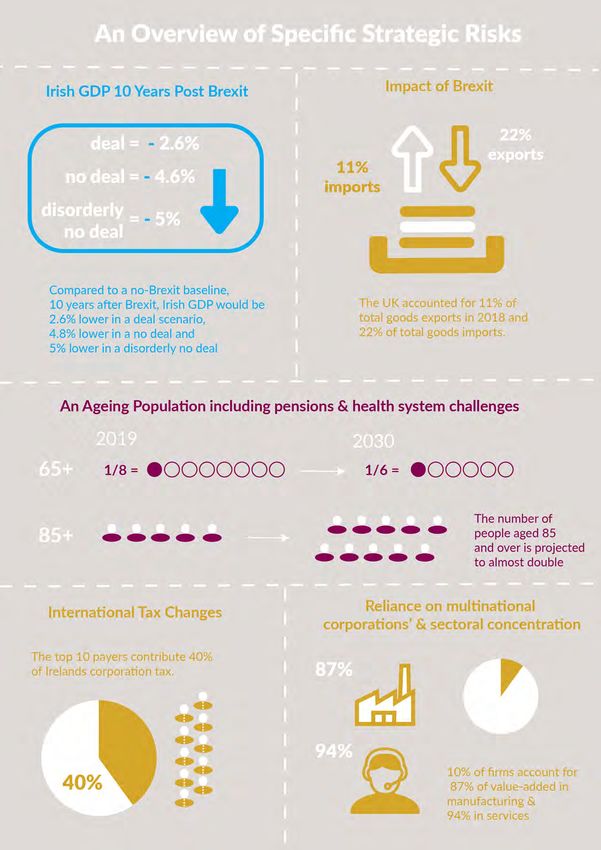
omy, but the impacts of a no-deal Brexit in previous years, our economy and employ-
would be particularly harsh, and these risks ment are heavily influenced by a relatively
are set out in Section 3.2 of the Report, small number of multinational corporations,
with a particular focus on the most vulnera- concentrated in a few enterprise sectors.
ble sectors of the economy in this regard. While, on the one hand, this multinational
investment has been transformative for the
Notwithstanding the possible effects of Irish economy, it also creates a vulnerability
Brexit, the risks of overheating in the econ- to changes in Ireland’s attractiveness as a
omy, and related loss of competitiveness location for those companies, as well as to
continue to be relevant for 2019. As the sector-specific changes or risks, and these
labour market continues to tighten and the are discussed in Section 3.6 of the Report.
economy potentially reaches and exceeds
its sustainable level of production in the
14National Risk Assessment – Overview of Strategic Risks 2019
Social Risks discussed in previous years, greater pub-
As mentioned above, some of the risks lic awareness and an increased sense of
identified in the social category have taken urgency and demand for action on related
a slightly new direction in this year’s Re- risks are apparent this year. Research finds
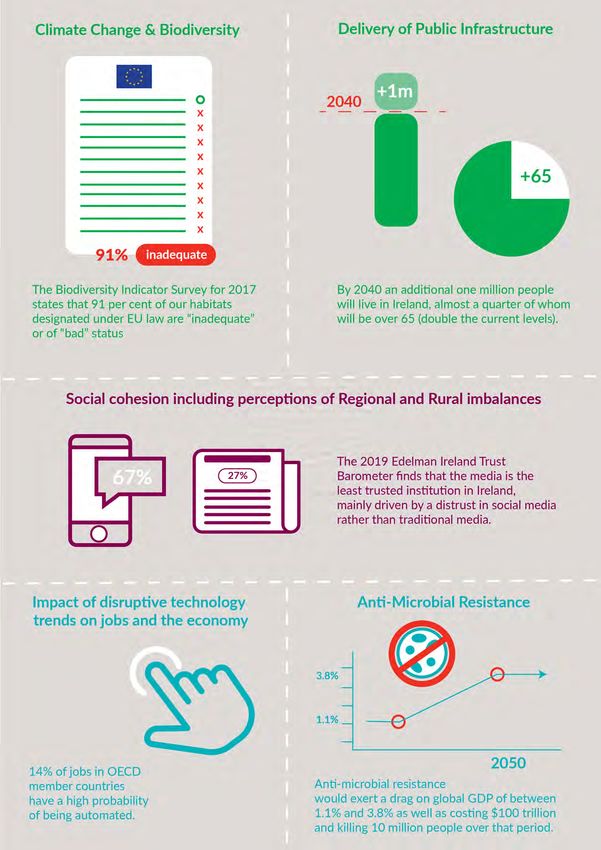
port, including risks around the capacity of that Earth is currently losing biodiversity at
the Higher and Further Education system a rate seen only during mass extinctions. In
and the potential impacts on our economy, addition, Irish biodiversity is highly vulner-
discussed in Section 4.1 and risks around able to the impacts of climate change and
a growing public discourse on rural and has a low adaptive capacity compared to
regional imbalances in the context of social other vulnerable sectors.
cohesion as the economic recovery contin-
ues, which are discussed in Section 4.4. In terms of climate change mitigation, we
know that the cost of inaction exceeds the
As previously mentioned, while the risks cost of action, and that this differential will
arising from the impact of social media on rise steeply with time. Potential costs to the
public debate were included in the 2018 exchequer include those associated with
Report, increasing public awareness and a not achieving compliance with our EU GHG
greater sense of responsiveness on all fronts emissions and renewable energy targets to
is apparent, with both the political and pol- 2020 and 2030. It will also be critical both
icy system and industry ramping up action to price the cost of carbon into our eco-
in this area. With large numbers of citizens nomic model to provide appropriate long-
now obtaining their news from social media term signals, and to define our approach to
platforms, there are clear implications for carbon neutrality for the agriculture sector
the generation, rapid dissemination, and in a way that allows for the achievement
impact of online disinformation. Large-scale of our climate targets and decarbonisation
disinformation or ‘fake news’ campaigns goals while respecting sustainable food
spread online are a high-risk issue for soci- security.
ety globally, including Ireland, and in partic-
ular where they target the electoral process, In terms of energy-related risks, disruptions
and electoral outcomes. Developments in to the supply or price of oil, gas, or electric-
this area are outlined in Section 4.3. ity could have significant economic, social
or competitive impacts, and our geographic
This chapter also outlines the risks emerg- position renders us particularly vulnerable Introduction 2019
ing from demographic issues, and in partic- to such disruptions. Brexit poses a particu-
ular pension and health system difficulties lar risk as Ireland imports the vast majority
in the context of our ageing population, as of its energy requirements, oil, gas and
well as expectations for public expenditure transport fuels, from or via the UK. This pro-
and associated risks, and the risks involved vides an added impetus to increase the use
if we fail to maintain our positive track re- of our renewable resources and to diversify
cord in terms of migration and integration, our sources of supply by developing further
made all the more pertinent in the context electricity interconnection to neighbouring
of Brexit. markets including France. As we electrify
vital services, new associated risks around
Environmental Risks development costs, and societal provisions
As mentioned above, while the risks around and acceptance for necessary infrastructure
Climate Change and Biodiversity have been development will emerge.
15National Risk Assessment – Overview of Strategic Risks 2019
Related to this, wider risks around our services, and on the reputation of business-
capacity to overcome infrastructure gaps, es and public service would be significant.
in the context of challenges in delivering a
significant increase in capital investment un- Disruptive technology trends likewise con-
der Project Ireland 2040, are still relevant, tinue to advance, and these advances bring
particularly when coupled with an ongoing related risks as they predict significant jobs
undersupply of housing and associated af- shifts and disruption. Automation is expect-
fordability issues, a tightening labour market ed to replace some jobs, re-shape others,
and continued strong economic growth and also create new ones. In a regional con-
(as discussed in the context of overheating text, research also highlighted the greater
risks). risks for regions from automation and job
loss. The risks, therefore, if our education
Risks around food safety continue to be and skills system don’t respond appropriate-
relevant, as in previous years, with signifi- ly and in time, are substantial.
cant health, trade, and reputational implica-
tions should a food scare or incident occur, As in previous years, risks around Anti-Mi-
and are discussed in Section 5.4. Again, crobial Resistance and Major Pandemics,
inter-linkages between risks are pertinent and Nuclear Contamination are relevant.
here, with the agri-food sector one of the Anti-Microbial Resistance is an increasing
sectors particularly exposed to Brexit. concern globally, with the extensive use,
misuse, and overuse of antimicrobials in hu-
Finally, the supply and affordability of hous- man health raising levels of resistance in a
ing persists as a significant risk in this year’s wide range of pathogens in all countries and
National Risk Assessment, with economic in patients of all age groups. In the animal
and social, as well as environmental im- population, the rate of development and
plications. While CSO statistics for 2018 spread of antimicrobial resistance has also
show that supply is increasing, difficulties increased. In addition, the risks arising from
around homelessness and affordability are a potential Major Pandemic have relevance
persisting, and overall housing demand is across several risk categories, including
also increasing. In the coming years, housing financial, geopolitical, social, environmental,
shortages are likely to act as a constraint and technological. In terms of nuclear con-
on economic activity and competitiveness, tamination, while the probability for Ireland
and reflect one of the most prominent risks is low, the obvious risks to public health and Introduction 2019
facing the country. well-being, as well as negative economic
impacts are clear, and both awareness and
Technological Risks planning is important in this regard.
In terms of technological risks, risks around
cybersecurity, including potential disruption
to critical information infrastructure, and
data fraud and theft, continue to be perti-
nent and continue to evolve as the extent
to which society relies on digital technology
increases. With Ireland positioning itself
as a technological society, with a growing
dependence on online services, the impact
of an attack or incident on the provision of
162. Geopolitical Risks
National Risk Assessment – Overview of Strategic Risks 2019

                  2.1.    Departure of the UK from the EU
                  2.2.    Instability in Northern Ireland
                  2.3.    Future direction and stability of the EU
                  2.4.    Changing distribution of global influence and move away
                          from a rules-based system
                  2.5     Terrorist incidents and armed conflicts

           2.1. Departure of the UK from the               awaiting its consent. The British Govern-
           EU                                              ment has also agreed to both the With-
                                                           drawal Agreement and the Political Declara-
           The decision of the UK to leave the EU          tion. However, the Withdrawal Agreement
           presents uniquely significant and unprec-       is still subject to ratification by the UK
           edented political, economic, social and         Parliament.
           diplomatic challenges for Ireland, given the
           extent of the inter-connectedness of our        The Withdrawal Agreement establishes the
           economies and people. These are challenges      terms of the UK’s departure from the EU.  It
           both to Ireland’s peace and prosperity, and     ensures that the withdrawal will happen in
           how they are dealt with in the months and       an orderly manner and offers legal certainty
           years ahead may have significant impacts        once the Treaties and EU law cease to apply
           for Ireland into the future.                    to the UK. The Withdrawal Agreement
                                                           covers all elements of the UK’s withdrawal
           Ireland’s priorities have remained consistent   from the EU including citizens’ rights, the
           throughout the process: minimising the          financial settlement, a transition period,
           impact on Ireland’s trade and economy; pro-     Protocols on Gibraltar and Ireland, as well
           tecting the Peace Process and the Good Fri-     as a range of other separation issues. It
           day Agreement in all its parts; maintaining     includes a Protocol on Ireland and Northern
           the Common Travel Area with the UK; and         Ireland and a legally operational ‘backstop’
           securing Ireland’s future in a strong EU. As    to ensure that there will be no hard border
           a result of intensive and sustained engage-     between Ireland and Northern Ireland. It
                                                                                                           Geopolitical Risks
           ment at the EU level, Ireland’s unique issues   contains UK commitments not to diminish
           and concerns have been fully understood by      the rights set out in the Good Friday Agree-
           the EU27 and have been to the fore of the       ment 1998 and recognises that people in
           EU’s negotiating approach.                      Northern Ireland will continue to enjoy EU
                                                           citizenship rights, and to protect North
           Following two years of intensive Article 50     South cooperation. It acknowledges the
           negotiations between the European Union         maintenance of the Common Travel Area
           and the United Kingdom, the European            arrangements between Ireland and the UK,
           Council endorsed the Withdrawal Agree-          and for the preservation of the Single
           ment and the Political Declaration on the       Electricity Market on the island of Ireland.
           future relationship in November 2018. The
           Withdrawal Agreement was subsequently           There is persisting uncertainty regarding the
           passed to the European Parliament and is        ratification of the Withdrawal Agreement

                                                                                                    18
National Risk Assessment – Overview of Strategic Risks 2019
Short-term risks of a no-deal Brexit
The Government published its Contingency Action Plan Update in early July, noting that despite the
extensive mitigation measures being undertaken at EU level by the Irish Government and by
businesses, significant short-term risks in the event of a no-deal Brexit include:
• Disruption of East-West trade between • Significant negative impact on the
Ireland and Britain due to delays at ports Northern Ireland economy, especially in
and/or inability of businesses to meet the area of agri-food exports;
regulatory requirements;
• Loss of or limited access to rights and
• Delays to transit of exports and imports entitlements for Northern Ireland
through the UK landbridge, with residents entitled to EU citizenship;
knock-on impacts on wholesale and retail
supply chains; • Disruption in North-South trade and the
all-island economy due to tariffs and the
• Closure of businesses and/or loss of jobs imposition of various regulatory
in Ireland due to trade disruption and requirements;
associated costs, tariffs and currency
movement, in particular in the agri-food, • Disruption to North-South cooperation in
fisheries, manufacturing and tourism areas such as energy, road and rail
sectors; connectivity;
• Regional economic and labour market • Loss of access to fishing landings from UK
impacts due to the location of most- EEZ, and displacement of other EU fishing
exposed business sectors; activity into Irish waters;
• Deterioration in Ireland’s • Notwithstanding mitigation measures in
macroeconomic position, including place, potential disruption to daily life in
deterioration in the public finances; areas such as online retail purchases from
UK, access to medicines and medical
• Community relations undermined, and devices, and financial services sourced
political instability in Northern Ireland and from the UK
potential related security concerns;
in the UK parliament. The decision of the publications1, and the recently published
European Council to extend the Article 50 Contingency Action Plan Update lists a
process until 31 October 2019 provides number of significant short-term risks that
the UK with more time to ensure an orderly may arise in the event of a no-deal Brexit. Geopolitical Risks
withdrawal. However, the possibility of the In addition to the economic impact and
UK leaving the European Union without an risks, which are discussed in detail in
agreement – a no-deal scenario – remains a Chapter 3, Brexit-related impacts include
significant risk. those to the Common Travel Area (CTA)
between Ireland and the UK, which allows
Due to the close, highly integrated and con- Irish and British citizens to move freely
centrated nature of our trading relationship
with the UK, amongst all EU Member States 1 These include previous National Risk Assessments, Budget 2019
documentation, the Copenhagen Economics report “Ireland and the
Ireland could be the most adversely affected Impacts of Brexit” published by the Minister for Business, Enterprise
and Innovation (available: https://www.copenhageneconomics.com/
by Brexit and to the greatest extent in a publications/publication/ireland-the-impacts-of-brexit), the 2019
nodeal scenario. in numerous Government ESRI/Department of Finance report “Ireland and Brexit: modelling the
impact of deal and no-deal scenarios” (available: https://www.esri.ie/
news/new-study-estimates-the-impact-of-various-brexit-scenarios-
on-the-irish-economy), and the Contingency Action Plan, Dec 2018
(available: https://www.dfa.ie/brexit/getting-ireland-brexit-ready/
governmentcontingencyactionplan/)
19National Risk Assessment – Overview of Strategic Risks 2019
and reside in either jurisdiction and enjoy particular impact at North-South level2.
associated rights and entitlements including
access to employment, healthcare, educa- In the context of immigration, Brexit
tion, social benefits and the right to vote in may also give rise to an increase in illegal
local and national parliamentary elections. movement of third country nationals into
As well as the East-West dimension, the Ireland from the UK, as well as possible
CTA arrangements also underpin the Good consequences for secondary movements of
Friday Agreement in all its parts, as well as asylum seekers and illegal migrants from the
the cross-border freedoms central to the UK to Ireland in the event of UK divergence
lives and livelihoods of the people of North- from EU asylum law.
ern Ireland and the border region. Any dimi-
nution of the CTA could have a destabilising A no-deal Brexit would be an exceptional
impact on the peace process and on North- economic event which would be met with
South relations. The Irish and British Gov- exceptional measures to support the contin-
ernments have committed to the continu- ued operation of the Irish economy and our
ation of the CTA in all circumstances and international trading links. Extensive con-
a Memorandum of Understanding on the tingency planning and preparedness work
Common Travel Area was signed by both is underway across all Government Depart-
Governments on 8 May 2019. Separate, ments and Agencies for a possible no-deal
sectoral agreements to underpin the rights Brexit. This response would be implemented
of the CTA have already been, or will shortly in close co-operation with our EU partners.
be introduced. For example, the agreement
required to maintain the current arrange-
ments in the field of social security after 2.2. Instability in Northern Ireland
the UK leaves the EU is in place – it was
signed by both States on 1 February 2019 The results of the referendum on the UK’s
and completed the required Parliamentary membership of the European Union in June
procedures in both States during March. 2016 showed that a majority of voters in
England and Wales voted to leave whilst a
Brexit will also impact on the operation of majority in Northern Ireland and Scotland
a wide range of EU legal instruments con- voted to remain within the EU. This has
cerning law enforcement and judicial coop- given rise to considerable issues for West-
eration. Of greatest concern to Ireland is the minster and the devolved administrations to Geopolitical Risks
future of the European Arrest Warrant, as consider.
well as EU instruments that provide for the
recognition and enforcement of judgements The breakdown of the NI Executive and the
in civil, commercial and family law matters. collapse of the talks on the formation of a
Disruption to law enforcement and judicial new Executive together with increases in
cooperation arrangements would have a cross community tensions created by the
2 The Political Declaration setting out the Framework for the Future
Relationship between the EU and the UK outlines the basis for a
Security Partnership which references measures to ensure coopera-
tion in law enforcement and judicial cooperation in criminal matters.
If a Withdrawal Agreement is ratified the application of the full EU
acquis to the UK during a transitional period is of great importance.
In the event that a Withdrawal Agreement is not ratified, domestic
legislation is being prepared to ensure workable extradition and
immigration arrangements with the UK can continue. However, any
contingency measures will not and cannot mitigate the overall impact
of a no-deal scenario.
20National Risk Assessment – Overview of Strategic Risks 2019
Brexit vote, means that Northern Ireland tion of the North South bodies set up under
is facing a challenging period ahead. The the GFA.
inability of the Northern Parties to reach a
compromise on contested issues during the Both the Irish and the UK governments
talks process has allowed the development have affirmed that the principles, proce-
of a political vacuum in Northern Ireland, dures and institutions of the Good Friday
along with the increased possibility of the Agreement remain the basis for their en-
re-introduction of direct rule by the UK gagement in Northern Ireland. Ensuring that
Government in Northern Ireland. This is the Good Friday Agreement and the bene-
something to which the Irish Government is fits of the peace process are not disturbed
opposed. by a UK exit from the EU is priority for the
Government.
The restoration of the institutions is essen-
tial in the context of full implementation of As mentioned above as regards the UK
the Good Friday Agreement. Following the withdrawal from the EU, the Withdraw-
tragic killing of Lyra McKee in Derry, the al Agreement also includes a Protocol on
two Governments convened a new short Ireland and Northern Ireland and a legally
and focussed talks process aimed at restor- operational backstop to ensure that there
ing all the institutions of the Good Friday will be no hard border between Ireland
Agreement. and Northern Ireland. There is continuing
uncertainty regarding the ratification of the
The Government will continue to engage Withdrawal Agreement in the UK. The Gov-
with the British Government and the parties ernments objectives in any Brexit scenario
in Northern Ireland as a co-guarantor of are clear – to avoid a hard border on the
the Good Friday Agreement to support the island of Ireland and to ensure the integrity
re-establishment at the earliest opportunity of the single market and the customs union.
of the power-sharing institutions.
A number of submissions, out of the 650
Brexit has added an additional and signif- plus submissions received under the public
icant challenge to the political situation in consultation, related to the “border poll
Northern Ireland. The lack of a power-shar- question”. Although a border poll would not
ing Executive in representing and pursuing be regarded as a risk, and the very import-
Northern Ireland’s interests in the context ant and sensitive policy issues related to
Geopolitical Risks
of the EU-UK negotiations, with the UK it would not be dealt with in the National
and Irish governments as appropriate, is of Risk Assessment process, the question of
significant concern in relation to the specific relationships on the island of Ireland, and
challenges of Brexit for Northern Ireland. An between the two islands, are always con-
Executive is also required for the function- sidered as part of the annual National Risk
ing of the North South Ministerial Council, Assessment. The National Risk Assessment
to oversee and further cross-border cooper- was one of the first official acknowledg-
ation in the agreed sectors and to consider ments of the risks posed by a potential
and address the all-island issues raised by Brexit including associated risks for North-
Brexit. The lack of an Executive has result- ern Ireland. Since the National Risk Assess-
ed in a tangible slowdown in North South ment was first introduced, these issues have
engagement at political level and has had a featured prominently, and been supported
detrimental effect on the effective opera- by accompanying text in the published an-
nual reports.
21National Risk Assessment – Overview of Strategic Risks 2019
The Preparing for the withdrawal of the a more sustainable basis, and to address key
United Kingdom from the European Union – issues of division between the main parties
Contingency Action Plan Update published that have affected partnership government
in July 2019 also identifies that a no deal in Northern Ireland. Having the institu-
Brexit risks significantly undermining wider tions working on behalf of all the people of
community relations and political stability Northern Ireland would be crucial in man-
in Northern Ireland, with potential related aging the impacts of any Brexit scenario on
security concerns and elaborates that calls the island.
for a border poll to be held would increase
in such a scenario. This could also have im- The Government has always recognised the
plications for the stability of the institutions need for advance preparations for referenda
if they are in place, or the process to restore and this would be of particular importance
them to operation. The longer the uncer- in the case of a border poll given the poten-
tainty of a no deal scenario persists, the tial impact on all the people of the island of
more political and community relationships Ireland. The lessons of the UK Brexit Ref-
in Northern Ireland would be tested. erendum are of particular resonance in this
context.
Uncertainty around a physical border on the
island could also be expected to become Brexit has also played significantly into the
a focus for dissident republican paramil- debate in Scotland about its future within
itary recruitment and activity. Garda and the UK, raising questions in relation to the
PSNI authorities have said publicly that any devolution settlement and the possibility
border infrastructure or personnel would of a further independence referendum.
become targets for dissident republican Disagreements have arisen between the
paramilitaries and require police or other Scottish and UK Governments in relation to
protection. the operation of current devolution ar-
rangements, and in particular the handling
A no deal Brexit also has the potential to post-Brexit of matters of EU competence
become a focus for increased loyalist para- that were not reserved to Westminster
military recruitment and activity, including under the terms of the Scottish devolution
in response to dissident republican paramil- settlement. The status of Scotland in the
itary actions and an increased public focus United Kingdom is an internal matter for the
on a border poll. people of Scotland and the people of the
Geopolitical Risks
United Kingdom, and therefore a matter on
If the institutions were not in place at the which the Irish Government does not and
time of a no deal Brexit, there is a risk that will not engage.
the UK Government might initiate a move
to Direct Rule in Northern Ireland as a Questions have been raised regarding the
response to managing the transition to new applicability to Scotland of any arrange-
arrangements in the timeframe involved. ments made to address the challenges
posed by Brexit for Northern Ireland and for
The central priority of the Government in the island of Ireland. However, the situa-
this regard is to work urgently and in part- tion in Northern Ireland is unique and not
nership with the UK Government to support directly comparable to that in Scotland in
the restoration of the institutions of the particular, given the nature of the political
Good Friday Agreement to full operation on and constitutional settlement of the Good
Friday Agreement.
22National Risk Assessment – Overview of Strategic Risks 2019
2.3. Future direction and stability But a recent European Council on Foreign
of the EU Relations (ECFR) report provides a worrying
snapshot of the potential disruptive effect a
Europe has undergone a series of crises one-third “anti-European” Parliament could
in recent years: the eurozone crisis, the have on foreign trade, the rule of law, mi-
migration crisis, terror attacks in a number gration, foreign policy, and the appointment
of Member States and the shock of Brexit. of the next Commission4.
These have played out against the back-
ground of a rise of populism as shown in The new European Parliament will also have
electoral advances by extreme right-wing an impact on the EU budget for 2021 to
and/or Eurosceptic parties in a number of 2027, the Multiannual Financial Framework
EU states while in some Central and Eastern (MFF). This is the first time Ireland will enter
Member States, there is a growing defiance a new MFF as a net-contributor. It will be
of EU values and norms. a challenge to ensure the final outcome re-
flects Irish priorities such as the protection
In addition, concerns about adverse market of the Common Agricultural Policy and pro-
reactions as monetary policy normalises, vides adequate funding for new challenges
and vulnerabilities in the broader euro area such as migration.
remain, particularly in the context of the
unwinding of the ECB’s Quantitative Easing Additional ongoing or continuing risks
programme, and significant amounts of debt to the unity and effectiveness of the EU
in some EU economies, including Ireland, include:
with related risks around the sustainability
of the Eurozone. • Risk of negotiations breaking down, caus-
ing divisions amongst Member States – for
On the other hand, employment in Europe example, in relation to the EU budget;
is at a record high and unemployment at • Risk that the loss of the UK voice in EU
a record low3. The European economy is decision-making could tip the balance of
expected to grow for the seventh consec- interests towards a more conservative or
utive year in 2019, but at a more moderate protectionist stance; and
pace at a time of more pronounced global • Risks specific to Ireland’s interests and in-
uncertainty. fluencing power within the EU which could
emerge from a disruptive European
Geopolitical Risks
This year marks the start of a new legislative Parliament and the loss of the UK as a
cycle in the EU. In May, there will be Euro- negotiation partner.
pean Parliament elections and, in turn the
new Parliament will elect the next European
Commission President and approve the ap- 2.4. Changing distribution of
pointment of a new European Commission. global influence and move away
from a rules-based system
The European Council is responsible for de-
termining the general political direction and Geopolitical volatility and uncertainty
priorities of the EU and in June it will adopt continued throughout 2018 and into 2019,
a new Strategic Agenda for 2019-2024. giving rise to heightened threats to
3 Available here: https://ec.europa.eu/social/main.jsp?langId=en&- 4 Available here: https://www.ecfr.eu/specials/scorecard/the_2019_
catId=89&newsId=9316&furtherNews=yes European_election
23National Risk Assessment – Overview of Strategic Risks 2019
international peace and security, sia and the UK and Western allies. This is
exacerbated by efforts to weaken the multi- reflected, for example, in the expulsion by
lateral rules-based system. the UK of 23 diplomats following a poison-
ing incident in the UK in March 2018 with
The last twelve months have seen an in- suspected Russian involvement, and the
crease in geopolitical tensions at regional subsequent expulsions by a number of EU
and global level, including (though not limit- and Western states, including Ireland, and
ed to) the Korean Peninsula, between Russia the US and NATO in solidarity. The Russian
and the US, Russia and UK, China and the government retaliated with the subsequent
US, the US and Iran, and India and Pakistan. expulsion of 59 diplomats from 23 coun-
The serious conflicts ongoing in Syria and tries, including 1 from Ireland.
Yemen are causing significant humanitarian
crises and irregular migration. The humani- Previous NRA Reports discussed globalisa-
tarian and political situation in the Occupied tion trends involving an ongoing and signif-
Palestinian Territory deteriorated further in icant shift of political and economic power
2018, with settlement building increasing towards countries in the East and South,
in the West Bank, and significant unrest in representing a challenge to the existing
Gaza being met by seemingly dispropor- international order. Comments that such
tionate Israeli military force. The US with- trends necessitate more strategic and deep-
drawal from the Iran nuclear agreement has er engagement with Asian, African and Latin
increased tensions across the Middle East, American countries continue to be valid, in
and risks damaging the potential to resolve terms of protecting and promoting Ireland’s
other global conflicts by means of interna- trade, tourism and investment interests.
tional agreements. The marked increase in
the use of chemical weapons in recent years As an open global economy, any move away
has seriously threatened to undermine the from a rules-based multilateralism system
universal prohibition on the use of chemical at the international level would not be in
weapons. line with Ireland’s interests, and could pose
significant risks for us.
The current US administration’s withdraw-
al from the Joint Comprehensive Plan of
Action with Iran, as well as the Trans-Pa- 2.5. Terrorist incidents and armed
cific Partnership (TPP), re-negotiation of conflicts Geopolitical Risks
the North American Free Trade Agreement
(NAFTA), reduced role at the World Trade The risks arising from terrorist incidents and
Organisation (WTO), and introduction armed conflicts, as highlighted in previous
of several rounds of tariffs on Chinese Reports, remain. 2018 saw continuing high
products over 2018 and 2019 all further tensions in the Middle East and in North
strengthen previous indications that the US East Asia (Democratic People’s Republic
are moving away from the free trade model, of Korea) as well as terrorist incidents and
with associated risks of reduced global eco- attacks across Europe, in particular in the
nomic growth, and increased uncertainties UK. Ongoing tensions between India and
and instabilities in the global economy. Pakistan represent a threat to regional sta-
bility and thus Irish interests in the region.
Russia - US relations are increasingly In addition, as both are nuclear powers, in-
strained, as are relations between Rus- creased conflict is a threat to Ireland’s policy
24National Risk Assessment – Overview of Strategic Risks 2019
position on and efforts to support nuclear wars or other armed conflicts could have
non-proliferation. significant repercussions for Ireland and the
EU, including potential impacts on energy
Over the past 12 months, conversations supplies, transport routes or the
around the risks to Ireland and the Irish environment.
response capacity in this regard have also
increased, highlighting increased awareness On the island of Ireland, the Good Friday
of the risks involved in the Irish context. Agreement has delivered a stable peace
process that commands overwhelming cross
Europol data suggests that the overall threat community support. Nonetheless, certain
from jihadist terrorism remains high, with groups in both communities, albeit with
the number of arrests totalling 705 in 2017, very limited levels of support, remain intent
down slightly from 718 in 2016. There has on disrupting the significant progress which
also been a significant slowdown in the has been achieved and perpetrating acts
number of foreign-born fighters travelling to of violence. Recent high-profile incidents,
Syria and Iraq. There has been a marked rise including attacks on security personnel in
in right-wing extremist attacks, with a jump Northern Ireland, the car bomb in Derry and
from 99 attacks in 2016 to 137 attacks in the murder of journalist Lyra McKee, are a
2017. This trend is evidenced by the recent reminder that we cannot be complacent.
mosque attacks in New Zealand. Left wing Accordingly, the relevant authorities need
and anarchist terrorism has declined slightly to continue their work to combat these
between 2016 and 20175. groups and their activities. Legacy issues
arising from conflict in Northern Ireland and
Like other countries, Ireland and its citizens current social and economic challenges also
could be negatively affected by terrorist need to be addressed. Both the Irish and
incidents, depending on the location of British governments have reaffirmed their
such incidents and their wider impact. The commitment to ensuring that the benefits
2017 attacks in London, Manchester and of the peace process are preserved in any
the recent attacks on a Mosque in Christ- new arrangements arising from the UK’s
church and Synagogue in Pittsburgh serve exit from the EU.
to highlight the challenging nature of the
threat and the need for continued co-oper-
ation among partner states to counteract it.
Geopolitical Risks
Such an attack here could have significant
impact in terms of public safety and security
in the short term, and there could possibly
be longer-term reputational damage to Ire-
land as a safe and secure destination to live
and work in, and to visit. Any impacts on
the tourism sector, for example, could have
potentially serious economic consequences.
Likewise, a breakdown in international
peace and security arising from inter-state
5 European Union Terrorism Situation and Trend Report 2018;
https://www.europol.europa.eu/activities-services/main-reports/eu-
ropean-union-terrorism-situation-and-trend-report-2018-tesat-2018
25You can also read


