NEWS UPDATE, 25 MARCH 2021 - The AMR Accelerator: A New Public-Private Collaboration to Tackle Antibiotic Resistance Together
←
→
Page content transcription
If your browser does not render page correctly, please read the page content below
NEWS UPDATE, 25 MARCH 2021

  The AMR Accelerator: A New Public-Private Collaboration to Tackle
                  Antibiotic Resistance Together
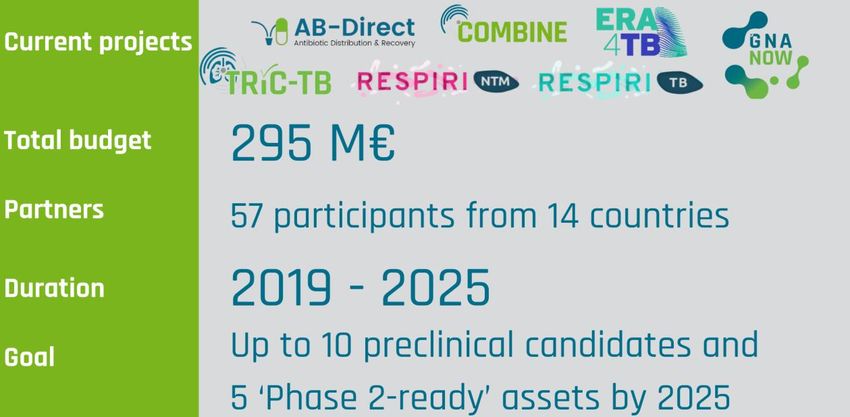
The AMR Accelerator Programme connects seven projects launched by the Innovative
Medicines Initiative (IMI) during 2019 and 2020. With more than 50 partners and 295 million
Euro of dedicated funding, the Programme is united by a common goal to develop new tools
and therapeutics to fight resistant pathogens. A wide-ranging series of antibacterial
programmes will advance the pipeline of antibiotics targeting Mycobacterium tuberculosis,
nontuberculous mycobacteria and Gram-negative bacteria. 2021 will be an exciting year with
the start of several First-In-Human studies, as well as the potential addition of two new
Accelerator projects.

The AMR Accelerator currently has seven projects: AB-Direct, COMBINE, ERA4TB, GNA NOW,
RespiriNTM, RespiriTB, and TRIC-TB. These public-private partnerships are funded by IMI with
matched in-kind contribution from EFPIA companies, and complement and build on the
capabilities of the IMI New Drugs for Bad Bugs (ND4BB) Programme. The AMR Accelerator will
address many of the scientific challenges of AMR.

www.amr-accelerator.eu
The AMR Accelerator Programme is composed of three Pillars:

   •   The Capability Building Network (COMBINE project) provides coordination and support
       across the Accelerator, in addition to its scientific goals to improve and standardise
       animal models used in AMR research, and optimise the design of clinical trials.
   •   The Tuberculosis Drug Development Network, encompassing the ERA4TB project, is
       working to accelerate the development of new treatment regimens for tuberculosis.
   •   The Portfolio Building Networks, integrating RespiriTB, RespiriNTM, TRIC-TB, GNA NOW,
       and AB-Direct projects, are set up to support collaborative efforts to discover and
       advance new antibacterial assets.

The recently published AMR Accelerator portfolio pipeline provides an overview of the 13
antibacterial programmes and where they stand in terms of novelty and development stage.
If successful, projects in the Accelerator are expected to deliver up to ten new preclinical
candidates and five ‘Phase 2-ready’ assets by 2025.

Ander Karlén, Professor at Uppsala University and COMBINE Coordinator: “It is very exciting to
see this large number of partners combining resources and experience to deliver these very
important goals”.

Concrete activities of the AMR Accelerator since start include:

   -   A virtual Cross-Pillar meeting, bringing together representatives from all projects to
       exchange information, explore synergies, and discuss challenges.
   -   A series of COMBINE webinars and the launch of an open call for preclinical and clinical
       data sets from the study of prevention or treatment of bacterial infections.
   -   Under the Respiri projects, nine research teams and Janssen Pharmaceutica have
       come together to search for new weapons in the fight against mycobacterial
       tuberculosis and non-tuberculous mycobacteria.
   -   Swiss pharmaceutical company, BioVersys, and GlaxoSmithKline (GSK) are co-leading
       the TRIC-TB project which kickstarted the development of a novel compound aimed at
       overcoming the resistance against ethionamide and prothionamide for the treatment
       of tuberculosis. The candidate has recently entered into Phase 1.
   -   In the two-year long AB-Direct project, GSK, together with project partners, initiated
       work on a programme investigating tissue distribution of gepotidacin, which will be
       investigating in a clinical Phase 1 study, sponsored by Inserm, to start early in 2021.
       Gepotidacin is currently in Phase 3 development by GSK as a potential treatment for
       uncomplicated urinary tract infection and uncomplicated gonorrhea.
   -   In the TB-dedicated network, the European Regimen Accelerator for Tuberculosis
       (ERA4TB) has already endorsed ten specific Asset Progression Plans for six different
       compounds which are in progress, two already in Phase 1 studies.
   -   In addition, the Gram-Negative Antibacterials NOW (GNA NOW) consortium successfully
       managed to keep on track its three programmes owned by the biotech companies
Evotec and Nosopharm in spite of the drug development challenges posed by the
COVID-19 pandemic.
Pierre Meulien, IMI Executive Director: “The AMR Accelerator shows how collaboration and
solidarity allow researchers to contribute to the elimination of antibiotic-resistant tuberculosis
and AMR. This is particularly important now, in the midst of the COVID-19 pandemic, as AMR
research is essential to reducing the burden of secondary bacterial infections in the future.”
About COMBINE
The COMBINE project was created to support the coordination of the AMR Accelerator projects and provide them with the
resources they need to achieve their goals. These include data management guidelines and an IT infrastructure to enable the
collection, aggregation, storage, sharing and analysis of datasets generated by AMR Accelerator projects. COMBINE is also
helping to ensure that data adheres to ‘FAIR’ principles, i.e. it is findable, accessible, interoperable, and re-useable. Promoting
communication among the projects is another COMBINE priority. On the scientific front, COMBINE is improving the animal
models used in AMR research and develop improved tools to reliably translate results in animals into results in humans. The
project is also optimising the design and analysis of clinical trials. These tools help all projects in the AMR Accelerator to
deliver results that will help to accelerate the development of novel antibiotics and vaccines against AMR.
For more information on COMBINE, please visit www.amr-accelerator.eu/project/combine.
About the AMR Accelerator
The aim of the Antimicrobial Resistance (AMR) Accelerator Programme is to progress the development of new medicines to
treat or even prevent resistant bacterial infections in Europe and worldwide. The programme comprises the following three
pillars: a Capability Building Network, a Tuberculosis Drug Development Network, and the Portfolio Building Networks.
The scope of the AMR Accelerator is broad; under one structure, it addresses many of the scientific challenges of AMR, and it
supports the development of new ways to prevent and treat AMR. More broadly, the AMR Accelerator contributes to the
European action plan on AMR.
For more information on the AMR Accelerator, please visit www.amr-accelerator.eu.
About the Innovative Medicine Initiative
The Innovative Medicines Initiative (IMI) is Europe’s largest public-private initiative aiming to speed up the development of
better and safer medicines for patients. IMI supports collaborative research projects and builds networks of industrial and
academic experts in order to boost pharmaceutical innovation in Europe. IMI is a joint undertaking between the European
Union and the European Federation of Pharmaceutical Industries and Associations, EFPIA.
For more information on IMI, please visit www.imi.europa.eu.
AMR Accelerator Participants
Asclepia Outsourcing Solutions Leiden University Medical Center
BEAM Alliance Lygature
Bill & Melinda Gates Foundation Medical University of Vienna
BIOASTER Mitologics
BIOCOM AG North Bristol NHS Trust
BioVersys Nosopharm
Centre Hospitalier Régional Universitaire de Tours Paul-Ehrlich-Institut
Centre Hospitalier Universitaire de Poitiers Public Health England
Clinical Studies Sweden Forum South QPS Netherlands
Consiglio Nazionale delle Richerche Research Center Borstel
Critical Path Institute Sciensano
École polytechnique fédérale de Lausanne Sorbonne University
Erasmus MC - University Medical Center Rotterdam Statens Serum Institut
Evotec Synapse Research Management Partners
FFUND BV TB AllianceFoundation Innovative Medicines for Tuberculosis The National Institute for Health and Care Excellence Fraunhofer IME Universidad Carlos III Madrid grit42 University Leiden GSK University of Antwerp Helmholtz Centre for Infection Research University of Copenhagen Helmholtz Institute for Pharmaceutical Research Saarland University of Dundee ImaBiotech University of Köln Infectious Diseases Models for Innovative Therapies University of Liverpool Inserm University of Padova Institute Pasteur University of Pavia Institute Pasteur de Lille Foundation University of Poitiers Instituto de Investigación Hospital Universitario La Paz University of Zaragoza Janssen Pharmaceutica Uppsala University Latvian Institute of Organic Synthesis Disclaimer This news update reflects the authors’ views and neither IMI nor the European Union, EFPIA or any Associated Partners are responsible for any use that may be made of the information contained herein. For more information Anders Karlén Clément Robijns COMBINE Project Coordinator COMBINE Communication Manager anders.karlen@ilk.uu.se; +46 18 471 4293 c.robijns@biocom.de; +49 30 2649 2158 The AMR Accelerator receives funding from the Innovative Medicines Initiative 2 Joint Undertaking under grant agreement No 853976 | 853967 | 853979 | 853932 | 853903 | 853800 | 853989. This Joint Undertaking receives support from the European Union's Horizon 2020 research and innovation programme and EFPIA. ERA4TB receives additional support from Global Alliance for TB Drug Development, Bill & Melinda Gates Foundation and University of Dundee.
You can also read


