STFC GLOBAL CHALLENGE NETWORK IN NUCLEAR SECURITY SCIENCE "NUSEC" - WWW.NUSEC.UK LEE THOMPSON - UNIVERSITY OF SHEFFIELD - SCIENCE AND TECHNOLOGY ...
←
→
Page content transcription
If your browser does not render page correctly, please read the page content below
STFC Global Challenge Network in
    Nuclear Security Science
            “NuSec”

                 www.nusec.uk

       Lee Thompson - University of Sheffield   !1
The Nuclear Security Sciences Network “NuSec”

    In 2016 we were awarded an STFC Global Challenge Network
    in Nuclear Security Sciences (NuSec)
    The network is led by the University of Surrey, and co-led by Dr. Neil Gaspar at
    AWE. (Note: this is a “Network”, not a “Network+” so no Champions, only part-
    time PM)
    The aims of the Network are to develop collaboration between the academic,
    industrial and defence sectors in the area of nuclear security
    1.     To encourage translational research and technology development, and to
           address end-user challenges related to nuclear security
    2.     To undertake challenge-led proof of concept and pilot studies,
           supported by AWE Pilot Study funding to the network.
    3.     To coordinate and support collaborations and bids for third party funding, eg.
           UK Research Councils, EU Horizon2020, CDE, InnovateUK, US DNDO/DTRA
           programs

Tuesday, 12 December 2017        Lee Thompson - University of Sheffield                     !2
How does the network operate?

    The network aims to promote collaboration and research, principally through
    technical meetings and information dissemination.

    Technology Workshops – encouraging translational R&D, focussed on specific
    technical themes, bringing together new research collaborations
    Challenge Meetings – focussed smaller meetings to develop cross-disciplinary
    solutions to address end-user challenges
    Student Pilot Projects – small student summer projects to encourage new
    collaborative research. Can be with either Universities or Industry.
    Personal Development Grants – for researchers who are either already active in
    nuclear security, or wanting to develop work in this area

Tuesday, 12 December 2017   Lee Thompson - University of Sheffield                   !3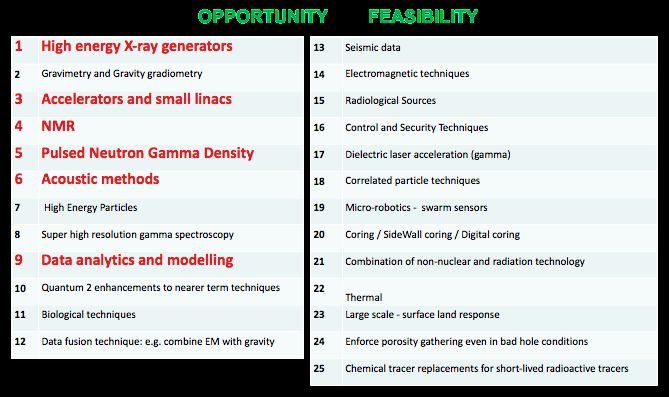
NuSec Network

We have regular workshops each focussed on a different technical area, with an annual NuSec Technical
Workshop:

• 2016 Workshop: Radioisotope detection and identification
• 2017 Workshop: Algorithms and Automated Decision Making
Algorithms for automated decision making; the interpretation and analysis of Complex Multiple Data Streams;
the practical implementation of decision making systems in the context of Border Protection and other scenarios.

• Proposed for 2019: End of Project Conference

Our aim is to encourage the collaborative development of Nuclear Security Science between academic,
industrial, and government stakeholders.
                                                               NuSec
Government is represented through the network’s                                              WPF
                                                                 Management group                       AWE
End User Panel, chaired by Neil Gaspar, AWE.
Representatives attend from Home Office, MOD,
                                                                 ~100 Academic members
Department of Transport, Department of Health.
                                                                 ~60 Industrial members         End User Panel
Jeremy Edwards (NNL) sits on the NuSec Management                                                ~12 members
Group as our Industrial Representative

Tuesday, 12 December 2017            Lee Thompson - University of Sheffield                                        !4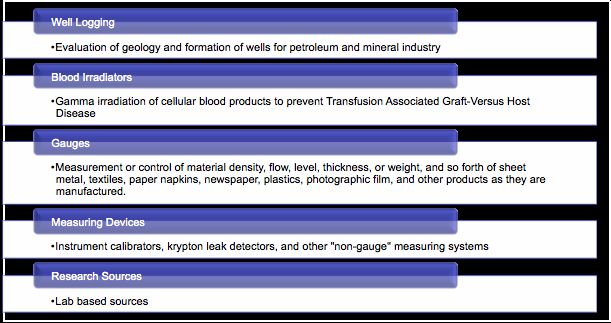
Challenge Meeting example - Well Logging Workshop

The Challenge:                                                            Can alternative methods
• Trafficking of illicit materials is a real, ongoing phenomenon
                                                                          and technologies be
• Terrorist groups have stated an ambition to acquire material
• Nuclear renaissance means more material available
                                                                          used to reduce the use of
                                                                          sources in well logging?
Principal industrial uses of radioactive materials:

                                 Lee Thompson - University of Sheffield
Challenge Meeting example - Well Logging Workshop
In order to address this particular challenge NuSec
organised a workshop in Cambridge which was attended
by representatives from industry (Shell, BP,
Schlumberger, Baker-Hughes, etc.) government
(including Home Office, MOD, NNSA) and academia
A morning of presentations (including Office for Security
and Counter Terrorism (UK), Office of Radiological
Security (US) plus industry) highlighting the challenge
and the need for alternatives
Government and industrial requirements were
considered (these do not always overlap!)
25 technologies were discussed considered on the day …
… of which a small number were shortlisted for further
consideration
Roadmaps put in place
40 page final report written
Lee Thompson - University of SheffieldChallenge Meeting example - Well Logging Workshop
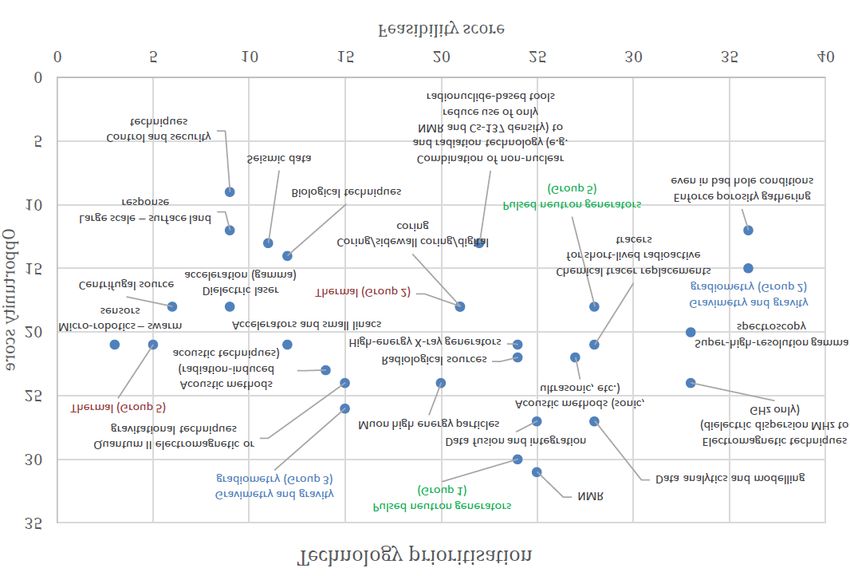
A long list of alternative methods and technologies were assessed for FEASIBILITY and
OPPORTUNITY
Lee Thompson - University of SheffieldChallenge Meeting example - Well Logging Workshop
Lee Thompson - University of SheffieldNuSec Pilot Projects
NuSec Pilot Projects
NuSec Pilot Projects are intended as summer student projects, to allow
researchers to undertake a pilot study or other exploratory work. The maximum
award value is £4k.
To date these pilot projects have all been carried out at Universities, but we
also welcome Industrial projects, or University-Company collaborations (one
instance of the the latter is supported in the 2018 pilot projects)
Pilot Projects
Project Author and University
Thallium Bromide sensors Nolan (Liverpool)
2016
Evidential Reasoning for Radiological Detection Walkinshaw (Leicester)
Colloid interaction with Muons Claiden (Liverpool)
Digital SiPMs for Spectroscopic Measurement Paschalis (York)
Passive radiation imaging Holman (Manchester)
Lee Thompson - University of Sheffield !9Project Author and University
Compact X-ray sources Murphy (York)
Enhancing source localisation for threat detection Vacheret (Imperial)
2017 PSA for temperature dependent scintillator signals Paschalis (York)
A Study of Van Allen Belt Signatures of Nuclear Weapon Tests for
Pilot Projects
Velthuis (Bristol)
Future CTBT Technologies
Fluorescence spectra of alpha emitting isotopes Gamage (Lancaster)
Project Author and University
Smith, Kokolova,
NESSY – A prototype Neutron Energy Spectrometer for Security
Wheldon (SHU, B’ham)
Measurement of anti-neutrino flux from nuclear reactors as a Cussans, Newbold
2018
method of verifying nuclear non-proliferation agreements (Bristol)
An investigation of glass Cherenkov detectors in a pulsed neutron
McMillan (Sheffield)
interrogation system
Development of Low-Cost Plastic Scintillation Materials for Thompson, Deakin
Enhanced Neutron Detection (Sheffield, LabLogic)
Develop a prototype “telescope”-style detector with a neutron
Taggart (Surrey)
detection capability for deployment as a portable neutron scannerNuSec Personal Development Grants
NuSec Personal Development grants provide up to £2k:
• To support researchers across a range of personal development activities
related to Nuclear Security Science
• To strengthen the research and innovation capacity of scientists in Nuclear
Security Science, and to develop new collaborations between researchers and
partner organisations
The scope of the Personal Development Grant is flexible, eg:
• Travel and subsistence costs for conferences, research collaborations,
industrial visits, networking
• Conference/event registration fees
Recipients are expected to report on their activities, as appropriate.
Lee Thompson - University of Sheffield !11Personal Development Grants in 2016/17
11 Awards totalling > £13,000 have been made to date to help Researchers
undertake training and support in Nuclear Security Science collaborations at
conferences in the USA & Europe including:-
• Waste Management Symposium, Phoenix (AZ, USA)
• 4 awards for ESARDA course on Nuclear Safeguards and Non Proliferation,
Ispra,
• Electromagnetic Non Destructive Evaluation (ENDE) conference, Saclay,
France
• 4 awards for IEEE Nuclear Science Symposium and Medical Imaging
Conference, Atlanta, Georgia
• Certified Nuclear Security Professional Course, World Institute for Nuclear
Security (WINS).
Lee Thompson - University of Sheffield !12NuSec Personal Development Grants
Eligibility
Applicants for Personal Development Gants:
• should be researchers based either at a University, Research Establishment or a
Company within the UK.
• are expected to either be active in the field of nuclear security, or wishing to apply
their expertise from other areas into nuclear security research.
• will normally only receive one award across the duration of the network.
Award Value
Grants will be awarded with a total project value of up to £2000.
50% matched funding will normally be required, ie. the maximum funding awarded will
be £1000.
However for Postgraduate Students and Postgraduate Researchers the matched funding
is not required, and the full project value up to £2000 will be funded.
Lee Thompson - University of Sheffield !13Conclusions
The STFC Nuclear Security (“NuSec”) network has a remit to develop
collaboration between the academic, industrial and defence sectors in the area
of nuclear security.
The network aims to promote collaboration and research, principally through
technical meetings and information dissemination and support a number of
activities including
• Technology workshops
• Challenge Meetings
• Student Pilot Projects
• Personal Development Grants
• (PDRA Support Grants)
• Further information: www.nusec.uk / info@nusec.uk
Lee Thompson - University of SheffieldReflections
(NB - a personal view)
The management structure is important: in our case we have a management board which meets ~3 pmes per
year and a separate end-user group (which meets less frequently). You need acpve, focussed individuals in
both bodies and good liaison between the two.
The composipon of the end-user group should reflect the areas where you think the challenges will come
from (for NuSec this is Home Office, MOD, Department of Transport, Department of Health) since they will
educate your acpvipes.
Successes: Challenge-led well-logging workshop
Weaknesses: how to fully engage the industrial sector (no take-up of summer studentships)
Less successful in our aim “to coordinate and support collaborapons and bids for third party funding”
Don’t be too ambipous in terms of the number of meepngs you can organise!
Previous 3 talks have given me some good ideas of acpvipes for a next-generapon NuSec!
GCRF (and ISCF) is a complex technology landscape, STFC-funded networks such as NuSec, can play an
important role in informing and supporpng the community (e.g. Pilot projects)
Lee Thompson - University of SheffieldYou can also read


