NEXT GENERATION (NG) ECALL VS LEGACY ECALL - PRINCIPLES AND DIFFERENCES - ETSI NG ECALL WEBINAR - MAR. 10, 2021 - ETSI DOCBOX
←
→
Page content transcription
If your browser does not render page correctly, please read the page content below

ETSI NG eCall Webinar - Mar. 10, 2021

      Next Generation (NG) eCall vs Legacy eCall
                     - Principles and Differences
                                         Dr. Ralf Weber

                                                     1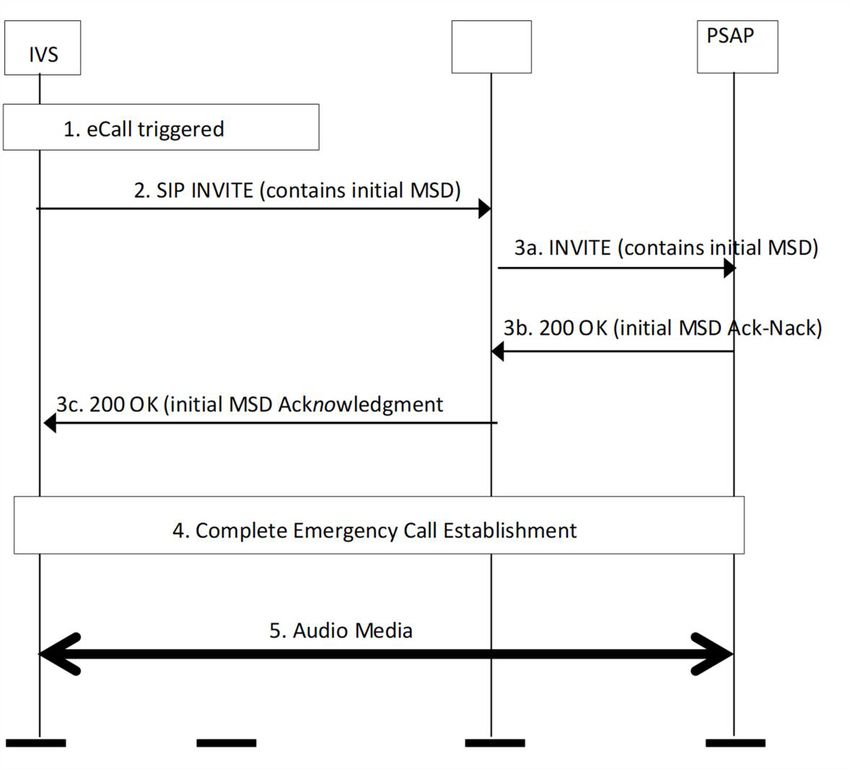
Introduction
  eCall standardisation began 2004
  − A GSM & UMTS world employing circuit switched (CS) networks
  − The chosen solution was in-band modem and CS 112 call
  − The in-band modem was optimised for GSM (2G) and UMTS (3G) – standard completed in 2008
  eCall for 4G (NG eCall) standardisation was started 2013 (completed 2017)
  −   There is no circuit switched domain in 4G/5G
  −   IMS emergency call will replace circuit switched emergency call
  −   Next generation (NG) eCall provides an extension to IMS emergency calls
  −   Support for 5G (NR) has since been added
  Deployment aspects
  −   Motor vehicles last longer than phones
  −   PSAPs investments must be protected
  −   GSM and UMTS spectrum is being re-farmed to 4G/5G
  −   4G coverage is better than 2G/3G in many regions
  −   5G is already being deployed in many regions                                            2
Operation of CS eCall (with Inband Modem)
                                                                                                                    PLMN
                                                                                                                Speech          Mobile
                                                                                                  Radio
                                                    In-Vehicle System (IVS)                                      Trans-        Switching
                                                                                                  Modem
                                                                                                                 coding         Center
                                                                                                  (BTS)
                                                   position data                                                (TRAU)          (MSC)
                                                                                     GPS
                                                                                    Receiver

                                 MSD              IVS
                             information          Data
                                source           modem                                                                             Digital Voice
                                                                          Speech     Radio                                         Transmission
                                                                          Codec      Modem
                                           Microphone &
                                                                                                                                      System
                                             Speakers
                                                                                                         PSTN/GSTN
                                                                   PCM (Signed 16bit, 8kHz)

                                                                                                   PCM
    The IVS instigates a 112 call (TS12) following an accident (sensor                         (G.711, A-Law,
    trigger) or user invocation                                                                 8bit, 8kHz)                PSAP
                                                                                                                            Data
                                                                                                                                            MSD

    The 112 call carries an automatic or manual eCall indication and
                                                                                                                                           Display
                                                                                                                           Modem

    can be routed by the serving PLMN to an eCall capable PSAP
    The PSAP and IVS use the inband modem to transfer the MSD                                                               Microphone &
                                                                                                                              Speakers

    over the voice path
                                                                                                                   Public-Safety Answering Point (PSAP)
    MSD transfer interrupts voice communication for around 4-10
    secs at the start of the eCall
                                                                                                                                                          3
In-band eCall Signals and Timings
time [s]
5 x START 3 x NACK ACK 5 x HL-ACK
PCM level
PSAP: OK, please
PSAP: OK, got it, lets speak
send your MSD
Downlink: IVS Rx
IVS initiation (up to 5 x SEND) MSD RV 0 MSD RV 1, ...
IVS: Hello IVS: Here is my MSD
I’m an eCall
Uplink: IVS Tx
UL sync
MSD HLACK
Δ ≈ 1.2s received received
Overhead for
Call 3GPP ‘Figure of Merit’ Total time for acknowledgements: Start of voice
IVS initiated signalling: (FoM): >≈ 1.4s, here 1.7s
CONNECT >≈ 2.0s, here 2.7s communication
0.8 – 2.0s, here 1.4s
MSD Transmission Time: here 2.9s
Mic and speaker muting period 4Operation of NG eCall for 4G (LTE)
Signaling Path
IMS
SGW
eNB PSAP
/PDG
Vehicle with IVS MGW
in accident
PLMN
Voice Path
The IVS instigates an emergency call over IMS following an accident or user invocation
The serving PLMN establishes a call to a PSAP with a SIP/IP signaling path through an IMS (pink arrow) and a
separate voice path (green arrow) for transfer of VoIP
If the PSAP uses CS access and not IP, an MGW transforms the VoIP into CS voice
The MSD is transferred in an SIP INVITE message sent to the PSAP over the signaling path
The voice path is not interrupted or affected by the MSD transfer
5G support is similar (e.g. a gNB replaces the eNB and a UPF replaces the SGW/PDG) 5Example: End to End SIP Call Flow for an IP capable PSAP
PLMN
MSD available
at call
CONNECT
Voice
communication
starts
immediately
6Comparison of NG eCall with CS eCall
Characteristic CS eCall NG eCall
Allowed Access Types GSM CS, UMTS CS 4G, 5G
Voice Path CS end to end VoIP end to end for IP capable PSAP
VoIP to MGW and then CS for legacy PSAP
Call Signaling SS7 ISUP SIP (IMS)
Initial MSD Transfer Inband over CS voice path Out of band SIP with IP capable PSAP
Inband over voice path with legacy CS PSAP
Updated MSD Transfer Supported via inband request/response Supported via SIP INFO request/response
Also supported inband for a legacy CS PSAP
Handover GSM/UMTS GSM/UMTS 4G/5G 4G/5G
4G/5G GSM/UMTS CS (one way only)
PLMN support Transparent to PLMN except for routing PLMN needs to support IMS emergency calls,
based on an eCall flag MSD transfer, updated MSD transfer and
routing based on an eCall service URN
PLMN support indication None SIB1 indicates PLMN/PSAP support for NG eCall
eCall only mode Supported Supported
7Co-existence of NG eCall and CS eCall
Vehicle Network PSAP
Circuit switched
In-band 2G / 3G
CS CS
CS CS
eCall eCall
In-band over VoIP
Packet switched
NG eCall 3G / 4G / 5G NG eCall
SIP
Only CS eCall supported in network or PSAP In-band over VoIP is only
NG eCall supported in network and PSAP
a solution of last resort
as performance cannot
No CS network available & no NG eCall support be guaranteed
8Phased Migration from CS eCall to NG eCall
We expect EU MNOs to phase out 2G/3G CS and shift spectrum to more spectral efficient
and higher bandwidth 4G and 5G
This can be accompanied by IVS migration to dual mode (supporting CS and NG eCall) and
PSAP migration from CS eCall to NG eCall through the following phases
− Phase 1 – predominantly CS eCall
− 4G coverage with PLMN support of NG eCall is zero or low, all PSAPs support CS eCall
− Phase 2 – mixed CS eCall and NG eCall
− 4G coverage with PLMN support of NG eCall is widespread, PSAPs support CS eCall and/or NG eCall
− Phase 3 – predominantly NG eCall with some CS fallback
− 4G/5G coverage with PLMN support of NG eCall is universal
− some PSAPs and/or IVS only support CS eCall
− Phase 4 – universal NG eCall
− IVS, PLMNs and PSAPs all support NG eCall
9CS and PS Domain Selection A IVS that supports NG eCall is also required to support CS eCall Hence an IVS supporting NG eCall will need to perform CS vs PS domain selection An NG eCall flag broadcast in an 4G or 5G cell (on SIB1) indicates whether NG eCall is supported in the cell A MNO can set the flag to indicate NG eCall support if: − The PLMN (or all PLMNs with 4G/5G RAN sharing) supports NG eCall − AND − At least one PSAP associated with (or reachable from) the cell is NG eCall capable Domain selection for eCall is performed based on this preference order: 1. 4G or 5G with NG eCall flag set 2. GSM or UMTS CS 3. 4G or 5G with normal IMS emergency call support but with the NG eCall flag not set • Note: − The IMS SIP protocol allows capable PSAPs to detect whether an IVS can use NG eCall or not 10
Conclusions
 IMS emergency call and NG eCall standards are ready
 − Provide robust and richer emergency services over PS networks
 − Framework that can easily be extended to provide value-added 3rd party services
 Network coverage depends on MNOs
 − MNOs are currently upgrading to packet-switched 4G/5G networks
 − 2G/3G networks are already or will be phased down in several regions/countries
 eCall service continuity needs to be maintained
 − Current EU regulation only provides 2G/3G as minimum requirement
 − Car manufactures are strongly advised to ensure that eCalls will be possible over the lifetime of a car by
   employing common best practice and state-of-the-art technologies
 − IVS deployment of NG eCall with in-band modem guarantees uninterrupted support of eCall for vehicle lifetime
 PSAPs need to make provisions now such that they can easily upgrade to IMS
 − NG eCall leverages commercial IP/SIP based protocols and equipment, reducing investment upgrade costs
   (especially when ISDN lines gets replaced by all-IP lines)
                                                                                                             11
Thank you
Follow us on:
For more information, visit us at:
www.qualcomm.com & www.qualcomm.com/blog
Nothing in these materials is an offer to sell any of the References in this presentation to “Qualcomm” may mean Qualcomm
components or devices referenced herein. Incorporated, Qualcomm Technologies, Inc., and/or other subsidiaries
or business units within the Qualcomm corporate structure, as
©2018-2021 Qualcomm Technologies, Inc. and/or its
applicable. Qualcomm Incorporated includes Qualcomm’s licensing
affiliated companies. All Rights Reserved.
business, QTL, and the vast majority of its patent portfolio. Qualcomm
Qualcomm is a trademark of Qualcomm Incorporated, Technologies, Inc., a wholly-owned subsidiary of Qualcomm
registered in the United States and other countries. Incorporated, operates, along with its subsidiaries, substantially all
Other products and brand names may be trademarks of Qualcomm’s engineering, research and development functions, and
or registered trademarks of their respective owners. substantially all of its product and services businesses, including its
semiconductor business, QCT.Abbreviations CS Circuit Switched NR New Radio EATF Emergency Access Transfer Function P-CSCF Proxy Call Session Control Function E-CSCF Emergency Call Session Control Function PDG Packet Data Network Gateway eNB evolved Node B (for LTE access) PLMN Public Land Mobile Network EPS Evolved Packet System PS Packet Switched gNB NR NodeB (for 5G NR access) PSAP Public-Safety Answering Point IAM Initial Address Message SGW Serving Gateway IMS IP Multimedia System SIB System Information Block IP-CAN IP-Connectivity Access Network SIP Session Initiation Protocol ISUP ISDN User Part UE User Equipment IVS In-vehicle system UPF User Plane Function MGCF Media Gateway Control Function URI Uniform Resource Identifier MGW Media Gateway URN Uniform Resource Name MNO Mobile Network Operator USIM Universal Subscriber Identity Module MSD Minimum Set of Data VoIP Voice over IP NG Next Generation 13
You can also read


