O7.1 Communication Plan - Education for zero energy Buildings using Building Information Modelling - BIMzeED
←
→
Page content transcription
If your browser does not render page correctly, please read the page content below
Education for zero energy
                         Buildings using Building
                           Information Modelling
                        Grant Agreement: 600946-EPP-1-2018-1-IE-EPPKA2-KA

O7.1 Communication Plan

 Issued by                  Architects’ Council of Europe
 Date:                      2019-03-12
 Version:                   V 0.1
 Report number              O-7.1
 Task number:               Task 7.1
 Status:                    Draft
 Dissemination level:       Confidential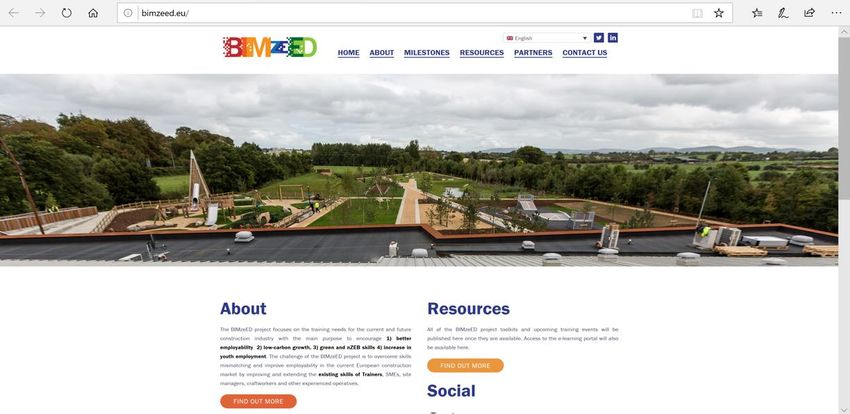
Education for zero energy Buildings
                                                                         using Building Information Modelling

   Document history
   V        Date                Organisation          Author                             Description
   0.1        2019/03/11        ACE                   Eleni Gkoni & Dr. Veronika         Initial version
                                                      Schröpfer
   1.0        2019/03/14        ACE                   Eleni Gkoni & Dr. Veronika         First version
                                                      Schröpfer                          submitted
   1.1        2019/04/01        LIT, UZ-FCE,          Elisabeth   O’Brien,   Dr.         Up-date,
                                ACE                   Bojan Milovancovis,    Dr.         comments
                                                      Veronika Schröpfer                 included

Approved on behalf of XXX as BIMzeED Lead WP
 Name:
 Organisation:
 Date:
 Signature:

Approved on behalf of LIT as BIMzeED Project Coordinator
 Name:
 Organisation:
 Date:
 Signature:

Disclaimer
The information in this document is provided as is and no guarantee or warranty is given that the information
is fit for any particular purpose. The user thereof uses the information at its sole risk and liability.

                                                                                                      P a g e |2
 BIMzeED– 600946-EPP-1-2018-1-IE-EPPKA2-KA
 O 7.2 Communication Plan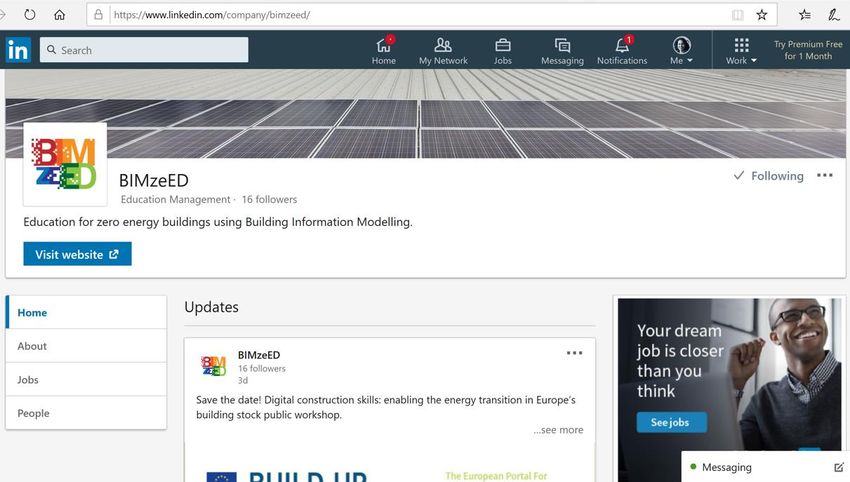
Education for zero energy Buildings
                                                                                                                              using Building Information Modelling

    The document reflects only the author’s views and the Community is not liable for any use that may be
    made of the information contained therein.

Table of contents

1         Executive summary ........................................................................................................................................................ 4
2         Communication and Dissemination Strategy ................................................................................................................. 5
3         Role of Consortium Partners .......................................................................................................................................... 7
4         Dissemination Content ................................................................................................................................................... 9
5         Target Groups and “Supportive” Key Stakeholders ..................................................................................................... 10
    5.1       Databases of major educational partners & training organisations and students .................................................. 16
6         Dissemination Channels ............................................................................................................................................... 18
7         Report on scheduled dissemination activities ............................................................................................................. 26
8         Appendices ................................................................................................................................................................... 27
    8.1       Corporate Visual Identity ......................................................................................................................................... 27
    8.2       Project Website........................................................................................................................................................ 28
    8.3       Social Media Outreach ............................................................................................................................................. 29
9         Conclusions................................................................................................................................................................... 30

                                                                                                                                                                           P a g e |3
      BIMzeED– 600946-EPP-1-2018-1-IE-EPPKA2-KA
      O 7.2 Communication Plan
Education for zero energy Buildings
                                                                           using Building Information Modelling

1   Executive summary

Effective Communication and Dissemination are the pillars of the BIMzeED approach in terms of reaching
different target groups in order to raise their awareness of new BIM and nZEB training opportunities and
initiatives. The Communication strategy differs for every category of identified stakeholders, while the
BIMzeED core message and project identity remain transversal to all communication and dissemination
activities.
The two main target groups in the project are the HEIs (higher education institutions), VETs (vocational
education training), i.e. educators and academics, along with students, apprentices and SMEs (site
managers, craft workers, senior operatives) being the direct beneficiaries, and policy makers, building
owners, industry providers being the indirect beneficiaries. The Communication Plan, apart from
incorporating different sectors of the construction and educational fields with experience in the areas of BIM
and nZEB, also addresses and involves “supportive“ stakeholders (members of EAB (External
Advisory Board), NSGs (National Steering Groups) and Associate Partners), that include policy makers,
local authorities, European and national construction federations and professional bodies, SMEs. These
stakeholders are expected to support the dissemination and the sustainability of the project even beyond
its lifetime.
This is the first Communication Plan (M4), outlining the overall strategy and planned activities for the
successful dissemination and communication of the project progress and results. As communication and
dissemination is a continuous process, activities will take place during all stages of the project and beyond
to ensure the sustainability of the outcomes. There is a strong link between the Dissemination and
Communication Plan and the Sustainability Plan O7.8. This document will be updated annualy throughout
the project duration with reports of the partners on their dissemination activities, new dissemination materials
and amendments to the strategy, if needed. At the end of the project all findings will be compiled in a final
report: O7.2 Dissemination Plan.
The current report aims to inform consortium partners of their expected contribution in all aspects of
Dissemination and Communication, and also to communicate to the EC the consortium’s strategy.
The Communication plan comprises:
1. Dissemination and Communication strategy, including communication levels (EU/National/Regional)
   and responsibilities/ roles attributed to each partner;
2. Activity plan per partner/ country;
3. The dissemination content;
4. List of target stakeholders to be addressed (inventory of key actors);
5. Dissemination channels: specifying the various tools that will be used to reach each target group;
6. Schedule and details of planned dissemination activities amongst partners, including a provisional list
   of events, conferences and fairs
7. Appendices:
    a) Corporate Identity
    b) Project Website
    c) Social Media Outreach

                                                                                                       P a g e |4
 BIMzeED– 600946-EPP-1-2018-1-IE-EPPKA2-KA
 O 7.2 Communication Plan
Education for zero energy Buildings
                                                                           using Building Information Modelling

2   Communication and Dissemination Strategy

The communication and dissemination strategy of BIMzeED, consists of a multi-layered approach to ensure
that the needs of all target groups are met and the sustainability of the project outcomes is established
beyond the project duration.
BIMzeED‘s dissemination and communication activities will be carried out in view of consolidating the
project‘s visibility among the identified target groups within the construction sector at regional, national, EU
level and beyond.
This communication plan foresees the design and implementation of different strategies, activities and
materials for raising (a) awareness and (b) understanding of new BIM and nZEB training opportunities and
initiatives, as well as for (c) involving stakeholders, hence enhancing the impact.
Dissemination activities stimulate further action are resulting from the adoption of outputs of the project
and will be targeted to key actors “influencing” and “bringing about change”, such as HEI and VET students
and training staff, and SMEs. The identified “supportive“ key stakeholders will be reached in order to be
involved and enhance the project impact.
Dissemination activities focusing on stimulating deeper understanding of the project outcomes, will
be addressed towards direct and indirect beneficiaries, internal and external partner organizations
(consulting and developing organisations/agencies public or private, policy makers, regional and local
authorities actors supporting BIM and nZEB).
Communication activities will be complementary to dissemination and are intended to raise awareness,
targeting media and public in order to promote BIMzeED’s objectives among communities in partner
countries and broader.
Clustering with other relevant European projects and cross-fertilization with other national and European
initiatives will also be promoted. Clustering activities especially with other EU projects such as NET-UBIEP,
VET4LEC, eCentral, BIMEET, iCARO and further BIM projects will be very important to strengthen impacts,
increase the outreach potential of the project concepts and raise awareness among different stakeholders
and eventually the public at large. Synergies can be found in joint exploitation of communication tools and
services including among others: web mutual link exchange, organisation of common events, common
outreach activities to local stakeholder groups, use of social media and exchange of best practices.
                                                                                                       P a g e |5
 BIMzeED– 600946-EPP-1-2018-1-IE-EPPKA2-KA
 O 7.2 Communication Plan
Education for zero energy Buildings
                                                                        using Building Information Modelling

In order to reach the identified target groups, BIMzeED will use a wide variety of online tools, offline
materials, articles, reports, presentations, networking, and events. The BIMzeED consortium will also build
on existing channels and networks.
The identified beneficiaries will be reached in several ways such as:
•   The project website and numerous links to it from other websites, including partners‘;
•   Promotional flyers, posters and brochures in four languages, project logo;
•   Bi-annual e-newsletter;
•   At least one national press release each year;
•   Establishing contacts with other HEIs and VETs offering related curricula; they will in turn reach their
    students/learners;
•   Training programmes presenting through workshops the learning units (LU), methodologies and the e-
    portal to be integrated in HEIs and VETs (two in each partner country)
•   Establishing contacts with SMEs, Networks, Associations in the field, in order to disseminate training in
    other countries (based on a database of major educational partners and organisations)
•   The digital community created by the active participation of the target groups and stakeholders, supported
    by construction networks; a key to connect knowledge and share experiences
•   The Erasmus+ project results dissemination platform;
•   Academic papers being submitted to relevant open access journals to show case the research and
    outcomes from the project.
•   The final conference at EU level, gathering all categories of target groups
•   To maximise dissemination, BIMzeED will exploit extensive networks, events, journals, professional
    bodies, centres of excellence and affiliated associations. Associated partners will be key to support the
    communication and dissemination of BIMzeED results.

                                                                                                    P a g e |6
 BIMzeED– 600946-EPP-1-2018-1-IE-EPPKA2-KA
 O 7.2 Communication Plan
Education for zero energy Buildings
                                                                            using Building Information Modelling

3   Role of Consortium Partners

All BIMzeED partners will have a major role for providing input and insights, supporting the dissemination
of the project‘s results, participating in the project‘s communication tools and activities and making the most
of their own dissemination networks and collaborations.
LIT : Being the project coordinator, the main role of LIT is to assure that the dissemination and
communication activities and materials are fully aligned with the project‘s objectives, and to review the
sustainability and exploitation plans. LIT will assist with the preparation of toolkits for educators and students
on the E-learning portal and will assist in the final conference organisation and implementation. LIT as a
HEI is responsible for submitting a minimum of two EU journal papers in open access during the lifetime of
the project
ACE: The ACE is in charge of coordinating all dissemination and communication activites and is responsible
for preparing the Sustainability Plan and final dissemination report. Its‘ contribution is particularly important
due to its interactions with EU bodies and professional representatives both at EU and national levels. It is
also responsible for the development of the bi-annual e-newsletters (in English), with the input from all
partners. The ACE will establish a Youtube channel to store and promote promotional and training videos.
Finally, the ACE will develop a database of major educational partners and relevant organisations with the
input and support from all consortium partners.
TEA: TEA is responsible for producing the exploitation plan and is also assigned with the task of reviewing
the sustainability plan and preparing the toolkits for educators and students on the E-learning portal with
LIT. TEA is also in charge of setting-up the project website and maintaining it for two years after the project‘s
end. TEA will establish the Social Media Platforms to promote the project. LIT, along with TEA are expected
to promote outputs of BIMzeED in Ireland, participating in events organised by the construction federation
and the Construction Industry Register.
UZ-FCE: UZ-FCE as a HEI is responsible for submitting a minimum of two EU journal papers in open access
during the lifetime of the project. They are also expected to contribute to the translation of the produced
dissemination materials into Croatian.
REGEA: Main expected contribution is increasing visibility of the project through participating in
dissemination activities and organise events. REGEA will support the translation of dissemination material
into Croatian.
OE: Apart from contributing to the dissemination activities of the project, OE will provide the necessary
translations into Hungarian. OE as a HEI is responsible for submitting a minimum of two EU journal papers
in open access during the lifetime of the project.
EMI: EMI is expected to work closely with ACE to outreach to the appropriate audience and achieve training
targets set out for the Pilot Training (Task 5.3). EMI will support the translation of dissemination material
into Hungarian.
CIM-UPC: The main expected contribution is increasing visibility, involving stakeholders and organizing
events. CIM-UPC will provide the Spanish translations of the dissemination materials.
IteC: Apart from contributing to the dissemination activities of the project, IteC will use BIM and infographics
to design e-flyers, e-posters and e-brochures to printable quality.
                                                                                                         P a g e |7
 BIMzeED– 600946-EPP-1-2018-1-IE-EPPKA2-KA
 O 7.2 Communication Plan
Education for zero energy Buildings
using Building Information Modelling
All partners are responsible for delivering one article per year promoting the project. Such articles can be
via Blogs or Vlogs, Press Releases, articles in relevant newsletters. It is expected from all partners to identify
and liaise with local and regional interested parties, and share experiences, methodologies and results, but
also to engage them in the project planning, implementation and evaluation, cultivating a permanent
cooperation for the use of project products in the future.
P a g e |8
BIMzeED– 600946-EPP-1-2018-1-IE-EPPKA2-KA
O 7.2 Communication PlanEducation for zero energy Buildings
using Building Information Modelling
4 Dissemination Content
BIMzeED aims to improve the human-capital basis of the construction sector, acting on HEIs and VET
systems in Europe. The BIMzeED project focuses on the training needs for the current and future
construction industry with the main purpose to encourage
1) better employability
2) low-carbon growth
3) green and nZEB skills
4) increase in youth employment
The challenge of the BIMzeED project is to overcome skills‘ mismatching and improve employability in the
current European construction market by improving and extending the existing skills of trainers, SMEs, site
managers, craftworkers and other experienced operatives.
The objectives of BIMzeED are:
• To identify the knowledge and skills gap in BIM and nZEB within the HEI and construction sector for
each partner country.
• To update the knowledge and skills of educators and trainers and SMEs in the field of BIM and nZEB
through provision of specific new innovation educational materials.
• To stimulate development of new training and education programmes/modules in the fields of
BIM/nZEB, which can be integrated into existing HEI programme delivery.
• To transfer knowledge of BIM and nZEB to and from other countries.
• To strengthen links between lecturers, industry and SMEs with innovative technologies and installations
creating connected learning communities (viewing case studies, on-site site visits, industry
demonstrations).
• To strengthen employability in teaching and SMEs, known as business development cooperation
Therefore the BIMzeED project supports the construction industry, through education and training to upskill
on technical innovation and digitalization. In this context, BIMzeED will:
• Develop and pilot 12-16 Learning Units (LU) acknowledging the gaps in BIM and nZEB training
programmes across Europe targeting the four countries: Ireland, Spain, Hungary, Croatia and the EU.
The aim will be to increase understanding of BIM/nZEB within existing construction training curricula,
thus capitalizing on the opportunities that environmental protection can offer to the labour force.
• Train and up-skill 120 educators at European HEIs and VETs by piloting the new learning resources
and training materials, which will be made available as transferrable Learning Units.
• Pilot the Learning Units with 400-500 construction/ architecture students, site managers, craftworkers
and other experienced operatives therefore improving their employability.
• Work with over 20 various professionals, SMEs, Industry, product and technology providers, R&D and
policy makers across Europe to support a profitable and low carbon future.
By working with SMEs to tackle skills mismatches and promote excellence in skills development, BIMzeED
is in line with the “renewed EU agenda for higher education” (Education and Training 2020 strategy ET2020)
and also ensures that SMEs are not left behind in this fast-developing industry.
P a g e |9
BIMzeED– 600946-EPP-1-2018-1-IE-EPPKA2-KA
O 7.2 Communication PlanEducation for zero energy Buildings
using Building Information Modelling
5 Target Groups and “Supportive” Key Stakeholders
BIMzeED will directly upskill existing educators in the HEI and VET systems, but it will also target existing
construction students, site managers, craftworkers and other experienced operatives. The targeted direct and
indirect stakeholders include: pivotal policy makers in the educational and construction chains, academics,
staff and students in the HEIs and VETs, various professionals (technologists, engineers, architects), SMEs
and employees, product and technology providers, R&D and large building owners.
Also addressed and involved early on in the project are identified “supportive“ key stakeholders (members
of EAB, NSGs and Associate Partners), that include policy makers, local authorities, European and national
construction federations, SMEs, industry providers, professional bodies, educational and training providers,
as well as experts in the fields of BIM and nZEB. These stakeholders are expected to support the
dissemination and the sustainability of the project even beyond its lifetime.
In order to establish contacts with other training partners and relevant organizations, a database of major
educational partners and relevant organisations will be developed by ACE, with the support and input from
all partners. This will be utilised to disseminate information and support exploitation and will be updated on
an annual basis (T7.1).
P a g e | 10
BIMzeED– 600946-EPP-1-2018-1-IE-EPPKA2-KA
O 7.2 Communication PlanEducation for zero energy Buildings
using Building Information Modelling
Table 1: Target groups to be reached through the project partners and key stakeholders
Target Group Targeted Impact Communication Level
Means
Direct Raise awareness, All members of the National (through the HEIs
beneficiaries: Stimulate deeper consortium and NSGs consortium members, HEIs
HEIs lecturers, understanding of the to make use of their associated parnters and key
HEIs academic project outcomes, networks to reach other stakeholders), European
managers, VETs Stimulate further action/ HEIs, VET/ training through the ACE
trainers impact: Train and up-skill providers throughout
with innovative methods, the EU taking
delivery and knowledge of advantage of the
BIM and nZEB database of major
educational partners
Direct Raise Awareness, Through HEIs and VET/ National (through the HEIs
beneficiaries: Stimulate deeper training providers, consortium members and
apprentices and understanding of the resulting from the HEIs associated parnters),
students project outcomes, adoption of the LUs. European through the ACE
Stimulate further Outputs of BIMzeED
action/impact, receive promoted by all
training partners
Direct Raise Awareness, Through Industry National (through the SME
beneficiaries: Stimulate deeper associations & sector consortium members and
SMEs and understanding of the organisations involved NSGs), European through
employees project outcomes, in the consortium ACE and FIEC, as an
Stimulate further associated partner
action/impact
Indirect Raise Awareness, Implications of long- National through NSGs and
beneficiaries: Stimulate deeper term impacts of the Associated partners,
Policy makers understanding of the BIMzeED training and European through ACE
project outcomes, such as approach to be brought
skill gaps and new training to the attention of policy
makers and public
authorities in partner
countries through all
consortium partners,
NSGs, Associated
partners
Indirect Raise Awareness, Outreach through National through partners
beneficiaries: Stimulate deeper partners‘ networks, and NSGs, EU level through
Building owners understanding of the Housing Agencies and ACE‘s network (to UIPI)
project outcomes Local Authorities within
NSGs
Indirect Raise Awareness, Through partners‘ National through NSGs and
beneficiaries: Stimulate deeper networks and Industry Associated partners,
Industry understanding of the representatives within European through FIEC
providers project outcomes NSGs and Associate
Partners
P a g e | 11
BIMzeED– 600946-EPP-1-2018-1-IE-EPPKA2-KA
O 7.2 Communication PlanEducation for zero energy Buildings
using Building Information Modelling
“Supportive“ Key stakeholders:
30 supportive stakeholders, apart of the NSGs and EAB, will play an important role in the dissemination of
the project outcomes. Among them are policy makers, local authorities, European and national construction
federations, SMEs, industry providers, professional bodies, educational and training providers, as well as
experts in the fields of BIM and nZEB.
These supportive key stakeholders, apart from advising BIMzeED, will be proactive in communicating
project outcomes to their contacts, disseminating and promoting the trainings at EU and national levels.
• FIEC, representing 29 member organisations, will dissemminate the information and trainings across
Europe.
• 3 Local Authorities and 3 Housing Agencies will communicate the outcomes to their networks and
contacts.
• 4 Industry providers (among which Saint Gobain) will outreach at EU level
• 4 Professional bodies to contribute in dissemination activities.
The outcomes of the work of NSG and EAB will be integrated into the ongoing communication activities and
will serve as focal points of interactions with the media.
National Steering Groups: Key stakeholders and relevant organisations will be involved to form National
Steering Groups in each partner country: experts, policy makers, industry partners and other relevant
organisations. The NSGs will meet in M6, M17 and M30 in each country, in order to advise and review the
trainings and disseminate relevant information (members to be identified). In M6 all partners will hold a
national NSG workshop in which skills shortages, gaps, mismatches and barriers in the
construction sector, in particular within SMEs, will be analysed and outcomes of skill needs and
future challenges will be established.
Expert Advisory Board: 10-12 experts and representatives from across the EU will form the Executive
Advisory Board (Table 2). A first list has been compiled at the beginning of the project, which will be up-
dated along the process, according on availability and expertise required.
Associate Partners: The Associate Partners will be supporting the dissemination and sustainability of
BIMzeED. They will be also part of the NSGs and the EAB. Among them are policy makers, Local
Authorities, European and national construction federations, SMEs, industry providers, professional bodies,
educational and training providers as well as experts in the fields of BIM and Nzeb. They are also potential
stakeholders, multipliers and opinion leaders, also proactive in dissemination across the EU. (Table 3)
P a g e | 12
BIMzeED– 600946-EPP-1-2018-1-IE-EPPKA2-KA
O 7.2 Communication PlanEducation for zero energy Buildings
using Building Information Modelling
Table 2: Identified Members of the Expert Advisory Board
Name & Additional Contact of
Country Description
No Organisation Information partner
https://www.ace-
Chair or member of ACE cae.eu/practice-of-
EU
1 tbd ACE
BIM working Group the-profession/work-
groups/
Professor https://www.rehva.e
Timo u/fileadmin/REHVA_
Coordinator BIMSPEED
Germany
Hartmann, Journal/REHVA_Jo
project
2 Civil urnal_2018/RJ5/20- ACE
Professor for Civil
Engineering 22/20-
Systems Engineering
Institute 22_RJ1805_WEB.p
TU Berlin df
http://www.bimplem
ent-
Poland
Piotr BIMplement project project.eu/about-
3 Dymarski, partner, EC project bimplement/objectiv ACE
Mostostal reviewer expert es/
https://www.mostost
al.waw.pl
Dr Henry
PhD, Dipl. -Ing., PGcert
Abanda
(Distinction) BSc (Hons),
Fonbeyin,
CEng MEEC MIET
School of the https://www.brookes
FHEA
Built .ac.uk/templates/pa
UK
4 Senior Lecturer ACE
Environment ges/staff.aspx?uid=
School of the Built
Faculty of p0075437
Environment
Technology,
Oxford Brookes
Design and
University
Environment
country of
ACE Member
https://www.ace-
Specific
interest
Organisation in a
5 tbd cae.eu/about- ACE
specific country of your
us/ace-members/
interest
https://www.fgg.uni-
prof. dr. Žiga
lj.si/seznam-
SI
6 Turk, univ. - LIT
zaposlenih/ziga-
dipl. inž. grad.
turk/
prof.dr.sc. Zlata
Dolaček Alduk is
teaching BIM and
prof.dr.sc.
energy efficiency in the
HR
7 Zlata Dolaček REGEA
course "Integrated
Alduk
design" at the
Universyty J.J.
Strossmay, Croatia
P a g e | 13
BIMzeED– 600946-EPP-1-2018-1-IE-EPPKA2-KA
O 7.2 Communication PlanEducation for zero energy Buildings
using Building Information Modelling
Iva Kovacic is Associate
Professor and Head of
Research Group for
Integrated Planning at
Associate
the Department for
Prof. Dipl.-Ing.
HR
8 Industrial Building and UZ-FCE
Dr.techn. Iva
interdisciplinary
Kovacic
Planning at the Faculty
of Civil Engineering,
Vienna University of
Technology.
9 Adam Chair of the EU BIM
EU
ACE
Matthews Task Group
UK
10 Adam Burd BSi LIT
11
12
Table 3: Associated Partners
Associated
No Country Description Expertise
Partners
1 National Standards
Public National Authority on standards and Standards
Authority of Ireland
certification nZEB/BIM
(NSAI)
2 Engineers Ireland National organisation promoting, supporting
nZEB/BIM
(EI) and regulating the built environment
3 Royal Institute of National organisation promoting, supporting
the Architects of and regulating the built environment for nZEB/BIM
Ireland (RIAI) architects.
4 Department of Government Department for the
Housing Planning development of policies and standards in
Standards and
and Local relation to nZEB and construction in Ireland
nZEB
Government
IRELAND
(DHLG)
5 Department of
Business Enterprise Government Department for Training, Skills, Education and
and Innovation Innovation, Research and Development Training
(DBEI)
6 Construction
Federation for the Construction Industry and
Industry Federation nZEB/BIM
SMEs
(CIF)
7 Saint-Gobain Industry
Construction Construction Products Industry Providers
Products (SGC) nZEB
8 Construction
Information
Industry Nationwide Organisation BIM
Technology Alliance
(CITA)
P a g e | 14
BIMzeED– 600946-EPP-1-2018-1-IE-EPPKA2-KA
O 7.2 Communication PlanEducation for zero energy Buildings
using Building Information Modelling
9 UK British Standards
Development of Standards BIM
Institute (BSI)
10 HEP ESCO d.o.o
Energy Consulting Agency in Zagreb nZEB
(HEP)
11 Professional Federation representing the
National Federation
interest of 190 Hungarian building
of Hungarian nZEB
contractors, SMEs at national and
Contractors (NFHC)
international level.
12 The largest national adult education
professional organization of 198 businesses,
Association of Adult schools, universities and non-profit
Education and
Education Providers organizations supporting quality assurance
Training
(AAEP) and consumer protection efforts. They are
organisers of the annual National Adult
HUNGARY
Education Conference.
13 National Federation
of Housing
Public Buildings and Authorities nZEB
Cooperatives
Hungary-(NFHC)
14 MAPASZ oversees construction, operation
Hungarian Passive and assessment of innovative buildings
House Association (energy-efficiency, environmental friendly nZEB
(HPHA) with high comfort level); issuing MAPASZ
Superior certificate for advisors.
15 Hungarian
National Umbrella Association for
Coordinating
associations, foundations, university Education and
Association of
faculties and VET related organisations in Training
Building
the field of building engineering services
Engineering (HCA)
16 Housing Agency
Large Housing Agency nZEB
Catalonya (HAC)
17 Private company creating information
Modelical
solutions for the AEC sector: digital
Consultoria S.L.
workflows and tools with BIM to provide BIM
SPAIN
(MCSL)
quality design, build and operation for a
better built environment.
18 College of Technical
Architects and
Professional Association of Building
Building Engineers BIM
Engineers
of Barcelona
(CTABEB)
19
EUROPE
European
Construction European Construction Industry Federation Industry
Industry Federation Network of 29 national federations. nZEB/BIM
(FIEC)
20 Development and financing energy
TI
O
C
R
A
A
HEP Esco (HEP) nZEB
efficiency projects
P a g e | 15
BIMzeED– 600946-EPP-1-2018-1-IE-EPPKA2-KA
O 7.2 Communication PlanEducation for zero energy Buildings
using Building Information Modelling
21 Industry
Planetaris (PLN) Design company
Providers
22 Faculty of Civil
Engineering, Josip
Higher Education Institution, faculty under a Education and
Juraj Strossmayer
public university Training
University of Osijek
(FCE)
23 School of Buildings Education and
Education Institution VET
and Crafts (SBC) Training
24 The Croatian
Industry
Chamber of Industry Representation.
Support
Commerce (CCC)
25 Industry
Keindlbau (KNB) Design Company
Providers
26 Karlovac County Building
Local Authority
(KVC) Owners
27 Zagreb County Building
Local Authority
(ZGC) Owners
28 Krapina-Zagorje Building
Local Authority
County (KZC) Owners
29 Croatian
Association of
Members of HUPFAS are a network of 15
Facade Thermal Industry
companies, who are producers of facade
Insulation System Providers
components and/or systems
Manufacturers
(HUPFAS)
30 Industry
Baumit d.o.o. (BAU) Design Company
Providers
5.1 Databases of major educational partners & training organisations and
students
Successful implementation of piloting and evaluation of trainings requires outreaching to the appropriate
audience (30 educators within HEIs and VETs per country, 120 in total). It is critical that a suitable number
of educators, who provide training in a number of construction related areas participate, thereby ensuring
that the resources developed have a wide application. The selection of educators will be based upon specific
criteria according to the content, the national context and the desired educators’ profile and it will be done
at least two months prior to the commencement of the piloting, under EMI leadership.
The outreach to the construction industry conducted in WP2 and WP7 will form the database for possible
students for Target Group 2. BIMzeED will aim to train between 400-500 construction workers and students
in the construction industry including apprentices.
In each country these will comprise of:
• 40 students (targeting students in 3 different existing courses in HEIs)
• 20 apprentices (targeting existing apprentices across VETs and HEIs)
P a g e | 16
BIMzeED– 600946-EPP-1-2018-1-IE-EPPKA2-KA
O 7.2 Communication PlanEducation for zero energy Buildings
using Building Information Modelling
• 40 workers in SMEs (target SMEs to carry out 3/4 workshops nationally)
P a g e | 17
BIMzeED– 600946-EPP-1-2018-1-IE-EPPKA2-KA
O 7.2 Communication PlanEducation for zero energy Buildings
using Building Information Modelling
6 Dissemination Channels
Various dissemination activities ensure a good visibility of the project towards the identified target groups
and general public. These are based on a Dissemination and Communication strategy tailored to the various
needs and expectations of the target groups. Ways of contacting actors differ in three main respects:
• Type of link established with each actor (from being informed to being involved);
• The number of actors being reached;
• The effectiveness in getting the outcomes of the project understood.
In order to maximise impact, the project first developed a visual design and corporate ‘brand’ identity
including a project logo, giving the project an image, recognition and impact. The above are to be used in
templates for tools, presentations, newsletters, and a website eye-catcher. Full consideration to graphical
guidelines of the EC Erasmus + were given.
BIMzeED website is a key tool for the project in providing access to information and resources from the
project. It is structured around the relevant target groups i.e. HEIs, VETs, Students, SMEs etc to allow users
to get direct access to the specific information they require. http://www.bimzeed.eu
Social Media activities will focus on a number of key platforms that are relevant to enterprise and
academia, i.e. LinkedIn, Twitter. All Social Media Platforms will be integrated and promoted using tracking
analytics utilizing key hashtags e.g. #BIM #nZEB #LowEnergy, etc. The Social Media Platforms will
commence following a large selection of relevant players in the construction market and also expert leaders
in the field. These will be used as both multipliers of information provided by the project but also as
information feeds into the project. Already collectively, the consortium has a total of 55,840 FB Followers,
13,205 Twitter followers and 28,228 LinkedIn followers, not including own personal individual contributions
(Table 4). The project outputs and results will also be transferred and multiplied through the partners’ own
dissemination channels.
Traditional promotion resources will also be used to support the project e.g. E-newsletters, brochures
and posters. Each partner will be provided with some standard materials e.g. PowerPoint presentations (10-
12 slides, to be updated annually) which they will use to promote and disseminate the work of the project
within their own countries and networks.
Publications, presentations and workshops
Academic papers will be submitted to relevant journals to showcase the research and outcomes from the
project. From M18 to M30, Train the Trainer and Training programmes will be implemented in each country.
The workshops will present the learning units, methodologies and portal and dissemination materials. All
partners will take every opportunity to promote the project through other events.
Final conference
The project will host a major European conference, if possible, side by side with e.g. the BIM Summit or the
European Education Summit, at the end of the project to promote and make available the outputs and results
from the project. This event, to be organised by LIT and ACE, will target European participants and will also
aim to record keynote presentations from relevant partners to be made available on the project website
afterwards.
P a g e | 18
BIMzeED– 600946-EPP-1-2018-1-IE-EPPKA2-KA
O 7.2 Communication PlanEducation for zero energy Buildings
using Building Information Modelling
Other EU projects being carried out by BIMzeED partners will also disseminate and discuss the results
and outcomes of this project. These include:
• VET4LEC, which identifies the issues that arise in low energy construction in Europe looking at the
industry labour market, VET system and on-site practices.
• BIMEET, harmonises energy related BIM qualification and skills frameworks available across Europe
with a view to reach a global consensus through a “BIM for energy efficiency” expert panel. This project will
assist greatly with the dissemination aspects of the learning units and integration into the adapted BIMEET
business models to ensure the sustainability of BIM-EQF trainings.
• Other EU projects such as iCARO, BIMcert, NET-UBIEP, Fit-to-nZEB, PROF/TRAC, RenoZEB,
TripleA-reno, BIMSpeed, BIM4EEB and BIMplement will disseminate common results and
recommendations.
Table 4: Dissemination channels overview
Communication Activity and content Targeted audience Coverage and update
channel
Public and Collect all relevant Academia and Trainers Online from M4 until 2
project websites news, results, (HEIs, VETs) Policy years after project’s
documents, and events makers; Education and completion; Regular
to disseminate openly. training institutions; updates (quarterly) of the
Explain and promote Research Community; public website; daily use
BIMzeED project SMEs , Wider public/ of the project website by
objectives and identified target groups; for the consortium. Input from
disseminate information project website: restricted all partners
by making the access area of the website
deliverables available for the consortium.
(public website); Events,
News and Updates
section. Access E-
learning portal;
collaboration workplace
for the consortium.
Social Media LinkedIn Groups, HEI & VET networks; All partners to be given
Twitter, etc. connected academic and student support to utilise these
to the public and project networks, Research platforms
website, websites of Institutes, SMEs, NGOs;
partners. platforms for knowledge
exchange; industry
providers, general public
P a g e | 19
BIMzeED– 600946-EPP-1-2018-1-IE-EPPKA2-KA
O 7.2 Communication PlanEducation for zero energy Buildings
using Building Information Modelling
Promotional Digital Newsletters/ e- Distribute to key market E-newsletters every 6
and flyers (for training actors (namely months (2 special editions
dissemination promotion), e-posters, organisations HEIs, VETs of the e-newsletters will
material and e-brochures, press and private, academics, be dedicated to main
releases, training and architects, engineers, project achievements and
promotional videos. building managers, SMEs, the pilot trainings).
industry players, project brochures, 1
distributors of nZEB- poster; 1 article per year
compatible technologies, per partner, 1 press
products and materials release per country per
providers) and generally year, Input and
interested public. distribution by all
partners.
Reports/ Toolkits providing basic Toolkit for Educators and 2 editions of each toolkit,
Educational guidelines to use the E- Toolkit for Students towards the end of the
material learning portal and project, to be published
access information of on the website, available
the project results. in 4 languages
Publications, Research papers, National, EU and HEIs are responsible for
presentations conference papers, and international academic and min 2 EU journal papers
and workshops presentations; Train the professional communities. during the project’s
Trainer workshops, Final conference to target duration. Targeted at
Training programmes EU participants. specific and relevant
workshops, Major final journals e.g Energy and
conference. Buildings Journal or
National educational
journals. 1 national paper
to be produced during
each year of the project.
Table 5: Partners‘ own dissemination channels
Partner Websites Other links
@LimerickIT
Limerick Partners
www.lit.ie @LimerickIT @A2pbeer
LIT Institute of Steering Groups
http://flexiblelearning.lit.ie @freed LimerickIT
Technology EU projects
@train2nzeb
23,324
5487 followers 20,864 followers (in total) 1,133 subscribers
followers
Tipperary Partners
www.tippenergy.ie
TEA @Tippenergy @TipperaryEnergyAgency Energy Steering Groups
Tippenergy
Agency EU projects
1380
2,542 followers 1694 followers 71 followers
followers
@UniZg Partners, steering
@fit2nzeb Bojan groups EU projects
UZ-FCE http://www.grad.unizg.hr/ - -
@netubiephr Milovanović Fit-to-nZEB; Net-
Ubiep
507
- 10,784 Followers (in total) -
Followers
@regeaSZhr North West Partners
REGEA www.regea.org @RegeaAgency
Croatia Steering Groups
P a g e | 20
BIMzeED– 600946-EPP-1-2018-1-IE-EPPKA2-KA
O 7.2 Communication PlanEducation for zero energy Buildings
using Building Information Modelling
Regional EU projects
Energy RegeaChannel
Agency
(REGEA)
201 followers 2 204 followers 79 followers 11 subscribers
Partners
EMI http://www.emi.hu - @EMI - - Steering Groups
EU projects
- 373 followers - -
Óbudai
Partners
Egyetem -
ÓE www.uni-obuda.hu @uni_obuda @ObudaiEgyetem Steering Groups
University
Óbudai Egyetem EU projects
Óbuda
332 followers 8303 followers
ITeC –
Institut de
Partners
Tecnologia
ITeC https://en.itec.cat/ @ITeC_es @ITeC_cat Steering Groups
de la
EU projects
Construcció ITeC
de Catalunya
2131
2275 followers 284 followers 84 subscribers
followers
Partners
CIM-
www.fundaciocim.org @cim_upc @cimupc - Steering Groups
UPC
EU projects
1432 followers 7977 followers - 155 subscribers
Architects' Partners
Architects’
www.ace-cae.eu Council of EU Steering
ACE @Ace_Cae @ArchitectsEU Council of
Europe Committees
EUrope
(ACE-CAE) EU projects
780
900 followers 3700 followers 1300 followers
followers
The following Table 6 elaborates on each dissemination channel in detail.
Table 6: Dissemination activities and target groups
Type of Type of Channels Number Indicators Contents
dissemination audience
Proactive General Through newsletters every 6 500 people Project
Communicati six months ( four progress,
on languages), one-to-one events and
communication, emailing relevant news
and invitation to events to
relevant stakeholders and
the European
Commission.
Social media General BIMzeED LinkedIn group, 800 people Project
Facebook and Twitter, plus progress,
social media run by events,
partners. relevant news,
interaction
with public
Videos General BIMzeED YouTube 1 800 views Trainings/
channel webinars, info
P a g e | 21
BIMzeED– 600946-EPP-1-2018-1-IE-EPPKA2-KA
O 7.2 Communication PlanEducation for zero energy Buildings
using Building Information Modelling
Dedicated General BIMzeED website: 1 (5 years 4000 visits BIMzeED
website interactive environment minimum) objectives
that will give access to all overview,
the aspects related to the partnership
project activities and will and public
permit to collaborate and deliverables
actively participate in the Latest news
platform development. The and features
private part will be a
collaborative working
space for developing the
project.
Poster and General Specific project poster, 9 2000 General
brochure flyer and brochure will be people information
prepared for external
communication and
translated to the 4 national
languages.
Presentation General PPT presentation 1 250 General
s (approx.10 slides) will be information
available in all partner
languages and by updated
annually for partners to
communicate main project
objectives and outputs
Publications Scientific HEI partners of BIMzeED 10 500 Publishable
community will publish the results in readers project results,
open access scientific specially
literature, in the field of devoted to
construction, energy, BIM WP2, WP3
and ICTs. Moreover, and WP4
results are intended also to
be published through EC
channels, e.g. CORDIS,
BuildUP.
National Target group Train the Trainer 4 120 BIMzeED
training & 1- HEIs AND Workshops (1 per country) learning units,
disseminatio VETs methodologies
n workshops educators , e-portal to be
tested
Target group Training Workshops (1 per 4 400-500 Reviewed
2- country) LUs, in order
construction to evaluate
workers, their suitability
students, in pilots
apprentices
Partners’ Direct & e.g. ACE Newsletter: - 4000 Project
disseminatio Indirect distributed by email to people progress,
beneficiaries 3.500 direct contacts every events and
P a g e | 22
BIMzeED– 600946-EPP-1-2018-1-IE-EPPKA2-KA
O 7.2 Communication PlanEducation for zero energy Buildings
using Building Information Modelling
n networks 2 months and to the 44 relevant
and channels Member of ACE, materials
representing over 600.000
practicing architects from
31 countries. ACE Website
and other web-based
channels ACE Events:
yearly Working Group
meetings and biannual
General Assembly,
attended by around 100
delegates of the ACE
member organisations.
Participation Scientific BIMzeED content, 5 500 people Publishable
in community, methodology and further project results
conferences, students, exploitation opportunities
congresses end-users will be presented at
and events conferences, exhibitions,
and peer reviews, enabling
the partnership to engage
with larger audiences.
Final conference at EU
level with min 100
participants
Clustering EU projects With other EU funded on- 6 400 people Information on
Activities and networks going related projects initiatives the project
(such as NET-UBIEP, and its
VET4LEC, eCentral and progress and
BIMEET), European and achievements
National Technology
Platforms and other
networks and initiatives.
FIEC, EFBWW and ACE
have an extensive
outreach to other
European organisations &
connections in
construction industry
including Global Alliance
for buildings and
Construction (Global
ABC); European
Construction Forum (ECF)
and European Council for
Construction Research,
Development, and
Innovation (ECCREDI)
Large scale General Results will be 6 2000 General
communicati public communicated to the people information.
on public at large scale via Relevant news
P a g e | 23
BIMzeED– 600946-EPP-1-2018-1-IE-EPPKA2-KA
O 7.2 Communication PlanEducation for zero energy Buildings
using Building Information Modelling
mass media
communication: social
networks, newspapers,
magazines, TV.
Table 7: Dissemination activities, target groups and Impact
Time Activity Target Groups Impact
Website Academia and Trainers Initial project insights
Launch & (HEIs, VETs) Policy makers; Develop project network and connections
Project Kick Off
Social Media Education and training
Month 0-6
Presence institutions; Research
Community; SMEs
KOM Project Partners, Associate Deeper understanding of project targets,
Partners, Observer Countries tasks and outputs
Article x 1 General Public and General Project information
Interested Parties
Website & All from M0-M6 Detailed project information provision.
Social Media Engagement with consultation.
Month 0-12
Phase 1
Presence Engagement with Gap Analysis
Article x 1 General Public and Update on tasks, outputs and status
Interested Parties
Conference Broader Interest Groups Broaden the engagement network
Pres x 1
Website & All from M0-M12 Detailed project information provision.
Month 12-24
Social Media Piloting and Evaluation of LUs/Modules
Phase 2
Presence
Article x 1 General Interest Update on tasks, outputs and status
Conference Broader Interest Groups Direct engagement and connection with
Pres x 1 other stakeholders and networks
Website All from M12-24 Detailed project information provision.
Month 24-36
Development Piloting and Evaluation of Learning Units
Phase 3
& Social
Media Activity
Article x 1 General Interest Key Project Outcomes and Results
Conference Broader Interest Groups Direct engagement and connection with
Pres x 1 other stakeholders and networks
Workshops Policy Makers Project Exploitation and sustainability
Post Project – Month
with Policy planning
Makers
Exploitation Observer Countries, National Meetings to progress us and value of
30+
Meetings Stakeholder Groups, EAB BIMzeED Nationally
Website All from M24-30+ Updating and highlighting outputs and
Development developments post project end.
& Social Partner and Observer Country updates
Media Activity and country activities
P a g e | 24
BIMzeED– 600946-EPP-1-2018-1-IE-EPPKA2-KA
O 7.2 Communication PlanEducation for zero energy Buildings
using Building Information Modelling
Quality controls are essential for the completion of dissemination and exploitation activities. Therefore,
For the dissemination and communication activities, critical indicators of success will include:
Number of Website Visitors, Social Media Followers, Engagement %
P a g e | 25
BIMzeED– 600946-EPP-1-2018-1-IE-EPPKA2-KA
O 7.2 Communication PlanEducation for zero energy Buildings
using Building Information Modelling
7 Report on scheduled dissemination activities
There will be regular reporting every six months on the forecast of planned and report on undertaken
dissemination activities for each consortium partner. Table 8 displays the reportin template for undertaken
dissemination activities or/ and planned by the consortium partners. This will be used for the partners to be
filled in. In the next up-dated version of this report, the report of the first 12 months will be included.
In addition to this, all consortium partners are requested to share any proof of the undertaken activities, such
as publications or photos of events. These will be included in the annex of the annual update of the
dissemination and communication guide.
Table 8: Dissemination activity reporting
P a g e | 26
BIMzeED– 600946-EPP-1-2018-1-IE-EPPKA2-KA
O 7.2 Communication PlanEducation for zero energy Buildings
using Building Information Modelling
8 Appendices
8.1 Corporate Visual Identity
The project logo was developed by LIT in M3. It was reviewed and approved by all partners. The logo will
be used in all project-related publications.
A template was developed for all partners to use when reporting their outputs:
EN templates (for infographics, e-flyers, e-posters and e-brochures) for PR material will be developed in
M6 by ITeC and ÓE
P a g e | 27
BIMzeED– 600946-EPP-1-2018-1-IE-EPPKA2-KA
O 7.2 Communication PlanEducation for zero energy Buildings
using Building Information Modelling
8.2 Project Website
The project website: http://bimzeed.eu/ was delivered by TEA at M3 (T7.4).
Currently, the website accommodates:
• Integrated Social Media Platforms
• Events, News and Updates section
Key functionality within the website will eventually include:
• User account creation to allow for tracking of users
• Access to E-Learning Portal
• E-Newsletter functionality
P a g e | 28
BIMzeED– 600946-EPP-1-2018-1-IE-EPPKA2-KA
O 7.2 Communication PlanEducation for zero energy Buildings
using Building Information Modelling
8.3 Social Media Outreach
The project has from early on established links on social media.
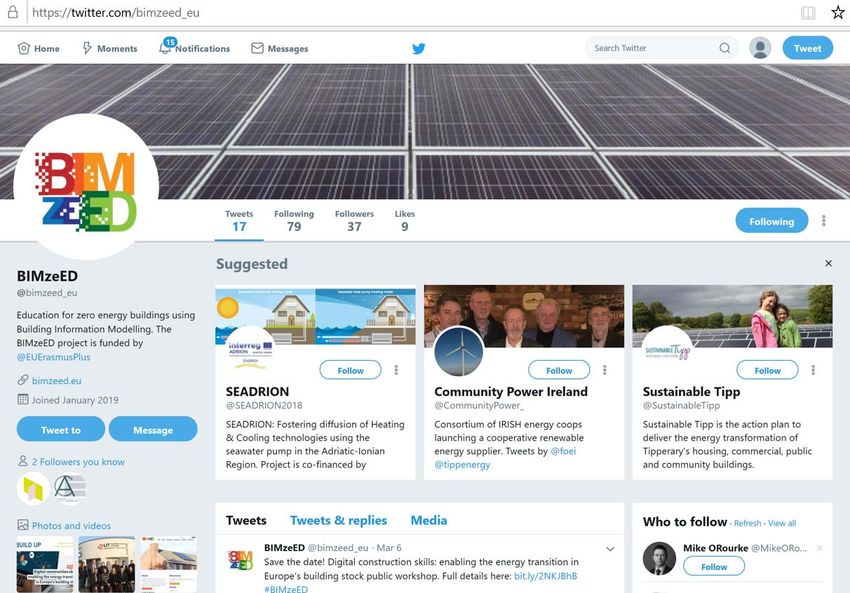
The Twitter account has 37 followers: https://twitter.com/bimzeed_eu
The LinkedIn company profile can be found here: https://www.linkedin.com/company/bimzeed/
P a g e | 29
BIMzeED– 600946-EPP-1-2018-1-IE-EPPKA2-KA
O 7.2 Communication PlanEducation for zero energy Buildings
using Building Information Modelling
9 Conclusions
This report has presented the overall strategy and planned activities for the successful dissemination of
BIMzeED project progress and outputs. As communication and dissemination is a continuous process and
not a one-time effort at the end of the project, activities will be taking place at all stages of the project. As a
result, this document will be constantly updated throughout the project lifespan with reports of the partners
on their expected and actual dissemination activities.
In order to ensure project recognisability and successful dissemination it is important that all partners follow
the indications mentioned in this plan (O7.2) when disseminating BIMzeED project results. This includes
proper use of the project name, logo, colour pallet, template as well as acknowledgment of EU funding.
P a g e | 30
BIMzeED– 600946-EPP-1-2018-1-IE-EPPKA2-KA
O 7.2 Communication PlanYou can also read


