OCEAN INITIATIVE (2015-2020) - DRAFT ONLY FOR REVIEW AND DISCUSSION NOT TO CIRCULATE; NOT TO QUOTE
←
→
Page content transcription
If your browser does not render page correctly, please read the page content below
DRAFT ONLY FOR REVIEW AND DISCUSSION
 AT THE SUSTAINABLE OCEAN INITIATIVE GLOBAL PARTNERSHIP MEETING (3-4 OCT, SEOUL)
                        NOT TO CIRCULATE; NOT TO QUOTE

     (DRAFT) ACTION PLAN FOR IMPLEMENTING THE SUSTAINABLE
                  OCEAN INITIATIVE (2015-2020)

                             BACKGROUND AND CONTEXT
                                              Introduction
Marine and coastal biodiversity – ecosystems, species and genetic material – provide enormous benefits
for human well-being. Hundreds of millions of people rely directly on marine biodiversity for their
livelihoods. Roughly 40% of the world’s population lives within 100 kilometres of the coast; fisheries
employ approximately 200 million people, provide about 16% of the protein consumed worldwide and
have an annual value estimated at US$80 billion. Coastal ecosystems provide services, including tourism
and protection from storms, valued at nearly US$26 billion annually.

Marine ecosystems are, however, increasingly facing threats that undermine their ability to provide
critical life-supporting services and contribute to sustainable development. The impacts of overfishing,
pollution, habitat destruction and emerging threats of climate change, among other threats, are causing
unprecedented biodiversity loss in the oceans.

Around the world, measures have been taken and institutional mechanisms put into place to address these
threats and support conservation and sustainable use of oceans. However, these efforts will not have the
impact needed unless the enabling conditions are in place to ensure effective ground-level implementation
and, namely, that those individuals and institutions charged with implementation are equipped with the
tools and resources needed to ensure success. Various capacity development efforts have aimed to address
these needs, yet there has been inadequate focus on the holistic aspects of capacity needs with regards to
oceans and marine life theirin.

The global mandate through the Aichi Biodiversity Targets and the focus of a number of the Aichi
Targets on marine and coastal biodiversity provides a broad range of opportunities and challenges in
addressing the capacity disparity in various countries and regions in accelerating their efforts toward
achieving the Aichi Biodiversity Targets in marine and coastal areas.

The Sustainable Ocean Initiative aims to catalyze partnerships, build on lessons learned and knowledge
gained, and facilitate improved coordination and two-way dialogue to address these capacity needs to
support countries in their efforts to achieve the Aichi Biodiversity Targets.

                 History and Development of the Sustainable Ocean Initiative
The tenth meeting of the Conference of the Parties to the Convention on Biological Diversity (COP 10,
Nagoya, Japan, October 2010) ushered in a new era of biodiversity conservation. The 193 Parties to the
Convention on Biological Diversity and their partners rose to the challenge of reversing biodiversity loss,
which is occurring at an unprecedented rate—up to 1000 times the natural rate of extinction—by adopting
a new 10-year Strategic Plan (2010-2020) and Aichi Biodiversity Targets to guide international and
national efforts to safeguard biodiversity.

                                                    1
DRAFT ONLY FOR REVIEW AND DISCUSSION
AT THE SUSTAINABLE OCEAN INITIATIVE GLOBAL PARTNERSHIP MEETING (3-4 OCT, SEOUL)
NOT TO CIRCULATE; NOT TO QUOTE
COP 10 urged Parties and other Governments to: achieve long-term conservation, management and
sustainable use of marine resources and coastal habitats; establish and effectively manage marine
protected areas, in order to safeguard marine and coastal biodiversity, marine ecosystem services, and
sustainable livelihoods; and to adapt to climate change, through appropriate application of the
precautionary approach and the use of integrated marine and coastal area management, marine spatial
planning, impact assessment, and other available tools.
COP 10 emphasized the need for training and capacity-building of developing country Parties through
regional workshops that contribute to sharing experiences and knowledge related to the conservation and
sustainable use of marine and coastal biodiversity.
Recognizing this urgent need, the Sustainable Ocean Initiative (SOI) was born at the margins of COP 10,
through the support of Japan, COP 10 Presidency, and in collaboration with various partners who were
willing to provide the necessary expertise, technical and financial resources. The SOI concept was further
developed in subsequent meetings, such as the SOI Programme Development Meeting (2-4 August 2011,
Kanazawa, Japan) and SOI High-level Meeting (5 June 2012, Yeosu, RO Korea). The implementation of
SOI is coordinated by the Secretariat of the Convention on Biological Diversity, and currently funded by
the Government of Japan, through Japan Biodiversity Fund, and the Government of France, through
French MPA Agency (Agence des aires marines protégées).
Linkages to the Aichi Biodiversity Targets
In light of new and expanded challenges that face global biodiversity and an enhanced understanding of
the value of biodiversity to global sustainable development, the Conference of the Parties to the
Convention on Biological Diversity adopted a Strategic Plan for Biodiversity 2011-2020 and a set of
Aichi Biodiversity Targets.
This Strategic Plan provides an overarching framework on biodiversity, not only for the Convention on
Biological Diversity, but for the entire United Nations system.
The Strategic Plan is organized under 5 Strategic Goals and 20 Aichi Biodiversity Targets, as follows:
Strategic Goal A: Address the underlying causes of biodiversity loss by mainstreaming biodiversity
across government and society
Strategic Goal B: Reduce the direct pressures on biodiversity and promote sustainable use
Strategic Goal C: To improve the status of biodiversity by safeguarding ecosystems, species and genetic
diversity
Strategic Goal D: Enhance the benefits to all from biodiversity and ecosystem services
Strategic Goal E: Enhance implementation through participatory planning, knowledge management and
capacity building
Most Aichi Biodiversity Targets address marine and coastal biodiversity, in particular Targets 6, 10, and
11.
2DRAFT ONLY FOR REVIEW AND DISCUSSION
AT THE SUSTAINABLE OCEAN INITIATIVE GLOBAL PARTNERSHIP MEETING (3-4 OCT, SEOUL)
NOT TO CIRCULATE; NOT TO QUOTE
Aichi Biodiversity Targets addressed by the Sustainable Ocean Initiative
Target 6: By 2020 all fish and invertebrate stocks and aquatic plants are managed and harvested
sustainably, legally and applying ecosystem based approaches, so that overfishing is avoided, recovery
plans and measures are in place for all depleted species, fisheries have no significant adverse impacts on
threatened species and vulnerable ecosystems and the impacts of fisheries on stocks, species and
ecosystems are within safe ecological limits.
Target 10: By 2015, the multiple anthropogenic pressures on coral reefs, and other vulnerable ecosystems
impacted by climate change or ocean acidification are minimized, so as to maintain their integrity and
functioning.
Target 11: By 2020, at least 17 per cent of terrestrial and inland water areas, and 10 per cent of coastal
and marine areas, especially areas of particular importance for biodiversity and ecosystem services, are
conserved through effectively and equitably managed, ecologically representative and well connected
systems of protected areas and other effective area-based conservation measures, and integrated into the
wider landscapes and seascapes.
Key Issues Addressed by the Sustainable Ocean Initiative
The Strategic Plan for Biodiversity 2010-2020 and its Aichi Biodiversity Targets laid out an ambitious
agenda to reverse the trends of biodiversity loss. However, this agenda is not self-implementing and will
require strategic, coordinated, and targeted efforts by a range of stakeholders across all sectors and at
different levels in order to make tangible process.
In particular, a number of key challenges face the achievement of the Aichi Targets in marine and coastal
areas, including:
Capacity gaps—Lack of institutional, technical, managerial, and scientific resources;
poor understanding of capacity needs at various levels in the context of cross-sectoral management;
lack of cross-sectoral training for managers at the ground-level;
Inadequate governance—Sectoral conflicts; lack of coordination across governmental agencies and
levels of governments; limited participation of indigenous and local communities;
Limited information base—Lack of policy-relevant information to support decision-making;
inadequate coordination of existing knowledge.
Strategic Approach of the Sustainable Ocean Initiative
“Bridging Gaps to Achieve the Aichi Biodiversity Targets”
The Sustainable Ocean Initiative focuses on the commitments of CBD Parties and the work undertaken
through the CBD on marine and coastal biodiversity to identify opportunities to address capacity needs to
achieve the Aichi Biodiversity Targets
While the challenges faced in achieving the Aichi Biodiversity targets are significant, countries are not
starting from nothing. Around the world, efforts are under way to improve conservation and sustainable
use of marine and coastal biodiversity. However, there has yet to be an effort to take a holistic and
3DRAFT ONLY FOR REVIEW AND DISCUSSION
AT THE SUSTAINABLE OCEAN INITIATIVE GLOBAL PARTNERSHIP MEETING (3-4 OCT, SEOUL)
NOT TO CIRCULATE; NOT TO QUOTE
comprehensive approach to capacity development for conservation and sustainable use of marine and
coastal biodiversity.
The Sustainable Ocean Initiative builds on these efforts, resources, and experiences by providing a
holistic and strategic framework through which to catalyze partnerships and leverage resources to
facilitate the achievement of Aichi Targets on marine and coastal biodiversity.
The Sustainable Ocean Initiative provides a means to build synergies and cross-sectoral exchange across
multiple scales (global, regional, national and local). It seeks to link progress in scientific and technical
approaches to inform policy development and implementation at multiple levels. It seeks to promote
learning and exchange of knowledge and best practices, promoting synergies among other relevant
initiatives/programmes, to address capacity needs in the context of the Aichi Targets. It provides a
platform to highlight positive examples of progress at different levels and catalyze leadership and
commitment to take further action.
Vision of the Sustainable Ocean Initiative
As the Sustainable Ocean Initiative aims to support countries in achieving the goals of the CBD Strategic
Plan for Biodiversity 2011-2020 and the Aichi Biodiversity Targets, Sustainable Ocean Initiative aligns
its vision with that of the Strategic Plan for Biodiversity 2011-2020, with particular focus on marine
and coastal biodiversity:
"Living in Harmony with Nature" where "By 2050, biodiversity is valued, conserved, restored and
wisely used, maintaining ecosystem services, sustaining a healthy planet and delivering benefits
essential for all people."
Mission of the Sustainable Ocean Initiative
The mission of the Sustainable Ocean Initiative is to provide a global platform to build partnerships and
enhance capacity to achieve the Aichi Biodiversity Targets related to marine and coastal biodiversity in a
holistic manner.
Specifically, the SOI aims at achieving its vision by:
(a) Achieving a balance between sustainable use and conservation and the promotion of
flexible and diverse approaches;
(b) Identifying best practices, facilitating information sharing, and learning from
experiences;
(c) Creating partnerships that can provide for targeted capacity building, training, technical
assistance and learning exchange;
(d) Providing for two-way communication among policymakers, scientific communities and
local stakeholders;
(e) Monitoring progress towards the Aichi Biodiversity Targets on marine and coastal
biodiversity (particularly Targets 6, 10 and 11);
(f) Facilitating the provision of guidance and guidelines that will help their achievement; and
(g) Improving the scientific basis for implementation.
By addressing these key aspects of capacity, SOI aims to build the groundwork and foundation for long-
term, effective and adaptive implementation. It aims to build capacity in a way that is adaptive and
4DRAFT ONLY FOR REVIEW AND DISCUSSION
AT THE SUSTAINABLE OCEAN INITIATIVE GLOBAL PARTNERSHIP MEETING (3-4 OCT, SEOUL)
NOT TO CIRCULATE; NOT TO QUOTE
flexible by addressing the key needs for training and tools for people to implement and supporting on-the-
ground implementation, drawing upon, among others, the CBD’s scientific and technical work, such as
the scientific assessment on ecologically or biologically significant marine areas (EBSAs), scientific
synthesis on the impacts of various threats (ocean acidification, underwater noise, unsustainable fishing
practices, marine debris, etc) on marine biodiversity, and technical guidance on various conservation
management and tools (e.g. integrated coastal and marine area management, marine and coastal protected
areas, impact assessments, marine spatial planning, etc).
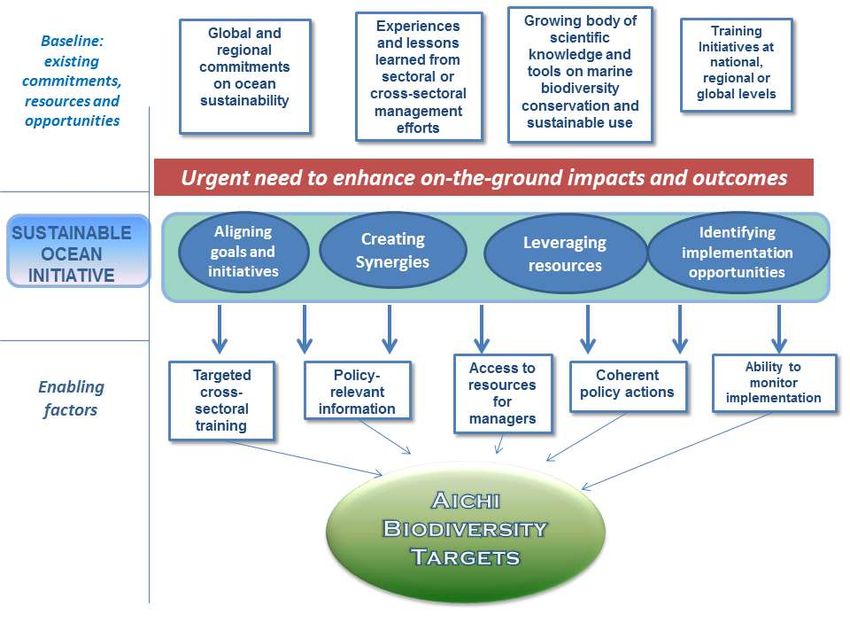
As illustrated below, the Sustainable Ocean Initiative seeks to provide a platform and framework by
which existing resources, knowledge, and experience can be linked and enhanced to fulfill the major
needs required to achieve the Aichi Biodiversity Targets related to marine and coastal biodiversity, and
thereby benefitting CBD Parties in further enhancing their current efforts.
5DRAFT ONLY FOR REVIEW AND DISCUSSION
AT THE SUSTAINABLE OCEAN INITIATIVE GLOBAL PARTNERSHIP MEETING (3-4 OCT, SEOUL)
NOT TO CIRCULATE; NOT TO QUOTE
SOI will generate incremental positive impacts from existing efforts by building on previous and ongoing
activities, and identifying opportunities for future synergies. By providing a coherent framework for
capacity development in the context of the Aichi Biodiversity Targets, SOI will ensure that the sum of the
various efforts of individual SOI partners is greater than its parts, when implemented in a collective
manner through the SOI partnership. The unique role of SOI is that it provides an umbrella under which
the knowledge, resources and experiences of these range of activities can be organized to link local,
national and regional level initiatives to global dialogues and create synergies to address specific capacity
needs to achieve the Aichi Biodiversity Targets on marine and coastal biodiversity. As well, it also
benefits from the significant amount of scientific and technical collaboration developed through the work
of the CBD on marine and coastal biodiversity.
By focusing especially on the Aichi Biodiversity Targets and the vision of the Strategic Plan for
Biodiversity 2011-2020, SOI frames it’s approach on the commitments and priorities of national, regional
and global leaders on oceans and coasts, priorities that are also embodied in the outcome of the Rio+20
Conference, the ongoing discussions on the Sustainable Development Goals, and other relevant global
processes.
Modalities of the Sustainable Ocean Initiative
Who benefits from SOI implementation?
The Sustainable Ocean Initiative aims to support CBD Parties in achieving the Aichi Biodiversity Targets
and implementing the decisions of the Conference of the Parties on marine and coastal biodiversity
(especially decisions X/29, XI/17 and XI/18). As such, countries benefit from the opportunities provided
through collaboration in SOI, which subsequently benefits the stakeholders, communities, individuals,
and ecosystems in those countries.
How is SOI implemented?
The Secretariat of the Convention on Biological Diversity coordinates the implementation of SOI, in
collaboration with SOI donors and partners and responding to the requests made by the Conference of the
Parties to the Convention regarding the capacity development needs. With the expansion of SOI activities,
the formation of a steering committee for coordinating various SOI activities can be explored.
SOI activities include: (i) those directly implemented by the CBD Secretariat, in accordance with the
mandates provided by relevant COP decisions, in collaboration with SOI partners, (ii) those directly
implemented by SOI partners in collaboration with CBD Secretariat, and (iii) those aligned to SOI vision
and mission implemented by SOI partners, of which results and lessons learned are shared through
various forums and information-sharing mechanism provided by SOI.
The involvement of SOI partners in specific implementation activities depends on respective strengths,
expertise and resources of SOI partners as well as the scale/scope of the proposed activities. SOI activities
are designed to address regional priorities of CBD Parties and build on the strengths, resources, and
experiences and expertise of participating SOI partners. Collaboration with various Parties and SOI
partners seek to create added value to existing activities, minimize duplication of effort, and identify new
opportunities for capacity building and on-ground implementation.
Likewise, the relevant activities of SOI partners can be characterized as “aligned initiatives” (see annex 3
for examples). Certain aspects of aligned initiatives are integrated into SOI activities, as appropriate, in
order to enhance coordination among the relevant activities of SOI partners and strengthen the impact of
6DRAFT ONLY FOR REVIEW AND DISCUSSION
AT THE SUSTAINABLE OCEAN INITIATIVE GLOBAL PARTNERSHIP MEETING (3-4 OCT, SEOUL)
NOT TO CIRCULATE; NOT TO QUOTE
these activities overall, and to identify ways in which the knowledge and information generated from
these activities can be applied in different countries and regions.
How to become SOI donors?
Parties interested in providing financial resources to support SOI implementation can become a SOI
donor through the development of a voluntary funding agreement with the Secretariat of the Convention
on Biological Diversity (e.g. Japan Biodiversity Fund, French MPA Agency). In some cases, the activities
are implemented through in-kind financial contribution by hosting countries (e.g. Republic of Korea, PR
China).
Who are SOI partners?
One of the core strengths of SOI is its wide range of partners and the opportunity to share and build upon
the many experiences, knowledge, and resources of these partners to achieve common goals. SOI partners
share:
A Common Vision;
Coherent and/or Complementary Goals and Objectives; and
A Commitment to Share (e.g., knowledge, expertise, experiences, human resources, financial
resources, networks, time, logistic support, etc)
SOI partners compose a wide range of global, regional or national institutions/programmes/initiatives,
who share the vision of SOI and provide in-kind contributions to contribute to its mission.
In-kind contributions can include, for example, provisioning of scientific and/or technical expertise,
contribution of relevant materials, and hosting of workshops and events, among other types of support.
For example, since the inception of SOI, in-kind contribution by Senegal, Republic of Korea, China
through hosting the workshops/meetings; technical support provided by Australia (through
Commonwealth Scientific and Industrial Research Organisation: CSIRO), Germany (through GIZ),
Monaco (through Monaco Blue Initiative), Republic of Korea (Korea Maritime Institute, Korea
Environment Management Corporation), United Nations Environment Programme, Food and Agriculture
Organizations of the United Nations, UN Division for Ocean Affairs and the Law of the Sea,
Intergovernmental Oceanographic Commission-UNESCO, regional seas organizations/regional fisheries
management organizations/other relevant regional initiatives (such as Abidjan Convention, North West
Pacific Action Plan, Partnership for Environmental Management for the Seas of East Asia, South-east
Atlantic Fisheries Organization, etc), IUCN-Commission on Ecosystem Management-Fisheries Expert
Group, Global Ocean Biodiversity Initiatives, Lifeweb Initiative, Global Island Partnership, MedPAN,
Brest-Metropole Oceane as the chair of the Maritime Innovative Territories’ International Network –
MITIN, and many other partner organizations.
SOI Implementation Thus Far
The implementation of the Sustainable Ocean Initiative has been largely funded by the Government of
Japan through the Japan Biodiversity Fund and the French marine protected areas agency (Agence des
Aires Marines Protégées), with additional in-kind funding (e.g., Republic of Korea, China) and technical
support (e.g., FAO, UNEP, IUCN-CEM-FEG, CSIRO, GOBI, Abidjan Convention Secretariat, PEMSEA,
etc.) mobilized for different implementation activities. Its implementation is being coordinated by the
CBD Secretariat.
7DRAFT ONLY FOR REVIEW AND DISCUSSION
AT THE SUSTAINABLE OCEAN INITIATIVE GLOBAL PARTNERSHIP MEETING (3-4 OCT, SEOUL)
NOT TO CIRCULATE; NOT TO QUOTE
Programme Development and Launching (2010-2012)
First consultation meeting for developing Sustainable Ocean Initiative at the 10th meeting of the
Conference of the Parties to the Convention (24 October 2010, Nagoya, Japan)
SOI launching and programme development meeting (2-4 August 2011, Kanazawa, Japan)
SOI Side Event at the 16th meeting of the Convention’s Subsidiary Body on Scientific, Technical
and Technological Advice (2 May 2012, Montreal, Canada)
SOI High-level Meeting at International Ocean Expo (5 June 2012, Yeosu, Republic of Korea)
SOI High-level Side Event at 11th meeting of the Conference of the Parties (17 October, 2012,
Hyderabad, India)
Regional Implementation and Global Implementation (2013 -2014)
SOI Capacity Building Workshop for West Africa (4- 8 February, 2013, Dakar, Senegal)
SOI Capacity Building Workshop for East Asia, South Asia and Southeast Asia (9-13 December,
2013, Guangzhou, China)
SOI/Lifeweb Financial Partnership Meeting during the 3rd International Marine Protected Areas
Congress (24 October 2013, Marseille, France)
SOI Website/Information-sharing Platform Development (2013-2014)
SOI Publication—Guidance document to address Aichi Targets through Integrated Coastal
Management (2013-2014)
Planned activities (2014-2016)
SOI Global Partnership meeting at COP 12 (3-4 Oct 2014, Seoul, Republic of Korea)
SOI High level Meeting at COP 12 (16 October 2014)
SOI Capacity Building Workshop in South America (Lima, Peru, 23-27 February 2015)
SOI Capacity Building Workshop in East Africa (October 2015)
SOI Capacity Building Workshop in South Pacific (December 2015)
8DRAFT ONLY FOR REVIEW AND DISCUSSION
AT THE SUSTAINABLE OCEAN INITIATIVE GLOBAL PARTNERSHIP MEETING (3-4 OCT, SEOUL)
NOT TO CIRCULATE; NOT TO QUOTE
SOI ACTION PLAN—IMPLEMENTATION ELEMENTS
SOI Global Partnership Meetings
Background
One of the core strengths of SOI is its wide range of partners and the opportunity to share and build upon
the many experiences, knowledge, and resources of these partners to achieve common goals.
Many efforts have been taken around the world to improve the state of the oceans and address capacity
gaps to enhance conservation and sustainable use. These efforts however, are often focused on specific
topics or geographic areas, occurring in isolation from other related efforts. As such, relatively few
initiatives have sought to leverage the positive experiences of these various activities to support efforts to
achieve the Aichi Biodiversity Targets related to marine and coastal biodiversity.
Purpose
The Sustainable Ocean Initiative aims to fill this gap by focusing centrally on facilitating partnerships to
link various initiatives and ensure that the sum of these efforts are greater than its parts.
SOI will facilitate partnerships in a number of different ways as a cross-cutting element of all of its
activities. However, a periodic high-profile multi-stakeholder event in the form of SOI Global Partnership
Meetings will be instrumental in focusing attention on SOI activities and serving as a marketplace for the
experiences of SOI partners. These meetings can also highlight local, national and regional level progress
at the global level, informing global policy discussions.
9DRAFT ONLY FOR REVIEW AND DISCUSSION
AT THE SUSTAINABLE OCEAN INITIATIVE GLOBAL PARTNERSHIP MEETING (3-4 OCT, SEOUL)
NOT TO CIRCULATE; NOT TO QUOTE
SOI Global Partnership Meetings will be convened every one year or two years, subject to available
resources, at the occasion of relevant meetings within the Convention (e.g. COP or SBSTTA). The
objectives of these meetings are to:
Provide a platform to highlight experiences of SOI partners;
Showcase positive experiences and success stories
Contribute to sharing of information;
Serve as a means to build goodwill and communication among current and potential SOI partners;
Provide a venue to catalyze partnerships in the framework of SOI; and
Encourage additional partners to join SOI.
Target Audience
The SOI Global Partnership Meetings will involve the following:
Donors and international financial institutions
Coordinators of ocean management initiatives at different scales
Representatives of international organizations
National level government representatives
Representatives from regional organizations
Managers and ground-level implementers
Providers of training and capacity support
Description
The SOI Global Partnership Meetings will entail:
Plenary sessions organized thematically
Symposium sessions/side events on specific topics of relevance to the theme of the Meeting
Exhibits and poster sessions highlighting experiences
Donor roundtables
Scoping session for future directions for SOI
Focusing on Regional Priorities:
SOI Regional Learning and Exchange Programme
Background
Increasingly, regional approaches for cooperation and governance are being relied upon in various ocean
areas around the world to support conservation and sustainable use efforts. However, there are important
contextual variations among different regions and sub-regions that necessitate the use of tailored
approaches, especially with regards to capacity development efforts. In addition to unique environmental
characteristics, different regions also have unique priorities, challenges and experiences, and different
types of institutional structures and mechanisms for cooperation.
Capacity development at the regional and sub-regional level is an important means to facilitate improved
governance of marine resources and engender increased cooperation among countries and organizations
in a given region. Additionally, capacity development focused at the regional level can allow for lessons
and knowledge to be adapted and transferred from other regions to facilitate cross-regional learning.
Training, information-sharing, and peer-to-peer learning and exchange is an important means to build on
experiences and lessons-learn, identify opportunities for synergies and partners, cultivate regional
networks and communities of practitioners and provide managers and decision makers with the tools
10DRAFT ONLY FOR REVIEW AND DISCUSSION
AT THE SUSTAINABLE OCEAN INITIATIVE GLOBAL PARTNERSHIP MEETING (3-4 OCT, SEOUL)
NOT TO CIRCULATE; NOT TO QUOTE
needed to improve conservation and sustainable use. When these efforts at the regional level that are
tailored to the unique context of a given region or sub-region, lends increased benefits that directly benefit
countries in the region, facilitate improved cooperation among countries and support regional
mechanisms/organizations.
Purpose
The SOI Regional Learning and Exchange Programme will provide key opportunities for training,
information-sharing, and peer-to-peer learning and exchange for managers and implementers in various
regions or sub-regions, which is tailored to the unique needs, priorities and challenges of each area. This
will be carried out in close partnership with countries in the region as well as appropriate regional
cooperative mechanisms (e.g. regional seas organizations, regional fisheries management organizations or
other regional initiatives). This will build on and develop synergies among existing training programs and
other capacity development efforts within the region and focus on providing training across different
sectors dealing with conservation and sustainable use of marine resources.
The Programme will also directly link to the SOI Training of Trainers, providing tangible opportunities
for those individuals who have undergone training of trainers to carry out further training in their
respective region/sub-region.
The SOI Regional Learning and Exchange Programme will aim to:
Support the development a strong linkage and networking for scientific and technical cooperation
using the SOI framework at the regional level
Enhance regional-level peer-to-peer learning and exchange
Develop regional-level partnerships to foster synergies among various capacity building providers
Provide government officials, project managers, community leaders with the skills and resources
they need to implement sound management of marine resources
Provide for the creation strong group of qualified recipients of support from SOI partners and
donors and opportunities for partnerships
Provide opportunities for individuals who have gone through the SOI Training of Trainers
program to carry out training at the regional/sub-regional level
Build linkages between global and regional/sub-regional initiatives on marine biodiversity
conservation and sustainable use
Target Audience
The SOI Regional Learning and Exchange Programme will target:
Managers and project leaders at regional/sub-regional levels
Practitioners or programme managers at national level from different sectors (e.g. environment,
fishery, academia, etc)
Description
The SOI Regional Learning and Exchange Programme will entail:
Training materials and modules
In-person or virtual training sessions (offered in different languages, as appropriate)
Online forums to facilitate continued dialogue and discussion among training recipients
Regional forums, peer-to-peer exchange sessions and networking opportunities
Linking training recipients networks to provide for continued information-sharing
11DRAFT ONLY FOR REVIEW AND DISCUSSION
AT THE SUSTAINABLE OCEAN INITIATIVE GLOBAL PARTNERSHIP MEETING (3-4 OCT, SEOUL)
NOT TO CIRCULATE; NOT TO QUOTE
Planting SOI Seeds: Training of Trainers
Background
Training is a key part of building capacity, especially improving the capacity of individuals that are
undertaking on-the-ground implementation. Training is a critical means to ensure that the people tasked
with undertaking ground-level action are equipped with the knowledge and skills required to effectively
conserve and sustainably utilize marine biodiversity. While these types of knowledge and skills can be
transmitted in different ways, training provides direct engagement and two-way communication that leads
to more effective uptake of this valuable information.
At its tenth meeting, the Conference of the Parties to the CBD emphasized the need for training and
capacity-building of developing country Parties, in particular the least developed countries and small
island developing States, as well as countries with economies in transition, as well as through relevant
regional initiatives, and that these training workshops should contribute to sharing experiences related to
integrated management of marine resources and the implementation of marine and coastal spatial
planning instruments, facilitate the conservation and sustainable use of marine and coastal biodiversity,
and may address other regional priorities that are brought forward as these workshops are planned
(paragraph 37 of decision X/29). Subsequently, the Conference of the Parties to the Convention, at its
eleventh meeting, further emphasized the urgent need for capacity-building on various issues/tools
concerning the conservation and sustainable use of marine and coastal biodiversity, including
ecologically or biologically significant marine areas (EBSAs), the impacts of climate change on coral
reefs, marine debris, and marine spatial planning (paragraphs 14, 19, 20 and 21 of decision XI/17;
paragraphs 12 and 27 of decision XI/18 A; paragraph 2(g) of decision XI/18 C).
The CBD Secretariat has conducted training and capacity development efforts pursuant to the COP
decisions, including through regional SOI capacity development workshops. The CBD Secretariat has
also developed various types of training materials on issues related to marine biodiversity, including on
ecologically or biologically significant marine areas (EBSAs). Other SOI partners, such as FAO,
DOALOS, IOC/UNESCO and Blue Solutions have developed training materials focused on certain ocean
sectors (such as fisheries) or are in the process of further developing training materials.
A necessary precursor to effective training is the need to have trainers who possess the knowledge that
must be passed on to managers and understand how to convey it effectively, including to different
audiences and in various contexts. A key means to improve the sustainability, longevity, and broader
impact of capacity development efforts is to train individuals to conduct subsequent training on their own
in different contexts.
Purpose
The SOI Training of Trainers programme will aim to give new trainers, including individuals in agencies
and organizations tasked with implementing ocean and coastal management, the background knowledge,
skills and practical experience needed to train individuals at different levels and relay this information in a
way that is useful to managers and ground-level implementers. The programme will aim to build
synergies among existing training initiatives on oceans and coasts, including sectoral training and
initiatives at different scales. This Training of Trainers programme will add value to existing efforts by
linking them in the context of the Aichi Biodiversity Targets and the scientific and technical work of the
CBD Secretariat and other SOI partners, and translate this knowledge into materials to train the trainers in
order to have more broad reaching impact and facilitate long-term and continued training by the
individuals who are trained as part of this programme.
12DRAFT ONLY FOR REVIEW AND DISCUSSION
AT THE SUSTAINABLE OCEAN INITIATIVE GLOBAL PARTNERSHIP MEETING (3-4 OCT, SEOUL)
NOT TO CIRCULATE; NOT TO QUOTE
After going through the SOI Training of Trainers programme, trainer candidates will be able to:
Understand the different approaches of ocean management and the various types of capacity and
information needed to support these approaches
Know how to effectively convey the information that training recipients require
Know how to adapt the information for different contexts
Provide access to further information for the benefit of training recipients
Activities
SOI Training of Trainers will entail:
Development of training materials and module, utilizing the knowledge and experiences of SOI
partners and building on existing training materials for oceans from various related initiatives
Convening of SOI Training of Trainers workshop to be held May 2015
Development of online forum on SOI website to facilitate continued dialogue and discussion among
participants from SOI Training of Trainers workshop
Continued provisioning of information to trainers through SOI website to ensure the training that they
conduct incorporates the latest relevant information on ocean science and policy
The SOI Training of Trainers will build on and integrate materials and information of existing relevant
training programmes and incorporate the representatives of these training programmes in the development
and implementation of the Training of Trainers. The experience of the trainers can be highlighted at the
SOI Global Partnership Meetings, ensuring continued engagement in SOI and sharing of experiences.
After going through the SOI Training of Trainers, trainer candidates will be able to:
Understand the different approaches of ocean management and the various types of capacity and
information needed to support these approaches
Know how to effectively convey the information that training recipients require
Know how to adapt the information for different contexts
Provide access to further information for the benefit of training recipients
Target Participants
The SOI Training of Trainers will target individuals from:
National-level offices and agencies tasked with ocean and coastal research and management
Regional-level intergovernmental bodies addressing ocean and coastal governance
Capacity building initiatives and projects
Training Programme Elements
Implementation of integrated coastal and marine management toward achieving Aichi
Biodiversity Targets (Target 6, 10 and 11)
Use of EBSA scientific information for developing marine spatial planning
Tools and guidance on marine spatial planning
Action planning for organizing national trainings
Priority actions for conservation of coral reefs and associated ecosystems
13DRAFT ONLY FOR REVIEW AND DISCUSSION
AT THE SUSTAINABLE OCEAN INITIATIVE GLOBAL PARTNERSHIP MEETING (3-4 OCT, SEOUL)
NOT TO CIRCULATE; NOT TO QUOTE
Facilitating On-the-Ground Implementation
through SOI National Training and Exchange
Background
The types of capacity required for on-the-ground implementation for conservation and sustainable use of
marine biodiversity includes a number of key factors, including access to scientific information on marine
ecosystems, guidance on prioritization and implementation of management measures, coordination across
different sectors, and often (with regards to developing countries) support for initiating implementation
through pilot projects.
The CBD’s work on ecologically or biologically significant areas (EBSAs), through its data assimilation
and distribution process, has synthesized a significant amount of scientific knowledge on marine
biodiversity. In doing so, it has also provided an important basis for regional scientific collaboration, a
starting point for future long-term continuous and more systematic assessment with increasing availability
of scientific information and potential focus for future research and monitoring. In addition to the EBSA
process, a number of SOI partners are conducting significant ongoing work related to assessment and
monitoring of the marine environment.
The next piece of the puzzle is supporting the use of this knowledge in management interventions. The
CBD Secretariat, in collaboration with a wide range of partners is engaged in a number of activities
focused on providing guidance to Parties in selecting and implementing appropriate management
measures for oceans and coasts. In particular, these efforts have recently focused on marine spatial
planning (MSP) and measures to achieve Aichi Biodiversity Target 10 for coral reefs and closely
associated ecosystems. Pursuant to decision XI/18 C, the Executive Secretary to the Convention is
convening an expert workshop from 9 to 11 September 2014 in Montreal to provide consolidated
practical guidance and a toolkit for marine spatial planning, building upon existing guidance, in order to
complement and further enhance the existing cross-sectoral efforts of Parties and other Governments on
the application of the ecosystem approach to the implementation of integrated marine and coastal
management, the identification of ecologically or biologically significant marine areas and the design and
establishment of conservation and management measures, as appropriate.
As well, the Parties to the CBD have recently made steps towards agreement on detailed guidance on
achieving Aichi Biodiversity Target 101 for coral reefs and closely associated ecosystems. Pursuant to
decision XI/18 A, the Executive Secretary compiled and synthesized proposals to update the specific
workplan on coral bleaching. Building on these proposals, CBD Secretariat developed a proposal on
priority actions to achieve Aichi Biodiversity Target 10 for coral reefs and closely associated ecosystems,
which was presented to the 18th meeting of the CBD Subsidiary Body on Scientific, Technical and
Technological Advice (SBSTTA 18) in June 2014. The priority actions were well-received by SBSTTA
and will be sent for consideration to the 12th meeting of the Conference of the Parties to the CBD in
October 2014.
Enhanced knowledge of the marine environment and guidance on implementing management measures
provide key tools to support implementation. In the context of capacity development, the provisioning of
1
Target 10: By 2015, the multiple anthropogenic pressures on coral reefs, and other vulnerable
ecosystems impacted by climate change or ocean acidification are minimized, so as to maintain their
integrity and functioning.
14DRAFT ONLY FOR REVIEW AND DISCUSSION
AT THE SUSTAINABLE OCEAN INITIATIVE GLOBAL PARTNERSHIP MEETING (3-4 OCT, SEOUL)
NOT TO CIRCULATE; NOT TO QUOTE
this information to developing countries should logically be accompanied by training, information-
sharing and exchange, which can be facilitated through national-level workshops.
Purpose
This project will provide a platform to support focused training, information-sharing and exchange at
national level in developing countries focused on enhancing the use sound scientific information
(including EBSA information) and building critical technical skills, including on the use of CBD
guidance on implementing marine spatial planning and priority actions to achieve Aichi Biodiversity
Target 10 for coral reefs and closely associated ecosystems.
Activities
This component will entail:
National-level training, information-sharing and exchange workshops focused on capacitating
developing countries with access to sound scientific information on the marine environment and
technical skills in utilizing this information, knowledge and skills in implementing marine
spatial planning and priority actions to achieve Aichi Biodiversity Target 10 for coral reefs and
closely associated ecosystems
Engaging SOI Local Leaders—Local Leaders Forum
Background
Local leaders possess a wealth of knowledge and experience in management of ocean and coastal
resources. These experiences can prove highly instructive to efforts and initiatives at various levels and in
different areas around the world. As well, local initiatives often utilize unique types of traditional
knowledge of indigenous and local communities in their conservation and management approaches.
However, the experiences of local leaders with respect to ocean and coastal management are too often
ignored and the benefits of these unique experiences go unutilized by other efforts and initiatives. Also
local leaders are often those tasked with conducted on-the-ground implementation of policy decisions
taken at higher political levels, making them key players in the management of oceans and coasts.
Purpose
The SOI Local Leader Forums will seek to directly engage local leaders that are making tangible on-the-
ground progress and highlight their experiences and knowledge for the benefit of a broader range of
stakeholders. These Forums will provide an opportunity to showcase and celebrate successful and
promising local initiatives around the world and a platform for sharing the experiences and lessons-
learned from these initiatives with a view to facilitating partnerships and leveraging capacity support to
broaden and enhance the impact of positive local level approaches around the world. These Forums will
be convened every two years at the SOI Partnership and Training Center, alternating with the SOI Global
Partnership Meetings.
The SOI Local Leader Forums will aim to:
Highlight positive experiences in ocean management and stewardship at the local-level
Draw lessons-learned across different local contexts
Facilitate identification and synthesis of best practices emanating from local-level approaches
Facilitate partnerships to catalyze support for tangible on-the-ground implementation and
promising local-level initiatives
15DRAFT ONLY FOR REVIEW AND DISCUSSION
AT THE SUSTAINABLE OCEAN INITIATIVE GLOBAL PARTNERSHIP MEETING (3-4 OCT, SEOUL)
NOT TO CIRCULATE; NOT TO QUOTE
Contribute to the development of networks of local-level leaders to facilitate two-way learning
among local-level efforts in different areas
Target Audience
The SOI Local Leader Forums will involve the following:
Managers and ground-level implementers
Scientists and researchers
Coordinators of ocean management initiatives at different scales
Donors and international financial institutions
National-level government representations
Description
The SOI Local Leader Forums will entail:
Panel presentations and discussions by local leaders making on-the-ground progress towards the
Aichi Targets on marine and coastal biodiversity
Presentations on emerging tools to support local implementation
Breakout roundtable sessions on thematic areas (e.g, land-use planning and coastal management,
coral reef management, community stewardship)
Exhibits and poster sessions
SOI Web-Based Information-Sharing and Coordination
Background
Information-sharing and coordination is a key aspect of capacity development. Providing stakeholders
with streamlined access to relevant sources of information to support their work is a valuable means to
enhance capacity, while ensuring that the knowledge and lessons learned from past experiences and
various efforts can support the efforts of decision makers, managers and users in enhancing conservation
and sustainable use of marine resources.
Information-sharing and coordination is an important means to enhance synergies among various capacity
development efforts and reduce overlap and duplication of efforts. As various efforts are underway
around the world focused on ocean and coastal management and capacity development, providing up-to-
date access to relevant information emanating from these experiences is a key means to directly support
the capacity of decision makers, managers and users, while also informing the efforts of capacity
development initiatives, allowing for greater impact of these efforts.
Purpose
SOI web-based information-sharing and coordination aims to support online collation and dissemination
of knowledge on various issues related to conservation and sustainable use of marine resources (with a
focus on capacity development activities), to support coordination among the activities of SOI partners
and related initiatives and to support linkages to other sources of online information as well as relevant
policy processes.
In addition to providing stakeholders, such as national level decisionmakers and ground-level managers,
with access to information to support their activities and enhance their capacity, this will support both
internal and external coordination. Web-based information-sharing and coordination will provide a
platform by which SOI partners can learn about progress in SOI implementation, provide updates on their
own activities and identify opportunities for partnerships. This will also bolster external coordination by
16DRAFT ONLY FOR REVIEW AND DISCUSSION
AT THE SUSTAINABLE OCEAN INITIATIVE GLOBAL PARTNERSHIP MEETING (3-4 OCT, SEOUL)
NOT TO CIRCULATE; NOT TO QUOTE
providing a means to support synergies with other related initiatives and identify opportunities for
partnerships and
The main goals of SOI web-based information-sharing and coordination are to:
Disseminate information on the results and outputs of SOI activities and related initiatives
Provide linkages to various online databases and other sources of relevant information
Provide an online presence necessary to support SOI implementation, such as SOI Training of
Trainers
Support coordination among the activities of various SOI partners
Support linkages to various global and regional policy processes
Activities
Information-sharing and coordination will be facilitated through a number of channels that address
different issues. These will include both mechanisms hosted by the CBD Secretariat as well as those of
partners, which will be all be linked. In particular, these include:
Sustainable Ocean Initiative online information-sharing mechanism
CBD EBSA portal website and repository— http://www.cbd.int/ebsa/
Blue Solutions platform
17DRAFT ONLY FOR REVIEW AND DISCUSSION
AT THE SUSTAINABLE OCEAN INITIATIVE GLOBAL PARTNERSHIP MEETING (3-4 OCT, SEOUL)
NOT TO CIRCULATE; NOT TO QUOTE
Annex 1. Format for Action Programming of SOI Implementation (2015 – 2020)
Programme 2015 2016 2017 2018 2019 2020
Elements
SOI Proposed SOI Proposed SOI Proposed SOI Proposed SOI Proposed SOI Proposed
Partner roles and Partner roles and Partner roles and Partner roles and Partner roles and Partner roles and
activities activities activities activities activities activities
Global
Partnership
Meetings
Regional
Learning
and
Exchange
Programme
Training of
Trainers
National
Training and
Exchange
Local
Leaders
Forum
Web-based
information-
sharing and
coordination
18DRAFT ONLY FOR REVIEW AND DISCUSSION
AT THE SUSTAINABLE OCEAN INITIATIVE GLOBAL PARTNERSHIP MEETING (3-4 OCT, SEOUL)
NOT TO CIRCULATE; NOT TO QUOTE
Annex 2. Strengths and opportunities that can be provided by various SOI partners for SOI Action plan implementation2
Scientific Information-Sharing
Organization Networks / Sharing of Experiences Expertise / Guidance
/ Technical support
International Organizations and Initiatives
CBD Secretariat --National-level experiences of CBD Parties in --Large amount of scientific and --EBSA training manual and modules
implementing ocean and coastal management technical information compiled
--CBD E-Learning Curricula
Coordination of SOI through ongoing EBSA regional
--Experiences in implementing conservation and
implementation workshop process --Technical analyses and guidance on
management based on EBSA information
specific topics, including through the
--EBSA website and SOI
--EBSA website and SOI website as tools for CBD Technical Series Reports, Global
website as tools for online
online sharing of experiences Biodiversity Outlook reports, global
information-sharing and
expert workshops, and technical
--Global network of expert scientists, practitioners coordination
studies
and policy analysts
--Connection to global policy process
UN Division on Ocean --Connection to global policy process --Experiences in training for ocean
Affairs and the Law of the and coastal management (H.S.
Sea (DOALOS) Amerasinghe Fellowship; TRAIN-
SEA-COAST program; and Technical
Cooperation Trust Fund-- Nippon
Foundation of Japan)
--Publications and a collection of
studies on oceans and the Law of the
Sea
FAO --Experiences in the implementation of the FAO --Information on status and --Relevant training materials on
Code of Conduct for Responsible Fisheries and trends of global fisheries sustainable fisheries and aquaculture,
other relevant guidelines including the FAO Ecosystem
Approach to Fisheries (EAF) Toolbox
--Linking experiences in management and
implementation from FAO Regional Fisheries --FAO Code of Conduct for
Management Organizations (RFMOs) Responsible Fisheries and other
2
This list has to be confirmed by respective SOI partners. This was not prepared as an exhaustive list, but as an indicative list to facilitate collaboration among SOI partners.
19DRAFT ONLY FOR REVIEW AND DISCUSSION
AT THE SUSTAINABLE OCEAN INITIATIVE GLOBAL PARTNERSHIP MEETING (3-4 OCT, SEOUL)
NOT TO CIRCULATE; NOT TO QUOTE
relevant guidelines
--Expert studies and analyses on
fisheries issues
IOC/UNESCO --Relevant experiences from the Global Ocean --Scientific and technical --Training activities of the
Observing System (GOOS), International information from GOOS, IODE, International Oceanographic Data and
Oceanographic Data and Information Exchange and the Ocean Biogeographic Information Exchange (IODE)
(IODE) Programme and the Ocean Data and Information System (OBIS) Programme
Information Networks (ODINs)
UNEP --Linking experiences from Regional Seas --Experiences from coordinating
Programmes Training Workshops Ecosystem
Approaches to Coastal and Ocean
--Information from national and regional
Management
experiences in implementing the Global
Programme of Action for the Protection of the --UNEP expert reports on issues
Marine Environment from Land-based Activities related to global environmental
(GPA), the Global Partnership on Nutrient sustainability
Management, and the Global Partnership on
--Analysis of experiences and lessons-
Marine Litter
learned in marine spatial planning
World Bank --Experiences and partnerships from the Global --Identification of candidates to take
Partnership for Oceans, and the World Bank-led part in SOI training
project on Oceans Partnerships for Sustainable
--World Bank publications on specific
Fisheries and Biodiversity Conservation – Models
topics
for Innovation and Reform
--Experiences from other relevant World Bank-
supported projects
Blue Solutions --Identification and analysis of “Blue Solutions” --Blue Solutions online --Training modules on ocean and
or positive approaches in sustainable ocean and information-sharing platform coastal issues in the context of
coastal management sustainable financing, climate change,
and ecosystem services
--Blue Solutions online information-sharing
mechanism
--Sharing experiences from relevant projects
supported by Blue Solutions partners (GIZ,
20DRAFT ONLY FOR REVIEW AND DISCUSSION
AT THE SUSTAINABLE OCEAN INITIATIVE GLOBAL PARTNERSHIP MEETING (3-4 OCT, SEOUL)
NOT TO CIRCULATE; NOT TO QUOTE
GRID-Arendal, IUCN and UNEP)
--Network of global, regional and national
trainers/experts
Global Ocean --Experiences in expert support to EBSA process --Identification of candidates to take
Biodiversity Initiative part in SOI training
(GOBI) --Scoping of capacity needs
Global Island Partnership --Sharing the experiences of island nations
--Engaging high-level political leaders
IUCN BEST Initiative --Partners and stakeholders from various BEST
projects
--Knowledge from experiences of BEST projects
--Information-sharing through BEST online
platform/clearinghouse mechanism
IUCN-CEM-FEG --Expert analyses on the ecosystem
approach to fisheries and conservation
Regional Organizations/Initiatives
Large Marine Ecosystem --Experiences in tools and approaches across --Information on status and --Training materials in Transboundary
(LMEs) projects LME projects trends regarding the state of the Diagnostic Analysis/ Strategic Action
marine environment in specific Programme
regions
--Identification of candidates to take
--Information from relevant part in SOI training
scientific monitoring networks
Regional Fisheries --Experiences in tools and approaches, including --Information on status and --Identification of candidates to take
Management with regards to management of Vulnerable trends of fisheries in specific part in SOI training
Organizations (RFMOs) Marine Ecosystems (VMEs) regions
--Monitoring and scientific
networks
Regional Seas --Experiences across various Regional Seas --Information on status and --UNEP Regional Seas Series Reports
Organizations Programmes trends regarding the state of the
marine environment in specific
regions
Secretariat of the Pacific --Experiences across the South Pacific region --Information on status and
Community (SPC) trends regarding the state of the
21DRAFT ONLY FOR REVIEW AND DISCUSSION
AT THE SUSTAINABLE OCEAN INITIATIVE GLOBAL PARTNERSHIP MEETING (3-4 OCT, SEOUL)
NOT TO CIRCULATE; NOT TO QUOTE
marine environment in the South
Pacific, through the SPC
Division of Fisheries,
Aquaculture and Marine
Ecosystems
National Institutions
CSIRO (Australia) --Experience in supporting regional governance --Scientific networks and --Identification of candidates to take
approaches information on status and trends part in SOI training programs
of marine environment in South
--Experience in technical support for EBSA
Pacific
process
French MPA Agency --Expert MPA networks --Training for MPA creation and
Ocean+ Action Plan management
--Experiences in creating MPA management
strategies and supporting MPA implementation in --Identification of candidates to take
France and French overseas territories part in SOI training
management teams
--Guidance on implementation of MPA
--Experiences in supporting Natura 2000 network and MPA management efficiency
of marine parks
Korea Maritime Institute --National-level experiences in ocean and coastal --Information on status and --Identification of candidates to take
management trends of oceans and coasts part in SOI training
--Scientific networks
Japan (MOE, MAFF, --National-level experiences in ocean and coastal -- Information on status and --Identification of candidates to take
Cabinet Secretariat, management trends of oceans and coasts part in SOI training
Universities, Academic,
--Scientific networks
Civil Society Groups)
Sub-National Partners
Indigenous and Local --Experience in traditional knowledge and local --Identification of candidates to take
Communities level management of marine resources part in SOI training
BREST-Metropole— --Networks of local level public authorities, --Identification of candidates to take
MITIN scientific parks, development agencies and part in SOI training
scientific organizations
--Knowledge and lessons learned from local level
experiences
22You can also read


