Orchidaceae - a new record for Australia
←
→
Page content transcription
If your browser does not render page correctly, please read the page content below
Taeniophyllum cylindrocentrum Schltr. (Vandeae:
                       Orchidaceae) – a new record for Australia
                  Mark A. ClementsA,D, John R. ClarksonB, Heidi C. ZimmerA &
                                        David L. JonesC

                                                    Summary

        Clements, M.A., Clarkson, J.R., Zimmer, H.C. & Jones, D.L. (2021). Taeniophyllum cylindrocentrum
        Schltr. (Vandeae: Orchidaceae) – a new record for Australia. Austrobaileya 11: 118–123. A specimen
        collected during the 1978 Australian Orchid Foundation expedition to the McIlwraith Range, Cape
        York Peninsula, Queensland is identified as Taeniophyllum cylindocentrum Schltr. This is the first
        record for this species in Australia. The identification key to Australian Taeniophyllum is updated to
        include this species.
        Key Words: Orchidaceae; Rhynchanthera; Taeniophyllum; Taeniophyllum cylindrocentrum;
        Australia flora; Queensland flora; McIlwraith Range; new species record
        A
         Australian National Herbarium, Centre for Australian National Biodiversity Research, GPO
        Box 1700 Canberra, ACT 2601, Australia; BQueensland Parks and Wildlife Service, PO Box 975,
        Atherton, Queensland 4083, Australia; CKalaru, New South Wales 2550, Australia; DCorresponding
        author. Email: mark.clements@csiro.au

Introduction
Taeniophyllum Blume is a genus of leafless                   such, it must be considered as rare, although
epiphytic orchids within tribe Vandeae,                      we acknowledge the possibility that further
subtribe Aeridinae. The genus Taeniophyllum                  yet-unidentified collections may have been
encompasses approximately 236 species,                       made, especially from New Guinea.
13 of which occur in Australia, including                        Taeniophyllum cylindrocentrum was first
Norfolk and Christmas Islands (Jones 2021);                  described by Rudolf Schlechter from material
the others in Asia, Malesia including New                    collected during one of his expeditions to the
Guinea, Solomon Islands, south Pacific                       region in northeast New Guinea then known as
islands as far east as the Austral Islands, New              German New Guinea or Kaiser-Wilhelmsland
Caledonia and New Zealand (Wood 2014).                       (Schlechter     1911–1914).    Taeniophyllum
     Upon returning a long overdue loan                      cylindrocentrum was one of 63 new species
from the Queensland Herbarium (BRI), a                       of Taeniophyllum that Schlechter discovered,
collection held in spirit as Taeniophyllum                   described or recognised from New Guinea.
sp. was re-determined by the senior author                   Schlechter placed this species in subgenus
as Taeniophyllum cylindrocentrum Schltr.                     Eu-Taeniophyllum, section Rhynchanthera
The material was originally collected by                     Schltr., a group with an undivided labellum
one of the authors (Clarkson 2436, BRI) on                   and distinctly beaked anther, as well as
an Australian Orchid Foundation sponsored                    glabrous peduncles and ovaries (Schlechter
field expedition in 1978 to the McIlwraith                   in Blaxell 1982).
Range in Cape York Peninsula (Lavarack                          Taeniophyllum section Rhynchanthera
1980, 2011). The specimen was one of three                   comprises more than 20 species, 18 of which
species of that genus collected during the trip.             are distributed in New Guinea (Schlechter
It is only the second confirmed collection of                1911–1914). This section includes T. malianum
this species and the first from Australia. As                Schltr., a species commonly encountered in

Accepted for publication 28 July 2021, published online 15 September 2021
© Queensland Herbarium 2021. ISSN 2653-0139 (Online)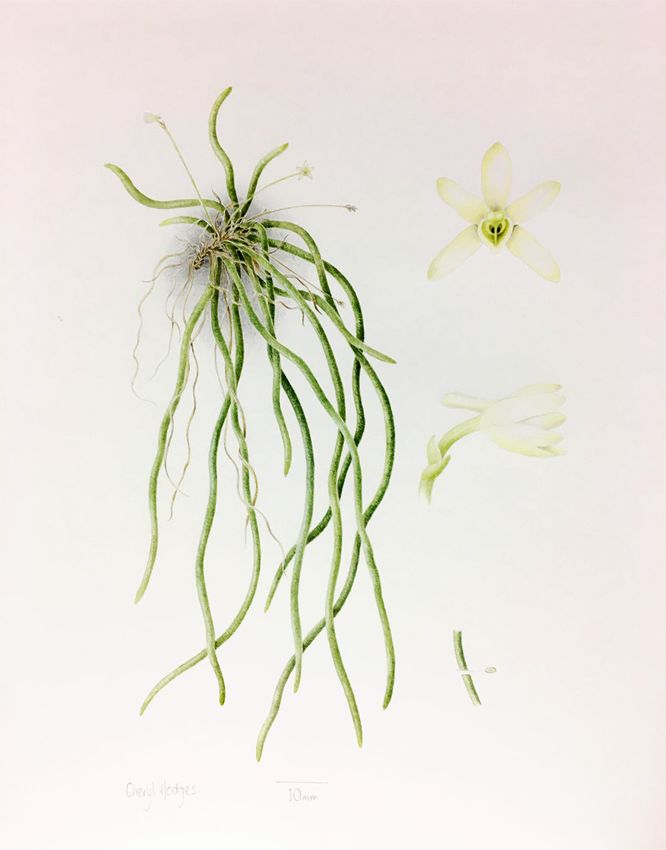
Clements et al., Taeniophyllum cylindrocentrum                                                  119
the rainforests of the McIlwraith Range and         with a cuneate pit; spur cylindrical, obtuse,
Iron Range of Cape York Peninsula (Lavarack         as long as the lip. Column very short, thick;
2011). Schlechter (1911–1914) noted that the        rostellum hammer-shaped. Anther ovate-
section, and some unique species therein            cucullate, long rostrate; pollinia obliquely
(such as the large-flowered T. macranthum           obovoid; stipe very slender, widened towards
Schltr.), was easily recognisable overall, based    the apex; viscidium linear-lanceolate, large.
on possession of tangled root masses mostly         Ovary subsessile, glabrous, 30 mm long (after
growing in the air. However, he also noted          Schlechter in Blaxell 1982).
that species delimitation within the section
                                                    Distribution and habitat: Taeniophyllum
was difficult, even with careful examination
                                                    cylindrocentrum is known from two
of the flowers – although root morphology
                                                    locations, one in northeast Papua New Guinea
appeared constant for each species.
                                                    and other in the McIlwraith Range, Cape
    This      record      of    Taeniophyllum       York Peninsula, Queensland, Australia. At
cylindrocentrum brings the number of species        the Australian location, this orchid occurs as
in this genus found in Australia and its island     a small twig epiphyte in low shrubs on the
territories to 13. This is in addition to the       margins of rainforest.
five new Taeniophyllum species recently
                                                    Notes: The holotype for this name was
described by Gray (2015, 2017, 2018). The
                                                    destroyed and no isotypes are known.
English translation of the original description
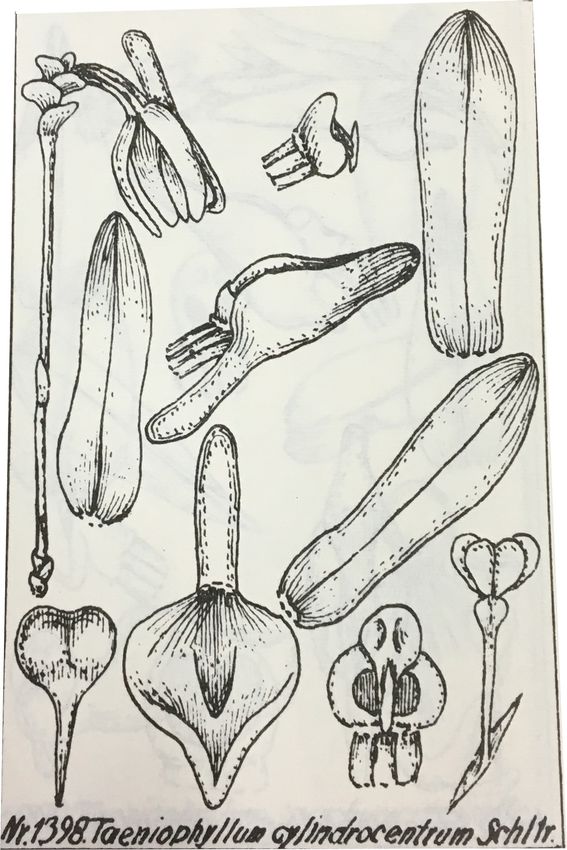
and Schlechter’s (1923–1928) illustration               The original protologue and illustration
(Fig. 1) of the T. cylindrocentrum species are      (Schlechter 1911–1914) provide a thorough
presented here.                                     description of the species. Lectotypification
                                                    using an herbarium specimen would bring
Taxonomy
                                                    additional value to an augmented description,
Taeniophyllum cylindrocentrum Schltr.,              not least the possibility of genetic sampling.
Repert. Spec. Nov. Regni Veg. Beih. 1:
                                                        Taeniophyllum cylindrocentrum can
1019–1020 (1913). Type citation: “Kaiser-
                                                    be distinguished from its congeners by the
Wilhelms-Land: Auf Bäumen in den Wäldern
                                                    combination of its distinctly broad labellum
des Kani-gebirges, c. 600 m ü. d. M. – R.
                                                    and the cylindrical shape of the spur, after
Schlechter no. 17873, blühend im Juni 1908.”
                                                    which it is named; the flowers are white-yellow
Type: Kaiser-Wilhelms-Land: On trees in the
                                                    (Schlechter in Blaxell 1982). To facilitate the
forest of the Kani Range, alt. c 600 m – R.
                                                    identification of T. cylindrocentrum, a colour
Schlechter no. 17873, flowering in June 1908
                                                    illustration (Fig. 2) was prepared by the artist
(holo: B†) (Schlechter in Blaxell 1982).
                                                    Cheryl Hodges based on the McIlwraith
Epiphytic, leafless, very slender; roots slightly   Range collection, Schlechter’s description,
flattened, flexuose, 1.25 mm wide, to 25 cm         illustration and notes particularly with
long, mostly hanging free from host, some           reference to flower colour and the comparison
appressed. Inflorescence densely several-           to living plants of the related T. malianum.
to many-flowered, tooth-like; including
                                                        Little is known about the ecology or
the hair-like peduncle to 6 cm long. Floral
                                                    biology of Taeniophyllum cylindrocentrum.
bracts deltoid, apiculate, much shorter than
                                                    Unlike the related species T. malianum,
the ovary. Flowers opening in succession,
                                                    which has a prominent nectiferous spur and
glabrous. Sepals oblong-ligulate, obtuse, 30
                                                    attracts mosquito-like species that can affect
mm long. Lateral sepals oblique. Petals similar
                                                    pollination, the spur of T. cylindrocentrum
to the sepals but somewhat shorter, oblique.
                                                    is relatively short and uniformly narrow,
Labellum very broadly ovate, as long as the
                                                    suggesting a different pollinator is attracted.
petals, narrowed towards the apex and with
swollen margins, subobtuse, in the middle
120 Austrobaileya 11: 118–123 (2021) Fig 1. Schlechter’s (1923–1928) original drawing of Taeniophyllum cylindrocentrum.
Clements et al., Taeniophyllum cylindrocentrum                                                                                    121
          Key to mainland Australian Taeniophyllum species (revised from Gray 2018)
1 Sepals and petals fused near the base forming a tube; flowers < 3 mm diameter .  .  .  .  .  .  2
1. Sepals and petals free to the base not forming a tube; flowers > 3 mm diameter.  .  .  .  .  .  . 6
2 Roots triangular or flattened in cross section.  .  .  .  .  .  .  .  .  .  .  .  .  .  .  .  .  .  .  .  .  .  .  .  .  3
2. Roots terete in cross section .  .  .  .  .  .  .  .  .  .  .  .  .  .  .  .  .  .  .  .  .  .  .  .  .  .  .  .  .  .  .  .  . 10
3 Roots triangular in cross section (having a raised longitudinal ridge).  .  .  T. triquetroradix
3. Roots flattened in cross section.  .  .  .  .  .  .  .  .  .  .  .  .  .  .  .  .  .  .  .  .  .  .  .  .  .  .  .  .  .  .  .  4
4 Peduncle not filiform, roots 2–3 mm broad; floral bracts overlapping,
		 hiding the rachis; flowers 4–5 mm long .  .  .  .  .  .  .  .  .  .  .  .  .  .  .  .  .  .  .  . T. confertum
4. Peduncle filiform, roots 1–1.5 mm broad; floral bracts not overlapping;
		 flowers 2–2.5 mm long .  .  .  .  .  .  .  .  .  .  .  .  .  .  .  .  .  .  .  .  .  .  .  .  .  .  .  .  .  .  .  .  .  .  .  5
5 Roots 1–1.5 mm broad; peduncle 12–15 mm long; rachis filiform; floral
		 bracts alternating c. 0.5 mm apart, all in one plane; flowers c.
		 2.5 mm long.  .  .  .  .  .  .  .  .  .  .  .  .  .  .  .  .  .  .  .  .  .  .  .  .  .  .  .  .  .  .  .  .  .T. explanatum
5. Roots up to 1 mm broad; peduncle 2–5 mm long; rachis not
		 filiform, fleshy, parallel sided, twice as wide as peduncle; floral
		 bracts alternating < 0.5 mm apart; flowers < 2 mm long.  .  .  .  .  .  .  .  .  .  .  . T. clementsii
6 Peduncle, rachis and ovary sparsely covered with erect short-bristly
		 hairs; flowers green, turning yellow with age.  .  .  .  .  .  .  .  .  .  .  .  .  .  .  .  .  . T. lobatum
6. Peduncle, rachis and ovary glabrous .  .  .  .  .  .  .  .  .  .  .  .  .  .  .  .  .  .  .  .  .  .  .  .  .  .  .  .  .  7
7 Peduncle filiform, roots, mostly hanging free from host, some appressed.  .  .  .  .  .  .  .  .  .  8
7. Peduncle not filiform, roots mostly appressed to host.  .  .  .  .  .  .  .  .  .  .  .  .  .  .  .  .  .  .  .  . 9
8 Roots flat in cross-section, green or grey; labellum spur widening near
		apex.  .  .  .  .  .  .  .  .  .  .  .  .  .  .  .  .  .  .  .  .  .  .  .  .  .  .  .  .  .  .  .  .  .  .  .  .  .  .T. malianum
8. Roots oval-shaped in cross-section; labellum spur uniformly
		 cylindrical.  .  .  .  .  .  .  .  .  .  .  .  .  .  .  .  .  .  .  .  .  .  .  .  .  .  .  .  .  .  .  . T. cylindrocentrum
9 Roots greyish green, flat in cross section, 2–3.5(–4) mm broad; peduncle
		 and rachis reddish, zig-zag from the base, 8–10 mm long; floral bracts
		 alternating 2–3 mm apart; flower 4.5–5 mm wide.  .  .  .  .  .  .  .  .  .  .  .  .  T. epacridicola
9. Roots green, ± terete in cross section, 1.5–2.1 mm broad; peduncle
		 up to 1 mm long, floral bracts overlapping hiding the rachis;
		 flower c. 4.5 mm wide. . . . . . . . . . . . . . . . . . . . . . . . . . . . . . . T. walkeri
10 Inflorescence with 4–8(–9) flowers,                              self-pollinating; sparsely
		 arranged flowers, 1.7–3 mm apart .  .  .  .  .                  .  .  .  .  .  .  .  .  .  .  .  .  .  .  .  .  .  .  . T. muelleri
10. Inflorescence with 6–20(–more) flowers,                       not self-pollinating; tightly
		 arranged flowers, 0.8–1.5 mm apart .  .  .  .                   .  .  .  .  .  .  .  .  .  .  .  .  .  .  .  .  .  .  .  . T. baumei
122 Austrobaileya 11: 118–123 (2021) Fig. 2. Taeniophyllum cylindrocentrum. Plant; open flower front view and side view; root showing cross-section. From (mostly) Clarkson 2436 (BRI). Del. Cheryl Hodges.
Clements et al., Taeniophyllum cylindrocentrum            123
References
Gray, B. (2015). Three new species of Taeniophyllum
       Blume      (Orchidaceae)    from    northern
       Queensland. Austrobaileya 9: 382–392.
  � (2017).    Taeniophyllum     walkeri    B.Gray
       (Orchidaceae), a new species from north
       Queensland. Austrobaileya 10: 65–69.
  � (2018).    Taeniophyllum     baumei      B.Gray
       (Orchidaceae), a new species from Cape York
       Peninsula, Queensland. Austrobaileya 10: 260–
       265.
Jones, D.L. (2021). A complete guide to the Native
       Orchids of Australia, 3rd edition. Reed New
       Holland Publishers Pty Ltd.: Sydney/Auckland.
Lavarack, P.S. (1980). Orchids of the McIlwraith
       Range. Australian Orchid Review 45: 90–105.
  � (2011). Expeditions to Cape York Peninsula North
       Queensland, Australia 1976–1989. Australian
       Orchid Research 6. Australian Orchid
       Foundation, DCP Group: Drouin, Victoria.
Schlechter, R. (1911–1914). Die Orchidaceen von
      Deutsch-Neu-Guinea. Repertorium Specierum
      Novarum Regni Vegetabilis, Beiheft 1: I–II, I–
      LXVI, 1–1079.
  � (1923–1928). Figuren-atlas zu den Orchidaceen
       von      Deutsch-Neu-Guinea.   Repertorium
       Specierum Novarum Regni Vegetabilis, Beiheft
       21: t. I–CCCLXXII.
  � (1982). The Orchidaceae of German New Guinea
       (incorporating the Figure Atlas to the above).
       In D.F. Blaxell (ed.), Translation of the German
       text from Die Orchidaceen von Deutsch-
       Neu-Guinea and including Figuren-atlas zu
       den Orchidaceen von Deutsch-Neu-Guinea.
       Australian Orchid Foundation, Essendon:
       Victoria.
Wood, J.J. (2014). Taeniophyllum. In A.M. Pridgeon
      et al. (eds.), Genera Orchidacearum Volume
      6 Epidendroideae (Part Three), pp. 299–305.
      Oxford University Press: Oxford.
You can also read


