Pocket Guide to the Native Bees of New Mexico
←
→
Page content transcription
If your browser does not render page correctly, please read the page content below
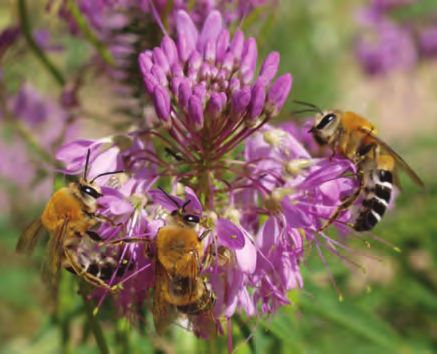
Pocket Guide to the
Native Bees of New Mexico
  Tessa R. Grasswitz, New Mexico State University
  Agricultural Science Center, Los Lunas, NM

  David R. Dreesen, Natural Resources Conservation
  Service Plant Materials Center, Los Lunas, NM

                         1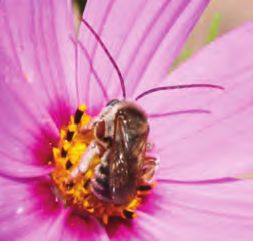
Contents
Introduction.......................................................... 3
Native bees and how they differ from honeybees...... 4
Habitat enhancement for bees................................ 7
Principal bee families of New Mexico...................... 9
Family: Andrenidae............................................. 10
Family: Apidae.................................................... 11
    1. Bumble bees............................................... 12
    2. Squash bees............................................... 13
    3. Digger bees................................................ 14
    4. Long-horned bees....................................... 15
    5. Mallow bees............................................... 16
    6. Cuckoo bees.............................................. 17
    7. Carpenter bees........................................... 18
Family: Colletidae............................................... 19
    1. Yellow-faced bees....................................... 19
    2. Plasterer bees............................................. 20
Family: Halictidae............................................... 21
Family: Megachilidae.......................................... 22
Predators and parasites of New Mexico bees......... 24
Other flower visitors............................................. 26
Suggested ‘pollinator plants’................................ 27
Further reading and other resources...................... 29

                                    2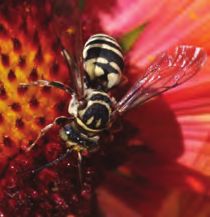
Introduction
Honeybees and wild native bees pollinate
approximately 75% of the fruits and vegetables
grown in the US. In recent years, however, honeybee
populations have declined in many parts of the world
due to the phenomenon known as Colony Collapse
Disorder. Research indicates that native bees can often
fill the ‘pollination gap’ when honeybees are scarce,
and there is increasing interest in growing flowering
plants to help sustain our native bees, honeybees, and
other beneficial insects. New Mexico State University
and the Natural Resources Conservation Service’s
NM Plant Materials Center are collaborating in testing
more than 200 species of (mostly native) plants for
their survival, ease of cultivation, and ability to attract
and sustain pollinators and other beneficial insects.
This publication, funded by the Western Integrated Pest
Management Center, is intended as an introductory
guide to the main groups of native bees that you
might expect to see visiting such plants. Information on
techniques for enhancing bee habitat is also included.

                             3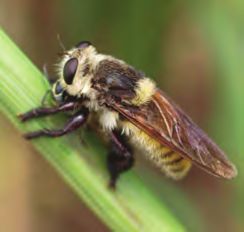
Native bees and
how they differ from
honeybees
The familiar European honeybee
(Apis mellifera), as its name
suggests, is not native to the
US, but is a semi-domesticated
species introduced to provide
honey and pollinate crops. Large-
scale fruit and nut growers often
rent hives of honeybees to ensure
pollination of their plants, and
the fact that honeybees can form
large ‘social’ colonies makes
them well-adapted to transport
and intensive management of
this type. Most native bees, in
contrast, are either ‘solitary’
species that nest and raise
their brood alone or form only
relatively small colonies (e.g.,     Honeybee on Helianthus
bumble bees (Bombus spp.)).          petiolaris (top) and
Some species show intermediate,      native bee on Phacelia
‘gregarious’ nesting behavior,       integrifolia (bottom).
whereby each female forms their
own nest but in close proximity to
the nests of other females of the
same species.
                             4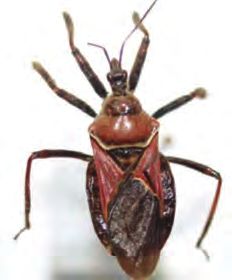
Ground nesting native bee on Gaillardia pinnatifida (left) and
entrance to her nest (right).

Preferred nesting sites vary:              but can be deterred
some native bees nest in the               from damaging
ground, excavating tunnels                 wooden structures
that may reach a foot or more              by applying paints
below the soil surface, while              or stains. The bees
others use existing holes in               typically provision
dead wood or hollow plant                  each ‘brood cell’
stems, eventually plugging the             (chamber) in the nest
entrance with mud or finely                with a ball of nectar
chewed plant material. The                 and pollen on which
so-called ‘carpenter’ bees                 their larvae feed and
(Xylocopa spp.) excavate their             develop.
own tunnels in dead wood,

                                  5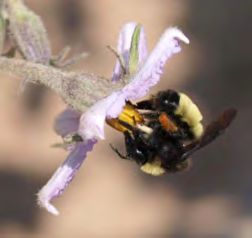
Native bees vary in the structure
and length of their mouthparts
and the degree to which
they specialize on particular
flowers. Some flowers (often
those with a tubular shape)
have nectaries inaccessible to
so-called ‘short-tongued’ bees
and are pollinated by species
with longer mouthparts. Some
bees are ‘generalists’ in their
foraging and will visit the flowers
of many different plants, while
others specialize on a much
more limited range of species.
When planting for pollinators,
try to include a broad range of
flower shapes, sizes, structures,
and colors to benefit as many
species as possible. Native
plants are excellent since our
wild bees are already adapted         Not all flowers are
to them. Species that bloom           equally accessible to all
in spring or autumn are               bees: flowers of Baptisia
particularly valuable, as floral      (top) and basil (Ocimum
resources are often scarce at         basilicum) (bottom).
these times.

                              6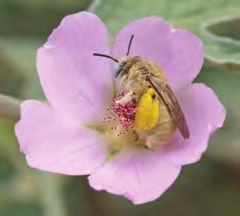
Habitat enhancement               empty the container
                                  every few days and
for bees                          allow it to dry out for
                                  several hours before
Any garden can be made more       refilling.
inviting for bees and other
beneficial insects. Remember
that even organically approved
insecticides can be toxic to
such species, so minimize their
impact by practicing integrated
pest management (IPM) and by
not spraying flowering plants
when pollinators are active.
Some systemic insecticides
(e.g., imidacloprid) can move
within the plant and reach
damaging concentrations in
nectar, so try to avoid such
products.
     Provide a source of clean
water, for example by filling
a shallow plant saucer with
pebbles and adding water until
they are partly submerged. The
exposed parts of the pebbles      Water dish with pebbles
provide landing sites for bees    (top) and honeybees
and other insects. To avoid       drinking at drip-irrigation
encouraging mosquitoes,           tape (bottom).

                           7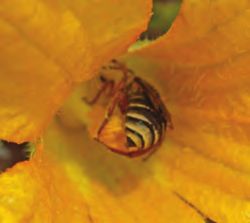
A homemade ‘bee house’ and close-up of bamboo nesting tubes:
some have been sealed with mud, others with chewed leaf material.

Nesting habitat for ground-             bamboo (with similar
nesting bees can be provided            diameters), cut with
by maintaining areas                    one end open and
of bare soil that remain                one closed (i.e., cut
undisturbed all year (such              just below a joint)
bees usually overwinter in their        can be packed into
subterranean nests). Habitat            an open container
for species that nest in holes          (open end outwards)
or plant stems can easily be            and used in a similar
provided by drilling holes in           way; place the
old tree stumps, untreated              packed container
logs, or scrap lumber. Holes            horizontally 3-4 feet
should be 4-5 inches deep               above ground in an
and with a variety of diameters         east-facing site.
from 3/32 to 3/8 inch.
Four- to 5-inch lengths of

                                8
Male long-horned bee
on Cosmos bipinnatus.
Females of this species
have much shorter
antennae.
Principal bee families of New Mexico
More than 4,000 species of fact that, in many
native bees occur in the US, cases, the female of
classified into 6 major families a species can look
(although there are more very different from the
elsewhere). Representatives of male. Nevertheless,
most of the US families are found all species within a
in New Mexico, although the family share certain
species are so diverse in size and characteristics
appearance that it is sometimes (although some
difficult for non-specialists to can only be seen
discern the basis on which with a microscope),
they are assigned to different and these distinctive
families. Bee identification is features form the basis
further complicated by the of their classification.
9in these two genera
Family: Andrenidae (i.e., Andrena and
(‘Miner’ bees) Perdita) make up
(various species) more than 80% of
US Andrenid bees.
All of the bees in this family
nest in the ground (usually
in sandy soil), giving them
the common name of ‘miner
bees’. They vary greatly in
size and general appearance,
although all have velvety
patches of hair (facial foveae)
between their eyes and the
bases of their antennae.
This family includes some
of the earliest species to
emerge in spring (e.g., the
Andrena species shown on
chokecherry, above right). In
many species, the adults are
active for only a few weeks Andrena sp. on Prunus
and the rest of the life-cycle virginiana (top) and
is spent below ground. Sizes Perdita sp. on Layia
of Andrenid bees vary greatly, platyglossa (bottom).
from approximately 16 mm in
length down to the tiny Perdita
bees (right), that can be just
a few millimeters long. Bees
10Family: Apidae
This is the largest and most
diverse bee family and is
divided into 3 subfamilies.
It includes honeybees and
bumble bees as well as less
well-known groups of native
bees such as long-horned
bees, digger bees, and squash
bees. The life-histories of these
bees are correspondingly
diverse, with solitary, social,
and gregarious nesters all
represented; some nest
above ground in cavities
(e.g., in dead wood), others
below ground. Some species
are even ‘cleptoparasites’
(“cuckoo bees”), taking over
the nests of other bees for
their own offspring.
Diversity of Apid bees:
honeybee (top), bumble
bee (center) and cuckoo
bee (bottom).
11Bumble bee (Bombus sp.)
‘buzz-pollinating’ an
eggplant flower: the
bee grasps the pollen-
bearing anthers with her
legs and rapidly vibrates
her wings to shake the
pollen free.
Family: Apidae bales. Compared to
those of honeybees,
Subfamily Apinae bumble bee colonies
are relatively small –
1. Bumble bees up to a few hundred
(Bombus species) workers. The queens
These familiar large, furry bees are active in early
are generally black with areas spring and the
of paler hairs (usually yellow or workers until the
white, depending on species). end of summer.
Mated queens hibernate Bumble bees are
overwinter and establish good pollinators of
small colonies in the spring, Solanaceous crops
either below ground (e.g., in such as tomatoes
abandoned rodent burrows) and eggplant.
or in places such as old straw
12Squash bee (Peponapis sp.)
the flowers, and the
Family: Apidae males can be found
Subfamily Apinae resting in the closed
blooms during the
2. Squash bees day. These bees are
(Peponapis species) brown with a striped
As their common name abdomen, and are
suggests, these bees specialize somewhat larger
on flowers of squash, than honeybees
pumpkins, melons, and their (but smaller than
wild relatives. They are more bumble bees). They
effective at pollinating such nest underground,
plants than are honeybees, often in large
and are active earlier in the aggregations.
morning. Mating occurs in
13Family: Apidae
Subfamily Apinae
3. Digger bees
(Anthophora species)
There are about 70 species of
Anthophora bees in the US,
with a considerable diversity
in New Mexico. Most are
relatively large, stout, hairy
bees (often grey in color)
that fly rapidly between
flowers. These so-called
‘long-tongued’ bees can
extract nectar from deeper
flowers such as those of some Two species of Anthophora:
native Penstemon species. on Physaria newberryi
As their name suggests, they (top) and Gaillardia
nest in the ground – some pinnatifida (bottom).
will even nest in heavy clay.
Like bumble bees (Bombus
spp.), some Anthophora
are important pollinators of
tomato plants.
14Male long-horned bee (Martinapis sp.) on lavender (left) and a
sleeping cluster on Helianthus petiolaris (right).
species visit a range
Family: Apidae of different flowers,
Subfamily Apinae while others are
more specialized;
4. Long-horned bees several species
(various species) are particularly
The long-horned bees (tribe associated with both
Eucerini) are so named wild and cultivated
because the males typically sunflowers. On
have very long antennae cool mornings,
(those of the females are aggregations of
much shorter, so that the males may some-
two sexes may at first glance times be found
be mistaken for different asleep on the
species). Most of these bees flowers.
nest underground. Some
15Female Diadasia sp. on
caliche globemallow
(Sphaeralcea laxa). Note the
pollen carried on the hairy
‘scopa’ of the hind leg.
have pale bands
Family: Apidae on their abdomens,
Subfamily Apinae giving them a striped
appearance. All are
5. Mallow, sunflower, or ground-nesting, and
cactus bees (Diadasia some protect the
species) entrance to their nest
There are about 30 species of by constructing short,
Diadasia in the US, mainly in the bent ‘towers’ of soil
western states. Different species particles. The species
are associated with different shown here is often
flowers, specializing to a greater found on flowers of
or lesser degree. Some species globe-mallows (e.g.,
are important pollinators of Sphaeralcea laxa and
commercial sunflower crops. S. ambigua).
Size and coloration vary, some
are uniformly pale, while others
16Cuckoo bees on Gaillardia pulchella (left) and Machaeranthera
pinnatifida (right).
Family: Apidae pollen, they lack the
specialized structure
Subfamily (scopa) that other
Nomadinae female bees possess
for this purpose
6. Cuckoo bees (e.g., (dense patches of
species of Epeolus modified hairs on
& Triepeolus) the legs or beneath
The subfamily Nomadinae the abdomen). The
is comprised only of Nomadinae are
cleptoparasitic ‘cuckoo bees’ generally less hairy
that take over the nests and than most bees, and
stored pollen of other bees can look more like
for their own offspring. Since wasps than ‘typical’
these bees do not collect bees.
17Carpenter bee
(Xylocopa sp.).
Note shiny
abdomen.
Family: Apidae by chewing out
Subfamily tunnels, but can
be prevented from
Xylocopinae damaging wooden
structures by
7. Carpenter bees painting or staining
(Xylocopa species) the timber. They
These are very large bees produce only a few,
that look at first glance very large eggs—
like bumble bees, but have perhaps 8 or less in
a shiny abdomen with their lifetime—but
relatively few hairs. Males show a greater
can be territorial and ‘buzz’ degree of maternal
around humans, but cannot care than do most
sting. The females create native bees.
nesting holes in dead wood
18Hylaeus sp. on Melampodium leucanthum (left) and in front view
showing yellow ‘face’ (right).
Family: Colletidae species) are small,
nearly hairless bees,
1. Yellow-faced bees mostly black in
(Hylaeus species) color with yellow or
The Colletidae is a small, white markings on
relatively primitive family the legs, face, and
of bees that includes thorax (just behind
species with very different the head). They
appearances, although look superficially
all of them have eyes that similar to small
slant slightly toward the wasps. Most of
mouth (when viewed from these species nest
the front), giving them a in hollow stems
slightly ‘heart-shaped’ face. or twigs.
Within the Colletidae, the
yellow-faced bees (Hylaeus
19Family: Colletidae
2. Plasterer bees
(various species)
Other members of this
family nest below ground
and line their brood
chambers with a glandular
secretion that makes it
waterproof. Some Colletes
species are highly specialized
foragers, visiting only a
few plant species. One
New Mexico species ‘buzz
pollinates’ the flowers
of tomatillo (Physalis
philadelphica) by grasping
the pollen-bearing structures
(anthers) with her legs, then
rapidly vibrating her wings
to shake the pollen free. Two Colletid bees:
Caupolicana yarrowi
on Dalea candida
(top) and a Colletes
sp. buzz-pollinating
a tomatillo flower
(bottom).
20Family: Halictidae
(Sweat bees) (various
species)
The Halictidae – another very
diverse group of bees–includes
some of New Mexico’s most
colorful species. Most nest in
the ground, although some
of the metallic green or blue
species nest in rotting wood.
This family includes important
pollinators of alfalfa seed
crops, commercial sunflowers,
and watermelons. Species in
one genus (Sphecodes) are
cleptoparasites – i.e., they
act as cuckoo bees, laying
their eggs in the nests of other
Halictid species. The family
gets its common name from a
few species that are attracted Top to bottom: Halictid
to human sweat for its salt bees on skunkbush
content. sumac (Rhus trilobata),
goldenrod (Solidago sp.),
and Emory’s baccharis
(Baccharis emoryi). Not all
halictids are this colorful.
21Family:
Megachilidae
(Leaf-cutter, mason,
carder, and blue
orchard bees)
Most members of this family
nest in holes in dead wood
or in hollow twigs; they
get their common name
because they use chewed
leaves or mud to construct
and seal their nests (a partial
protection against predators
and parasites). Some of
these species cut neat,
almost circular holes from Cottonwood leaf damaged
the edges of cottonwood or by leaf-cutter bee (top)
rose leaves (above right); and female Megachilid on
generally, though, this Baccharis emoryi (bottom).
damage is not sufficient Note the pale pollen-
to affect the growth of the collecting hairs (scopa)
plant. A unique feature beneath the abdomen.
of this family is that the
females collect pollen not
on their legs but on the hairy
undersurface (scopa)
of the abdomen.
22Coelioxys female on goldenrod (Solidago sp.) (left) and a carder bee
(Anthidium sp.) on Machaeranthera pinnatifida.
Several members of (Anthidium spp.)
the Megachilidae are (above right) that
cleptoparasites, taking over line the brood cells
the nests of other solitary of their nests with
bees. This includes the hairs combed or
Coelioxys species shown ‘carded’ from plant
above (left), which can be leaves. Anthidium
recognized by its distinctive species somewhat
pointed abdomen. The resemble small
family also includes the wasps, but lack
blue orchard bee (Osmia complete bands of
lignaria) (a more efficient color across the
pollinator of fruit trees abdomen.
than the honeybee) and
the so-called ‘carder’ bees
23A bee-mimicking robber fly waiting for prey (left) and with captured
long-horned bee (right).
Predators and parasites
of New Mexico bees
When bee numbers increase pair of wings and
as a result of providing is a bee predator.
habitat for them, their It perches close to
natural enemies are likely to flowers and can
increase as well. The robber intercept bees
fly (family Asilidae), shown in flight.
above may look superficially
like a bee, but has only one
24Bee assassin bug (left), Chrysidid wasp (top right) and bee fly
(bottom right).
The ‘bee assassin’ bug (above parasites, laying their
left) is a ‘sit-and-wait’ predator eggs inside the nests
that ambushes bees as they of various solitary
visit flowers. Both the bee bees. Adult bee
fly (family Bombyliidae) and flies are particularly
the brightly colored cuckoo common in late
wasp (family Chrysididae) summer and early
(which resembles some of our autumn.
metallic bees) are actually
25Other visitors to New Mexico pollinator plantings: butterflies
(above), predatory wasps (2 species), and a hoverfly (left to right,
second row).
Other flower visitors
Pollinator plantings also include the larval
attract other visitors, such as host plants for the
the butterflies shown above. species of interest.
While not very effective as Of rather more
pollinators, butterflies can value to gardeners
add greatly to the enjoyment are the various
that such plantings can predatory wasps
provide. If trying to create a and hoverflies that
garden mainly for butterflies, can help to control
however, remember to pest insects.
26Suggested ‘pollinator plants’
In our initial trials, the following plants have been
shown to attract honeybees, a variety of native bees,
predatory wasps, and some butterflies. A good planting
mix should include species that flower at different
times of the year, as well as provide a diversity of
flower shapes, sizes, colors, and structures. Many of
the species below are shown in the photographs of the
various bee species.
Spring-flowering shrubs:
Native willows (e.g., Salix lasiolepis and S. irrorata),
skunkbush sumac (Rhus trilobata), American plum
(Prunus americana), New Mexico olive (Forestiera
pubescens), chokecherry (Prunus virginiana).
Summer-flowering annuals:
Prairie sunflower (Helianthus petiolaris), Rocky
Mountain beeplant (Cleome serrulata), Blue-headed
gilia (Gilia capitata), golden crownbeard (Verbesina
encelioides), basil (Ocimum basilicum).
27Summer-flowering perennials:
Firewheel/blanket flower (Gaillardia pulchella),
red dome blanket flower (Gaillardia pinnatifida),
whorled mountain mint (Pycnanthemum verticillatum),
white prairie clover (Dalea candida), stiff greenthread
(Thelesperma filifolium), catmint (Nepeta cataria),
showy goldeneye (Heliomeris multiflora), Mexican
hat (Ratibida columnifera), fernbush (Chamaebatiaria
millefolium).
Late summer- and autumn-flowering
species: Globemallows (Sphaeralcea species),
Emory’s baccharis (Baccharis emoryi) (especially male
plants), sneezeweed (Helenium autumnale), native
goldenrods (Solidago nemoralis, S. petiolaris, and
S. speciosa).
28Further reading and other resources
Grasswitz, T. R. (2011). Integrated Pest Management
(IPM) for Home Gardeners (Circular No. 655;
4 pp). Las Cruces, NM: NMSU Cooperative
Extension Service. Available on-line at: http://aces.
nmsu.edu/pubs/_circulars/cr-655/welcome.html
Mader, E., Shepherd, M., Vaughan, M., Hoffman
Black, S. and Le Buhn, G. (2011). Attracting native
pollinators. 372 pp. Storey Publishing.
Moisset, B. and Buchmann, S. (2011). Bee basics: An
introduction to our native bees. 40 pp. Published
by the USDA, US Forest Service and Pollinator
Partnership. Available on-line at: http://www.
pollinator.org/ PDFs/BeeBasicsBook.pdf
New Mexico ‘Plants for Pollinators’ project website:
http://aces.nmsu.edu/ipm/pollinator-project.html
All photographs taken by the authors.
29Cooperative Extension Service
Agricultural Experiment Station
New Mexico State University is an equal opportunity/
affirmative action employer and educator. NMSU and the U.S.
Department of Agriculture cooperating.
USDA is an equal opportunity provider and employer.
30You can also read


