2020 PRACTICE of Professional Engineers Registration Examination
←
→
Page content transcription
If your browser does not render page correctly, please read the page content below
Professional Engineers Registration Examination

PRACTICE
of
Professional
Engineering
Examination
2020

            professional engineers board Singapore
          52 Jurong Gateway Road #07-03 Singapore 608550
Page 1
Professional Engineers Registration Examination
Practice of Professional Engineering Examination 2020
Information for Applicants
Contents Page
1 Introduction ....................................................................................... 2
2 Description of Examination .................................................................. 2
3 Eligibility to Sit for Examination ............................................................ 2
4 Fees .................................................................................................. 3
5 Date of Examination ............................................................................ 3
6 Venue ................................................................................................ 3
7 Application ......................................................................................... 3
8 Structure of Examination ..................................................................... 3
9 Passing Requirements Final Results and Notification .............................. 4
10 Review Courses …………………………………………………..………..4
11 Refund of Fees ……………………………………………………………..4
12 Request for Accommodation ………………………………………………………………5
Annex A: FORMAT, SYLLABUS AND SAMPLE QUESTIONS
I Practice of Professional Engineering Examination - Part 1 (Common)…………. 6
II Practice of Professional Engineering Examination - Part 2 (Civil) ................... 9
III Practice of Professional Engineering Examination - Part 2 (Electrical) .......... 15
IV Practice of Professional Engineering Examination - Part 2 (Mechanical) ....... 26
V Practice of Professional Engineering Examination – Part 2 (Chemical)……….. 35
Professional Engineers Registration Examination PPE 2020Page 2
Professional Engineers Registration Examination
Practice of Professional Engineering Examination 2020
Information for Applicants
1 INTRODUCTION
The mission of the Professional Engineers Board is to safeguard life, property, and
welfare of the public by setting and maintaining high standards for registering
professional engineers and by regulating and advancing the practice of professional
engineering.
The Professional Engineers Board registers professional engineers in the branches of
civil, electrical, mechanical and chemical engineering. A person applying for
registration as a professional engineer to the Professional Engineers Board is required
to hold an approved degree or qualification listed in the Professional Engineers
(Approved Qualifications) Notification and acquired not less than 4 years of relevant
practical experience. He is also required to sit and pass examinations prescribed by
the Board. In addition, the applicant is required to attend an interview.
The following sections set out the requirements and details for the Practice of
Professional Engineering Examination 2020 while details on other application
requirements are available on the PEB website at www.peb.gov.sg.
2 DESCRIPTION OF EXAMINATION
The Practice of Professional Engineering Examination tests the applicant’s ability to
apply his knowledge and experience in professional engineering practice, and his
knowledge of the rules and regulations regulating the practice of professional
engineering in civil, electrical, mechanical or chemical engineering.
3 ELIGIBILITY TO SIT FOR EXAMINATION
A person may apply to sit for the Practice of Professional Engineering Examination
after he has-
(a) obtained not less than 2 years 6 months of practical experience in
engineering work relevant to the branch of engineering that he seeks to
be registered in; and
(b) sat for and passed the Fundamentals of Engineering Examination.
Professional Engineers Registration Examination PPE 2020Page 3
4 FEES
The fee for an application to sit for the Practice of Professional Engineering
Examination is $450.
5 DATE OF EXAMINATION
The dates for the Practice of Professional of Engineering Examination 2020 are:
a) Civil Engineering - 27 May 2020
b) Electrical Engineering – 27 May 2020
c) Mechanical Engineering – 27 May 2020
d) Chemical Engineering – 27 May 2020
6 VENUE
The venue would be determined by PEB and successful applicants would be informed
of the details of the venue.
7 APPLICATION
Application and payment shall be made online at PEB’s website by 9 March 2020. All
required documents are to be submitted to PEB within a week after application is made
online. Applicants are advised to send in their applications early to allow time for
processing. They would be informed of the status of their applications and other details
by post at least two weeks before the examinations.
8 STRUCTURE OF EXAMINATION
A summary of the structure of the Practice of Professional Engineering Examination
2020 is shown in the table below. The examination is ‘open book’ and further details
are given in Annex A: Format, Syllabus and Sample Questions.
Subjects Time Allocated Format
Answer 10 compulsory
Multiple Choice
PPE Part 1
2 hrs 10 mins Questions
Common paper
(9.00 am – 11.10 am) Answer 3 out of 5 essay
questions
Professional Engineers Registration Examination PPE 2020Page 4
PPE Part 2
Answer 1 compulsory
Civil/mechanical/
4 hrs 10 mins question plus 4 out of 7
electrical/chemical
(1.00 pm – 5.10 pm) questions
engineering
(Note: For PPE 2020 Part 2 Civil, only answers based on Eurocodes will be accepted.
Answers based on Singapore/British Standards will not be accepted.)
9 PASSING REQUIREMENTS, FINAL RESULTS AND NOTIFICATION
(a) A candidate is required to take both Parts 1 and 2 when he sits for the
examination unless he qualifies for an exemption as described in (b)
below. Examination results will be given to candidates on a Pass/Fail
basis and no scores or marks will be given to candidates. To obtain a
‘Pass’ in the examination, a candidate is required to obtain a pass score
in both Parts 1 and 2 respectively.
(b) A candidate who has taken both parts when he sits for the examination
and obtains a pass score in only one of the two parts is deemed to have
failed the examination. However, if he sits for the examination again, he
would be granted an exemption from the part for which he has obtained
a pass score. This exemption shall be granted provided the candidate
sits for the examination again within a 3-year period from the date of
result. With the exemption, he would only need to take the part of the
examination for which he did not obtain a pass score. No exemption shall
be granted if he sits for the examination again after the exemption
period, in which case he is required to take both Parts 1 and 2.
(c) Examination results will be mailed to the candidates within twelve weeks
after the examination.
10 REVIEW COURSES
The Board does not endorse any review course or material provided as study aids.
11 REFUND OF FEES
Where an applicant who has been accepted is unable to sit for the examination
subsequently, the Board may, at its discretion, refund $150 to the applicant if the
applicant submits a medical certificate by mail within 2 weeks after the examination.
There will be no refund if the applicant sends a scanned copy of medical certificate
via email.
Professional Engineers Registration Examination PPE 2020Page 5 12 REQUEST FOR ACCOMODATION A candidate who has disabilities may submit a written request for accommodation. The request is to be received by PEB not later than 6 weeks before the date of examination and late request would not be considered. PEB’s decision will be conveyed to the applicant by written mail not later than one week before the examination date. Professional Engineers Registration Examination PPE 2020
Page 6

Annex A: FORMAT, SYLLABUS AND SAMPLE QUESTIONS

 I  Practice of Professional Engineering Examination Part 1
(Common)

Professional conduct and ethics are important areas because most of the
disciplinary actions taken by the Professional Engineers Board are in the area
of ethics and not technical matters. Professionalism and ethics are closely
related and inseparably bound as professional status and recognition are based
on public interest. A professional engineer’s judgment and decisions can have
great impact on public health and safety. He is expected to uphold the dignity,
standing and reputation of the profession. He shall practise ethically in relation
to his clients, employers, fellow professionals and the public at large.

Format

This is a common paper which has two sections on the Professional Engineers
Act and Professional Conduct and Ethics. The paper comprises 10 multiple
choice questions (MCQs) and 5 essay type questions based on hypothetical case
studies. The candidates must answer all the 10 compulsory MCQs (25 marks)
and can choose to answer any 3 out of the 5 essay questions (75 marks) during
the 2 hrs 10 mins examination period.

Syllabus

The paper will focus on the latest revisions of the following Professional
Engineers Act and Rules:

-        Professional Engineers Act

-        Professional Engineers (Code of Professional Conduct and Ethics) Rules

-        Professional Engineers Rules

References will also be made to past disciplinary actions taken by the
Professional Engineers Board arising from complaints against professional
engineers.

Questions will be set to test the candidates’ understanding and interpretation
of the provisions in the act and rules as well as how they will tackle hypothetical
cases involving the clients, the employers, fellow professionals and the public
at large.

Professional Engineers Registration Examination PPE 2020
Page 7

Sample Questions From Past Year Papers for Practice of Professional
Engineering Examination Part 1 (Common)

Section A - Answer 10 Multiple Choice Questions – each at 2.5 marks
(COMPULSORY)

1        Under what circumstances shall a professional engineer advise the client
         to engage the services of experts and specialists?

         (a) The professional engineer shall give the advice when in his opinion
             and judgment such services are in the interest of his client.
         (b) The professional engineer shall give the advice when he feels such
             services will pass the responsibility to others.
         (c) The professional engineer shall give the advice when he can
             indirectly benefit from the appointment of experts and specialists.
         (d) The professional engineer shall give the advice when he considers
             that in doing so the cost input of his company will be reduced.

2        A professional engineer may publicise his practice. However, in doing so,
         the professional engineer shall ensure that the publicity —

         (a) contains information that is related to all the projects undertaken
             by him or his company but without the consent of the clients.
         (b) contains only information beneficial to his business even though it
             is likely to diminish public confidence in the engineering profession
             or to otherwise bring the profession into disrepute.
         (c) contains only justifiable claims to expertise or specialization; makes
             no reference to past project information which constitutes a breach
             of confidentiality to the client; and does not compare or criticise the
             quality of services provided by any other professional engineer or
             allied professional.
         (d) contains information with material facts even if it may create an
             unjustified expectation about the results that can be achieved by
             him.

3        Engineer A provides design, plans and specifications for a commercial
         building to Developer P who submits them to the authority for approval
         but fails to pay Engineer A for the work performed. Thereafter,
         Developer P asks Engineer B to review, endorse and resubmit the plans
         to the authority for approval. Shall Engineer B agree to undertake the
         project?

         (a) Engineer B shall not agree to undertake the project as he has an
             ethical obligation to recognise and give credit to the creative works
             of other engineers.
         (b) Engineer B shall agree to undertake the project as long as Engineer
             A does not complain.
Professional Engineers Registration Examination PPE 2020
Page 8
(c) Engineer B shall agree to undertake the project as Engineer A does
not know.
(d) Engineer B shall agree to undertake the project as he is employed
by the Developer.
Section B - Answer 3 Out Of 5 Essay Questions (each at 25 marks)
Question 1
Engineer A, on behalf of the engineering firm of which he is a principal,
submitted a statement of qualifications to a developer for a mega project.
In due course he was notified that his firm was on the "short list" for
consideration along with several other firms, but it was indicated to him that
his firm did not appear to have qualifications in some specialised aspects of the
requirements, and that it might be advisable for the firm to consider a joint
venture with another firm with such capabilities.
Engineer A thereupon contacted Engineer B, a principal of a firm with the
background required for the specialised requirements, and inquired if Engineer
B’s firm would be interested in a joint venture if Engineer A was awarded the
job. Engineer B’s firm responded in the affirmative.
Thereafter, Engineer C, a principal in a firm which was also on the "short list,"
contacted Engineer B and indicated the same requirement for a joint venture
for specialised services, and also asked if B’s firm would be willing to engage in
a joint venture if the C’s firm was selected for the assignment. Engineer B also
responded in the affirmative to Engineer C but did not notify Engineer A of his
response to Engineer C.
Is it ethical for Engineer B to agree to participate in a joint venture arrangement
with more than one of the several since he did not make a full disclosure to all
of the firms?
Discuss the issues and comment on Engineer B‘s conduct with reference to
relevant sections of the Professional Conduct and Ethics rules where applicable.
Professional Engineers Registration Examination PPE 2020Page 9
II Practice of Professional Engineering Examination Part 2 (Civil)
The paper aims to examine the candidates on their proficiency in the practice of
civil/structural engineering at a professional level. Candidates are expected to
have a good working knowledge and experience of civil/structural engineering
design and practices in Singapore. In particular knowledge is required in the
areas of regulatory framework, submission and approval procedures, statutory
acts and regulations, practices guidelines and codes of practice.
The examination will place emphasis on the Professional Engineer’s role in
building projects in the local context either acting as the Qualified Person for the
project or Professional Engineer for the civil and structural engineering works.
Format
This is a 4 hrs 10 mins paper and a candidate is required to answer 1 compulsory
question covering the design of concrete and steel structures and choose 4 out
of 7 questions covering areas of design, codes of practice, acts and regulations,
submission/approval procedures & site supervision. The candidates may bring
along their own reference materials and calculators as necessary.
(Note: For PPE 2020 Part 2 Civil, only answers based on Eurocodes will be
accepted. Answers based on Singapore/British Standards will not be accepted.)
Syllabus
The list of reference literature, codes, acts, regulations, etc., appended below is
meant as a guide and is not exhaustive. The latest Acts and Regulations,
Publications and Civil Engineering Codes /Standards will apply.
Acts and Regulations
Professional Engineers Act and Regulations
Building Control Act and Regulations
Publications
URA
- Planning Control Handbooks and Guidelines for Building Works
SCDF
- Code of Practice for Fire Precautions in Buildings
- Handbook on Fire Precautions in Buildings
- FSSD Fire Safety Handbooks
LTA
- Guidelines & Publications on Rapid Transit Systems
Professional Engineers Registration Examination PPE 2020Page 10
- Building Works & Restricted Activities in Railway Protection
Zone
- Street Proposals
- Vehicle Parking
- Other Guidelines and Standards
NEA
- Code of Practice on Environmental Health
- Code of Practice on Pollution Control
PUB
- Code of Practice on Surface Water Drainage
- Standard Specifications for Drainage Works
- Code of Practice on Sewerage and Sanitary Works
- Sewerage and Drainage Standard Drawings
NParks
- Procedures and Guidelines for Plan Submissions
MOM
- Workplace Safety & Health Act and Subsidiary Legislations
BCA
- National Productivity and Quality Specification (NPQS)
- Guidelines and Handbooks on Civil Defence Shelters
- Code of Practice on Buildable Design
Civil Engineering Codes/Standards
- Codes and Standards under Building Control Act and
Regulations
- Codes and Standards for Roads and Transit Systems to LTA's
Requirements
Professional Engineers Registration Examination PPE 2020Page 11
Sample Questions From Past Year Papers for Practice of
Professional Engineering Examination Part 2 (Civil)
Section 1- Question 1 (20 marks) is COMPULSORY
Question 1
A segment of a long pipe rack system is shown in Figure Q1-1. The main
structural system comprises columns spaced at 6m centre to centre supporting
a central spine beam connected the columns. The cantilever beams that support
the four water pipes are spaced at 2m centre to centre. The 500mm diameter
water pipes have a self-weight of 2 kN/m length and when the pipe rack system
is in operation the variable action is 2 kN/m length. The arrangement of pipe
rack system with dimensions is shown in Figure Q1-2.
The section of the cantilever beams and central spine beams are both UB
305x165x40. The section of the columns is UC 203x203x60 (Class 1 section) of
5m height. The columns are rigidly connected via baseplates to concrete
footings. The bottom flange of the cantilever beams are welded to the top
flange of the central spine beam. The client expects the pipe rack system to be
designed to cater for any configurations in the use of the pipes during operation
and during maintenance periods.
All steel sections are grade 355 N/mm2. Steel section properties are provided
in Annex. Refer to figure Q1-1 for additional information.
Figure Q1-1 Isometric View showing typical bays
Professional Engineers Registration Examination PPE 2020Page 12
Question 1 (Cont’d)
Central Spine Beam
Cantilever Beam with Stiffener Plate
Column
Fixed end support
Figure Q1-2 Elevation view
(a) Under a critical loading case when two pipes are removed for maintenance
on one side of the pipe rack, determine and sketch the ultimate bending
moment and torsional moment diagram of the pipe rack system, including
the central spine beam, cantilever beam and column
(b) State the effective length (bucking length) to be considered for the design
of the columns and the cantilever beams with explanation.
(c) Check the adequacy of the column to SS EN 1993 using the critical load
case in Q1 (a).
(d) Suggest possible improvements with justifications to the pipe rack system
in a clear sketch.
Professional Engineers Registration Examination PPE 2020Page 13
Section 2 - Answer 4 Out Of 7 Questions (each at 20 marks)
Question 2
A new 10-storey commercial development is located in a built up area of
Singapore. The proposed grid is 8m x 8m. One side of the site boundary is 6m
from the MRT 1st Reserve Line. Crown level of the existing 6m diameter MRT
Tunnel is at RL 85. There is a set back requirement of 5m from the boundary.
Platform Level is RL 100. The soil investigation report is provided by URA during
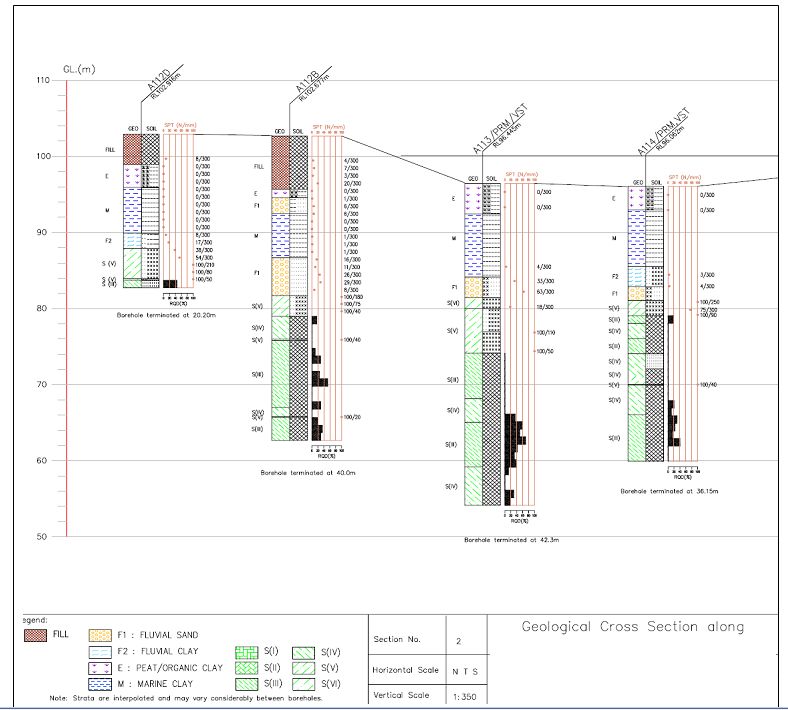
land sale (Figure Q2-1).
(a) Propose the foundation type, justify with preliminary calculations and give
reasons for your recommendation.
(b) State the consideration for Rail Way Protection Requirement and illustrate
with diagrams.
(c) List the structural submission requirements of BCA and LTA.
Figure Q2-1
Professional Engineers Registration Examination PPE 2020Page 14
Question 3
While carrying out piling works for a single-unit housing development, it is
reported by the Builder that there is an existing 200 mm diameter minor sewer
present within the site as shown in Figure Q3. What is the immediate action
that must be taken to safeguard the minor sewer?
List down the proper procedures to be followed to prevent a similar situation
from occurring in the future.
It has been decided that the minor sewer shall be diverted to another location
within the site, avoiding the new proposed building. Sketch out a feasible
proposal for the diversion works within the site indicating the size, gradient and
levels of the proposed new sewer line.
Figure Q3
Professional Engineers Registration Examination PPE 2020Page 15
II Practice of Professional Engineering Examination Part 2
(Electrical)
The paper aims to examine the candidates on their proficiency in the practice of
electrical engineering at a professional level. Candidates are expected to have a
good working knowledge and experience of electrical engineering design and
practices in Singapore. In particular knowledge is required in the areas of
regulatory framework, submission and approval procedures, statutory acts and
regulations, practices guidelines and codes of practice.
The examination will place emphasis on the Professional Engineer’s role in
building projects in the local context in relation to electrical engineering works.
Format
This is a 4 hrs 10 mins paper that examines candidates on technical competency
and understanding of standards and codes that are applicable in Singapore for
the discipline of electrical engineering.
The paper consists of 2 Sections and 8 questions. Candidates must answer
questions in both sections (Section 1 and Section 2). Section 1 consists of a
compulsory question on SS 638, statutory acts and regulations. Candidate is
required to answer this compulsory question. Section 2 consists of 7 questions.
Candidates shall choose to answer 4 out of 7 questions.
Syllabus
Codes of Practice
SS 638: Code of practice for electrical installations
SS 626: Code of practice for design, installation and
maintenance of escalators and moving walks
CP 39: Installation of MATV for the reception of VHF and UHF
sound and TV
SS 650 - 1 : Code of practice for temporary electrical
installations - Construction and building sites
SS 650 - 2 : Code of practice for temporary electrical
installations - Festive lighting, trade-fairs, mini-fairs and
exhibition sites
CP 88 - 3 : Code of practice for temporary electrical installations
- Shipbuilding and ship-repairing yards
Professional Engineers Registration Examination PPE 2020Page 16
SS 530: Code of practice for energy efficiency standard for
building services and equipment.
SS 531-1: Code of practice for lighting of work places – Indoor.
SS 531-2: Code of practice for lighting of work places – Outdoor.
SS 531-3: Code of practice for lighting of work places - Lighting
requirements for safety and security of outdoor work places.
SS 532: Code of practice for the storage of flammable liquids.
SS 535: Installation, operation, maintenance, performance and
construction requirements of mains failure and standby
generating system.
SS 538: Code of practice for maintenance of electrical
equipment of electrical installations.
SS 546: Emergency voice communication system in building.
SS 550: Installation, operation and maintenance of electric
passengers and goods lifts.
SS 551: Code of practice for earthing.
SS 555-1 : Code of practice for protection against lightning –
General requirement.
SS 555-2 : Code of practice for protection against lightning –
Risk management.
SS 555-3 : Code of practice for protection against lightning –
Physical damage to structures and life hazard.
SS 555-4 : Code of practice for protection against lightning –
Electrical and electronic systems within structures.
SS 558: Code of practice for construction, installation, operation
and maintenance of intruder alarm systems.
SS 563-1: Code of practice for the design, installation and
maintenance of emergency lighting and power supply systems in
buildings. Part 1 : Emergency lighting.
SS 563-2: Code of practice for the design, installation and
maintenance of emergency lighting and power supply systems in
buildings. Part 2 : Installation requirements and maintenance
procedures.
Professional Engineers Registration Examination PPE 2020Page 17
SS 564-1: Green data centres - Part 1 : Energy and
environmental management systems
SS 564-2: Green data centres - Part 2 : Guidance for energy and
environmental management systems
SS 576: Code of practice for earthworks in the vicinity of
electricity cables.
SS 601: Code of practice for maintenance of grid-tied solar
photovoltaic (PV) power supply system
SS 645: Code of practice for the installation and servicing of
electrical fire alarm systems
TR 25: Technical Reference for electric vehicle charging system
Electricity Act
Electricity (Electrical Installations) Regulations
Handbook for Application of Installation Licence, published by
EMA
Fire Code & Fire Code Handbook
BCA Green Mark Assessment Criteria published by BCA
Code on Accessibility in the Built Environment published by BCA
Handbook for solar photovoltaic system (PV) Systems, published
by BCA and EMA
How to Apply for Electricity Connection, published by SP Group
Code of Practice for Info-communication Facilities in Buildings
(COPIF) published by IMDA
Electrical Power Supplies, Tariffs and Design
Electricity market
Generation, transmission and distribution in Singapore
Electricity bill calculation for HT and LT consumers
Design of electrical installations
Load estimation
Professional Engineers Registration Examination PPE 2020Page 18
Power factor correction
Power quality and power system harmonics
Consumer Substation, Switchboards and Switchgears
Maintenance of electrical equipment, switchgears and cables
Design for energy efficiency and sustainability
Lighting requirement for workplace, indoor and outdoor
Visual needs for safety and security
Determine the lighting requirements for indoor and outdoor work
places.
Energy efficiency and accessibility requirement for buildings
Minimum energy-efficiency requirements for new installation and
replacement of systems and equipment in buildings
Replacement of components of systems and equipment in
buildings
Criteria for determining compliance with energy efficiency in
building with regards to air-conditioning and heat rejection
equipment, water heaters, motor drives and lighting used in
buildings.
Requirement and guidelines for buildings to be designed or
retrofitted to provide accessibility and safety to persons with
disabilities and families with young children.
Protection for Safety
Measures in protection against electric shock (direct and indirect)
Principle of operation of protective devices
Maximum demand and diversity factors
Protection against over-current and short circuits
Protective devices and circuit conductors
Discrimination in protection of electrical circuits
Professional Engineers Registration Examination PPE 2020Page 19
Cables, Busways, and Distribution Boards
Type and characteristic of cables
Method of installation
Sizing of conduit and trunking
Factors affecting the current carrying capacity of cables
Sizing of cables and busways for use under different types of
conditions
Connected load, maximum demands and circuit breakers ratings
for a electrical distribution board
Earthing
Purpose of earthing
Methods of earthing
Earth fault loop impedance and earth fault current
Suitable sizes of circuit protective conductor
Testing of earthing
Lightning Protection Systems
Rolling sphere technique of determining zones of protection
Spacing of air terminations and types of air termination
Down conductors for building below 45 m and those exceeding
45 m
Earth electrodes, earth resistance values and hazards of a rise in
ground potential caused by lightning strike
Selection of appropriate materials and installation methods
Prevention of side flashing
Design requirement of complete lightning protection system
Transients and surge suppression
Effect of lightning on system and structure
Professional Engineers Registration Examination PPE 2020Page 20
Source and type of damages due to lightning
Risk assessment aspect in lightning protection
Emergency Lighting
Exit and emergency lighting requirements for evacuation of
occupants
Types of back-up power supplies
Exit and directional Signs
Standby Power Generator System
Types of essential and critical loads
Sizing of generator with considerations for maximum demand of
essential load, transient or motor starting loads and voltage dip
Voltage regulation and its effects on generator sizing
Protection for alternator and prime mover
Installation of standby generator system including day-tank,
battery and charger, fuel supply, engine cooling system, plant
room ventilation, exhaust and fresh air intake, control and
instrumentation panel and automatic transfer switch.
Underground fuel storage system
Grounding/Earthing arrangement
Maintenance
Automatic Fire Alarm System
Requirement for automatic and manual fire detection system and
purpose of compartmentation as required by the Fire Code
Interaction with other building services such as emergency voice
communication system, lifts, AHUs, pressurization fans and auto-
doors during alarm activation
Emergency Voice Communication System
Requirements for public address system for building above 24 m
but less than 60 m
Professional Engineers Registration Examination PPE 2020Page 21
Requirements for emergency voice communication for building
above 60 m
Requirements for fireman intercom
Inspection, Testing and Common Violation In Electrical
Installation
Mandatory requirements for inspection and testing of electrical
installation prior to energisation of electrical supply
Types of test instruments and standard methods of testing
Professional Engineers Registration Examination PPE 2020Page 22
Sample Questions From Past Year Papers for Practice of Professional
Engineering Examination Part 2 (Electrical)
Section 1 - Question 1 (28 marks) is COMPULSORY
Question 1
(a) Explain the difference and purpose of bonding and earthing as required
for an electrical installation in Singapore.
You are checking the lightning protection system for a building for
compliance to the new code, what is the minimum size of stranded
copper bonding conductor allowed to connect the non-ferrous connector
point to the earth termination system?
(b) You are the LEW responsible for the electrical installation in a newly built
mixed development. The main switchboard is ready for turn on. Identify
the certificate(s) to be submitted to SP Services Ltd (SPS) when you
request for an energisation appointment.
(c) An electrical installation with an approved load of 1000 KVA is taking
direct supply from PowerGrid’s network. The low voltage main
switchboard (MSB) with air circuit breaker (ACB) had passed the factory
acceptance test and was delivered to site; feeder cables were laid and
terminated to the MSB. Identify the tests to be carried out on site before
requesting for the turn-on by SP Services Ltd (SPS).
(d) Explain the purpose of the primary injection test.
(e) Refer to the distribution board shown in Figure Q1(e). A new load, an
air handling unit (AHU) rated at 11 kW 3-phase 400V at 0.8 pf, will be
added to the distribution board.
(i) Is there a need to upgrade the incoming breaker size and the bus
bar ratings of the distribution board? State the reason(s) for your
answer.
(ii) Determine the current rating of the MCB and the cable size for
the new AHU. Assume that the cable length from the distribution
board to the new AHU is 20m and the permitted Line-Line voltage
drop is 8V.
(iii) Is there a change in the short-circuit rating of the MCCB in the
distribution board when the new load is added? State the reasons
for your answer.
Professional Engineers Registration Examination PPE 2020Page 23
Question 1 (continue)
(iv) How would the LEW in-charge of the operation and maintenance
of the electrical installation isolate the distribution board to make
it safe for the modification works to be carried out? Elaborate
on the procedures and safety measures to be taken before
physical works on the distribution board can commence.
Figure Q1(e)
Professional Engineers Registration Examination PPE 2020Page 24
Section 2 – Answer 4 Out Of 7 Questions (each at 18 marks)
Question 2
(a) You are asked to design an installation where electronic system will be
installed and required to comply with electromagnetic compatibility
(EMC) requirement. Identify the three criteria for your design?
(b) Figure Q2(b) shows the basic decomposition of a typical EMC coupling
problem where EMC is concerned with the generation, transmission and
reception of electromagnetic energy. What are the three ways to
prevent unintended interference?
Source Transfer Receptor
(emitter) (coupling (receiver)
path)
Figure Q2(b)
(c) A vertical electrical riser housed inside an office/commercial complex is
radiating electromagnetic field (EMF) as measured and indicated in
Figure Q2(c). Explain how to remove or reduce the radiated EMF and to
protect the occupants from this exposure?
Figure Q2(c)
Professional Engineers Registration Examination PPE 2020Page 25
Question 2 (continue)
(d) (i) State the main purpose of the lightning protection system.
(ii) Explain how the main purpose stated in above (i) can be achieved.
(iii) Explain how to reduce the dangerous side-flashes for a building?
Question 3
(a) Before work can commence on a high voltage switchboard, what are the
5 essential steps that need to be carried out to ensure the safety of the
workers? Assume that you can only shut down half of the switchboard.
(b) With the aid of a diagram, describe the protection requirements of the
incoming panel of a 22 kV supply. You should include the type, rating
and accuracy class of various devices where appropriate.
(c) A 22kV/400V 2-MVA transformer is connected directly to the “incoming
mains” air circuit breaker of a LV switchboard. The 22 kV cable is
protected by an IDMTL overcurrent relay R1 which is connected to
100/5A current transformers. R1 is set at 50% plug setting and time
multiplier at 0.3. The protection on the LV side is an IDMTL overcurrent
relay R2 which is connected to 3000/5A current transformers. Both the
relays R1 and R2 have the same time-current characteristic which is
given by:
t = 0.14/(M0.02 -1) secs ( for Time Multiplier = 1 )
where M = Plug Setting Multiplier
The symmetrical fault current at the 400-V switchboard is 36,000 A.
Determine a suitable plug setting and a suitable time multiplier for relay
R2 if the time discrimination between the two relays R1 and R2 is 0.4 secs.
Available plug settings for the two IDMTL relays are 50%, 75%,
100%,125%,150%,175% and 200%.
Assume the LV circuit breaker does not have direct-acting element.
Professional Engineers Registration Examination PPE 2020Page 26
IV Practice of Professional Engineering Examination Part 2
(Mechanical)
The paper aims to examine the candidates on their proficiency in the practice of
mechanical engineering at a professional level. Candidates are expected to have
a good working knowledge and experience of mechanical engineering design
and practices in Singapore. In particular knowledge is required in the areas of
regulatory framework, submission and approval procedures, statutory acts and
regulations, practices guidelines and codes of practice.
The examination will place emphasis on the Professional Engineer’s role in
building projects in the local context in relation to mechanical engineering works.
Format
This is a 4-hour paper that examines candidates on technical competency and
understanding of the use and application of standards and codes that are
applicable to the practice of mechanical engineering at a professional level in
Singapore.
The paper consists of 2 Sections comprising a total of 8 questions. Candidates
are required to answer questions in both sections (Section 1 and Section 2).
Section 1 will consist of a compulsory question on principles, codes, and
legislation related to general mechanical engineering practice, safety and
environmental protection. Section 2 will consist of a total of 7 optional
questions. Candidates may choose to answer any 4 out of the 7 questions.
Syllabus
The scope of professional engineering work covered by Professional Engineers
(Mechanical) may include the following fields: -
Piped Services
Cold and Hot Water Services; Sanitary Plumbing Systems within
buildings; Town Gas Incoming Supply and Distribution; Liquefied
Petroleum Gas (LPG) Multi-Cylinder Systems; Swimming Pool
Filtration System
Air Conditioning & Mechanical Ventilation
Indoor Air Quality Comfort / Environmental Control / Fire Safety
Requirements
Fire Safety in Buildings
Wet and Dry Rising mains/Hydrant Systems; Fire Hose reel System;
Automatic Fire Sprinkler System; Fire Detection and Alarm System;
Gas Flooding System
Professional Engineers Registration Examination PPE 2020Page 27
Lift and Hoisting Systems
Lifting / Hoisting Equipment
Other Major Mechanical Systems and Services
Boiler Plants, Calorifiers, Pressure Vessels, Pressure Piping
Energy Conservation for Mechanical Building Services /
Buildings
Relevant Codes of Practices, Standards and Acts (Based on
latest applicable Codes of Practices, Standards and Acts)
All relevant regulations, by-laws, Acts and accepted codes of practice
of:-
National Environment Agency
Public Utilities Board
PowerGas Ltd
PowerGrid Ltd
Singapore Civil Defence Force
Ministry of Manpower
Building and Construction Authority
Energy Market Authority
Singapore Standards – Codes of Practice (Based on latest
applicable Codes)
SS 497: Code of practice for design, safe use and maintenance
of gantry cranes, overhead travelling cranes and monorail hoists
SS 536: Code of Practice for safe use of mobile cranes
SS 559: Code of Practice for safe use of tower cranes
SS 567: Code of Practice for Factory Layout – Safety, Health and
Welfare Considerations
SS 595: Singapore Standard for steel wire ropes for hoisting -
Part 3: Code of practice for the care, inspection and
maintenance of steel wire ropes for hoisting
Professional Engineers Registration Examination PPE 2020Page 28
SS 617: Code of practice for the lifting of persons in work
platforms suspended from cranes
SS 532: Code of Practice for the Storage of Flammable Liquids
SS 597: Code of practice for bulk liquid oxygen storage
installations on user premises
CP 48: Code of Practice for Water Services
CP 52: Code of Practice for Automatic Fire Sprinkler System
SS 530: Code of Practice for Energy Efficiency Standard for
Building Services and Equipment
SS 553: Code of Practice For Air-Conditioning And Mechanical
Ventilation In Buildings
SS 554: Code of practice for indoor air quality for air-conditioned
buildings
SS 575: Code of practice for fire hydrant, rising mains and
hosereel systems
SS 578: Code of Practice for Use and Maintenance of Portable Fire
Extinguishers
SS 591: Code of practice for long term measurement of central
chilled water system energy efficiency
SS 608: Code of practice for gas installation
CP 10: Code of Practice for The Installation and Servicing of
Electrical Fire Alarm Systems
SS 550: Code of Practice for Installation, Operation and
Maintenance of Electric Passengers and Goods Lifts.
SS 626: Code of practice for design, installation and
maintenance of escalators and moving walks
SS 564 - 1: Singapore Standard for Green data centres - Part 1:
Energy and environmental management systems
SS 564 - 2: Singapore Standard for Green data centres - Part 2:
Guidance for energy and environmental management systems
Professional Engineers Registration Examination PPE 2020Page 29
Other Standards and Codes (Based on latest applicable
Standards and Codes)
NFPA 2001: Standard for Clean Agent Fire Extinguishing systems
(FM200)
American Society of Mechanical Engineers codes on pressure
vessels and piping
American Petroleum Institute codes on pressure vessels and
piping
British Standards on pressure vessels and piping
Professional Engineers Registration Examination PPE 2020Page 30
Sample Questions From Past Year Papers for Practice of Professional
Engineering Examination Part 2 (Mechanical)
Section 1 (28 marks) - Compulsory
Question 1
(All TEN parts in Q1 carry equal marks)
1.1 (a) When is pressurization required for staircases? What are the
performance criteria that must be achieved in pressurization?
(b) For duct penetrations, when are fire dampers not permitted?
(c) Describe how you should design a mechanical ventilation system
for a smoke free lobby.
1.2 (a) Where passenger lifts are installed in a building with manual or
automatic fire alarm system as required in the code, describe how
the lifts should function when the fire alarm is activated.
(b) Also describe how the lifts should function in the event of normal
power failure or interruption.
(c) In a building without standby generator what should you provide
for the safe operation of the passenger lifts in the event of main
power failure or interruption?
1.3 Town gas is to be provided for food and beverage outlets in a new
commercial building development.
(a) What are the requirements if the gas piping is to be routed
through a naturally ventilated basement car park?
(b) Describe the interlocking system to be provided if the kitchen of
a food and beverage outlet is not naturally ventilated and is
located in the basement.
(c) What are the requirements if the gas piping is routed within the
false ceiling of an air conditioned corridor which is 30 m long at
storey 1?
1.4 (a) What is hot-tapping as practiced in process plant operation?
(b) Under what considerations can hot tapping technique be used?
Professional Engineers Registration Examination PPE 2020Page 31
1.5 Discuss the purpose of pressure testing? Write short notes on the
following pressure testing methods:
(a) Leak testing;
(b) Pneumatic testing; and
(c) Proof testing.
1.6 (a) Explain the meaning of “design point” in the design of an Ordinary
Hazard sprinkler system.
(b) A circular duct is located more than 150 mm from the wall. What
is the maximum width this can be before a sprinkler must be
installed underneath it?
(c) What is the maximum distance below a non-combustible ceiling
that a sprinkler may be installed?
1.7 (a) State the density of discharge (mm/min) for OHII design.
(b) Explain briefly the operation of a pre-action sprinkler system.
1.8 In air-conditioning cooling load calculations for the purpose of sizing
systems, what are the indoor and outdoor design conditions to be used?
Support your answers with recommendations from the relevant code of
practice.
1.9 In designing an air-conditioning system to handle out-gassing from
furnishings and other works what provisions must be made to the
system?
1.10 (a) What is the definition of “Factor of Safety” as associated with the
use of steel wire ropes for hoisting?
(b) What are the respective minimum Factor of Safety for stationary
and running wire ropes used for winches and cranes?
Professional Engineers Registration Examination PPE 2020Page 32
Section 2 – Answer 4 Out 7 Questions (each at 18 marks)
Question 2
(a) What are the primary objectives in maintaining swimming pool water in
a safe and pleasant condition?
(b) Calculate the minimum volume of a storage sump (m³) and the pump
flow rate in l/s for a pumped drainage system with a catchment area of
800m². You may use the data in Table 1 below.
Table 1
Duration (hrs) 3 4 5 6 12 24
Total Rainfall (mm) 151.4 210.6 253.4 281.9 376.7 533.2
Question 3
(a) What are the differences between a winch and a hoist?
(b) Under what conditions can you use a winch for lifting?
(c) You have to pull a load of 6,000kg. The load is not and cannot be
mounted on wheels. The only winch you have at hand is one rated at
5,000kg. Suggest a method that you may use to effect the pull.
Professional Engineers Registration Examination PPE 2020Page 33 Question 4 Use the isometric design of an Ordinary Hazard Group II sprinkler system as shown in Figure Q4, to design according to the pre-calculated method. (a) Determine the water supply requirements and show them on Figure Q4. (b) Size all range points. (c) Insert the Design Point. (d) Size all distribution pipes downstream of the Design Point. (e) Complete the Statement of Distribution Pipe Losses. Submit the answer sheets provided with the rest of your answers in the answer book. Figure Q4. Isometric design of an Ordinary Hazard Group II sprinkler system Professional Engineers Registration Examination PPE 2020
Page 34
Question 5
A pressure vessel consisting of a shell and two hemispherical heads is
constructed from SA 516-70 carbon steel material (Tensile Strength – 70 ksi).
The self-reinforced nozzles in the vessel are made from type SA 213-316
stainless steel material (Tensile Strength – 75 ksi). The vessel is shut down
eight times a year for maintenance. At start-up, the full pressure of 300 psi
and full temperature of 450°F are reached in two hours. The maximum ΔT
between any two points during start-up is 300°F. At normal operation, the ΔT
is negligible. At shutdown, the maximum ΔT is 100°F. Determine the maximum
number of years that this vessel can be operated if a fatigue evaluation is not
performed.
You may use the following information:
(i) In accordance with ASME Boiler and Pressure Vessel Code, Section VIII
Division 1, paragraph UG-22 or U-2(g), fatigue analysis is not required
for materials with a tensile strength of less than 80 ksi when the total
number of cycles in (a) through (d) below is less than 1000.
(a) The design number of full range pressure cycles including startup
and shutdown.
(b) The number of pressure cycles in which the pressure fluctuation
exceeds 20% of the design pressure.
(c) Number of changes in metal temperature between two adjacent
points. These changes are multiplied by a factor obtained from
Table 2 in order to transform them to equivalent cycle number.
Table 2
Metal Temperature Factor
Differential, °F
50 or less 0
51 to 100 1
101 to 150 2
151 to 250 4
251 to 350 8
351 to 450 12
Higher than 450 20
(d) Number of temperature cycles in components that have two
different materials where a difference in the value (α1 — α2)
ΔT exceeds 0.00034. Where, α is the coefficient of thermal
expansion and ΔT is the difference in temperature.
(ii) The coefficient of expansion for carbon steel is 6.5 X 10⁻⁶ in./in./°F and
that for stainless steel is 9.5 X 10⁻⁶ in./in./°F.
Professional Engineers Registration Examination PPE 2020Page 35
V Practice of Professional Engineering Examination Part 2
(Chemical)
The paper aims to examine the candidates’ proficiency in the practice of
chemical engineering at a professional level. Candidates are expected to have
a good working knowledge and experience in process safety, process design &
operations and related chemical engineering practices in Singapore.
Candidates are also expected to have a good understanding and knowledge of
regulatory framework, including safety case regime, statutory acts & regulations
and legislative requirements on chemical safety management, fire safety and
environmental pollution control.
The examination will place emphasis on the Professional Engineers’ roles in the
practical application of standards, codes of practice, technical guidance,
recommended practices relevant to the chemical & process industries and
chemical engineering works to support the industries.
Format
This is a 4-hour paper that examines candidates on technical competency and
understanding of the use and application of legislation, standards and codes
that are relevant to the practice of chemical engineering at a professional level
in Singapore.
The paper consists of 2 sections comprising a total of 8 questions. Candidates
are required to answer questions in both sections (Section 1 and Section 2).
Section 1 will consist of a compulsory question on safety case, process safety
management, principles, standards & codes and legislation related to general
chemical engineering practices. Section 2 will consist of 7 optional questions.
Candidates may choose to answer any 4 out of the 7 questions.
Syllabus
The scope of professional engineering work covered by Professional Engineers
(Chemical) may include the following fields: -
Plant & Process Design
Process Design; Process Equipment Design; Plot Plan / Equipment Siting;
Instrumentation & Control Schemes; Materials of Construction (material
properties and selection, corrosion considerations Etc.); Equipment
Design Life.
Process Safety Management (PSM)
Process Safety Management Elements; Process Safety Performance
Indicators (CCPS Process Safety Leading and Lagging Metrics); WSH
Professional Engineers Registration Examination PPE 2020Page 36
Guidelines on Process Safety Performance Indicators; OSHA 1910.119
Process Safety management of highly hazardous chemicals; Singapore
Standard SS 506: Part 3.
Process Hazard Analysis
Hazard Identifications Techniques [What-If / HAZOP Terminology and
Methodology / HAZOP Revalidation / Failure Mode Effect Analysis
(FEMA)]; Logic Tree - Fault Tree Analysis; Bow-Tie Concept.
Functional Safety SIL Classification and Verification
Functional Safety (IEC 61508 / IEC 61511 / SIS Safety Life Cycle); Basic
Process Control System to HIPS/SIS, SIF, SIL; from HAZOP to Layer of
Protection (LOPA); Estimating Consequences & Risk Tolerant Criteria;
Failure Types; Hardware Fault Tolerance and Redundancy; Common
Cause Failures – ß factor.
Fundamental of Hazardous Area Zone Classification
Standards for Hazardous Area Zone Classification [IEC System; American
System (NEC)]; Principles of Hazardous Area Zone Classification;
Explosive Dusts Classification; Material Classification; Temperature
Classification; Explosion Protection Type for Electrical Equipment;
Equipment Protection Level (EPL) Symbols.
Chemical Runaway Reactions and Auto-refrigeration
Characteristics of Chemical Runaway Reactions; Hazard Assessment of
Chemical Reactions; Selecting and Specifying a Basis of Safety [Factors
to be Considered / Preventive Measures (Temperature; Addition;
Agitation; Scrubber System / Vents; Safe Time; Instrumentation &
Control) / Protective Measures (Emergency Relief System; Inhibiting
Runaway Reaction; Quenching & Dumping; Containment)]; Inherent
Safer Design (Minimize; Substitute; Moderate / Attenuate; Simplify / Limit
Effects – Plant Layout & Equipment Spacing); Auto-refrigeration, controls
and materials selection.
Pressure Relief System
Overpressure Scenarios and Identification; Pressure Relief Valve Type;
Effects of Backpressure on Pressure Relief Valve; Pressure Relief Valve
Selection; Rupture Disk Devices and Application; ASME Boiler & Pressure
Vessel Code Section VIII Requirements [References: Sizing Pressure
Relief Valve Back to Basic; API 520 Sizing, Selection, and Installation of
Pressure-relieving Devices in Refineries Part I – Sizing and Selection];
Safety Blowdown and Flare system.
Professional Engineers Registration Examination PPE 2020Page 37
Safe Plant Operations
Common Hazards Associated with Process Plant to Avoid; Start-up
Preparation & Procedures (Elimination of Air / Tightness Testing /
Elimination of Water Etc.); Shut Down for Maintenance (De-inventory /
Hydrocarbon Freeing / Positive Isolations Etc.); Dust Explosion; Electrical
Safety; Management of Change (MOC); Pre-Start-up Safety Review
(PSSR); Standard Operating Procedures (SOP); Static-Electricity,
Pyrophoric Materials, Auto-ignitions plus control measures.
Quantitative Risk Analysis
Various Consequences Modelling; Source Modelling & Dispersion; Event
Tree Analysis; Common Preventive and Mitigation Measures to Reduce
the Failure Frequencies; Individual Risk (IR) Contours and Risk Criteria.
Safety Case
Concept of safety case; Identification of major accident hazards;
Determination of major accident scenarios and safety critical events;
Barrier and mitigation measures; ALARP demonstration.
Energy Conservation for Chemical, Process & Utilities Plants
Environmental Consideration (Emissions Evaluation and Permitting;
Pollution Prevention and Mitigation; Waste Determination and
Management); Energy Efficiency Assessment, Evaluation and Mitigation
Measures for Carbon Emission Reduction; Process Optimization including
Optimal Energy Consumption.
Relevant Legislation, Standards, Codes of Practices,
Guidelines (Based on latest applicable Legislation, Standards,
Codes, Guidelines)
Legislation
- Workplace Safety and Health Act
- Workplace Safety and Health (Major Hazard Installations)
Regulations
- Workplace Safety and Health (General Provisions)
Regulations
- Environment Protection and Management Act
- Fire Safety Act
- Gas Act
Professional Engineers Registration Examination PPE 2020Page 38
Standards and Code of Practices
- Singapore Standard CP 75 – Code of Practice for Gas
Cylinders – Procedures for change of gas services
- Singapore Standard SS 506 Part 3 – Occupational Safety
& Health Management System for the Chemical Industry
- Singapore Standard SS 532 – Code of Practice for the
storage of flammable liquids
- Singapore Standard SS 568 – Code of Practice for
Confined Spaces
- Singapore Standard SS 586 – Specification for hazard
communication for hazardous chemicals and dangerous
goods
- Singapore Standard SS 634 – Fire Safety for Open Plant
Processing Facilities in Oil, Chemical and Process Industries
- Singapore Standard SS 639 – Code of Practice for the
filling, inspection, testing and maintenance of gas cylinders
for the storage and transport of compressed gases
- IP 15 – Hazardous Area Classification Guide
- IEC 61508 – Functional Safety of
electrical/electronic/programmable electronic safety-
related systems
- IEC 61511 – Functional Safety – Safety Instrumented
Systems for the process industry sector
- API RP 505 – Recommended Practice of Classification of
Location for Electrical Installations at Petroleum Facilities
classified as Class 1, Zone 0, Zone 1 and Zone 2
- API RP 520 Part 1 & 2 - Sizing, Selection, and Installation
of Pressure-Relieving Devices in Refineries
- API RP 521- Guide for Pressure-Relieving and –
Depressuring Systems
- API 580 - Risk-based Inspection
- API 610 - Centrifugal Pumps for Petroleum, Heavy Duty
Chemical and Gas Industry Services
- API 617 - Centrifugal Compressor for Petroleum, Chemical
and Gas Service Industries
- API 618 - Reciprocating Compressors for Petroleum,
Chemical and Gas Industry Services
Professional Engineers Registration Examination PPE 2020Page 39
- API 619 - Rotary type Positive Displacement Compressors
for Petroleum, Chemical, and Gas Industry Services
- API 650 - Welded Tanks for Oil Storage
- API RP 751- Recommended Practice for Safe Operation of
Hydrofluoric Acid Alkylation Units
- API RP 2003 - Protection Against Ignitions Arising Out of
Static, Lightning, and Stray Currents
- API RP 2219 – Safe Operation of Vacuum Trucks in
Petroleum Service
-
Guidelines
- Safety Case Technical Guide
- Safety Case Assessment Guide
- QRA Technical Guidance
- WSH Guidelines – Process Safety Performance Indicators
Professional Engineers Registration Examination PPE 2020You can also read


