CIMEA The Italian Higher Education System - TAICEP
←
→
Page content transcription
If your browser does not render page correctly, please read the page content below
The Italian Higher Education System
 https://www.youtube.com/watch?v=020sJzh5uJs
            TAICEP Conference 2017 - Rome

CIMEA                                   LUCA LANTERO
Italian pre-HE system
Higher Education
5 years Scuola secondaria di 2° grado
Upper Secondary Education
3 years Scuola secondaria di 1° grado
Lower Secondary Education
5 years Scuola primaria
Primary EducationAdmission to Higher Education
a) Diploma di superamento dell’esame di Stato conclusivo dei corsi di
Istruzione Secondaria Superiore usually called Diploma di Maturità or
Maturità = 13 years of global schooling;
b) foreign school leaving qualification that:
satisfies the requirements for access to university education in the
awarding country;
was conferred on completion of minimum 12 years of global schooling
minimum two years of studies abroad
special cases (i.e. HSD, A levels, etc.)Diploma di Maturità Obtained after passing the relevant State Exam (called Maturità) which is accessed with a decision take by the class council in the final scrutiny in the last class of a study course followed in Liceo (lyceum), Istituto tecnico (technical Institute) or Istituto professionale (professional Institute) and after a total of 13 years of schooling. The State Exam is structured in 3 written tests (in few cases 4) and an oral component. The first 2 written tests are on a national level: one common to all the study majors, while the second is specific to the major attended. The third written test depends on each exam commission. The oral test is based on the specific learning outcomes of the course and according to subjects studied during the last year. The final grade of the Exam is expressed in hundredths (from 60/100 to 100/100). The Diploma gives access to all Italian HE institutions and courses. Specific admission may be requested by single institutions or in the case of courses with limited access on the basis of national legislation.
Italian HE: a binary system
University sector AFAM institutions
Arts and Music sector
State Universities – Università statali Academies of Fine Arts – Accademie di
Belle Arti
Non-State Universities – Università
non statali, legalmente riconosciute Higher School of Design – Istituti Superiori
per le Industrie Artistiche – ISIA
Technical Universities – Politecnici National Dance Academy – Accademia
Nazionale di Danza
Universities for foreigners –
Università per stranieri National Academy of Drama – Accademia
Nazionale di Arte Drammatica
Higher Schools – Scuole Superiori
State Music Conservatories and
Online Universities – Università Recognised Music Institutions –
Conservatori di Musica e Istituti Musicali
telematiche Pareggiati
please see: www.universitaly.itRecognised institutions & accredited courses The list of all the official institutions (universities and AFAM institutions) is available on the UNIVERSITALY website (www.universitaly.it). The terms “official” institutions means the recognised institutions in Italy officially belonging to the HE system and which are authorised to award academic titles that hold legal value and are part of the Italian system. Interactive map: http://www.universitaly.it/index.php/maps/ The educational offer and the relevant accredited courses are available on the UNIVERSITALY as well.
Pre-Bologna University system

       Dottorato di ricerca – DR
3rd   Diploma di Specializzazione                 Attestati /
                                                  Certificati

2nd
       (Diploma di) Laurea – DL

              (4-6 years)                                 Diploma
                                     Diploma
1st                                                     universitario
                                      SDAFS
                                                             DU
                                    (2/3 years)
                                                         (2/3 years)
Pre-Bologna University degrees Degree Length of Degree Course 1st level Diploma universitario 3-2 years Diploma SDAFS 2-3 years 2nd level Diploma di Laurea 4-6 years 3rd level Diploma di Specializzazione 2-6 years Dottorato di ricerca Minimum 3 years Attestati and Diplomi di formazione permanente e ricorrente from a few months to max. 1 year
Bologna University system (since 1999)

                                                            Master
3rd              Dottorato di Ricerca - DR              Universitario di
      Diploma di Specializzazione – DS (120-360 ECTS)   secondo livello
                                                        (1 year – 60 ECTS)

                    Laurea Specialistica/Magistrale -       Master
2nd                                                     Universitario di
                                 LS/LM                   primo livello
                          (2 years – 120 ECTS)          (1 year – 60 ECTS)

1st                            Laurea – L
                          (3 years – 180 ECTS)
Bologna University degrees
Degree ECTS credits Length of Degree Course
1st cycle
Laurea 180 3 years
2nd cycle
Laurea specialistica / 120 2 years
Laurea magistrale
Master universitario di
primo livello 60 Minimum 1 year
3rd cycle
Dottorato di ricerca Minimum 3 years
Diploma di 120-360
specializzazione
2-6 years
Master universitario di
secondo livello 60 Minimum 1 yearPre-Bologna vs Bologna system 3-year Diploma universitario/Diploma SDAFS equivalent by law to Laurea Diploma di Laurea equivalent by law to Laurea Magistrale/Specialistica Dottorato di Ricerca equal to Dottorato di Ricerca (no changes) Diploma di Specializzazione equal to Diploma di Specializzazione (no changes) “Master universitario di primo” and “di secondo livello” = new qualifications Please consider the concept of “legal duration” of the previous system and “normal duration” for the actual one.
Some international comparisons

Laurea = Bachelor of Arts / of Sciences

Laurea Magistrale and Laurea Specialistica = Master of Arts / of Sciences

Laurea Magistrale a ciclo unico = Integrated Master of Arts / of Sciences

Dottorato di Ricerca = PhD

Diploma di Specializzazione = Professional Doctorate

Master universitario di primo and “di secondo livello = post-graduate Diplomas /
Professional Master
Some tips
“Master” does not means a 2nd cycle degree that gives access to PhD courses.

The name “Master” or any other translations in English of academic degrees are not protected by
law: it means that priate not accredited institutions can award qualifications named “Master” (not
Master universitario).

“Dottore” is not an holder of a PhD but of a 1st cycle degree.

In the previous system Dottore was the holder of a 2nd cycle qualification (Diploma di Laurea).

Even if the official name of the previous 2nd cycle university degree was Diploma di Laurea, on
diplomas it is typically written “Laurea di Dottore in [+ subject]”

To determinate if a qualification was awarded according to the Bologna or to the pre-Bologna system,
check on the diploma/transcript the “classe di laurea” or “classe di laurea magistrale” (typically
indicated like L + a number [L3] or LM + a number [LM12]): on those cases qualifications are awarded
according to the Bologna reform.
http://www.universitaly.it/index.php/cercacorsi/universita
Laurea

Classification: Bologna process first cycle
qualification/EQF level 6
Access: by the upper secondary school leaving
qualification, or a comparable foreign one
Workload: 180 ECTS
Duration: 3 years
Academic title: Dottore
Further studies: admission to "Laurea Magistrale" and to
"Master universitario di primo livello"
Laurea Magistrale (Specialistica)

Classification: Bologna process second cycle
qualification/EQF level 7
Access: by a Laurea, or a comparable foreign degree
Workload: 120 ECTS
Duration: 2 years
Academic title: Dottore Magistrale
Further studies: admission to Dottorato di ricerca,
Diploma di Specializzazione and Master universitario di
secondo livello
NB: final dissertation (thesis) compulsory
Laurea Magistrale (Specialistica) a ciclo unico

Classification: Bologna process second cycle
qualification/EQF level 7
Access: by the upper secondary school leaving
qualification, or a comparable foreign one
Workload: 300 to 360 ECTS
Duration: 5 or 6 years
Academic title: Dottore Magistrale
Further studies: admission to Dottorato di ricerca,
Diploma di Specializzazione and Master universitario di
secondo livello
NB: final dissertation (thesis) compulsory
Dottorato di Ricerca

Classification: Bologna process third cycle
qualification/EQF level 8
Access: by Laurea magistrale, or a comparable foreign
qualification; admission is dependent upon passing a
public competition
Workload: n.a.
Duration: minimum 3 years
Academic title: Dottore di ricerca; PhD
Diploma di Specializzazione

Classification: Bologna process third cycle
qualification/EQF level 8
Access: by Laurea magistrale, or a comparable foreign
qualification; admission is dependent upon passing an
entrance exam
Workload: from 120 to 360 ECTS
Duration: from 2 to 6 years
Academic title: Specialista in …
Master universitario di primo livello

Classification: Bologna process second cycle
qualification/EQF level 7
Access: by a Laurea, or a comparable foreign degree
Workload: minimum 60 ECTS
Duration: minimum 1 year
Further studies: the qualification does not allow access to
PhD and to 3rd cycle programmes, since this type of
course does not belong to the general requirements
established at national level, but it is offered under the
autonomous responsibility of each university
Master universitario di secondo livello

Classification: Bologna process third cycle
qualification/EQF level 8
Access: by Laurea magistrale, or a comparable foreign
qualification
Workload: minimum 60 ECTS
Duration: minimum 1 year
Further studies: the qualification does not allow access to
PhD and to 3rd cycle programmes, since this type of
course does not belong to the general requirements
established at national level, but it is offered under the
autonomous responsibility of each university
Elements of the system

Classes of degree courses: all degree courses sharing the same
educational objectives and fundamental types of teaching-learning
activities are organized in groups called classi di appartenenza
Diploma Supplement (Supplemento al diploma): established by law

Academic titles:
   Laurea – Dottore (dottore/dottoressa = dott./dott.ssa)
   Laurea Specialistica/Magistrale (Diploma di Laurea – DL; Laurea di
   Dottore in …) – Dottore Magistrale
   Dottorato di Ricerca – Dottore di Ricerca (dott. ric./PhD)
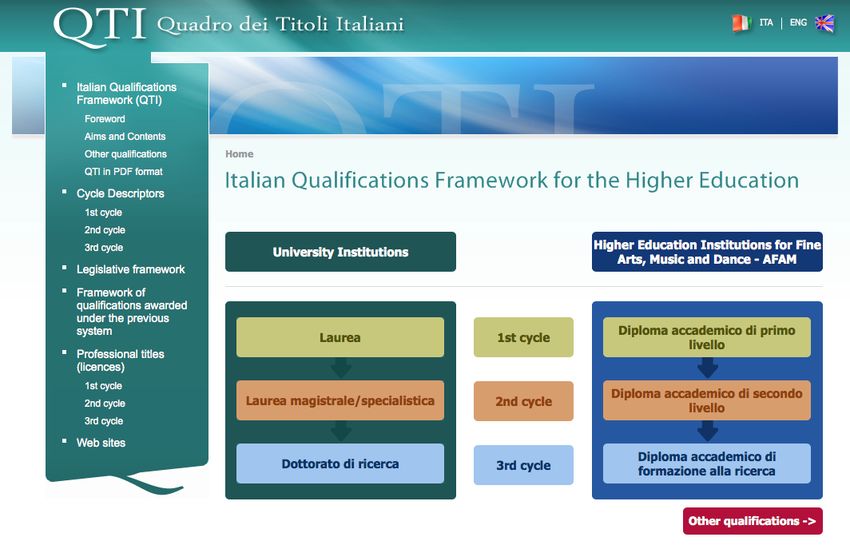
AFAM sector
       Alta Formazione Artistica e Musicale

3rd                               Diploma accademico di
                                  formazione alla ricerca

                                                                       Diploma di
      Diploma accademico       Diploma accademico di secondo
2nd    di specializzazione                 livello
                                                                   perfezionamento or
                                                                         Master

1st                          Diploma accademico di primo livello

      please see: www.quadrodeititoli.it
Italian grading scale system single exams: 18 – 30 (con lode) final degree: 66 – 110 (con lode) Scale: 0-10 (6 minimum) Historically 3 professors for each exams (3 marks from 0 to 10) and 11 for the final dissertation (11 marks from 0 to 10) Failure to pass an exam is not indicated in the exam transcript, therefore the student must retake the exam in order to achieve a positive result. Each university can choose autonomously how many times a student may repeat an exam within the period reserved for subjects exams.
Italian credit system
The “credit” system in Italian courses was introduced because of the need
to implement the policies deriving from the Bologna Process. Indeed,
such a system was non-existent in preceding legislation.
Italy has two different credit systems referring to the two sectors of Italian
higher education: university credits (CFU) for universities and academic
credits (CFA) for Education for Art, Music and Dance (AFAM) institutions.
Both systems are based on the concept of “workload” and are equivalent
to the ECTS credit system.
The university credit (CFU) and academic credit (CFA) normally
correspond to 25 hours of student work, including individual study. The
average quantity of academic work performed by a full-time student in
one year is by convention measured as 60 credits.
Italian QF of the EHEA
     Quadro dei titoli italiani - QTI
Italian qualifications framework for the Higher Education
             Website: www.quadrodeititoli.it
Non-official HE institutions awarding
official qualifications
HIGHER SCHOOLS FOR LANGUAGE MEDIATORS (SCUOLE SUPERIORI PER MEDIATORI LINGUISTICI)
These higher schools are the former higher schools for interpreters and translators (SSIT) as
transformed in conformity to the Ministerrial Decree No. 38 of 10 January 2002. They award
qualifications equivalent to all legal effects to 1st university degrees in class 3 (Class of Laurea
degrees in Sciences of language mediation). Study programmes last 3 years, i.e. 180 university
credits.
SPECIALISATION INSTITUTES/SCHOOLS IN PSYCHOTERAPY (ISTITUTI DI SPECIALIZZAZIONE IN
PSICOTERAPIA)
Those non-state institutes/schools offer postgraduate programmes in applied psychology and in
psychotherapy which have been recognised by the Ministry of Education, Universities and Research -
MIUR. The main purpose of those postgraduate programmes is to provide advanced education and
training to professional psychologists wishing to specialise as psychotherapists. The successful
passing of the final examination, which includes the defence of a dissertation, results in the
awarding of a professional qualification (e.g. Diploma in Psicoterapia Cognitiva) with the same legal
validity of the postgraduate specialisation degrees (Diploma di specializzazione) in psychological
fields conferred by Italian universities.Diploma di mediatore linguistico Higher Schools for Language Mediators - Diploma di mediatore linguistico AIM: to provide intensive training at academic level in at least two languages other than Italian and the related cultures. Furthermore, they aim to develop speci!c technical and linguistic skills – both written and oral – to train students to practice the profession of language mediators CLASSIFICATION: 1st cycle degree ACCESS: by the Italian school leaving quali!cation and adequate linguistic knowledge WORKLOAD: 180 ECTS credits DURATION: 3 years full time FURTHER STUDIES: these qualification allows access to Laurea Magistrale programmes in the same field of study http://hubmiur.pubblica.istruzione.it/web/universita/elenco-delle-scuole
Diploma di specializzazione in psicoterapia
Specialisation Institutes/Schools in Psychoterapy - Diploma di specializzazione in psicoterapia

AIM: to provide professional training for the profession of psychotherapist, both for individual and
group therapy, following methods, theoretical and cultural approaches recognised at international
level
CLASSIFICATION: 3rd cycle degree
ACCESS: by Laurea Magistrale in Psychology or in Medicine and Surgery and registration in the
corresponding professional councils
DURATION: min. 4 years

http://www.miur.it/ElencoSSPWeb/
Lisbon Recognition Convention
                                           The Italian context
   Law 148/2002: Ratification and execution of the Convention on the recognition of
higher education qualifications in the Europe Region signed in Lisbon on 11 April 1997,
             and provisions for the adjustment of the internal regulations
                       Italian ratification of the Lisbon Convention

   Decree 214/2004: Regulations regarding recognition criteria and procedures for
   qualifications issued by foreign higher education institutions operating in Italy
       Legal provisions on the accreditation of foreign universities (Article VI.5)

Presidential Decree N. 189 of 30 July 2009: Regulation on the recognition of academic
          qualifications, as provided by art. 5 of Law n. 148 of 11 July 2002
              Recognition of academic qualifications for different purposes

 Article 26 comma 3a of the Legislative Decree 251/2007, as modified by the content of
                   Legislative decree n. 18 of 21 February, 2014
                   Refugee qualification recognition (Article VII)
Role of HEIs The responsibility for foreign qualification recognition for academic purposes in Italy has been passed on to the Higher Education Institutions, who must reach a decision within 90 days, as established by Article 3 of Law n.148 of 11 July 2002. On the subject of timelines relating to recognition procedures, Article 48 comma 2 of the Presidential Decree n.394 of 31 August, 1999 is also relevant. It is possible to appeal a decision that withholds academic recognition as established by Article 48 comma 3 of the Presidential Decree n.394 of 31 August, 1999: “Regulation containing rules of implementation of the consolidated law of the dispositions concerning the control over immigration and rules on the condition of foreigners, as regulated by Article 1, comma 6, of the legislative decree n. 286 of 25 July, 1998”. As established by Articles 39 and 43, comma 2, paragraph c) of the Legislative decree n. 286 of 25 July, 1998, equal treatment for Italian citizens and foreigners for access to higher education is guaranteed, as well as the prohibition of any form of discrimination for any reason.
Recognition of foreign qualifications
                                issued in Italy
By applying Article VI.5 of the Lisbon Recognition Convention, Italy
regulates recognition of academic qualifications issued by foreign
universities operating in Italian territory, subordinating the
possibility of access to recognition procedures to a procedure of
accreditation specific to the foreign institution, as established by
Decree n. 214 of 26 April, 2004: “Regulation containing criteria
and procedures for foreign institutes of higher education
operating in Italy with a view to recognition of the qualification
issued by them (implementation of Article 4 of Law n.148 of 11
July, 2002)”.
LRC and TNE
Article VI.5
Each Party may make the recognition of higher education
qualifications issued by foreign educational institutions operating in
its territory contingent upon specific requirements of national
legislation or specific agreements concluded with the Party of origin
of such institutions.
Document adopted by the Lisbon Recognition Convention Committee:
Revised Code of Good Practice in the provision of Transnational Education
June 2007 (first version in 2001)Decree 214/2004: How does it work? (1/2)
A degree issued by a foreign HEI operating in Italy (i.e. a Branch campus) can be
recognised if the above awarding foreign HEI is accedited according to the
procudure establish by Decree 214/2004.
Example:
An official institution X in country A has opened a Branch campus XIT in Rome.
Italian authorities can evaluate a degree awarded in country A by X (official
foreign qualification), but in order to have the possibility to evaluate the same
official foreign degree awarded by XIT in Rome, XIT has to be accredited in Italy by
our Ministry according to Decree 214/2004.
Consequence:
The official foreign qualification (i.e. a Bachelor degrees) awarded abroad can
gain access to Italian recognition procedures; the same qualification (i.e. a
Bachelor degrees) awarded in Italy by the same official institution or following a
study programme in Italy, cannot gain access to recognition procedures.Decree 214/2004: How does it work? (2/2)
The accreditation procedure is made by our
Ministry of Education, University and Research.
After this accreditation procedure, the foreign institution operating in Italy (i.e. a
Branch campus) does not became an official Italian institution and it cannot
automatically award recognised degrees in Italy: the procedure of the Decree
214/2004 is related only to the possibility to gain the access to recognition
procedures: if the institution operating in Italy is not accredited, it is not possible
to recognise their degrees.
NB: Each foreing institution have the possibility to open a Brench campus or to operate in
Italy thanks to the Art. 2 of Law No. 4 of 14 January 1999 (and to our Constitution as well).
WHY THIS PROCEDURE???Decree 214/2004: RATIO
We want to be sure that the quality elements and aspects of the institution
operating in Italy and of each study programme taken abroad (in Italy) - usually
checked by the competent quality assurance agency in the home country - are
respected also in our country.
Not all quality assurance agencies use to check the quality of a HEI operating
abroad or of a study programme organised in another country.
The lack of quality aspects is the reason why we do not proceed with any
evaluation procedures for those qualifications awarded in Italy by foreign
institutions not accredited according to the Decree 214/2004.
LRC concept of substantial differences
Suggestion to QA agencies: be clear on this issue on your website!!!TNE examples (1/2)
Branch campuses
A campus established in Italy by a foreign higher education institution. It offers its
own educational programmes/qualifications, irrespective of the students’
provenience.
Off-shore institutions
They are autonomous institutions established in Italy but belonging, in terms of
their organisation and contents, to the educational systems of other countries;
some are accredited by regional or national accrediting commissions in the US,
some may have articulation agreements with other educational institutions in the
country to which they belong.TNE examples (2/2)
Franchised institution/programmes
Institution A of country X entitles B (the franchised institution / organisation
representative) in country Y the right to offer their own programmes and degrees to
students from X, Y and / or Z (third country): A can consent B to allow the activation of full
courses of study, with the consequent issue of the corresponding final degrees, validated
by A always under the conditions specified in the particular franchise agreement. For what
concerns the assessment by the host country Y, institution B is often not recognised in
country Y, even if institution A with its degrees (issued in X) can find recognition.
International HE institutions
Official “international” HE institutions are very few and are not officially belongin to any
national HE systems. Usually they are established by international organisations or they
are the results of an international, bilateral or multilateral treaty.
- European University Institute – Fiesole (EU Commission)
- United Nations University – Tokyo (UN)
- Centre International de Hautes Etudes Agronomiques Mediterraneennes / Istituto
agronomico meditterraneo - Bari (OECD + Mediterranean countries)Information Centre on Academic Mobility and Equivalence
Established in 1984
Staff: 10 people – Status: private and indipendent Association (acting as a public body)
Information service: more than 12.000 contacts per year
Websites: www.cimea.it / www.erasmusmundus.it / www.quadrodeititoli.it /
www.study-in-italy.it / www.rivistauniversitas.it / www.eurostudent-italia.it /
www.enic-naric.net
Evaluation service: more than 10.000 qualifications per year
Publications: BRIDGE Handbook: Joint programmes and recognition of joint degrees
CIMEA againts the mills: How to spot and counter diploma mills
Study and work in Italy: How to recognise foreign qualifications in Italy
Higher Education systems of Brazil, China, India and Russia etc.
Recent projects: RecoLatin, MEETWEB, SCAN-D, BRIDGE, INTER-HED, RecoNow,
ShaloMUNDUS, Magna cum laude, ENIC-NARIC WEB etc.
National and International databases on: 50 university systems, grading scale systems,
joint programmes in Italy etc.
Credential Information Service (CIS): qualification reports, statements of qualification
level, certified translationsGrazie!
Luca Lantero
info@cimea.it
www.cimea.it Twitter: @CIMEA_NaricYou can also read


