Public Health Sudbury & Districts' COVID-19 Vaccination Program Playbook January 2021
←
→
Page content transcription
If your browser does not render page correctly, please read the page content below
Public Health Sudbury & Districts’ COVID-19 Vaccination Program Playbook   January 2021
                                                   i
Version                          Version date                     Changes or comments
 Original                         January 15, 2021
 Version 2                        January 20, 2021
 Version 3                        January 30, 2021

This Playbook is an evergreen document, which will be adapted as new direction and
information becomes available.

Public Health Sudbury & Districts COVID-19 Vaccination Program Playbook            January 2021
                                                  ii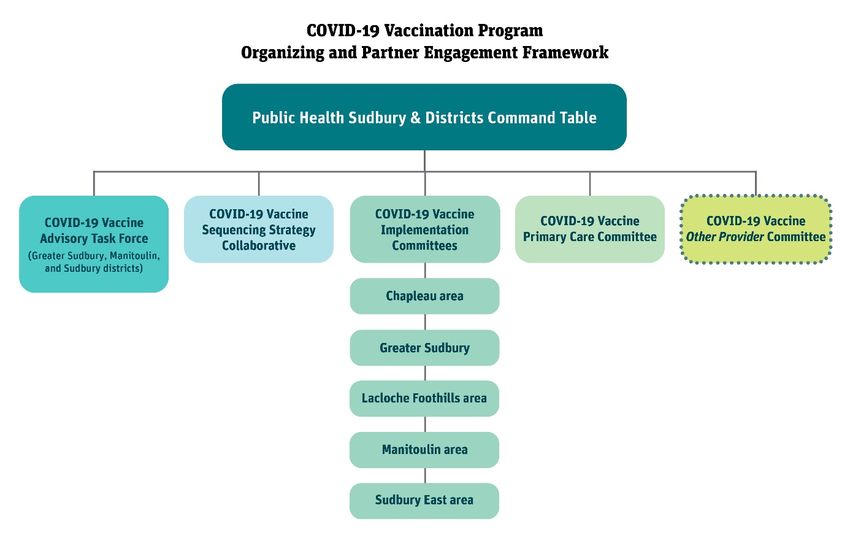
Contents
            Background                                                                      1
            Purpose and objectives                                                          2
            Overarching planning assumptions                                                3
            Leadership and partnership                                                      4
            COVID-19 Vaccination Program At-a-Glance                                        8
            Logistics: Vaccine management and distribution                                 12
            Operations for Public Health-led mass vaccination clinics                      16
            Communications and engagement                                                  19
            Finance                                                                        22
            Data, quality, and documentation                                               23
            Evaluation                                                                     24
            Concluding statements                                                          25
            Appendix 1: Public Health Incident Management Structure                        26
            Appendix 2: Public Health Sudbury & Districts COVID-19 vaccination
            implementation template                                                        27
            Vaccine Storage and Cold Chain                                                 28
            Appendix 3: Vaccination Program Organizing and Partner Engagement
            Framework Terms of Reference                                                   30
            Appendix 4: Principles for decision-making                                     46
            Appendix 5: Scenarios vaccination distribution plan                            47
            Appendix 6: Potential locations of mass vaccination clinics                    50
            Appendix 7: General process map                                                52
            Appendix 8: Public Health Sudbury & Districts COVID-19 vaccination clinic floor
            plan samples                                                                    53
            Appendix 9: Vaccination clinic and administrative role descriptions            56
            Appendix 10: Specific staffing roles and orientation                           59
            Appendix 11: Staffing scope of practice for implementation of COVID-19
            vaccination program                                                            60
            Appendix 12: COVID-19 vaccination program communication plan                   68

Public Health Sudbury & Districts COVID-19 Vaccination Program Playbook           January 2021
                                                  iii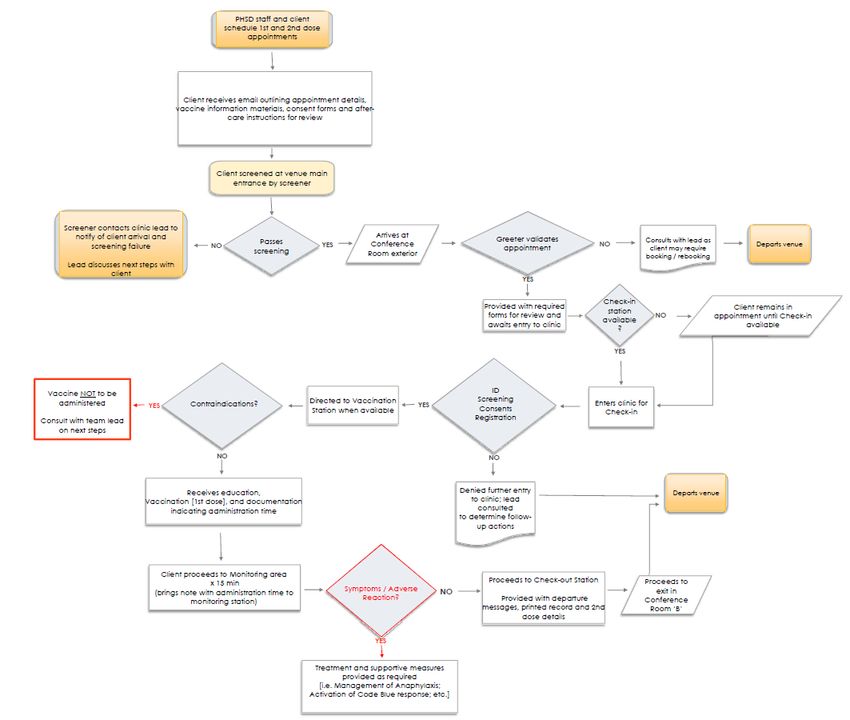
Background
On December 11, 2020, the Government of Ontario released Ontario’s Vaccine Distribution
Implementation Plan, which is based on a three-phase approach outlined below:
Figure 1:

As a local public health agency with responsibilities under the Ontario Public Health Standards
(Ontario Ministry of Health) for immunization and infectious and communicable disease control,
Public Health Sudbury & Districts has the overall responsibility for the unprecedented COVID-
19 vaccination program. This responsibility is executed in close collaboration with others in
health care (e.g. acute care, primary care, congregate settings, Community Paramedicine,
pharmacy) and non-health care sectors (e.g. social services, First Nations, municipal government,
enforcement agencies).

Public Health Sudbury & Districts’ COVID-19 Vaccination Program Playbook            January 2021
                                                   1
Purpose and objectives
Purpose
The Public Health Sudbury & Districts COVID-19 Vaccination Program Playbook (Playbook)
provides the essential pillars for the development of geographic and sector-specific
implementation plans to achieve a vaccine coverage level of at least 75% of eligible recipients in
Public Health Sudbury & Districts’ service area, within the prescribed timeframe and respecting
provincial direction on vaccine recipient sequencing.
The Playbook is the overarching framework from which geographic-based and sector-specific
implementation plans will be developed. The Playbook and subsequent detailed implementation
plans outline a coordinated approach for storage, delivery, distribution, and administration of the
COVID-19 vaccine.
The Playbook recognizes the diversity of communities and capacities within Public Health
Sudbury & Districts’ service area and is committed to building on unique strengths and
partnerships to ensure local implementation plans are maximally effective.
Importantly, Public Health Sudbury & Districts recognizes that its service area is within
Anishinaabe and Cree territory and the Playbook explicitly acknowledges the rights of
Indigenous peoples under the Robinson-Huron Treaty, Treaty 9, and the unceded territory of
Wikwemikong. As such, the Playbook includes working with Indigenous peoples locally to
support the COVID-19 vaccination program in ways that are aligned with self-determination.
Objectives
The overall objectives of Public Health Sudbury & Districts’ COVID-19 vaccination program
are to:
1. Minimize societal disruptions, including infrastructure and economic impacts.
2. Implement sustained public education and community outreach efforts.
3. Maintain public confidence.
4. Achieve a coverage rate of 75% of those eligible for vaccine by the provincially
prescribed timelines.
Public Health Sudbury & Districts COVID-19 Vaccination Program Playbook January 2021
2Overarching planning assumptions
The COVID-19 vaccine environment is very dynamic with many key elements either not yet
known or rapidly evolving. Assumptions are therefore required to make planning possible. The
Playbook will be adapted as the following assumptions are confirmed or otherwise amended:
1. COVID-19 vaccines will be supplied by the province.
2. Initially, demand will outstrip supply and the supply stream will be uneven, requiring
nimble logistical responses and communications.
3. The province will provide direction on how doses are to be sequenced and will determine
when and how much vaccine will be available to residents in our service area.1
Indigenous Services Canada may provide further direction on how vaccine is to be
sequenced within First Nations.
4. Notwithstanding the above, it is assumed that the provincial Ethical Framework for
COVID-19 Vaccine Distribution (Government of Ontario), which include important
equity principles, along with the provincial COVID-19: Guidance for Prioritizing Health
Care Workers for COVID-19 Vaccination (Ontario Ministry of Health), will need to be
applied by Public Health Sudbury & Districts to our local context to refine sequencing
decisions.
5. The first two vaccines to be available, Pfizer-BioNTech and Moderna, have specific
storage and handling requirements. The original constraints on the onward distribution of
the Pfizer-BioNTech are removed; however, all products will need to be carefully
handled with wastage minimized and security ensured.
6. Two doses of vaccine are required (21 or 28 days apart) and planning must ensure
availability of the second dose for all recipients.
7. The 2021 projected area population of those aged 16 and over is 167 846. To achieve a
vaccine coverage rate of 75% (125 885 residents), a total of 251 769 vaccine doses will
be required.
8. Vaccine hesitancy will be present and will require careful management.
9. The local vaccination program will intersect with future waves of local cases and
outbreaks, requiring ongoing public health measures for the entire population, and will
stretch local public health capacity.
10. Transparent decision making and clear communication to all parties will be critical to
ensure public confidence and a successful vaccination program. This is particularly
challenging given the supply and demand dynamics, the need for transparent, ethical, and
equity-based decisions on who receives the vaccine, the newness and complexity of the
1
The Canadian National Advisory Committee on Immunization (NACI) has provided recommendations nationally
on the priority groups for the initial doses of COVID-19 vaccine as outlined in Guidance on the prioritization of
initial doses of COVID-19 vaccine(s) (Health Canada).
Public Health Sudbury & Districts COVID-19 Vaccination Program Playbook January 2021
3products, anticipated supply chain issues, vaccine schedules, multiple providers and their
own stretched capacities during the pandemic, and the need to ensure ongoing COVID-19
public health prevention measures.
Leadership and partnership
Public Health Sudbury & Districts is responsible for immunization in partnership with various
stakeholders within:
> Chapleau area
> Greater Sudbury
> Lacloche Foothills area
> Manitoulin area
> Sudbury East area
Public Health works with Indigenous peoples locally to support the COVID-19 vaccination
program in ways that further self-determination. For First Nations aligned with the service area
of Public Health Sudbury & Districts, it is anticipated that Public Health will work to support
access to COVID-19 vaccine in partnerships that are led by the First Nation, including for
example First Nations health staff, Aboriginal Health Access Centres, and Indigenous Services
Canada.
Outlined below are key stakeholders and their respective overarching roles, subject to further
refinement, within the COVID-19 vaccination program planning and rollout.
Stakeholders and proposed roles
Table 1:
Stakeholder Roles
Federal government > Procure vaccines on behalf of all jurisdictions.
> Authorize vaccines for use.
> Support provinces and territories to manage more complex
logistics, in partnership with all jurisdictions via the new National
Operating Centre.
> Provide scientific guidance on vaccine use.
> Coordinate pan-Canadian surveillance and reporting.
> Liaise with international partners.
> Support First Nations and government-to-government dialogue
related to the vaccination program.
Provincial and territorial > Decide the policy and process for vaccine distribution.
governments > Plan, store, administer, and deliver vaccination programs to the
populations they serve, including deciding on how to:
> sequence the initial and subsequent doses
Public Health Sudbury & Districts COVID-19 Vaccination Program Playbook January 2021
4Stakeholder Roles
> manage, track, and share data on coverage and adverse
events
Municipal governments > Participate in planning as appropriate (i.e. Emergency Control Group
structures).
> Facilitate access to and use of municipal facilities for mass
vaccination clinics as feasible.
> Engage appropriate municipal staff in interdisciplinary approaches
to providing administrative or other support for vaccination clinics.
> Support communication to local constituents regarding vaccine,
clinics, and other aspects as appropriate.
> Support access to clinics (e.g. public transportation) and
vaccination for those with limited means (most marginalized
populations).
All governments together with > Federal, provincial, and territorial governments work together with
respective Indigenous leaders First Nations, Inuit, and Métis leaders to support community-led
and key partners approaches for access to an effective and culturally safe
vaccination program.
Local public health > Lead local implementation of the provincial COVID-19 vaccination
strategy, which includes:
> coordinate local vaccine sequencing, distribution and
administration as aligned with provincial direction
> administer vaccine as part of the vaccination strategy
including mass vaccination clinics and targeted clinics,
supported by municipal partners and other providers
> collaborate with partners to provide vaccine including
primary care
> manage public, vaccine provider, and stakeholder
communications
> report and investigate adverse events following
immunization (AEFIS)
> conduct ongoing surveillance
> provide requested data to the Ministry of Health and Public
Health Ontario
> lead and/or participate in evaluations
Ontario Health North sub-regions > Support vaccination program planning and logistics across sectors.
> Supplement health human resources for specific sectors’
participation in the vaccination program (e.g. long-term care and
retirement homes, and home and community care).
> Immunize chronic home health care clients in partnership with
Paramedic Services and others as required.
> Support local evaluation efforts.
> Liaise and coordinate with other Ontario Health North and other
Ontario Health regions to ensure knowledge exchange and
continuous learning and improvement.
Hospitals > Immunize all hospital staff (broadly defined) and patients (aligned
with provincial direction).
> Work in partnership with Public Health to roll out on-site clinics
accessible to non-hospital individuals (e.g. long-term care staff), as
applicable.
Paramedic Services teams > Participate in targeted and mass vaccination clinics led or
coordinated by Public Health (e.g. long-term care residents).
Public Health Sudbury & Districts COVID-19 Vaccination Program Playbook January 2021
5Stakeholder Roles
> Participate in chronic home health care vaccinations as needed in
partnership with Ontario Health and coordinated by Public Health.
Community Health Centres and > Immunize clients, sequenced in alignment with provincial direction
Aboriginal Health Access Centres and in coordination with Public Health.
Long-term care homes and > Immunize residents and staff (broadly defined and including
retirement homes essential care providers) in partnership with other providers as
required.
Primary care providers > Immunize patients in either practice settings or in mass clinics as
organized by Public Health.
> Participate in communication campaigns.
> Representatives participate in COVD-19 Vaccine Primary Care
Committee.
> Participate in other vaccination clinics and opportunities as feasible
(e.g. chronic home care, essential workers, congregate settings).
Agencies serving marginalized > Participate in communication campaigns.
groups > Support dissemination of vaccine information.
> Once authorized and as applicable, immunize clients in either
practice settings (e.g., shelters) or mass clinics as organized by
Public Health.
Workplaces including the > Support dissemination of vaccine and clinic information.
academic sector > Once authorized and as applicable, immunize employees and
students at on-site clinics (e.g. Laurentian University, Vale) as
coordinated by Public Health.
> Provide venues for public vaccination as applicable.
Pharmacies > Once authorized, immunize clients in pharmacy settings.
Police > Contribute to security assessments and planning.
> Consult on security resource requirements.
Community Paramedicine > Provide support during vaccination clinics (ie. immunizer and
monitor and recovery role).
District Social Services > Support communication with clients regarding vaccine availability.
Administration Board (DSSAB) > Support access to clinics and vaccination for those with limited
means (most vulnerable populations).
Organizing structures
To operationalize the vaccination program, Public Health Sudbury & Districts will implement
internal and external structures (see Figure 2) and adjust as circumstances necessitate.
The Command Table is led by Public Health Sudbury & Districts and ensures oversight of the
entire COVID-19 vaccination program. The Command Table (Public Health Incident
Management System structure, Appendix 1) is responsible for directing, providing oversight, and
being accountable to all stakeholders for the vaccination program, in alignment with the purpose
and principles as set out in the Playbook. The Command Table follows the Incident Management
System (IMS) and includes redundancies for business continuity with designated alternates for
the Incident Commander, Section Chiefs, and all roles.
Public Health Sudbury & Districts COVID-19 Vaccination Program Playbook January 2021
6The Vaccine Advisory Task Force advises the Command Table on the planning and coordination
of the vaccination program for the population across Public Health Sudbury & Districts’ service
area. Membership is from health and non-health sectors and representation from Indigenous
agencies and First Nation communities is anticipated.
The Vaccine Sequencing Strategy Collaborative advises the Command Table on the sequencing
of vaccine recipients within provincially-established priority groups and based on local context.
Membership includes diverse views from affected parties and groups to inform local decision
making. Representation is anticipated to include for example, cultural and linguistic groups
including First Nation and Indigenous community members, leadership from key health and
social service sectors, and an ethicist.
The Vaccine Implementation Committees are to be established for the five geographic clusters
within Public Health Sudbury & Districts’ service area. This committee structure recognizes that
while adherence to core elements of the vaccination program is required (e.g. sequencing of
priority groups, vaccine storage and handling, COVID-safe measures, key communications),
actual implementation will look different across our region. Health system capacity, vaccine
availability, administrative supports, population density, and community infrastructure are all
characteristics that will impact on how vaccines are most effectively delivered across the region.
A COVID-19 Vaccine Implementation Template is developed to facilitate this work (Appendix
2). Membership includes representation from groups responsible for the actual vaccination
clinics and venues (e.g. Public Health, Indigenous partners and First Nation communities,
municipal sector representatives, health care providers, buildings and support facilities, and
communications).
The Vaccine Primary Care Committee ensures coordinated primary care engagement in the
Vaccination Program with clinician representation from across Public Health Sudbury &
Districts’ service area.
The Vaccine Other Provider Committee is a placeholder to recognize that other committees may
need to be established to ensure coordination of the work of other providers (e.g. Community
Paramedicine, pharmacies) if not well captured in other structures.
The Vaccination Program Organizing and Partner Engagement Framework terms of reference
for the respective committees can be found in Appendix 3. The Principles for Decision-Making
(Appendix 4) includes prompts for considering health equity to help guide this work.
Public Health Sudbury & Districts COVID-19 Vaccination Program Playbook January 2021
7Figure 2:
COVID-19 Vaccination Program At-a-
Glance
Per Ontario’s Vaccine Distribution Implementation Plan (Government of Ontario, PDF), the
Playbook addresses priority populations 2 in all three phases:
> Phase 1
> Congregate living for seniors—residents
> Congregate living for seniors—staff, essential care, and other employees
> Health care workers
> Adults (16+) First Nations, Métis, and Inuit—On-Reserve Indigenous
residents
> Adults (16+) First Nations, Métis, and Inuit—Urban Indigenous and off-
reserve Indigenous populations
> Adults (16+) chronic home care recipients
2
Priority populations is a term used by public health to denote populations at greater risk of experiencing health
inequities. The term in this Playbook is used as per Ontario's prioritization of vaccine distribution.
Public Health Sudbury & Districts COVID-19 Vaccination Program Playbook January 2021
8> Phase 2
> Essential workers
> Adults 75+ years
> Adults 60 to 74 years
> At-risk populations
> Additional congregate care settings (for example shelters, groups homes and
correctional facilities)
> Adults 16 to 59 years
> Phase 3
> Remaining eligible Ontarians (16+ years)
As per the provincial Ethical Framework for Covid-19 Vaccine Distribution (Government of
Ontario), Public Health Sudbury & Districts’ processes will be guided by the following
principles:
> minimize harms and maximize benefits
> equity
> fairness
> transparency
> legitimacy
> public trust
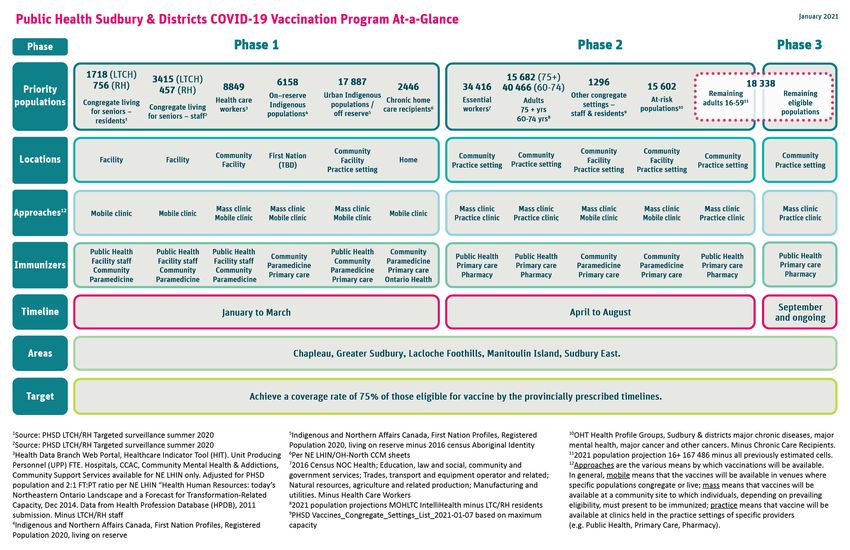
Three different approaches will be utilized for vaccination of all residents in the Public Health
Sudbury & Districts service area: mass clinics (led by Public Health), mobile clinics (vaccination
clinics in specific settings where people live or congregate, such are long-term care homes,
retirement homes, shelters, etc.), and practice clinics (e.g. primary care, pharmacies).
The At-a-Glance plan describes the vaccination scenarios designed to achieve 75% vaccine
coverage of the population according to priority sequence and projected vaccine availability. It
maps out the locations, approaches, and providers, against the vaccine recipients in each
priority population. This then permits Public Health to plan for the required human resources and
partnerships to actually administer the vaccine in the Public Health Sudbury & Districts’ service
area.
The vaccination program At-a-Glance is based on the three phases described above and situates
the approaches within these phases. The figure below describes the overall vaccination program
which is further detailed in Appendix 5. Appendix 5 incorporates planning assumptions
described in the Operations section of this Playbook and includes the following detailed tables:
> Estimated priority populations and COVID-19 vaccine doses required;
> Public Health Sudbury and Districts’ target vaccination coverage rate by estimated
priority population and doses required per week to achieve this target;
Public Health Sudbury & Districts COVID-19 Vaccination Program Playbook January 2021
9> Possible vaccination staffing scenarios by vaccination approach; and
> Estimated sequencing of vaccination by phase, if vaccines were available in required
quantities.
The planning details were developed based on a number of local planning assumptions and
estimates as well the latest provincial COVID-19 Vaccination Update (Government of Ontario).
While the scenarios are therefore subject to change as new guidance and information is available,
they provide helpful guidance for the use of Implementation Committees in their planning.
Public Health Sudbury & Districts COVID-19 Vaccination Program Playbook January 2021
10Figure 3: Public Health Sudbury & Districts COVID-19 Vaccination Program Playbook 11 January 2021
Logistics: Vaccine management and
distribution
Public Health Sudbury & Districts recognizes the criticality of correct vaccine storage and
handling practices to minimize wastage and preserve vaccine efficacy. Public Health has expertise
and responsibility under the Ontario Public Health Standards, Vaccine Storage and Handling
Protocol (Ontario Ministry of Health, PDF).
Established protocols with quality assurance checks for transferring vaccine from the ultra-low
freezer or -40⁰C freezer to the fridge for thawing are to be strictly followed. These include all
Ministry of Health required accountabilities for vaccine storage, clinic briefing logs, contingency
plans, inventory management, safety, and security.

Vaccine storage and cold chain
The COVID-19 vaccines are temperature-sensitive and must be stored correctly to ensure efficacy
and maximize shelf life. The Pfizer-BioNtech vaccine requires ultra-low temperature freezer
storage between -60⁰C and -80⁰C, whereas the Moderna vaccine requires freezer storage at -20⁰C.
These cold chain requirements, from the manufacturers, will be carefully followed and monitored.
Public Health Sudbury & Districts meets the following vaccine storage and temperature
monitoring requirements:
       > Use purpose-built or pharmaceutical-grade equipment to store vaccines. Public Health
         Sudbury & Districts is not currently responsible for storage of the Pfizer-BioNtech
         vaccine. Public Health Sudbury & Districts has two -40⁰C freezers; one will be the
         primary freezer for applicable vaccines with the needed monitoring approaches and the
         second will be a back-up freezer to mitigate against main freezer failure.
       > Set-up temperature monitoring devices. Monitoring includes temperature range
         surveillance, out of range alarms, and low battery alarms. Public Health Sudbury &
         Districts monitors temperatures through a live system. A temperature gauge will be
         used to monitor minimum and maximum temperature ranges over a 24/7 period.
       > Ensure uninterrupted power supply. Public Health Sudbury & Districts has an
         uninterrupted power supply for its freezers.
       > Conduct regular maintenance of storage units and temperature monitoring devices.
         Public Health Sudbury & Districts has a regular maintenance schedule for storage units.
         Maintenance of temperature monitoring devices is conducted by an external provider.

Public Health Sudbury & Districts COVID-19 Vaccination Program Playbook               January 2021
                                                  12
> Identify alternate storage if primary unit(s) cannot be repaired or replaced. Public
Health Sudbury & Districts has a back-up freezer, if needed. Partnerships are also in
place for vaccine storage and monitoring as an alternative option.
Public Health also meets the Ministry of Health requirements for facilities.
> Public Health Sudbury & Districts meets facility requirements. These include space for
freezers; backup generators; automatic transfer switches and action in case of power
failure; well-functioning HVAC for optimal temperature control and air circulation for
freezers and refrigerators; reliable storage and temperature monitoring equipment;
accurate vaccine inventory management; and freezer rooms with security camera
monitoring.
Processes for handling and storing vaccines has been established consistent with manufacturer
requirements.
Inventory and distribution systems
Public Health Sudbury & Districts has an established supplies inventory system that provides
thresholds and automated notifications ensuring inventory levels are maintained. Supply thresholds
will be adjusted to support this vaccination program. The system provides reporting functionality
for continuous supply management.
Public Health Sudbury & Districts also has a robust vaccine delivery system for current influenza
vaccine and many other routine vaccines. As applicable, the current model for influenza vaccine
will be used as a model for COVID-19 vaccination planning, distribution, and delivery.
Public Health Sudbury & Districts is working with key community partners in the planning and
development of a vaccine distribution model. The distribution system will be partly dependent on
vaccine storage and handling requirements for each of the vaccines as well as local resources to
support these requirements.
Health human resources
Health human resources need to be considered for the vaccination program as a whole, including
for each of the approaches that will be used: mass vaccination clinics, mobile vaccination clinics,
and vaccination clinics in practice settings.
Public Health Sudbury & Districts has compiled an inventory of staff skills and has hired casual
nurses to support the vaccination program. With this, we currently have a pool of 61 available
nursing staff to immunize targeted populations across our service area. Based on our current
assumptions of a steady supply of available vaccines, these resources would be sufficient to meet
provincially prescribed timelines, albeit with a significant impact on current Public Health
Public Health Sudbury & Districts COVID-19 Vaccination Program Playbook January 2021
13resources and programs. Further, if available vaccine supplies increase, timelines become shorter,
or COVID-19 case and contact management work escalates, more capacity will be required. In
anticipation of these needs, the following work is underway:
> Post-secondary nursing students have been contacted for placements
> Retired nurses are being sought for onboarding
> The opportunity for medical learners is being explored
> Response assistants are being recruited and trained to support check-in and check-out
roles
The measures above are in addition to engaging with facility health care providers, primary care,
community paramedics, and pharmacies.
Call centre staff from Public Health are also available to support the vaccination program. Support
from the City of Greater Sudbury 311 Call Centre is also being explored. Further, recruitment of
volunteers to support vaccination clinic logistics is underway.
Transportation of clients
Transportation is an issue for many northerners and a comprehensive vaccination program must
consider thoughtful strategies to meet clients’ needs.
Existing formal and informal networks of patient and client transportation will be leveraged to
ensure transportation is not a barrier to vaccine access. Local municipalities and volunteer groups
are essential to addressing this issue.
The City of Greater Sudbury is exploring free transportation for community members to help
ensure equitable access to the COVID-19 vaccine. Additional discussions are to occur with district
partners to address transportation.
Sites for mass vaccination clinics
Public health-led vaccination clinics will occur in various sites during the vaccination program and
will be determined based on factors such as vaccine product, community logistics, provider
availability, program phase, and priority population served. Public Health Sudbury & Districts is
working with partners to match sites with these factors to enable rapid decision-making and ramp-
up once details are known, enabling local action. Public Health is currently assessing various
community locations. Potential locations are listed in Appendix 6. Public Health’s close linkages
with local municipalities and other service providers and workplaces will be leveraged to secure
sites as was done for the early years of the Universal Influenza Immunization Program.
Proposed vaccination clinic locations will be assessed based on a number of factors including:
Public Health Sudbury & Districts COVID-19 Vaccination Program Playbook January 2021
14> accessibility > geography > safety > security
> physical > large open > indoor > privacy
distancing area waiting area > parking
> chairs and tables > electrical > Wi-Fi > space for staff
on-site outlets connection (breaks/lunches)
> two or more > temperature > washroom > ventilation
entrances/exits control in facilities
> janitorial room > waste
services > snowplowing disposal
(if
applicable)
Information technology (IT)
Provincial IT supports include COVax, a vaccination system that tracks vaccinations provided to
clients. In some instances, hospital sites are being provided a clinic in a box. The Ministry of
Health will provide IT support (Accenture team or other Ministry IT support) for hospital sites for
the first week of implementation. Following the first week, all clinics will have access to a
provincial service desk for IT support if required.
IT considerations:
> on-site IT structures and protocols in place
> local on-site IT support is available to support as required
> client booking system established
> staff scheduling system is being explored
Safety and security
All security measures and situation protocols will be established and effectively managed.
Emergency response measures and potential risks will be identified, assessed, and mitigated.
Public Health Sudbury & Districts contracts security services and ensures 24/7 security is available
when required.
Public Health is prepared and equipped to deploy public health inspectors to assist with clinic flow
and additional clinic security. Safety and security considerations include:
> security plans for site-specific and clinic operations
> emergency protocols identified and mitigation strategies established
> dry runs completed at clinic sites and planning for unknown incidents
> alarms on freezers and generator or back up power
> security guard presence (venue dependent)
> freezer(s) capacity testing: two to seven days of stability data
Public Health Sudbury & Districts COVID-19 Vaccination Program Playbook January 2021
15Contingency planning
Public Health Sudbury & Districts will use the existing Emergency Planning and Business
Continuity plans as a baseline for consistent delivery of vaccinations. The plans will be regularly
reviewed and updated by the Logistics and Operations Chiefs to ensure they continue to
encompass current and emerging concens (e.g. seasonal weather, security issues, access issues,
etc.) and evolving logistical factors (e.g. vaccine supply, internet access, etc.).
Continuity of operations includes:
> A vaccine storage and handling contingency checklist, to be used in the event of a
power outage, electrical disruption or refrigerator/freezer malfunction
> Backup vaccine freezers/refrigerators will be identified, and transport processes in
place to safeguard vaccine supply against emergencies
> A plan for “surge capacity” staffing, or over-staffing, to address unexpected staff
> absences;this includes systems to cancel clinics and notify clients
> Alternate locations will be determined in advance to mitigate the risks associated with
emergencies whereby space cannot be used
> Protocols for emergencies, security and communication will be developed in the form
of a “security plan tool box” for each vaccination clinic site with checklists and site-
specific emergency plans
Operations for Public Health-led mass
vaccination clinics
This section outlines operations requirements for mass vaccination clinics led by Public Health.
Other approaches for vaccination include mobile and practice-based clinics. Operations
requirements for these approaches will be developed in discussions with key partners involved in
implementation (e.g. long-term care homes, shelters, clinical practices, etc.).
Staffing
Staffing needs are based on the following assumptions:
> Clinics will operate from 9 a.m. to 7 p.m., seven days per week
> Staffing assumptions are based on the goal of 14 vaccinations per hour
> Clinic staffing, throughput capacity, and setup will be dependent on venue and vaccine
availability
> On average, mass vaccination clinics will host:
Public Health Sudbury & Districts COVID-19 Vaccination Program Playbook January 2021
16> two (2) public health nurses (PHN) as clinic leads
> twenty (20) immunizers (combination of temporary, casual, and full-time
PHNs, community paramedics, and/or nursing and medical students)
> fifteen (15) response assistants to support greeting and check in
> eight (8) response assistants to support check out
Vaccination appointment scheduling
Public Health Sudbury & Districts is responsible for scheduling appointments. At the time of
booking, clients will be asked to provide their name, date of birth, gender, Ontario Health Card
number, identification type, phone number, mailing address, and email address. The email address
will be used to send appointment details, educational materials, and consent forms for review prior
to attending scheduled appointments. Health equity considerations will be planned for clients
without telephone access, a health card, identification, address, or internet access. Cancellation
instructions will also be given at the time of booking.
Clinic process
The goal for mass vaccination clinics is 14 vaccinations per hour, or one vaccination per every 4.3
minutes. Clinics will be planned to ensure a seamless process, including flow and distancing.
Community Mass Vaccination Clinics
The scenarios below are estimates based on the following:
> clinics are open from 9 a.m. to 7 p.m.
> vaccines are preloaded
> consent forms are completed prior to arriving at vaccination station
> uninterupted flow of clients
> operating with a float staff immunizer
Table 2: Summary Scenarios by Estimated Vaccinations / hr Over a 10 hr Day
Immunizers 10 vaccinations / 12 vaccinations / 14 vaccinations / hr x 10 hrs =
Required hr x 10 hrs = 100 hr x 10 hrs = 120 120 vaccinations / day
vaccinations / day vaccinations / day
For 1000 10 9 8
Vaccinations / Clinic
Day
For 750 8 7 6
Vaccinations /
Clinic Day
Public Health Sudbury & Districts COVID-19 Vaccination Program Playbook January 2021
17For 500 5 5 4
Vaccinations /
Clinic Day
For 250 3 3 2
Vaccinations /
Clinic Day
COVID-19 prevention remains critical throughout the vaccination program. Including:
> clinics by appointment only
> just-in-time appointments, early arrivals will be requested to wait outside of clinic site
> client attendance only at appointment, unless extenuating circumstances exist
> provision of electronic fact sheets and consent form
> option for clients to print consent form and bring signed hard-copy to appointment
> COVID-19 screening immediately prior to entering clinic
> mandatory masking, unless exempt
A general process map is found in Appendix 7 and as well as two models of a vaccine floor plans
in Appendix 8.
Roles
Vaccination clinic roles
Each vaccination clinic will include staff listed below and further described in Appendix 9.
Required rolls include clinical and administrative staff. The number of required staff will be
dependent on venue and vaccine availability.
Public Health Sudbury & Districts COVID-19 Vaccination Program Playbook January 2021
18Table 3:
Clinical roles Administrative and supportive roles
> clinic lead > booking and scheduling (office assistant or
> greeter (response assistants) intake staff)
> check-in (response assistants) > staff scheduling (administrative assistant)
> immunizer (PHNs, Community Paramedicine, > information technologist
student nurses) > security (contracted)
> monitor (PHNs or Community Paramedicine) > waste collection (contracted)
> check-out (response assistants)
> runner (response assistants or volunteers)
Training and orientation
Role-specific training and orientation will be provided by public health managers, with support
from the Chief Nursing Officer, to each group of staff assisting with vaccination clinics. Training
and orientation, using a just-in-time approach, will include independent review, virtual review, and
in-person training. Training and orientation will be ongoing and as needed, starting in January
2021. Completion of each session will be dependent on module progress, knowledge of the key
concepts, and comfort with assigned roles. Details related to specific staffing roles and training and
orientation are in Appendix 10. Additionally, see staffing scope of practice for implementation of
COVID-19 vaccine (Appendix 11).
Communications and engagement
Context
Public Health Sudbury & Districts’ COVID-19 vaccination program communications approach
will align with the phases of the provincial vaccination program and will be reflected throughout
the entirety of vaccine deployment. Public Health has in-depth experience in traditional and non-
traditional media, and relevant to this program, is a trusted source of information on COVID-19
and on vaccination in general. The need for constant communication and engagement with all
stakeholders and the general public is key to building and establishing trust and encouraging
vaccine uptake.
This section describes the communications strategy and approach to informing residents in Greater
Sudbury and the districts of Sudbury and Manitoulin. The strategy will be deployed throughout the
implementation of the vaccine program and will include internal and external communication
tactics.
Public Health Sudbury & Districts COVID-19 Vaccination Program Playbook January 2021
19Communications objectives
1. Setting the stage for vaccine arrival
a) outline the leadership and preparedness of local public health
b) provide credible information on the COVID-19 vaccines and who is eligible
c) raise awareness of vaccine safety and efficacy
2. Vaccine readiness
d) identify and address barriers leading to vaccine hesitancy
e) communicate benefits to receiving a vaccine
f) address misinformation
3. Vaccine rollout
g) foster trust: demonstrate to the public how Public Health Sudbury & Districts will
effectively deploy the vaccine
h) communicate information on the administration of the vaccine
4. Ongoing transparency and accountability
i) communicate timely information
j) report back on local vaccine data and uptake
Setting the stage for vaccine arrival
In anticipation of the vaccine, Public Health Sudbury & Districts aims to build trust among the
community, promote transparency, offer evidence and credible sources of information to make an
informed decision, and build an environment conducive to vaccine uptake while adhering to
COVID-safe behaviours. Messaging will be tailored to communities and target populations as
required.
Communications regarding the vaccine will follow important guiding principles. Public Health
Sudbury & Districts will:
1. Put provincial and federal information into a local context.
2. Address rumours and misconceptions in a timely manner.
3. Be transparent and proactive in its communications to residents.
4. Consider diversity and inclusion in its communications.
5. Communicate in both official languages.
6. Coordinate with partner organizations to create communications that better serve residents.
Public Health Sudbury & Districts COVID-19 Vaccination Program Playbook January 2021
20Vaccine readiness
Environmental analysis
Public Health Sudbury & Districts has conducted situational assessments to inform our agency’s
work in this context and allow us to provide our community partners and decision-makers the best
advice possible, both during the response and into the future. Gathering information from residents
and stakeholders in our service area through surveys, staff engagement sessions, and call centre
and social media themes are important to inform these situational assessments.
To date, over 10 COVID-19 themes surveys have been administered of residents aged 16+. Our
most recent surveys have focused on safe COVID-19 practices and vaccine readiness.
Local perceptions and frequently asked questions are also collated and themed based on call centre
inquiries and messages or comments received through social media.
Particular attention should be paid to vaccine hesitancy among Indigenous populations in the
context of historical trauma and recent public health emergencies (e.g., SARS, H1N1). Approaches
should be sensitive and supportive given this context.
Local communication approach
Rolling out a broad campaign to encourage residents to get vaccinated will include spokespeople
and campaign materials to deliver key messages in a way that strikes the right balance between
simultaneous—yet sometimes conflicting—truths. Messaging will address the various stages of
change to encourage vaccine uptake.
Ongoing public education and timely response to inquiries will continue to through a variety of
communication media including Public Health Sudbury & Districts’ website and social media
channels. Key messages will guide communication plans and speaking points. Continuous
monitoring of the local context and public feedback (from partners, social channels, and call centre
themes) will inform additional communication to ensure community needs are addressed.
The Public Health Sudbury & Districts’ bilingual call centre customer services representatives will
support local communication by responding to calls and email messages, addressing general
inquiries, providing requests for information, such as immunization records, direct calls to the
most appropriate contact, and inform the public about available website resources. Messages can
be left after-hours on public health’s answering machine; calls will be returned by customer
service representatives as soon as possible.
Public Health Sudbury & Districts COVID-19 Vaccination Program Playbook January 2021
21Vaccine rollout
Communication planning is ongoing for an effective rollout of the COVID-19 vaccine, under the
leadership of Public Health and in collaboration with key partners. Public Health will provide the
community with relevant, practical, and timely information about the vaccines in advance of and
throughout the vaccine rollout. Various tactics and mediums will be used to disseminate
information to the public and community partners.
Noting that each vaccine clinic will have specific needs, each vaccine clinic will follow their own
specific communications plan to ensure that the information communicated to the public is
accurate, timely, and relevant.
Ongoing transparency and accountability
Public Health Sudbury & Districts is committed to keeping the public and stakeholders updated on
the COVID-19 vaccine and vaccine rollout in our local communities. Communication strategies
will include ongoing updates through various communication methods such as social media
updates and bulletins to community partners and members of the public. Local data on vaccine
administration and uptake will also be presented as it becomes available.
Through continuous monitoring and feedback from the public and community partners, specific
questions will continue to emerge. Continuous monitoring of the local landscape will help plan for
and address emerging questions as they arise. This work will also be informed by monitoring of
the corporate social media channels and through identified call centre themes. Staying up-to-date
with emerging questions will help keep a finger on the pulse, help inform gaps of information, aid
in informing decisions, and help improve our services.
The COVID-19 vaccination program communication plan outlines the communications strategy to
be used by Public Health with respect to the local COVID-19 vaccine rollout and can be found in
Appendix 12.
Finance
Boards of health are accountable for using funding efficiently as outlined by the fiduciary
requirements domain of the organizational standards within the Ontario Public Health
Standards. The Ministry of Health (MOH) must ensure that there is efficient use of public
resources and ensuring value for money. Part of the requirements within the standard are for local
public health agencies (LPHA) to provide financial reports as requested to the MOH.
Public Health Sudbury & Districts COVID-19 Vaccination Program Playbook January 2021
22COVID-19 vaccination program costs will be tracked separately from the Board of Health
approved cost-shared budget for reporting of costs associated with the COVID-19 vaccination
program.
Cost being tracked will include but not be limited to:
> staff costs in full time equivalents (FTEs) and dollar value; including overtime costs
> materials and supplies, and other operating costs in dollar value
> costs associated with the COVID-19 vaccination program
> other subcategories to track may include but are not limited to (based on reporting of
extraordinary costs in 2020): Travel and accommodation, supplies and equipment,
purchased services, communications
Data, quality, and documentation
Throughout the COVID-19 vaccination program it will be required to collect data for various
purposes. All data about vaccinations will be reported in accordance with Ministry of Health
requirements. COVax will be the primary means of vaccine tracking. Training in COVax is
currently underway..
For the purposes of this Playbook it is noted that it will be important to identify the methods to
collect, manage, store, and transport data and to establish appropriate systems to support secure
data management, based on jurisdictional legislative and policy requirements.
A sample preliminary list of data identified as essential by Public Health Sudbury & Districts is
below. For each data set it will be critical to specify the data source, responsibility, storage, ethics
considerations, and reporting purpose and destination.
> vaccine recipient list, priority > number of people > clinic attendance:
populations immunized: Dose, by Location, date, time
> consent forms volume, day, facility > vaccine wastage
> number of people immunized > COVax requirements > number of no shows
> number of scheduled > number of adverse and cancelled, with
appointments by volume, day, reactions details
facility > number of staff > other statistics:
> number of clinics, size of immunizing per person Details on recipients,
clinic > other metrics for staffing, costs
> continuous quality monitoring operations:
improvement (CQI): Standards Audits, tracking
of work, processes, utilization,
queues, wait times, time per
station
Public Health Sudbury & Districts COVID-19 Vaccination Program Playbook January 2021
23Evaluation
The overall purpose of this evaluation will be to understand Public Health Sudbury & Districts’
COVID-19 vaccination program planning and implementation with respect to the efficiency and
effectiveness of processes and the impact of the vaccination program. This will include an
exploration of what worked well, what worked less well, and what could be improved in planning
for, and responding to, further evolution of the COVID-19 pandemic and/or future pandemics. An
overview of the key focus areas and questions that will guide the evaluation are presented in the
Table below, along with proposed data sources.
Evaluation framework
Table 4:
Focus area Evaluation questions Data sources
Process: What was the efficiency and > COVaxON
Implementation— the effectiveness of the > Tracking data: human resources,
vaccine logistics and vaccine administration procurement, communications
operations (all sites) process? > Infection Prevention and Control (IPAC) and
Occupational Health & Safety (OH&S)
Surveys:
> general public, targeted populations
> clinic clients
> planning and implementation teams
> support teams
Outcome: Vaccine What was the uptake of the > COVaxON
uptake vaccine in the local population Surveys:
and what factors influenced > general public, targeted populations
vaccine uptake? > clinic clients
> planning and implementation teams
> Tracking data
Process and outcome: What was the effectiveness > COVaxON
Leadership and and efficiency of the Surveys:
partnership leadership and partnership > planning and implementation teams
collaboration collaboration? > support teams
Process and Outcome: What was the effectiveness > Communications metrics
Communications and and efficiency of > Surveys:
engagement communications and > general public, targeted populations
engagement efforts?
Priority populations / How equitable was the > COVaxON
Health equity vaccination program? Surveys:
> general public, targeted populations
> clinic clients
> planning and implementation teams
Public Health Sudbury & Districts COVID-19 Vaccination Program Playbook January 2021
24Concluding statements
Planning for the implementation of the COVID-19 vaccination program within the Sudbury &
Districts’ service area and within multiples sectors and settings in the context of incomplete
information is a challenging task that is made possible by Public Health’s experience and expertise
in mass vaccination programs and strong partnerships with local health and non-health sector
partners.
Successful planning and implementation of the COVID-19 vaccination program can only be
achieved in partnership with many sectors across Chapleau, Greater Sudbury, Lacloche Foothills,
Manitoulin, and Sudbury East. Public Health Sudbury & Districts is committed to leading and
coordinating the vaccination program to ensure an effective roll out as determined by vaccine
coverage rates and community trust in this work.
The Playbook is our framework to guide preparations as we progress through the COVID-19
vaccination program. It is an essential tool as we join up our collective efforts to put the COVID-
19 pandemic squarely in our rear-view mirror.
Public Health Sudbury & Districts COVID-19 Vaccination Program Playbook January 2021
25Appendix 1: Public Health Incident Management Structure
Governance
Public Health I ncident Board of Health
Commander Chair / Vice-Chair
Medical Officer of Health
(MOH)
*Note: It is expected that there
would be only one Operations
Section Chief as appropriate to
the event.
Manager Manager Manager Manager Manager Manager Facility Manager Manager Specialist
Coordinator
CSO
Epi Research IT Finance HR Volunteer
ESO
Facilities
Team
Public Health Sudbury & Districts COVID-19 Vaccination Program Playbook 26 January 2021Appendix 2: Public Health Sudbury & Districts COVID-19 vaccination implementation template
Description of clinic being planned for (e.g. geographic location, priority population, approach, etc.):
Date:
Elements/Domains Goals – Important Considerations Identified Gaps Proposed Actions to Fill Supports Needed Anticipated Status Items Items
Gaps Date for Complete Outstanding
Completion
Staffing - Health Human > number of immunizers
Resources > identify pool of immunizers
> list of staff who can support
vaccination clinic (e.g.
registration, runner, recovery
> monitoring staff, parking
> staff and security,
> cleaning staff, volunteers
> etc.)
> contingency staff in the event
of illness
*Once number of immunizers and clinic
size known, this will allow estimation of
rate of vaccinations/hr. etc.
Staff Training > list of staff who will be available
for training
> who will be responsible for
training staff
> format of training (e.g. module
and hands on training)
Public Health Sudbury & Districts COVID-19 Vaccination Program Playbook 27 January 2021Elements/Domains Goals – Important Considerations Identified Gaps Proposed Actions to Fill Supports Needed Anticipated Status Items Items
Gaps Date for Complete Outstanding
Completion
> Vaccine storage and temperature
Vaccine Storage and Cold Chain
monitoring:
> temperature monitoring
devices
> uninterrupted power supply
> regular maintenance of storage
units and temperature
monitoring devices
> identification of alternate
storage, if primary unit cannot
be repaired or replaced
> Distribution
> Transportation to site/clinics
Location Sites for Vaccination > number of potential clinic sites
Clinics > dates of availability
> hours of operation
> number of days per week
> weekend availability
> adequate space to allow for
recovery after vaccination while
adhering to physical distancing
> adequate caretaker staff and
cleaning supplies
> adequate space for registration
> adequate parking
> washroom facilities
> internet connectivity
Transportation of Clients > transportation of clients to
vaccination clinics, if
appropriate (i.e. equitable
access for priority populations)
Vaccination Clinic Supplies > adequate supplies of PPE for
staff
> masks for clients who are
unable to afford them
> hand sanitizer for vaccine clinic
staff and clients
> adequate supplies of
vaccination equipment (e.g.
syringes, needles, alcohol
swabs, cotton etc.)
> monitoring of inventory
Information Technology (IT), > client and staff scheduling
Tracking, Documentation, and systems
Monitoring > onsite and remote IT support
> training on and access to COVax
> paper documentation system in
the event of IT failure
Public Health Sudbury & Districts COVID-19 Vaccination Program Playbook 28 January 2021Elements/Domains Goals – Important Considerations Identified Gaps Proposed Actions to Fill Supports Needed Anticipated Status Items Items
Gaps Date for Complete Outstanding
Completion
Safety and Security > 24/7 security personnel onsite
> number of security personnel
needed for clinic operations and
to safeguard vaccine
> where will security be sourced
> contingency security personnel
identified in event of illness etc.
> generator/back-up power
> planning for unknown incidents
Communication Materials > internal communications with
staff
> external communications with
the public
Vaccine Implementation Materials Preclinic Preparation:
> scheduling instructions
> self-screening questions
> education & consent
Clinic Day:
> in clinic signage &
communications
> departure message and second
dose communications
Post-Clinic Communications:
> automatic emails
> (FAQs) reminder & confirmations
Finance > adequate financial resources to
support implementation of
vaccination clinic
IPAC > identified IPAC lead
> training of staff on appropriate
IPAC clinic measures
> checklist to monitor adherence
to IPAC measures
Public Health Sudbury & Districts COVID-19 Vaccination Program Playbook 29 January 2021You can also read


