QUICK SERVICE RESTAURANTS - US, MARCH 2021 - Mirren ...
←
→
Page content transcription
If your browser does not render page correctly, please read the page content below
QUICK SERVICE RESTAURANTS
US, MARCH 2021
NEXT 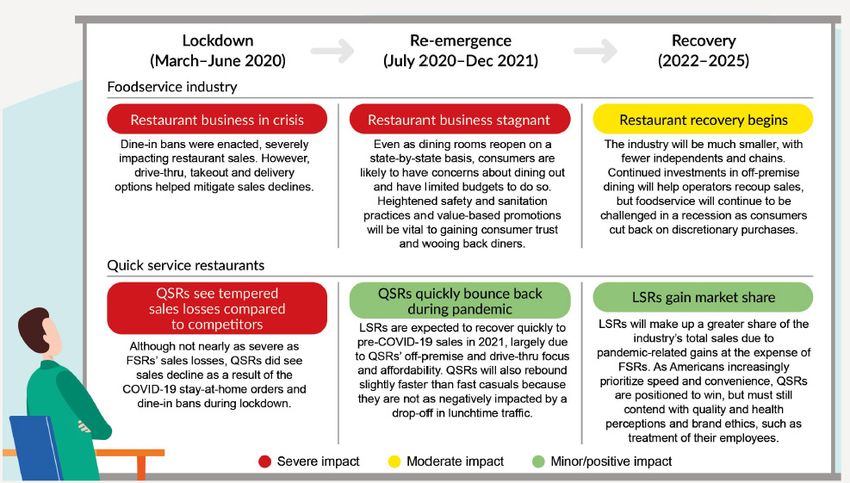
EXECUTIVE SUMMARY PREVIOUS NEXT
QUICK SERVICE RESTAURANTS, US - MARCH 2021 9
QUICK SERVICE RESTAURANTS STOOD TO BENEFIT THE MOST FROM THE COVID-19 CRISIS THANKS TO THEIR
AFFORDABILITY AND THEIR LONGSTANDING INVESTMENTS IN DRIVE-THRU, TAKEOUT AND DELIVERY. THEY’RE ALSO
VIEWED AS THE SAFEST AND MOST CONVENIENT MEAL SOLUTION FOR MANY AMERICAN FAMILIES RIGHT NOW AND
FOR THE FORESEEABLE FUTURE. QSRS WILL NEED TO CONTINUALLY INVEST IN THEIR OFF-PREMISE SERVICES AND
THEIR EMPLOYEES IN ORDER TO PROSPER IN THE YEARS AHEAD.
Jill Failla, Senior Foodservice Analyst
Top takeaways
QSRs come out ahead during pandemic Cater to core customers with more QSRs shouldn’t ignore or underestimate
but competitors are closing in convenient, automated off-premise the power of brand ethics
options
QSRs are the quickest of any foodservice In addition to staying ahead of competitors, One shortcoming of QSRs in 2021 is their
segment to recover consumer purchases QSRs also need to optimize convenience brand ethics perception, starting with their
overall during the pandemic. This quick for their core customers. Gen Zs drive the treatment of employees, which the majority
recovery has helped boost the entire LSR need for speed and drive-thru options at of QSR customers say needs improvement.
subsegment to prepandemic sales levels QSRs, and at least half of all Millennial fast These needs came to further public light
in 2021, stealing notable market share food customers prefer avoiding interaction amid the racial unrest of 2020, and QSRs
from FSRs in the interim. Competitors are with QSR employees and are fine with came under more scrutiny for their lack
taking note of QSRs’ winning strategies QSRs doing away with the on-premise of benefits, living wages and COVID-19
and investing in them at unprecedented dining room option altogether. These protections that negatively impacted their
speeds. Speed and safety are increasingly important cohorts demonstrate growing employees of color, in particular. QSRs
important convenience pillars. Fast food demand for off-premise-only locations and that invest in their employees stand to
needs to get even faster to remain on top. more automated and personalized ordering gain a more smoothly operating business
and purchasing methods. overall and more loyal, long-term young
customers.
PREVIOUS © Mintel Group Ltd. All rights reserved. NEXT QUICK SERVICE RESTAURANTS, US - MARCH 2021 10
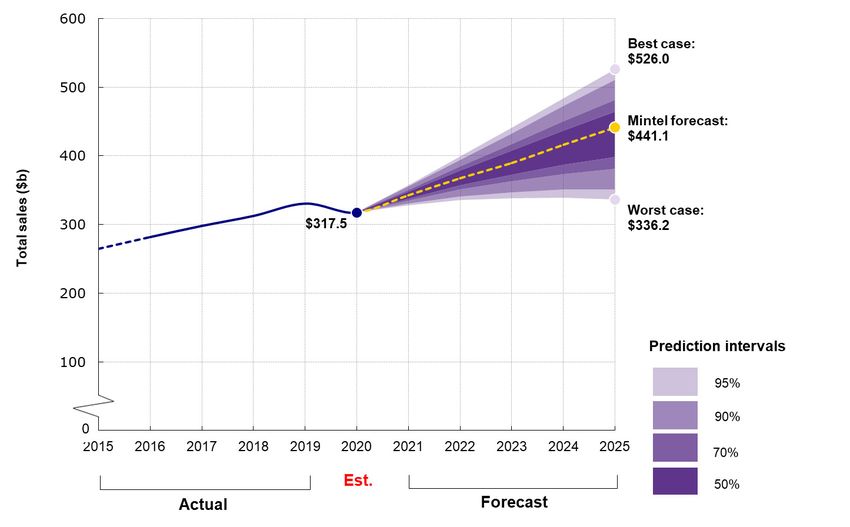
Market overview FIGURE 1: TOTAL US SALES AND FAN CHART FORECAST OF LIMITED-SERVICE
RESTAURANTS*, AT CURRENT PRICES, 2015-25
The LSR market, which includes QSRs
and fast casual restaurants, experienced
a notable loss of revenue in 2020 due to
the pandemic. Many Americans replaced
foodservice with grocery purchases,
resulting in an estimated 4.0% decline to a
$317.5 billion industry. However, thanks to
this segment’s prior investments in takeout
and delivery as well as its lower price points
and stronger value positioning, the LSR
segment is well outperforming its FSR
counterpart during the pandemic. For these
same reasons, LSRs will also steal notable
market share from FSRs over the next five
years, from 51% in 2019 to 54% in 2025.
Mintel forecasts LSRs to quickly recover
sales to prepandemic levels in 2021, with
QSRs driving the sales rebound. QSR sales
represented the vast majority of the Top 200
LSR industry at 86.9% in 2019 (see Market
Breakdown), and they are currently better * limited-service restaurants, cafeterias, grills/grill buffets, and snack/non-alcoholic beverage bars
suited to meet consumers’ off-premise and Source: based on US Census Bureau, Annual Retail Trade Survey; US Bureau of Economic Analysis/Mintel
low-price demands than their fast casual
counterparts.
PREVIOUS © Mintel Group Ltd. All rights reserved. NEXT QUICK SERVICE RESTAURANTS, US - MARCH 2021 11
Impact of COVID-19 on quick in the latter half of 2020 thanks to their safe, The following Figure provides a traditional
service restaurants convenient and well-known off-premise stoplight analysis of the impact of COVID-19
services, such as the drive-thru, as well on quick service restaurants, which
Just as with all restaurants, quick service as their affordable price points. As leading includes Mintel’s analysis for when we
ones felt a steep drop in visitation and sales QSRs continue to perfect and improve these anticipate consumer behavior to resume
during lockdown, with so many Americans strengths, they are well positioned for future to more normal or traditional levels prior to
following stay-at-home orders. However, growth in terms of both sales and market COVID-19.
quick service restaurants began bouncing share in 2021 and beyond.
back far faster than all of their competitors
FIGURE 2: SHORT-, MEDIUM- AND LONG-TERM IMPACT OF COVID-19 ON QUICK SERVICE RESTAURANTS, MARCH
2021
Source: Mintel
PREVIOUS © Mintel Group Ltd. All rights reserved. NEXT QUICK SERVICE RESTAURANTS, US - MARCH 2021 12
Opportunities and challenges FIGURE 3: QSR ATTITUDES – NET AGREEMENT, JANUARY 2021
Fast food recovers fastest from “How much do you agree or disagree with the following statements about fast food
pandemic challenges thanks to restaurants?” – NET agreement
safety advantages
QSRs were the quickest to recover
purchases from consumers during Fast food restaurants are the
the pandemic compared to any other safest restaurant option during the 46% 38% 16%
foodservice segment, and they are the pandemic
driving force behind LSRs’ 2021 sales
rebound. The reason for fast food’s swift
Any agree Neither agree nor disagree Any disagree
recovery after the COVID-19 outbreak and
government stay-at-home orders is due Base: 1,403 internet users aged 18+ who have visited a QSR in the last three months
primarily to their strong safety perception. Source: Lightspeed/Mintel
This enhanced safety perception is thanks
to their historic focus on lower-contact FIGURE 4: QSR TECHNOLOGY EXPERIENCE, FEBRUARY 2020 AND JANUARY
ordering and purchasing methods, from 2021
the drive-thru lane to delivery service –
especially with fast food pizza chains. “How would you describe your usage of, and interest in, the following technologies
offered by fast food restaurants?” [Have used and would like to use again]
In this way, safety has become a core
pillar of convenience during the pandemic,
since the speedier and more convenient an
ordering or purchasing method is, the less 50%
Any pre-order NET
likely it is to require human contact. QSR
62%
competitors figured out this competitive
advantage very early on, and they have
since been making huge investments in
safety and convenience amenities as well,
compelling QSRs to further innovate and 43%
invest, rather than resting on their laurels. Website pre-order and pickup
53%
Digital ordering usage takes off at
QSRs, opening up new doors
Although comparing a more engaged 40%
QSR customer base in January 2021 (ie Mobile app pre-order and pickup
who visited in past three months) to a 49%
less-engaged one (ie who visited in past
12 months) before the pandemic, the
striking changes in the QSR technology February 2020 January 2021
experience still reveal how the pandemic Base: 1,861 internet users aged 18+ who visited a fast food restaurant in past 12 months as of February 2020; 1,403
has permanently affected QSR technology. internet users aged 18+ who have visited a QSR in past three months as of January 2021
Fast food consumers have much greater Source: Lightspeed/Mintel
usage and intent to reuse rates for
preordering technology as a result of by the safety and convenience benefits of launch more personalized marketing efforts.
the pandemic, driven roughly equally preordering/digital ordering, which reduces Increased preordering trends should also
by website preordering and mobile app the need for human engagement. help boost general restaurant mobile app
preordering. This shift is again largely driven usage as well as restaurant mobile-based
This tech adoption greatly benefits QSRs loyalty program usage – especially as more
looking to gather more valuable consumer QSR loyalty programs become available.
data to inform their business decisions and
PREVIOUS © Mintel Group Ltd. All rights reserved. NEXT QUICK SERVICE RESTAURANTS, US - MARCH 2021 13
Fast food needs to get even faster FIGURE 5: FACTORS FOR CHOOSING A QSR – NET ANY RANK, BY
to appease Gen Z GENERATION, JANUARY 2021
When choosing a fast food restaurant, Gen “Besides price, which of the following are most important to you when choosing
Zs tend to care more than other generations a fast food restaurant? Please select and rank up to three in order of importance,
do about fast service and a drive-thru with 1 being most important.” [NET – Any rank]
option, the latter of which is usually thought
of as a fast service option or time-saver
as well. Interestingly, Baby Boomers are
roughly equally as likely as Gen Zs in early
46
2021 to say the drive-thru is important to 41
their fast food dining decision, which is likely Fast service
for safety reasons during the pandemic. 38
% Respondents 36
As Gen Zs age, their demand for speed
will grow alongside their increased career
and familial obligations and alongside their
spending power, making it of increasing 39
importance to QSRs. Moreover, Gen
Zs are actually the least satisfied of any 32
generation with their current fast food Drive-thru option
32
drive-thru experience (see QSR Drive-
Thru Experience), indicating a huge 41
opportunity for QSRs to immediately begin
improving their drive-thru speed, accuracy
and convenience. QSRs should look to
automation to solve for some of these Generation Z Millennials Generation X Baby Boomers
issues, including preordering options for a Base: 1,403 internet users aged 18+ who have visited a QSR in the last three months
dedicated drive-thru lane, additional drive- Source: Lightspeed/Mintel
thru lanes with automated food delivery
(eg via a conveyer belt) and automated
drive-thru menu boards with personalized
suggestions.
PREVIOUS © Mintel Group Ltd. All rights reserved. NEXT QUICK SERVICE RESTAURANTS, US - MARCH 2021 14
Many Millennials are OK with QSRs FIGURE 6: QSR ATTITUDES – NET AGREEMENT, BY GENERATION, JANUARY
ditching the dining room 2021
Millennials are the most frequent fast food “How much do you agree or disagree with the following statements about fast food
customers (see QSR Ordering Frequency), restaurants?” – NET agreement
drawn to them in part for their kid-friendly
positioning, since this cohort makes up the
majority of young parents in 2021. As their
46
core customers, QSRs should note that
most Millennials prefer to avoid interacting I prefer to avoid interacting with 56
with employees when they purchase fast employees when purchasing fast
food 46
food, and about half also agree that QSRs
don’t need to provide a dining area, which 35
% Respondents
is a significantly higher agreement rate than
other generations.
As a result, QSRs have ample opportunity 31
to continue to test and roll out takeout- and
delivery-only concepts, drive-thru-only 49
Fast food restaurants don't need to
concepts and mobile-order-only concepts, provide a dining area for customers
33
as many have just begun doing, especially
in young urban areas. QSRs may also 26
want to start testing contactless technology
solutions for on-premise purchases, such
as those found at retailers and c-stores Generation Z Millennials Generation X Baby Boomers
like Amazon Go. In October 2020, Dunkin’ Base: 1,403 internet users aged 18+ who have visited a QSR in the last three months
became one of the first restaurant chains to Source: Lightspeed/Mintel
do so with its completely cashierless, self-
serve prototype in California using its mobile FIGURE 7: QSR ATTITUDES – NET AGREEMENT, JANUARY 2021
app technology.
“How much do you agree or disagree with the following statements about fast food
Fast food brand ethics need restaurants?” – NET agreement
improvement
The vast majority of consumers, spanning
from Gen Zs to Gen Xers, agree that fast
Fast food chains need to treat
food chains need to treat their employees their employees better 64% 31% 6%
better, which is another racial and social
justice priority that became a hot topic
during the racial unrest of 2020. Top-of-mind
concerns for fast food employees include Any agree Neither agree nor disagree Any disagree
a lack of COVID-19 protections, paid sick
leave and living wages – especially as Base: 1,403 internet users aged 18+ who have visited a QSR in the last three months
these issues disproportionately affect fast Source: Lightspeed/Mintel
food employees of color. Fast food chains
have an opportunity to make a positive
contribution to their workforce and to society
overall ahead of government mandates,
such as a $15 federal minimum wage
requirement, and gain consumer trust and
loyalty in response. In the long term, more
automation will likely result in a need for
fewer QSR employees overall, which should
also allow QSRs to offer remaining QSR
employees better benefits, training and
growth opportunities.
PREVIOUS © Mintel Group Ltd. All rights reserved. NEXT You can also read


