Information Day for Operators - June 13, 2019 - Ile-de-France Mobilités
←
→
Page content transcription
If your browser does not render page correctly, please read the page content below
Information Day for Operators - June 13, 2019

Public transport in Île-de-
France
-
Public transport in Île-de-France

  The Île-de-France Region
  Key figures
  ▪   12.1 million inhabitants (~20% of the French population)
  ▪   6.2 million jobs
  ▪   30% of the national GDP
  ▪   12,000 km²
  ▪   46 million tourists / year
  ▪   Europe's leading job pool
  ▪   41 million travels / day (including 8.5 million by public transport)

                                                                             Urban

                                                                             Rural

                                                                             Wood/ forests

                                                                             Water

 3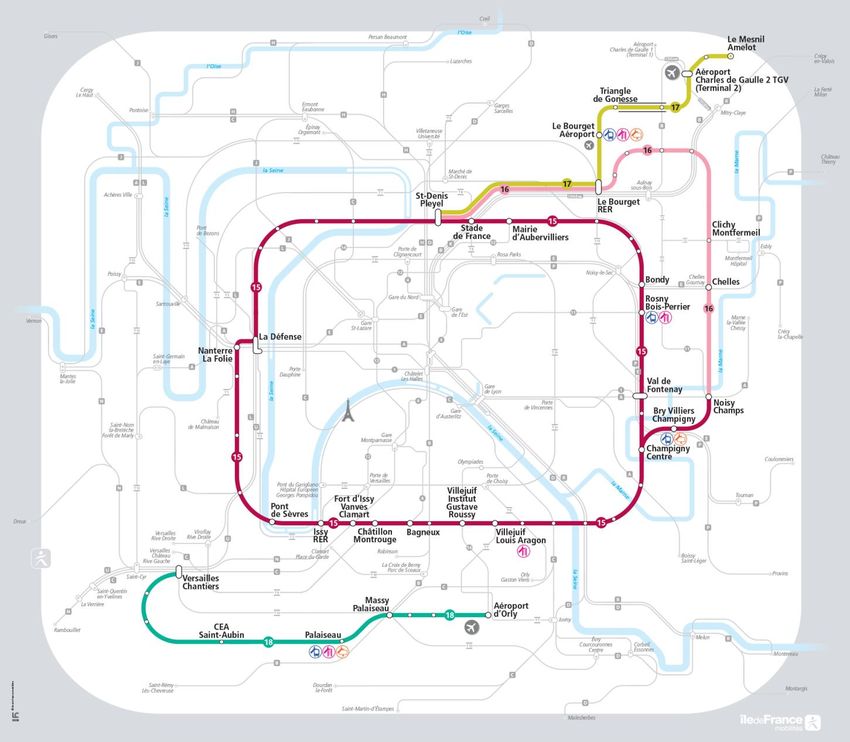
Public transport in Île-de-France

  A rich multimodal network

         5 RER lines                  16 metro lines         More than 1,500 bus
       9 transilien lines            10 tramway lines               lines

     1,441 M trips in 2017*         1 833 M trips in 2017*   1 431 M trips in 2017*

     * Source: OMNIL data
 4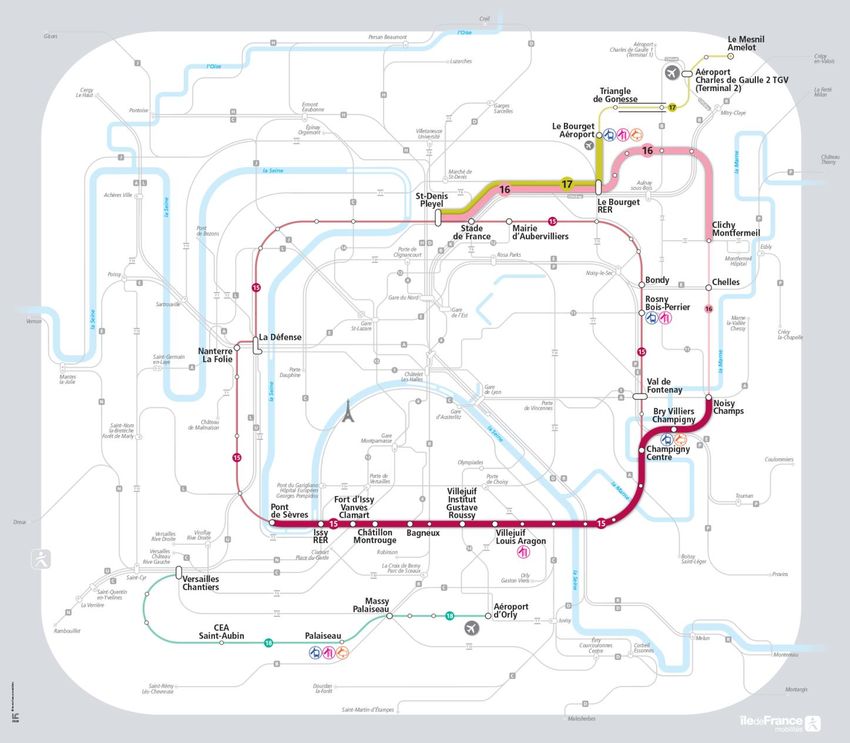
Île-de-France Mobilités

 Missions of Île-de-France Mobilités
 Île-de-France Mobilités is an integrated public transport authority, for
 all modes of public transport (Bus, Tram, Metro, Suburban trains).
 Its main missions are:

 • Requirements regarding the public transport services, the fare
   policy, the networks “train-km” offer, the service quality
   objectives, the contractual assignments with the operators,
 • Mobility planning,
 • Studies and investments policy made on the network,
 • Preparation and setting up of new mobility
                   …while ensuring a sustainable financial balance

 5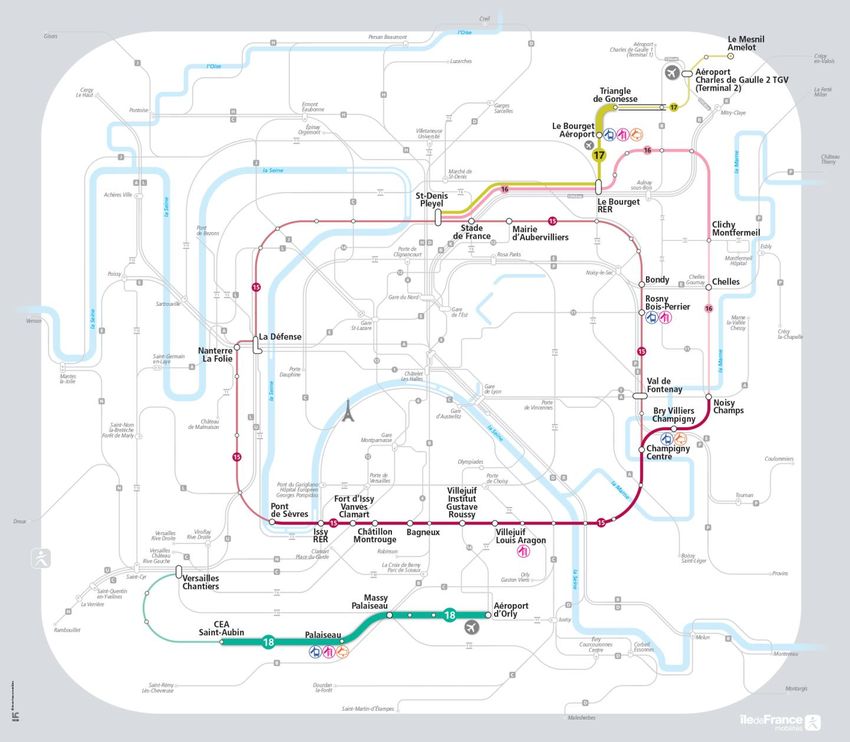
Île-de-France Mobilités

 A stable governance since 2005

     Since its devolution in 2005
     Île-de-France Mobilités is a local public authority
     Governed by a 29-members Board, chaired by the President of the Île-de-France
     Region

                  Valérie Pécresse
                  President of Île-de-France Mobilités

                  Laurent Probst
                  Chief Executive Officer of Île-de-
                  France Mobilités

 6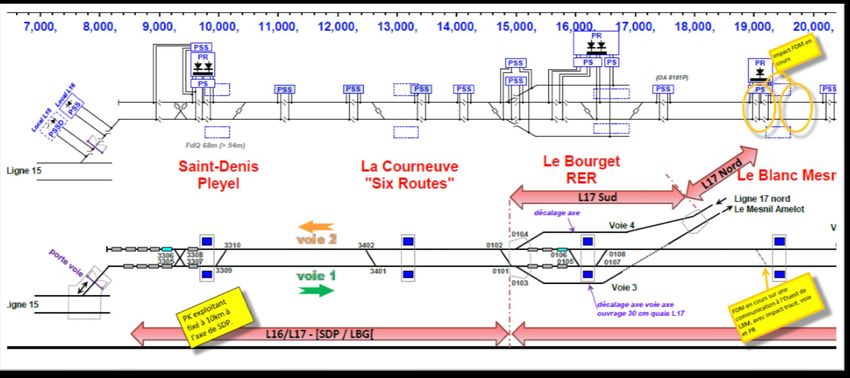
The Grand Paris Express
-
Île-de-France network

 A stronger service offer and a projected higher number of visitors

                                                    Modal shift allowed by the
                                                    development       of a new
                                                    structuring offer

                                                   Demographic and economic
                                                   growth

     Significant increase in the daily number of trips by public transport:

                            +13% between 2013 and 2025
                            + 20% between 2013 and 2035
     almost exclusively outside Paris

 8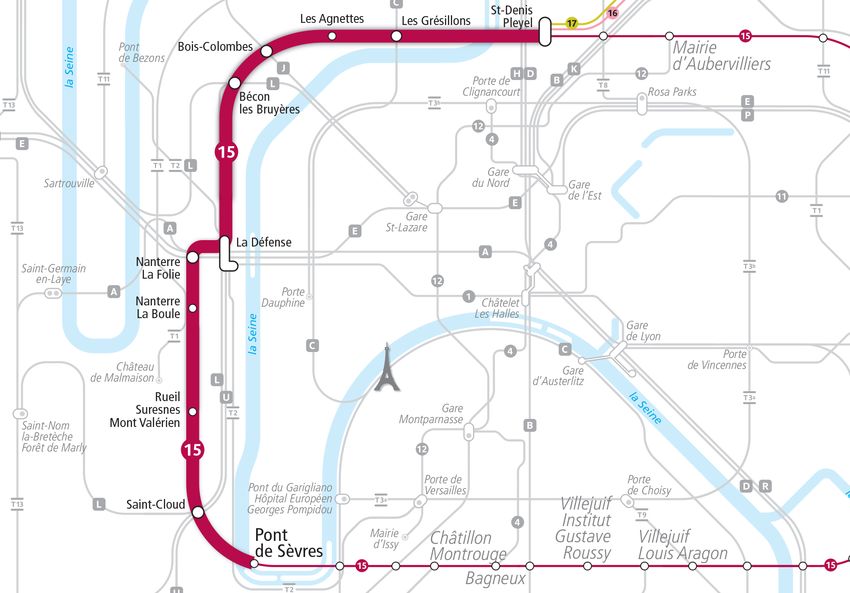
Introduction

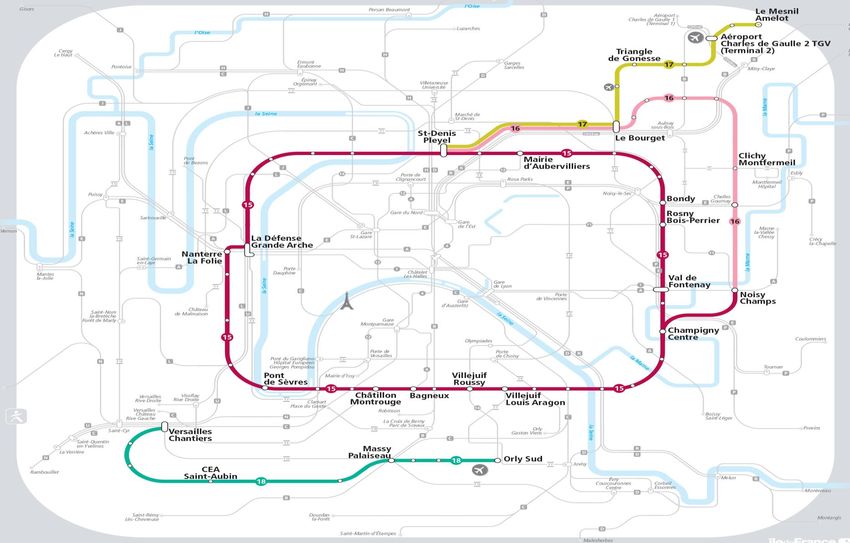
 A strategic transport network for the Île-de-France Region
 • 4 new high-performance automatic metro lines around Paris, heavily
   connected with existing rail networks (metro/RER/train)

 • About 160 km of lines                                       17

                                                                16

 • 60 new stations                              15

 • Suburban-suburban commuting
   purpose and decongestion on
   cross-city lines target

 • Better connection of main areas
   (airports,  universities)   and         18

   improvement        of     poorly
   connected activities
 9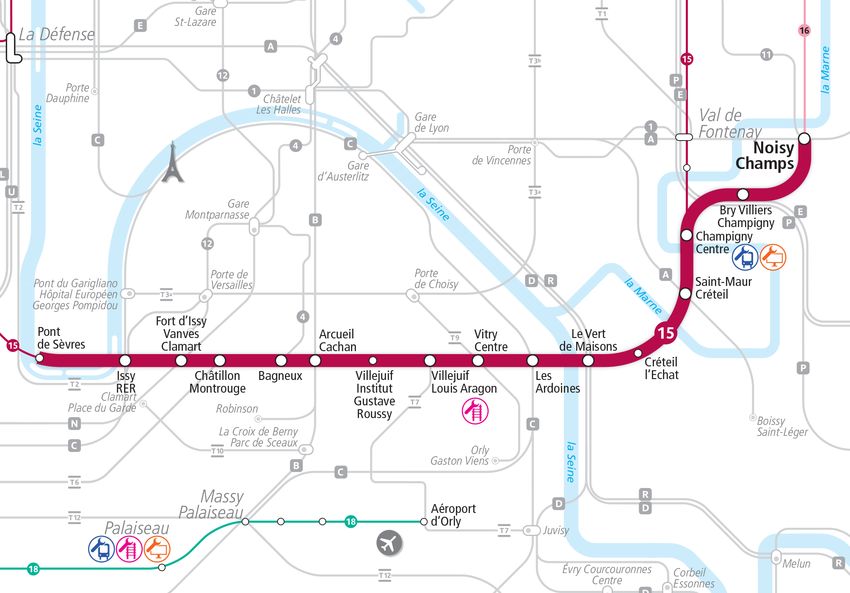
Introduction

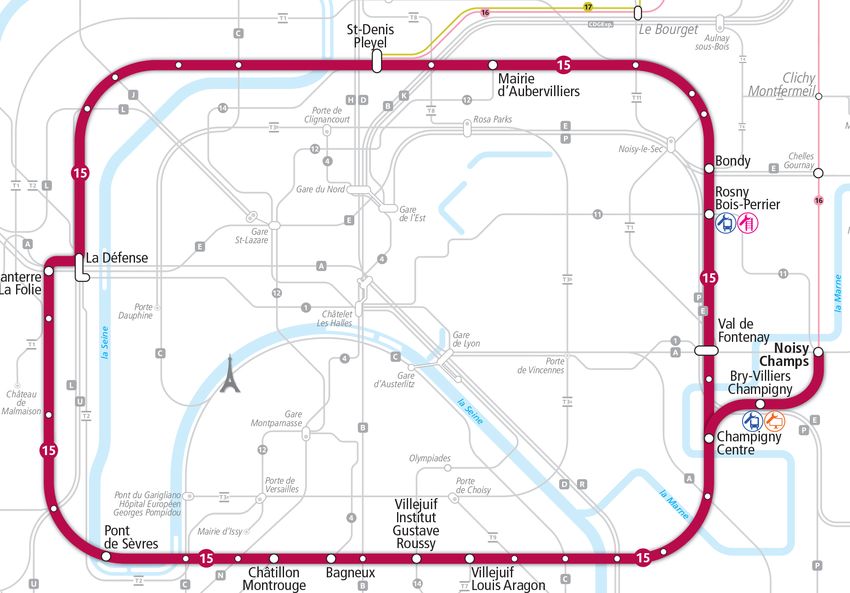
 General description of lines 15, 16, 17 and 18
      15

 10
Introduction
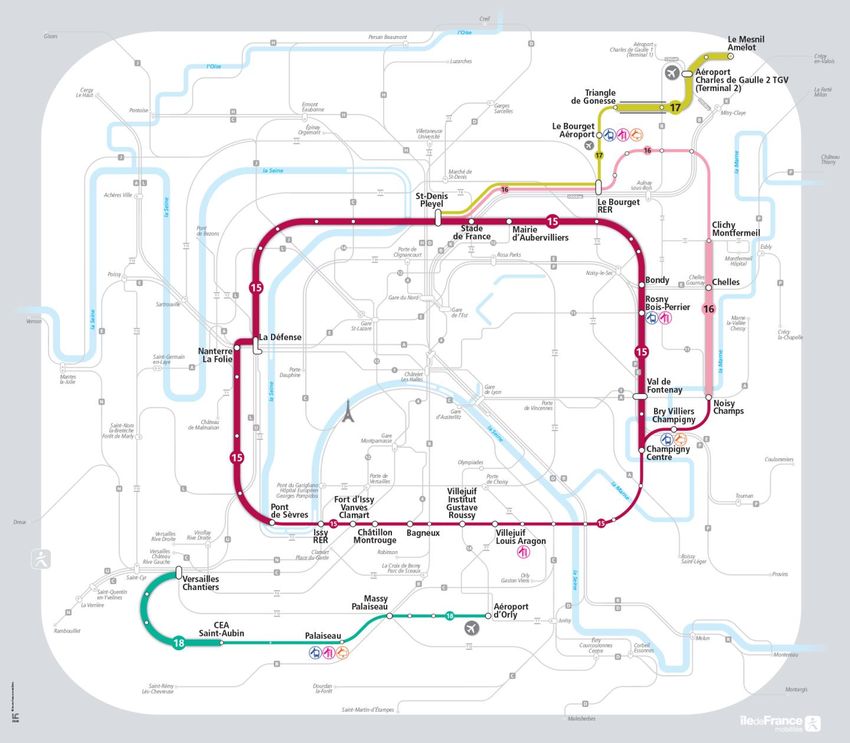
General description of lines 15, 16, 17 and 18
16
11Introduction
General description of lines 15, 16, 17 and 18
17
12Introduction
General description of lines 15, 16, 17 and 18
18
13SUMMARY
1. The new lines 15, 16, 17 and 18 of the Grand Paris
Express
A. Main data
B. Commissioning schedule
C. Actors
2. The bidding process for the operation of the service
A. Transport operators’ missions
B. Coordination between operators / infrastructure manager
C. Geographical scope and duration of the contracts
D. Timetable for the bidding process
1401 - The new lines 15, 16, 17 and 18 of the Grand Paris Express - A. Main data
1.A. The new lines 15, 16, 17, 18 of the Grand Paris Express

 General description of lines 15, 16, 17, 18

                                                               17
                                                                         • A common section 16/17

                                                                    16
                                                                         • A railway connection:
                                                                            ✓ Between 15 and 16/17 in St-
                         15                                                   Denis-Pleyel station (1 track),
                                                                            ✓ Between 15 and 16 in Noisy-
                                                                              Champs, station (1 track)
                                                                            ✓ Between 15 and the National
                                                                              Rail Network in Rosny-Bois-
                                                                              Perrier station

                    18

 16
1.A. The new lines 15, 16, 17, 18 of the Grand Paris Express
Lines general parameters
Line 15 Line 16 Line 17 Line 18
Number of stations 36 10 9 10
26,8 km
27,5 km Of which 6km of
Linear 76 km Of which 6km of common section with 35 km
common section with line 16
line 17 Of which 5,5km of
aerian section
Line depth
25-30 m 25 m 20 m 0-10 m
(average)
Inter-stations
~ 2 km 2,9 km 3,3 km ~ 3,7 km
(average)
171.A. The new lines 15, 16, 17, 18 of the Grand Paris Express
Lines general parameters
All lines are fully automatic driverless (GOA4)
Line 15 Ligne 16 Lines 16/17 Line 18
Type of bearing Iron Iron Iron Iron
Forecast commercial speed on ~ 50km/h ~ 70km/h ~ 70km/h Btw. 60km/h
main track and 70 km/h
Maximum speed 110km/h 110km/h 110km/h 100km/h
970 485 485 350
Forecast capacity of rolling stock
passengers passengers passengers passengers
108m 54m 54m 45m
Rolling stock length (6 carriages) (3 carriages) (3 carriages) (3 carriages)
86s
Minimum projected interval 86s
112s (on common 170s
MPH* by 2030 (on common section)
section)
Forecast traffic MPH 100 000-130 000 20 000-30 000 20 000-30 000 10 000-15 000
by 2030 passengers/h passengers/h passengers/h passengers/h
18 *MPH : morning peak hour1.A. The new lines 15, 16, 17, 18 of the Grand Paris Express
General description of lines 15, 16, 17, 18 – Operation centers
• A common lines’ 16/17
MSS/CCP in Aulnay
• 2 main IMS in Aulnay and
Vitry for the lines 15/16/17 +
1 storage IMS in Rosny
• 1 backup CCR for the lines
15, 16 et 17 in Noisy-
Champs
MSS : Maintenance and storage site
IMS : Industrial maintenance site
CCR : Centralised control room
191.A. The new lines 15, 16, 17, 18 of the Grand Paris Express General description of lines 15, 16, 17, 18 • To follow the progress of the construction of the lines, • For more detailed information on stations and systems: https://www.societedugrandparis.fr/ 20
01 -
   The new lines 15, 16, 17, 18 of the
   Grand Paris Express
   -
   B. Commissioning schedule
1.B. The timetable for the commissioning of lines 15, 16, 17 and 18

Present timetable - Commissioning in 2024-2025

22
1.B. The timetable for the commissioning of lines 15, 16, 17 and 18

Present timetable – Commissioning in 2026-2027

23
1.B. The timetable for the commissioning of lines 15, 16, 17 and 18

Present timetable – Commissioning in 2030

24
01 -
   The new lines 15, 16, 17, 18 of the
   Grand Paris Express
   -
   C. Actors
1.C. Actors

 A multi-actors Project
 The Grand Paris law (law n° 2010-597 of 3 June 2010) distinguishes several
 actors

 • Île-de-France Mobilités, the Public Transport Authority (PTA)
      •   Local public authority
      •   Financing the public transport service
      •   Fixing the public transport service fare system
      •   Appointing the transport operators
      •   Owner of the rolling stock (after purchase by SGP)

 • Transport Operators (TO)
      • Designated by the PTA through a competitive bidding process
      • Operating the Grand Paris Express network
      • Technical managers (maintenance) of rolling stocks, systems and
        secondary structures of stations
 26
1.C. Actors
A multi-actors Project
The Grand Paris law (law n° 2010-597 of 3 June 2010) introduces several key
actors in the Project
• The Société du Grand Paris (SGP)
• National public authority (State)
• Responsible body for the design and construction of the network
• Owner of the infrastructure and stations until its dissolution
• Purchaser of the rolling stock, on behalf of Île-de-France Mobilités
• RATP Infrastructures - The Infrastructure Manager (IM)
• Technical manager (maintenance) of lines, works and installations -
i.e. all the infrastructure and parts of the stations (according to a
decree and a ministerial order of 8 February 2019)
271.C. Actors A multi-actors Project The future lines 15, 16, 17 and 18 of the GPE have the particularity of being organized around several actors. As a result, there is: - A splitting of responsibilities between the network owner during construction and the technical managers (maintenance) during operation - A sharing of technical management missions (maintenance) between RATP- Infrastructures and Transport Operators Unlike the Paris Region metro, in which RATP is the owner of the network together with the operator and the technical manager (maintenance). This organization is usual for main international cities for the operation of metros Therefore, a dedicated contractual scheme between the various GPE actors is necessary, in which the public service contracts to be concluded with Transport Operators, will be included 28
1.C. Actors

 The contractual scheme

         RATP Infrastructures
                                                   Bidding    Public
 Cadrage des relations entre les                   process   Service
           acteurs                                           Contract
       Technical
                         Multi-year
      Management
                         Agreement
       Agreement

                                          IDF Mobilités                 OT
       Interface         Framework
      Agreement          Agreement

                   SGP

      Mandatory Agreement by the Loi Grand Paris

 29
02 - Bidding process for the operation of the service - A. Transport Operators’ missions
2.A. Transport Operators’ missions

Missions
Operator’s missions are not fully finalized and are likely to change. It will
be specified in the tender documentation

1. Operation of the transport service
2. Commercialization of transport tickets
3. Storage, maintenance and upkeep of rolling stock and station
   equipment necessary for the performance of the service
4. Reception, information and safety of passengers in
     stations and rolling stock
5. Traffic management from the CCR
6. Anti-fraud measures
7. Maintenance and storage site management
8. Business in stations (stores/advertising)    – subject to a possible legislative
     amendment
31
2.A. Transport Operators’ missions
Missions
Missions carried out under a public service contract will be paid on the
basis of:
• A fixed payment
• A variable payment based on passengers traffic - Île-de-France
Mobilités will collect the revenue from the sale of transport tickets
• Variable payment based on the achievement of performance
objectives set for both train traffic and service quality (based on Key
Performance Indicators)
No first establishment investments to be provided
3202 - Bidding process for the operation of the service - B. Cooperation between operators / infrastructure manager
2.C. Cooperation between operators / infrastructure managers

Missions of the infrastructure manager

 RATP Infrastructures is responsible for the technical management of the
 network on the following infrastructures (ministerial order of 8 February
 2019):
• Lines, structures and installations (excluding stations)
• Infrastructure maintenance sites
• Maintenance and storage sites and centralized control centers:
               •   Civil works
               •   Electrical power supply equipment
               •   Tracks, turnouts and point machines
               •   Centralized control centers including IT architecture and software
               •   Communication networks (including infrastructure)

• Automatic train operation and centralized controls:
               • Ground equipment
               • Software and data transmission system

• Stations (subject under discussion)

34
2.C. Cooperation between operators / infrastructure managers
Operators / infrastructure manager interfaces
A clear partition of IM and TO maintenance responsabilities will be
described in Interfaces Agreement and will be made available for the TO
candidates in the tender package.
The IM and the OT will detail the modalities of their cooperation in
Operational Protocols, to be finalized and concluded during the pre-
operation phase, the main principles of which will be described in the
Interfaces Agreement
• Some examples:
• Cooperation and management in the event of operational incidents and
disrupted situations;
• Procedures for managing alerts from TO to IM and from IM to TO;
• Interface management methods: rolling stock / infrastructure interfaces;
system interfaces, including automatic train operation and platform
doors...
3502 - Bidding process for the operation of the service - C. Geographical scope and duration of the contracts
C. Geographical scope and duration of the contracts

Public service contracts

3 contracts
         Line 15

         Lines 16 and 17

         Line 18

Why this scheme?
             Common
              Un postesection
                       de commande
                              16/17, control
                                      centralisé
                                             center
                                                 pardesign
                                                     périmètre

             Attractiveness of the call for competition
37
C. Geographical scope and duration of the contracts
Estimated duration
For the 1st public service contract:
Pre-operating 2 years
Operating 6 years
Duration of
the contract
8 years
3802 - Bidding process for the operation of the service - D. Timetable for the bidding process
2.E. Timetable for the bidding process

Present calendar

2 years of procedure for the 1st wave of contracts:

                                      Written
          Pre-
                                   comments on
     qualification
                                    the tender
     of candidates
                                     package        Negotiations
     to submit an
                                  by prequalified
          offer
                                    candidates

40
2.E. Timetable for the bidding process
Present calendar for the successive bidding processes
2020 2021 2022 2023 2024 2025 2026 2027 2028 2029 2030 2031 2032 2033 2034 2035 … 2041 2042
Competition Pre-operating Operating
Competition Pre-operating Operating
L16/L17
MAB MES
Competition Pre-operating Operating
Competition Pre-operating Operating
L15
MAB MES
Competition Pre-operating Operating
Competition Pre-operating Operating
L18
MAB MES
MAB = Operation Tests Phase of the 1st section
MES = Commissioning of the 1st section
41 Commissioning of the extensionThank you - For any question: juliette.vinck@Îledefrance-mobilites.fr
03 -
   Appendices

   -
1.A. The new lines 15, 16, 17, 18 of the Grand Paris Express

 Morning Peak Hour forecast

           Headway (s)                 L15                 L16/17                    L18
           2024 / 2025                  190                    120                      -
                                                        (on common section)

                                          -                                   (horizon being defined)
           2026 / 2027                                         120
                                                        (on common section)

           2030                         112                    86                     170
                                                        (on common section)

 Rolling Stock increase

           RS size                     L15                 L16/17                    L18
           2024 / 2025                  30                     25                       -
           2026 / 2027                   -                     26                      15
           2030                         101                    43                      29

 44
1.C. The actors of lines 15, 16, 17, 18 of the Grand Paris Express The contractual scheme Interface Agreement: Île-de-France Mobilités / RATP-Infrastructures / Société du Grand Paris • Management of the SGP/IDFM-TO/RATP-I interfaces relating to works, infrastructure availability and commercial commissioning • The Master Timetable by operation units until the release of guarantees • Allocation of maintenance perimeters between main maintainer, associated maintainer and system maintainer • Operational principles for future cooperation between transport operators and RATP-Infrastructure • Network data management over time Technical Management Agreement: RATP-Infrastructures / Société du Grand Paris / Île-de-France Mobilités (under discussion) • The transfer of infrastructure to RATP for technical management 45
1.C. The actors of lines 15, 16, 17, 18 of the Grand Paris Express

 The contractual scheme

 Framework Agreement: Île-de-France Mobilités / Société du Grand Paris

 • The technical management of stations and interfaces in stations
 • The commitments for cooperation during bidding process

 Multi-year Agreement: Île-de-France Mobilités / RATP-Infrastructures

 • Missions of the infrastructure manager
 • Objectives and performance indicators for infrastructure management

 46
2.B. L’articulation opérateurs / gestionnaire d’infrastructures

Appendix - The tasks of the infrastructure manager
• Lines, structures and installations (excluding stations)
                 •   Civil engineering
                 •   Platform and track equipment
                 •   Tunnel safety equipment
                 •   Energy transformation and distribution infrastructures
                 •   Telecommunications infrastructure
                 •   Secondary works and equipment

• Infrastructure Maintenance Sites (IMS):
                 • Shell, enclosed and covered
                 • Secondary work, industrial equipment or fixed maintenance means structurally
                   linked to buildings, external installations, access roads
                 • Platforms, tracks and equipment from the beam to the IMS
                 • Electrical power supply equipment
                 • Telecommunications infrastructure
                 • Industrial IT equipment (technical alarm management, fire detection and safety,
                   site protection, video protection, chronometry, sound system)
                 • Electromechanical equipment (service elevators, ventilation, air conditioning,
                   heating, exhaustion, compression and automatic closing smoke extraction
                   equipment)
                 • Infrastructure Maintenance Vehicles (IMVs)
47
2.B. The link between operators and infrastructure managers
Appendix - The tasks of the infrastructure manager
• Maintenance and storage sites and centralized control centers:
• Shell, enclosed and covered
• Electrical power supply equipment
• Platforms, tracks and equipment of the storage cluster
• Centralized control including IT architecture and software
• Communication networks (infrastructure)
• Automatic train operation and centralized controls:
• Ground equipment
• Software and data transmission system
• Interface safety equipment between control systems and platform facades
482.B. The link between operators and infrastructure managers
Appendix - The tasks of the infrastructure manager
• Stations:
• Structural work on equipment whose degradation or lack of maintenance will have
an impact on safety and availability (structural elements supporting the invert and
the docks, inverts, docks, cast walls)
• Flood safety equipment
• Technical rooms for equipment and systems managed by the IM
• Multi-service network infrastructure (MSN), timing and radio infrastructure,
intercom and telephony
• Energy transformation and distribution infrastructures
• Platform doors are excluded from the IM perimeter (if technically
isolated from the rest of the systems for which the IM is responsible –
their operation and maintenance has no impact on the remaining part
of the systems and their maintenance does not require the use of IM
logistics support)
492.B. The link between operators and infrastructure managers Appendix - Interface Agreement: Themes of the IM/TO Operational Protocols • Cooperation and management in the event of operational incidents and disrupted situations • Procedures for managing alerts from TO to IM and from IM to TO; • Interface management methods: rolling stock/infrastructure interfaces; system interfaces, including automatic train operation and platform façades; Infrastructure Maintenance Site / Maintenance and Storage Center interfaces (shared equipment, e. g. water distribution); civil engineering infrastructure/TO local infrastructure interfaces; GI/TO information systems interfaces; • Management of urgent corrective action by the IM during operating hours; • Management methods for night work sites; • Routing and operating procedures for IM and TO agents in the stations, in the Centralized Control Center and in the Maintenance/Storage Center; • Rules for sharing the financial operating costs within the buildings used by the IM and TO (e.g. water and power supply in stations, Centralized Control Center and the Maintenance and Storage Center) 50
2.C. Geographical scope and duration of contracts

Appendix - Lines layout

51
2.C. Geographical scope and duration of contracts

 Appendix - Lines layout

15 Sud
16 stations

52
2.C. Geographical scope and duration of contracts

Appendix - Lines layout

15 Ouest

 10 stations
 without Pont de Sèvres

53
2.C. Geographical scope and duration of contracts

 Appendix - Lines layout

15 Est

10 stations
 Without SDP et CC

54
2.C. Geographical scope and duration of contracts

Appendix - Lines layout

16

 10 stations
 Without Noisy Champs

55
2.C. Geographical scope and duration of contracts

Appendix - Lines layout

17

     8 stations
     Without Saint-Denis-
           Pleyel

56
2.C. Geographical scope and duration of contracts
Appendix - Lines layout
18
10 stations
Of which Orly Sud
57Annex :
• The metro lines will be operated :
• 7 days a week ;
• 365 days per year.
• Provided the maintenance can be organised accordingly, a 24h/24
operation over 2 days could be implemented if needed.
58Annex • Line diagram, track common section 16/17 59
You can also read


