Reef Check Australia's Whitsundays Citizen Science Project
←
→
Page content transcription
If your browser does not render page correctly, please read the page content below
Reef Check Australia’s
                                 Whitsundays Citizen
                                 Science Project

                                                                                       Interim Report
                                                                                                            April 2020

The Reef Check Australia Whitsundays Citizen Science Project is funded by the partnership between the Australian Government’s Reef
                                           Trust and the Great Barrier Reef Foundation.
Project Introduction
Reef Check Australia (RCA) is an environmental charity dedicated to protecting
Australia’s reefs and oceans by engaging the community in hands-on citizen
science and education initiatives. In April 2019 RCA were successful in their
application for funding through the Great Barrier Reef Foundation’s (GBRF)
Community Reef Protection grants (Link).

This funding has enabled RCA to continue collecting reef health data on long-
term sites in the Whitsundays region and expand citizen science activities in
the region. We are working with project partners to expand the number of
volunteers engaged in Great Barrier Reef Marine Park Authority’s (GBRMPA)
Reef Health and Impact Survey (RHIS) methods. We are also aiming to train and
engage Reef Ambassadors as enthusiastic community leaders looking to promote
information about the condition of our coral reefs and what communities can do to
help.

This report summarises project activities undertaken in the Whitsundays region over the life of RCA’s
Whitsunday Citizen Science Project between April 2019 and March 2020.

Multiple Monitoring Methods
An integral element of the project is the monitoring of reef health using multiple citizen science research
methods. We have attempted to implement multiple monitoring methods across the region. Data is then fed
into respective program databases to be used in regional reports, reef health summaries and potentially to
support management decision making and resource allocation.

                      Reef Check Australia
                      Reef Check surveys are conducted along an 80m transect line laid along a constant
                      depth and reef habitat type. RCA’s survey methods collect quantitative data for
                      substrate cover, key invertebrate species, target fish species, as well as anthropogenic
                      and natural impacts in reef habitats. Read more at www.reefcheckaustralia.org/methods

GBRMPA Eye on the Reef
The Eye on the Reef Reef Health and Impact Survey is a quick and efficient way to
provide a snapshot of reef health at any time on any Reef. It is a quantifiable survey
method that assesses reef health in a series of five-metre radius circles (a total of 78.5
square metres). Read more at www.gbrmpa.gov.au/our-work/eye-on-the-reef

                      CoralWatch
                      The CoralWatch Coral Health chart integrates global coral health into a simple and
                      engaging tool to enable opportunities for hands-on experience collecting scientific data
                      on coral bleaching. CoralWatch is an easy-to-use tool to quantify changes in coral colour
                      associated with coral bleaching on the reef. Read more at www.coralwatch.org/index.
                      php/monitoring/survey-methods/

 National Environmental Science Programme (NESP) Aesthetics
 Project partner Reef Ecologic has been collecting additional data to determine the
 efficacy of citizen scientists rating coral reefs based on aesthetic values alone. We are
 testing whether health and beauty ratings from citizen scientists are equivalent to those
 of ratings given by marine scientists and artificial intelligence. If successful, a whole
 new monitoring regime could be developed where casual observations on the aesthetic
 beauty of a site will provide a new way of collecting up to date information on reef
 health. (Link)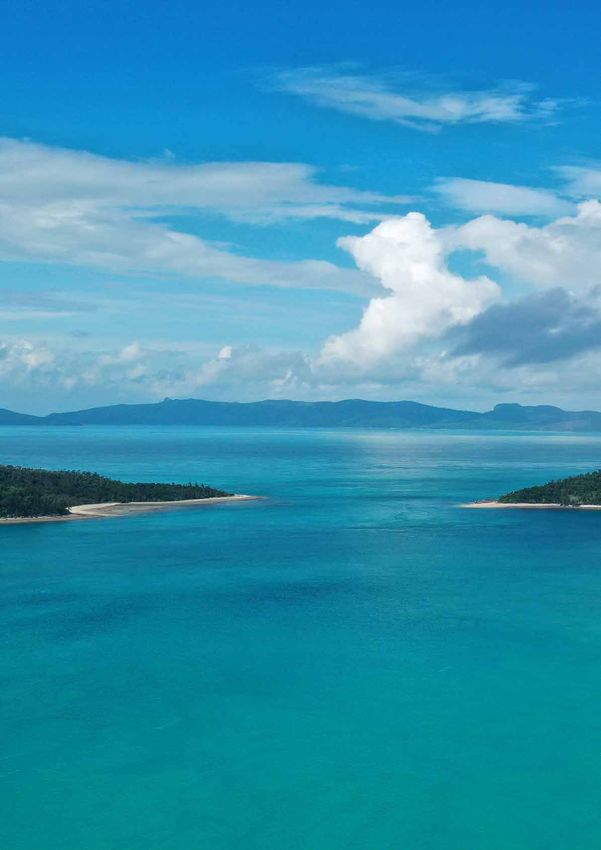
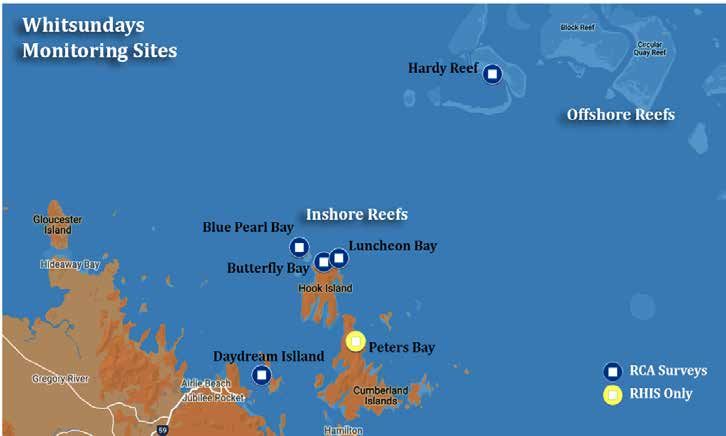
Monitoring Sites
                                                      Since July 2019, Reef Check Australia volunteers visited
                                                eight sites across six locations in the Whitsundays. Locations
                                                      included Hardy Reef (Offshore, 2 sites), Hayman Island,
                                                    Blue Pearl Bay (Inshore, 1 site), Hook Island Butterfly Bay
                                              (Inshore, 1 site), Luncheon Bay (Inshore, 1 site) and Daydream
                                                Island (Inshore, 2 sites). In addition volunteers also surveyed
                                              Whitsunday Island, Peters Bay (Inshore, 1 site). Peters Bay was
                                                                         surveyed using the RHIS method only.

Key Findings
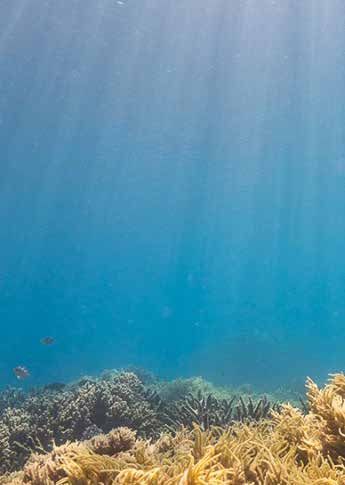
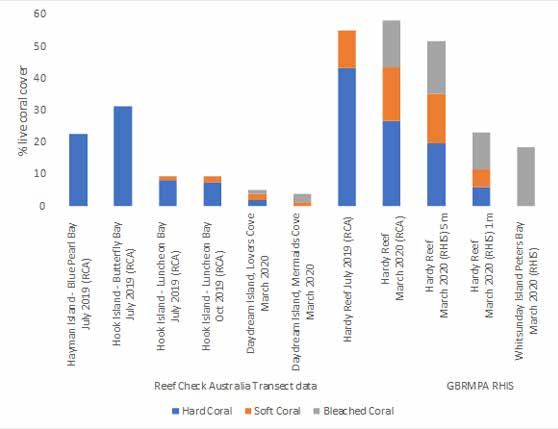
•   Live coral cover was higher at Hardy Reef (Offshore) than inshore reefs.
•   Many inshore reefs illustrated reasonable coral cover, however at some locations diversity of species
    remains very low.
•   Coral bleaching was having substantial impacts at both inshore and offshore locations through February
    and March 2020. Across 4 sites surveyed in March, 32% of the coral populations were bleached.
•   Incidences of coral disease were
    very low (recorded at only one           Live coral cover illustrating hard, soft and
                                             bleached corals recorded across 6 locations
     inshore site).                          in the Whitsundays using either Reef Check
                                            Australia surveys and/or GBRMPA RHIS
                                            surveys. Offshore locations (n=1), inshore
                                            locations (n=5).

A full summary of RCA data will be available in the 2019-2020 RCA Regional Annual Report August 2020.
Traditional Owners Engagement and Participation
                                   Over the past few months Reef Check Australia and partners Reef Ecologic and Reef
                                         Catchments have been working with and consulting Traditional Owners in the
                                           Whitsundays region to increase their involvement in supporting monitoring
                                                            and management of culturally relevant sites and species.

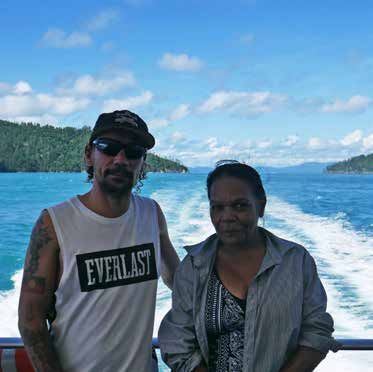
                                                       Ngaro Traditional Owners joined Reef Check Australia in surveyor
                                                      training, and reef monitoring at both inshore and offshore sites in
                                                    the Whitsundays region. Both Adrena and Kurtis learned about reef
                                                   monitoring and what it takes to collect reef health data. They shared
                                             stories of Traditional Owner sea-country connections and provided advice
                                            on new monitoring sites that provide cultural relevance completing spatial
                                              coverage in the Whitsundays region. In the coming months we will begin
                                        monitoring these new sites, hopefully in partnership with the Ngaro Traditional
                                                                                                   Owners in the region.

    Reef Check Surveyor Training
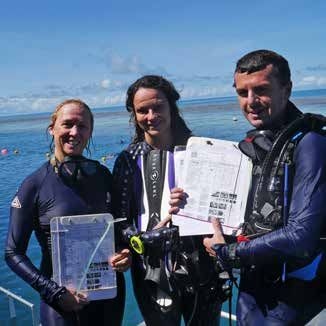
    Two Reef Check Australia survey training programs were conducted in the
    Whitsundays region during this reporting period totalling six newly trained
    surveyors to help gather data about the health of local reefs. We also had a
    Reef Check Ambassador, a project partner from Reef Catchments and two
    Traditional Owners, Adrena Pryor, and Kurtis Dow participate in the March
    2020 training activities learning about Reef monitoring, how we provide
    information to management about the health of the Reef and what we can
    all do to support its ongoing resilience and upskilling in different areas.

                                            Reef Check Ambassador Training
                                       Reef Ambassadors are reef role models who actively empower their
                                        communities to better understand and help protect marine environments at
                                         a local level. The program mentors volunteers to develop their knowledge
                                          and skills in reef ecology, communications, behaviour change principles,
                                          and project planning to support positive locally relevant action for the reef.
                                          In February 2020 we conducted the first Reef Check Australia Ambassador
                                         workshop in the Whitsundays and four new RCA ambassadors joined the
                                        team. Using their new community engagement skills, our new Ambassadors
                                      partnered with local yoga and fitness studios to schedule Earth Hour events
                                   in both Bowen and Airlie the following month however COVID-19 proved
                              challenging.

Acknowledgements
 This project was made possible by a network of dedicated volunteers, generous dive operators, wise advisors, innovative collaborators
 and supportive funding agencies.Thank you to the dedicated citizen scientists who have contributed to survey activities. Project
 activities were conducted on the traditional lands of the Ngaro and Gia People. We acknowledge the Traditional Custodians and their
 connections to land, sea and community. We pay our respect to their elders past and present and emerging.

 Thank you to industry supporters who provided in-kind support during these survey activities and volunteer training events including
 Cruise Whitsundays, Explore Whitsundays, Coral Sea Marina Resort and Daydream Island Resort. Thank you also to project partners
 Reef Ecologic and Reef Catchments.
                                                                                                                               April 2020
You can also read


