Rough Sleeper Multi-Disciplinary Team Toolkit for Practitioners - HERTFORDSHIRE COUNTY COUNCIL
←
→
Page content transcription
If your browser does not render page correctly, please read the page content below
Rough Sleeper Multi-Disciplinary Team
       Toolkit for Practitioners

         Public Health and Adult Care Services
         HERTFORDSHIRE COUNTY COUNCIL

                            0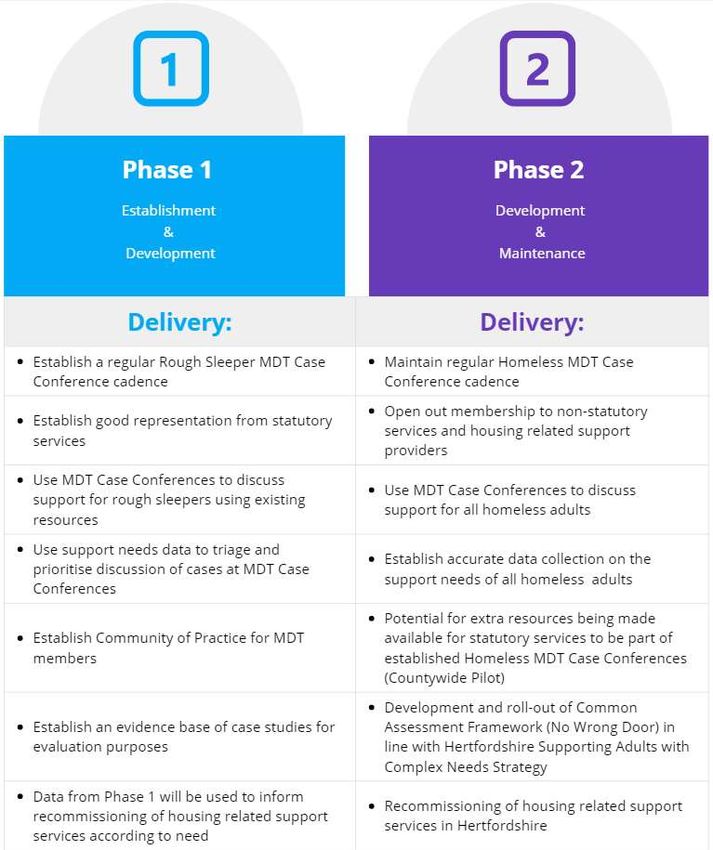
Rough Sleeper Multi-Disciplinary Team (RS MDT)
                               Toolkit for Practitioners

Table of Contents
Section 1
Introduction ............................................................................................................................... 2
   The Evaluation and Links with Strategy ................................................................................. 3
   A Phased Approach to Development ..................................................................................... 4
   Benefits for Agencies..............................................................................................................5
Section 2
The Toolkit .................................................................................................................................6
   Terms of Reference and Information Sharing........................................................................6
   Terms of Reference Overview................................................................................................ 7
   Features of a Successful RS MDT Case Conference ............................................................... 8
   Using the Rough Sleeper Tracker ........................................................................................... 9
   Prioritisation of Cases...........................................................................................................10
   Ideas for Engaging Entrenched Rough Sleepers with Support Services .............................. 12
   Community of Practice.........................................................................................................13
Section 3
Next Steps ................................................................................................................................ 15
Section 4
Appendix ..................................................................................................................................18

Appendix A – Full Terms of Reference
Appendix B – Information Sharing Agreement
Appendix C – RS MDT Case Conference Agenda
Appendix D – RS MDT Case Conference Notes & Actions
Appendix E – Case Study Template
Appendix F – Public Health Rough Sleeper Tracker

                                                                      1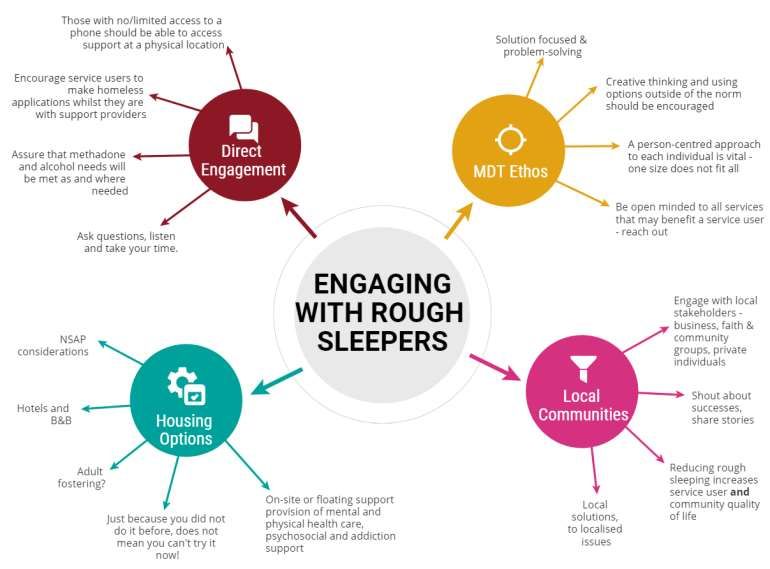
Section 1: Introduction
   “Everyone In”
   In response to COVID-19, the Government’s ‘Everyone In’ initiative sought to bring in Rough
   Sleepers off the streets to protect their health and to prevent wider transmission, thereby
   reducing the impact of the virus on people experiencing homelessness and local
   communities.
   The Hertfordshire Accommodation and Recovery Cell (a multi-agency partnership of
   representatives from District Local authority Housing, Adult Care Services, Public Health,
   Probation, CCGs and MHCLG) was set up to plan and manage the Countywide response to
   meeting the housing, health and support needs of the homeless, including rough sleepers.

   Initiation of the RS MDT Case Conferences and the Rough
   Sleeper Tracker
   To establish the support needs of rough sleepers accommodated under the ‘Everyone In’
   initiative (April 2020), Public Health designed a service user level tracker. The tracker
   identified each rough sleeper, along with any self-reported health, housing and support
   needs. Once this was populated by each of the District Councils, Public Health identified
   priority cases which had the greatest support needs that were currently not being met or
   where further support was needed.
   This priority list then formed the basis of the Rough Sleeper Multi-Disciplinary Team (RS
   MDT) Case Conferences, led by each of the District/Borough Housing Options Managers
   (or equivalent), offering an assessment of need by each individual agency and/or the
   necessary referral into the appropriate agency for housing and support.

                                               2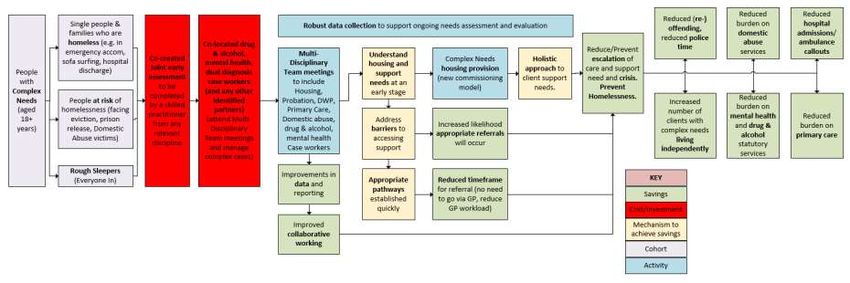
The Evaluation and links with Strategy

     The Public Health Evidence and Intelligence Team undertook an evaluation to:
        (1) Explore whether the RS MDT approach should be considered for the future
            Housing Related Support model as a tried and tested way of working
        (2) Gather insight of any challenges or gaps in the model which could prevent the
            approach from becoming successful, and recommendations for overcoming them
     The evaluation consisted of observations of RS MDT case conferences and 15 interviews
     with MDT members across a range of Districts and agencies. The findings from the
     evaluation have resulted in:

        •   An understanding of the features of successful RS MDT Case Conferences (page
            8), challenges which members have faced, potential benefits for service users and
            benefits for agencies involved (page 5).
        •   The development of the Rough Sleeper Tracker (co-created with District Housing
            Colleagues) (Appendix F) which aims to;
                 o Capture the level of unmet support needs in this population
                 o Capture outcomes over time
                 o Monitor outcomes and needs for those with protected characteristics
                 o Ensure effective targeting of resources
                 o Inform commissioning and MHCLG funding decisions
                 o Enable effective running of RS MDT Case Conferences (including the
                    prioritisation of cases for discussion)
        •   Recommendations for future work both short-term and long-term. See page 4 and
            Section 3 (Next Steps).

     One of the recommendations which came from the evaluation was the creation of a toolkit
     which could help districts organise and run effective RS MDT Case Conferences.

     How this approach links into our Complex Needs Strategy

     The collaborative working amongst RS MDT partners aligns with the vision of the Complex
     Needs Strategy of ‘Working together. Delivering prevention focused services to enable
     adults to live independently’. The commitment of partners throughout the pandemic
     allowed us to test the RS MDT approach and the outcome of the evaluation will provide
     key learning for future commissioning of housing related support services.
     The RS MDT approach aligns with the strategic aims:

        •   Fair access to services
        •   Prevention and crisis intervention
        •   Housing provision

                                                 3
A Phased Approach to Development

   The recommendations from the RS MDT evaluation will take time to fully embed. This toolkit
   describes how to set up and run effective RS MDT Case Conferences now (Phase 1) and as
   Phase 2 begins to roll out, this toolkit will be updated. We anticipate further development of
   the tracker itself as we continue to learn throughout both phases.
   The most up to date versions of the Toolkit and the Tracker will be available centrally via the
   Hertfordshire Health Evidence website. Please see below for an overview of what Phases 1
   and 2 will look like. Section 3 (Next Steps) of this toolkit describes how we will progress with
   Phase 2.

                                                  4
Benefits for Agencies
From the evaluation of the RS MDT approach, the following benefits have been identified
for the agencies involved in RS MDT Case Conferences:
Better Communication
between agencies
➢ Break down barriers of information
sharing
➢ Conversations between case
Time Savings
conferences due to contacts made
➢ Understanding of increased
➢ Reduce time chasing information
2 demand (due to COVID-19)
➢ Shared commitment to find
for individual service users
➢ Oversight of all cases from one 1 appropriate housing
➢ Multi-agency framework
contact
established
➢ Decisions made
o Holistic approach to
quickly allowing cases
supporting service
to progress
users with multi-
➢ Reduce workload
faceted support
needs
4
3
Expectations of
Referrals
➢ Understand who each service can or cannot Correct Signposting
help
➢ Manage expectations of each service ➢ Learn about other agencies & their work
➢ Advice & guidance shared
➢ Allow agencies to identify gaps in provision
➢ Triage referrals
➢ Inappropriate referrals prevented.
➢ Correct pathways established quickly
Appropriate referrals to voluntary/non-
➢ Pursue viable options only
statutory services lead to reduced burden ➢ Leading to prevention of inappropriate
on statutory services referrals and reduced burden on
statutory services
5Section 2: The Toolkit
This toolkit has been created using observations from successful RS MDT Case Conferences,
solutions developed to overcome the reported challenges from RS MDT practitioners and
from conversations and interviews with Housing Options Managers on what could assist
them.
We anticipate further development of the toolkit as we continue to learn and progress from
Phase 1 to Phase 2 of the RS MDT Case Conference rollout.
The most up to date version of the Toolkit will be available centrally via the Hertfordshire
Health Evidence website.
Terms of Reference and Information Sharing
TERMS OF REFERENCE INFORMATION SHARING
A clear and concise Terms of Reference All Rough Sleeper MDTs should have an
(ToR) document should be agreed upon by Information Sharing Agreement (ISA) in
members of any existing RS MDT. Any new place to enable the proportionate and
members should be sent the document relevant sharing of service user
prior to their attendance for agreement. information, in support of the aims of the
RS MDT.
Appendix A is a suggested draft Terms of
Reference that you can use for your RS Appendix B is an Information Sharing
MDT Case Conference. A brief overview of Agreement developed by Public Health and
this document is also provided below. signed off by the HCC Information
Governance Team.
The Terms of Reference, as well as acting
as a document to focus the work of the All RS MDT member agencies and
Case Conference, also acts as a buy-in organisations, whether permanent or ad
mechanism for members of the RS MDT. hoc, must agree to and sign the
All RS MDT agencies and organisations, Information Sharing Agreement.
whether permanent or ad hoc, should
The MDT Coordinator or their nominated
agree to and sign the ToR prior to
administrator will be responsible for
attending.
ensuring the Terms of Reference have
The RS MDT Coordinator or their been signed by all agencies in attendance.
nominated administrator will be
responsible for ensuring the Terms of
Reference have been signed by all agencies
in attendance.
6Terms of Reference Overview
Full Terms of Reference in Appendix A
Purpose of the Rough Sleeper Multi-Disciplinary Team (RS MDT) Case Conference
Aim: Focus on priority cases to ensure that every individual is offered an assessment of need
and/or the necessary referral into the appropriate agency.
Objective: Establish the lead support agency which will undertake an assessment to
determine the pathway for housing related support. During Phase 2 of MDT development we
will be co-creating a common assessment framework – please see Section 3: Next Steps for
further details.
Definition of client group
Cases will be assessed for priority based on:
• Identified support needs (mental health, substance misuse, offending, safeguarding,
No Recourse to Public Funds (NRPF) and not currently receiving support
• At risk of rough sleeping due to eviction or are on a final warning from temporary
accommodation and not currently receiving support
• Clinically Extremely vulnerable and not currently receiving support
• Evicted and not currently receiving support
• Assessed for move-on and has ongoing unmet support needs
Agency attendee list Key Agencies
A key representative should attend from each • MDT Coordinator (Housing Options
of the key agencies to enable consistency and Manager or equivalent)
a commitment to the aims of the group. If they • Housing Options
are unable to attend, a representative who has • Probation
been briefed should attend in their place, or an • Hertfordshire Partnership
update of cases should be provided in writing Foundation University Trust (HPFT)
prior to the case conference. • CGL (Change Grow Live) Spectrum
• Primary Health Care
• Any Third Sector agency with
Service user confidentiality and data
knowledge of/ involvement with
sharing
cases that may be discussed
All partner organisations represented at the RS
MDT will have read, agreed and signed the
Updates and agreed actions will be
Rough Sleeper MDT Information Sharing recorded on the Public Health Rough
Agreement developed by Public Health. Sleeper Tracker.
No service user details will be formally The tracker will be shared with Public
recorded by any of the agencies attending the Health every quarter to enable the
RS MDT case conference unless the person is Master Tracker to be updated and an
already open to them. analysis summary shared.
7Features of a Successful RS MDT Case Conference
ADMINISTRATION GOOD REPRESENTATION SHARING OUTCOMES
Well run RS MDTs keep to Agencies that should attend Outcome summaries will
time, most take 1.5 hours as a matter of course: enable a picture to form
but are scheduled for 2 Hertfordshire Partnership that will show patterns that
hours to allow for Foundation Trust (HPFT) led to success, and potential
particularly complex case patterns to identify system
discussions as and when Change, Grow, Live (CGL) improvement. The Tracker
they arise. Housing (District Team) has an Outcomes Summary
tab which can be a helpful
Probation
visual to show RS MDT
It is recommended that RS members the progress that
MDT Case Conferences are is being made with complex
Agencies that can have a
held every 4 to 6 weeks. cases.
significant impact on
positive outcomes:
The Chair (RS MDT Primary Health Care Case studies and examples
Coordinator) should always of good practice should be
Adult Care Services (ACS)
be a separate person to the shared within the RS MDT
Social Workers
minute taker. Appendix C and wider still, to senior
provides a suggested Agenda Children’s Services managers of each attending
and Appendix D a template Voluntary, Community and agency.
for minutes. Social Enterprise (VCSE)
organisations providing
mental health services VCSE members should be
The tracker, where possible, encouraged to complete
should be updated during VCSE organisations providing case studies each quarter.
the RS MDT itself - there is family support services There is a template for this
no need for detailed Supported Housing in Appendix E.
sentences; bullet points are Providers
best for tracking actions.
A Community of Practice
Agencies who cannot attend has been set up where
Details of the cases to be in person should provide a members of RS MDTs across
discussed at each RS MDT written update or summary the County can meet and
should be circulated at least on each case under their share good practice,
3 days prior to the meeting. remit. This decreases inter- challenges and solutions. If
This includes cases carried agency duplication and you would like to know
over from the previous RS overlap. more about this please e-
MDT and any new cases that mail
have come to light since the RoughSleeperMDT@hertfor
previous RS MDT. Ideally dshire.gov.uk
you will discuss no more
than 15 cases per RS MDT -
all service users should have
a Date of Birth attributed to
them as this allows all
agencies to look up cases.
8Using the Rough Sleeper Tracker
The purpose of the Rough Sleeper Tracker is to:
• Capture the level of unmet support needs in this population
• Capture client outcomes over time
• Monitor outcomes and needs for those with protected characteristics
• Ensure effective targeting of resources
• Inform commissioning decisions
• Enable effective running of RS MDT meetings (including the prioritisation of cases for
discussion)
Every quarter we will request that the Tracker is shared with Public Health to enable the
Master Tracker to be updated and the data to be analysed. Public Health will report back on
District-level statistics such as the number of presentations in each support need category,
further broken down by age, gender and whether they’re receiving support.
We recommend the following actions for best use of the tracker alongside the MDT Case
Conferences:
The General Data section should be filled in before the RS MDT Case Conference. We recommend
trying to recruit some admin help to do this
Put all Rough Sleeper cases into the tracker, the questions in the 'General Data' section (in
orange) will help you to prioritise cases. In Phase 1, we request that only rough sleeper cases are
discussed at RS MDTs and entered into the tracker. If you have capacity to also discuss homeless
cases at your MDTs, please speak to us and we will amend your version of the tracker to capture
this data.
Ensure when cases are closed to change the status to ‘closed’, then you can filter for just the
open cases. This will help you to keep focused on the cases you are discussing. You can also filter
on names or any other field.
Share the tracker on screen in the RS MDT Case Conference and update as discussion progresses.
All cases start at MDT 1, the baseline (blue section), and then progress through MDT 2, MDT 3
etc. The RS MDT number therefore refers to each individual case, rather than the total number
of MDTs held.
Save time by copying the actions straight from the action columns into an email for circulation
after the RS MDT. This helps to ensure agreed actions are completed.
9Prioritisation of Cases
Defining the Client Group
For the purposes of conducting rough sleeping street counts and evidence-based
estimates, the Ministry of Housing, Communities and Local Government (MHCLG) defines
people who sleep rough as:
1. People sleeping, about to bed down (sitting on/in or standing next to their
bedding) or bedded down in the open air (such as on the street, in tents, doorways,
parks, bus shelters or encampments).
2. People in buildings or other places not designed for habitation (such as stairwells,
barns, sheds, car parks, cars, derelict boats, stations, or “bashes” which are
makeshift shelters often comprised of cardboard boxes).
This is a helpful definition for those Districts who have a backlog of cases on their Rough
Sleeper Tracker. Focusing on verified rough sleepers for new case discussions will
automatically lend itself to prioritisation thereafter. Those who are temporarily housed
(i.e. those in hostels, shelters or hotels) would then follow in terms of priority based on
housing status. It is the remit of the MDT Coordinator to prioritise cases for discussion
both from internal identification, and of those cases put forward by partner agencies and
organisations.
It is important to recognise that people move in and out of periods of rough sleeping.
Rough sleeping can be a transitory state, and many experience a ‘revolving door’ cycle,
moving in and out of short-term accommodation – therefore the two tier prioritisation
approach outlined above will likely pick up these individuals at some point with a view to
breaking the cycle.
We recognise that ‘Everyone In 2’ means that there should be nobody rough sleeping at
present, but we learned from 2020 that the entrenched rough sleeping cohort often do
not ‘stay in’ for long without a high level of support.
The flow diagram on the next page has been created to facilitate the prioritisation of
cases for the RS MDT Case Conferences.
If after using the prioritisation tool on the next page you are struggling to narrow your
case discussion focus to the recommended 10-15 cases, please e-mail
roughsleepermdt@hertfordshire.gov.uk.
1011
Ideas for Engaging Entrenched Rough Sleepers with Support Services

                                                     12
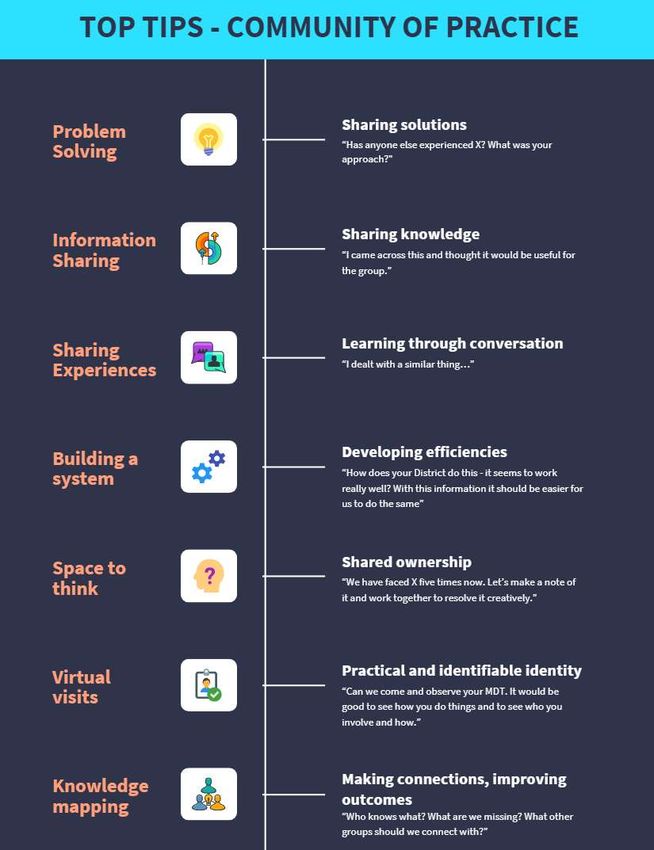
Community of Practice
For RS MDT members
For practitioners, by practitioners
Communities of Practice (CoP) work when they are attended by professionals that share a job
function. When people that do the same work in different environments get together, share
what works, and share discrete practices, it can be a very rewarding experience. CoPs are
learning communities.
You can set up a CoP within your district, with neighbouring districts and boroughs, or with
some coordination and co-operation at a county level.
CoPs exist only if they provide value
We have heard from some would-be CoP leaders that they worry about an unknown time
commitment. CoPs are learning communities, unofficial networks that people find time to
attend because they are worth it, and what we learn makes us more effective at our jobs.
Think of starting a new CoP as an experiment. If value exists, people will keep coming. If not,
stop running the CoP. It is a perfectly acceptable outcome to try to start a community and
have it not last. Experiments are worth trying.
Choose a meeting frequency
Running a Community of Practice does not have to be a huge time commitment. Only meet
as often as is practical. It can be once a month, once a quarter, or twice a year; whatever
works best for your community.
Choose a communication channel
Whether it’s a mailing list, monthly in-person or virtual meetup, a website, or whatever, it
doesn’t matter so long as it works for your group. Less is more, think about what it will be
like to maintain your choices six months from now.
1314
Section 3: Next Steps
What you can expect in Phase 2

                            Complex Needs Data Focus Group
                            The Data Focus Group’s role is to examine the source, purpose and the value of data collected
 Initiated                  by the 10 Districts, Adult Care and Public Health. It aims to standardise data collection where
  January                   possible and avoid duplication. The group’s objective is to create an evidence base for housing
     2021                   related support needs across the County, which will inform future commissioning decisions.

                            Group membership includes five Districts, Public Health and Adult Social Care – all acting as
                            Complex needs data champions.

                             MDT Community of Practice
                             The RS MDT Community of Practice (CoP) provides a forum for RS MDT members to come
                             together to discuss challenges they’re facing, to problem-solve and to share best practice. The
 Initiating                  RS MDT CoP will be developed and owned by members of the RS MDT.
  February                   Look out for an invitation for the first event which will take place on Microsoft Teams on 3rd
      2021                   February.

                             We envisage the CoP to become a valuable feedback mechanism for further development of
                             the model in Phase 2 – a Public Health representative will periodically request to attend for the
                             purposes of learning about developments from a practical and operational perspective.

                                                                                 Countywide pilot
              The Countywide pilot will involve the introduction of dual diagnosis workers into the                  Spring
              MDT Case Conferences as well as dedicated HPFT and CGL case workers in each District.                  2021
              Development and roll-out of the common assessment framework forms part of this
              pilot (see below).

              See diagram on Page 17 for the theory of change model for the pilot.

                                                                 15
Common Needs Assessment Framework Creation
Another step towards creating a Whole Person Approach to addressing the support
needs of homeless people and those facing multiple disadvantages is creating a
Spring Common Needs Assessment Framework, which will enable a ‘No Wrong Door’
approach.
2021
This assessment form will be completed by the first point of contact a resident has
with any service, regardless of discipline. It will cover all potential aspects of support
required; ensuring residents get on the right pathway for help much earlier which
will facilitate early intervention and aid prevent needs escalation.
Recommissioning of services
The process for the recommissioning of Housing Related Support services will begin Spring 2021 –
in March 2021 for a roll out in April 2022. As per the Complex Needs Strategy, we
Spring 2022
aim to take an evidence-based approach to future commissioning decisions using
data from phase 1 of the Rough Sleeper Tracker.
Directory of Services
A comprehensive Complex Needs Directory of Services is being developed which will
sit along the Community Services Directory. The Complex Needs Directory will mirror
Autumn
the Community Services Directory in that it will be regularly updated and hosted 2021
online.
Please follow this link to access Hertfordshire’s Mental Health Directory.
16Anticipated Benefits of the Countywide Pilot (Theory of Change Model)
17Section 4: Appendix
APPENDIX A – Full Terms of Reference
APPENDIX B – Information Sharing Agreement
APPENDIX C – RS MDT Case Conference Agenda
APPENDIX D – RS MDT Case Conference Notes & Actions
APPENDIX E – Case Study Template
APPENDIX F – Public Health Rough Sleeper Tracker
The pdf versions of these appendices can be downloaded separately from the website. If you
require a Word version or the MDT tracker spreadsheet, please e-mail
ph.evaluation@hertfordshire.gov.uk and we will send them out to you.
18You can also read


