School Guide 2020 | 2021 - The International School of The Hague Primary Secondary
←
→
Page content transcription
If your browser does not render page correctly, please read the page content below
Primary
            The International School of The Hague
            School Guide 2020 | 2021
Secondary
Welcome Letter from the Principals

    Curious, Connected and Compassionate

    On behalf of The International School of The Hague (ISH), we would like to welcome you to our
    School Guide. We are very proud of the quality of education that we provide for the students
    of all ages and nationalities and can proudly say that it is a true international school with 2000
    students on roll from 100 nationalities. Accordingly, our mission is to inspire personal excellence
    in our strong and diverse community.

    ISH has been serving the community of The Hague for many years. We joined the Primary and
    Secondary Schools together under one roof when we moved to our current Kijkduin campus in
    the south of the city. The Primary School prides itself on being the first school in the world to be
    awarded ‘Mastering’ in the accreditation of the International Primary Curriculum (IPC) in 2009.
    In 2013, we were also awarded ‘Re-mastering’, a great confirmation of the quality of education
    that we provide.

    The School follows the International Baccalaureate (IB) Middle Years Programme (MYP), Diploma
    Programme (DP) and Career-related Programme (CP) and our results at both MYP and DP are
    above the world average. For CP our first students graduated in 2019 with a 100% success rate,
2
    demonstrating the huge success of this initiative.

    CIS Timeline following the Synchronised Accreditation Visit in November 2019
    ● October 1st, 2020 – Submit CIS Supplementary Report
    ● January 1st, 2021 - Submit CIS Annual Report
    ● January 1st, 2022 - Submit CIS Annual Report
    ● CIS Preparatory and Team Visits are not yet scheduled, but if they fall within the regular
       5 year-cycle, then they will be around April 2022 and November 2024 respectively.

    ISH is also a member of the Rijnlands Lyceum group of schools, a non-profit educational foundation
    that has schools in the local and surrounding area in Sassenheim, Oegstgeest and Wassenaar. In
    The Hague we have also the Eerste Nederlandse Montessori School (ENMS) and The European
    School (ESH). As part of a Dutch foundation, we receive subsidies from the Government. This
    enables us to have our fees at a competitive level.

    Both the Primary and Secondary Schools are key members of the Dutch International Secondary
    Schools (DISS) and Dutch International School Primary Schools (DIPS), where issues such as
    benchmarking, inspections and staff professional development are discussed.

    We hope that this School Guide for the academic year 2020-21 will give you some useful and
    detailed information about the school, to supplement the information available on our website.
    This will be our first full academic year with our new Guiding Statements in place, so we invite you
    to look closely at Chapter 1 where these statements are explained in full.

    Richard Matthews and Juliette van Eerdewijk
How to Contact the International School of The Hague

    Primary School Office
    Telephone: +31 (0)70 328 4567
    Fax: + 31 (0) 70 328 2049
    Email: primary@ishthehague.nl

    Secondary School Office
    Telephone: +31 (0)70 328 14 50
    Fax: + 31 (0) 70 328 2049
    Email: ish.secondary@ishthehague.nl

    Reception Desk
    Telephone: +31 (0) 70 328 1450
    Fax: + 31 (0) 70 328 2049
    Email: ish.reception@ishthehague.nl (for all issues related to Absences in Secondary School)

    On entering ISH Secondary, please report to the Reception if you have any questions or queries

3
    Admissions Office (for issues related to Admission of new students)
    Telephone: +31 (0)70 328 14 50
    Fax: + 31 (0) 70 328 2049
    Email: ish.admissions@ishthehague.nl

    Format for emailing individual staff within ISH:
    email: first-initial.surname@ishthehague.nl

    Visiting address:                                        Postal address:
    The International School of The Hague                    The International School of The Hague
    Wijndaelerduin 1                                         P.O. Box 52047
    2554 BX The Hague                                        2505 CA The Hague
    The Netherlands                                          The Netherlands
                                                             www.ishthehague.nl
    NB: In 2020-2021, the school will change
    address. The new address will be communicated with
    the community and is as follows:

    New visiting address:
    The International School of The Hague
    Wijndaelerweg 11
    2554 BZ The Hague
    The Netherlands

     Finance Department at Stichting Het Rijnlands Lyceum Wassenaar
     Email: debiteuren@rijnlandslyceum-csb.nl
     Bank: ING Bank
     Account Name: Stichting Het Rijnlands Lyceum Wassenaar
     IBAN: NL85 INGB 0669461741
     BIC: INGBNL2A
     All payments should clearly display the name of the student(s) and the debtor number.
Table of Contents

    Introduction				                                                               Page
    A.		               Welcome letter from the principals                             2
    B.		               Contact information                                            3
    C.		               Table of contents 		                                           4

    The International School of The Hague (Whole School)		                            8

    Chapter 1: ISH Philosophy, Mission, and Learning Policy		                         9
               1.1     Our Guiding Statements		                                       9
               1.2     Value Statements: Curious, Connected and Compassionate		       9
               1.3     Overall Objectives for 2020-2021		                             9
               1.4     Learning at the International School of The Hague		           10
               1.5     Intercultural Understanding for Global Citizens		             10
               1.6     The International School of the Hague Community Profile		     10
               1.7     High Quality Learning		                                       12
               1.8     Student Charter		                                             13
               1.9     Anti-bullying		                                               14
               1.9.1 Behaviour		                                                     14
4
               1.10 Staff                                                            14

    Chapter 2: School Organisation and Community                                     15
               2.1    Leadership & Management                                        15
               2.2    Organogram                                                     16

    Chapter 3: ISH Background                                                        17
               3.1    Context Statement                                              17
               3.2    Dutch International Schools (DIS)                              17
               3.3    Stichting (Foundation) Het Rijnlands Lyceum                    17
               3.4    The School Population                                          18

    Chapter 4: School Fees and Financial Matters                                     19
               4.1     Annual School Fees                                            19
               4.2     Registration and Deposit Fee                                  19
               4.3     Examination Fees IBDP and IBCP                                20
               4.4     Policy on Scholarships and Financial Support on Fees          20
               4.5     Accident Insurance                                            21

    Chapter 5: Security, Safety and Health                                           22
               5.1     Safeguarding and Child Protection                             22
               5.2     Parking and Drop-off Zone                                     22
               5.3     School Badges                                                 22
               5.4     Health Office                                                 23
               5.5     Accessibility of the school                                   24

    Chapter 6: Attendance and Inclusive Education                                    28
               6.1    Attendance and Punctuality                                     28
               6.2    The Law on Inclusive Education (Passend Onderwijs)             29
               6.3    The Law on Suspension and Expulsion of Pupils                  30
Table of Contents

    Chapter 7: Data and Privacy                                                          32
               7.1   Why do we process your child’s data?                                32
               7.2   What data do we process about your child?                           32
               7.3   How do we handle your child’s data?                                 32
               7.4   What rights do students and parents of students under 16 have?      33

    Chapter 8: School Plans, Parents Associations and Participation Councils (MR)        34
               8.1   School Plans                                                        34
               8.2   Participation Communities and Councils                              34
    		               8.2.1. Medezeggenschapsraad (MR) - Participation Council            34
    		               8.2.2. Gemeenschappelijke Medezeggenschapsraad (GMR)                35
               8.3   Primary and Secondary Parent Associations                           35
               8.4   Confidential Persons and Complaints Procedures                      36
               8.5   Complaints Procedure                                                36

    Chapter 9: Facilities		                                                              38
               9.1     Canteens                                                          38
               9.2     Library Resource Centres                                          38
5
               9.3     Information and Communications Technology (ICT) Facilities        38
               9.4     Science Labs		                                                    39
               9.5     Sports Facilities                                                 39
               9.6     School Bookstore                                                  39
               9.7     School Bus Services                                               39

    Primary School                                                                       40

    Chapter 10: Primary School Structure		                                               41
               10.1 The Primary School Structure and Teams                               41

    Chapter 11: Curriculum Information and Specialist Lessons                            42
                11.1 Our Early Years Programme (Early Years, Early Years 1 and Year 2)   42
                11.2 Curriculum Years 1-6                                                43
    		                 11.2.1 Language Arts                                              43
    		                 11.2.2 Mathematics                                                43
    		                 11.2.3 The International Primary Curriculum (IPC)                 43
    		                 11.2.4 Subject Goals                                              44
    		                 11.2.5 Personal Goals                                             44
                11.3 International Goals                                                 45
                11.4 Educational and Residential Visits                                  45
                11.5 Information and Communication Technologies (ICT)                    45
                11.6 Student Wellbeing Programme                                         45
                11.7 Specialist Lessons		                                                46
                11.8 Physical Education                                                  46
                11.9 Dutch                                                               46
                11.10 Music                                                              47
                11.11 Extra Opportunities                                                47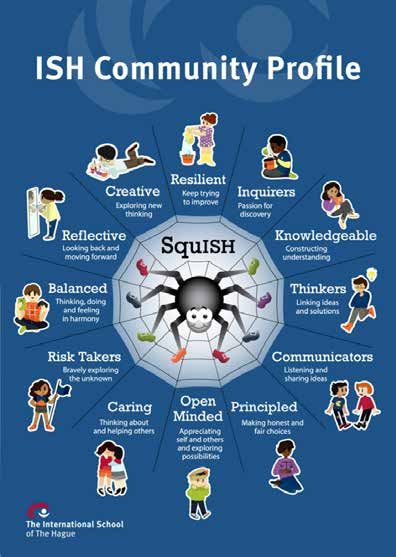
Table of Contents

    Chapter 12: Educational Support within the School Day                   48
                12.1 English as an Additional Language (EAL)                48
                12.2 Learning Support                                       48
                12.3 Home Language                                          48

    Chapter 13: Assessment, Reporting and Parent-Teacher Meetings		         50
                13.1 Assessment                                             50
                13.2 Reporting on and Tracking the Progress of your Child   50
                13.3 Class Reviews                                          51

    Chapter 14: The Primary School Day and Attendance Procedures            52
                14.1 Early Years to Year 6 Primary School Day Schedule      52
    		                14.1.1 Arrival at School		                            52
                14.2 The School Day		                                       52
    		                14.2.1 Breaks		                                       52
    		                14.2.2 School Canteen and Packed Lunches		            52
    		                14.2.3 Packed Lunches		                               52
    		                14.2.4 School Canteen		                               52
6
    		                14.2.5 Collecting Children from School		              53
                14.3 Attendance Procedures		                                53
    		                14.3.1 Late arrivals		                                53
    		                14.3.2 General Absence		                              53
    		                14.3.3 Medical Appointments		                         54
    		                14.3.4 Special Leave of Absence from School		         54
    		                14.3.5 Schedule of Events and Holidays		              54

    Chapter 15: Communications with Parents/Guardians                       55
                15.1 How we Communicate in Primary                          55
                15.1.1 Our Communications Channels in Primary School        55

    Chapter 16: Expectations of Parents/Guardians and Students              56
                16.1 School Community and Student Charter		                 56
    		                16.1.1 ISH Rights and Responsibilities                56
    		                16.1.2 Home School Agreement		                        56
    		                16.1.3 Health forms		                                 56

    Chapter 17: After-school Care and Activities                            57
                17.1 After-School Care                                      57
                17.2 After-school Activities and Sports		                   57
                17.3 Student Council                                        58

    Secondary School                                                        59

    Chapter 18: Secondary School Organisation		                             60
                18.1 The Secondary School Structure and Teams		             60
                18.2 Student Participation		                                60
Table of Contents

                18.3   Student Council		                                                     61
                18.4   Parent Participation		                                                61
                18.5   The Secondary School Day		                                            61
                18.6   Attendance and punctuality                                            61

    Chapter 19: Communication with Parents about Academic Progress                           64

    Chapter 20: Secondary School Curriculum                                                  66
                20.1 IB Mission Statement                                                    66
                20.2 The IB Middle Years Programme (IBMYP)		                                 66
    		                20.2.1 The MYP Curriculum Model                                        66
    		                20.2.2 MYP Programme: Pathfinder                                       68
                20.3 The IB Diploma Programme (IBDP)                                         70
                20.4 The IB Career-related Programme (IBCP)                                  70
                20.5 Diplome Results		                                                       71

    Chapter 21: Curriculum Support and Extension                                             72
                21.1 Mother Tongue/Home Language                                             72
7
                21.2 Support for learners of English as an Additional Language (EAL)         72
    		                 21.2.1 The Academic Language Programme (ALP)                          72
    		                 21.2.2 The Individual Learning Programme (ILP)                        72
    		                 21.2.3 Information Technology                                         73
                21.3 The Secondary Library Resource Centre                                   73
                21.4 Learning Support                                                        74
                21.5 Curriculum-related trips and activities                                 74
                21.6 Celebrating Success                                                     77

    Chapter 22: Expectations of Parents/Guardians and Students                               78
                22.1 Guidance and Support Structures		                                       78
    		                 22.1.1 Pastoral System		                                              78
    		                 22.1.2 Role of the Mentor, Assistant Year Leaders, Year Leaders and
    			                       Deputy Heads Pastoral                                          78
    		                 22.1.3 The Mentor Programme                                           78
    		                 22.1.4 Antibullying Advisor		                                         78
                22.2 Careers Advice                                                          79
                22.3 Student Wellness and Counselling		                                      79
    		                 22.3.1 Student Wellbeing Department		                                 79
    		                 22.3.2 Different types of support		                                   80

    Chapter 23: Co-curricular Activities and Opportunities                                   82
                23.1 Sports Activities and Facilities                                        82
                23.2 Service Learning in Global and Local Issues                             82
    		                 23.2.1 Charity Fundraising Activities                                 82
    		                 23.2.2 Global Issues Network (GIN)                                    82
    		                 23.2.3 Model United Nations (MUNISH)                                  83
The International School of The Hague
    (Whole School)

8
Chapter 1: ISH Philosophy, Mission, and Learning Policy

1   1.1 Our Guiding Statements

    Mission: Curious, connected and compassionate:
    Inspiring personal excellence in our strong and diverse community.

    Vision: To shape a better future for all:
    Inspiring students to become compassionate and proactive global citizens.

     1.2 Value Statements:

     Curious, Connected and Compassionate
     Curious
     ● We are open-minded critical thinkers who learn through inquiry, reflection and engaging
       with different perspectives
     ● We learn about ourselves and the world around us through service and experiential learning
     ● We are independent and interdependent life-long learners with a thirst for knowledge
9
     Connected
     ● We take pride in the strength of our community and the diversity within it
     ● We value our individual identities and celebrate cultural diversity
     ● We connect with local and global communities through our learning

     Compassionate
     ● We develop self-respect and show compassion to others
     ● We take responsibility for our actions and strive to have a positive impact
     ● We show courage and act with integrity, fairness and respect

    1.3 Overall Objectives for 2020-2021:
    A. To ensure that the ISH mission, vision and values are integral to our thinking, actions and
       decision-making across the whole school
    B. To promote high quality teaching and learning through evidence-based inquiry and the
       appropriate use of data
    C. To provide our students and our staff with a physically and psychologically safe learning
       environment that is conducive to learning and wellbeing
1.4 Learning at the International School of The Hague
A Philosophical Stance
The International School of The Hague shares an understanding that at the centre of
international education are students who come to school with combinations of unique and
shared patterns of values, knowledge and experience of the world and their place within it.
ISH encourages these students to pursue personal excellence by being curious, connected and
compassionate lifelong learners.
The International School of The Hague takes a holistic view of education, so that along with
cognitive development, the school programs address social, emotional and physical well-
being. ISH offers opportunities for students to become active and caring members of local,
national and global communities and develop international mindedness and intercultural
understanding through the attributes of the ISH Community Profile.
Teachers at the school are committed to an inclusive learning environment and help empower
and inspire personal excellence in all students by encouraging them to take responsibility for
their learning. Teaching and learning grows from an understanding that people work together
10
to construct meaning and make sense of the world. ISH supports and challenges students
to improve their learning by engaging with a strong, diverse community and a coherent
curriculum that is broad, balanced, challenging, conceptual and connected.
1.5 Intercultural Understanding for Global Citizens
The International School of The Hague, with its strong diverse community within the International
City of Peace and Justice, is well placed to provide a dynamic learning environment that is
conducive to intercultural learning and global citizenship.
Intercultural Learning challenges students to learn from different cultures and to deepen their
understanding, acceptance and respect for diverse groups of people. It allows students to
develop their own cultural identity and to facilitate open-minded discussion. This enhanced level
of communication helps engage students in tackling global issues.
Global Citizenship is about understanding the ongoing and inevitable global opportunities and
challenges we face. Global learners develop awareness and respect that motivates them to take
action in relation to the complexities of the world.
1.6 The International School of the Hague Community Profile
The International School of The Hague Community Profile is used to promote intercultural learning
and develop global citizenship. It is based on the IB Learner Profile, the concept of international
mindedness, the IPC Personal Goals and the ISH Guiding Statements. Different departments in
the school are encouraged to develop subject-specific and/or age-appropriate adaptations for
the attributes in the profile.ISH Community Profile
Attribute ISH Community Profile Descriptors: Curious Connected Compassionate
Creative We value creative processes and innovation even when the results are
unpredictable and surprising. We create ideas individually and in diverse
groups across the whole range of subjects and beyond. We respect and
celebrate the creativity arising from our different cultural backgrounds.
Resilient We persevere with a task, are capable of acknowledging disappointment
and adapting when we are not successful straight away. We strive to
achieve the best possible outcomes and support each other. We welcome
the learning opportunities provided by difficulties and challenges.
Inquirers We nurture our curiosity, developing skills for inquiry and research.
We know how to learn independently and with others. We learn with
enthusiasm and sustain our love of learning throughout life.
11
Knowledgeable We develop and use conceptual understanding, exploring knowledge
across a range of disciplines. We engage with issues and ideas that have
local and global significance.
Thinkers We use critical and creative thinking skills to analyse and take responsible
action on complex problems. We exercise initiative in making reasoned,
ethical decisions.
Communicators We express ourselves confidently and creatively in more than one
language and in many ways. We collaborate effectively, listening
carefully to the perspectives of other individuals and groups.
Principled We act with integrity and honesty, with a strong sense of fairness and
justice, and with respect for the dignity and rights of people everywhere.
We take responsibility for our actions and their consequences.
Open-minded We critically appreciate our own cultures and personal histories, as well
as the values and traditions of others. We seek and evaluate a range of
points of view, and we are willing to grow from the experience.
Caring We show empathy, compassion and respect. We have a commitment to
service, and we act to make a positive difference in the lives of others
and in the world around us.
Risk-takers We approach uncertainty with forethought and determination; we work
independently and cooperatively to explore new ideas and innovative
strategies. We are resourceful and resilient in the face of challenges and
change.Balanced We understand the importance of balancing different aspects of our
lives - intellectual, physical, and emotional - to achieve well-being for
ourselves and others. We recognise our interdependence with other
people and with the world in which we live.
Reflective We thoughtfully consider the world and our own ideas and experience.
We work to understand our strengths and weaknesses in order to
support our learning and personal development.
1.7 High Quality Learning
At ISH we inspire our students to be curious. To do this, we use student-led inquiry to solve
challenging problems that are set in authentic contexts wherever possible. Students learn to apply
their knowledge and skills to deepen conceptual, disciplinary and interdisciplinary understanding
and make effective connections. Our students learn how to collaborate, act with compassion and
become responsible global citizens. Our students, teachers and community model the attributes
of the ISH Community Profile.
12
High Quality Learning at ISH is:
● An active process where students make connections between new ideas and prior
understandings
● Collaborative and supported by quality interactions with teachers and other students
● Centred on students’ responsibility for their own learning; they are able to exercise choice,
develop goals, plan their approach and work independently
● Reflective, enabling students to monitor and review their learning with a clear sense of how to
improve; students are supported to learn from their failures as much as their successes
● A process of change and personal growth
High Quality Learning at ISH occurs when students:
● Are curious, inspired and motivated to take ownership of their learning
● Build on prior skills, knowledge and understanding
● Remain resilient and engaged, especially when learning about complex or unfamiliar ideas
● Feel safe and secure in their learning environment and at home
● Have confidence in their teachers and trust their peers
● Actively apply their knowledge and skills towards solving local and global issues
High Quality Learning at ISH occurs when teachers:
● Have high expectations, and encourage students to set high expectations for themselves,
which inspire, motivate and challenge students
● Maintain good relationships with students in order to involve and motivate them
● Promote students’ love of learning and intellectual curiosity
● Guide students to reflect on the progress they have made and their emerging needs
● Are aware of students’ capabilities and their prior knowledge, and plan teaching to build on
these
● Demonstrate knowledge and understanding of how students learn and encourage them to
take a responsible and conscientious attitude to their own work and study
● Demonstrate an awareness of the physical, social and intellectual development of students, and
know how to adapt teaching to support students’ learning at different stages of development● Have a clear understanding of the needs of all students, including those with unique and
individual challenges. Teachers are able to adopt and constantly review a variety of teaching
approaches to engage and support all students
● Develop effective professional relationships with colleagues leading to successful collaboration,
knowing how and when to draw on advice and specialist support
● Reflect systematically on the effectiveness of lessons and approaches to teaching and its
impact on learning
● Make productive use of formative and summative assessment to support students’ learning
● Use digital tools to effectively support and enhance pedagogical approaches which are known
to improve learning
High Quality Learning at ISH occurs when parents:
● Are well informed and curious about their own child’s learning
● Connect and collaborate with others to further support their child’s learning and wellbeing
● Provide a compassionate home environment which celebrates and promotes individuals’
culture and language
13
1.8 Student Charter
The student charter was developed to set out the rights and responsibilities of all students who
are part of the ISH Community. It was created by students for students and developed from
the United Nations Convention on the Rights of the Child and our school’s Guiding Statements.
Students have the right to:
1. Be treated with respect regardless of who we are, where we are from and what we believe
2. Be consulted about decisions that affect us through our student representatives; be able to
question those decisions; and to assert our rights as they are set out in school policies and
protocols
3. A safe, clean and well-maintained school environment, which supports our learning and
personal development
4. Share our personal views about the things that we learn and that affect us, keeping in mind that
we must respect the views of others and not share views that are harmful and disrespectful
5. Learn about ways to take care of our well-being and personal safety
6. Support systems that take care of our physical and mental health
7. A healthy and balanced learning experience, which allows us to pursue our own interests
8. Experience learning in line with the school’s High Quality Learning Statements so that we are
enabled to achieve our own personal excellence and be well prepared for life after-school
9. Be informed about our rights within and beyond school
10. Learn about and share our culture and language and have it valued by others
The school along with parents/guardians work together to uphold these rights.
With rights come responsibilities. To enjoy these rights, students will:
1. Be respectful of others regardless of who they are, where they are from and what they believe
2. Be safe in how they take care of themselves and in their behaviour towards and around others
3. Be responsible in their behaviour and in their learning
Students behave in accordance with these responsibilities to ensure that they can all enjoy these
rights. They understand that if they do not, there may be negative consequences for themselves,
their environment and others.1.9 Behaviour
We strive to teach and promote positive behaviour and use restorative practices to address
behaviour when things do not go well. Our behaviour policy seeks to promote and develop the
values inherent in the ISH Community Profile and to ensure that students behave in line with the
responsibilities that the students have set out for themselves in order to ensure that they receive
the rights to which they are entitled. We believe that students benefit from clear boundaries
and it is important that students learn that all behaviours have consequences both positive and
negative. Our behaviour policy and related protocols set out our philosophy and approach in
more detail including the way in which we manage behaviour in a developmentally appropriate
way for our Primary and Secondary School students.
In joining the school, families commit to supporting us in implementing our behaviour policy and
in promoting the values of our school community.
1.9.1 Anti-bullying
Staff and students have the right to be treated with respect in a safe environment and we do
not tolerate bullying in our school. Bullying is completely against our values. However, we also
recognise that bullying is a complex and often misunderstood issue. Therefore, educating our
students on this issue is a key part of how we work towards prevention.
14
We fully investigate all reports of bullying. In all cases both the victim and the initiator can be
damaged by their interactions; bullying incidents are often indicative of underlying issues affecting
all involved. With this understanding, we offer support to the one harmed and the one causing
harm. We aim for reconciliation, conflict resolution and prevention. These principles are the core
of what we teach our students and how we respond to bullying incidents.
You can find full details about our approach to bullying in our "Antibullying Policy".
1.10 Staff
At ISH we have talented teachers from all over the world. We also have strong administrative
and support staff to support the students, parents and teaching staff to contribute to the smooth
functioning of the school. A full overview of staff will be available in the near future on our website
www.ishthehague.nlChapter 2: School Organisation and Community
2 2.1 Leadership & Management
The Senior Leadership Team of the school is led by the two Principals. They are supported by a
team of Vice Principals and the Director of Operations.
Secondary Principal Mr R. Matthews
r.matthews@ishthehague.nl
Primary Principal Ms J. van Eerdewijk
j.vaneerdewijk@ishthehague.nl
Director of Operations Mr E. Mossel
e.mossel@ishthehague.nl
Vice Principal School Improvement Mr A. Lorenzini
a.lorenzini@ishthehague.nl
Secondary Vice Principal Academic Mr S. Middleton
s.middleton@ishthehague.nl
15 Secondary Vice Principal Experiential Learning Mr B. Le Heux
b.leheux@ishthehague.nl
Secondary Vice Principal Pastoral Ms E. Hilkes Leane
e.hilkesleane@ishthehague.nl
Primary Vice Principal Ms M. Lawrence
m.lawrence@ishthehague.nl
Deputy Head Academic IBMYP Coordinator Ms M. Lamminaho
Secondary m.lamminaho@ishthehague.nl
Deputy Head IBCP/IBDP Coordinator Ms A. Trumic
Secondary a.trumic@ishthehague.nl
Deputy Head Teaching and Learning Mr N.Bruce
Secondary n.bruce@ishthehague.nl
Deputy Head Students Data and Logistics Mr S. Brooks
Secondary s.brooks@ishthehague.nl
Deputy Head Student Guidance Ms B. Nijsten
Secondary b.nijsten@ishthehague.nl
Assistant Principal Academic Ms S. Goodhand
Primary s.goodhand@ishthehague.nl
Assistant Principal Lower School Ms C. Lapierre
Primary (Early Years Y3) c.lapierre@ishthehague.nl
Assistant Principal Upper School Ms I. McKenna
Primary (Y4 - 6) i.mckenna@ishthehague.nl2.2 Organogram ISH
Primary Principal Secondary Principal
PA Primary PA Secondary
Vice Principal Director of Vice Principal Vice Principal Vice Principal
Vice Principal
School imp. Operations Academic Pastoral Experiential
Assistant Assistant Assistant
Principal Principal Principal
Academic Lower School Upper School
Primary Office Building
Reception Finance
16 Secondary Office
Security
Admissions Deputy Heads Deputy Heads Service &
Reception
Health Office Academic Pastoral Experiential
Technicians Learning
Timetable
External Agents SALs YLs
ICT SCs AYLs Co-Curricular
Library
Teachers Mentors Coordinators
CommunicationsChapter 3: ISH Background
23 3.1 Context Statement
The International School of The Hague is:
● Subsidised by the Dutch Ministry of Education and supported by the Municipality of The Hague,
as well as by local international interests
● Accountable to the inspectors of the Dutch Ministry of Education
● Part of the foundation, Stichting Het Rijnlands Lyceum (SRL)
● An International Primary Curriculum (IPC) school in Primary
● An IB World School in Secondary, with successful MYP, CP and DP programmes
● A member of the Educational Collaborative for International Schools (ECIS)
● Secondary School is a member of the Council of International Schools (CIS)
● Dutch Laws require ISH to have Dutch inspections and Dutch educational regulations such as
absence registration, a School Plan, and a Participation Council.
3.2 Dutch International Schools (DIS)
In 1983, the first Dutch International School was established in The Hague and this developed
into The International School of The Hague in 1991. The ISH is a member of the group of Dutch
International Schools which comprises of Dutch International Primary Schools (DIPS) and Dutch
International Secondary Schools (DISS) across the Netherlands. The group caters for the needs
17
of both primary and secondary students who are not Dutch, as well as Dutch students whose
education is, at least in part, obtained overseas in order to provide continuity of education.
Dutch International Schools are financially supported by the Dutch government. This makes it
possible to charge relatively low school fees in comparison with private international and foreign
educational facilities.
The International School of the Hague is subject to Dutch legislation and regulations, school
holidays are determined nationally each year and allocated to three regions; Noord, Midden and
Zuid. The School falls under the Central Netherlands region
For more information see www.dutchinternationalschools.nl
3.3 Stichting (Foundation) Het Rijnlands Lyceum
The International School of The Hague is part of the Foundation Het Rijnlands Lyceum (SRL). The
Rijnlands Lyceum (SRL) Foundation is a semi-public organisation headed by an Executive Director
as the competent authority (the Board) and is managed and supervised by a Supervisory Board.
The Foundation’s Chairman of the Executive Board is Mr. Drs. A. (Arjan) Kastelein MBA.
For more details on the Rijnlands Lyceum Foundation, view www.rijnlandslyceum.nl
Stichting Het Rijnlands Lyceum
Backershagenlaan 5, 2243 AB Wassenaar
Tel: 071-573 0910
Fax: 071-531 2167
www.rijnlandslyceum.nlThe other schools which are also part of the Rijnlands Foundation are:
Rijnlands Lyceum Oegstgeest
Apollolaan 1, 2341 BA Oegstgeest
P.O. Box 61, 2340 AB Oegstgeest
Dutch Department
Tel: 071-519 3500
www.rlo.nl
Rijnlands Lyceum Oegstgeest
International Department
Tel: 071-519 3555
www.isrlo.nl
Rijnlands Lyceum Sassenheim
Van Alkemadelaan 2, 2171 DH Sassenheim
18
P.O. Box 79, 2170 AB Sassenheim
Tel: 0252-243 070
www.rijnlands.nl
Rijnlands Lyceum Wassenaar
Backershagenlaan 5, 2243 AB Wassenaar
Tel: 070-511 0400
www.rijnlw.nl
Eerste Nederlandse Montessori School (ENMS) - First Netherlands Montessori School
Laan van Poot 353, 2566 DA Den Haag
Tel: 070-323 13 11
www.enms.nl
Europese School Den Haag (ESH) - European School The Hague
Houtrustweg 2, 2566 HA Den Haag
Tel: 070-7001600
www.europeanschoolthehague.nl
3.4 The School Population
The expected enrolment for the 2020-2021 year is 1940 students, with 600 students in Primary
School and 1340 students in Secondary School.Chapter 4: School Fees and Financial Matters
4 4.1 Annual School Fees
The ISH is officially recognised by the Dutch Ministry of Education which contributes funds to the
school, as part of the “Stichting Rijnlands Lyceum”. These government funds, or subsidies, cover
approximately half of the actual costs of the ISH. Parents are required to pay fees to cover all
remaining expenses.
Fees are charged annually in advance and can also be paid in four instalments. The school
publishes standard terms and conditions for the payment of fees. These are issued to all parents
and available on our website www.ishthehague.nl under "Admissions", "Fees" and on the Parent
Portal under "Forms and Documents"
School fees for 2020-2021:
School Year Fees
Pre-Early Years Available on request*
Early Years to Year 4 € 7,329
Year 5 € 7,434
Year 6 € 7,486
19
Years 7/8/9: € 8,410
Year 10: € 8,840
Year 11: € 8,840
Year 12 IB-DP: € 9,462
Year 12 IB-CP: € 10,462
Year 13 IB-DP: € 9,122 + 720 examination fee
Year 13 IB-CP: € 9,422 + 720 examination fee
*The fee structure for Pre-Early Years is calculated separately and is available on request.
Payment Information
Bank: ING Bank
Account Name: Stichting Het Rijnlands Lyceum Wassenaar
IBAN: NL85 INGB 0669461741
BIC: INGBNL2A
● All payments should clearly display the debtor number and the invoice number to ensure
proper delivery of payment.
● The debtor number can be found on the invoice.
● Should you have questions, please contact: debiteuren@rijnlandslyceum-csb.nl
4.2 Registration and Deposit Fee
There is an additional non-refundable registration fee of € 325 for the processing of applications
to the school and a deposit fee of € 1000. The deposit will be refunded, upon request, when the
student leaves the school having returned all books, cleared any outstanding debts, as long as
due notice has been given.4.3 Examination Fees IBDP and IBCP
IBDP Fees
IBDP Fees Examination fees, payable by students sitting examinations for the IBDP, are charged at
the current rates applied by the IB. Parents will receive a separate invoice for examination fees.
The fees are € 720 for 6 subjects, including exam fees, extended essay, TOK and administrative
charges.
IBCP Fees
Examination fees, payable by the IBCP students sitting examinations for the DP subjects,
are charged at the current rates applied by the IB. Parents will receive a separate invoice for
examination fees. The current fee for the IB Diploma exam covering an average of 3 subjects is €
720 including, exam fees, administrative charges, and Career-related study (BTEC) fees.
Separate fees will be charged for retake examinations and other special services provided by the
IB, in accordance with the IB scale of fees and deadlines and with the school scale of admin fees.
These are reviewed and communicated annually to the relevant groups of students and parents.
20
4.4 Policy on Scholarships and Financial Support on Fees
It is not the School’s Policy to give financial support to any student at the point of joining the
school. The fees have to be accepted as being affordable for a student to be granted entry.
Please note that the School will also not admit students where there are outstanding debts to
other schools, or evidence of a poor payment record.
In the case of a family with an enrolled student/students suffering unexpected hardship (e.g.
unemployment or bereavement) making the fees absolutely impossible to pay, the School will
consider giving financial support for a short period, at which point in time alternative education
should be arranged. For the purpose of this policy a stage of education is seen as being the end
of Years 2, 6, 11 and 13.
Applications should initially be made to the Principal. In considering the application supporting
financial information will be requested, such as a statement of incomings and outgoings, and
bank statements.
Any support given will be against tuition fees only, not school trips, examination fees, resources,
or other costs.4.5 Accident Insurance
The school has a collective accident insurance policy for students which provides maximum cover
as follows:
● in case of fatal injury € 4,540
● in case of permanent injury to a maximum of € 68,000
● medical and hospital costs € 2,270
● dental cover € 2,270
This insurance covers only such injuries that are not covered by the student's own health insurance
policy, which is obligatory in the Netherlands. It does not cover parents’ own basic national
contribution. It applies to injuries incurred on the way to school (by the most direct route), in the
school and in the course of school activities such as school excursions and study trips.
Damage to property such as spectacles, clothes or bicycles is not covered by this insurance.
Students who take part in school trips are recommended to have private insurance.
21Chapter 5: Safeguarding, Security and Health
5 5.1 Safeguarding and Child Protection
The International School of The Hague is committed to safeguarding and promoting the welfare
of children. We expect all staff, volunteers and visitors to share this commitment in accordance
with the United Nations Convention on the Rights of the Child (UNCRC) Article 19: “Children have
the right to be protected from being hurt and mistreated, physically or mentally.”
In addition, the decisions made within the school about a child’s welfare will always be made in
“the best interests of the child” (Article 3 UNCRC).
All staff are provided with regular training in regard to safeguarding and child protection,
including reporting obligations and procedures where a concern arises. The school will, in most
circumstances, endeavour to discuss all concerns with parents about their children. However,
there may be exceptional circumstances when the school will discuss concerns with Veiligthuis
(Safe Home: https://veiligthuis.nl/ ) and/or the Police without parental knowledge (in accordance
with the Meldcode - Dutch reporting procedures: https://www.rijksoverheid.nl/onderwerpen/
huiselijk-geweld/meldcode). The school will, of course, always aim to maintain a positive
relationship with all parents.
In addition, the most powerful safeguarding tool is the education of the child. Through our
22
pastoral programmes we educate our students about how to keep safe, healthy and happy and
encourage them to share any concerns they have with the appropriate adults in school.
At ISH we are a strong and diverse community, which is a welcoming and safe place for our
children, staff, parents/carers and visitors alike. We expect all adults who enter our school site at
any time to set examples of behaviour and conduct that meet the high standards that we expect
of our students. All parents, carers and visitors must show respect to all other parents and carers,
children, and staff.
If you have any concerns about the safety of any of our children, please contact either of the
school Principals or our Designated Safeguarding Leads: Eveline Hilkes Leane (Secondary Vice
Principal Pastoral) and Michelle Lawrence (Primary Vice Principal).
5.2 Parking and Drop-off Zone
The area directly outside the school buildings is considered to be a drop-off zone: Please do not
park there. To ensure a smooth traffic flow we prefer you to use this drop-off zone closest to the
school. We also encourage you to cycle to school to ensure a smooth traffic flow. This promotes
the health of our community and also reduces the amount of traffic coming to and entering the
school site, which is beneficial for us all. If you wish to stay with your children, you will need to
park in the car park opposite the school. Parents of Early Years students may park for a short
period of time on the triangle. For reasons of safety, children should not be left before the school
opens for students at 8:00.
5.3 School Badges
To ensure the safety and security at our school, we require parents/guardians, staff, and all visitors
to visibly wear a school-issued badge on school campus at all times. Nobody will be allowed
access to the building without swiping in and out. In case of an emergency, we need to be able
to verify who is in the building.Our primary concern is the safety of our students at all times. As such, we expect all staff, parents,
volunteers, and visitors to share this common commitment. All data from the access system is
treated with the utmost privacy in accordance with GDPR laws. It is stored securely and deleted
after two weeks. It will only be used in case of emergency.
Visitors can obtain a badge from Reception for entrance to the building.
Parents/Guardians can request a personalized badge by filling out a form that will require a login
to the parent portal. This badge will display their photo. This form will require the user to upload
a photo adhering to certain specifications.
The link to the form can be found on the parent portal, as well as in the weekly parent newsletter.
At the Beginning of the Year
For now, at the beginning of the school year, we are processing parent badges in batches, and
they will receive communication about how to request the badge and the collection date.
23
Throughout the Year
As soon as you the badge is ready, the badge holder will be sent an e-mail to let them know their
badge is ready for pick up from Reception.
If you are applying for a badge for someone who is not registered as a parent or guardian with our
school, please be aware that this person will need to produce proof that they have permission
from you, when they pick up the badge.
Badges remain property of the school and have to be returned upon permanent withdrawal. If
you have lost your badge, you can obtain a replacement badge. This will cost €10,-
For questions regarding badges, please email to ishbadges@ishthehague.nl.
This system is new and subject to evaluation. Arrangements may be altered according to the
needs for keeping the community safe.
5.4 Health Office
The Health Office at the International School of The Hague aims to foster the health and
educational success of the students. The link between optimal health and academic success
is supported through the provision of services geared towards preventative health care and
support, intervention for minor injuries or illnesses, and referral to the larger health community
for more urgent health concerns. The School Nurses are available to support students in achieving
a healthy and well-balanced lifestyle.
The School nurses are present from Monday to Friday 8:00-16:30 during the academic year.
The School nurses look after children who fall sick or are injured during the school day, contact
parents to collect them while advising about possible referral to the relevant medical services
or provide urgent care/first aid. Some children with chronic or acute medical conditions require
medication during the day and this medication can be stored in the Health Office, once a
medication administration form is completed.In case of chronic medical conditions (for example: diabetes, asthma) or severe life threatening
allergies (for example: nut allergy), please make an appointment with the School nurses by writing
to healthoffice@ishthehague.nl. The School nurses will then make a care plan that will guide
everyday management and care of the student to then be shared with the relevant staff.
Staff and parents should only use the health service in emergencies.
5.5 Accessibility of the school
Means of communication:
● Newsletters, emails and the website to parents and students are provided with "focus points"
These points help the user see which part of the page is currently in focus. This makes it easier
for users who navigate with a keyboard instead of a mouse, and users with short-term memory
problems or difficulty keeping attention.
● All photos on the website are provided with alt text. This is read by screen readers of visually
impaired users.
24
Health Office
● Students in a wheelchair can access the school using the ramp in front of the school. Parents
can park there (not sure if there’s a disabled parking spot nearby the ramp) We could add a
sign. See above.
● Students can leave the wheelchairs in the area in front of the exit on the ground floor if they
are collected by the parents and don’t need the wheelchair at home.
● Classrooms are accessible for wheelchair use.
● Secondary students in a wheelchair are allowed to use the lift if they have permission from
the Health Office and collected their lift pass. Primary students are not allowed to use the lift
without a teacher/assistant. There’s a lift in the main building and in the new primary building.
● In the girls toilets there’s one cubicle next to the wall with special handrails for disabled
students. There’s a black dot on those cubicle doors. (Not sure how it is in the boys toilets.)
● There are disabled toilets on the first floor behind the main entrance, in the new primary
building and in front of the PE office. The toilet next to the primary health office is accessible
for a small wheelchair. (not sure if there is a disabled toilet in the Q and R block as there’s no
lift either.)
● There are 5 evac chairs in the main building to evacuate disabled students in case of an
emergency.
● All areas are accessible for wheelchair dependent students, there are wide corridors.
Safety/security and badges:
● Multiple evac-chairs in case of an evacuation
● Ramps to access both buildings. Good point above about signage written above.
● Badges: I’m creating a manual with all the information about badges. But for now some points
about accessibility:
Temporary badges
For interns staying in the ISH-community for a maximum of 2 months or 10 weeks a temporarybadge can be requested that can be recycled.
Requesting a temporary badge:
● The temporary badge is meant for persons staying at ISH for a maximum of 2 months under
the contract of ISH like an intern. External companies, see next paragraph.
● Validated requestors are: HR, Director of Operations and primary- and secondary office
● Request needs to be done through e-mail to ish.security@ishthehague.nl (and CC r.zaal@
ishthehague.nl)
● E-mail need to contain at least:
1. First and Last name of badgeholder
2. Role example: Intern or Interim
3. Start date + end date
4. Any additional access
Make sure, you send an email as soon as possible to allow security to produce the badge.
Defective or damaged badge
In case of a defective and/or damaged badge, the holder of the badge can report the defect to
the Secondary Reception, which can contact the Security Coordinator or Security to see what the
25
defect is to fix the problem.
If the badge is not working without any major damages the badge can be replaced for a new
badge with a new chip.
If the badge is severely damaged because of misuse like damaging the photo, breaking the badge
or not using a badge holder, the costs of the badge can be credited to the badgeholder.
The badgeholder needs to provide the following information:
1. What is the problem with the badge?
2. When did this happen or when did the problem start?
3. Are there any changes that need to be made on the badge, like a different photo or spelling of
a name?
Security will take the existing information of the cardholder and will request a new badge in the
card center to be printed out.
This process will go the same way as paragraph 3 when a badge has been printed.
Lost or stolen badge
In case of a lost or stolen badge, security needs to be informed immediately to assure the safety
of the community to (temporarily) block the badge with accessrights in Genetec. In case of a lost
badge the following can be done:
Lost badge for the day:
In case a person has forgotten their badge, a temporary badge can be given out in Genetec by
the receptions for the day. Report the lost badge to security at ish.security@ishthehague.nl so
security can (temporary) block the badge.
Permanently lost badge:
Report the permanently lost badge and send an email to ishbadges@ishthehague.nl andCC ish.security@ishthehague.nl.
E-mail need to contain at least:
1. First and Last name of badgeholder
2. Where did you last used/saw your badge
3. Any additional information
Adjusting authorization level or data, like company name, on a badge
If a different authorization level is needed, like access to the expedition door or other entrances
that are out of the appointed doors to a cardholder group, the authorization needs to be requested.
Validated requestors are: Director of Operations, Facility manager, assistant facility manager,
head concierge or members of the SLT or HR.
Kinds of changes for a badge to ensure right authorization and information:
1. Changed position (like BHV or parent becoming teacher)
2. Photo not similar to the badgeholder anymore
3. Person needs different accessrights (like BHV)
4. Person needs access to a specific door (like Expedition access)
26
Expedition door:
Special request is the door for the expedition to ensure people who can’t use the stairs have access
to building freely without obstacles. There are two different types of access rights to this door:
Permanent access:
1. BHV-team
2. Disability to use stairs
3. External contractors that must haul heavy/big objects
4. Freely/quickly move around ISH-grounds because of job; Concierge, security etc.
Temporary access:
1. Temporary disability like a broken leg
2. One time or short period of time to use the door like: Event or loading/unloading
All requests needs to be done through e-mail to ish.security@ishthehague.nl
(and CC r.zaal@ishthehague.nl)
E-mail need to contain at least:
1. First and Last name of badgeholder
2. Role
3. (Mobile) Telephone number
4. Kind of change for the badge
5. Reason for the access right and end date for the access in case of temporary access
In case a different authorization is requested, the old authorization becomes due.
In case a new badge has to be printed, the badgeholder needs to hand in their old badge.At card collection - Reception secondary
Identity check will be performed by Reception and Security, every time a card is collected.
Verification of identity will be done by the following official documents (make sure they bring
their identification):
● ID-card (European countries)
● Drivers licence (European countries)
● Passport (worldwide)
Interns will sign for their badge, as every badge will be accompanied with a form ‘House Rules –
New Temporary Badge’ (draft - can be changed – but a good start). This form has to be signed for
before handing out the badge. The form will be held in the binder where created & contractor
badges are held until the end of the stay. The binder will be placed at the card center – secondary
Restrictions to the accessibility
Changes may occur with regard to school accessibility due to unforeseen or special circumstances
such as COVID-19.
27Chapter 6: Attendance and Inclusive Education
6 6.1 Attendance and Punctuality
Our approach to attendance and punctuality is determined by Dutch law. The “Leerplicht
Wet” (Compulsory Education Law) dictates that children aged 5 to 16 (or 18 if they do not
yet have a diploma) must attend school unless there is a valid reason.
Parents are responsible for ensuring that their children are present in school and on time.
Absences
If a child is ill or needs to be absent for a medical or dentist appointment parents/guardians need
to inform school before 7.30 following the procedure for the specific section of the school.
● For Primary School: email Primary Office at primary@ ishthehague.nl and copy in the class
teacher.
● For Secondary School: email Reception at ish.reception@ishthehague.nl.
In the event that a long illness is anticipated, parents/guardians should also inform their child’s
class teacher/mentor and Year Leader. The email should include the reason for the absence
and an indication of how long the child will be absent for.
28
Regular or persistent absence (excused or unexcused) and/or late arrival must be followed
up by the school as the school is obliged to inform any unexplained or persistent absences/
late attendance to the Dutch Attendance Officer (Leerplicht).
If repeated or extended illness is a cause for concern (regularly sent home ill from school,
absence during specific days/events, patterns of absence etc), the school will inquire about
the absence and where appropriate will refer the child to the school doctor (Centrum Jeugd
en Gezin, CJG) who will arrange a meeting with the parents.
The school doctor will inform the school of the next steps.
Late arrivals
You will be contacted if your child arrives late. You will be required to provide an
explanation for their late arrival, which must be a valid excuse. We will determine whether
the explanation is justifiable in line with the Attendance Law.
Please note that traffic (except in exceptional cases e.g. traffic accident) is not an acceptable
reason for late arrival.
Please also see the sections on Attendance and Punctuality from Primary School and Secondary
School for more specific details about the follow up for late arrivals and absences for each school
section.
Special Leave
If a student must be absent for reasons other than illness or a medical or dentist appointment,
a ‘Request for Special Leave’ form should be completed at least two weeks prior to the
requested leave date. In cases of emergency the request can be submitted later.
The Special Leave Forms for Primary and for Secondary School and all details regarding Special
Leave can be found on the school website and in the weekly Parent Newsletter.ISH is bound to Dutch regulations in this respect and can only approve special leave for very
specific reasons like serious illness, death or marriage of a close relative or moving house.
Special Leave can be approved by the school to a maximum of 10 days per school year as
long as it abides by the rules and regulations.
Any requests for Special Leave of more than 10 days will need to be referred to the Attendance
Officer (Leerplicht) who will then determine whether or not the leave can be granted.
6.2 The Law on Inclusive Education (Passend Onderwijs)
All students who are resident in The Netherlands have the right to access education that suits
their qualities and abilities. The education provided by a school must provide them with the
potential to be successful and therefore the school should try to determine before entry whether
the education that is offered by the school is appropriate. Admission to The International School
of The Hague is determined by the nature of our academic programmes and the availability of the
additional support that we provide.
We offer a range of support for students with additional needs, including academic, social-
emotional and health - but we are not a special educational needs school. At entry, families are
29
required to provide us with all available information regarding their children's additional needs so
that we are able to determine whether they are able to benefit from our educational programmes
in a safe manner. Complete and accurate information is vital for us to ensure that we can provide
appropriate education and a safe learning environment. In the event that we are provided with
inaccurate and/or incomplete information a student’s place at the school may be jeopardised.
At present we have five Learning Support Specialist and two Learning Support Assistants in ISH
Primary led by a Learning Support Coordinator who is also responsible for addressing the social-
emotional and behavioural needs of our Primary students.
In ISH Secondary, we have four counsellors and two psychologists whose focus is on social-emotional
and behavioural needs as well as general mental health; and four learning support specialists
who are responsible for specialist academic support beyond the classroom. Additional support
is provided for students with English as an Additional Language (EAL) via our EAL department
comprising of 4 teachers. This support is available to our students who are in the lower phases
of English Language Acquisition in years 7 - 11 and some students requiring specialist support in
years 12 - 13.
In addition, we have a team of nurses who are responsible primarily for the physical health needs
of our students.
We continually review the support services and staffing that we provide in line with the needs of
our community and to ensure that we manage this area in a financially responsible way within
our remit as a mainstream school.
Once we have implemented the support and interventions that are available within our school,
there may be cases when we determine that we are not able to provide appropriate education to
meet the needs of a child that ensures their success and safety and/or the safety of others. In such
cases, we have a responsibility to work with families in order to help them to find appropriate
alternative education.If you would like to find out more about the law relating to learning support, please visit the
following website: www.passendonderwijs.nl.
6.3 The Law on Suspension and Expulsion of Pupils
In the event that poor behaviour continues that does not respond to our interventions and/or
is deemed unsafe for the student themselves or for others around them, we have the right to
remove them from the school setting.
In addition, in the event that a student demonstrates that despite appropriate support and
interventions they are unable to benefit from our academic programmes, we also have the right
to initiate a departure from our school.
One measure of intervention to enable students to make necessary progress may be to allow a
student to repeat a school year in order to give them additional time to develop. However, this
option is limited:
● Students may repeat a year only once
● Students may repeat only twice in the duration of their time at the school
30
❍ Students who start the school one or two years below that which aligns with their year of
birth can only repeat once
The restrictions that apply to this particular intervention because students should only continue
at our school if they have the potential to be successful within our educational context and to
benefit from our educational programmes. We also recognise that for many students, working
alongside others who are significantly younger whilst their peers move on, can be very detrimental
to their emotional well-being.
There may be some occasions where a student has experienced mental or physical ill health,
which has resulted in them taking substantial time out from their schooling. We will review
such situations on a case by case basis to ascertain whether repeating a year in a manner that
contravenes the general rules set out above is in the benefit of the child.
In the event that a student has to leave our school due to either behavioural or academic
circumstances, we have a responsibility to work with the family to support them in finding other
appropriate schooling and to work alongside relevant external organisations to facilitate this
process.
However, there may be times that the behaviour of a student leads to suspension if they engage
in serious or repeated unacceptable behaviour.
In our Primary School, this will result in an internal suspension or removal from the class. However,
if behaviour remains disruptive our policy allows us to contact parents and ask for the child to be
picked up.
In our Secondary School, the suspension may take place internally or externally depending on the
age of the child and the nature of the behaviour they have engaged in.You can also read


