SCHOOL OPENING GUIDE 2020 2021
←
→
Page content transcription
If your browser does not render page correctly, please read the page content below
2020 - 2021

      SCHOOL
OPENING GUIDE

        July 30, 2020
Table of Contents
Section      Topic                                                          Page

I.           Introduction                                                     2
             Message from the Superintendent
             Guiding Principles/Values
             Adapting to Changing Conditions
                 Public Health Conditions and PUSD Phases
                 Determining When It’s Safe Return to In-Person
             Instruction
             Timeline
             Before School Starts Checklist for Students & Families
             Communication with Students, Families, Staff and
             Community
             Parent Survey Results

II.          What to Expect When School Starts on                             9
             August 17
             2020-2021 Educational Options
             Phase 3: Instructional Models
                  Learning Environment Considerations: Phase 3
             Enrollment & Registration
             Attendance
             Technology
                 Student & Parent Tech Applications
             Social Emotional Learning
                  Mental Health and Health Programs
             Supportive Services for Students with Unique Needs
             Family & Community Engagement
             Food & Nutrition Services (Grab & Go Centers)
             Other Program Information:
                   Childcare
                   Early Childhood Education
                   Pasadena LEARNs
                   Adult Education
                   Athletics
                   Arts Education

III.         What to Expect When Students Return                             23
             to School In-Person
IV.          Appendix                                                        26

     Information in this Guide is current as of July 30, 2020 and is subject to change.   2
             Please check our website at www.pusd.us/covid19 for updates.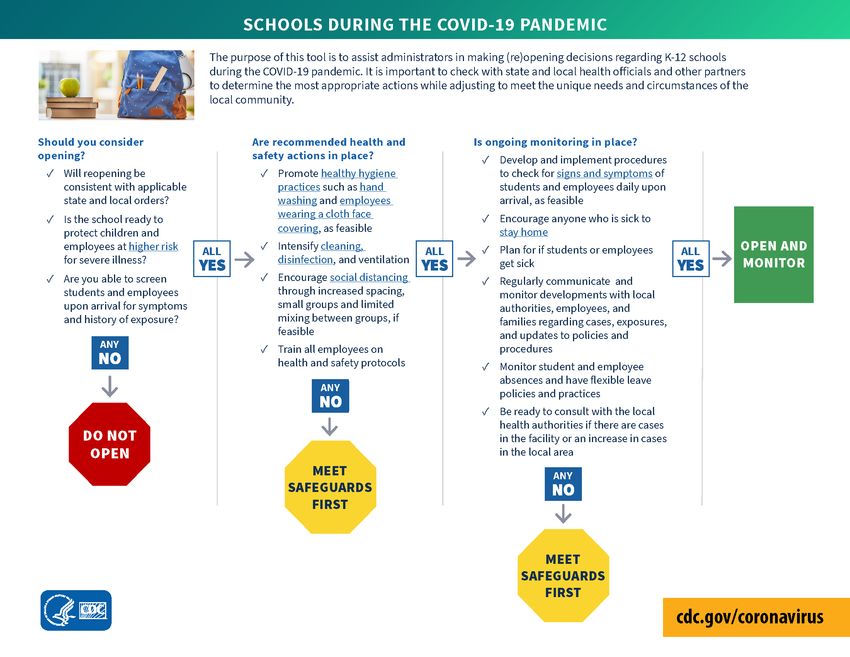
Message from the Superintendent
Dear Pasadena Unified Community,

I want to begin by thanking you for your continued support as we navigate the challenges of the COVID-19
pandemic. Within a few months, we have all had to adapt and change our way of living.

Since the pandemic began, we have been planning for the return of students and staff to our beloved
campuses, keeping in mind the unique learning needs of students, the impact the virus is having on working
families, and the health and safety of all in the school community. The health and safety of our students and
staff is at the forefront of all our work.

In keeping with the PUSD Board of Education’s authorization and mandates from California Governor Gavin
Newsom and state and local public health authorities for schools located in counties with high COVID-19
infection rates, PUSD students will begin the 2020-2021 school year on August 17, 2020, in a remote
learning environment.

We will continue to closely monitor and evaluate public health conditions and data. We are preparing for
the safe return of students and staff for in-person learning and will switch to in-person learning in
accordance with the most recent state and local guidelines and in collaboration with our labor partners.

The intent of this guide is to provide our families, students, and staff insight into what the 2020-2021 school
year will look like based on the latest information, guidance, and mandates from state, county, and public
health authorities. Please note that this document is subject to change.

Sincerely,

Brian O. McDonald, Ed.D
Superintendent

                             Pasadena Unified School District Board of Education
  Patrick Cahalan, District 4, President                         Roy Boulghourjian, District 2
  Scott Phelps, District 7, Vice President                       Michelle Richardson Bailey, District 3
  Elizabeth Pomeroy, District 5, Clerk                           Lawrence Torres, District 6
                                                                                                                  3
  Kimberly Kenne, District 1

                                www.pusd.us        www.pusd.us/covid19
Guiding Principles/Values
The 2020-21 School Opening & Safety Plan has its origins in the PUSD’s Emergency
Operations Center (EOC) which served as the District’s central coordination,
command, and control point for emergency related operations and activities.
Teams met regularly since March to plan for the safe reopening of schools.
Plans were continually adjusted as state and county guidelines were updated.

                                                                  VALUE #1:
                                                                  To open schools safely for students, staff,
                                                                  and families.

                                                                  VALUE #2:
                                                                  To nurture students academic and social
                                                                  emotional development.

                                                                  VALUE #3:
                                                                  To engage student, staff and family voices.

                                                                                                                44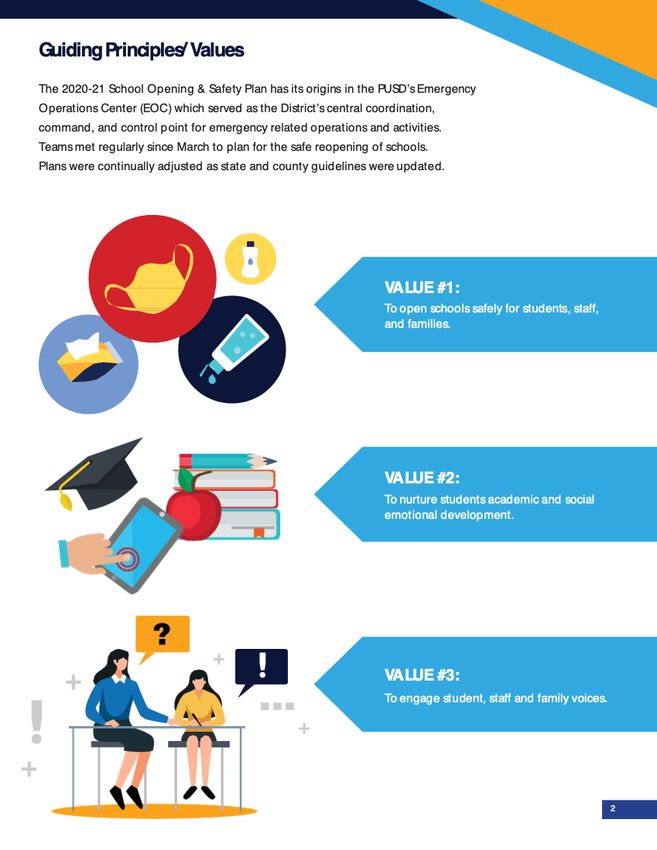
Adapting to Changing Conditions
The chart below shows the alignment between State and Local Public Conditions and PUSD’s Phases. PUSD has
established protocols for moving between these phases at the District and/or specific school site levels in
accordance with the City of Pasadena Health Office Order for the Control of COVID-19 issued on July 14, 2020,
and the California Department of Public Health COVID-19 and the Reopening In-Person Learning Framework for
K-12 Schools in California, 2020-2021 School Year issued on July 17, 2020, guidelines from the Pasadena Public
Health Department and changing orders from the State of California and Los Angeles County.

    Level of Risk           Country/State Description
                                                                      Description of PUSD Phases

                          Reopening Safer at Work and in the
                          Community for Control of COVID-19         Phase 1: Learning is remote, meals provided “grab- and-
    HIGH
                          Order - Stay at home except for           go” at designated places. School facilities open to a
                          essential and permitted activities,       limited number of staff but not for students, visitors or
                          maintain physical distance, wear a face   volunteers. Dates/times to safely distribute textbooks and
                          covering                                  other instructional materials to students will be shared with
                                                                    parents in early August.

                          Gradual opening                           Phase 2: Learning is still remote. School facilities open to
    MEDIUM                of some lower-risk                        staff and a limited number of student and adult visitors for
                          workplaces                                direct services meeting specific criteria. Childcare Centers
                                                                    open.

                          Gradual opening of higher-risk            Phase 3: Schools reopen under Hybrid in-person model
    LOW                   businesses, K-12 schools, colleges        but with less than 50% of student population on campus at
                          and universities                          any given time. Physical distancing measures and strict
                                                                    health and safety protocols in place for staff, students,
                                                                    families, and visitors.

                          Return to normal operations
    NEGLIGIBLE                                                      Normal operations but prepared to revert to Phase 1, 2 or 3
                                                                    depending on risk level and with minimal disruption to
                                                                    student learning.

                                                                                                                                    5
Determining If It’s Safe to Return to In-person Instruction

PUSD’s plan is designed to allow for a smooth transition from one instructional model to another. A waiver application
process is being designed by the Pasadena Public Health Department (PPHD) and the Los Angeles County Department
of Public Health to allow schools to transition from remote learning to in-person learning models. If health and safety
conditions change during in-person learning, a cohort, classroom, school, or District may have to return to remote
learning. Movement between PUSD Instructional Models is determined through consultation with PPHD and subject to
agreements with our labor partners.

Although information continues to change rapidly, please see PPHD COVID-19 Health Orders as well as Appendix B for
links to resources and guidance from LA County, CDPH, the Centers for Disease Control and Preventions (CDC), and
others.

                                                                                                                      6
Timeline
2020

                                      Enrollment/Registration is ongoing. Registration is completed
   Ongoing                            through an online process. Waitlists from the lottery will be
                                      maintained until August 6. After August 6, students must complete
                                      the online process for their school of residence.

   August 10-21                       Distribution of textbooks, supplies, and devices

   August 17                          School Starts for students in remote learning

                                      Constant monitoring of health conditions and planning and
   Throughout the first               modifications to open in hybrid model if conditions improve (low
   10 weeks/first quarter             risk) and close if conditions worsen (high risk). After schools are
                                      cleared to open by public health, we will transition to in-person
                                      learning, subject to agreements with our labor partners.

2021

   January 4, 2021                    Start of second semester

Before School Starts
Checklist for Students and Families

       Students new to PUSD complete School                              All Parents/Families Sign up for Parent
       Registration to Enroll by August 6, 2020                          Portal for important communication

       New Students Pick up Chromebook from                              Returning students please charge and check
       school site and if needed, request a                              your assigned PUSD Chromebook/devices
       hotspot through our PUSD helpdesk                                 before the start of school

       All Students Pickup instructional materials                       Returning Parents Update emergency contact
       and supplies based upon school site                               information on Parent Portal Account
       schedule

       All Families Complete the LCFF Funding
       Data Collection Form: English, Español

                                                                                                                   7
Communication with Students, Parents,
Employees, and the Community
Delivering timely, accurate and comprehensive information to our students, parents, employees and
community is more important than ever. With a unified and consistent voice, PUSD will provide frequent,
clear, and two-way communication responsive to stakeholder concerns. PUSD has a dedicated website
www.pusd.us/covid19, a family hotline (626.396.3680), and sends out regular updates via email, text, phone,
mobile app, videos, social media and flyers. We will keep you updated via email/text/phone with latest
information as it becomes available.

Using your Aeries Parent Portal account, please be sure your child’s school has your most recent contact
information (email and telephone number). How to Sign Up for Parent Portal.

Parent Survey Results

 PUSD’s planning has been guided by the voices of our community. We received high response rates on two parent
 surveys. Thank you for engaging with us!

June 2020 Survey
                                                   Options                        Yes       No             No
What type of instruction                                                                                   t
would you be comfortable                                                                                   Sur
for your child in the fall?                                                                                e

                                                   In-person (following public
                                                   health safety guidelines for      55%        15.5%            28.9%
                                                   distancing)

                                                   100% virtual/online
                                                   (supported with additional
                                                                                     51%        26.1%            22.2%
                                                   live lessions and more
                                                   defined schedules)

                                                   Blended in-person and online
                                                                                     57%        17.4%            25.5%
                                                   learning
July 2020 Survey

Which would you choose for
                                                  55% of students Hybrid/on campus
your student: on-campus
hybrid or virtual 100%                            45% 100% online
online?                                           13,538 completed survey responses
                                                                                                                     8
II. What To Expect When School
 Starts August 17, 2020 in Remote
 Learning
Students will begin the year with remote learning in keeping with the PUSD Board of Education’s
authorization and mandates from California Governor Gavin Newsom and state and local public health
authorities for schools located in counties with high COVID-19 infection rates. Our primary goals in planning
are to ensure a safe learning environment for our students and teachers and to provide robust academic
programs.

Using lessons learned from last Spring, parent feedback from surveys, and with more time to prepare, PUSD
has built a more robust remote learning program. There will be more live interaction with teachers and school
personnel and a more structured daily schedule. We will shift to a new online learning platform called Canvas,
which will allow us to organize instruction and monitor student progress. This will also allow us to ensure that
our students are connecting regularly with school and district personnel. At the same time, when practicable,
PUSD is committed to maintaining the extracurricular programs, clubs, and athletics that are important to the
physical, mental, and social well-being of our students. Information about daily schedules will be forthcoming
and posted at www.pusd.us/covid19

2020-2021 Educational Options
Quality instruction and a commitment to equity for all students continue to be the main focuses for the PUSD
educational programs. We know the needs of our students and families vary which is why we have provided
instructional options for the 2020-2021 school year. Student schedules may be accessed through Parent Portal
and Canvas.

                                                                                                                   9
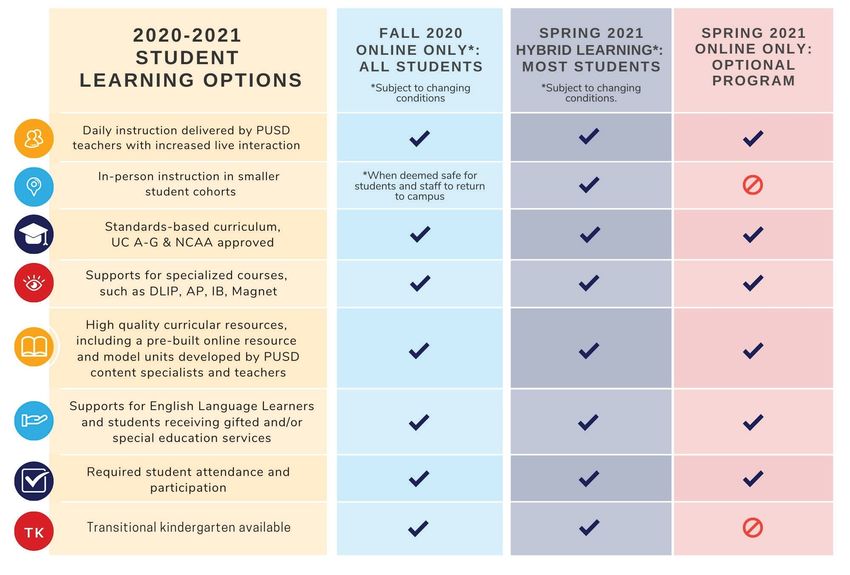
PUSD will begin the first semester of the 2020-21 school year in Phase 1 & 2 due to
public health concerns. This means we will be in a remote learning setting. Re-evaluation will
occur at specified times in the first semester, in preparation to return to in-person when possible.
The following models will be activated once PUSD enters Phase 3, with the ability to return in-person.

Phase 3: Instructional Models

For the 2020-2021 academic year, PUSD will provide families a choice of the following
instructional options during Phase 3 (subject to change):

                 HYBRID MODEL                                            ONLINE MODEL

       What is the Hybrid Model?                               What is the Online Model?
       PUSD’s 2020-21 structure of learning                    PUSD’s 2020-21 structure of learning
       wherein students attend school with a                   wherein students attend school in an
       combination of in-person and distance                   entirely online environment while
       learning environments.                                  remaining enrolled at their current
       •   In-person learning environment - Learning           school. The Online Model is intended as
           that occurs in the classroom on campus.             a continuation of distance learning for a
       •   Distance learning environment -                     longer term or full school year.
           Learning that occurs from a remote
           location not on campus.                             What does the Online Model include?
                                                               • Standards-based curriculum that is UC a-g
       What does the Hybrid Model include?                         & NCAA approved
       •   Standards-based curriculum that is UC a-g
                                                               •   Combines PUSD core adoptions with a
           & NCAA approved
                                                                   pre-built online resource, along with and
       •   Combines PUSD core adoptions with a
                                                                   model units developed by specialists and
           pre-built online resource, along with and
                                                                   PUSD teachers.
           model units developed by specialists
                                                               •   Supports for English Language Learners
           and PUSD teachers.
                                                                   and students receiving GATE and/or
       •   Supports for English Language Learners,
                                                                   Special Education services.
           and students receiving GATE and/or
                                                               •   Daily live instruction delivered virtually by
           Special Education services
                                                                   PUSD teachers.
       •   Instruction delivered by PUSD teachers
                                                               •   Continuation of distance learning for a
           following a cohort schedule.
                                                                   longer term or full school year.
       •   Ability to participate in learning on-
                                                               •   Supports are in development for
           campus in smaller student cohorts.
                                                                   special programs such as DLIP, AP, IB,
       •   Directly supports special courses such as
                                                                   Magnet, etc.
           DLIP, AP, IB, Magnet, etc.
                                                               •   K-12 (No TK)
                                                                                                                   10
PUSD will work with students and families to ensure equity and access to quality
instruction. Accommodations for students with disabilities, students with diverse learning
needs, students who are medically vulnerable, and English Learners will be made as needed.
Learning Environment Considerations: Phase 3 (subject to change)
HYBRID MODEL: ONLINE MODEL:
Structured learning environment in a Low safety risk
familiar in-person setting when
Daily live instruction
PROS possible PROS
Allows for student collaboration and Consistency of online program for
social interaction when possible longer term or full school year
Required social distancing & PPE when
in-person Limited direct interaction with other
students
Based on Public Health guidance, the CONS Some students may need parent
CONS program may toggle between Remote support
Learning and in-person
Special Programs such as DLIP, GATE,
During Remote Learning, students may AP, IB, Magnet, etc., are not yet
need childcare and support at home guaranteed or may be modified
in this format
What is the difference between Remote Learning and the Online Model?
• Remote Learning refers to the environmental setting. It is a response to school closures to ensure the continuity of
learning for students when Public Health guidelines demonstrate high risk for in-person learning. This is the setting
all PUSD students will be in during Phases 1 & 2. Students and staff return to campus when public health
conditions allow.
• The Online Model program provides an alternative to the Hybrid Model program once students are permitted to
return in-person. In the Online Model, the educational program is delivered through a virtual setting using a pre-
built, native online program as a baseline for delivering the district core curriculum. This is a model that is activated
once PUSD enters Phase 3. More information will be provided during the first semester regarding the opportunity
for students and families to opt into continuing with the 100% Online Model once plans to return in-person under
Hybrid Model are announced.
Can a student move from the Online Model program back to the Hybrid Model program at any time?
The Online Model is intended as a continuation of full distance learning, ideal as a longer term or full- year
program. With that said, any changes to a student’s program will be addressed on a case by case basis and
recommended to be evaluated at a trimester or semester break. By doing this, we can ensure a continuity of the
program for the student.
What will grading look like in these models?
For both models and settings, PUSD is resuming its regular Grading Policy for the 2020-21 school year,
11
which follows the A-F scale for all grade levels.Enrollment & Registration
How do I complete my Registration for 2020-2021?
Are you new to Pasadena, Altadena or Sierra Madre? Or is this your first time enrolling in a PUSD school?
Here’s what is required to register:
Registration for the 2020-2021 school year is online only. In-person registration at school site or district
office is not an option.
Online Registration for New Students to PUSD or New Students to a School Site (TK-12)
1. Access Online Registration: Select here
- If your student has an IEP with SDC services, please contact the Special Education
Department first. Select here for contact information.
2. Include the following documents at the time of registration:
-Your child’s birth certificate (copy)
-Your child’s most recent immunization record (copy)
-Transcripts or report card for middle & high school students only (copy)
-Two proofs of residency (copies):
1) Recent gas, electric or water bill in parent/guardian’s name
2) A deed of trust, mortgage payment receipt, rental receipt with a copy of the lease
agreement, or a property tax bill in parent/guardian’s name
For School Registrar Information, Select here
3. If you are unable to complete online enrollment, you may mail registration form and documentation to
Enrollment Permits & Student Records, 351 S. Hudson Avenue Room 123, Pasadena CA 91101 or Fax to
(626) 795-9530. Please contact District Registrar, Annie Jananian districtregistrar@pusd.us before mailing or
faxing documents. To obtain Registration Forms, select here: English form and Spanish form.
Note: Only legal parent/guardian may enroll a student. All documentation will be verified by staff before the
enrollment process is completed.
Registration for Preschool
If you wish to enroll in preschool, please contact the Early Childhood Education Program here or email
earlychildeducation@pusd.us for information.
12Attendance
PUSD will ensure that all students are provided with equitable learning opportunities in remote
learning or hybrid/in-person model. Attendance practices will be in alignment with CDE Average Daily
Attendance (ADA) requirements.
Attendance for prek-5th grade will be taken daily and in each period for students in 6-12th grade.
PUSD’s attendance methods for distance learning days may include: a daily assignment on the learning
management system, email, google form, or a visual check in. Sites will utilize district resources such as
AERIES to document how students have been contacted and how often and the attempts to reach
those who have not been in contact with the teacher.
SB 98 specifies that 2020-21 ADA, for the purposes of making funding determinations, is fixed at the
2019-20 level for any county office of education, district or charter school. This provision will serve as a
hold-harmless for any local educational agency (LEA) that sees declining enrollment (and thus declining
ADA) in 2020-21 either as a result of the pandemic or as a result of the more natural decline occurring for
demographic or mobility reasons.
Learning Continuity and Attendance Plan
The PUSD’s Learning Continuity and Attendance Plan is being developed through a collaborative
process to ensure intentional actions result in quality student learning opportunities and engagement.
Stakeholder engagement will occur during the month of August. Public hearings are tentatively planned
for early- to mid-September.
13Technology
PUSD provides Chromebooks to all students through a 1:1 tech device program.
Dates/times to safely distribute student textbooks, devices, and supplies will be
shared with parents in early August.
The resources and links that you see listed below are available for both technical and
academic support. Some of these resources require that our parent/guardian users create an
account using information provided by the school site or teacher.
Families New to PUSD: Technology Resources
• PUSD Account Access - Your student’s login information can be provided by the school site they will
be attending
• Chromebooks - All students can check out a Chromebook and charger to support their learning
• Hotspots - If your family is in need of internet access in order to engage in remote learning, please
submit a request from our Helpdesk http://gopusd.com/helpdesk
• Chromebook Insurance - If you would like to purchase insurance for your Chromebook to cover theft,
please visit pusd.us/Page/6892 to learn more
Please call PUSD’s Innovative Technology
Services (ITS) Helpdesk at 626-396-3699 or
submit a support ticket by visiting
gopusd.com/helpdesk.
Note that you will be unable to submit a
ticket if your student doesn’t have their
PUSD account login information yet.
14Student Tech Applications
Parent Tech
NEW! Canvas - Every student will engage in their online learning through
our Learning Management System (LMS), Canvas. Students can access
Applications
their accounts through the Clever Dashboard (clever.com/in/pasadenausd)
Aeries: Parent Portal - With access to
or PUSD Portal (https://arms.pusd.us). By logging into Canvas, students
the Parent Portal, you as a student’s
will be able to click on their courses to: engage in lessons, complete
parent/guardian can see the
assignments, submit work, send messages to teachers and classmates,
assignments added by the teacher,
and participate in their live synchronous lessons.
grades for those assignments,
attendance, view state assessment
NEW! WebEx: Classroom Conferencing - Students will engage in live
results, provide confirmation of your
synchronous learning by using our new classroom WebEx tool, which
student’s information, and update
replaces Google Meet. Webex integrates into the student’s Canvas
personal information. If you don’t
classroom where all archived lessons, office hours, and small groups
already have an account setup, you will
instruction can be found in one place. WebEx provides a safe and secure
need to get in touch with your school
platform allowing the teacher to facilitate engaging instruction with
site to receive a verification code.
enhanced teaching tools and breakout rooms.
Please visit gopusd.com/aeries4parents
Clever Dashboard - Students can find all of their learning applications for more information.
through their Clever dashboard. When students are logged into their
Canvas: Observer Accounts - Every
Chromebook or logged into a Chrome browser, they will have access to all
student will engage in their online
of their PUSD applications. Students can access the Clever dashboard by
learning through our Learning
visiting http://clever.com/in/pasadenausd.
Management System (LMS), Canvas.
Aeries: Student Portal (6th - 12th Graders) - All of secondary (grades Each parent/guardian will also be able
6-12) students have Aeries Student Portal accounts with access to create a Canvas Observer account
grades, attendance records, report cards, and state assessment linked to their students’ Canvas
scores. We encourage all students to access and accounts which will allow them to see
monitor their accounts throughout the school year. To learn more, students’ course(s), assignments,
students can visit http://gopusd.com/aeries4students. classwork, lessons, feedback, and
completed and reviewed assignments.
ITS HelpDesk - All students can submit a ticket for technical support Your student’s teacher(s) will be able to
through our helpdesk portal. Our helpdesk team is available to assist provide you with a code that will link
with troubleshooting, making appointments for repair, assisting in your parent account to your student(s).
hotspot checkouts, and support with PUSD applications. Support More information about Observer
tickets can be created by visiting gopusd.com/helpdesk. accounts will be available soon.
Curbside Tech Support
ITS will continue to offer technical support for all PUSD families
from a centralized location while we are in remote learning.
Students can request an appointment for support by submitting a
ticket through our helpdesk at gopusd.com/helpdesk. A student
must be logged into their PUSD account in order to submit a 15
ticket.Social Emotional Learning (SEL)
District and school staff are committed to supporting students’ social emotional wellness and offering
resources to help students while they are learning remotely and when they transition back to school.
The Office of Child Welfare, Attendance, and Safety (CWAS) works with schools to implement School-
wide Positive Behavioral Interventions and Supports (SWPBIS). Key components of this effort during
these challenging times include:
• Ensuring that all PUSD elementary and middle schools have access to the online SEL curriculum
Second Step
• Conducting virtual one-on-one site visits with schools in August/September in support of mobilizing
and tailoring each school site’s universal interventions, Tier I-classroom management.
Mental Health Services
As students’ mental well-being is of utmost importance, we want to make sure you are aware of the
resources that will continue to be available for our students. CWAS and Mental Health Services have
developed a plan to provide services in three scenarios as circumstances allow:
• Remote/Telehealth mental health services - to continue as of 8/17
• In-person/On-site mental health services utilizing safety measures to consider for clinicians and
clients; and pending room availability for confidential and safe sessions, and personal protective
equipment (PPE)
• Hybrid scenario combines in-person and remote services
Access to Resources and Support Services
CWAS provides outreach to ensure students with unique needs, including foster youth and homeless
students, have the necessary resources to access learning while following public health guidelines as
well as supports to address academic and social-emotional needs.
For more information, contact:
Dr. Eric Sahakian, Student Wellness and Support Services Department
626-396-3960
See also PUSD Extended Resources List
Health Programs
The services provided by the Health
Programs Department will be available on an
appointment basis. Please contact our office
at 626.396.3600 ext 88243 and visit our
website for current information. 16Supportive Services for Students
with Unique Needs
English Learners
Support for English Learners (ELs) will be provided through the Language Assessment and Development
Department (LADD) in close collaboration with the Curriculum, Instruction, and Professional Development
Department and the Family Engagement office, and will be an integral part of the hybrid and online
instructional models. These services include:
• Support for teachers in providing specialized and differentiated daily content lessons to ELs so that
English Language Development (ELD) is embedded into their instruction
• Supplemental programs will be accessible to teachers so that specialized applications can be linked within
their Canvas LMS accounts and can then be delivered in their daily online virtual classrooms; specialized
applications include Scholastic Reading (for elementary and secondary) and Newsela (for secondary),
giving our EL students access to rigorous, engaging lessons, and rich content specific curriculum
• Daily student learning will be supported and reinforced in an online virtual tutoring setting with
knowledgeable site or district staff, organized and funded by LADD, as well as accounts created through
UCLA’s free online tutoring and other available sources
• Family Engagement office will support and ensure that parents can access virtual meetings and receive
language support and communication
• LADD will continue to provide translation and interpretation services to ensure that vital home
communications are maintained for parents in a language they understand
• LADD will continue to provide all regular duties and responsibilities as mandated by the CDE EL Program
Instrument including: professional development for school staff, assessment of language proficiency,
reclassification, monitoring, and intervention specialized support
Please see Appendix C for further details or contact LADD at (626) 396-3600 ext. 88299
or email us at ruelas.juan@pusd.us and saldivar.arnold@pusd.us for more information.
17Students With Disabilities
The Special Education Department will support and reinforce learning for all students, including
students with disabilities, via remote learning platforms. The District will be using Canvas as its Learning
Management System. The Special Education department will work in collaboration with other
departments to ensure all students have access to curriculum and instruction as well as related support
services. Special Education service providers will develop and expand their online classrooms to
continue to serve students in accordance with each student’s Remote Learning Plan.
• Education Specialists and other special education service providers will contact parents to develop and/or
revise their child’s/children’s Remote Learning Plan
• Support for teachers in providing specialized and differentiated daily content lessons to students with
identified disabilities to make curriculum accessible
• Family Engagement office provides support to ensure that parents can access virtual meetings and
receive support and communication
• Psychoeducational evaluations will be conducted in accordance with Center for Disease Control (“CDC”),
California Department of Education (“CDE”), and Department of Public Health (“DPH”) physical
distancing guidelines, being mindful of assessment tools specifications
• Support to special education teachers and related services in the IEP through multiple modalities specific
to each student: Canvas learning management system, web based instructional materials, videos, and
specialized learning materials
• Supplemental materials made accessible to teachers to meet the needs of each student based on their
Individualized Education Program/Remote learning plan
• Collaborate with general education teachers, related service providers, outside agency providers, and
administrators to provide appropriate supplementary aids, accommodations and modifications for
students to access general education curriculum
• Provide professional development for school staff
• Education specialists will collaborate with families through
phone conferences and emails and offer regular office hours
to both families and students as needed
• Education specialists continually monitor student progress
and adjust services as needed as reflected on the remote
learning plan
• Special Education will continue to provide all regular duties
and responsibilities as mandated by SB 98 to the greatest
extent possible
For further details contact the Special Education Department
at (626) 396-3600 ext. 88600 or email us at sped@pusd.us for
more information. 18Family & Community Engagement
PUSD’s Family Resource Center is a place, both physically and virtually, where parents and guardians
can get information, support, and skills to help their children succeed academically and emotionally.
We are a place where you can get resources to help families navigate the education system,
connect with educators, volunteer in the classroom, support your child’s learning at home and more.
The Family Resource Center empowers families and cares for students by connecting parents to
resources and community partners. Parents can access the following by contacting:
Office of Family and Community Engagement
351 S. Hudson Ave., Room 121
Pasadena, CA 91109
(626) 396-3600, Ext. 88191
familycenter@pusd.us
gopusd.com/families
• During Phase I: Services will be provided remotely
• During Phase 2/3: When district and schools are open for limited numbers of parents/visitors,
the FRC will be physically open to the public for service by appointment only, Monday-
Thursday, 8am-12pm; FRC phone calls will be redirected to staff 12-4pm on these same days.
Office of Family & Community Engagement Services
• COVID-19 information and resources for families • Support schools, engage parents in school and
• Support families navigating Remote Learning district leadership committees (CAC, DAC,
including Parent Portal, Canvas, and more DELAC, FYC, AAPC, LCAP PAC, PTA)
• Parent University offers parent and student • Provide orientation and clearance of Level
support workshops related to Health and 2 volunteers supporting K-12 student
Wellness, Mental Health, Social Emotional developmental and academic achievement
Support, Academics and Technology • Guidance with enrollment, transfers, and
• Referral to Community resources including registration needs
food, clothing, transportation, utility assistance,
financial support, and housing
• The FRC provides tools, Learning Guides,
helpful sites, and information to keep families
informed about latest resources to help
students learn and excel
• Connect families to agencies providing school
supplies, uniforms, tutoring services, medical,
dental, mental health, and insurance
enrollment services 19Food & Nutrition Services
Grab & Go Centers
During Remote Distance Learning starting August 17, Grab & Go breakfast and lunch will be distributed curbside
Monday-Friday between 9:00 a.m. - Noon at:
All PUSD school sites. See locations at www.pusd.us/schools
The following sites will be combined into one distribution line:
Blair Middle and High School at McKinley School and Rose City High School at
Blair High School the McKinley School campus
1201 South Marengo Avenue 325 South Oak Knoll
Pasadena, CA 91106 Pasadena, CA 91101
Washington Elementary and Washington Middle at Willard Elementary meal distribution at
Washington Elementary School Wilson Middle School campus
1520 North Raymond Avenue 300 S Madre Street
Pasadena, CA 91103 Pasadena, CA 91107
In the beginning of September, we plan to survey parents to determine if they would like us to add supper service
from 4:00 p.m. - 6:00 p.m. at Muir High School and Pasadena High School.
Community Eligibility Program:
All PUSD schools have been approved for the 2020-2021 Community Eligibility Program (CEP), a universal meal
service option included in the National School Lunch Program and the School Breakfast Program. All PUSD
schools will participate in the CEP program and will be offering meals each day at no charge for all students
enrolled during the 2020-2021 School Year.
All families are asked to complete the LCFF Funding Data Collection Form that is part of the Parent Portal. The
form is here in English, and, aquí en Español. If you have any questions or concerns, please contact Food Services
at 626-396-5852.
On-Campus (when deemed safe to return to in-person learning)
To the extent possible, meals will be eaten without any mingling of elementary school students from different
classrooms.
If students line up to pick up food, tape or other markings will be used to assure a 6-foot distance between any two
students. If meals take place in a cafeteria, meal times are staggered to the extent feasible to reduce the number
of students in the cafeteria at one time and space between tables/chairs has been increased to support 6 feet of
physical distancing.
Food preparation and service operations have been redesigned, where possible, to achieve physical distancing
between employees. For example, kitchen and other back of house floors are marked to reinforce physical
distancing requirements.
20Other Program Information
Childcare
Early Childhood Program/Childcare
As of the most recent (July 27, 2020) guidance from the California State Preschool Program (CSPP),
General Child Care (CCTR) that is operated by a District will physically close and continue to be funded
when the District has determined it may not open. Under this new guidance, a program component that
closes as a result of these conditions must provide distance learning for enrolled children and families.
Once the District or the state or local public health agency decides its campus(es) are safe to reopen, the
Early childhood education programs on the respective District campus(es) must physically reopen as well.
PUSD’s Early Childhood Education (ECE) program will continue to provide families with online
developmentally appropriate activities that can be done at home including an activity plan for each child
that can be incorporated into the daily activities and assist with creating a predictable routine in the
family’s home.
Activities are similar to those conducted in the program and promote the developmental progress of
social emotional skills, language and literacy skills, problem solving skills, math and science skills, and
physical health. ECE will continue offering virtual learning opportunities daily through various methods to
maintain the developmental progress of children. These include, but are not limited to, email, online
learning platforms, video and/or activity. Outreach consists of a mix of individual and group activities to
maintain relationships and support for families and children with each other and with program staff. ECE
will continue communicating with families about their progress and needs with remote learning and the
family’s overall well-being; providing resources and referrals to support services, social services, and health
services as needed.
The Early Childhood Education Program will also offer Emergency Child Care for essential workers and at-
risk families, but the timing to begin this is expected to be confirmed by early August. For updates,
please visit our website at gopusd.com/ece or contact us at Earlychildeducation@pusd.us. Families who
are interested in enrolling in the Online Preschool Program will need to complete the online application
found on our website gopusd.com/ece or can contact the enrollment office at (626) 396-5762 ext 10070.
21PasadenaLEARNs 2020-21 COVID 19
PasadenaLEARNs is currently working with the district and our community partners to offer in-person
expanded learning programs for PUSD students in grades K-8. Proposed in-person programs would
be held at designated PUSD campuses across the district Monday through Friday from
approximately 8:00am to 4:00pm daily. More information will be made available on the LEARNs
website and is in the Pasadena LEARNS 2020-21 COVID-19 Reopening Plan.
Contact the LEARNs coordinator at your school site or visit gopusd.com/learns.
Adult Education
PUSD Fall 2020 Adult Education online courses will be available in mid-August.
For more information, please visit pusd.us/twilight.
Athletics
Please note that there will be no practices on any PUSD school or district facility until there is notification
from our Public Health Department and guidance on what is safe for students and staff. On July 20, the
California Interscholastic Federation (CIF) Southern Section announced that it was condensing three
seasons of sport into two seasons, with traditional fall sports beginning in November/December. See the
CIF Southern Section announcement.
Arts Education
Arts teachers (K-12) will continue to provide instruction remotely. We are purchasing an online program
for K-5 (Quaver Music) and High School Music (MusicFirst) to support teachers in the development of
rich online content. Our community partners and teaching artists will continue to support teachers and
students in the online environment. The My Masterpieces program and the TK - 2nd grade Theatre and
Dance Explorations program are under development for an online rollout. Online lessons and resources
in theatre and visual arts will be available to all K-5 teachers on Canvas, and we will be providing arts
supplies to support our online curriculum to all K-5 students.
Please visit gopusd.com/arts or email pusdarts@pusd.us for more information.
22III. What To Expect When
Students Return To School In-
Person (Phase 3)
The health and safety of our students, staff, and families are of utmost importance. PUSD will transition to
the Hybrid Learning Model with in-person learning in Phase 3 when it is deemed safe and is subject to
agreements with our labor partners. When students return to their school, it is important for them to be
aware that school and routines will look different from last year in order to provide a safe environment for
students and staff due to new health and safety measures.
Screening At Home:
• Families are recommended to take students’ temperatures daily and observe for any COVID-19
symptoms before going to school. Anyone with a fever of 100.4° F or higher and exhibits cough,
shortness of breath, difficulty breathing, chills, fatigue, muscle pain, headache, sore throat, congestion,
runny nose, nausea, vomiting, diarrhea, or loss of taste or smell should not go to a school site. Personal
illness, quarantine, and COVID-19 illness or symptom related absences will be excused.
• Families/students, adults, and staff should also screen themselves for COVID-19 symptoms prior to
coming to school each day. Families/students, adults, and staff experiencing those symptoms should
not attend school.
• Staff members are required to self-screen and complete a daily temperature check prior to coming
to work. If staff members are experiencing symptoms, they should stay home and contact Human
Resources.*
*pending agreements with our labor partners
Covid-19 Symptoms
Fever of 100.4° F or Higher Shortness of Breath
Chills Difficulty Breathing Headache
Congestion Fatigue Sore Throat Muscle Pain
Diarrhea Runny Nose Loss of Taste or Smell
Vomiting Nausea
23Phase 3
Arriving at school:
• All students and staff will be required to wear masks as directed by the Los Angeles County
Department of Public Health. Face coverings will be provided for students who need them.
• When open in-person, all Early Childhood Programs (ECE) students and staff will be temperature checked
prior to entry.
• Parents and visitors will have limited access to the school campus.
• School sites will designate routes for entry and exit in order to limit direct contact with others.
• School sites will have signage and floor markings throughout campus to remind students and staff about
required physical/social distancing of six feet or more, hand washing, and preventing the spread of germs.
• School sites will have hand washing stations or hand sanitizer available at designated locations to allow for
frequent hand washing.
• The District is committed to securing additional handwashing and sanitation stations and PPE to the
extent possible.
Transportation:
• Vehicles will be cleaned and disinfected at the end of each route.
• Students and drivers will be required to wear face masks.
• Students will practice physical distancing to the best extent possible.
• Should a student become ill while in transit, they will be seated in a dedicated seat directly behind
the driver.
Ventilation
• HVAC systems are set to maximize indoor/outdoor air exchange unless outdoor conditions (recent fire,
very high outside temperature, high pollen count, etc.) make this inappropriate.
• If HVAC systems are not functioning at maximum capacity, doors and windows are kept open during the
school day if feasible and if outdoor conditions make this appropriate.
• Air filters will be upgraded to the highest efficiency possible.
24Cleaning/Sanitation Protocols*
• Cleaning and disinfecting of space, surfaces, and objects throughout the school.
• A cleaning and disinfecting schedule has been established in order to avoid both under- and over-use of
cleaning products.
• Common areas and frequently touched objects in those areas (tables, doorknobs, light switches,
countertops, handles, desks, phones, keyboards, elevator switches and buttons, touch screens, printers/
copiers, grab bars, and handrails) are disinfected multiple times daily using appropriate products.
• Restrooms, lobbies, break rooms, and lounges and other common areas are disinfected frequently.
• Use of shared objects is eliminated wherever possible; for example, water fountains are shut down and/or
high touch playground equipment may be taken out of use.
• Where individualized alternatives are not feasible, for example, in laboratories and art rooms where some
equipment may have to be used by multiple students, objects and surfaces are cleaned and disinfected
between users.
• Cleaning products that are effective against COVID-19 (these are listed on the Environmental Protection
Agency (EPA)-approved list “N) are used according to product instructions.
• Deeper cleaning is done when students are not at school with adequate time to let spaces air out before
the start of the school day.
• Custodial and other staff responsible for cleaning and disinfecting school surfaces and objects are trained
on manufacturer’s directions, Cal/OSHA requirements for safe use and as required by the Healthy Schools
Act, as applicable.
• Custodial staff and other staff responsible for cleaning and disinfecting are equipped with appropriate
personal protective equipment as required by the product.
*We are in the process of negotiations with our bargaining units
which will allow us to begin training and creation
of cleaning and disinfecting schedules
Sanitation Stations
• Hand sanitizer effective against COVID-19 is available
to all employees in or near the following locations:
- Central office
- Classrooms
- Faculty break room
- Faculty offices
• Additional sinks and/or sanitation stations will be
provided in high frequency areas for students
25Personal Protective Equipment
• Anyone entering school property (school buses as well as school buildings and grounds) who has
contact with others (students, parents, or other employees) is required to wear a cloth face covering.
• Masks will be provided should a student not have one.
• Alternative protective strategies may be adopted to accommodate students who are on
Individualized Education or 504 Plans and who cannot use or tolerate cloth face coverings.
• Employees will be offered, at no cost, a cloth face covering and/or face shield. The covering is to be
worn by the employee at all times while on-site and in contact or likely to come into contact with
others. Employees need not wear a cloth face covering when alone in a private office or booth or a
walled cubicle.
• A medical grade mask is provided to any employee who cares for sick children or who has close
contact with any child with a medical condition that precludes the child’s use of a cloth face covering.
• Employees are instructed to wash their face coverings daily. Parents are instructed to ensure that
children have clean face coverings.
• All individual employee workstations or areas used by employees working as part of a team must allow
for separation of at least 6 feet.
• Classroom furniture is arranged to permit a distance of at least 6 feet between the teacher’s desk
and between each student.
Food Services On Campus
See page 20
IV. Appendix
A. Glossary of Terms
B. Resource and Guidance Links
C. Services for English Learners
26You can also read


