Schools & Colleges handbook - COVID-19 National Testing Programme: This guidance has been developed with the Department for Education and ...
←
→
Page content transcription
If your browser does not render page correctly, please read the page content below

COVID-19 National Testing Programme:

Schools
& Colleges
handbook
             This guidance has been developed with the Department for Education and currently
 th
4 Jan 2021   applies to England only. Further guidance will be developed by the devolved
             governments.
About the Schools & Colleges Handbook

• This handbook provides a brief overview of how to begin rapid coronavirus testing of staff, pupils or students in
  secondary schools and colleges from January 2021.

• The appendix to this document contains printable materials to support schools, colleges, parents and carers.

• A range of materials are available to help you support your staff, parents and pupils with rapid testing, including a
  detailed step-by-step ‘How To Guide’, Training Overview, Digital Guidebook, consent form templates and
  instructional videos. These are available on the Schools and Colleges document sharing platform for rapid testing.

• Your school or college will receive information and updates on testing in the daily bulletin, along with access to the
  testing support materials.

• Guidance is available for Schools and Colleges on phased return to education and should be followed.

• In a small number of schools and colleges, in areas with the highest infection or transmission rates, we will be
  applying our contingency framework for education. More information on the contingency framework is available at
  the Contingency framework webpage.

Staff and pupil/student testing – quick, safe, easy
Staff, pupils and students will be tested using a        Safe
validated Lateral Flow Device.                           Lateral flow tests are very accurate, which means
                                                         that only a very small proportion of people who do not
Up to a third of individuals who test positive for       have coronavirus will receive a positive result (false
COVID-19 have no symptoms at all and can                 positive). The tests have lower sensitivity, but they
therefore spread the virus unknowingly. That is why      are better at picking up cases when a person has
the testing those without symptoms is vital.             higher viral load, and more contagious, hence the
Identifying those individuals will save lives. This is   need to test frequently.
what is known as ‘rapid testing’.
                                                         When used in combination with other measures
Initially testing will be provided for all secondary     such as Personal Protective Equipment (PPE),
pupils, students and staff as they return. After this,   washing hands regularly and social distancing,
staff will be tested once a week on an ongoing           these tests further reduce the risk of
basis. Any pupils and staff who have symptoms            transmission. We must not relax any of these
should not be attending school and should be self-       measures – this testing programme is in addition to
isolating.                                               them.

Pupils, students and staff will be tested if they        Easy
come into contact with a positive case. This new         Lateral flow devices do not require a laboratory to
approach, known as ‘daily contact testing’, will         process the test. The devices are designed to be
allow those who are in close contact with someone        intuitive and require minimal training to operate.       * If staff, pupils or students cannot take a test (e.g.
who has tested positive for COVID-19 to return to                                                                 on the weekend) they should self-isolate for that
school or college if they agree to be tested for 7                                                                day, and resume daily contact testing on their
days* following last contact with a positive case and                                                             return to school / college. If they return after the 7
that test is negative.                                                                                            days are finished, then they should take one final
                                                                                                                  test, and if it is negative they can return to
                                                                                                                  school/college.
Quick
Swabbing and processing of these tests will be
conducted at a dedicated testing site in the school or
college with results available in around 30
minutes.
Who is being tested and why?
 Testing is important because staff, students and pupils without symptoms could be
 carrying the virus and may spread it to others. Testing staff and students will
 support schools and colleges to operate as safely as possible.

 New, simple and quick tests, known as Lateral Flow Device (LFD) tests, enable us
 to rapidly test pupils, students and staff, without the need for a laboratory.
 Secondary schools and colleges will be provided with these test kits to conduct the
 testing.

 We will keep schools and communities safer by working together to:

1•   Test as many secondary pupils and students on their return to school and
     FE colleges as possible. This means two LFDs tests three to five days
     apart.

2•   Carry out weekly testing of school and college staff

 •   Carry out daily contact testing for seven days of pupils and students and
3    staff who are close contacts of a positive case

 Note: Any students or staff with symptoms should not attend school or college and should
 immediately self-isolate in line with current public health guidance
                                                                                            4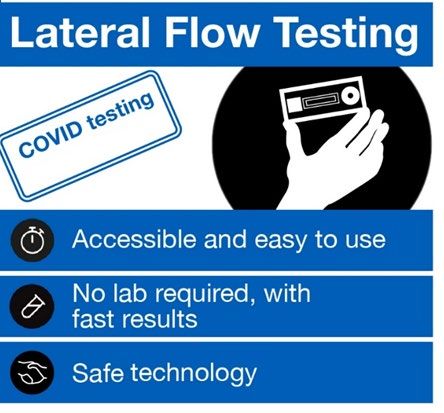
The components of Rapid Testing

             1                                       2                                     3

Test as many secondary pupils          Carry out weekly testing           Carry out daily contact testing of
and students on their return to        of school and college staff        pupils, students and staff who
school and FE colleges as                                                 are close contacts of a positive
possible                                                                  case

When returning to their school or      Staff will be offered one LFD      Those identified as a close contact of
college, pupils and students will be   test starting from 4 January and   someone who has tested positive will
offered two Lateral Flow Device        on an on-going weekly basis        be provided with daily testing for
(LFD) tests spaced three to five       thereafter.                        seven days.
days apart (minimum three days).
                                       A positive confirmatory PCR will   If they test negative on a daily basis,
A positive confirmatory PCR will       be required for all positive       they can continue to attend school
be required for all positive cases.    cases.                             without having to self-isolate.

                                                                             !       This is an alternative
                                                                                     to isolation

                                                                                                                    5
Quotes from schools & colleges

                                                          “Routine and repeat testing at Newcastle Sixth Form College has
                                                        given all of our students and staff the reassurance that the college is
                                                           a safe environment for them to work and study. The testing
 “Given staff have tested negative, it has
                                                            process is smooth and has minimal impact on teaching and
 given them a lot of confidence to know
                                                          learning. In addition to this, the daily testing of close contacts has
that social distancing makes a difference”
                                                           enabled students who would normally have had to self-isolate to
   Clare Cassidy, Sedgehill Academy.                    continue to attend and enjoy the benefits of face-to-face teaching.”
                                                                    Gerard Garvey, Newcastle Sixth Form College

                                                                                “The programme has been enormously
               “This has been a game-changer and                             popular with parents who are happy that we
               repeat testing has kept both staff and                         are keeping kids in school – I have received
                        students in school.”                                    many thanks from parents. I have really
                                                                             enjoyed being involved in this programme as
              Michele Chilcott, South Wilts Grammar
                                                                             a contribution to society and to science. It
                              School
                                                                                 has been a privilege to be a part of it.”
                                                                                Amanda Smith, Poole Grammar School
Workforce planning
Schools and colleges participating in testing will need to determine how many staff they need and where those staff will come from, for
example existing staff and/or volunteers or agency workers. Where schools or colleges ask existing staff to undertake a testing role,
employers should make sure this is in line with agreed terms and conditions of employment.

There are seven roles/job types that will need to be filled to enable schools to deliver testing. These roles are set out in the How To
Guide. The number of roles is not the same as the number of staff you will need to deliver testing. The size of workforce a school or
college will need to deliver testing will depend on the number of staff and pupils/students, the physical space available and the time
available to complete all tests.

What help is available?

•   Webinars are available which provide more detail on how a testing centre works in practice to help answer any questions schools or
    colleges may have. More details are provided during these sessions on how to access more support if required to help with planning.

•   Military support will be made available and is designed to make sure that those schools and colleges that require additional help can
    access it.

•   An online training package is available to enable testing staff to prepare to carry out their role. The training package is mandatory.
Funding
Schools and colleges will receive funding to support them with testing costs incurred. We have made £78m available to support
schools and colleges with the initial roll-out of mass testing. This will be paid retrospectively.

•   Independent schools and colleges will not be eligible for this funding, with the exception of non-maintained special schools and
    independent special schools

•   The amount of funding available to a school or college will depend on its size as this will impact the number of additional staff required
    to conduct testing. Our workforce planning tool provides illustrative workforce requirements and associated funding.

Consent
•   Participating in testing is voluntary. You will gain medical consent from a test subject (or from parent and guardians of those detailed below).

•   Before giving consent, the person giving consent needs to read the privacy notice to understand what will happen with their data. A template is
    provided on the Schools and Colleges document sharing platform
Data security and handling
A template Privacy notice has been developed, in order to meet data protection guidance, please share this with staff, parents/legal guardians,
students/pupils.
Processing personal data in support of COVID-19 testing
There is a small amount of processing of personal data which will be needed as part of the testing programme. To simplify this part of the process,
DfE has provided some information and templates for you to use. This does not replace your own due diligence and assurance as Data Controllers
but we hope this will make these discussions and decisions easier for you.

Lawful Basis for Processing
You will need to satisfy yourself that you have a lawful basis for processing the personal data. You might want to consider whether the duties
prescribed in education legislation on schools and FE institutions within the statutory FE sector to make arrangements to safeguard and promote the
welfare of pupils/children provide sufficient legal basis without having to rely on consent.

Privacy Notice template and Frequently Asked Questions
We have put together a Privacy Notice which outlines how the personal data is to be used in the event of both positive and negative tests and the
rights that individuals have. You are not obliged to use these templates but for ease we recommend you keep as much as the original wording as
possible so that parents who have children at two or more schools or colleges are not receiving conflicting information.

We recommend that you send a copy of this with your initial correspondence about the testing so that when people are making a decision about
whether to agree to a test, they are doing so with a full understanding of what happens to their personal data.

We also suggest that you place a copy on your website and have it displayed in a common area of the school or college. The Frequently Asked
Questions have been designed as another format for privacy information and you may find that your community respond better to the question and
answer style of Privacy Notice.                                                                                                                       Please find the template
                                                                                                                                                      privacy notice in the
                                                                                                                                                      separate attachment on
If you have questions about these please contact the Data Protection Officer for DfE via dp.enquiries@education.gov.uk and mark your email “COVID
                                                                                                                                                      the Schools and colleges
Testing in Schools/Colleges – Data Protection Issues”.
                                                                                                                                                      document sharing
If you live in Wales, Scotland or Northern Ireland, there is country-specific information on retention of records in relation to COVID-19.            platform.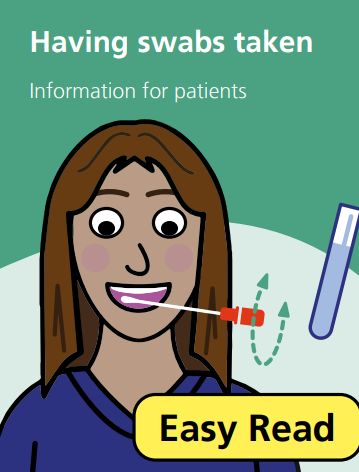
Suggested communication activities with parents,
students and staff
                                              Activity *                                                   Audience                                   Link to resources

School head teacher or college principal review the testing engagement handbook and check if
                                                                                                      School/college leader                               This pack
they have the latest guidance and templates

                                                                                                                                  Sample letter in Schools and Colleges document sharing
Send letter via most appropriate channel to inform testing activities taking place                Local stakeholders, governors
                                                                                                                                                          platform

                                                                                                           Parents
Send letter via most appropriate channel to inform testing activities taking place, attach test                                   Sample letter, Consent form and privacy notice in Schools
                                                                                                              Staff
result guidance, privacy notice and consent form                                                                                          and Colleges document sharing platform
                                                                                                        Pupils/Students

Educate and raise awareness of testing activities, provide reassurance (e.g. staff meetings,               Parents
                                                                                                                                                    Posters, user guides,
parental communications, assemblies, form group discussions) and use resources to support                     Staff
                                                                                                                                                     www.storicise.com
young people to explore, learn, discuss testing and the impact of COVID-19.                             Pupils/Students

                                                                                                           Parents
Host Q&A session to clarify/address concerns. A list of FAQs will be available to download from                                   Sample FAQs in Schools and Colleges document sharing
                                                                                                              Staff
the Schools and colleges document sharing platform.                                                                                                     platform
                                                                                                        Pupils/Students
                                                                                                           Parents
Track and ensure consent forms are received                                                                                        Sample letter and consent form in Schools and Colleges
                                                                                                              Staff
Send reminder of testing activities                                                                                                               document sharing platform
                                                                                                        Pupils/Students
                                                                                                           Parents
Send out reminder, and testing instructions, test result guidance                                             Staff                               Leaflet in digital platform
                                                                                                        Pupils/Students

                                                                                                           Parents
Provide advice on new approach to managing close contacts of positive cases and daily ‘serial                                     Advice on when student/pupils test positive in Schools and
                                                                                                              Staff
contact testing’ arrangements                                                                                                               Colleges document sharing platform
                                                                                                        Pupils/Students

                                                                                                           Parents
                                                                                                              Staff                Advice on serial contact testing in Schools and Colleges
Start testing, communicate test results to staff, students/ pupils and parents as appropriate
                                                                                                        Pupils/Students                          document sharing platform
Important Contacts
Schools and colleges in England can raise questions, concerns or report issues, via the DfE coronavirus helpline:
0800 046 8687. Opening hours Monday to Friday from 8am to 6pm, Saturday and Sunday from 10am to
6pm. You can also use this contact form to report issues relating to delivery and supply of testing kits.
Anyone with one or more of symptoms of coronavirus - a high temperature, a new continuous cough; or a loss or
change in sense of smell or taste - should self-isolate and book a test or call 119 in England and Wales, or 0300 303
2713 in Scotland and Northern Ireland.
If you have an urgent media query or you or your school or college is approached by a member of the media,
please contact the Department of Health and Social Care press office in the first instance.
The latest guidance and templates are available on the DfE Portal.
11Appendices Useful resources to support communication and engagement
Communication
Consistent, accurate and positive communication about testing activity is essential.

We would advise communicating with parents         A graphic video to mark the launch here:         https://www.youtube.com/c/DepartmentofHealt
and staff directly via existing school/college     https://twitter.com/educationgovuk/status/1338   handSocialCare
communication channels e.g. letters/emails         819876798992387?s=20                             https://twitter.com/educationgovuk
home using the templates provided.
                                                   A video interview with Prof Tim Brooks / PHE:    Teachers: There are also resources available
We would also encourage proactive use of           https://twitter.com/educationgovuk/status/1338   for schools / colleges to talk to young people
agreed materials such as the instructional         909220197064705?s=20                             at www.storicise.com
leaflets and the graphics / links on this slide,
or other materials on Government social            And with the Principal of Small Heath            And general materials on coronavirus
media feeds related to lateral flow / serial       Leadership Academy:                              including in different formats via Public Health
contact testing at schools / colleges.             https://twitter.com/educationgovuk/status/1338   England:
                                                   907957547962369?s=20                             https://coronavirusresources.phe.gov.uk/
There is an explainer video on lateral flow
testing here:                                      And please monitor our accounts for the latest
https://twitter.com/10DowningStreet/status/132     information to share:
8387524490911745?s=20                              https://twitter.com/10DowningStreet
                                                   https://twitter.com/DHSCgovuk
Media handling, site access and photography
A template Privacy notice has been developed to share with those participating in the tests, in order to meet data
protection guidance, please share this with staff, parents/legal guardians, students/pupils.
Your support for the delivery of communication All media enquiries about the mass testing
activity is welcomed and encouraged. programme should be directed to DHSC press office
https://www.gov.uk/government/organisations/depart
Please let the DHSC mass testing communications ment-of-health-and-social-care/about/media-
team know if you would like to invite media, enquiries
distribute press releases or conduct photography and
filming on site for external communications Please share the following details:
purposes. What is the purpose of the press visit / photo shoot
or filming? How is the footage going to be used?
Please give a minimum of seven days' notice for
• Who will be taking the picture, i.e. name of the
media communication about, including press notices
agency?
or media visits.
• Do you need anything from the operational staff on
site?
!
Please find below Those tested Operational staff Visitors info
some guidance that Please protect Please be Please send your
we usually share those being tested respectful of the full name in
with photographers/ and their identities teams on the site advance of the visit
videographers if they have not and their time. and bring photo ID
attending the site. granted permission They are working with you.
for filming. Please extremely hard and
avoid faces unless their focus is on
permission has completing tests
been given. safely and quickly.COVID-related pupil/student absence –
Printable Guidance for Parents and Pupils/Students (1/2)
The guidance below addresses what a positive or negative test result means for
How does my child testing
your child and your household, and the support available to you.
positive impact the rest of
my household?
What happens if a close What do I need to do if
my child tests positive
contact of my child tests for COVID-19 on a
positive on a Lateral Flow Lateral Flow Device?
Device? • Your household will have to self-isolate
for 10 days
• Follow the latest government guidance.
• They will need to take a further ‘PCR test’ to
• They can consent to take part in ‘daily confirm the positive result
contact testing’ where they are tested
• Contact the school / college to inform them of the
daily for 7 days When can my child return to
PCR test result which you will receive via text /
• If they test negative, they can remain in school / college after testing
email
school/college that day positive for COVID-19?
• If the PCR result is positive, your child will need
• If you or they do not wish to take part, to self-isolate for a minimum of 10 days
they will need to self-isolate
• You and other members of your household will
also have to self-isolate and follow government
• Your child can stop self-isolating and
guidelines
return to school / college on day 11
What if my child tests after the positive PCR test if they’ve
negative for COVID-19 on a not had a high temperature for 48
Lateral Flow Device? • There will be no need for them to self-isolate and they hours and are well
can remain in school / college as normal • They can return then even if they have
• Social distancing and face coverings where appropriate a cough or loss of taste/smell as these
will remain necessary symptoms can last for several weeksCOVID-related pupil/student absence –
Printable Guidance for Parents and Pupils/Students (2/2)
The guidance below addresses what a positive or negative test result means for
your child and your household, and the support available to you.
!
What does a positive
Addressing your
result mean for my child’s
concerns
education?
We have a strong commitment to ensuring all
For more information you can visit:
pupils/students can access a wide range of
learning resources remotely and will continue https://bit.ly/covidhomelearning
to support their education whilst they are self- If you’re worried about your child
isolating. medically, visit https://www.nhs.uk/ or call
111.
Additional information can be found
https://bit.ly/covidhomelearning
.
IMPORTANT: If, at any point, a
student, pupil or staff member begins
displaying symptoms they must follow
government guidelines, order a PCR
test and self-isolate.COVID-related pupil/student absence
Printable Guidance for Staff (1/2)
How does testing positive
The guidance below addresses what a positive or negative test result means for impact the rest of my
you and your household, and the support available to you. household?
What do I need to do if I When can I return to school / • Your household will have to self-isolate
test positive for COVID- college if I tested positive on for 10 days
19 on a Lateral Flow a Lateral Flow Device for • Follow the latest government guidance.
Device? COVID-19?
• You will need to take a further ‘PCR What happens if a close
test’ to confirm the positive result • You can stop self-isolating and
contact of mine in school /
return to school / college on day 11
• Contact the school / college to inform college tests positive on a
after the PCR test if you’ve not had
us of the PCR test result which you will Lateral Flow Device?
a high temperature for 48 hours and
receive via text / email
are well
• If positive, you will need to self-isolate
• You can return then even if you
for a minimum of 10 days.
have a cough or loss of taste/smell • You can consent to take part in ‘daily
as these symptoms can last for contact testing’ where you are tested
several weeks daily for 7 days
• If you test negative, you can remain in
school/college that day
• If you do not wish to take part, you will
need to self-isolateCOVID-related pupil/student absence
Printable Guidance for Staff (2/2)
The guidance below addresses what a positive or negative test result means for
you and your household, and the support available to you.
!
What if I test negative for
Addressing your
COVID-19 on a Lateral
concerns
Flow Device?
• There will be no need for you to self-
isolate and you can resume activities
as normal. If you’re worried about your health, visit
https://www.nhs.uk/ or call 111.
• Social distancing and face coverings
where appropriate will remain
necessary and frequent hand washing
is recommended.
• You may not be informed if your
lateral flow test result is negative.
IMPORTANT: If, at any point, a student/pupil or
staff member begins displaying symptoms they
must follow government guidelines, order a
PCR test and self-isolate.Equality, Diversity and Inclusion (EDI) considerations
We have a responsibility to ensure materials and processes are accessible to all and to be mindful
of potential barriers to participation.
Some guiding principles are outlined below. General materials from Public Health
England in different formats / languages are available at
https://coronavirusresources.phe.gov.uk/ and we will provide further materials
relating to school / college testing in due course.
Communication: Are you communicating Site accessibility/User guidance: Do your
through formats accessible to everybody testing sites and guidance include
including those who have disabilities, those reasonable provisions for those with both
who are digitally excluded or face language visible and non-visible disabilities?
barriers? E.g. size 14 font, left aligned,
clearly visible text on paper. Data: Do you use clear languages across
your campaigns to explain what data is
Engagement: Are you engaging with local collected, why it is being collected and how
communities and faith leaders whose co- it will be used?
operation and support can mitigate the
concerns of those who have limited trust or Isolation support: Have you considered
confidence in the government? the barriers vulnerable groups face to
isolating and adequately communicated
Representation and language what resources are available from the
appropriateness: Are the visual images Government and their local communities?
and language you use in
your communications and across your
campaign locations representative and
inclusive?Additional resources 1
Resource Access
Campaign Materials from Public Health England on Test and • https://coronavirusresources.phe.gov.uk/
Trace
• Posters • https://coronavirusresources.phe.gov.uk/Test-and-Trace/
• Signages
• Social media content
Please note: there are a range of technologies and processes
being used by NHS Test and Trace, so please check before using
any of these materials.
Guidance for teachers, school / college leaders, carers, • https://www.gov.uk/coronavirus/education-and-childcare
parents and students
• Support learning during coronavirus • There are also resources available for schools/colleges to talk to young people about COVID
• Pupil / student wellbeing and safety and mass testing at www.storicise.com with more planned to be ready for schools/colleges,
• School/college operations, exams and managing a school / parents and young people to access from Jan.
college or early years setting
• Funding and support for education and childcare • DHSC have co-created a similar set of materials with the Scouts who have a set of activities
• Student accommodation, travel and financial support for young people along similar lines which are freely available for any organisation to deliver
• Further and higher education and vocational training and can be white-labelled too: https://www.scouts.org.uk/coronavirus/covid-19-the-facts/
Remote learning resources and support • https://www.gov.uk/government/publications/actions-for-schools-during-the-coronavirus-
outbreak/guidance-for-full-opening-schools#section-5-contingency-planning-for-remote-
education
• https://www.gov.uk/government/publications/what-parents-and-carers-need-to-know-about-
early-years-providers-schools-and-colleges-during-the-coronavirus-covid-19-outbreak/what-
parents-and-carers-need-to-know-about-early-years-providers-schools-and-colleges-in-the-
autumn-term
Printable action list on what to do if a pupil / student is displaying • https://assets.publishing.service.gov.uk/government/uploads/system/uploads/attachment_dat
symptoms of coronavirus (COVID-19) a/file/928841/Symptomatic_children_action_list_SCHOOLS_FINAL_22-10.pdfAdditional resources 2
Resource Access
Test and Trace resources in alternative formats • PHE coronavirus resource hub: https://coronavirusresources.phe.gov.uk/
including: • Most folders accessible to all; some folders restricted to .gov or .nhs email users,
• Audio register here and then email partnerships@phe.gov.uk requesting superuser
• BSL and BSL (with voiceover) access
• Easy read and large print formats
Easy read guidance: • https://www.gov.uk/government/publications/covid-19-stay-at-home-guidance
• Gov.uk stay at home guidance and staying well during • https://assets.publishing.service.gov.uk/government/uploads/system/uploads/att
coronavirus information achment_data/file/876996/Easy_read_looking_after_your_feelings_and_body.pd
• Achieve together easy read guidance on what is f
coronavirus and getting tested • https://www.achievetogether.co.uk/easy-read/covid-19-easy-reads/
• Rdash easy read information on coronavirus, face • https://www.rdash.nhs.uk/support-and-advice/coronavirus-
coverings, self-isolation, swab testing information/coronavirus-british-sign-language/
Coronavirus news summaries and information from • https://signhealth.org.uk/resources/coronavirus/
various charities in various formats • https://www.rnib.org.uk/coronavirus-updates
• Signhealth news summaries in BSL • https://www.scope.org.uk/coronavirus-information/
• RNIB coronavirus updates e.g. on sighted guiding and • https://www.rdash.nhs.uk/support-and-advice/coronavirus-
wearing face coverings and helpline information/coronavirus-british-sign-language/
• SCOPE information on care, education, work, housing • https://rnid.org.uk/coronavirus-response/
and more during coronavirus
• Rdash BSL videos on staying alert and coronavirus
FAQs
• Royal National Institute for Deaf People coronavirus
information and support
© Crown copyright 2020
This publication is available for reuse under the terms and conditions of the Open Government License v.3, available for
download here: http://www.nationalarchives.gov.uk/doc/open-government-licence/version/3/You can also read


