Stakeholder's Perceptions of Mexico's Federal Corn Flour Fortification Program: A Qualitative Study
←
→
Page content transcription
If your browser does not render page correctly, please read the page content below
nutrients
Article
Stakeholder’s Perceptions of Mexico’s Federal Corn
Flour Fortification Program: A Qualitative Study
Anna W. Waller 1 , Astrid Dominguez-Uscanga 1 , Emely Lopez Barrera 1 , Juan E. Andrade 1,2
and Jeanette M. Andrade 3, *
 1   Department of Food Science and Human Nutrition, University of Illinois at Urbana-Champaign,
     Urbana, IL 61801, USA; awaller2@illinois.edu (A.W.W.); astrid86@illinois.edu (A.D.-U.);
     eclb@illinois.edu (E.L.B.); jandrade@illinois.edu (J.E.A.)
 2   Division of Nutritional Sciences, University of Illinois at Urbana-Champaign, 572 Newell Dr.,
     Urbana, IL 61801, USA
 3   Food Science and Human Nutrition Department, University of Florida, Gainesville, FL 32611, USA
 *   Correspondence: jandrade1@ufl.edu; Tel.: +1-352-294-3975

 Received: 9 December 2019; Accepted: 6 February 2020; Published: 8 February 2020

 Abstract: Background: In Mexico, the fortification of corn and wheat flours with iron, zinc, and
 folic acid and the restoration of B-vitamins is a mandatory program. However, the monitoring and
 evaluation (M&E) of this fortification process is not well understood. Thus, the purpose of the
 study was to understand the M&E of the food fortification program in Mexico, with an emphasis
 on technology research and development. Methods: Open-ended exploratory interviews were
 conducted with food technology representatives (n = 9), food science academic faculty (n = 1),
 president of a private tortilla-making federation (n = 1), and representatives of the federal monitoring
 agency (n = 2). Interviews were transcribed and themes were identified using the content analysis
 methodology. Inter-rater reliability was assessed by calculating an intraclass correlation coefficient
 (ICC) between the raters (n = 3). Results: A total of 49 codes were identified that resulted in three
 overarching themes, manufacturing/processing, monitoring logistics, and nutrition. Overall, there is
 a need for more robust internal and external M&E with Mexico’s fortification program to improve the
 manufacturing/processing of fortifying the tortillas, the monitoring of this fortification program, and
 the impact the fortified tortillas have on the nutritional status of the Mexican population. The overall
 ICC was 0.87. Conclusions: The present study can be used to gain insight into Mexico’s fortification
 program and to inform food fortification policymakers of best practices.

 Keywords: fortification; iron; corn flour; program implementation; qualitative assessment

1. Introduction
      Micronutrient malnutrition (hidden hunger) afflicts more than 2 billion people worldwide,
especially women and children. Predominately those affected reside in low-resource regions and
food insecure, low-income households [1,2]. The most prevalent micronutrient deficiencies are iron,
iodine, and vitamin A [3–6]. Iron deficiency can lead to iron-deficiency anemia (IDA), resulting in
an increased risk of developmental issues, infection, and death [2]. According to ENSANUT, 2012
(Mexico’s national health and nutrition survey), 23.3% of children who are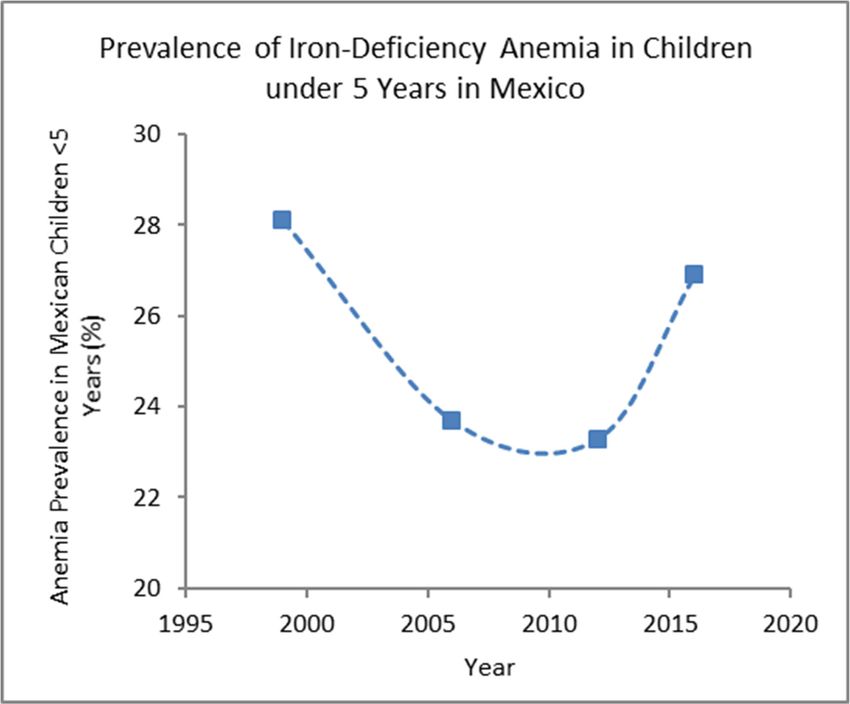
health significance (40.0% severe public health problem) [11]. The WHO has
responded by recommending food companies within Mexico to fortify their corn flours with iron to
eradicate iron deficiency and its related complications [12].
Though
Nutrients IDA
2020, 12, 433 is a countrywide public health concern, Central Mexico suffers from high 2iron- of 14
deficiency and anemia rates. In Central Mexico, in 2012, it was estimated that 30.5% of women
between the ages of 20–49 years suffered from iron deficiency [7], and in 2016, female preschoolers
moderate
were public health
significantly problem;
associated ≥40.0%
with severe
higher oddspublic healthanemia
of having problem) [11].ratio
(odds The WHO
= 1.9, has
p < responded
0.05) [10].
by recommending food companies within Mexico to fortify their corn flours with
Because of these concerns, efforts to combat iron deficiency have largely focused on thisiron to eradicate iron
geographic
deficiency and its related complications [12].
region.
Figure
Figure 1. Prevalence
1. Prevalence of anemia
of anemia in children
in children under
under 5 years
5 years in Mexico
in Mexico (%).Data
(%). Data retrieved
retrieved fromfrom
Mexico’s
Mexico’s national health and nutrition survey, ENSANUT (1999,
national health and nutrition survey, ENSANUT (1999, 2006, 2012, and 2016). 2006, 2012, and 2016)
In Mexico,
Though IDA nixtamalization
is a countrywide has been the process
public used sinceCentral
health concern, Mesoamerican
Mexico times
sufferstofromtreat high
corn
with lime beforeand
iron-deficiency grinding
anemia it to a dough
rates. (“nixtamal
In Central Mexico,masa”, or just
in 2012, “nixtamal”)
it was estimated to that
make tortillas,
30.5% which
of women
is the main
between thestaple
ages of food commodity
20–49 [13,14].
years suffered fromNixtamal masa can
iron deficiency [7],beandflash driedfemale
in 2016, to make a nixtamalized
preschoolers were
corn flour, which
significantly can also
associated withbehigher
utilized
oddsto of
make
havingtortillas
anemiaby (odds ratio = the
rehydrating p < 0.05)
1.9, flour to make dough. In
[10]. Because of
addition to changing
these concerns, effortsthe flavor and
to combat irontexture of the
deficiency havetortilla,
largelythefocused
nixtamalization process increases
on this geographic region. the
nutritional value
In Mexico, of corn tortillas
nixtamalization hassuch
beenasthe
dietary
processfiber,
usedthesince
bioavailability
Mesoamerican of amino
times acids
to treat and
cornniacin,
with
and
limecalcium [13]. These
before grinding it totortillas
a dough are(“nixtamal
available for purchase
masa”, or justat“nixtamal”)
small, local to tortillerías (neighborhood
make tortillas, which is
stores
the mainselling
stapletortillas), supermarkets,
food commodity andNixtamal
[13,14]. convenience masastores,
can beorflash
made at home.
dried to make Contrary to other
a nixtamalized
parts of thewhich
corn flour, worldcan thatalso
consume corn flour,
be utilized to make in Mexico,
tortillas the nixtamalizedthe
by rehydrating corn flours
flour are the
to make ones
dough.
mandated
In additionby to the government
changing to be
the flavor andfortified
texturewith
of theiron, zincthe
tortilla, andnixtamalization
folic acid, and process
restoredincreases
with thethe B-
vitamins
nutritional [15] dueoftocorn
value thistortillas
longstanding
such astradition.
dietary fiber, the bioavailability of amino acids and niacin, and
The[13].
calcium MexicanThese government’s Normas Oficiales
tortillas are available Mexicanas
for purchase at small,(NOM) are technical
local tortillerías regulations issued
(neighborhood stores
by various
selling federal
tortillas), government agencies,
supermarkets, which establish
and convenience stores, orrules,
madespecifications,
at home. Contrary attributes, guidelines,
to other parts of
characteristics
the world that or requirements
consume applicable
corn flour, in Mexico,to a the
product, process,corn
nixtamalized installation,
flours aresystem,
the ones activity, service
mandated by
or
themethod of production
government or operation.
to be fortified with iron, Thezinc NOM-247-SSA1-2008
and folic acid, and restored detailswith
the the
production
B-vitamins process
[15] dueof
flours, including the fortification
to this longstanding tradition. of flours [15]. This document outlines that a vitamin and mineral
premixTheshould
Mexican be government’s
mixed into theNormas flour and adequately
Oficiales Mexicanasdosed(NOM)
such that the final regulations
are technical flour will contain
issued
by various federal government agencies, which establish rules, specifications, attributes, guidelines,
characteristics or requirements applicable to a product, process, installation, system, activity, service
or method of production or operation. The NOM-247-SSA1-2008 details the production process of
flours, including the fortification of flours [15]. This document outlines that a vitamin and mineralNutrients 2020, 12, 433 3 of 14
premix should be mixed into the flour and adequately dosed such that the final flour will contain
zinc (40 mg/kg), iron (40 mg/kg), folic acid (2 mg/kg), niacin (35 mg/kg), riboflavin (3 mg/kg), and
thiamine (5 mg/kg). This document is to be used by the governmental organization, Comisión Federal
para la Protección contra Riesgos Sanitarios (COFEPRIS), a quality control agency responsible for
the monitoring of compliance with these regulations, to ensure quality products for consumers [16].
However, the extent the nixtamalized corn and wheat flours on the market are adequately fortified is
unknown, because there are no available reports on monitoring and evaluation (M&E), specifically for
30% of the corn flour market, which is comprised of small- to medium-scale operations [17,18]. There
could be many reasons for the limited M&E of fortification, such as a lack of fortifying equipment [19],
lack of flour producers’ fortification knowledge [20], or lack of proper monitoring equipment or tools
(i.e., atomic emission spectroscopy in the case of iron) [21], which is often the case in low-resource
settings [22].
To aid food companies in quantifying micronutrients within fortified food products, the WHO
has published guidelines for developing analytical tools in low-resource settings, known as the
ASSURED (Affordable, Sensitive, Specific, User-friendly, Rapid and Robust, Equipment-free, and
Deliverable to end-users) criteria [23]. The ASSURED criteria can be applied to the development
of inexpensive micronutrient analysis tools to support government food fortification policies in
low-resource settings [22]. One example of such appropriate technology is the Nu3px smartphone
iron sensor for fortified foods, which is a cost-effective and user-friendly alternative to its traditionally
used gold standard counterpart, atomic emission spectroscopy [24]. Sensors can be used to monitor
compliance and efficacy of food fortification programs, a critical component of fortification policies to
fulfill the program’s stated objectives [1]. To have an adequate monitoring system, fortification experts
recommend that internal monitoring of the fortification process (i.e., quality control by food processor)
should be conducted daily and external monitoring (i.e., factory visits by external monitoring auditor)
should be conducted once every 3–6 months, or every 1–4 months in the case of detected problems [1].
However, a recent narrative review of the literature showed that current methods for internal or
external micronutrient detection in food lacks the affordability, precision, simplicity, robustness, and
validation to comply with the WHO criteria for fortification programs [22].
Furthermore, a qualitative study was conducted to understand external monitoring of food
fortification in Africa and Asia. Participants of this study included fortification experts (n = 11) and
individuals (n = 18) from regulatory agencies and the food industry. The authors found that there
was a lack of monitoring resources, unclear monitoring legislation, and variable perceived value of
monitoring. Moreover, the authors were able to provide valuable and actionable recommendations to
current and future fortification programs such as clear legislation, strong leadership, and compliance
enforcement [19]. No known qualitative studies, though, have been conducted among stakeholders
of fortification programs in Latin America to understand their M&E of fortified products within
this context. The objective of the present work was to understand strengths and weaknesses of the
M&E of Central Mexico’s nixtamalized corn and wheat flour fortification program and to provide
recommendations for improvement within the Latin American context. Therefore, this exploratory
qualitative study was conducted among fortification stakeholders in Central Mexico to understand the
context of the nixtamalized corn and wheat flour fortification program and to identify strengths and
weaknesses related to monitoring and evaluation (M&E).
2. Materials & Methods
2.1. Qualitative Research Approach
This qualitative study encompassed interviewing individuals in decision-making or influential
positions from organizations (food industry, academia, government) in Mexico’s fortification program.
The information discussed in this section will follow the Consolidated Criteria for Reporting Qualitative
Research (COREQ) [25]. The stakeholders’ roles were considered direct (i.e., fortified food producersNutrients 2020, 12, 433 4 of 14
and processors) or indirect (i.e., subject matter experts and regulatory oversight). Stakeholder analysis
was selected as an approach as it is a well-established method for identifying areas of growth and
critical actors who can influence policy [26]. Stakeholders were identified through knowledge of the
in-country nixtamalized corn flour producers and by in-country collaborators.
2.2. Phase 1: Participant Recruitment
Stakeholders were invited through an email invite and one follow-up reminder email occurred
after 3 months through purposive sampling (n = 12) and snowball sampling (n = 1) in central Mexico
(Estado de Mexico and Querétaro states) [27]. Central Mexico was chosen as the study’s location
due to its proximity to many of the pertinent stakeholders of the fortification program (i.e., federal
government and flour producing facilities). Stakeholders were identified as directors or managers of
relevant companies and organizations, or experts in the field such as small-scale private nixtamalized
corn flour companies (n = 6), private vitamin and mineral premix producers (n = 3), experts in the area
from academia (n = 1), president of a private tortilla-making federation (n = 1), and federal government
monitoring agency representatives (n = 2). Two academic experts declined participation for reasons
of time and one nixtamalized corn flour company declined participation for privacy reasons. The
researchers had no prior relationship with the study participants. All study protocols were granted
ethical approval by the University of Illinois Institutional Review Board #18576.
2.3. Phase 2: In-Depth Interviews with Stakeholders
In-depth interviews (n = 6) were conducted in Mexico by two Spanish-speaking interviewers
(doctoral researcher AWW and postdoctoral researcher AD, PhD) who were trained in conducting
interviews, in August 2018. All of the interviews were conducted in-person in the Spanish language.
Field notes were written as needed for non-verbal observations. Stakeholders signed a written consent
form to participate in the interview, which included the goals of the study. Though varying slightly
between stakeholder groups, the stakeholders were generally probed to discuss topics related to
monitoring logistics, individual perceptions of fortification, and fortification procedures and processes.
The interviews were expected to last between 30–45 min. Interviews were conducted in the stakeholders’
private offices or communal work meeting spaces, which was deemed as most convenient by the
stakeholders. Only the researchers (n = 2) and the study participants were present for the interviews.
Some of the organizations, tortillería (n = 1) and nixtamalized corn flour manufacturing plants (n = 2)
also invited the interviewers for tours of their production facilities. The interviews were conducted in
urban settings in the states of Querétaro and Estado de Mexico.
Semi-structured, open-ended exploratory questions (designed to address the research question [28])
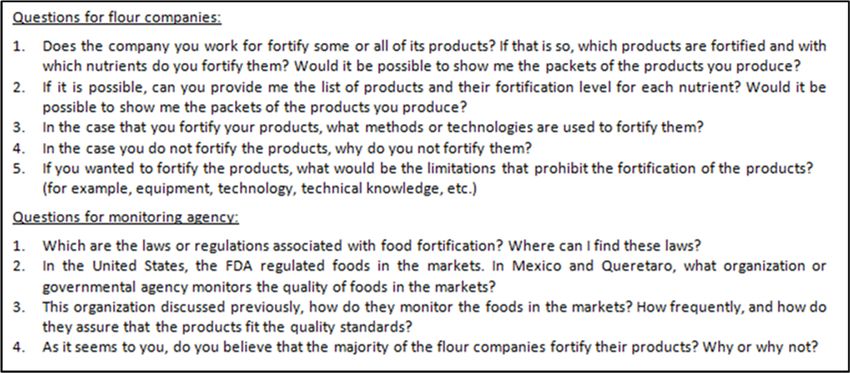
were used to obtain relevant context information about the fortification program (see Figure 2). The
content of the interview questions was reviewed by two experts (doctorates of food science with
experience in conducting research in Mexico) before deploying its use in Mexico and being revised
accordingly. The guiding questions (n = 5) posed for stakeholders at a food company were different
from questions (n = 4) posed to the government agency because of their different roles in the
program. Responses were recorded via iPhone 8 Voice Memos application (audio recording device)
and hand-written field notes to capture each response to the fullest. No compensation was provided to
the participants. Transcripts were read by researchers (AWW and AD) and, as no new information was
obtained, data saturation was considered reached.Nutrients 2020, 12, 433 5 of 14
Nutrients 2020, 12, x FOR PEER REVIEW 5 of 13
Figure
Figure 2.2. Interview
Interviewquestions
questions translated
translated to English
to English for flour
for flour companies
companies (n = 5) (n
and= monitoring
5) and monitoring
agencies
agencies
(n = 4). (n = 4).
2.4. Phase
2.4. Phase 3:
3: Thematic
Thematic Analysis
Analysis
The six
The six phases
phases of of thematic
thematic analysis
analysis werewere undertaken
undertaken for for this
this study
study [29]. The entire
[29]. The entire thematic
thematic
analysis process (coding and analysis) was conducted in Spanish.
analysis process (coding and analysis) was conducted in Spanish. For Phase (1), interviews were For Phase (1), interviews were
transcribed verbatim
transcribed verbatim by by aa Spanish
Spanish speaker
speaker (AWW)
(AWW) and and native
native Spanish
Spanish speakers
speakers (AD (AD and and EB)EB) into
into
Microsoft Word. In Phase (2), three individual researchers
Microsoft Word. In Phase (2), three individual researchers (authors AWW, AD, and EB)(authors AWW, AD, and EB) independently
read all the transcripts
independently read all and identified main
the transcripts codes [26,28].
and identified mainCodes
codeswere referred
[26,28]. Codestowereas descriptors
referred toofasa
quotation [29].
descriptors of aOfquotation
the three [29].
lists ofOfcodes, 6 identical
the three lists ofcodes
codes,were independently
6 identical codes identified by all three
were independently
identified by all three researchers, 10 identical codes were independently identified by were
researchers, 10 identical codes were independently identified by two researchers, and 53 codes two
independently
researchers, andidentified
53 codesby were oneindependently
researcher for aidentified
total of 69 bycodes. In Phase (3),
one researcher for researchers
a total of 69agreed
codes. onIn
grouping
Phase (3),similar
researcherscodes agreed
into concepts (groups similar
on grouping of similar codes).
codes intoResearchers
concepts (groupsdeliberated until one
of similar final
codes).
agreed-upondeliberated
Researchers list of codesuntil (n =one51) final
grouped into concepts
agreed-upon = 13)(n
list of(ncodes was generated.
= 51) grouped After consultation
into concepts (n =
withwas
13) qualitative
generated. researchers (authors JMA
After consultation withand JEA) familiar
qualitative with the
researchers subject JMA
(authors matter,
andtwo codes
JEA) were
familiar
deleted,
with the and
subject onematter,
concepttwo wascodes
reworded. Thus, a and
were deleted, finalone
list concept
of 49 codes wasand 13 concepts
reworded. Thus, was identified.
a final list of
49 codes and 13 concepts was identified. In Phase (4), researchers (authors AWW, AD, and and
In Phase (4), researchers (authors AWW, AD, and EB) independently grouped similar concepts EB)
their codes into grouped
independently themes (groupssimilarofconcepts
similar concepts). The themes
and their codes identified
into themes linkages
(groups betweenconcepts).
of similar concepts.
For Phase
The themes (5),identified
all researchers
linkages deliberated
betweenuntil a finalFor
concepts. agreed-upon
Phase (5),set themes (n =deliberated
allofresearchers 3) and definitions
until a
was generated,
final agreed-upon forming a thematic
set of themes (n =map (seedefinitions
3) and Figure 3). was Finally, for Phase
generated, (6), transcript
forming a thematic documents,
map (see
concepts,
Figure and codes
3). Finally, for were
Phaseimported
(6), transcriptinto documents,
Atlas.ti 8.1 software
concepts,[30]. Researchers
and codes (authorsinto
were imported AWW, AD,
Atlas.ti
and EB) independently coded the transcripts using Atlas.ti. Frequencies
8.1 software [30]. Researchers (authors AWW, AD, and EB) independently coded the transcripts using were generated by Atlas.ti,
and inter-rater
Atlas.ti. Frequencies reliability
werewas calculated
generated using intra-class
by Atlas.ti, coefficient
and inter-rater (ICC)was
reliability using SPSS v.24
calculated statistical
using intra-
class coefficient (ICC) using SPSS v.24 statistical software [31]. Based on the ICC, reliabilitygood
software [31]. Based on the ICC, reliability was considered poor (0.9) [32]. After
all six transcripts
deliberation were coded.
and agreement A final
among allset
of of
thefrequencies
researchers, ofall
codes were calculated
six transcripts were on Atlas.ti.
coded. Based
A final set on
of
agreement among the researchers, verbatim quotations from interviews
frequencies of codes were calculated on Atlas.ti. Based on agreement among the researchers, were extracted to demonstrate
the main themes.
verbatim quotations Researcher AWW translated
from interviews the selected
were extracted quotations the
to demonstrate from mainSpanish to English,
themes. Researcherand
researcher
AWW AD verified
translated their clarity.
the selected Participants
quotations did notto
from Spanish provide
English, feedback on the findings.
and researcher AD verified their
clarity. Participants did not provide feedback on the findings.
3. Results
The interviews ranged from 20 min to 2 h (mean length 50 min). From the data analysis of the
interviews, three main themes were identified (and their subsequent concepts) and can be seen in
Figure 3. Overall, ICC between the reviewers was 0.87, indicating good inter-rater reliability.
Disagreements between reviewers tended to be prevalent in monitoring logistics codes. Thus, these
codes were regrouped into concepts by the reviewers, and disagreements were discussed and
deliberated until all three researchers (authors AWW, AD, and EB) agreed.Nutrients 2020, 12, 433 6 of 14
Nutrients 2020, 12, x FOR PEER REVIEW 6 of 13
Figure 3. Thematic
Figure 3. Thematic Map. Codes (n
Map. Codes (n == 49)
49) were
were grouped
grouped into
into concepts (n =
concepts (n 13, rectangular
= 13, rectangular boxes
boxes in
in
figure) and themes (n = 3, circles in figure).
figure) and themes (n = 3, circles in figure).
3. Results
3.1. Monitoring Logistics
The interviews ranged from 20 min to 2 h (mean length 50 min). From the data analysis of
the interviews,
3.1.1. three main Capacity
External Monitoring themes were identified (and their subsequent concepts) and can be seen
in Figure 3. Overall, ICC between the reviewers was 0.87, indicating good inter-rater reliability.
Government participants mentioned that the monitoring capacity has declined in recent years
Disagreements between reviewers tended to be prevalent in monitoring logistics codes. Thus,
due to a lack of funding and laboratory infrastructure. The participants indicated that the program
these codes were regrouped into concepts by the reviewers, and disagreements were discussed and
started out as a federally funded project, but it is no longer federally funded and has been the states’
deliberated until all three researchers (authors AWW, AD, and EB) agreed.
responsibility for the last 5 years. Additionally, it was noted, by one participant, that each state in
Mexico
3.1. previously
Monitoring had its own authorized laboratory for samples; now, however, producers send
Logistics
samples across state lines, acquiring more fees and taxes.
3.1.1. External Monitoring Capacity
3.1.2. Frequency of External Regulatory Audits
Government participants mentioned that the monitoring capacity has declined in recent years
due toThrough
a lack ofthe interviews,
funding participants
and laboratory discussed that
infrastructure. the loweredindicated
The participants monitoringthatcapacity (i.e.,
the program
fundingout
started and
aslaboratory
a federallyinfrastructure)
funded project,hasbutaffected external
it is no longer monitoring
federally checkup
funded and hasfrequency. These
been the states’
participants discussed
responsibility that
for the last the external
5 years. monitoring
Additionally, cannoted,
it was resultby
in one
product recalls or
participant, thatmanufacturing
each state in
suspension.
Mexico The participants
previously had its ownindicated that the
authorized size of the
laboratory forfood production
samples; will dictate
now, however, the frequency
producers send
of external monitoring visits, such that smaller
samples across state lines, acquiring more fees and taxes. production facilities will have fewer external
monitoring checkups compared to larger companies. For example, a corn flour producer stated,
3.1.2.
“TheseFrequency
controls canofbeExternal Regulatory
very varied. Audits
Maybe because of the size of the company, it [the checkups] has never touched
us.” Through the interviews, participants discussed that the lowered monitoring capacity (i.e., funding
and laboratory infrastructure) has affected external monitoring checkup frequency. These participants
3.1.3. Variation
discussed in External
that the externalRegulatory
monitoringAudit Processes
can result in product recalls or manufacturing suspension.
The participants indicated that the size of the food
As the participants mentioned, government auditors production willseveral
review dictateaspects
the frequency of external
of the fortification
monitoring visits,
process during such
their thatsuch
visits smaller production
as the sanitationfacilities will and
conditions havethe
fewer external
overall monitoring
upkeep of these checkups
facilities,
compared to larger are
but these reviews companies.
infrequent Forand
example, a corn flour
inconsistent. Theyproducer stated, “These
also mentioned controls
that the can be very
fortification is
varied. Maybe because of the size of the company, it [the checkups] has never touched
monitored such as inputs and outputs of flour and premix, but the record keeping may not beus”.
accurate as alluded to by a government representative:
“During the visits we review the addition of micronutrients. We have a NOM 251 that speaks of all
Good Manufacturing Practices. We monitor everything that is the facilities, the process water, the
drainage, the toilets, the ventilation… We also check the warehouse with special attention to theNutrients 2020, 12, 433 7 of 14
3.1.3. Variation in External Regulatory Audit Processes
As the participants mentioned, government auditors review several aspects of the fortification
process during their visits such as the sanitation conditions and the overall upkeep of these facilities, but
these reviews are infrequent and inconsistent. They also mentioned that the fortification is monitored
such as inputs and outputs of flour and premix, but the record keeping may not be accurate as alluded
to by a government representative:
“During the visits we review the addition of micronutrients. We have a NOM 251 that speaks of
all Good Manufacturing Practices. We monitor everything that is the facilities, the process water,
the drainage, the toilets, the ventilation . . . We also check the warehouse with special attention to
the storage of flour that has been added and the premix, and so all this is documented. Then in the
warehouse they must have a record of inputs and outputs”.
3.1.4. Internal Monitoring Capacity
As indicated by the participants, internal monitoring for small scale flour producers is accomplished
using qualitative methods for iron determination in a yes/no binary system on a more frequent basis
than the external validated analysis in authorized laboratories. As they mentioned, the qualitative
method is utilized more often than the validated analysis due to its rapid and low-cost nature, but it is
not always precise. When the researchers asked the participants if an alternative method was available
to detect micronutrients as opposed to the qualitative method, the small-scale flour producers agreed
an alternative technology would be better if it were cost-effective, faster, and more precise. As a vitamin
and mineral premix producer stated, “Customers are currently occupying the qualitative techniques [to
analyze micronutrient content] for faster determinations. Because [of cost] they cannot send all the batches to
analyze”.
3.2. Manufacturing and Processing
Preparation of Tortillas
Participants described how nixtamalized corn flour is processed into tortillas, a main staple
commodity for the Mexican diet. They indicated that the tortilla recipes vary from tortillería to
tortillería. The recipes utilized by tortilleros (the people who make tortillas) can be made from fresh
nixtamal masa (non-fortified), nixtamalized corn flour (fortified), or any ratio of both together. These
differences are often based on local consumer preferences. Participants indicated that as a result of these
variations, added micronutrient content in tortillas is likely to fluctuate. A research professor described
how, “In Mexico City, the tortillas are made of 70% nixtamal and 30% flour. [Thus] the fortification is diluted”.
Whereas a Tortilla-maker in Queretaro stated, “We are using 95% pure corn [non-fortified] and 5% flour
[fortified] [to make tortillas]”. Which was reinstated by a corn flour producer, “The problem we have . . .
is that mixing nixtamal masa with nixtamalized corn flour makes the product [the tortilla] not 100% [flour].
So, although we fortify the flour correctly, the final consumer, is no longer acquiring [the micronutrients] in the
tortilla”.
Participants mentioned several reasons that tortilla producers use a blend of masa nixtamal and
fortified nixtamalized corn flour. These reasons may include cost, texture, shelf-life, and flavor. As the
president of a tortilla-making federation explained:
“It [the flour] is added with softener, bleach, and some substance that serves to give strength or that
does not break the tortilla when you make a taco. But, we are removing [decreasing the use of] those
flours, to give a little texture, or softness to the tortilla. Why have we reduced the consumption of
flour? First, we find it is more expensive to produce tortillas with flour than we do our own nixtamal
. . . Without using a lot of corn [fortified] flour, we already have the softness, we have a very good
texture, we have very good resistance of the tortilla to make a taco”.Nutrients 2020, 12, 433 8 of 14
This was further verified by a research professor, “[People eat the tortillas] for the taste. The fortified flours
have a characteristic flavor. Here, we recognize the taste if you give someone a fortified flour tortilla. If you go to
the north of the country, they are used to eating fortified flour. If you go to the center of the country and to the
south of the country, they are not so used to eating fortified flours”.
3.3. Nutrition
3.3.1. Limited Evaluation of the Fortification Program’s Impact on Health
Since the implementation of the fortification program, it was noted by participants that the Mexican
government has yet to conduct an efficacy trial to assess the program’s impact on the prevalence of
iron deficiency or IDA amongst the population. Assessing efficacy is an important part of a successful
program’s M&E process. Because of this limitation, it was noted that it is difficult to assess the impact
the process of combining fortified nixtamalized corn flour and non-fortified masa nixtamal, in different
quantities, has on health outcomes. Without a population-based approach to evaluate the fortification
program’s efforts in reducing micronutrient deficiencies, it was noted that participants such as the
government or the industry cannot be sure that the program is a cost-effective approach to improving
public health as mentioned by a government representative:
“We have not measured the contribution [the fortification program] on the health of the population.
However, we believe that it is contributing [to their health] since the entire population practically
consumes this, be it bread or tortilla”.
3.3.2. Limited Impact Divided by Geographic Location and Socioeconomic Status
Participants stated that the fortification program is currently perceived to be reaching limited
segments of the Mexican population, such as those with a higher economic power, those situated in
urban regions, and those in the north of the country. This is problematic for the program’s intended
impact, which is to improve the micronutrient status on all populations throughout the country.
Previous literature has documented higher iron deficiency prevalence in rural areas and the central and
south of the country compared to other areas within the country [7,32], indicating a larger emphasis
should be placed on these more vulnerable subpopulations as emphasized by a corn flour processor:
“The fortification programs are for the population that has significant nutritional deficiencies. Our
product is fortified because it is mandatory. But our product does not normally go to the population
[that needs it], but to a higher purchasing sector”.
3.3.3. Diets of the Mexican Population
As the diets of the Mexican population evolve, the demand for tortillas is diminishing [33]. Thus,
participants question the validity of fortifying this product as mentioned by a research professor:
“We, as Mexicans, have changed our diet, we have stopped eating tortillas. We should see the
consequences that this change in diet has had on these problems [micronutrient deficiencies] that
are occurring”.
4. Discussion
The purpose of the present work was to understand the context of the fortification program
in Central Mexico and to identify strengths and weaknesses related to monitoring and evaluation
(M&E) and to recommend strategies for improving its M&E. Three main themes were derived from
the interviews through content analysis: 1. Monitoring logistics; 2. Manufacturing and processing;
and 3. Nutrition. The main findings highlight the inconsistencies with program design and practice,
such as the monitoring strategies, evaluation of the program impact, and actual consumption of
nixtamalized tortillas made of flour. Stakeholder insights offered potential strategies for improving theNutrients 2020, 12, 433 9 of 14
program, such as increased internal monitoring technical capacity, increased fortification education for
tortilleros, and raising awareness of the nutritional differences between nixtamalized tortillas made of
fortified flour and tortillas made of masa nixtamal.
4.1. Monitoring Logistics Theme
The interviews revealed that in recent years, the access and use of authorized laboratories in
Mexico for analyzing the micronutrient content of flour samples has declined. Furthermore, a lack of
authorized laboratories ultimately increases the cost for nixtamalized fortified corn flour producers
to monitor their products, as sending samples across state lines will accrue more taxes and fees for
the analysis. For these reasons, the M&E component of the NOM-247 has decreased in volume and
frequency of monitoring checks. The frequency of checks is correlated to the size of the company, as
smaller companies will be audited less frequently. A parallel case can be seen in fortification programs
in Africa and Asia, where similar budget restraints affect M&E rigor and frequency [19].
Literature shows that having a rigorous M&E component, in any mass mandatory fortification
policy, is critical for understanding whether the program is reaching its nutritional goals within the
context success [34]. Additionally, monitoring is required to identify problems such as non-compliance
and implement corrective actions [1]. An ideal fortification program will have a small number of
locations producing the fortified product, such that M&E resources can be consolidated [1]. Thus, in
the case of fortified nixtamalized corn flours in Mexico, it presents an ideal case for a rigorous and
successful M&E program, as one company dominates 70% of the corn flour sales, and the remaining
30% of the market is made up of a few, small flour companies, such as the ones interviewed within this
study [17,18]. However, the perspectives of stakeholders outlined in this study demonstrate that gaps
remain in the M&E capacity, in terms of the frequency and consistency of external checkups, and the
use of imprecise internal qualitative methods (i.e., iron spot test).
The iron spot test is often recommended as a qualitative methodology for internal monitoring [35].
In this test, a mix of solution is added to the flour, then it will oxidize iron, if present, and thus, red
spots will appear in the flour. The presence or absence of red spots indicate fortification in a binary
system (yes/no), but it is not quantitative [36]. The iron spot test is estimated to cost $1 USD per assay
plus laboratory staff costs [36]. Currently, the iron spot test is being utilized by the corn flour producers
in Mexico. However, the stakeholders expressed an interest in a more precise alternative method,
specifically one that is more cost-effective.
Furthermore, through the results of this study, the actions in case of non-compliance are not well
understood. In the Compliance section (Section 12) of the NOM-247-SSA1-2008, it only states:
“12. Compliance with the standard
12.1. The monitoring of the application of this rule corresponds to the Ministry of Health in the terms
and applicable legal provisions”.
The stakeholders mentioned product recalls or manufacturing suspensions as possible actions to
take in the case of non-compliance, but there is no publicly documented protocol that supports a
standardized procedure.
4.2. Manufacturing and Processing Theme
Fortified nixtamalized corn flour producers sell household-size packages of fortified nixtamalized
corn flour that is sold in supermarkets or convenience stores. Additionally, it is known that
these producers sell large, bulk quantities of fortified nixtamalized corn flour to tortillerías
(neighborhood tortilla producing facilities). However, it is up to the tortilla producer’s discretion
to produce their tortillas using all fortified nixtamalized corn flour, or whether they mix fortified
nixtamalized corn flour into the traditionally used masa nixtamal. Prior literature indicates that in
Mexico, tortillas are often made from a mix of fortified nixtamalized corn flours (dried) with traditional
masa nixtamal (wet) [14,36]. The stakeholders identified several reasons for mixing traditional masaNutrients 2020, 12, 433 10 of 14
nixtamal with fortified nixtamalized corn flour such as enhanced texture, longer shelf-life, improved
flavor, decreased cost, and flavor preferences. Production cost is lowered by using a mix of nixtamalized
corn flour (as low as 5%) with their own masa nixtamal. It has been estimated that tortillerías that
use a mix of nixtamalized corn flour and their own nixtamalized corn (to make the masa nixtamal
themselves) can raise $559,312 MXN pesos (approximately $29,275 USD) per year in revenue more
than their only masa nixtamal tortillería counterparts in the State of Mexico [37].
These variances in tortilla-making are dependent on regional consumer preferences. For instance,
in Mexico City, the final blend may contain around 70% masa nixtamal and 30% fortified nixtamalized
corn flour. However, in the state of Querétaro, an owner of several tortillerías uses only 5% fortified
nixtamalized corn flour. This difference between flour ratios across regions highlights the uncertainty
in the amount of fortified nixtamalized corn flour that is consumed by people who purchase
their tortillas from tortillerías and not mainstream supermarkets. This variance undermines the
potential for nutritional impact and dilutes the micronutrients reaching the consumers, as indicated by
the stakeholders.
4.3. Nutrition Theme
IDA prevalence in Mexican children under 5 years of age decreased since the implementation of
the mandatory flour fortification program to 23.3% from the years 1999 to 2006, but increased in 2016 to
26.9% (see Figure 1) [9,10]. The exact cause of the recent increase (2012–2016) is unknown, but experts
believe it may be attributed to the nutritional transition occurring in Mexico, in which foods rich in
iron are being replaced with foods rich in energy and poor in micronutrients [38]. While the Mexican
government attributes the decrease in anemia prevalence (1999–2006) to the flour fortification program
and other government nutrition initiatives, they also acknowledge a lack of impact evaluation of this
program to confirm this hypothesis.
The assumption that Mexico’s corn flour fortification program is responsible for the reduction in
countrywide anemia prevalence is contrary to other studies that demonstrate a lack of efficacy using
corn flour fortified with electrolytic iron, an iron fortificant recommended by Mexico’s fortification
policy, but with limited bioavailability [15]. A randomized controlled trial was conducted in Kenya to
compare the efficacy of NaFeEDTA to electrolytic iron in 516 children between the ages of 3–8 years
old who consumed iron-fortified whole maize flour five times a week. Concentrations of hemoglobin,
plasma ferritin, and transferrin receptors after 5 months compared to placebo indicated that children
consuming corn flours fortified with electrolytic iron showed no change in IDA, but there was a positive
change (−89% IDA prevalence) when consuming corn flours fortified with 56 mg Fe/kg flour using
NaFeEDTA [39].
Bioavailability of iron sources are heavily influenced by factors such as disease state and dietary
patterns. Malaria, commonly present in developing countries, inhibits iron absorption due to increased
inflammation. Electrolytic iron is highly susceptible to binding to phytates in cereals such as corn [39].
Thus, factors, such as bioavailability of iron source and consumption patterns, must be considered
before making efficacy assumptions. Ideally, a randomized controlled trial of consumption of fortified
nixtamalized corn flour in these tortillas among low-income individuals within Mexico could be
conducted in order to substantiate any claims.
Additional limitations to identify the impact the fortification program has on nutritional outcomes
of the population are related to socioeconomic status and geographic variation. It was identified,
in the interviews, that the principal beneficiaries of this program would be people who live in the
north of the country (where consuming 100% flour tortillas is more common), people in urban areas
(who purchase 100% flour tortillas from convenience markets), or the upper class (who typically buy
tortillas in a supermarket where the tortillas are made from flour). In the 2012 ENSANUT, 30.5%
and 31.9% of women between the ages of 20–49 years were iron deficient in the central and south
region of the country, respectively, while 22.8% of women of similar age in the north of the country
were iron-deficient [7]. Similarly, the 2016 ENSANUT showed that adolescents (5–11 years) wereNutrients 2020, 12, 433 11 of 14
more likely to have anemia in rural settings (15.7%) than urban (11.3%), and in the Southern regions
(14.6%) than the northern (10.1%) [10]. In the 1999 and 2006 ENSANUTs, it was found that Mexican
women were significantly more likely to have IDA belonging to a low socioeconomic level than their
high or medium socioeconomic level counterparts [40]. Though these are nutrition indicators of the
population at large and do not necessarily imply consumption or lack of consumption of fortified
tortillas as causation, its findings correlate to the stakeholder perceptions that the iron fortification
program’s principle beneficiaries (i.e., those receiving the benefits of a diet with increased iron) could
be those situated in the north or urban areas, and/or those with a higher socioeconomic status.
4.4. Recommendations
Comprehensive evaluation of fortification programs requires adequate and constant M&E [34].
Based on the uncertainties surrounding the impact and utilization of the flours for reducing IDA
within Mexico, the authors recommend that a more rigorous M&E be implemented in Mexico’s
fortification program. This includes a population-based evaluation that can assess the reduction
of anemia in response to consuming tortillas made with fortified nixtamalized corn flours alone
or in a mix with masa nixtamal. The evaluation should focus on all sectors of society who may
benefit from this program, including rural, urban, and other geographical zones, and different
socioeconomic strata [1]. The authors recommend a more thorough and frequent internal monitoring
system (such as implementing Nu3px, an alternative ASSURED-designed iron quantification tool
previously mentioned) to ensure quality fortified products [24]. Finally, the NOM could be modified to
include a standardized protocol for actions to take in the case of non-compliance.
The quality of fortified products can also be enhanced through educating tortilleros on the
importance of using fortified flours in tortillas for nutritional deficiencies. One way of doing this is
to conduct continuous trainings to improve processes in the form of in-person seminars. Park et al.
found that one in-person 30-min training and a 2-week follow-up training amongst low-technical
skilled food handlers, increased their knowledge of food safety practices by 30% [41]. Consumers
should be empowered to understand the difference between tortillas made from masa nixtamal and
fortified nixtamalized corn flour in order to best decide the nutrition for their family. A government
initiative can be implemented that uses both education and marketing strategies to educate tortilleros
on the importance of using fortified nixtamalized corn flours in their tortillas and to raise awareness
for Mexican consumers about the significance of consuming fortified foods in the diet. Rothschild
describes how self-interests (i.e., production costs for a tortillero) can influence whether or not an
individual is prone to behavior change, and how to navigate individual self-interests when designing
an effective educational and marketing strategy [42]. In both cases, the educational initiatives should
be designed such that each stakeholder understands the benefit that they have to gain by producing
or consuming fortified products in a communication medium that meets the target audience at their
present cognitive abilities [1]. An example of a successful large-scale program to improve nutrition
in Mexico can be seen by the PROGRESA program in which a combination of education, health
care, and cash transfers influenced families’ decisions to consume nutrient supplements [43]. Efforts
to introduce a fortification educational and awareness initiative may be drawn from the education
component of PROGRESA.
One limitation of the present study is that an interview with the largest corn flour producer
(70% of the market) was not able to be conducted for privacy and access reasons. Furthermore,
interviews were geographically limited within the states of Estado de Mexico and Querétaro and do
not represent the perspectives of stakeholders from every part of the country. The results presented
within this research are specific to the context of Mexico’s program and should not be extrapolated to
other contexts without conducting similar interviews with other stakeholders. Finally, the interviews
were limited to those people available and willing to participate, but did not include NGOs, other
government offices beyond the regulatory agency, or beneficiaries (consumers).Nutrients 2020, 12, 433 12 of 14
In conclusion, the present study was a qualitative evaluation of Mexico’s flour fortification program
using interviews with stakeholders from various perspectives: academic, public sector, and private
sector. It was found that there are a reduced number of laboratories capable of providing accurate and
reliable data to support M&E activities of the program. Nixtamalized corn flour producers are interested
in inexpensive, fast, and precise alternatives to support their quality control processes. The fortification
efforts in central Mexico may be diluted by mixing masa nixtamal with fortified nixtamalized corn flour
for motives of texture, shelf-life, cost, and flavor. Finally, the principal beneficiaries of the program
may be those found in urban areas, in parts of the country where consuming tortillas made from 100%
flour is more common, and/or with a higher socioeconomic power. Recommendations to improve the
program include the implementation of simpler technologies for frequent internal monitoring of the
fortification process and to have an external entity evaluate the impact of the program on the anemia
prevalence in the country. Future studies should include a more expansive qualitative assessment of
the program, including interviews with consumers, as well as the larger production companies.
Author Contributions: A.W.W., J.E.A., A.D.-U., and J.M.A. designed the research; A.W.W. and A.D.-U. conducted
research; A.W.W., A.D.-U., and E.L.B. analyzed data; A.W.W. wrote the paper; J.M.A. and A.W.W. had primary
responsibility for final content. All authors have read and approved the final manuscript.
Funding: This work was supported by the Tinker Foundation [Tinker Field Research Grant for Graduate Student
Research in Latin America, 2018].
Conflicts of Interest: The authors declare no conflict of interest.
Abbreviations
ASSURED (Affordable, Sensitive, Specific, User-friendly, Rapid and robust, Equipment-free, Deliverable)
COFEPRIS (Mexico’s Federal Commission for Protection against Health Risks)
ENSANUT (Mexico’s National Health and Nutrition Survey)
ICC (Intraclass Correlation Coefficient)
NOM (Norma Oficial Mexicana)
WHO (World Health Organization)
IDA (Iron-Deficiency Anemia)
References
1. Allen, L.H.; De Benoist, B.; Dary, O.; Hurrell, R. Guidelines on Food Fortification with Micronutrients; WHO
Press: Geneva, Switzerland, 2006.
2. Horton, R. Maternal and child undernutrition: An urgent opportunity. Lancet 2008, 371, 179. [CrossRef]
3. World Health Organization. Vitamin and Mineral Nutrition Information System (VMNIS). 1995. Available
online: https://www.who.int/vmnis/en/ (accessed on 1 August 2019).
4. World Health Organization. Iron Deficiency Anaemia: Assessment, Prevention and Control: A Guide for Programme
Managers; WHO Press: Geneva, Switzerland, 2001.
5. World Health Organization. Iodine Status Worldwide: WHO Global Database on Iodine Deficiency; WHO: Geneva,
Switzerland, 2004; pp. 1–58.
6. World Health Organization. Global Prevalence of Vitamin a Deficiency in Populations at Risk 1995–2005;
WHO Global Database on Vitamin A Deficiency: Geneva, Switzerland, 2009.
7. Shamah-Levy, T.; Villalpando, S.; Mundo-Rosas, V.; De, V.C.-G.; Mejía-Rodríguez, F.; Méndez, I.G.-H.
Prevalence of anemia in reproductive-age Mexican women. Salud Pública México 2013, 55, S190–S198.
[CrossRef]
8. Villalpando, S.; Mundo-Rosas, V.; Shamah-Levy, T. Prevalence of anemia in Mexican children and adolescents:
Results from three national surveys. Salud Publica Mex. 2013, 55, S180–S189.
9. Rivera, J.A.; Irizarry, L.M.; González-de Cossío, T. Overview of the nutritional status of the Mexican
population in the last two decades. Salud Publica Mex. 2009, 51, S645–S656. [CrossRef]
10. de la Cruz-Góngora, V.; Villalpando, S.; Shamah-Levy, T. Prevalencia de anemia y consumo de grupos de
alimentos en niños y adolescentes mexicanos: Ensanut MC 2016. Salud Pública México 2018, 60, 291–300.
[CrossRef]Nutrients 2020, 12, 433 13 of 14
11. De Benoist, B.; Cogswell, M.; Egli, I.; McLean, E. Worldwide Prevalence of Anaemia 1993–2005; WHO Global
Database of Anaemia: Geneva, Switzerland, 2008.
12. Guideline, W. Fortification of Maize Flour and Corn Meal with Vitamins and Minerals; World Health Organization:
Geneva, Switzerland, 2016.
13. Paredes López, O.; Guevara Lara, F.; Bello Pérez, L.A. La nixtamalización y el valor nutritivo del maíz.
Ciencias 2009, 92.
14. Gasca-Mancera, J.; Casas-Alencáster, N. Adición de harina de maíz nixtamalizado a masa fresca de maíz
nixtamalizado. Efecto en las propiedades texturales de masa y tortilla. Revista Mexicana de Ingeniería Química
2007, 6, 317–328.
15. NORMA Oficial Mexicana. NOM-247-SSA1-2008, Productos y Servicios. Cereales y sus Productos. Cereales,
Harinas de Cereales, Sémolas o Semolinas. Alimentos a Base de: Cereales, Semillas Comestibles, de Harinas,
Sémolas o Semolinas o sus Mezclas. Productos de Panificación. Disposiciones y Especificaciones Sanitarias y
Nutrimentales. 2008. Available online: http://depa.fquim.unam.mx/amyd/archivero/NOMcereales_12434.
pdf (accessed on 7 February 2020).
16. PROFECO. Acciones y Programas: Gob.mx. Available online: https://www.gob.mx/profeco#2237 (accessed
on 1 August 2019).
17. Chauvet, M.; González, R.L. Globalización y estrategias de grupos empresariales agroalimentarios de México.
Comer. Exter. 1999, 49, 745–754.
18. Quintana, S.; Víctor, M. Crisis de la Tortilla, Crisis del Modelo. 2007. Available online: http://colombiareport.
ss.uci.edu/webdocs/crisisdelatortilla.pdf (accessed on 7 February 2020).
19. Luthringer, C.L.; Rowe, L.A.; Vossenaar, M.; Garrett, G.S. Regulatory Monitoring of Fortified Foods:
Identifying Barriers and Good Practices. Global Health: Sci. Pract. 2015, 3, 446–461. [CrossRef]
20. Neufeld, L.M.; Baker, S.; Garrett, G.S.; Haddad, L. Coverage and Utilization in Food Fortification Programs:
Critical and Neglected Areas of Evaluation. J. Nutr. 2017, 147, 1015S–1019S. [CrossRef] [PubMed]
21. Uauy, R.; Hertrampf, E.; Reddy, M. Iron fortification of foods: Overcoming technical and practical barriers.
J. Nutr. 2002, 132, 849S–852S. [CrossRef] [PubMed]
22. Waller, A.W.; Lotton, J.L.; Gaur, S.; Andrade, J.M.; Andrade, J.E. Evaluation of Micronutrient Sensors for
Food Matrices in Resource-Limited Settings: A Systematic Narrative Review. J. Food Sci. 2018, 83, 1792–1804.
[CrossRef] [PubMed]
23. Peeling, R.; Holmes, K.; Mabey, D.; Ronald, A. Rapid tests for sexually transmitted infections (STIs): The way
forward. Sex. Transm. Infect. 2006, 82, V1–V6. [CrossRef]
24. Waller, A.W.; Toc, M.; Rigsby, D.J.; Gaytán-Martínez, M.; Andrade, J.E. Development of a Paper-Based Sensor
Compatible with a Mobile Phone for the Detection of Common Iron Formulas Used in Fortified Foods within
Resource-Limited Settings. Nutrients 2019, 11, 1673. [CrossRef]
25. Tong, A.; Sainsbury, P.; Craig, J. Consolidated criteria for reporting qualitative research (COREQ): A 32-item
checklist for interviews and focus groups. Int. J. Qual. Health Care 2007, 19, 349–357. [CrossRef]
26. Brugha, R.; Varvasovszky, Z. Stakeholder analysis: A review. Health Policy Plan. 2000, 15, 239–246. [CrossRef]
27. Harris, J.E.; Gleason, P.M.; Sheean, P.M.; Boushey, C.; Beto, J.A.; Bruemmer, B. An introduction to qualitative
research for food and nutrition professionals. J. Am. Diet. Assoc. 2009, 109, 80–90. [CrossRef]
28. Rowley, J. Conducting research interviews. Manag. Res. Rev. 2012, 35, 260–271. [CrossRef]
29. Braun, V.; Clarke, V. Using thematic analysis in psychology. Qual. Res. Psychol. 2006, 3, 77–101. [CrossRef]
30. Muhr, T. Atlas.ti Version 8.1. Berlin, Germany: ATLAS.ti Scientific Software Development GmbH; Atlas.ti: Berlin,
Germany, 2017.
31. IBM Corp. Ibm Spss Statistics for Windows, Version 24.0; IBM Corp: Armonk, NY, USA, 2016.
32. Koo, T.; Li, M. A Guideline of Selecting and Reporting Intraclass Correlation Coefficients for Reliability
Research. J. Chiropr. Med. 2016, 15, 155–163. [CrossRef] [PubMed]
33. Mantilla, R.; Fernando, R.; Torres Sanabria, G.; Garrido Roldán, S. Un modelo econométrico de la demanda
de tortilla de maíz en México, 1996–2008. Estud. Soc. (Hermosillo Son) 2014, 22, 37–59. [CrossRef]
34. Bhutta, Z.A.; Ahmed, T.; Black, R.E.; Cousens, S.; Dewey, K.; Giugliani, E.; Haider, B.A.; Kirkwood, B.;
Morris, S.S.; Sachdev, H.P.S.; et al. What works? Interventions for maternal and child undernutrition and
survival. Lancet 2008, 371, 417–440. [CrossRef]
35. Johnson, Q.W.; Wesley, A.S. Miller’s best/enhanced practices for flour fortification at the flour mill. Food Nutr.
Bull. 2010, 31, S75–S85. [CrossRef]You can also read


