Starting School Information for Parents Reception Class September 2021 - Forest Gate Academy
←
→
Page content transcription
If your browser does not render page correctly, please read the page content below
Starting School Information for Parents
Reception Class
September 2021
Executive Headteacher = Miss A. Edwards
Head of School = Mrs K. Higginson
EYFS Leader= Mrs C Donaghy

Class Teachers

Nursery = Miss Rothwell
Reception = Ms Donaghy

Teaching Assistants/Nursery Nurses = Miss Stout Miss Taylor

SENCO = Miss S. Layton
Office Manager = Mrs R McDermott
Ms Donaghy    Miss Taylor   Miss Rothwell   Miss Stout
 Reception   Reception TA      Nursery      Nursery TA
  Teacher                     Teacher
Foundation Stage is from beginning of
Nursery to the end of Reception and has
its own separate curriculum.

The curriculum is play based where the
children investigate and explore with
hands on and practical activities which
promotes the children to become and
continue to be independent learners.

There are 7 areas of learning in the EYFS
and all the teaching that we do relates to
these areas.
The Prime areas are Communication & Language, Personal Social
and Emotional Development and Physical Development.
These are the most important areas of learning and when these
areas are developing well then we move on to concentrate on the
specific areas of learning which are: Literacy, Maths, Understanding
the World and Expressive Art and Design.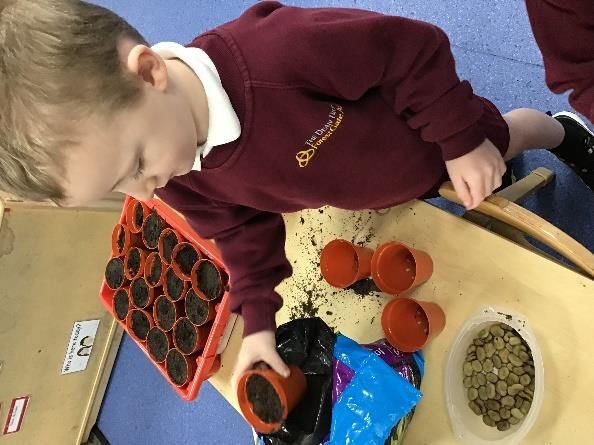
Within each of these 7 areas there are statements of learning which
all lead into final statements called the Early Learning Goals which
all the children work towards. The majority of children will have
reached this Good Level of Development by the end of Reception.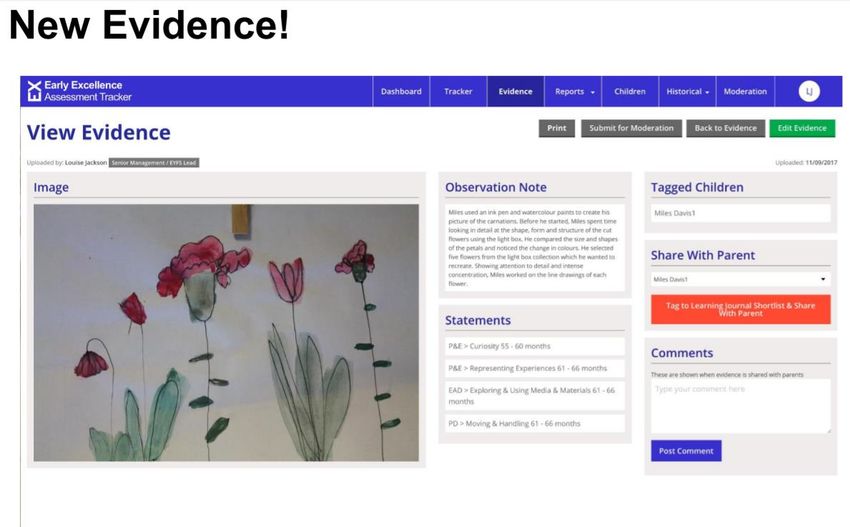
The classroom is divided into areas e.g. writing, creative, construction,
playdough, role play, small world, sand, water, computer area, book area,
maths etc.
These areas are regularly enhanced in relation to our focus
topics to engage the children fully and are accessed daily.
We also access the outdoor area daily and this promotes the children’s
physical skills. We take many elements of our indoor learning outside e.g.
writing, maths, role play and construction. These are on a larger scale than
indoors.
The children go outside every day come rain or shine so it is really important
that the children wear suitable school shoes everyday and bring a coat even if
it looks like a warm day. Wellies are provided for wet weather or children can
bring their own.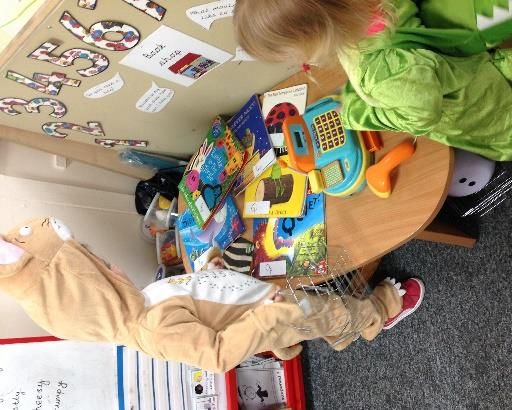
In Reception we teach in focus groups and the rest of the time
children will be in the continuous provision areas where they can
engage in different activities and expand on their learning as well as
learn to work cooperatively and share ideas with their peers. These
are planned around the statements of learning and around the
children’s interests.
If we do have concerns or a child is finding a particular area of
learning tricky then they may join an intervention group which is led
either by a teacher or a TA. This helps them to become more
confident within the area and takes place 2-3 times a week. The
children will also work 1-1 with an adult where required.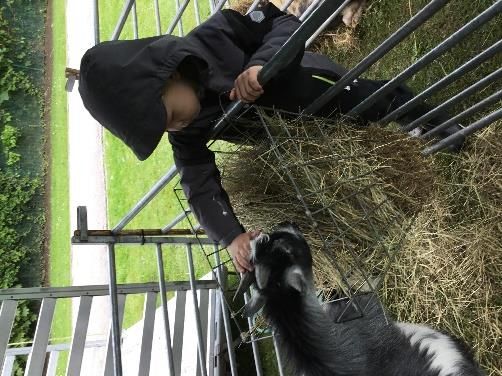
Monday                               Tuesday                              Wednesday                            Thursday                             Friday
8.45-          SELF REGISTATION, CP                 SELF REGISTATION, CP                 SELF REGISTATION, CP                 SELF REGISTATION, CP                 SELF REGISTATION, CP
               (individual readers, small groups)   (individual readers, small groups)   (individual readers, small groups)   (individual readers, small groups)   (individual readers, small groups)
9.00
9.00-          Phonics /CP                          Phonics/CP                           Phonics/CP                           Phonics/CP                           Phonics/CP
10.00
10.00-         Calendar                             Calendar                             Calendar                             Calendar                             Calendar
10.05
10.05-         Funky Fingers                        Funky Fingers                        Funky Fingers                        Funky Fingers                        Funky Fingers
10.15
10.15-         Snack/Plan                           Snack/Plan                           Snack/Plan                           Snack/Plan learning Snack/Plan
10.25          learning                             learning                             learning                                                 learning
10.25-         Continuous provision/small           Continuous provision/small           Continuous provision/small           P.E                 Continuous
11.25          group                                group                                group                                                    provision/small group
                                                                                                                              10.45 -11.30
11.25-         TIDY UP/Review                       TIDY UP/Review                       TIDY UP/Review                                           TIDY UP/Review
11.30
11.30 –        Maths/English                        Maths/English                        Maths/English                        Maths/English                        Maths/English
12.00
12.00 – 1.15
               LUNCH                                LUNCH                                LUNCH                                LUNCH                                LUNCH
1.15 –         5 a day                              5 a day                              5 a day                              5 a day                              5 a day
2.00           Maths/English                        Maths/English                        Maths/English                        Maths/English                        EAD/PSED/UW

2.00-          Continuous provision/small           PD Trim Trail         Open the book                                       Continuous provision/small           Continuous provision/small
               group/tidy up                                                                                                  group 2.15-2.45/tidy                 group 2.15-2.45/tidy up
2.45                                                SINGING 2.15-2.40     assembly                                            up/review                            Celebration
2.45 –         STORY/REVIEW                         School Value Assembly 2.30-3.00 pm/                                       STORY/REVIEW                         assembly 2.45
3.05                                                2.45pm                STORY/REVIEW
Before children learn to read they need to have good listening,
attention and concentration skills and good speaking skills.
In nursery and at the beginning of reception class the children
spend much of their time developing the pre-phonic skills below.
These enable the children to tune into different sounds, describe
sounds, rhyme and hear the initial sounds in words.
• Environmental sounds
• Instrumental sounds
• Body percussion
• Rhythm and rhyme
• Alliteration
• Voice sounds
• Oral blending and segmenting Blending is a skill needed for reading. To read an unknown word,
children sound out the word by saying each sound separately and then
squashing/blending the sounds together e.g. d - o - g = dog
Segmenting is a skill needed for spelling. To spell a word children need
to break it up into its separate sounds
e.g. dog = d – o – g
These skills are taught orally before the children are introduced to
letters. Only when children can do this orally are they ready to be
formally taught to read. Children often acquire writing skills later than
reading as so many other skills are needed as well e.g. Fine motor
control, forming letters, remembering letter shapes etc We use the Read Write Inc phonics scheme to teach children to
read.
Once the children can orally blend and segment the sounds in
words we start to teach them letter sounds - m a s d t i n p are the
first ones we teach
Once the children recognise these letters (graphemes) and the
sounds they represent (phonemes) they then learn to read and spell
words with these sounds e.g. mat sad tip etc
The children are shown a picture as well as a letter to help them to
remember e.g. In reception we have daily activities to develop children's
fine motor control including funky fingers and dough
gym.
We encourage children to mark make in all areas of the
classroom.
We model daily the correct letter formation to the
children.
In reception the children practice their handwriting
everyday in their phonics sessions. We use rhymes from
Read Write Inc to help the children remember how to
form their letters. In Reception we aim to nurture children's passion for stories. Children have daily story time and lots of our topics stem from key texts and stories. We also send home a weekly storybook for you to read to your child. Reading stories repeatedly helps children to not only develop their vocabulary but also helps to develop their listening and attention, develops their knowledge of story structures and story language and develops their imaginations.
In the EYFS maths is taught everyday during carpet sessions and
children are encouraged to choose maths activities in their play.

In nursery we focus on 1-1 counting, number recognition as well as
developing children's understanding of shape, space and measure.

In reception we develop a deeper understanding of number, focusing
on a new number every two weeks.
Maths
In the EYFS we use a mastery maths approach to encourage the
children to reason and problem solve.
We largely follow the ‘White Rose’ maths scheme
We develop their thinking skills through questioning:
How do you know?
Prove it?
How is this the same/different?
Can you show me another way? All children will be given weekly homework on a Friday to be
returned on Monday.
In reception phonics and maths homework will be sent home each
week.
We kindly ask that you read the weekly story book we will send
home regularly with your child and make a note of it in their diary.
We will collect and change your child’s book every Monday
When the children are ready for a reading book it will be sent home
every night with a diary for you to sign and make comments in.
It is school policy that the children read every night at home with an
adult and return their reading book and signed diary to school each
day. We constantly observe and assess against the learning statements and
goals and record these on a computer programme called EEXAT. The
assessment tools allow us to see where the children’s level of development
was when they started EYFS and how far they have come in the year.
Parents can download the EEXAT app which will enable us to send you
photos and written observations of your children. Parents can also send
their own observations and photos of their children learning at home.This is an example of how a shared observation will look on EExAT.
We believe that the wearing of school uniform helps a child identify with the
school and their peers, it also has practical and financial advantages.
Boys
Grey trousers/ shorts
Burgundy sweatshirt with Dean’s Trust logo
White polo shirt
Black shoes
Girls
Grey skirt/ trousers or dress
Burgundy sweatshirt or cardigan with Dean’s Trust logo
White polo shirt
Summer dress ( red gingham)
Black shoes (not laces)
All children will be expected to wear sensible BLACK SHOES. Children not
wearing adequate footwear will be asked to wear their PE pumps instead– not
trainers of choice from home.
PE KIT
Burgundy shorts, white T –Shirt and black pumps. Burgundy or black joggers
can also be worn in the winter months.
PLEASE NOTE THAT ALL ITEMS OF CLOTHING SHOULD BE CLEARLY MARKED WITH
YOUR CHILD’S NAME.SCHOOL WILL NOT TAKE RESPONSIBILITY FOR LOST ITEMS No earrings or jewellery is permitted.
Long hair must be tied up with plain hair accessories.
Nail polish or tattoos are not permitted.
Toys and personal items should not be bought to school as they can
easily get lost or broken.
All children will need a school pump bag and book bag. These can
be purchased from our uniform supplier - Petites Modes which can
be found on Tatton Road in Sale. Uniform can be ordered via their
website.
https://petitesmodessale.com/Snack Free fruit and milk is provided daily for all children. Water is available at all times. School Dinners All children will be provided with a school dinner everyday. Children with allergies or dietary needs are provided for. School meals are prepared on site and the children are given plenty of choice and variety. Our expectation is that all children have a school dinner. School dinners enable children to eat a variety of nutritious food, develop table manners and learn to use a knife and fork correctly. Dinners are eaten in the school hall supervised by myself, TAs and lunchtime supervisors. Packed lunches from home We have a healthy eating policy. Children are not allowed to bring fizzy drinks, sweets, chocolate bars or energy drinks. One small cake or chocolate biscuit will be acceptable.
We aim to become partners with parents, as together we seek the child’s
  optimum growth. We aim to provide a happy, safe, secure and stimulating
  environment with opportunities for children to enjoy learning and build good
  relationships with others.
Please feel free to discuss any worries or aspirations you may have regarding
  your child, as we have a common goal - the best for each child. Below is a
  list of things we think are important for parents to do.

*Set aside some time each day to talk and listen to your child and encourage
   a positive attitude towards school.
*Find out what’s happening by attending meetings, parents evening, open
   days and events.
*Ensure your child is properly equipped for school. Please make sure every
   item of clothing is labelled, including PE kit. If clothing is not labelled we can
   not guarantee its safe return if misplaced.
*Make sure you and your child are aware of the school rules and values and
   that they are respected.
*Keep the school informed about any factors that may affect your child’s
   performance and well being at school.
On starting school, it would be helpful if you could encourage and
 support your child to learn how to complete the following.

1) Put on and take off their own coat.
2) Go to the toilet, wipe themselves and wash their hands.
3) Eat with a knife, fork and spoon.
4) Dress and undress
5) Be aware of how to turn their clothes the correct way around once
  undressed.
6) Take care of toys and equipment around them
7) Share and take turns.
To support your child to make a smooth transition from
   nursery/preschool/childminder to FGA Reception Class we have several
   events planned. (A final list of dates and times will be emailed out at the end
   of June)
1) Transition day – Children currently attending FGA Nursery will spend their
   normal nursery session in Reception Class with the Reception staff and
   have the opportunity to explore the indoor and outdoor classroom
   environments. (Tuesday 6th July)
2) EYFS setting tour– Children who are new to FGA are invited to bring one
   special adult to come and take a tour around the EYFS setting and meet
   the EYFS Staff at a scheduled time. (Dates to be arranged)
3) Ms Donaghy to visit children at their day nursery/preschool/childminder.
   (Dates to be arranged)
4) Doorstep visits to family homes of children new to FGA Reception Class.
   (Dates to be arranged)

Ms Donaghy will also be making contact with all feeder settings so
 transition records can be shared.
We are really looking forward to your children starting in Reception
class in September. We are mindful that it is a big step and some
children may be very apprehensive. We will therefore be introducing
the new children to FGA into the school routine in smaller groups to
best settle and reassure them.
The settling in time frame is flexible to respond to the differing needs
of children and their families.
As part of the settling in procedure the children will be given the
opportunity to stay for dinner
All staff will stay with the children to support them within the dining
room.
Doors open at 8.35am and school starts at 8.45am. School finishes
at 3.05pm. Please drop older siblings off first. Reception children
should enter and be collected from the EYFS door.Come and speak to the teacher. We will always help where we can and look into your concerns. Before / after school is usually the best time although sometimes we may have to arrange an appointment time due to staff meetings, clubs and training sessions. Useful contacts: Mr Wilmott (Attendance & Punctuality) Miss Layton (SEND) Mrs Marsh (Safeguarding) If you’re not sure who is best to deal with your concern then please see the main office staff and they will point you in the right direction. Most issues will be dealt with by the class teacher.
Please pick up an information pack from the school office and return any
paperwork ASAP.
Children new to Forest Gate Academy will all be given a free
sweatshirt/cardigan and polo shirt. Please collect these from the school
office.You can also read


