Strengthening Australia's cities and regions - The Australian Government's 10 Year Investment in Infrastructure - Infrastructure Investment ...
←
→
Page content transcription
If your browser does not render page correctly, please read the page content below
Strengthening Australia’s
       cities and regions
           The Australian Government’s
     10 Year Investment in Infrastructure

                                 MAY 2018

Strengthening Australia’s
       cities and regions
           The Australian Government’s
     10 Year Investment in Infrastructure

                               May 2018
ii

     © Commonwealth of Australia 2018
     May 2018/INFRA3467
     ISBN: 978-1-925701-26-5
     Ownership of intellectual property rights in this publication
     Unless otherwise noted, copyright (and any other intellectual property rights, if any) in this publication is
     owned by the Commonwealth of Australia (referred to below as the Commonwealth).
     Disclaimer
     The material contained in this publication is made available on the understanding that the Commonwealth is
     not providing professional advice, and that users exercise their own skill and care with respect to its use, and
     seek independent advice if necessary.
     The Commonwealth makes no representations or warranties as to the contents or accuracy of the information
     contained in this publication. To the extent permitted by law, the Commonwealth disclaims liability to any
     person or organisation in respect of anything done, or omitted to be done, in reliance upon information
     contained in this publication.
     Creative Commons licence
     With the exception of (a) the Coat of Arms and (b) the Department of Infrastructure and Regional
     Development’s photos and graphics copyright in this publication is licensed under a Creative Commons
     Attribution 3.0 Australia Licence.
     Creative Commons Attribution 3.0 Australia Licence is a standard form licence agreement that allows you to
     copy, communicate and adapt this publication provided that you attribute the work to the Commonwealth
     and abide by the other licence terms. A summary of the licence terms is available from
     http://creativecommons.org/licenses/by/3.0/au/deed.en. The full licence terms are available from
     http://creativecommons.org/licenses/by/3.0/au/legalcode.
     This publication should be attributed in the following way: © Commonwealth of Australia 2018.
     Use of the Coat of Arms
     The Department of the Prime Minister and Cabinet sets the terms under which the Coat of Arms is used.
     Please refer to the Department’s Commonwealth Coat of Arms and Government Branding web page
     https://www.dpmc.gov.au/resource-centre/government/australian-government-branding-guidelines-
     use-australian-government-logo-australian-government-departments-and-agencies and in particular, the
     Commonwealth Coat of Arms Information and Guidelines publication https://www.dpmc.gov.au/resource-
     centre/government/commonwealth-coat-arms-information-and-guidelines.
     Contact us
     This publication is available in hard copy or PDF format. All other rights are reserved, including in relation to
     any Departmental logos or trade marks which may exist. For enquiries regarding the licence and any use of
     this publication, please contact:
     Director - Publishing and Communications
     Communications Branch
     Department of Infrastructure and Regional Development
     GPO Box 594
     Canberra ACT 2601
     Australia
     Email:   publishing@infrastructure.gov.au
     Website: www.infrastructure.gov.au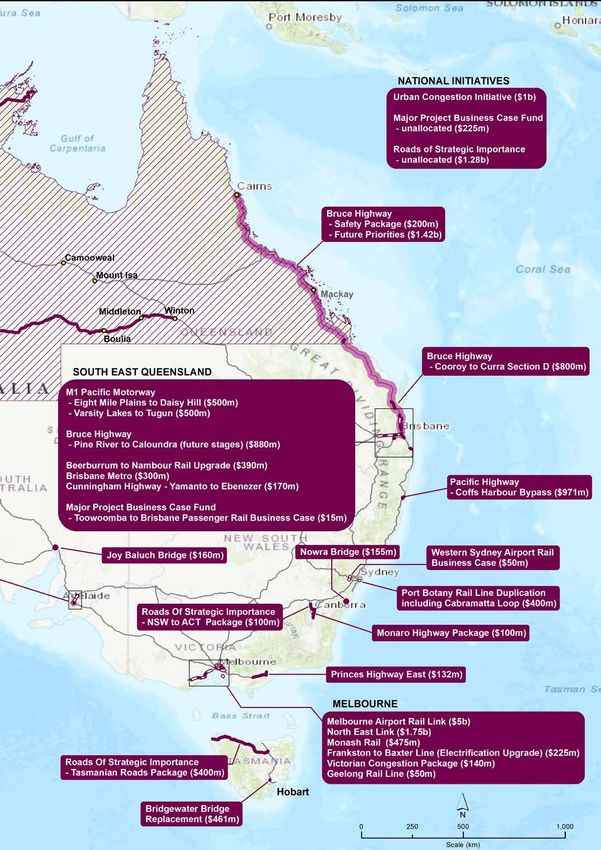
1

Contents

           Ministers’ Foreword..............................................................................2
           Introduction.........................................................................................3
           A National Infrastructure Pipeline..........................................................3
           10 Year Infrastructure Investment Pipeline.............................................4
           A more informed, active and early stage investor....................................6
           Key drivers for our $75 billion land transport investment.........................7
           Map of Pipeline projects.......................................................................8
           Priorities by State...............................................................................11
               New South Wales..........................................................................12
               Victoria.........................................................................................14
               Queensland..................................................................................17
               Western Australia..........................................................................20
               South Australia..............................................................................22
               Tasmania......................................................................................24
               Australian Capital Territory.............................................................26
               Northern Territory..........................................................................28

           National Initiatives.............................................................................29
              Roads of Strategic Importance.......................................................31
               Urban Congestion Initiative.............................................................31
               Major Project Business Case Fund .................................................31

           Current major projects........................................................................33
2

    Ministers’ Foreword
    The Liberal and Nationals Government has demonstrated leadership in land transport infrastructure,
    evidenced by our record investment. This investment is driving the national economy and ensuring
    Australian industries remain globally competitive across all sectors, supporting jobs and economic
    growth in urban and regional areas.

    In the 2018–19 Budget, the Government has committed over $75 billion towards new and upgraded
    transport infrastructure. This commitment builds on our existing record levels of investment,
    recognising that in order for the Australian economy to continue to grow and be competitive,
    infrastructure investment must remain a core focus for the Government.

    The Pipeline of future infrastructure priorities has been called for by our communities, investors and
    the construction industry. Key projects include: the Melbourne Airport Rail Link, METRONET in Perth,
    the Coffs Harbour Bypass on the Pacific Highway and the Beerburrum to Nambour Rail Upgrade
    in Queensland. We are also investing $3.5 billion through our new Roads of Strategic Importance
    initiative to support the regional freight industry and grow the visitor economy.

    The Government will be actively engaged with State and Territory Governments and the private sector
    through the development of these projects to determine the optimal timing, delivery models and
    funding structures to achieve value for money.

    This Pipeline signifies a shift from the Australian Government’s historic approach to investment in
    transport infrastructure, where the Government was regarded as simply a source of funding for State
    priorities as they arise. Through the Pipeline, the Australian Government is setting out a commitment
    to a long-term plan to progressively build projects which deliver nationally significant outcomes over
    the next decade: growing the national economy; shaping our major cities; and ensuring we support
    the increasing role of our regional centres in providing access to employment opportunities.

    These new commitments build on the Government’s current major investments which are delivering
    transformational projects such as the Western Sydney Airport and Inland Rail. We are also funding
    major road projects across the nation, including upgrade programs on the Pacific Highway in
    New South Wales, the Bruce Highway in Queensland, the Monash Freeway in Melbourne, the
    North‑South Corridor in Adelaide, the Midland Highway in Tasmania and in Northern Australia.
    Our current investment program also funds major rail initiatives such as METRONET in Perth and
    Regional Rail Revival in Victoria.

    The Government is getting on with the job of delivering the major infrastructure priorities required to
    drive productivity, support population growth and sustain our strong economic position for the benefit
    of all Australians while creating local jobs.

    The Hon Michael McCormack MP                        The Hon Dr John McVeigh MP
    Deputy Prime Minister                               Minister for Regional Development, Territories
    Minister for Infrastructure and Transport           and Local Government

    The Hon Paul Fletcher MP                            The Hon Keith Pitt MP
    Minister for Urban Infrastructure and Cities        Assistant Minister to the Deputy Prime Minister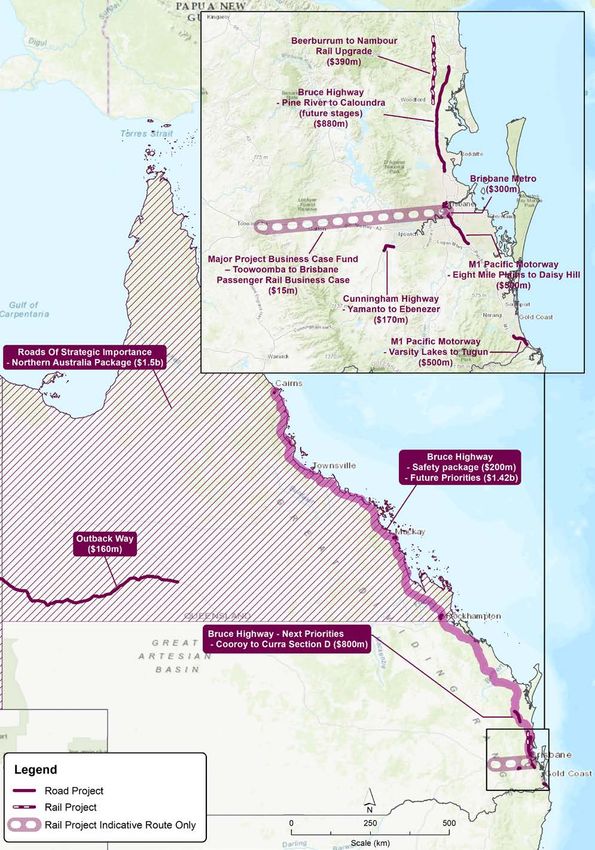
3

Introduction
Demand for high quality infrastructure will continue to increase over coming years. The domestic
freight task and total kilometres travelled on our roads are forecast to grow by more than a quarter
over the next decade.

Transport infrastructure connects people to jobs, their homes and their communities, and allows
Australian businesses to connect to domestic and global export markets. The efficient movement of
people and products grows our economy and improves the liveability of our cities and regions.

To harness these benefits, the Government has committed more than $75 billion over the next
10 years to new and upgraded transport infrastructure projects across Australia, building on our
current investments to improve our road, freight rail and urban transit networks.

Our current investments are already delivering significant economic benefits to urban and regional
areas across Australia. Analysis of more than 70 major projects funded through the Infrastructure
Investment Program indicates that approximately 190 million passenger hours and 50 million
freight and business hours were saved as a direct result of the Government’s investment in major
infrastructure projects.

These investments have also reduced the number of crashes on our roads, with approximately
1,800 accidents estimated to have been avoided due to safer driving conditions through upgraded
road surfaces, targeted lane widening, additional overtaking lanes, improved signage and upgrading
of intersections to improve turning points on our major highways.

These projects are also collectively supporting more than 50,000 direct and indirect jobs, and provide
greater opportunities for Indigenous employment and participation.

A National Infrastructure Pipeline
In the 2018–19 Budget, the Government has committed to a new 10 Year Infrastructure Investment
Pipeline. The Pipeline is a list of nationally significant land transport priorities in our major cities and
across regional Australia that will benefit every State and Territory.

The Pipeline will see substantial investment in urban road and rail initiatives, including under the
National Rail Program, that will transform the way people commute across their cities for work and
leisure. It will also deliver vital investments in key corridors across regional Australia—linking industry
to export markets and people to vital services, including health and education.

The Pipeline recognises that major infrastructure projects take many years to plan, design and
deliver. New projects will be added to the Pipeline over time as further priorities are identified through
continuing analysis and engagement with State and Territory Governments and the private sector.
4
10 Year Infrastructure Investment Pipeline
Program/ Australian Government
initiative State/ Territory Project name contribution ($ million)
Initiatives National Roads of Strategic Importance Initiative 3,500.0
Northern Australia Package 1,500.0
Tasmanian Package 400.0
NSW to ACT Package 100.0
Bindoon Bypass 220.0
Unallocated 1,280.0
Urban Congestion Initiative 1,000.0
Major Project Business Case Fund 250.0
EastLink WA (Orange Route) 10.0
Toowoomba to Brisbane Passenger Rail 15.0
Unallocated 225.0
Infrastructure National Outback Way 160.0
Investment New South Wales Pacific Highway – Coffs Harbour Bypass 971.0
Program
Port Botany Rail Line Duplication, including Cabramatta Loop 400.0
projects
Nowra Bridge 155.0
Victoria Melbourne Airport Rail Link 2,500.0
North East Link 1,750.0
Victorian Congestion Package 140.0
Geelong Rail Line 50.0
Princes Highway East 132.0
Queensland Bruce Highway – Next Priorities 3,300.0
Pine River to Caloundra (future stages) 880.0
Cooroy to Curra Section D 800.0
Safety Package 200.0
Future Priorities 1,420.0
M1 Pacific Motorway 1,000.0
Eight Mile Plains to Daisy Hill 500.0
Varsity Lakes to Tugun 500.0
Brisbane Metro 300.0
Cunningham Highway – Yamanto to Ebenezer (Amberley Interchange) 170.0
Western Australia Perth Congestion Package 943.5
Tonkin Highway Stage 3 Extension 252.5
Tonkin Highway Gap 145.0
Tonkin Highway Interchanges 183.0
Mitchell Freeway Extension - Hester Avenue to Romeo Road 107.5
Leach Highway (Welshpool Road Interchange) 46.5
Roe Highway (Great Eastern Highway Bypass Interchange) 144.0
Stephenson Avenue Extension 65.0
Bunbury Outer Ring Road Stages 2 and 3 560.0
South Australia North-South Corridor 1,388.0
Regency Road to Pym Street 177.0
Future Priorities 1,211.0
Joy Baluch Bridge 160.0
Tasmania Bridgewater Bridge Replacement 461.0
Australian Capital Territory Monaro Highway Package 100.0
Northern Territory Central Arnhem Road Upgrade 180.0
Buntine Highway Upgrade 100.0
National Rail New South Wales Western Sydney Airport Rail Business Case 50.0
Program Victoria Melbourne Airport Rail Link 2,500.0
projects
Monash Rail 475.0
Frankston to Baxter Link (Electrification Upgrade) 225.0
Queensland Beerburrum to Nambour Rail Upgrade 390.0
Western Australia METRONET – further Stage 1 projects 1,052.1
Morley-Ellenbrook Line 500.0
Byford Extension 240.5
Midland Station Project 82.5
Lakelands Business Case 2.0
Further projects to be agreed 227.1
South Australia Gawler Rail Line Electrification 220.0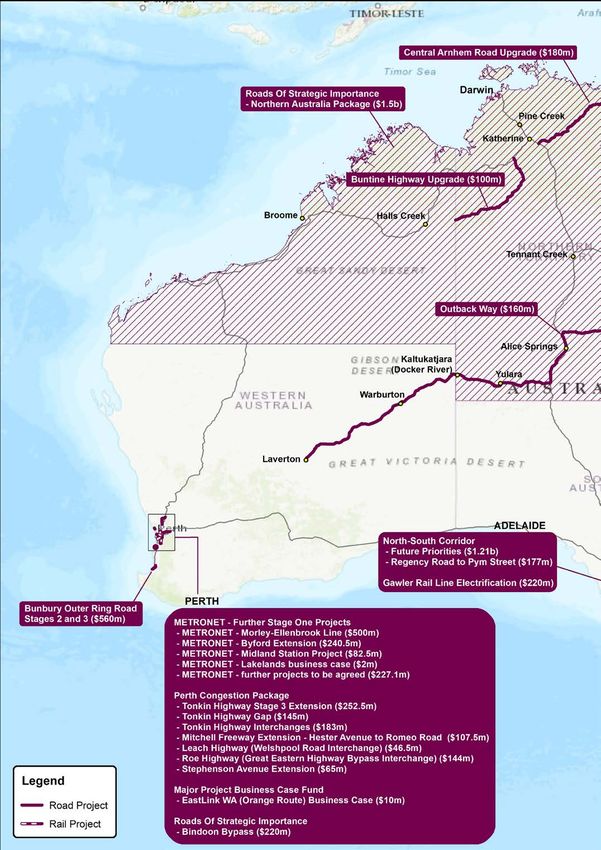
5

		                                   Current Investment         New Investment

 2018–19   2019–20   2020–21   2021–22   2022–23      2023–24     2024–25        2025–26   2026–27   2027–28

6

    A more informed, active and early stage investor
    The Pipeline has been developed by identifying critical transport network deficiencies that will
    constrain commuter and freight movements, across both urban and regional Australia. Practical
    solutions were identified: informed by the work of Infrastructure Australia—the Government’s
    independent expert infrastructure advisory body—and State and Territory Governments’
    locally‑focused infrastructure strategies.

    In delivering the Pipeline, the Government will ensure that all jurisdictions pay their fair share of the
    costs. Acknowledging the national productivity benefits that can be derived through investment
    in key freight corridors, the Government will commit up to 80 per cent of the delivery cost of
    regional projects. The Australian Government will partner with State and Territory Governments
    on a 50:50 basis for the major initiatives in our cities. In some cases, the Government will be the
    sole contributor, such as where funding is for a freight rail initiative through the Australian Rail Track
    Corporation.

    The Government is also committed to being an active investor in these key infrastructure initiatives,
    not simply allocating grant funding to State and Territory Governments. The Government will engage
    early to ensure national economic objectives are built into project design from the start and the full
    benefits of our investment are realised. The Government will also continue to drive greater use of new
    ways of funding and financing projects to deliver more value for taxpayers.

    To support these objectives, the Government is committing to governance arrangements for our
    10 Year Infrastructure Investment Pipeline that require:

    •    major projects to be subject to a robust business case assessment process before the
         Australian Government investment amount is finalised and funding starts to flow.
    •    investments to be predicated on State and Territory Governments providing their fair share of
         funding (nominally 50 per cent in urban areas; 20 per cent in regional areas).
    •    opportunities for private investment to be explored and value captured through the project used
         to defray the capital costs of the project on an equal basis.
7
Key drivers for our $75 billion
land transport investment
• Australia’s population is forecast to grow to around 29 million over the next
decade, with much of this increase expected to occur in our major cities.
99 Our Pipeline investments, such as up to $943.5 million for a Perth Congestion
Package and up to $971 million towards the Coffs Harbour Bypass, will help
future-proof our urban transport networks and better connect our regions.
• Our cities remain the engine rooms of our economy—over 75 per cent of Australians
live in our major cities, responsible for over 80 per cent of our economic activity—but
our urban transport networks are increasingly congested.
99 As part of this Budget, the Australian Government has announced major
investments in critical public transport projects, such as up to $5 billion
towards the long‑awaited Melbourne Airport Rail Link and up to
$1.05 billion towards the Perth METRONET, which will also kick-start a
City Deal for Perth.
99 Our new $1 billion Urban Congestion Initiative will target congestion on our
urban road networks.
• Domestic freight is forecast to grow 26 per cent by 2026—with much of this
freight task generated by our agricultural and mining sectors in regional areas.
99 While our Urban Congestion Initiative will target urban constraints, our new
$3.5 billion Roads of Strategic Importance Initiative will fund upgrades to
our key regional freight routes to improve access for higher productivity vehicles
and to regional communities.
• Without these major new investments, construction activity would suffer a
significant decline from the early 2020s as current projects are completed.
99 The Pipeline will provide certainty to the construction industry, facilitating the
retention of a skilled workforce and enabling the creation of approximately
50,000 additional jobs over the next decade.
99 Planning for the next phase of construction will be supported through our new
$250 million Major Project Business Case Fund.8
Map of Pipeline projects
Alignments are indicative only9
Priorities by State
The Government has identified the following projects as suitable for Commonwealth
investment over the coming decade. It is anticipated that these projects will deliver the
greatest benefit to productivity, the economy and road safety, while leveraging off the
significant investments that are already underway.
12

 New South Wales
 Pacific Highway Coffs Harbour Bypass                  Airport and Port Botany. The contribution
                                                       towards these works will be $400 million.
 The 2018–19 Budget commitment of up to
 $971 million towards a bypass of Coffs Harbour        The project will deliver wide benefits, including
 builds on the $5.6 billion currently invested by      increased effectiveness and capacity of the
 the Australian Government to duplicate and            Metropolitan Freight Network that supports the
 improve the Pacific Highway. Approximately            logistics and supply chain activities of intermodal
 15,000 vehicles a day currently travel through the    terminals, both existing and under construction
 Coffs Harbour CBD along a route that includes         at Moorebank.
 12 sets of traffic lights. The bypass will reduce
 travel times and improve travel conditions for all    Nowra Bridge
 road users by allowing heavy vehicles to bypass       The Princes Highway serves as the main
 the CBD, and will alleviate congestion on the         transport corridor providing freight and
 local road network. It will also improve safety and   passenger movements to and from the
 amenity for traffic, pedestrians and cyclists using   Illawarra and South Coast regions. The
 the existing highway through Coffs Harbour.           existing Princes Highway crossing of the
                                                       Shoalhaven River limits the efficient movement
 Port Botany Rail Line Duplication,                    of freight and other vehicles. The southbound
 including Cabramatta Loop                             bridge is over 137 years old, has vehicle
 The Commonwealth will fully fund the duplication      height and weight restrictions, and has
 of the remaining single-track section of the          substantial maintenance costs and risks. The
 Port Botany Rail Line between Mascot and              Government has committed up to $155 million
 Botany, and the construction of a passing loop        towards constructing a new bridge to improve
 at Cabramatta. This will encourage a shift in         safety, capacity and efficiency across the
 freight share from road to rail, reducing truck       Shoalhaven River at Nowra.
 movements and congestion around Sydney
13
Western Sydney Airport Rail
The Commonwealth and NSW Governments Through the 2018–19 Budget, the Government
have jointly committed to the first stage of the has initially committed $50 million towards a
North South Rail Link from St Marys to Badgerys $100 million business case to support joint
Creek Aerotropolis via Western Sydney Airport as planning for the first stage of the rail link.
part of the Western Sydney City Deal. The two The business case will investigate options for
governments have a joint objective of having rail a full North South Rail Link from Schofields to
connected to the Western Sydney Airport in time Macarthur, and a South West Rail Link from
for the opening of the airport and have agreed Leppington to the airport via an interchanges at
that they will construct the North South Rail Link Badgerys Creek. A market sounding process
as equal partners, each contributing 50 per cent will also test private sector interest in station
of the funding. developments and explore innovative financing
solutions.
New South Wales Infrastructure Pipeline Priorities Map
Alignments are indicative only14
Victoria
Melbourne Airport Rail Link operate less frequently between Frankston and
Stony Point. The 2018–19 Budget commitment
The Melbourne Airport is Australia’s second
of up to $225 million will duplicate and electrify
busiest, handling 34 million passengers in 2016.
8 kilometres of the Stony Point Rail Line from
Melbourne Airport is expecting passenger
Frankston to Baxter.
numbers to rise to 60 million by 2030. An
Australian Government investment of up to Victorian Congestion Package
$5 billion towards a rail link between Melbourne’s
CBD and the Melbourne Airport will address Between 2011 and 2031, Melbourne’s
growing passenger demand, helping to alleviate population is projected to increase by
congestion on the Tullamarine Freeway. The 42.6 per cent to 6.0 million and have a labour
Australian Government has already invested force of 3.1 million, equal to Sydney’s projected
$30 million towards developing a business case labour force in 2031. Melbourne’s population
to investigate alignment options. is expected to surpass Sydney’s, and is largely
forecast to grow in Melbourne’s CBD, as well
North East Link as in the outer suburbs in the north, west and
south-east. Population growth is already placing
The North East Link will provide the “missing link”
pressure on roads as more people commute to
in Melbourne’s outer metropolitan road network.
and from the CBD to access jobs.
The 2018–19 Budget commitment of up to
$1.75 billion towards the construction of the Up to $140 million will be provided through the
North East Link is designed to give Melbourne 2018–19 Budget to deliver a package of targeted
a complete orbital road connection for the first upgrades on arterial roads across Melbourne
time. Construction of the North East Link will to address congestion. This is in addition to our
address congestion issues and provide a more existing commitment of $155 million, including
efficient route for freight movements. interest earned on East West Link and unutilised
planning money, and takes the total Victorian
Monash Rail Congestion Package to $295 million.
The Monash precinct has been identified as
Melbourne’s most established middle to outer
New investment in regional rail –
suburban employment centre and the suburbs Geelong Rail Line
surrounding the Monash Freeway and Monash Currently many Victorian regional rail lines require
University are some of the fastest growing in upgrades to the track, station and signalling
Melbourne. The Australian Government has infrastructure to enable more efficient and reliable
committed up to $475 million to improve public passenger services. The Australian Government
transport access in and to the Monash precinct has already committed $1.55 billion towards
through a heavy or light rail connection. The the $1.7 billion Regional Rail Revival package
project will support productivity gains, enabling in Victoria, to upgrade the Ballarat, Geelong,
the movement of people to and from the CBD Warrnambool, Gippsland, Bendigo/Echuca and
with greater efficiency. the North East Rail Lines.
Frankston to Baxter Link (Electrification The 2018–19 Budget commitment of up to
Upgrade) $50 million will plan and deliver further upgrades
on the Geelong Rail Line to improve the reliability
The Stony Point Rail Line is a 31 kilometre
and efficiency of passenger rail services.
single-track non-electrified rail line that connects
Frankston to Stony Point on the Mornington
Peninsula. At present, metropolitan electric trains
operate between Melbourne and Frankston on
electrified double track. However, diesel trains15
Princes Highway East
The Princes Highway East is the primary volumes of traffic lead to driver frustration and
connection between Gippsland and Melbourne, risk-taking that contributes to a high crash rate.
and is an important transport corridor between
Melbourne and the south east coast of The Australian Government commitment of up
New South Wales. It is also the main freight to $132 million will complete the duplication of
route from Victoria’s south-east for products the Princes Highway East between Traralgon
destined for export via the Ports of Melbourne, and Sale by addressing the remaining two
Hastings and Geelong. While much of the sections of the highway, totalling approximately
highway between Traralgon and Sale is being 12.1 kilometres.
progressively duplicated, the Flynn and Kilmany
sections remain unduplicated. Limited overtaking
opportunities, varying road standards and high
Victorian Infrastructure Pipeline Priorities Map
Alignments are indicative only16
17

Queensland
Bruce Highway – next priorities                        M1 Pacific Motorway – Varsity Lakes
The Australian Government has already                  to Tugun
committed $6.7 billion towards improving the           The M1 Pacific Motorway – Varsity Lakes to
Bruce Highway from 2013–14. Our 2018–19                Tugun project is a priority for the southern end of
Budget commitment adds an additional                   the corridor. Potential upgrade options include
$3.3 billion over the next ten years to bring our      increasing the capacity in both directions,
total investment up to $10 billion. This further       pavement reconstruction work, and better
investment will address areas that are expected        active transport connectivity between centres.
to experience severe congestion, safety and            The Australian Government has committed
flooding issues, particularly north of Brisbane        $500 million to deliver these works.
and other major populated areas. Specific
works may include additional safety and critical       Beerburrum to Nambour Rail Upgrade
asset renewal, targeted capacity upgrades,
                                                       The North Coast Line between Beerburrum and
and bridge and culvert upgrades. The following
                                                       Nambour is currently a single-track line servicing
commitments have been made to specific parts
                                                       both passenger and freight transport, and
of the corridor:
                                                       conflict between the two is constraining growth.
•    Up to $880 million for Pine River to              Freight paths are expected to reach capacity by
     Caloundra – including approximately               2023, causing additional freight in the corridor
     $120 million for the Dohles Rocks Road            to switch to road, increasing the strain on road
     Intersection                                      infrastructure. The Australian Government has
                                                       committed $390 million to upgrade the rail line.
•    Up to $800 million for Cooroy to Curra
     Section D
                                                       Brisbane Metro
•    Up to $200 million for a Safety Package
                                                       Brisbane’s bus network has reached capacity at
•    Up to $1.42 billion for Future Priorities
                                                       many inner-city locations, resulting in increased
                                                       commute times and constrained accessibility
M1 Pacific Motorway – Eight Mile                       to jobs and services. Further congestion on the
Plains to Daisy Hill                                   public transport system is forecast into the future,
The M1 Pacific Motorway is one of the most             which could risk users reverting to private car
important and heavily congested routes in              usage. Up to $300 million has been committed
Queensland. In addition to congestion at peak          towards the Brisbane Metro project to improve
periods, the Eight Mile Plains to Daisy Hill section   access to the Brisbane CBD.
of the motorway has a variety of safety and
capacity issues, which affect its ability to cater
for current and future traffic demands. Through
the 2018–19 Budget, $500 million has been
committed to addressing these constraints.
18
Cunningham Highway – Yamanto to Outback Way
Ebenezer (Amberley Interchange) The Outback Way is a 2,800 kilometre route
The Cunningham Highway has the third highest that links Laverton in Western Australia with
crash risk out of major Queensland routes, Winton in Queensland via Alice Springs in
behind the Bruce and Warrego Highways. The the Northern Territory. Improvements to the
Australian Government commitment of up to Outback Way benefit the inter-jurisdictional
$170 million will upgrade the Yamanto and transport network by increasing connectivity and
Amberley intersections with the Cunningham reducing travel times, cutting costs for freight
Highway, and build a new two-lane deviation off operators and enhancing economic opportunities
the highway connecting with the northern end for the cattle, mining and tourism industries.
of Amberley Road. There will also be a range
The Government has previously committed
of safety works undertaken along the route
$170 million to the Outback Way through the
that could include safety barriers, channelised
Infrastructure Investment Program and Northern
right turn intersection upgrades, wide centreline
Australia Roads Program. The Government has
treatment to separate opposing traffic, and
identified further high priority sections of this
overtaking lanes.
road for upgrades using current funding, and
as such, an additional commitment of up to
$160 million will be provided across Queensland,
Western Australian and the Northern Territory
to deliver safety and productivity improvements,
such as road widening and sealing. This brings
the Government’s total commitment to the
Outback Way to $330 million.19
Queensland Infrastructure Pipeline Priorities Map
Alignments are indicative only20
Western Australia
METRONET • $183.0 million for Tonkin Highway
interchanges
Perth’s road and rail network suffers from
• $107.5 million for Mitchell Freeway
congestion and overcrowding due to population
Extension – Hester Avenue to Romeo Road
growth, and is expected to reach capacity
by 2031. • $46.5 million for Leach Highway
(Welshpool Road interchange)
Alongside the Government’s current commitment
• $144.0 million for Roe Highway
of $1.28 billion to the Perth to Forrestfield
(Great Eastern Highway Bypass and
Airport Line, Yanchep Rail Extension and the
Abernethy Road interchanges)
Thornlie Cockburn Link, an investment of up to
• $65.0 million for Stephenson Avenue
$1.05 billion towards further METRONET Stage 1
Extension.
works through the 2018–19 Budget brings this
commitment to $2.33 billion. These additional
works will accommodate the expected pressures Bunbury Outer Ring Road
on the metropolitan region, particularly around – Stages 2 and 3
future growth areas. Further components of Due to a mix of through traffic, heavy vehicles
METRONET Stage 1 include up to: and high volumes of local traffic on the Forrest
Highway, Robertson Drive and Bussell Highway,
• $500.0 million for Morley-Ellenbrook Line
the road corridor is experiencing congestion and
• $240.5 million for Byford Extension
safety issues, resulting in associated transport
• $82.5 million for Midland Station Project ineffiencies and cost. An Australian Government
• $2.0 million for Lakelands business case commitment of up to $560 million will complete
• $227.1 million for further projects yet to be the remaining two stages from the South
agreed. Western Highway to the Bussell Highway and
from the Perth-Bunbury Highway to near Picton
The Government’s investment in METRONET Boyanup Road.
(and other transformational infrastructure) will
underpin a new Perth City Deal and a shared Outback Way
long term vision for the future growth of Perth. Through the 2018–19 Budget, an additional
commitment of up to $160 million will be
Perth Congestion Package provided across Queensland, Western Australian
Increased population in Perth has underpinned and the Northern Territory to deliver safety
growth in demand and congestion on the and productivity improvements, such as road
transport network. This growth has also widening and sealing.
increased the volume of containerised
freight, which is expected to continue in the
future, placing further pressure on transport
infrastructure in the area. Up to $943.5 million
for a new Perth Congestion Package will ease
pressure on the urban transport network and
significantly improve safety levels on key urban
freight and commuter networks. The Package
includes up to:
• $252.5 million for Tonkin Highway Stage 3
Extension
• $145.0 million for Tonkin Highway Gap21
Western Australian Infrastructure Pipeline Priorities Map
Alignments are indicative only22
South Australia
North-South Corridor – Future Gawler Rail Line Electrification
Priorities Passenger numbers on the Gawler Rail Line
North-South Corridor is the major motorway have grown 30 per cent in the last decade to
stretch running through Adelaide, providing become the busiest passenger rail corridor in
access to the CBD and freight and employment Adelaide. Current services are reaching capacity
hubs. The Corridor experiences severe and will be unable to support future demand
congestion with major delays in both directions. expected to result from planned future residential
The 2018–19 Budget commitment of up to development adjacent to the line. The inability to
$1.39 billion to deliver future priorities on the operate electric railcars on the Gawler Rail Line
North-South Corridor builds on the existing results in underutilisation of the fleet, creates
$1.6 billion Australian Government commitment operational inefficiencies due to reduced
towards upgrading the North South Corridor. flexibility, and restricts capacity. A commitment of
This will bring the Australian Government up to $220 million will continue the electrification
investment in the Corridor to $2.9 billion. of the Gawler Rail Line in Northern Adelaide from
Salisbury to Gawler, building on the commitment
The package will include up to $177 million for from South Australia to electrify the line from
the Regency Road to Pym Street upgrade, which Adelaide to Salisbury.
will complete a 47 kilometre non-stop section of
the North-South Corridor between Gawler and Joy Baluch Bridge
the River Torrens. A continuous motorway on this
Joy Baluch Bridge is an important freight and
section of the Corridor will decrease travel times
passenger link to access the Upper Spence Gulf
for road users, increase productivity for freight
in Port Augusta. However, the current bridge
vehicles, and improve safety.
limits freight vehicle movements and causes
safety issues for road users and pedestrians.
Up to $160 million will be provided to duplicate
the existing two-lane bridge in Port Augusta and
provide safer pedestrian access.23
South Australian Infrastructure Pipeline Priorities Map
Alignments are indicative only24
Tasmania
Bridgewater Bridge Tasmanian Roads Package – including
Bridgewater Bridge is the gateway into Hobart, Bass Highway upgrades
providing vital access over the Derwent River on The Bass Highway is Tasmania’s busiest freight
the Midland Highway. The existing bridge has route, and is key for Tasmania’s growth and
operational issues and is close to capacity, which prosperity. The Highway connects Tasmania’s
is impacting on the Midland Highway network two highest volume ports at Burnie and
leading into Hobart. Devonport, as well as major agricultural and
industrial areas. Tourism is also growing along
The Australian Government’s commitment
the Bass Highway corridor, with visitors drawn to
of up to $461 million will contribute towards
Tasmania’s northern coastline.
construction of a new four lane bridge to
cross the Derwent River, including a shared While the Australian Government is already
pedestrian and cycle path. This will reduce travel contributing to a number of small, targeted
times, improve traffic flow into Hobart from improvements on the Bass Highway, this
the Midland Highway and reduce freight and stretch of road still faces significant challenges.
travel costs. The new bridge will also support The Australian Government has committed up to
freight and passengers travelling from northern $400 million through the new Roads of Strategic
Tasmania’s agricultural and industrial regions. Importance (ROSI) initiative to deliver a package
of targeted works to improve the safety and
efficiency of this important corridor, including the
upgrade of key intersections, widening works
and the provision of overtaking lanes.25
Tasmanian Infrastructure Pipeline Priorities Map
Alignments are indicative only26 Australian Capital Territory Monaro Highway Package The Australian Capital Territory’s continued To address this pressure, the Australian population and employment growth is placing Government has committed up to $100 million to increasing pressure on its existing transport a Monaro Highway Package in the networks. The Monaro Highway, as part of 2018–19 Budget. the Australian Capital Territory’s north-south transport corridor, is expected to experience greater congestion as this growth continues. In addition, interstate road users, including heavy freight vehicles, frequently use this corridor to reach their intended destination either within, or beyond, the Australian Capital Territory. The expansion of road-focused distribution centres in south-west Sydney and Goulburn will continue to increase this type of road usage.
27

Australian Capital Territory Infrastructure Pipeline Priorities Map

                                                                      Alignments are indicative only
28
Northern Territory
Central Arnhem Road Upgrade connecting cattle freight operators to the National
Land Transport Network in both the Northern
The Central Arnhem Road is a 710 kilometre
Territory and Western Australia.
road connecting Katherine via the Stuart Highway
to Nhulunbuy. The route links Nhulunbuy to the Many sections of the Buntine Highway suffer
National Land Transport Network, services a from corrugation and potholes, and can be
large number of Indigenous communities and susceptible to flooding and wash-outs, limiting
is a key tourist and freight route for mining and mobility and access to the pastoral interests that
pastoral industries. are located along the road.
The majority of the communities serviced by the Up to $100 million will be provided to
Central Arnhem Road are cut off during the wet progressively upgrade the road to a two-lane
season, limiting access to essential services and standard seal to strengthen links to markets and
reducing productivity for freight operators. reduce freight costs for the several large cattle
properties that the Buntine Highway supports.
Through the 2018–19 Budget the Australian
Government has committed up to $180 million Outback Way
towards progressively upgrading the road to a
two-lane standard seal to provide better access The Australian Government has made an
to healthcare, education, and employment additional commitment of $160 million to be
opportunities all year round, in addition to better provided across Queensland, Western Australian
supporting freight operators. and the Northern Territory to deliver safety
and productivity improvements, such as road
Buntine Highway Upgrade widening and sealing.
The Buntine Highway is a 558 kilometre rural
arterial road that runs from the Victoria Highway
via Top Springs to the Western Australian border.
The Buntine Highway plays an important role in29
Northern Territory Infrastructure Pipeline Priorities Map
Alignments are indicative only30
31

National Initiatives
Roads of Strategic Importance
The Australian Government will invest $3.5 billion over the next decade through the new Roads of
Strategic Importance (ROSI) initiative, ensuring our key freight roads efficiently connect agricultural and
mining regions to ports, airports and other transport hubs.

ROSI will deliver works such as road sealing, flood immunity, strengthening and widening, pavement
rehabilitation, bridge and culvert upgrades and road realignments—opening up corridors to provide
a more reliable road network, improve access for higher capacity vehicles, better connect regional
communities, and facilitate tourism opportunities. Improved access provided through ROSI will deliver
substantial social and economic benefits, including opportunities for greater regional employment and
business growth.

ROSI reserves $1.5 billion for projects in Northern Australia, acknowledging the importance of this
region and recognising benefits delivered through the Australian Government’s Northern Australia
Roads Program and Northern Australia Beef Roads Program.

Tasmania will receive $400 million for roads such as the Bass Highway, $100 million has been
committed to improve access from regional New South Wales to the Australian Capital Territory via the
Barton Highway, and Western Australia will receive $220 million for the Bindoon Bypass.

Urban Congestion Initiative
In the 2018–19 Budget we are continuing our ongoing commitment to alleviate congestion not
only through our investments in major urban projects on the Pipeline but also through our targeted
$1 billion Urban Congestion Initiative.

Congestion cost the national economy more than $16 billion in 2015. This will worsen as our urban
populations grow, and freight demand increases. In the 10 years from 2018-19, the Government will
invest in projects that target congestion, including to remediate pinch points, improve traffic safety and
increase network efficiency for commuter and freight movements in urban areas.

Major Project Business Case Fund
While it is important that our investment Pipeline establishes our plan for Commonwealth-funded
priorities over the next 10 years, it is also essential that there is support to plan for the next phase
of Government investment. Planning and business case development is a critical period in project
delivery, often commencing many years before construction can start—especially when community
consultation and complex engineering are required.

The Government has therefore allocated $250 million towards a fund to support the development
of major project business cases. This allows the Government to continue to meet its commitment
to being an informed investor and engage early on the next phase major priority projects that will be
required to keep the country moving.

The commitment also provides certainty that there is funding capacity to support this critical planning
work, as new priorities are identified, ensuring early engagement by the Commonwealth to determine
whether or not projects will deliver value for money and help address nationally significant deficits in
the transport system.

Early commitments under this Fund include $10 million to plan Eastlink WA (Orange Route) in
Western Australia, and $15 million for a Toowoomba to Brisbane passenger rail connection.
32
Current major projects
Australian Government Australian Government
contribution: contribution:
State/ Territory Project name total 2018–19 onwards
Northern Australia Northern Australia Roads Program 600.0 443.4
Northern Australia Beef Roads Program 100.0 60.9
Outback Way ($100m commitment) 100.0 85.0
New South Wales M1 Productivity Package 195.8 72.9
NorthConnex 412.3 7.0
Pacific Highway – Woolgoolga to Ballina 3,466.1 1,113.5
WestConnex* 3,500.0 0.0
Western Sydney Airport** 5,300.0 ***
Western Sydney Infrastructure Plan – 997.0 967.9
M12 Motorway
Western Sydney Infrastructure Plan – 407.0 124.8
Bringelly Road Upgrade
Western Sydney Infrastructure Plan – 1,233.5 751.4
The Northern Road Upgrade
Victoria Princes Highway East – Traralgon to Sale 210.0 17.0
Duplication
Monash Freeway Upgrade 500.0 0.0
M80 Ring Road 500.0 116.1
Western Highway – Ballarat to Stawell 499.4 109.1
Duplication
Regional Rail Revival 1,535.0 1,501.6
Queensland Bruce Highway — Caloundra Road to 650.4 466.4
Sunshine Motorway
Mackay Ring Road – Stage 1 397.9 250.9
Haughton River and Pink Lily Lagoon Upgrade 412.0 372.0
Cape York Region Package 208.4 3.0
Gateway Upgrade North 914.2 279.2
M1 Pacific Motorway – Gateway Motorway 115.0 21.8
Merge
Bruce Highway – Cairns Southern Access – 384.8 384.8
Stage 3 – Edmonton to Gordonvale
M1 Pacific Motorway – Mudgeeraba to 110.0 70.0
Varsity Lakes
Peak Downs Highway Safety Works 166.2 30.3
Toowoomba Second Range Crossing 1,137.0 54.4
Warrego Highway – Toowoomba to Miles 508.0 253.4
Western Australia METRONET 1,282.0 772.0
Muchea to Wubin 275.8 107.2
NorthLink WA 820.8 263.1
Armadale Road – Anstey Road to Tapper Road 116.0 96.0
Armadale Road Bridge 189.6 184.6
South Australia Goodwood and Torrens Junction 189.4 14.4
North South Corridor – Darlington Interchange 496.0 95.3
North South Corridor – Torrens Road to 400.5 35.7
River Torrens
North South Corridor – Northern Connector 708.0 244.2
Oakland’s Crossing Grade Separation 95.0 82.8
Tasmania Midland Highway 400.0 208.1
Freight Rail Revitalisation Tranches 1 and 2 119.6 73.0
Northern Territory Northern Territory Roads Package 77.0 11.4
* includes concessional loan
** equity
*** commercial-in-confidence33 2018–19 2019–20 2020–21 2021–22 2022–23 2023–24
You can also read


