STUDENT HANDBOOK Senior - Student Name: Form Class: Harristown State High ...
←
→
Page content transcription
If your browser does not render page correctly, please read the page content below
Senior
          STUDENT
         HANDBOOK
         Student Name:
         Form Class:

Page 1                   2020 Senior Student Handbook
We acknowledge the traditional custodians of
 this land on which we work each day, the
   Giabal and Jarowair clans, and pay our
 respects to the Elders both past, present
and future for they hold the memories, the
    traditions, the culture and hopes of
              Aboriginal people.
                                (Adapted from Dare to Lead)
         http://www.daretolead.edu.au/servlet/Web?s=169694&p=PROT_APAPDC_ACK -)

Page 2                                                     2020 Senior Student Handbook
2020 SENIOR STUDENT HANDBOOK
                           TABLE OF CONTENTS
                                                                              Page
            Acknowledgement of Country                                            2
            Alteration to Year 11/12 School-based Program                        28
            Assignments and Assessment Policy                                 11-20
            Attendance Policy                                                    10
            Checking Senior Data Records                                          8
            Child Employment Laws                                                10
            Compulsory Participation Phase                                       10
            Complaints and Appeals Policy (OP and VET)                           27
            Name on Official Records                                              8
            Pink Cards (OP, Non-OP and VET)                                      33
            Presentation Night                                                    7
            Principal’s Letter                                                    4
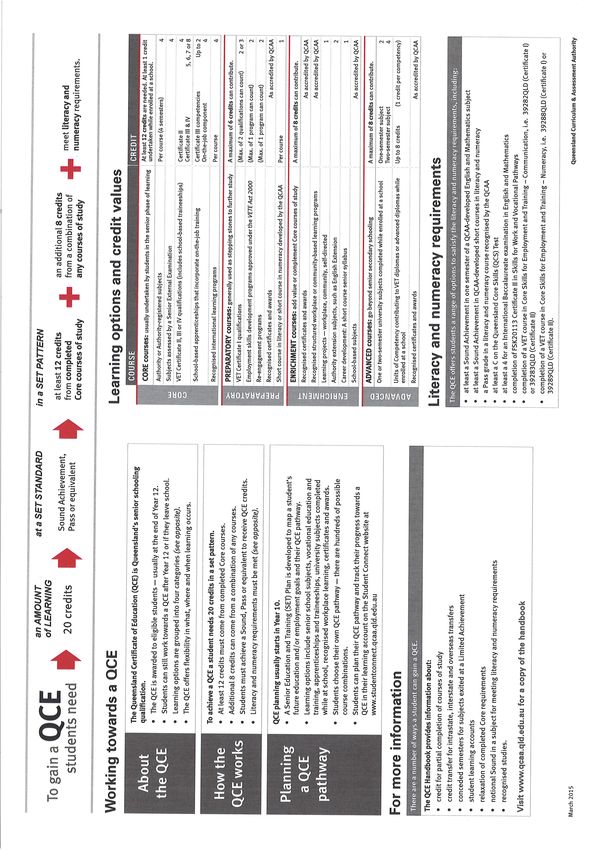
            Queensland Certificate of Education                                  24
            QCE Credit Table                                                     25
            References                                                            8
            Referencing Written Work                                          21-23
            Refund Procedure                                                      8
            Senior Formal                                                         6
            Student Drivers and Passengers Policy.                                9
            Student Leadership Positions                                          6
            Uniform Expectations                                                  6
            Wednesday Period 7 & 8 – Year 11 & 12 Hawk                            7
            Development
            Vision and Values                                                     5
            VET: Vocational Education & Training & Vocational                 29-32
            Opportunities
            VET: USI – Unique Student Identifier                                 34
            VET Expectations (SATs/TAFE Courses, Work Experience)             32-33
            VET: Industry Placement                                              33
            VET: RPL - Recognition of Prior Learning, Credit Transfer            35
            vs Mutual Recognition
            Year 12 Accreditation                                                 26
            FORMS
            Request for an Extension                                              38
            Access Arrangements and Reasonable Adjustments
                                                                              39-40
            Application Form AARA application Yr11 & Yr12
            Register of Student Driver                                           41
            RPL (Recognised Prior Learning) Application Form                  42-43

   Senior Students are also required to familiarise themselves with other school rules and
                      policies as set out in the 2020 Student Planner

Page 3                                                       2020 Senior Student Handbook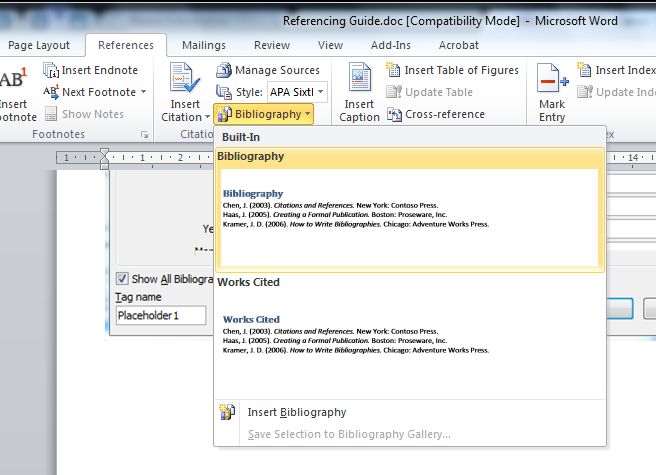
A Letter to Year 11 and Year 12 Students
Congratulations on reaching your final year(s) of Senior Secondary education at Harristown State
High School. Not every student makes it this far, so well done.

Independent of whether you are currently in Year 11 or Year 12, you are now in a prime position to
capitalise on everything that has happened so far in your education and in your life and to use all of
the knowledge, skills and experience you have gained to finish well, and to achieve your best
possible results and competencies.

If you are in Year 11, there will be significant changes from Year 10 in terms of your number of
subjects and also in terms of academic rigour.

There will also be significant changes to your assessment in Years 11 and 12 as you join over
30,000 other students across the state who will be the second group of students to achieve an
ATAR – an Australian Tertiary Admission Rank – as opposed to an OP – Overall Position – at the
conclusion of Year 12.

There may also be other significant changes in terms of the specific nature of the English and
Mathematics subjects you undertake, and well as possibly your first-ever introduction to one or more
of our school’s many Vocational Education and Training (VET) subjects, leading to a completed
Certificate I, II or III.

If you are in Year 12, much more of your assessment this year may be summative in nature. Our
Year 12s of last year, 2019, worked hard and brought significant improvement to their results in their
Year 12 year. I look forward to the same from you.

Like many other aspects of life, for example, sport, music, art, drama, your achievements will reflect
your effort, commitment and involvement – the more effort you make, the greater your rewards will
be; the more you commit to being involved in the life of the school the greater will be your personal
satisfaction, especially as it comes time for you to leave. I want you to leave with no regrets about
things you could have chosen to be involved in but didn’t, so when in doubt, participate, ‘have a go’,
and give it your very best.

As Year 11 and 12 students you have a vital part to play as leaders and role models for both your
peers and also for younger students. Whether they are aware of it or not, younger students observe
and learn from you about leadership, about attitude, about standards of behaviour, and about
personal presentation.

You are the people who pass on to them the cultural, sporting and community traditions that have
made Harristown the proud, dynamic school it is today.

You thus have a serious responsibility to properly guide and assist younger students, but you will, in
turn, have the support and the goodwill of your teachers, Year Coordinators, Positive Behaviour
Coaches, Heads of Departments, Deputy Principals and Principal as you lead the school.

Harristown State High School is very highly regarded in the Toowoomba community and you may
have helped make it the great school it is – but remember always that we must all continue to bear
the responsibility of ensuring that we as a school remain highly regarded.

Take good note of our school vision – Engage, Achieve, Excel – and apply this three-step process to
everything you do in life and school to achieve excellence.

I wish you the very best in these last all important years of your secondary schooling. I am proud of
you in reaching this important moment in your educational journey.

Ken Green
Executive Principal
Page 4                                                               2020 Senior Student Handbook
Vision and Values

                                Vision
                   Engage, Achieve, Excel….
                              an agenda for excellence

                                Values

As a place of learning, we value:

P articipation

R elationships

I ntegrity

D iligence

E nthusiasm

Page 5                                        2020 Senior Student Handbook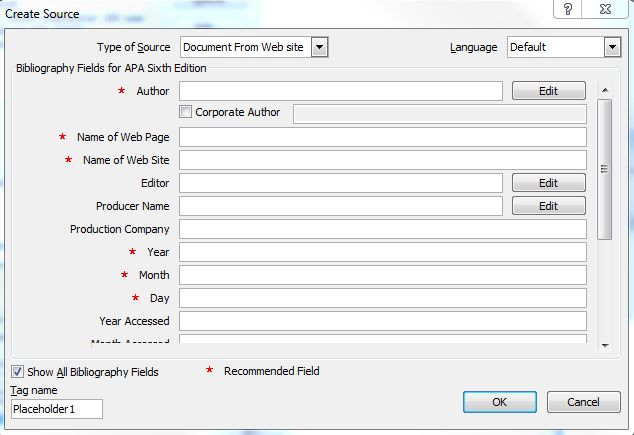
UNIFORM EXPECTATIONS
Year 11 students are encouraged to wear their formal uniform each day whilst Year 12 students are
expected to wear their formal uniform each day. The intention is to have the senior students stand
out as a group from the general student body. Seniors have an important leadership role to play in
modelling for younger students. This leadership role begins with your presentation.

Locker rooms in F Block are available for seniors to change from sport uniform to formal uniform
when needed during the school week.

                      STUDENT LEADERSHIP POSITIONS

Student Leadership has an important role to play in the Harristown High School community. At the
end of Year 11, twelve students will be elected to represent their peers as Gold Leaders. These
twelve students will include, two male and two female School Captains, 2 Arts and 2 Sports Prefects
and 4 Year Level Prefects. The Year Level Prefects will hold the Executive positions of the Student
Representative Council (SRC) as joint Presidents, Treasurer and Secretary. All other Gold Leaders
will represent the Year 12 students in the SRC. (Eight Year 11 students will also be elected to the
council.)

Each House will appoint 2 Captains and 2 Vice Captains (1 boy and 1 girl in each position). These
captains will work closely with the relevant Deputy Principal to action appropriate House and
lunchtime activities specific to the Houses. These students are known as Silver Leaders.

The school’s extra curricular programs operate smoothly because of the support of students elected
to the positions of captains of each sport and cultural activity such as debating and music. Positions
such as Basketball Captain, Drama Production and Debating Captains are known as Bronze
Leaders. At the end of Year 11, students can apply to undergo training in the Inter-year Program.
This program involves Year 12 students in developing relationships and nurturing Year 8 students.
Opportunities also exist to participate in Interact and the Formal committees.

                                 THE SENIOR FORMAL
The Senior Formal is a special occasion that recognises, in both a symbolic and practical way, that a
student has fulfilled his/her responsibilities to this school and the Queensland Curriculum and
Assessment Authority (QCAA) and will therefore be awarded a certificate to mark the completion of
his/her senior secondary years of schooling.

To be eligible to attend the Year 12 Formal, a student must:
   • attend school for a minimum 90% of the school year in each of the Senior years of schooling
       i.e. Year 11 and Year 12.
   • ensure that the school has received acceptable explanations for all absences in a timely
       manner (ie. it is not appropriate to explain all absences for the year towards the end of the
       school year)
   • have submitted ALL assessment for each subject
   • have no outstanding school fees or debts eg sporting or excursion fees or outstanding
       commitments to the textbook and equipment hire scheme
   • have returned any school resources that have been borrowed eg library books, sporting
       uniforms, music etc
   • have behaved appropriately throughout the school year.

Page 6                                                              2020 Senior Student Handbook
WEDNESDAY – PERIODS 7 and 8
YEAR 11 & 12 – HAWK DEVELOPMENT
ALL Year 11 & 12 students will remain at school for periods 7 and 8 on Wednesday afternoons to
participate in a Hawks Development Program of activities relevant to their successful transition to
the world beyond formal schooling. It will involve students in activities relating to Study Skills, Stress
Management and Lifestyle Balance, Leadership, Driver Education and Road Safety, and, where
applicable, Literacy/Numeracy Catch Up, Work Experience or Community Service.
PRESENTATION NIGHT
Presentation Night is a special event where students’ achievement is celebrated and their dedication
to their studies is recognised. To be eligible to be considered for various awards and prizes
students are encouraged to work diligently in all of their subjects and to keep a record in their diary
of the various school and community activities in which they participate during the year. For further
details see Student Planner.
Page 7 2020 Senior Student HandbookNAME ON OFFICIAL RECORDS
In recent years students have given serious thought to the name that appears on their official
records. Some students have sought to have their name on official records changed to that which
appears on their birth certificate. If a student wishes to have Year 12 Certificates issued in the name
on their birth certificate, then he/she will need to provide a copy of his/her birth certificate and a
written request from his/her custodial parent/caregiver to the office. This should be done as early as
possible to avoid disappointment.
CHECKING SENIOR DATA RECORDS
It is the responsibility of senior students to thoroughly check data records to ensure the accuracy of
data included in the Year 12 Senior Statement when issued. This data relates to name, date of
birth, contact details and details of study undertaken. This data can be check in the student’s QCAA
learning account which can be accessed at https://studentconnect.qcaa.qld.edu.au/ To access their
learning account students will require their LUI (which can be found on their school ID card) the
default password is their date of birth in the format DDMM eg 1st January is 0101. Students should
also list a personal email address so that QCAA / QTAC can contact them after their school email
account has been closed.
REFERENCES
Year 12 students leaving the school may apply for a reference. Given the lengthy process involved
in compiling references, a strict time line of submitting applications is implemented. Students must
submit their application for a reference by the due date advised. School references can be useful
not only when finding employment but when securing accommodation or perhaps even loans. This
reference will be compiled by form teachers who incorporate the knowledge of all subject teachers
regarding the student’s application to study and personal qualities. Extra curricular activities noted
on the application for reference will also be generally recorded within this reference. It would be
advisable to keep a list of your involvement and achievements throughout your secondary years to
include when you are making your application.
REFUND PROCEDURE
1. No refund is available for activities costing less than ten dollars, unless the school cancels the
activity.
2. If a student requests a refund prior to the closing date of an activity the student may apply for a
refund of the non-committed costs. “committed costs” are not refundable and may include the
cost of travel, prior reservations and administrative fee, among other items.
3. If a student is unable to attend an activity due to illness, a medical certificate will be required to
apply for a refund. The extent of the refund will depend upon the school’s consideration of the
excursion’s cost profile of committed and non-committed costs.
4. If a medical certificate is not supplied, committed costs (eg travel, reservations, administrative
fee) are not refundable.
5. Once a course has commenced through a private Registered Training Organisation (RTO) e.g.
TAFE, Binnacle Training, then a refund cannot be given as these courses have committed their
funds to the delivery of the training.
Page 8 2020 Senior Student HandbookSTUDENT DRIVERS AND PASSENGERS
POLICY
Rationale
This policy is designed to ensure that the school can fulfil its legal obligations and parents’
expectations. It will also serve to ensure that the reputation of the school is enhanced by the
development of high standards of student responsibility.
Policy
Any student who wishes to drive him/herself to school, or who wishes to travel in a vehicle driven by
another student going to or from school must firstly notify the school of this arrangement.
Procedures
• All students who wish to drive themselves to school must first notify their Year Co-ordinator of this
arrangement. It will be necessary to complete a “Register of Student Driver” form indicating
parent/guardian permission and the “Student Driver Declaration”.
• All student cars are to be parked in the area to the north of the Hennessy Street gate, along the
Stephen Street fence line or in Burton Street near Harristown Primary School. Cars may not be
parked in the school grounds.
• Student drivers may access their cars only when they leave at 3.00pm, or when they have been
given permission to leave the school grounds (eg for appointments).
• Students are not permitted to drive to sport or other school excursions where transport is
provided by the school. An exception to this is Presentation Night practice, where transport is
only provided to students who are unable to organise their own transport to the Empire Theatre.
• Any student who wishes to travel as a passenger in a car driven by another student must
have written permission from his/her parent/guardian specifying the terms, and have the letter
approved by their Year Co-ordinator prior to getting in the vehicle.
• Where this travel is a regular occurrence, (eg. daily travel to school), a single note will suffice.
Where this travel occurs occasionally, written permission will be required each time before
travelling. The note must indicate which student will be driving. It is assumed of course that the
student driver will have notified the school.
Page 9 2020 Senior Student HandbookCOMPULSORY PARTICIPATION PHASE
From the end of compulsory schooling, a young person enters a compulsory participation phase. A
young person’s compulsory participation phase starts when s/he stops being of compulsory school
age (i.e. turns 16 or completes Year 10 whichever comes first) and ends when the person –
gains a Senior Certificate, Certificate III or Certificate IV or
has participated in eligible options (various approved education or training programs) for 2
years after the person stopped being of compulsory school age or
turns 17.
In certain circumstances students may apply for an exemption from participating in the compulsory
participation phase if they are participating in eligible options. For further information, see your
Deputy Principal.
ATTENDANCE REQUIREMENTS IN POST-COMPULSORY
SCHOOLING (YEARS 11 & 12)
This school aims to develop in post-compulsory students a clear sense of responsibility for their actions, and
to prepare them for a successful transition into the world of work.
Regular attendance at school significantly enhances a student’s ability to achieve his or her academic
potential. To be eligible to receive a Queensland Certificate of Education a student must show that he/she
attends school consistently, participates in all aspects of the course of instruction and completes all course
assessment requirements. Our school attendance target is 95%, and this is expected of every student.
In Years 11 and 12, parent/guardian explanation for student absence is required. Parents are encouraged to
contact the school as early as possible to advise that a student will be or has been absent. Parents should
either telephone the school on the absence hotline (4636 8789) or email the details to
absence@harristownshs.eq.edu.au. Independent students must have their absences validated by the
guidance officer.
CHILD EMPLOYMENT LAWS
Child Employment Laws are applicable to students aged up to and including 15 years. These laws
limit the hours students are able to work so that children’s studies aren’t adversely affected by
employment. Senior students are urged to consider these guidelines so as not to disadvantage their
studies in their important senior years. The laws state the maximum allowable hours of work for
school-aged children as:
On a school day On a non-school day During a school week During a non-school
week
4 hrs 8 hrs 12 hrs 38 hrs
Page 10 2020 Senior Student HandbookSENIOR SCHOOL ASSESSMENT POLICY Scope Harristown State High School is bound by the General Principles, Assessment Requirements and Guidelines as set out in the school Assessment Policy. This policy forms part of that by providing information for teachers, students, parents/carers, and tutors about roles, responsibilities, processes and procedures to ensure the integrity of assessment that contributes to the Queensland Certificate of Education (QCE). The framework for the policy is developed from the QCE and QCIA policy and procedures handbook available from www.qcaa.qld.edu.au/senior/certificates-and-qualifications/qce- qcia-handbook-2019 and applies to Applied, Applied (Essential), General, General (Extension) subjects, and Short Courses across all faculties. Purpose Harristown State High School is committed to an educational philosophy that encourages all students to achieve personal excellence by developing their talents and abilities. This policy is designed to build capacity as students work towards summative assessment completion for the QCE. Principles Harristown State High School’s expectations for teaching, learning and assessment are grounded in the principles of academic integrity and excellence. Assessment includes any examination, practical demonstration, performance or product that allows students to demonstrate the objectives as described by the syllabus. Assessment should be: • aligned with curriculum and pedagogy • equitable for all students • evidence-based, using established standards and continua to make defensible and comparable judgments about students’ learning • ongoing, with a range and balance of evidence compiled over time to reflect the depth and breadth of students’ learning • transparent, to enhance professional and public confidence in the processes used, the information obtained and the decisions made • informative of where students are in their learning. High-quality assessment is characterised by three attributes: • validity, through alignment with what is taught, learnt and assessed • accessibility, so that each student is given opportunities to demonstrate what they know and can do • reliability, so that assessment results are consistent, dependable or repeatable. Page 11 2020 Senior Student Handbook
Promoting academic integrity
Harristown State High School promotes academic integrity by developing students’ skills and modelling
appropriate academic practices. The following whole-school procedures support this endeavour.

QCE and QCIA      Policy and procedures
policy and
procedures
handbook

Location and      The senior school assessment policy is located on the school website and in the Year 11 &
communication     12 Student Handbook. All questions regarding this policy should be directed to the
of policy
                  Guidance Officer or House Deputy Principal.

                  To ensure the assessment policy is consistently applied, it will be revisited at the beginning
                  of each semester in form classes. Relevant processes will be revisited:
                  •      at enrolment interviews
                  •      during SET planning
                  •      when the assessment schedule is published
                  •      when each task is handed to students
                  •      in the newsletter and by email in response to phases of the assessment cycle.

Expectations      At Harristown State High School there is an agenda for excellence. As such, the Assessment Policy
about engaging    is guided by the mantra of ‘non-submission is not an option’.
in learning and   Harristown State High School, therefore, has high expectations for academic integrity and student
assessment        participation and engagement in learning and assessment. Students become eligible for a QCE
Section 1.2.4     when they have accrued the set amount of learning, at the set standard, in a set pattern, while
                  meeting literacy and numeracy requirements. Students are required to complete all course and
Section 2
                  assessment requirements on or before the due date for their results to contribute credit to the QCE.
Section 8.5.1
                  Student responsibility
                  Students are expected to:
                  •       engage in the learning for the subject or course of study
                  •       produce evidence of achievement that is authenticated as their own work
                  •       submit responses to scheduled assessment on or before the due date.

                  To emphasise the importance of sound academic practices, staff and students will complete the
                  QCAA academic integrity courses.

Due dates         Harristown State High School is required to adhere to QCAA policies for gathering
(including        evidence of student achievement on or before the due date.
exams)
Section 8.5.2     Due dates for final responses and drafts will be published in the assessment schedule.
Section 8.5.3     Assessment schedules will be published by the end of week 3 of term1 and week 3 of term
                  3.

                  The assessment schedule will:
                  •      align with syllabus requirements
                  •      provide sufficient working time for students to complete the task
                  •      allow for internal quality assurance processes
                  •      enable timelines for QCAA quality assurance processes to be met
                  •      be clear to teachers, students and parents/carers
                  •      be consistently applied
                  •      be clearly communicated by the end of Week 3 of each semester
                  •      give consideration to allocation of workload.

Page 12                                                                    2020 Senior Student Handbook
Student responsibility:
Students are responsible for:
• recording due dates in their student planners
• planning and managing their time to meet the due dates
• informing the school as soon as possible if they have concerns about assessment
load and meeting due dates.
In cases where students are unable to meet a due date, it is the student’s responsibility to:
• inform both the Head of Department and classroom teacher as soon as possible
• provide the school with relevant documentation, for example, medical certificate
• adhere to alternative arrangements for submission of assessment, if applicable, as
decided by the school.
All final decisions are at the Principal’s discretion. Refer to AARA information below.
Submitting, Assessment instruments will provide information about Harristown State High School’s
collecting and arrangements for submission of draft and final responses, including due dates, conditions
storing and file types.
assessment
information All assessment evidence, including draft responses, will be submitted by their due date.
Section 9 Draft and final responses for all internal assessment will be collected and stored in each
student’s folio. Live performance assessments will be recorded and stored as required for
QCAA processes.
Appropriate Harristown SHS staff select materials in accordance with syllabus requirements, curriculum
materials priorities and Department of Education principles of inclusivity.
Section 7.1
Students are responsible for considering the appropriateness of any materials
Section 8.5.3 independently accessed or produced ensuring they are aligned with the school values.
Ensuring academic integrity
Harristown State High School has procedures to ensure that there is consistent application of the
assessment policy and that staff and students optimise opportunities to understand academic integrity.
The following procedures are to be applied in this context.
Internal assessment administration
QCE and QCIA Policy and procedures
policy and
procedures
handbook
Scaffolding Scaffolding for assessment helps students understand the process for completing the
Section 7.2.1 task. Scaffolding will:
• maintain the integrity of the requirements of the task or assessment instrument
• allow for unique student responses and not lead to a predetermined response.
Across the phases of learning, students will gradually be given more responsibility for
understanding the processes required to complete their tasks.
Checkpoints Checkpoints will:
Section 8.5.3 • be detailed on student task sheets
• monitor student progress
• be used to establish student authorship.
Students will work on assessment during designated times and show evidence of
Page 13 2020 Senior Student Handbookprogress at scheduled checkpoints.
Teachers will use these checkpoints to identify and support students to complete their
assessment.
Heads of Departments and parents/carers will be contacted if checkpoints are not met.
Drafting Drafting is a key checkpoint. Types of drafts differ depending on subject, for example,
Section 7.2.2 written draft, rehearsal of a performance piece, or a product in development. Drafts
Section 8.3 might be used as evidence of student achievement in the case of illness or
misadventure, or non-submission for other reasons.
Feedback on a draft is:
• provided on a maximum of one draft of each student’s response
• a consultative process that indicates aspects of the response to be improved or
further developed
• delivered in a consistent manner and format for all students
• provided ideally within one week of a submission of a draft.
Feedback on a draft must not:
• compromise the authenticity of a student response
• introduce new ideas, language or research to improve the quality and integrity of the
student work
• edit or correct spelling, grammar, punctuation and calculations
• allocate a mark.
A copy of the feedback will be stored with the draft in the student’s folio.
Parents and caregivers will be notified by text message about non-submission of drafts.
Managing Students must adhere to assessment response lengths as specified by syllabus
response length documents. The procedures below support students to manage their response length.
Section 7.2.3
• All assessment instruments indicate the required length of the response.
• Teaching and learning programs embed subject-specific strategies about responding
purposefully within the prescribed conditions of the task.
• Model responses within the required length are available.
• Feedback about length is provided by teachers at checkpoints.
After all these strategies have been implemented, if the student’s response exceeds
the word length required by the syllabus, the school will either:
• mark only the work up to the required length, excluding evidence over the prescribed
limit
or
• allow a student to redact their response to meet the required length, before a
judgment is made on the student work.
and, annotate any such student work submitted for confirmation purposes to clearly
indicate the evidence used to determine a mark.
Page 14 2020 Senior Student HandbookAuthenticating Accurate judgments of student achievement can only be made on student assessment
student responses that are authenticated as their own work.
responses
Section 7.3.1
Harristown State High School uses the authentication strategies promoted by the
QCAA. The authentication strategies will be specified on assessment instruments.
Where authorship of student work cannot be established, the school will:
• provide an opportunity for the student to demonstrate that the submitted
response is their own work
• make a judgment about the student’s knowledge and skills using the parts of
the response that can be identified as the student’s own work.Click or tap here to enter text.
Access Applications for AARA
arrangements
and reasonable Harristown State High School is committed to reducing barriers to success for all
adjustments, students. AARA are actions taken by the school to minimise, as much as possible,
including illness barriers for a student whose disability, impairment, medical condition or other
and circumstances may affect their ability to read, respond to or participate in assessment.
misadventure
(AARA)
Section 6 The school follows the processes as outlined in the QCE and QCIA policy and
procedures handbook available from www.qcaa.qld.edu.au/senior/certificates-and-
qualifications/qce-qcia-handbook-2019.
The Principal manages all approval of AARA for students.
All AARA applications must be accompanied by the relevant supporting documentation
(outlined in Section 6.5.1) and made as far in advance as possible to meet the QCAA
published timelines. All evidence used to make decisions is recorded in the student’s
file by the Principal or their delegate.
Students are not eligible for AARA on the following grounds:
• unfamiliarity with the English language
• teacher absence or other teacher-related issues
• matters that the student could have avoided (for example, misreading an examination
timetable)
• matters of the student’s or parent’s/carer’s own choosing (for example, family
holidays)
• matters that the school could have avoided.
Applications for extensions to due dates for unforeseen illness and
misadventure
Students and parents/carers must contact the Principal’s delegate on or before the due
date and submit the relevant supporting documentation. In the case of assignments a
copy of the student’s draft must be submitted for an extension to be considered.
Copies of the medical report template, variation application and other supporting
documentation are available from the school website
Page 15 2020 Senior Student HandbookCompletion of When enrolled in a General, General (Extension), Applied, Applied (Essential) subjects
course or Short Courses, students are expected to complete all course and assessment
requirements requirements. For summative units, a student must produce evidence of responses to
for senior
each of the summative assessments in order to receive an overall subject result.
subjects
Schools are responsible for ensuring that students have opportunities to access
Section 8.5
assessment.
Schools are responsible for ensuring that school communities are aware of assessment
requirements. The school will inform students and parents/carers in a timely manner
when incomplete assessment will mean that the student will not meet requirements for
a subject or course result.
Where a student is a late entry into Units 1 or 2 due to a change of subject, change of
school, or AARA-eligible illness or misadventure, a satisfactory result may be based on
a single piece of assessment, provided that all syllabus objectives are assessed by the
conclusion of units 1 and 2.
Managing non- Teachers will collect progressive evidence of student responses to assessment
submission of instruments at the prescribed checkpoints.
assessment by
the due date
Section 8.5 The checkpoints on the instrument-specific task sheets provide details of the evidence
that will be collected.
In circumstances where students are enrolled in a subject but do not submit a final
response to an assessment (other than unseen examinations) and where evidence of
student work:
• provided by the student for the purposes of authentication during the assessment
preparation period is available, teachers make judgments based on this
• was not provided by the student on or before the due date as specified by the school
and no other evidence is available, ‘Not-Rated’ (NR) must be entered in the Student
Management system by the date published in the SEP calendar.
In circumstances where a student response is judged as NR, the student will not meet
the requirements for that subject.
Internal quality Harristown State High School’s quality management system ensures valid, accessible
assurance and reliable assessment of student achievement. This process includes:
processes
Section 8.5.3 • quality assurance of all assessment instruments before they are administered to
students using quality assurance tools provided by the QCAA
• quality assurance of judgments about student achievement.
All marks for summative internal assessment for General and General (Extension)
subjects are provisional until they are confirmed by the QCAA.
Results for Applied and Applied (Essential) subjects and Short Courses may be subject
to advice from the QCAA.
Review Harristown State High School’s internal review processes for student results (including
Section 9.1 NR) for all General subjects (Units 1 and 2), Applied subjects, and Short Courses is
Section 9.2 equitable and appropriate for the local context.
Section 9.5
Page 16 2020 Senior Student HandbookExternal assessment administration
QCE and QCIA Policy and procedures
policy and
procedures
handbook
External Harristown State High School will administer external assessment in compliance
assessment is with the External assessment – administration guide, published by The QCAA
developed by See the QCE and QCIA policy and procedures handbook (Section 7.3.2) and follow
the QCAA for the External assessment — Administration guide for processes, roles and
all General and responsibilities of the school external assessment (SEA) coordinator, teachers and
General students.
(Extension) The academic responsibilities inherent in assessment administration should be
subjects approached by all parties in an honest, moral and ethical way.
Section 7.3.2
Schools:
Section 10.3
Section 10.4 • communicate rules and expectations for external assessment to their school
community, including teachers, students and parents/carers
See also: • maintain the security of external assessment materials
External
assessment — • provide supervision and conditions that comply with the external assessment
administration schedule and guidelines.
guide (provided
to schools each School external assessment (SEA) coordinators:
year)
• ensure that all external assessment guidelines and rules are shared with and
understood by teachers and students
• supervise external assessment, ensuring no undue assistance is provided that
contributes to a student’s assessment response.
Teachers:
• comply with rules and expectations when supervising the external assessment
• inform students that the SEA coordinator will be advised of any alleged incident of
academic misconduct
• report incidents of suspected or observed academic misconduct to the SEA
coordinator.
Students:
• read and comply with the external assessment student rules and information
provided by the school
• understand the importance of academic integrity when completing external
assessment and what constitutes academic misconduct (see Section 7.1.2:
Understanding academic misconduct)
• are aware that if unauthorised material is taken into an assessment room,
regardless of whether an attempt is made to use that material, they are in breach of
the regulations.
• Admitting students into an assessment room: Students should be admitted and
seated with sufficient time for supervising staff to communicate to students the
administrative requirements of the assessment. Once inside the room, students are
not permitted to speak, except to an external assessment supervisor.
• Late arrival to external assessment: If arriving within 40 minutes of the scheduled
starting time, the student is permitted entry into the assessment venue to complete
the assessment. No extra time to complete the external assessment is granted if a
student arrives late. The student may be required to complete the assessment in a
Page 17 2020 Senior Student Handbookdifferent room at the assessment venue. See External assessment —
Administration guide for further information.
• Refusing entry to external assessment: Any student not listed on the assessment’s
attendance roll will not be permitted entry, unless authorised by the QCAA. A
supervisor may also stop a student from entering an assessment room in
accordance with the rules governing refusing entry. Grounds for refusing entry to a
student relate only to unacceptable behaviour, or arriving too late to be admitted.
Breaches of the external assessment rules are a form of academic misconduct.
Managing academic misconduct
Harristown State High School is committed to supporting students to complete assessment and to submit
work that is their own, and minimising opportunities for academic misconduct. There may be a situation
when a student inappropriately and falsely demonstrates their learning. The following are some examples
of academic misconduct along with the procedures for managing them:
Types of misconduct Procedure
Cheating while A student: For authorship issues
under When authorship of student work
supervised
• begins to write during perusal time or cannot be established or a response is
conditions
continues to write after the instruction to not entirely a student’s own work the
stop writing is given college will provide an opportunity for
• uses unauthorised equipment or the student to demonstrate that the
materials submitted response is their own work.
• has any notation written on the body,
clothing or any object brought into an
assessment room For all instances of academic
misconduct
• communicates with any person other Results will be awarded using any
than a supervisor during an evidence from the preparation of the
examination, for example, through response that is available that is
speaking, signing, electronic device or verifiably the student’s own work and
other means such as passing notes, that was gathered in the conditions
making gestures or sharing equipment specified by the syllabus, on or before
with another student. the due date.
Collusion When:
• more than one student works to
produce a response and that response
is submitted as individual work by one
or multiple students
• a student assists another student to
commit an act of academic misconduct
• a student gives or receives a response
to an assessment.
Contract A student:
cheating
• pays for a person or a service to
complete a response to an assessment
• sells or trades a response to an
assessment.
Page 18 2020 Senior Student HandbookTypes of misconduct Procedure
Copying work A student:
• deliberately or knowingly makes it
possible for another student to copy
responses
• looks at another student’s work during
an exam
• copies another student’s work during an
exam.
Disclosing or A student:
receiving
information
• gives or accesses unauthorised
about an
information that compromises the
assessment
integrity of the assessment, such as
stimulus or suggested
answers/responses, prior to completing
a response to an assessment
• makes any attempt to give or receive
access to secure assessment materials.
Fabricating A student:
• invents or exaggerates data
• lists incorrect or fictitious references.
Impersonation A student:
• arranges for another person to
complete a response to an assessment
in their place, for example
impersonating the student in a
performance or supervised assessment
• completes a response to an
assessment in place of another student.
Misconduct A student distracts and/or disrupts others For instances of academic misconduct
during an in an assessment room. during examinations
examination
Students will be awarded a Not-Rated
(NR). See the QCE and QCIA policy and
procedures handbook (Section 8.5.1 and
Section 8.5.2). Where appropriate, the
school’s behaviour management policy
will be implemented.
Plagiarism or A student completely or partially copies or
lack of alters another person’s work without
referencing attribution (another person’s work may
include text, audio or audiovisual
material, figures, tables, design, images,
information or ideas).
Self-plagiarism A student duplicates work, or part of work
already submitted as a response to an
assessment instrument in the same or
any other subject.
Page 19 2020 Senior Student HandbookTypes of misconduct Procedure
Significant A student arranges for, or allows, a tutor,
contribution of parent/carer or any person in a
help supporting role to complete or contribute
significantly to the response.
Related school policy and procedures
Harristown State High School Responsible Behaviour Plan for Students
Harristown State High School assessment policy
Page 20 2020 Senior Student HandbookReferencing and Academic
Integrity Vocabulary
To cite or to reference = to
Academic Integrity quote or refer to a source;
It is important that all students understand how to demonstrate academic acknowledge others’ work
integrity or honest practice by referencing your sources correctly and A source = a person or an
avoiding plagiarism. Plagiarism is when you misrepresent work as your item (book, image, website)
own or fail to properly acknowledge your sources, including giving credit that supplies information
for images, coding and music, in your work.
What is referencing?
Referencing is acknowledging the information sources you have used in your assignment preparation
including ideas, theories and word-for-word quotations. Referencing is like putting together a puzzle. You find
the pieces of a reference when you look carefully around the resource. You need all the right pieces in the
right order: Author, Year, Title and Location. Different resources need different details.
Your teachers expect you to use a Referencing Style and use both In-Text Referencing and a Reference List.
A. What is a Referencing Style?
• A referencing style is a set of rules for how the reference list should look and how sources should be
acknowledged. There are many different referencing styles e.g. Harvard AGPS or APA.
• Punctuation is important. Each style has specific requirements. Rule #1 – be consistent use one tool
only.
• Refer to USQ Referencing Guides http://www.usq.edu.au/library/referencing or QUT CiteWrite for a
comprehensive list of examples http://www.citewrite.qut.edu.au/
APA style Harvard style
1. Microsoft Word 1. Online Referencing Generator
• References tab – select Style APA 6th • via Library Online referencing tab
2. Online Citation Makers (choose APA Style) • login: leave the username blank
• http://www.noodletools.com/noodlebib/citeone_s.php?st password = index
yle=APA 2. Pride Planner summary
• http://www.calvin.edu/library/knightcite/index.php
B. What is a Reference List or Bibliography?
• A list of all the resources you have referred to or cited when preparing your assignment
• All of the information about the source is formatted in a specific style
• It is placed at the end of the assignment and is arranged alphabetically by author
C. What is an In-text Reference or Citation?
• A short reference placed in brackets immediately after you quoted or used the source
• It is a summary of who said it (author) and when (year), and page if the quote is from a book
• It links to the full reference in your reference list
• In-text referencing is also required when you use a table, diagram or image from another work
Referencing checklist Check with your
Librarian or use
Have you made it as easy as possible for the reader to locate your source?
the Referencing
Have you supplied all the necessary details – Author, Year, Title and Location?
tab on Library
Is your referencing consistent and accurate?
Online for helpful
Has your teacher approved or requested the referencing style you are using?
videos and guides.
Have you acknowledged all words and ideas that you have drawn on?
Have you compiled a bibliography or list of references?
Does every in-text citation correspond to a specific reference in the bibliography/list of references?
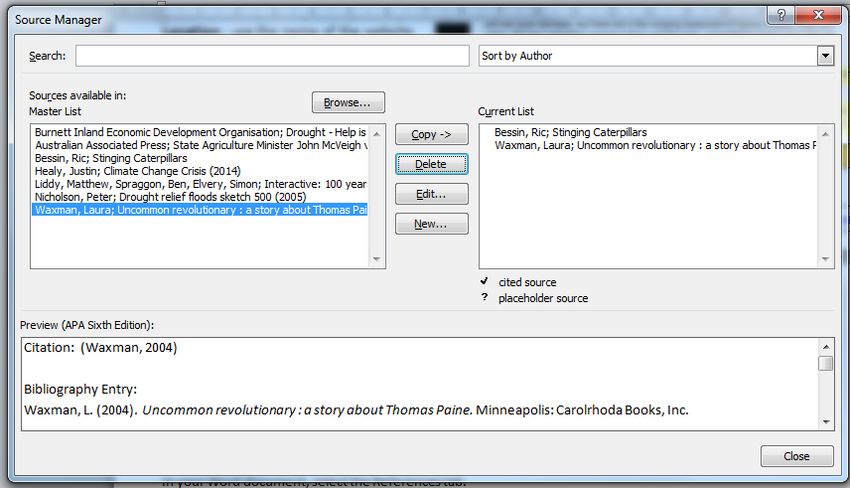
Page 21 2020 Senior Student HandbookMake referencing easy with Microsoft Word:
Use the References tab of your word document as you are preparing your assignment. Every time you take
notes from a source, record the details of the source and save.
1. Select the References tab
2. Check the Style (APA 6th edition)
3. Select Manage Sources
1 3
2
4. Select New to create a source
4
5. Complete Create Source form:
• Choose Type of Source from drop down menu (Hint: if your source type isn’t there, click on closest
e.g. if a web article choose Document from web site; Tick Show All Bibliography Fields)
• Complete details for
Author – click Edit and enter names, tick ‘Corporate Author’ for an organisation
Year - for websites use n.d. for ‘no date’ if you can’t find a date for a the page
Title of the document, page or image
Location – Place of Publication and Publisher for print resources; web address (URL) for websites.
Page 22 2020 Senior Student Handbook5
6. Select Insert Citation (in-text references) for every
quote or reference to someone else’s ideas. Choose 6
your source or add a new source.
7. When you have a record of all sources you have used, select Bibliography to automatically insert the
reference list at the end of your assignment. This can then be copied into a slide or other if presenting an
oral/multi-modal assessment.
7
Page 23 2020 Senior Student HandbookQueensland Certificate of Education (QCE) & Banking Credits
Eligibility for a QCE
To be eligible for a QCE, a student must be enrolled with a school and registered with the
Queensland Curriculum and Assessment Authority. It is an expectation that students will
achieve the QCE over Years 11 and 12.
The total amount of learning required is at least twenty credits. This reflects an amount of learning
that could be reasonably achieved by most young people over a two-year, full-time program of study
in the Senior Phase of Learning.
What is a credit?
A credit is the minimum amount of learning at the set standard that can contribute to the QCE. A
credit has two elements: an amount of learning and a set standard. For example, a credit for a
school subject is one unit at satisfactory achievement. A credit for a certificate II qualification is 25%
of the competencies.
Some learning achievements will be recorded in the Learning Account but will not be a credit
because they either do not have the required amount of learning or they do not meet the set
standard. For example, a limited / unsatisfactory achievement in a school subject does not meet the
set standard to be a credit.
Banking Credits
Students are responsible to complete a Credit Banking Form to advise the school of qualifications or
appropriate documented experiences completed external to the school so that these may be banked
on your behalf. (see QCE Banking Credits Form)
Flexibility
This qualification will recognise more learning options. Students can design a program of study to
match their career goals. There is more flexibility in what, where and when learning occurs. Not all
the learning need take place at school. Some learning can be with a registered training provider
(e.g. TAFE), in a workplace or with a community group. The list of options is in the table on the
following page.
The Senior Statement
The Senior Statement is an official record of all the learning achievements in a Learning Account. It
details: what learning was attempted, the standard achieved and, where and when the learning took
place.
The QCAA will issue the Senior Statement to young people who:
• Have met the requirements for the Queensland Certificate of Education, or
• Are attending a school, and have banked at least one achievement in their Learning
Account, and are enrolled at a school until the prescribed date at the end of Year 12, or
• Have completed a pattern of study which makes them ATAR eligible.
Relevant Laws
The QCE complements the Government’s “learning or earning” laws which mean everyone will be
required to complete Year 10 at school and go on to either complete a further two years of education
and training, or move into full time employment. (See Compulsory Participation Phase)
Page 24 2020 Senior Student HandbookPage 25 2020 Senior Student Handbook
YEAR 12 ACCREDITATION
What accreditation will students receive at the end of Year 12?

All students with at least one semester of study and in attendance on the last day of
Year 12 will receive:

          ♦ A Senior Statement documenting the subjects studied and levels of
            achievement.

Students who satisfactorily complete an English subject, and complete five General
subjects, or four General subjects plus one Applied subject or VET course at AQF
Certificate III or above will receive:

          ♦ An Australian Tertiary Admission Rank (ATAR)

Students with at least 12 years of schooling and school recognition that the student has
an impairment or learning difficulty who is in attendance on the last day of Year 12 will
receive:

          ♦ A Queensland Certificate of Individual Achievement detailing: their
            achievements, any VET competencies and a statement of participation.

Students who have successfully completed the necessary core and elective Vocational
Education Modules with either Harristown State High School or an external Registered
Training Organisation will receive:

          ♦ A Certificate I, II, III or IV

Students who obtain 20 credits by meeting the various requirements, as noted
previously, will receive:

          ♦ A Queensland Certificate of Education
            Attainment of a QCE is viewed by State Schooling as ‘graduation’ from
            secondary school.

Page 26                                                       2020 Senior Student Handbook
Complaints and Appeals Policy (ATAR and VET)
Should you have a complaint or wish to appeal a decision made by the school, then there is a
process that you will need to go through. There is also a formal appeal process available through
the Queensland Curriculum and Assessment Authority (QCAA) should you wish to appeal your OP
Score or VET results. Please refer to the QCAA website for this information.
Student identifies
complaint and
commences process
Student completes
Appeals Form.
Appeals form can
be collected from
HOD Senior
Student and Schooling or Student submits Student prepares
Teacher attempt Deputy Principal appeals form stating written application to
to resolve issue. (VET), Student, nature of complaint. Principal. Meeting
(mutually agreed Parent/Caregiver, Reviewed by Guidance with Guidance
time/venue) Teacher and Head Officer, HOD and Officer, HOD,
of Department Teacher. Parents & Principal
review appeal. Parents/Caregivers to review grievance.
informed of the Student and
grievance and appeal. Teacher may speak
HOD prepares written to the issue. Five
response (within 10 days notice given of
working days). meeting. Decision
given within 5 days
of meeting.
APPEAL PROCESS
Page 27 2020 Senior Student HandbookREQUEST TO ALTER SCHOOL
BASED CURRICULUM PROGRAM
Student’s Name: ___________________________ Form: ____ Year Level: _____
SUBJECT DETAILS: Enter the subjects you have studied since commencing study in Year 11
Semester 1 Semester 2 Semester 3 Semester 4
Subject Result Subject Result QCE IMPLICATIONS
Subject Result Subject Result
Literacy
Numeracy
Completed Core
(3 subjects/Cert 2 over 4
semesters completed
successfully)
Working towards 20 credits
QUALIFICATION
VET Competency
ATAR eligible
Initialled by GO: ______
Initialled by DP: ______
Change/s Requested
Signature
Subjects Teacher Recommended
Teacher HOD
FROM: Y/N
*TO: Y/N
FROM: Y/N
*TO: Y/N
FROM: Y/N
*TO: Y/N
*where a GAP is requested please see GAP REQUEST section below.
Guidance Comment ___________________________________________________________________________
________________________________________________________________________________________________________________
GAP REQUEST: Written Application must be lodged outlining particular circumstances. In addition, documentary evidence (proof
of course enrolment, Dr Certificate, etc) is to be attached to written application.
Reason for GAP:
Head Start Program ESL Student
TAFE Course: Course Details _________________________________________________________
Study off Campus/SDE: Course Details __________________________________________________
Personal Reasons – give brief details: ___________________________________________________
Other – give details: _________________________________________________________________
Subject to be dropped to gain GAP: __________________
AUTHORISATION
Parent/Guardian Signature: ___________________________ Date: ____________
Student’s Signature: _________________________________ Date: ____________
House Deputy Signature: _____________________________ Date: ____________
Approved by Deputy Principal: _________________
Page 28 2020 Senior Student Handbook2020
VOCATIONAL EDUCATION &
TRAINING (VET)
(Nb. This section was correct at time of printing)
VOCATIONAL EDUCATION STAFF
Ms Sharon Matheson Head of Department - Senior Schooling S210
Ms Jeanine Briese Industry Placement Officer S208
VET TOPICS IN THIS SECTION
An Overview of VET
VETiS – VET in Schools
VET Study Options through HSHS
I’ve decided which VET Option is for Me. What now?
USI – Unique Student Identifier
USI FAQs
Credit Transfer versus Mutual Recognition
RPL – Recognition of Prior Learning
Nb. For the fullest and latest VET information, please use the links provided in this document.
Page 29 2020 Senior Student HandbookAN OVERVIEW OF VET
Australia’s VET Sector (http://www.asqa.gov.au)
Vocational education and training (VET) enables students to gain qualifications for all types of
employment, and specific skills to help them in the workplace.
The providers of VET include technical and further education (TAFE) institutes, adult and community
education providers and agricultural colleges, as well as private providers, community organisations,
industry skill centres, and commercial and enterprise training providers. In addition, some universities
and schools provide VET.
Vocational education and training is provided through a network of eight state and territory governments
and the Australian Government, along with industry, public and private training providers. These
organisations work together to provide nationally consistent training across Australia.
The VET sector is crucial to the Australian economy; both for the development of the national workforce
and as a major export industry.
Registered Training Organisations – RTOs https://www.usi.gov.au/about and SRTOs
An RTO* is any organisation that is registered with a regulator eg: ASQA (Australian Skills Quality
Authority) to deliver nationally recognised training and qualifications.
There are currently (26/02/2019) around 5,000 RTOs in Australia and they can include:
• colleges of Technical and Further Education (TAFEs) and other government training
organisations
• private/non-government training organisations
• high schools that provide nationally recognised training ie: Harristown SHS
• employers and other organisations that provide nationally recognised training
Training organisations can offer qualifications at the following levels:
• Certificate I, II, III and IV
(Nb. Harristown SHS delivers courses at Certificate II level Binnacle Training delivers courses
at Certificate II and III levels)
• Diploma
• Advanced Diploma
• Vocational Graduate Certificate
• Vocational Graduate Diploma
Note: Even if you enrol with a training organisation to complete only part of a course, a module or a
single unit you will still require a USI.
Harristown SHS is registered to provide nationally recognised training please visit training.gov.au
or ask Harristown’s VET staff.
Most training organisations are regulated by the Australian Skills Quality Authority (ASQA).
An SRTO* (Supervising Registered Training Organisation) is a registered training organisation that
delivers training and assessment services to an apprentice or trainee under a training contract.
SRTOs also work with employers and apprentices or trainees to develop a training plan and will issue a
qualification on successful completion of the apprenticeship or traineeship—therefore every
apprenticeship and traineeship must have an SRTO.
https://www.qld.gov.au/education/apprenticeships/for-trainers/training
Page 30 2020 Senior Student HandbookYou can also read


