TEACHER ACTIVITY GUIDE - PRO FOOTBALL HALL OF FAME 2019-2020 EDITIOn
←
→
Page content transcription
If your browser does not render page correctly, please read the page content below
PRO FOOTBALL HALL OF FAME
TEACHER ACTIVITY GUIDE
          2019-2020 EDITIOn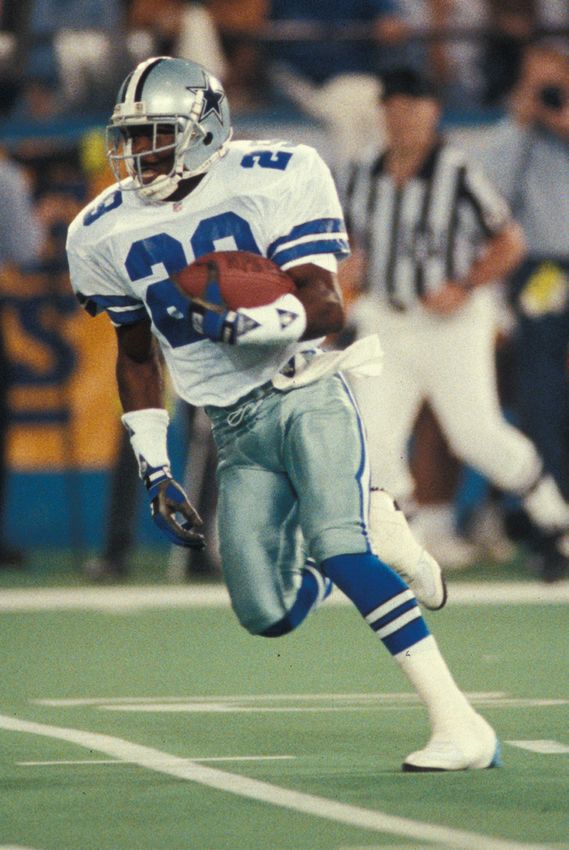
DALLAS COWBOYS
                              Team History
In 1960, the Dallas Cowboys became the NFL’s first successful new team since the collapse of the All-
America Football Conference 10 years earlier. Clint Murchison Jr. was the new team’s majority owner and
his first order of business was to hire Tex Schramm as general manager, Tom Landry as head coach and
Gil Brandt as player personnel director.
This trio was destined for almost unprecedented success in the pro football world but the “glory years”
didn’t come easily. Playing in the storied Cotton Bowl, the 1960 Cowboys had to settle for one tie in 12
games and Dallas didn’t break even until its sixth season in 1965. But in 1966, the Cowboys began an
NFL-record streak of 20 consecutive winning seasons. That streak included 18 years in the playoffs, 13
divisional championships, five trips to the Super Bowl and victories in Super Bowls VI and XII.
Dallas won its first two divisional championships in 1966 and 1967 but lost to the Green Bay Packers in
the NFL championship game each year. Similar playoff losses the next seasons were followed by a 16-13
last-second loss to Baltimore in Super Bowl V following the 1970 season. The Cowboys were typified as
“a good team that couldn’t win the big games.”
But they dispelled such thought for good the very next year with a 24-3 win over the Miami Dolphins in
Super Bowl VI. The Cowboys were Super Bowl-bound three more times from 1975 to 1978. They lost to
Pittsburgh in extremely competitive games in Super Bowls X and XIII but defeated the Denver Broncos
27-10 in Super Bowl XII. During their big years of the 1970s, the Cowboys were led by such future Pro
Football Hall of Fame members as quarterback Roger Staubach, tackle Rayfield Wright, defensive tackles
Bob Lilly and Randy White, defensive back Mel Renfro and running back Tony Dorsett.
In 1967, Murchison announced that the Cowboys would build their own stadium in suburban Irving,
Texas. A new Dallas pro football era began on October 24, 1971, when 65,024-seat Texas Stadium was
opened.
The Cowboys of the 1970s and early 1980s were known as “America’s Team,” an outfit that was just a
step ahead of almost every other club when it came to image-enhancing promotions such as The Dallas
Cowboys Newsweekly with a circulation of 100,000, sales of Cowboys souvenirs and apparel and the
famous Dallas Cowboys cheerleaders.
The Cowboys suffered their first losing season in two decades in 1986 and fell all the way to 3-13 in
1988. H. R. “Bum” Bright, who had purchased the Cowboys from Murchison in 1984, sold the team to
Jerry Jones in 1989. Jones named former University of Miami coach Jimmy Johnson to replace Landry,
who finished his career with 270 victories, third most by any coach in history. Jerry Jones’ efforts were
recognized in 2017, when he was enshrined into the Pro Football Hall of Fame.
Johnson’s first team won only once in 16 games but some daring trades and shrewd selections in the
annual NFL draft - that included Hall of Fame quarterback Troy Aikman - quickly returned the Cowboys
to championship status in Super Bowl XXVII, the fourth season of the Jerry Jones regime. They followed
with a second straight world title in Super Bowl XXVIII. In March 1994, college coach Barry Switzer
replaced Johnson and the winning continued under Switzer. The team won its third Super Bowl in four
years with a 27-17 victory over the Pittsburgh Steelers in Super Bowl XXX. After Switzer, there were 4
more head coaches until Jason Garrett was named head coach in 2011 after serving as the teams interim
head coach midway through the 2010 season. After seeing Tony Romo retire in 2016, the team looked to
quarterback Dak Prescott and running back Ezekiel Elliott to take them back to The Big Game.

 ProFootballHOF.com                                1            Pro Football Hall of FameYouth & Education
DALLAS COWBOYS
Canton, Ohio and the National Football
League
E
ach year, approximately 250,000 fans from all over the world visit the Pro Football Hall of Fame in
Canton, Ohio. The museum’s guest register reveals that in a year’s time, visitors come from all fifty
states and from sixty to seventy foreign countries.
Many wonder why the Hall of Fame is located in this small northeast Ohio city. Often, museums are
built in locations that have historical significance to their subject matter. The Pro Football Hall of Fame
is no exception. Canton’s ties to pro football began long before the Hall of Fame was built in 1963. On
September 17, 1920, a meeting was held in an automobile showroom in downtown Canton. It was at
this time that the American Professional Football Association was formed. Two years later, the league
changed its name to the National Football League.
Today, fans follow teams like the Dallas Cowboys, San Francisco
49ers, and the Miami Dolphins. But, in 1920, none of those
teams existed. Rather, the NFL had teams like the Columbus
Panhandles, Dayton Triangles, Rochester Jeffersons, and the
Canton Bulldogs.
The Canton Bulldogs were the first real pro football
powerhouse. They won the NFL title in 1922 and 1923 making
them the league’s first two-time champion.
They were a strong team even before the NFL began because
of their star player Jim Thorpe. Thorpe, a Native American
Indian, was a tremendous athlete. Not only did he play pro
football but he played pro baseball and won two gold medals
in the 1912 Olympic Games. Even today, he is considered to
be one of the world’s greatest athletes of all time.
While the Bulldogs are no longer around, pro football
remembers its early days in Canton, Ohio. Visitors, young and
old, enjoy the story of pro football’s history in the city where
the NFL began! The Legendary Jim Thorpe
Pro Football Hall of Fame Youth & Education 2 ProFootballHOF.comDALLAS COWBOYS
Who Was Jim Thorpe?
It seems that whenever stories are written about an all-time pro football great, Jim Thorpe’s name
comes up. Jim Thorpe was born in a one-room cabin in Prague, Oklahoma, on May 28, 1888. Though he
had some Irish and French blood, he was mostly of Sac and Fox Indian heritage. In fact, his Indian name
was Wa-Tho-Huk, which means Bright Path.
Though football was his first love, he gained his greatest fame as a track star, winning the decathlon
and pentathlon events in the 1912 Olympics, held in Stockholm, Sweden. King Gustav V of Sweden told
Thorpe as he presented him with his medals, “Sir, you are the greatest athlete in the world.” But soon
afterward, Thorpe was stripped of his records and medals when it was learned that he had played minor
league baseball for money in 1911. In 1984 the Olympic Committee decided that this was an unfair
interpretation of the then Olympic rules and restored his records and returned his medals to his family.
In 1915, Thorpe’s great abilities and fame led Jack Cusack to offer him $250 a game to play football for
the Canton Bulldogs. While that may not sound like much, it was twice as much as most players were
making back then. Even Cusack’s friends warned him that he was paying Thorpe too much. Just the
same, Thorpe was everything Cusack had hoped he would be -- a great player and a gate attraction.
After missing the first two games of the 1916 season because he was playing pro baseball for the New
York Giants, Thorpe joined the Canton squad. With Jim playing halfback, the Bulldogs were unofficial
World Champions in 1916, 1917 and 1919. (The Bulldogs’ championships are said to be unofficial since
no organized pro league existed at the time.)
Many old-timers who actually played against Thorpe claimed he was the toughest man ever to play
the game. Legend says that Jim would drop-kick a field goal from the 50-yard line, then turn and kick
another 50-yarder in the opposite direction with perfect results-just to show off. Others say he could
punt a ball the length of the field. Both are probably exaggerations. In any case, there is no doubt that
Thorpe was a superb athlete. All accounts suggest he could run with speed and bruising power. He
could pass and catch passes with the best. He could kick with accuracy and strength. And, of course, as
players did back then, he played defense too.
By the time the NFL was organized in 1920, the thirty-two-year-old Thorpe, who was already past his
athletic prime, was unanimously voted the league’s charter president. However, he managed to play
eight NFL seasons with six different teams and his gate appeal continued. Though at times he sparkled
like the Thorpe of old, he never really excelled as much in the NFL as he had in his earlier career. In
1928, at the age of forty he finally called it quits. In 1950, the nation’s press honored Thorpe by naming
him the most outstanding athlete of the first fifty years of the twentieth century. In 1963, he was elected
a charter member of the Pro Football Hall of Fame.
Source: Excerpt from The Official Pro Football Hall of Fame Answer Book by Joe Horrigan, Simon &
Shuster Inc., 1990.
If you would like to know more about Jim Thorpe, a good book to read is Jim
Thorpe by Bob Wheeler (University of Oklahoma Press, 1979).
ProFootballHOF.com 3 Pro Football Hall of FameYouth & EducationDALLAS COWBOYS
Emmitt Smith
Goals/Objectives:
Students will:
• Conduct research on issues and interests by generating ideas and questions and by posing
problems. They gather, evaluate and synthesize data from a variety of sources (e.g., print
and nonprint displays and artifacts) to communicate their discoveries.
• Use a variety of technological and informational resources (e.g., video, displays, databases)
to gather and synthesize information and to create and communicate knowledge.
• Develop an understanding of and respect for diversity in language use, patterns and
dialects across cultures, ethnic groups, geographic regions and social roles.
• Use spoken, written and visual language to accomplish their own purposes (e.g., for
learning, enjoyment, persuasion and exchange of information).
Common Core Standards: RI- Key Ideas and Details, Integration of Knowledge and Ideas; W-
Text Types and Purposes, Research to Build and Present Knowledge; SL- Presentation of Knowledge and
Ideas
Methods/Procedures:
• Students will read the biographical sketch on Emmitt Smith (next page) as a class and
discuss his role in black history and the history of pro football.
• Students will compile a list of questions that they would ask Emmitt Smith if he were
available at the Hall of Fame the day of the visit.
• If each student were allowed to ask three questions from his/her list, which three would
he/she ask? Students should star those three questions.
• Students would be given an assignment to research any Cowboys Hall of Famer to gather
five to ten facts or bits of information on them to share with the class. Students would be
encouraged to access the Hall’s official website: ProFootballHOF.com.
• Students will gather more information on their chosen individual that they previously did
not know.
• Students will then write the information in paragraph form and present any new facts or
bits of information that they discovered.
Materials:
• Emmitt Smith biography (1 page)
• ProFootballHOF.com
Assessment:
• Students will submit the informational essay/reports on their chosen Cowboys Hall of
Famer.
• Students will deliver formal presentations on their chosen Cowboys Hall of Famer that will
demonstrate a clear and distinctive perspective on the subject chosen and convey relevant
information and descriptive details.
Pro Football Hall of Fame Youth & Education 4 ProFootballHOF.comDALLAS COWBOYS
Emmitt Smith
The Dallas Cowboys were rebuilding when they selected Florida running back Emmitt Smith in the first
round of the 1990 draft. After a holdout during all of training camp and preseason of his rookie season,
Smith reported to the Cowboys in time for the start of the regular season. He wasted no time in proving
he was going to be a huge part of the team’s future.
Smith rushed for 937 yards and scored 11 touchdowns to earn
Offensive Rookie of the Year honors and the first of eight career Pro
Bowl nods. He followed that season by rushing for a league-leading
1,563 yards. Smith won four rushing crowns during a five-year span
as he added titles in 1992, 1993, and 1995. He also led the NFL in
rushing touchdowns three times and contributed 277 pass receptions
during that same five-season period.
His best year came in 1995 when he recorded career highs for
rushing yards (1,773), rushing touchdowns (25), and receptions (62).
Not surprisingly, Smith’s impact on the team helped nurture the
Cowboys back to the top of the NFL. The Cowboys, with their star
runner leading the way, won three Super Bowls over four seasons
from 1992 to 1995. Smith was named first-team All-Pro in each year during that four-year period. In
1993, he was named the NFL’s MVP and followed that by earning Most Valuable Player honors in the
Cowboys’ 30-13 win over the Buffalo Bills in Super Bowl XXVIII.
After narrowly missing the 1,000-yard mark as a rookie, Smith embarked on a record run of 11 straight
seasons with 1,000 yards rushing. His streak came to end in Smith’s final season in Dallas in 2002
when he missed the 1,000-yard mark by a mere 25 yards. However, that season was highlighted by one
particular game against the Seattle Seahawks on Oct. 27, 2002. In that contest, Smith supplanted Walter
Payton as the NFL’s all-time rushing leader.
Smith, who was named to the NFL’s All-Decade Team of the 1990s, finished his 226-game career by
playing two final seasons with the Arizona Cardinals. He retired with a career total of 18,355 yards and a
NFL record 164 rushing touchdowns. He also added 515 receptions for 3,224 yards and 11 touchdowns.
ProFootballHOF.com 5 Pro Football Hall of FameYouth & EducationDALLAS COWBOYS
Tackling Football Math
Goals/Objectives:
Students will:
• Improve math skills by applying basic functions to the game of football.
• Learn basic football facts and game terms.
• Utilize statistics of NFL football players and teams for computing math problems.
• Research statistics of selected NFL football players and teams for use as alternative
information in certain math problems.
Common Core Standards: Operations and Algebraic Thinking; Number Operations in Base Ten;
Measurement and Data
Methods/Procedures:
• Students will complete the math worksheets provided on the following pages related
to the game of football. They may work independently or with others. Feel free to
make adaptations in players and teams to suit your students. Answers to the following
worksheets are found in the back of this publication.
* Conversions in Football (CCS: Measurement and Data)
* Super Bowl Thunder (CCS: Number Operations in Base Ten; Measurement and Data)
Materials:
• Pencil
• Scrap paper for working problems
• Calculators if permitted
• Worksheets
Assessment:
• Students will be assessed on accuracy of responses.
Pro Football Hall of Fame Youth & Education 6 ProFootballHOF.comDALLAS COWBOYS
Conversions in Football
Directions: Complete the following problems, be sure to show all of your work on a
seperate sheet of paper.
1. During his career, Emmitt Smith rushed for 18,355 yards. How many feet is that? __________
2. In 2018 Amari Cooper’s longest reception of the year was 90 yards. How many inches is that?
______
3. Dak Prescott threw for 3,885 yards in 2018. How many miles is that? _______ Round to the
nearest tenth. *(Hint: 1 mile = 1,760 yards)
4. In 2018 Ezekiel Elliott led the Cowboys in rushing with 1,434 yards. How many feet is
that?__________
5. The Cowboys have the ball on their own 25-yard line and they complete a 45-yard pass. They
then lose 4 yards on the next play. What yard line are they now on? __________
6. Dak Prescott threw a 54-yard pass. How many inches did he throw? _________ How many
centimeters?__________ Hint: 1 inch = 2.54 centimeters
7. A football field measures 100 yards from goal line to goal line. A field is 53 1/3 yards wide.
Convert these measurements to feet. __________ _____________
8. If an NFL player weighs 303 pounds. How much does he weigh in ounces? ____________
9. A game normally lasts 60 minutes. During a 16-game season, how many total minutes does one
team play? ___________
10. There are seven officials on the field for every NFL game. If 16 games are played each week,
what is the total number of officials officiating throughout the NFL each week? ____________
ProFootballHOF.com 7 Pro Football Hall of FameYouth & EducationDALLAS COWBOYS
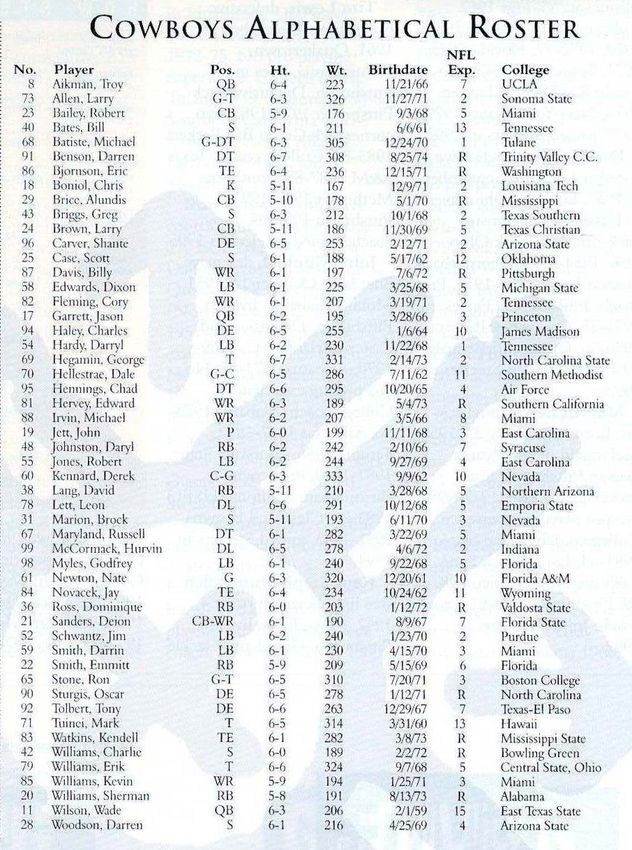
Super Bowl Thunder
Directions: Answer the following questions using the Dallas Cowboys’ roster on the
following page.
1. Who was the oldest player on the team?
2. What number was Michael Irvin?
3. How many wide receivers (WR) were there?
4. How many players had 10 or more years of NFL experience?
5. How many quarterbacks (QB) were listed?
6. Who was the only player to attend Emporia State University?
7. Who was the heaviest player on the team?
8. Who was the lightest player on the team?
9. What position did number 21 play?
10. Add up the total weight of all the running backs (RB).
Pro Football Hall of Fame Youth & Education 8 ProFootballHOF.comDALLAS COWBOYS
Super Bowl Thunder
Dallas Cowboys Super Bowl XXX Roster
Source: Super Bowl
XXX Game Program
ProFootballHOF.com 9 Pro Football Hall of FameYouth & EducationDALLAS COWBOYS
How Much Can Be Recycled?
Goals/Objectives:
Students will:
• Explain how technology influences the quality of life.
• Discuss how decisions about the use of products can result in desirable or undesirable
consequesces.
• Use examples to predict and analyze.
• Recognize that science can only answer some questions and technology can only solve
some human problems.
• Describe examples of scientific advances and emerging technologies and how they impact
society.
National Standards: Science: 5-Science and Technology
Methods/Procedures:
• The students and teacher will compile a list of objects that accumulate from fans, players
and workers at any NFL game.
• Students gather, if possible, concrete examples of listed items.
• Students determine which listed objects can be recycled.
• Through letters, calls, emails, and possibly personally, determine which stadiums recycle
and what items they recycle.
• After compiling all three lists, using a mathematical formula, including amount of each
product sold, students determine the weight of each recyclable item/team’s game and or
season through extrapolation.
Materials:
• Students and teacher created item list
• ProFootballHOF.com
• Scales for weighing objects
Assessment:
• Student created tables of items sold, recyclable items, items recycled and total poundage.
• Students will deliver a formal presentation on their findings.
• Teacher posts results and student findings (charts).
Pro Football Hall of Fame Youth & Education 10 ProFootballHOF.comDALLAS COWBOYS
How Much Can Be Recycled?
AT&T Stadium
Item A Item B Item C Item D
Items Sold
Total Weight: Total Weight: Total Weight: Total Weight:
Game 1
Total Weight: Total Weight: Total Weight: Total Weight:
Game 2
Total Weight: Total Weight: Total Weight: Total Weight:
Game 3
Students may add items, delete items, add games, delete games depending on time constraints.
ProFootballHOF.com 11 Pro Football Hall of FameYouth & EducationDALLAS COWBOYS
From Humble Beginnings:
The Story of the Cowboys
Goals/Objectives:
Students will:
• Understand the beginnings of football as we know it today.
National Standards: U.S. History: 11 - Era 7: The Emergence of Modern America (1890-1930); 12
- Era 8: The Great Depression and World War II (1929-1945); 13 - Era 9: Postwar United States (1945 to
early 1970’s); 14 - Era 10: Contemporary United States (1968 to the Present)
Methods/Procedures:
• Students will visit the Dallas Cowboys’ website: DallasCowboys.com and the Pro Football
Hall of Fame;’s website: ProFootballHOF.com. A tour through these websites informs
students how the Cowboys began, who were the early superstars, and who helped the
Cowboys become what they are today. Students will take notes.
• If the class can take a field trip to AT&T Stadium, students should take notes as they tour.
• Students will complete a one page report on the history of the Dallas Cowboys from the
research gathered.
• Students will then present this information (first game, first player drafted, etc.) to the
class.
Materials:
• Access to the Internet
• DallasCowboys.com
• ProFootballHOF.com
• Cowboys History on page 1.
Assessment:
• Students will be able to verbally share with others more about the rich history of the Dallas
Cowboys.
Pro Football Hall of Fame Youth & Education 12 ProFootballHOF.comDALLAS COWBOYS
Cowboys’ Team Travel
Goals/Objectives:
Students will:
• Improve geography skills using football team facts and locations.
• Use map skills with football facts.
• Explore data from NFL players and teams.
National Standards: Geography: 2-Places and Regions; 5-Environment and Socie
Methods/Procedures:
• Have students complete the Cowboys’ Team Travel worksheet
Materials:
• Worksheet: Cowboys’ Team Travel
• Maps, atlas, online resources
• 2019 Dallas Cowboys’ Schedule
• Writing utensils
• Paper or posterboard
• Pushpins and string
Assessment:
• Students will be assessed on accuracy of responses to worksheet: Cowboys’ Team Travel
ProFootballHOF.com 13 Pro Football Hall of FameYouth & EducationDALLAS COWBOYS
Cowboys’ Team Travel
Directions: Using a blank United States map (next page) and a 2019 NFL schedule
complete the following activities.
1. Label each individual state.
2. Label each NFL team in its correct city. On a separate piece of paper, list those states which do not
have a NFL team.
3. Secure the map to a piece of cardboard to push pins through. Locate Dallas, TX and mark it by
attaching a string to a pin and placing the pin on Dallas, TX.
4. Refer to a copy of the team’s schedule for the current NFL season (DallasCowboys.com). Using the
pins and string, locate and mark your team’s away games. How many away games do they play?
5. Determine and keep track of the direction your team traveled to play their away games.
6. Using an online map, determine how many miles the team traveled to each of their away games.
How many total miles did the team travel throughout the season?
7. Determine if Dallas, TX is in a different time zone than Canton, OH. What is the time difference? If
the starting time of a game is 4:00 p.m. in Canton, OH, what time is the game starting in Dallas, TX?
8. Keep a log of your team’s win-loss record for the season plus the number of points they have scored
during each game.
9. Did your team win more home or away games?
10. How many miles is it from Dallas, TX to Miami Gardens, FL, site of Super Bowl LIV?
Pro Football Hall of Fame Youth & Education 14 ProFootballHOF.comDALLAS COWBOYS
Cowboys’ Team Travel
ProFootballHOF.com 15 Pro Football Hall of FameYouth & EducationDALLAS COWBOYS
Career Exploration
Goals/Objectives:
Students will:
• Identify NFL careers.
• Conduct an exploratory interview to get an insider’s view of a particular career.
• Investigate career opportunities that reflect their interests, abilities, and personality.
• Utilize various sources of career information.
National Standards: FACS: 1 - Career, Community, and Family Connectio
Methods/Procedures:
• Have students complete the following career worksheets and activities provided on the
following pages:
* Careers with the Cowboys
* Cowboys Career Matching
* Cowbody Career Future
Materials:
• Career worksheets and activity descriptions
• Career reference books including:
* Dictionary of Occupational Titles
* Occupational Outlook Handbook (OOH)
* Guide for Occupational Exploration
* Occupational Outlook Quarterly
• Computer program “Ohio Career Information System (OCIS)”
• Internet access to career/job/vocation sites (i.e. http://stats.bls.gov)
Assessment:
• Students will be assessed on performance and accuracy of responses.
Pro Football Hall of Fame Youth & Education 16 ProFootballHOF.comDALLAS COWBOYS
Careers with the Cowboys
Name:__________________________________________
There are hundreds of jobs in and around the Cowboys in addition to being an athlete. See if
you can think of one job for each letter in the alphabet.
A.
B.
C.
D.
E.
F.
G.
H.
I.
J.
K.
L.
M.
N.
O.
P.
Q.
R.
S.
T.
U.
V.
W.
X.
Y.
Z.
ProFootballHOF.com 17 Pro Football Hall of FameYouth & EducationDALLAS COWBOYS
Cowboys Career Matching
Name:__________________________________________
Directions: Match the careers on the left with the correct definition on the right:
_____ Players Agent A. Good with computers and networking. Oversee all
technology applications for teams.
_____ Game Official B. Requires a keen eye, fast reflexes, stamina, self-control, and
knowledge of rules and ability to make quick and correct
decisions.
_____ Sports Photographer C. Has a strong science background with an emphasis on
anatomy and physical therapy for athletes.
_____ Sports Psychologist D. Makes sure the stadiums and arenas are operable and safe
for both players and fans.
_____ Facilities Manager E. Participates in contract negotiations, arranges personal
appearances and sets up endorsements for commercial
products.
_____ Director of IT F. Advises athletes on how to eat to perform their best.
_____ Official Statistician G. Expert in mathematics, bookkeeping, statistics and operating
a computer.
_____ Scout H. Artist who uses a camera to capture the single action of an
individual’s successes as well as defeats.
_____ Athletic Trainer I. Evaluates potential players as well as next week’s opponents.
_____ Sports Nutritionist J. Helps athletes cope with pressure.
Pro Football Hall of Fame Youth & Education 18 ProFootballHOF.comDALLAS COWBOYS
Cowboys Career Future
Name:__________________________________________
The NFL can offer a ticket to fame and fortune. However, only a small percentage of people actually
become professional athletes. Even those who do must some day retire and begin new careers Education
is the key to the future.
Think about the types of NFL career possibilities that exist for a person with your interests, abilities, and
personality. Project yourself into the future and choose one occupation that interests you. Answer the
following questions using any resources available (parents, relatives, career mentors, teachers, guidance
counselors, Internet and printed material).
• What education and training would I need?
• What skills and aptitude should I have?
• Is there an age requirement? If so, what is it?
• What would my work environment be like?
• What hours would I spend on the job?
• What is the starting salary?
• What are the opportunities for advancement in this line of work?
• What are the benefits of the career?
• What is the dress code?
• What specific duties would I perform?
• What are the advantages and disadvantages of the job?
Now that you know more about the career, is it still something you would like to pursue?
Why or why not?
ProFootballHOF.com 19 Pro Football Hall of FameYouth & EducationDALLAS COWBOYS
Cowboys Jersey Design
Goals/Objectives:
Students will:
• Create an original frontal design for a jersey, employing color choices, fabric/clothing details and
lettering design. This lesson focuses on use of contrast, center of interest and balance.
National Standards: 1 -Understanding and applying media, techniques and processes
Methods/Procedures:
• Fold drawing paper in half, short sides together, to create a center line. This line will be
used as guide when drawing the neckline and number.
• Using pencil and ruler, divide the paper vertically into fourths, using very light guidelines.
These lines represent approximate areas where sleeves are sewn onto the sides of the
body.
• Decide on the thickness of sleeves, drawing them to extend to the outside edges of the
paper.
• Sketch the neckline – standard jerseys usually have v-necks, but use another shape if you
like.
• Add detailing – clothing that must endure the rigors of a contact sport usually has double
stitching for strength. This can be shown at the sleeves, bottom and any other area you
choose.
• Determine a color pattern – borrow colors from the Cowboys or create your own
combinations. No more than two or three colors are necessary. Highlights of black and
white are often used on jerseys in conjunction with one or two other colors. Use your color
pattern to create bands on the sleeves, neckline and other areas as desired. Colors should
have good contrast that allows the design to be visible from a distance, especially the
number(s).
• Use the fold line to help you center the number you chose. Examples of block letters are
shown on the accompanying illustration, but be as creative as you’d like. Jersey numbers
are often “shaded” with a second colors. Frequently, smaller numbers are sewn to the
shoulders. From this viewpoint, only part of the shoulder numbers would be visible.
• Add a tag inside the neckline to show the size. Jerseys often have outside tags on the
lower portion of the body that show the manufacturer’s name. This would be an ideal are
to sign your name or create a company with your initials. Add any other detail you would
like.
• If desired, cut out your jersey and mount on a contrasting color.
Materials:
• White or manila drawing paper, 12” x 18” or 9” x 12”
• Drawing pencil/eraser
• Ruler or straightedge
• Colored pencils, markers, crayons or other coloring media
Assessment:
• Ask the student to write an advertisement for his/her jersey, describing the type of fabric
that would be used, why the color choices are successful, the durability of the shirt, other
details that were used, and the approximate price of the shirt.
Pro Football Hall of Fame Youth & Education 20 ProFootballHOF.comDALLAS COWBOYS
Cowboys Jersey Design
ProFootballHOF.com 21 Pro Football Hall of FameYouth & EducationDALLAS COWBOYS
The Internet and Football
Goals/Objectives:
Students will:
• Identify the Internet as a viable source for information and research.
• Identify key phrases and words in searching the Internet for football related information.
• Identify various and reliable Internet sites.
• Identify main points of article.
• Effectively analyze Internet sites
National Standards: Technology: 2-Issues; 3-Technology Productivity Tools; 4-Technology
Communication Tools; 5- Technology Research Tools, 6-Technology Problem Solving
Methods/Procedures:
• Students complete the worksheets provided on the following pages in this section
concentrating on one activity at a time.
• Teachers are encouraged to adjust, adapt, and alter activities to suit class needs.
• Answers are located in the back of this publication.
* ProFootballHOF.com
* DallasCowboys.com
* Additional Internet Sites
• Students would be encouraged to access the Hall’s official site: ProFootballHOF.com. On
this site students can examine articles to analyze and discuss.
• Students can present the information gathered from the lessons to the class.
Materials:
• Internet Activity Sheets
• DallasCowboys.com
• ProFootballHOF.com
• Access to the school and/or public library as well as a computer center
Assessment:
• Students will be assessed based upon completed worksheets and/or presentations
Pro Football Hall of Fame Youth & Education 22 ProFootballHOF.comDALLAS COWBOYS
ProFootballHOF.com
Name: _______________________________________
Directions: After finding your way to the Pro Football Hall of Fame website, find the answers
to the following questions.
1. What are the three reasons the Pro Football Hall of Fame is located in Canton, Ohio?
A. _______________________________________
B. _______________________________________
C. _______________________________________
2. In the “Football History” section, find one story about the 1980’s. Summarize the article below.
3. Under “NFL History and Stats,” list two players talked about in “African Americans in Pro Football.”
A. _______________________________________
B. _______________________________________
4. Who were the enshrinees in the Class of 2019?
A. _______________________________________
B. _______________________________________
C. _______________________________________
D. _______________________________________
E. _______________________________________
F. _______________________________________
G. _______________________________________
H. _______________________________________
5. One jersey number has been worn by more Hall of Famers (12) than any other number. Which
number is it? _________
ProFootballHOF.com 23 Pro Football Hall of FameYouth & EducationDALLAS COWBOYS
DallasCowboys.com
Name: _______________________________________
Directions: After accessing the website DallasCowboys.com, find the answers to the
following questions:
1. Who is the Owner, President, and General Manager of the Dallas Cowboys?
2. What Cowboys’ running back is the NFL’s All-Time leading rusher?
3. How many Super Bowls have the Cowboys won?
4. Who is the Head Coach for the Cowboys?
5. Name three players drafted by the Cowboys in the 2017 NFL Draft.
A.
B.
C.
6. Find one article on the site. Summarize that article below.
Pro Football Hall of Fame Youth & Education 24 ProFootballHOF.comDALLAS COWBOYS
Additional Internet Sites
The following websites can be accessed for
additional information for your students.
www.usatoday.com
www.espn.com
www.cbssports.com
www.sportsillustrated.com
www.nfl.com/superbowl
ProFootballHOF.com 25 Pro Football Hall of FameYouth & EducationDALLAS COWBOYS
Even Dak Prescott Had to Start
Somewhere
Goals/Objectives:
Students will:
• Correlate the fitness concepts of strength, agility, flexibility, and endurance to basic yet
specific forms of exercise.
National Standards: Physical Education: 2-Movement Concepts, Principles, Strategies, and Tactics;
3-Physical Activity; 4-Physical Fitness; 6-Values Physical Activity
Methods/Procedures:
• Students will be asked to discuss and list basic exercises that can be done to improve one’s
muscular strength, agility, flexibility, and muscular endurance.
• Basic Exercise Examples
* Muscular Strength Push-ups, Sit-ups (Few Repetition), Chin-ups, Pull-ups,
Squat thrust, Bench dips
* Agility Line jumps (forward, backward, side to side, scissors), One
Foot hop
* Flexibility Standing toe touch, Standing V stretch, Butterfly, Seated toe
touch, Seated V stretch, Inverted hurdles stretch
* Endurance Push-ups, Sit-ups, Chin-ups, Squat thrust, Bench dips, Walking,
Jogging (slow, medium or fast) Jump rope (Many Repetitions)
Materials:
• Notepad/paper and pencil/pen
• Blackboard or Dry mark board
• Access to computer
Assessment:
• Students will be assessed on their participation in activities.
Pro Football Hall of Fame Youth & Education 26 ProFootballHOF.comDALLAS COWBOYS
Answer Key
Conversions in Football T = Trainer
1. 55,065 feet U = Umpire
2. 3,240 inches V = Vendor
3. 2.21 miles W = Writer
4. 4,302 feet X = X-Ray Technician
5. 34 yard line of opposing team Y = Yoga Instructor
6. 1,944 inches, 4937.76 centimeters Z = Zeppelin Driver
7. 300 feet long, 160 feet wide
8. 4,848 ounces Cowboys Career Matching
9. 960 minutes E- Players Agent
10. 112 officials B- Game Official
H- Sports Photographer
Super Bowl Thunder J- Sports Psychologist
1. Wade Wilson (2/1/1959) D- Facilities Manager
2. 88 A- Sports Promoter
3. 6 G- Official Statistician
4. 9 I- Scout
5. 3 C- Athletic Trainer
6. Leon Lett F- Sports Nutritionist
7. Derek Kennard - 333 lbs.
8. Chris Boniol - 167 lbs. DallasCowboys.com
9. Cornerback-Wide Reciever 1. Jerry Jones
10. 1055 lbs. 2. Emmitt Smith
3. Five
Careers with the Cowboys 4. Jason Garrett
Possible Answers 5. Answer varies
A = Agent 6. Student’s choice
B = Broadcaster
C = Coach ProFootballHOF.com
D = Doctor 1. A. The American Professional Football
E = Equipment Manager Association, was founded in Canton in 1920.
F = Field Judge B. The Canton Bulldogs were an early day pro
G = Groundskeeper football power. First two-time champion of the
H = Head Linesman NFL. Jim Thorpe played for Bulldogs.
I = Intern C. Canton citizens launched a determined and
J = Journalist organized campaign in the 1960’s to earn the
K = Kinesiologist site.
L = Lawyer 2. Answer varies
M = Mascot 3. Answer varies
N = Nutritionist 4. Champ Bailey, Pat Bowlen, Gil Brandt, Tony
O = Owner Gonzalez, Ty Law, Kevin Mawae, Ed Reed & Johnny
P = Photographer Robinson
Q = Quarterback Coach 5. 81 & 22
R = Referee
S = Scout
ProFootballHOF.com 27 Pro Football Hall of FameYouth & EducationYou can also read


