The Australian Property Market - an Overview - Institute of Public Accountants
←
→
Page content transcription
If your browser does not render page correctly, please read the page content below

The Australian
Property Market – an
Overview

Kel Spencer –
Spencer Property Group

                         1
Global Economic Outlook

•   Global Conditions area reasonable however tilted
    towards downside over upside
•   Growth in international trade has declined and
    intentions have softened
•   Forecasted global conditions are accommodative to
    further growth – Equity markets strengthened & bond
    yields are low
•   Global inflation is expected to be subdued,
    unemployment rates are low and wage growth has
    picked up

             Australian Economic Review
• Australian economy expected to grow between 2-3% in 2019
• Growth has stemmed from increased investment in infrastructure,
  pick-up in the resource sector and higher export prices
• Labour market remains strong, unemployment remains steady at
  5% and set to decrease further by 2021
• Inflation has been lower than expected (1.3% March Qtr 2019) and
  confirms subdued inflationary pressures across the economy
• Low income growth across the economy has resulted in lower levels
  of household consumption
• More favorable labor conditions are needed to improve household
  consumption and long term income growth

                                                                      2
National Key Economic Indicators

Australian Residential Property Market
Overview

                                         3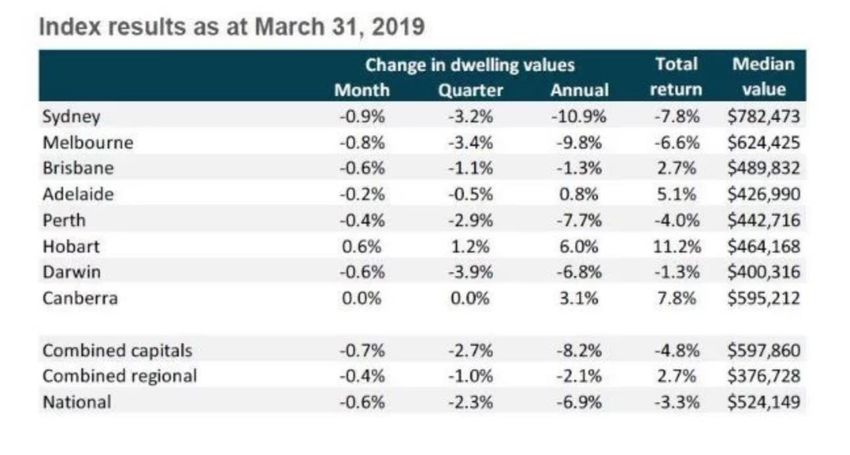
How Big Is The Correction?
• Melbourne and Sydney continue to experience price
  correction falls and it is expected to continue throughout
  2019
• House prices have been relatively stable in Perth,
  Brisbane and Adelaide – however concerns of oversupply
  in unit market.
• Hobart the only capital city to enjoy decent growth in
  2018
• Unit Prices have also endured losses across all major
  capital city’s

  Australian Residential Property Market
  Overview

                                                               4
Credit Availability & Royal Commission
 • Credit availability has been a major headwind impacting
   Australia’s residential market
 • Banks have imposed stronger lending guidelines post royal
   commission, decreasing the amount of approved loans
 • Investors hurt the most, with a major decrease on credit
   availability for investment loans
 • House & unit price corrections have been driven by this
   decrease in borrowing capability

  Where Does the Market Go Now?
• Future Risks – Further impacts of the tightening of credit
• Market expected to bottom out in 2020 (Melbourne & Sydney)
  however it may take longer due to uncertainty.
• Reasonable amount of factors (credit, taxation, decreasing foreign
  investment) influencing the market that creates further
  uncertainty.
• Australian property market is robust, correction falls had to be
  endured on the back of extraordinary capital growth.
• Market not expected to ‘crash’ and should enjoy gains in the future
  from increased population growth & increased wage growth

                                                                        5
Australian Commercial Property Overview

            Retail Overview & Outlook
 • The Australian retail market continues to be supported by
   strong population growth and a steady employment
   market.
 • Retail ‘Localism’ is rising with an increase of participation in
   spending within local communities & shopping centres.
 • Retail spending growth has been subdued in 2019 on the
   back of higher debt and falling house prices.
 • Retail spending is forecasted to improve in 2020 with
   greater income growth and house price stabalisation.
 • Large retail centres offering an overall experience have
   performed well and the need for an experience remains
   vital in the performance of shopping centres and
   destination retail.

                                                                      6
Retail Investment & Rents (National)

 Rise of Online Retail Spending

                                       7
Australian Office Market Review & Outlook
• Overall the Australian office vacancy dropped 0.7% in January
  to 8.5%
• The tightest markets are the Melbourne CBD where vacancy
  fell to 3.2% (down from 3.6%) and Sydney CBD which dropped
  to 4.1% down from 4.6%
• Adelaide and Perth achieved net absorption with both
  vacancies falling marginally to 14.1% and 18.5% respectively.
• More than 1 million sqm of office space will be added to the
  Australian CBD markets over the next three years with half of
  the new space added to the Melbourne CBD which is growing
  rapidly
• All capital cities tracked a recorded vacancy rate increases
  except for Hobart

   Australian Office Investment (Transactions)

                                                                  8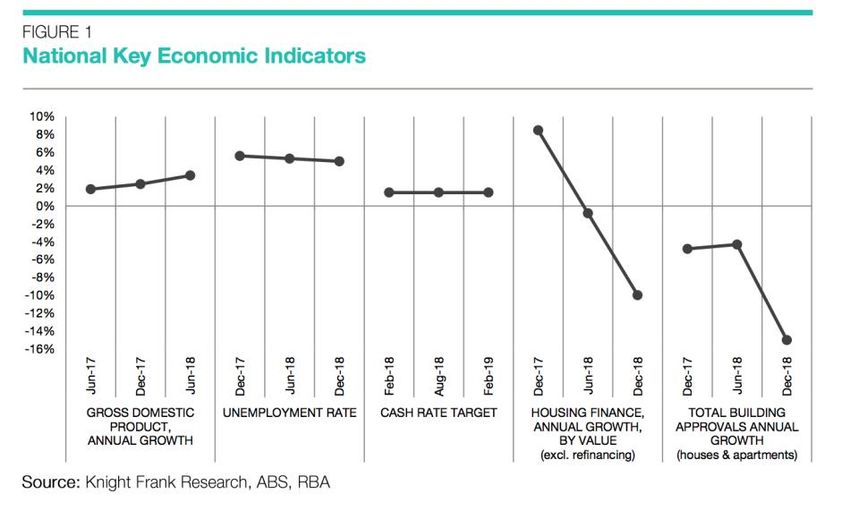
Australian Industrial Review & Outlook
• The Industrial investment market continues to grow across major
  capital cities.
• Demand for industrial investments has benefitted from
  expansions in global investment allocations towards the sector.
• Low interest rates and great online spending has generated
  greater interest and growth in the sector for both investors and
  manufacturers.
• Net face rents continue to grow across most capital cities and
  this is forecasted to continue.
• Land values growing rapidly in Victoria and NSW due to the lack
  of industrial zoned land coupled and strong leasing demand.

        Industrial Investment & Yield
                Compression

                                                                     9
Thank You For Your Time
           Are There Any Questions?

              IPA TASMANIA CONGRESS 2019

     THE AUSTRALIAN PROPERTY MARKET – AN
                  OVERVIEW

Sources – CBRE 2019, JLL 2019, RBA statement May 2019, Savills 2019,
Knight Frank 2019, The Property Journal Australia, Colliers International
2019, ABS Australia, Fairfax News.

Disclaimer – Past performance is not a reliable indicator of future
performance. Any forecasts given in this document are predictive in character.
Whilst every effort has been taken to ensure that the assumptions on which
the forecasts are based are reasonable, the forecasts may be affected by
incorrect assumptions or by known or unknown risks ad uncertainties. This
information has been produced in good faith and is to be used solely as a
general guide. No liability for negligence or otherwise is assumed by Spencer
Property Group for any loss or damage suffered by any party resulting from
their use of this information

                                                                                 10
11
You can also read


