The identity of Azara s description No. 18 Gavilán mixto pintado is a juvenile Harris s hawk (Parabuteo unicinctus) Identita Azarovho opisu . 18 ...
←
→
Page content transcription
If your browser does not render page correctly, please read the page content below
Raptor Journal 2020, 14: 77 – 80. DOI: 10.2478/srj-2020-0001
© Raptor Protection of Slovakia (RPS)
The identity of AzaraLs description No. 18 JGavilán mixto pintadoK is
a juvenile HarrisLs hawk (Parabuteo unicinctus)
Identita Azarovho opisu W. 18 MGavilán mixto pintadoJ je juvenilný myQiak Qtvorfarebný
(Parabuteo unicinctus)
Paul SMITH
Abstract: The classic ornithological work by Félix de Azara vApuntamientos para la historia natural de los páxaros del Paraguay
y Rio de la Plataw was one of the first descriptive texts dealing with the avifauna of the Southern Cone of South America. Azarays
No. 18 vGavilán mixto pintadow has long been misidentified as a juvenile great black hawk (Buteogallus urubitinga ((Gmelin,
1788)). However, there are clear inconsistencies in the description of the plumage coloration, shape and measurements which
make that identification erroneous, and Azarays No. 18 can in fact be convincingly identified as the juvenile plumage of the Har¢
risys hawk (Parabuteo unicinctus (Temminck, 1824)). The description by Azara contains numerous diagnostic characteristics for
that species, and the measurements provided by him are inconsistent with those of the great black hawk, yet remarkably similar
to those provided by the same author for the description of the adult No. 19 vGavilán mixto obscuro y canelaw. No scientific
names have apparently ever been based on Azara No. 18.
Abstrakt: Klasické ornitologické dielo Félixa de Azaru |Apuntamientos para la historia natural de los páxaros del Paraguay
y Rio de la Platav bolo jedným z prvých popisných textov zaoberajúcich sa avifaunou juného cípu Junej Ameriky. Azarove
íslo 18 u |Gavilán mixto pintadov je u dlho nesprávne identifikované ako juvenilný myiak vodný (Buteogallus urubitinga
(Gmelin, 1788)). Avak v opise sfarbenia, tvaru a rozmerov sú zrejmé nezrovnalosti, ktoré spôsobujú, e toto urenie je
nesprávne, a Azarove íslo 18 mono v skutonosti presvedivo identifikova ako myiaka tvorfarebného (Parabuteo unicinctus
(Temminck, 1824)) v juvenilnom ate. Popis od Azara obsahuje mnostvo diagnostických charakteristík tohto druhu a ním
uvádzané rozmery sa nezhodujú s parametrami myiaka vodného, avak sú obzvlá podobné tým, ktoré sú uvedené Azarom pre
adultného jedinca . 19 u |Gavilán mixto obscuro y canelav. Z Azarovho . 18 zrejme neboli nikdy odvodené iadne vedecké
mená druhov.
Key words: Buteogallus urubitinga, Gavilán mixto, Great Black Hawk, Paraguay
Paul Smith, FAUNA Paraguay, Encarnación, Paraguay, www faunaparaguay.com, and Para La Tierra, Centro IDEAL, Mariscal
Estigarribia 321 c/ Tte. Capurro, Pilar, Dpto. Ñeembucú, Paraguay. E-mail: faunaparaguay@gmail.com.
Acknowledgements: The author is grateful to the Pronii Program of CONACyT Paraguay for its support. Sergio Ríos kindly
allowed use of his excellent photographs. No permits were required for this research.
Shortly after the publication of Azarays (1802, 1805a,b) stated that the description was of a hitherto undescribed
key ornithological text vApuntamientos para la historia species. However, the description (both of the morpho¢
natural de los páxaros del Paraguay y Rio de la Plataw, logy and the behaviour) and measurements provided
the identity of his No. 18 Gavilán mixto pintado (Azara refer to a quite different bird, as Azara (1802) himself
1802) was proposed by Kaup (1847) to be a juvenile acknowledged, despite recognising a superficial similar¢
great black hawk (Buteogallus urubitinga (Gmelin, ity in plumage.
1788)), though he did not provide any justification. This Azara described his No. 18 Gavilán mixto pintado as
conclusion has since been repeated without question by follows (my translation; the original text is included in
all major reviewers of Azarays work (Hartlaub 1847, Appendix 1):
Berlepsch 1887, Laubmann 1939, Pereyra 1945), vIt has many things in common in its colours and
though Sonnini (in Azara 1809) had earlier correctly their distribution with the previous species, and in what
77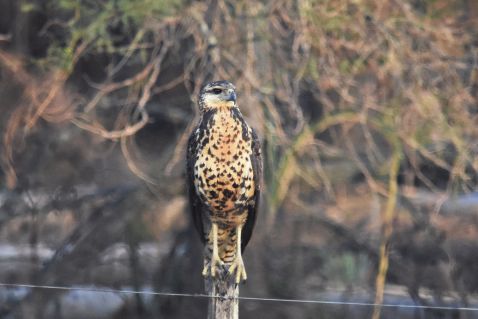
Smith P: The identity of Azara’s description No. 18 “Gavilán mixto pintado” is a juvenile Harris’s hawk (Parabuteo unicinctus)
S Ríos

                                                                   a                                                             b
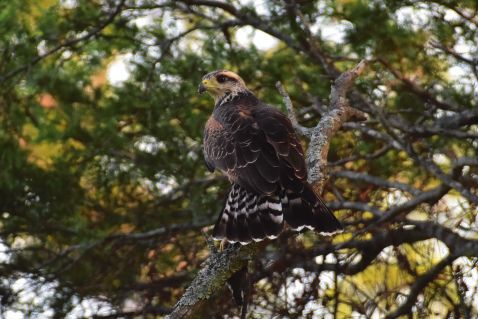
Fig. 1. Juvenile of great black hawk (Buteogallus urubitinga) (a), juvenile of Harrisas hawk (Parabuteo unicinctus) (b). Presidente
Hayes Department, Paraguay.
Obr. 1. Juvenilný jedinec myeiaka vodného (Buteogallus urubitinga) (a), juvenilný jedinec myeiaka etvorfarebného (Parabuteo
unicinctus) (b). Región Presidente Hayes, Paraguay.

I have observed of the customs of both of them; only                          Flight feathers 24, the fourth longest. Tail 12 feathers
that this one is much more scarce; it seems more active                   in slight wedge-shape, the outermost 11 lines shorter.
and it is much smaller.                                                   Leg 57. Tarsus 45, colour of straw feathered at the top,
    Length 20 inches; tail 9 ½; wingspan 43. A cinnamon                   with flattened scales on the front and a triangular prism.
eyebrow, varied a little with dark, begins over the eyelid                Mid-toe 22, its nail 9, united by a membrane to the
and goes to the side of the nape. From the rear edge of the               outermost until the last phalange. Bill 18, its membrane
eye there is a line thinner than the eyebrow, and it                      greenish-yellow, in which is the nostril, half outside: the
accompanies it below. The rest of the side of the head,                   tip is black, the rest clear blue, and the iris is dark
and also part of the neck and sides of the nape, have the                 cinnamon.
feathers of the aforementioned cinnamon with dark mark¢                       I killed an adult, whose upper mandible was so
ings in the centres. The rest of the neck or nape is the                  inclined to the right that its tip was deviated four lines
same, but the dark dominates much more. The crown is                      from the lower, which was straight, it being impossible
dark brown, like the back and as far as the upper-tail cov¢               for them to unitew.
erts, which are white. The scapulars are also dark brown;                     Azara (1802) begins his description by noting the
but lifting up the feathers cinnamon cross lines are vis¢                 similarity in colour and pattern to his previous species,
ible, and those of the rump are white. The coverts are                    No. 17 Gavilán mixto chorreado, but highlights
dark with the edges cinnamon, and small cinnamon-white                    differences in behaviour and size. No. 17 refers to the
spots in the form of random, irregular lines. The tail has                juvenile great black hawk (Buteogallus urubitinga) (Fig.
the base white, and the rest has even stripes of dark and                 1a), the morphologically similar adult of which is
grey, with the tip cinnamon-white. The upper side of the                  described later as No. 20 Gavilán mixto negro.
flight feathers and the outer coverts are like the tail. The              However, the measurements provided for No. 18 are so
foreneck to the venter is streaked with cinnamon-white                    different to these that it becomes impossible to
and dark, because every feather has a large, pear-shaped                  rationalise them as belonging to the same species (Table
spot of this colour. The white venter has a dark heart on                 1). Azara (1802) No. 19 Gavilán mixto obscura y canela,
every feather, and from the anus to the tail is cinnamon-                 on the other hand, has measurements which are remark¢
white with strange dark markings in the form of an arrow.                 ably similar to those of No. 18, and both of these de¢
Legs are cinnamon with dark barring. The flight feathers                  scriptions in fact refer to the same species, Harrisys
and underside of the tail are barred dark and white; but on               hawk (Parabuteo unicinctus), with No. 19 featuring the
the outer part there is a large white spot from the base to               adult and No. 18 the juvenile (first basic) plumage (Fig.
the two-thirds. The underwing coverts are streaked with                   1b).
cinnamon-white and dark, and each of these has another                        Whilst the morphometrics are clear enough to distin¢
of cinnamon next to it.                                                   guish Harrisys hawk from the much larger, much longer-

78
Raptor Journal 2020, 14: 77 – 88. DOI: 10.2478/srj-2020-0001
© Raptor Protection of Slovakia (RPS)
Tab. 1. Comparative measurements (mm) taken from Azaraas descriptions (one inch = 25.6 mm; one line = 2.21 mm). In parentheses
next to some of the major measurements provided by Azara are range measurements for the species given in the modern literature,
taken from the following sources: total length (Thiollay 1994); tail (Ferguson-Lees & Christie 2001); wingspan (Parabuteo unicintus:
Dwyer & Bednarz 2020; Buteogallus urubitinga: Van Dort 2020); tarsus (Blake 1979).
Tab. 1. Porovnanie rozmerov (mm) prevzatých z Azarových opisov (jeden palec = 25,6 mm; jedna iiara = 2,21 mm). V zátvorkách
vedma niektorých z hlavných rozmerov, uvedených Azarom, sú hraniiné rozmery týchto druhov uvádzaných v modernej literatúre,
prevzaté z nasledujúcich zdrojov: celková dlfka (Thiollay 1994); dlfka chvosta (Ferguson-Lees & Christie 2001); rozpätie krídel
(Parabuteo unicintus: Dwyer & Bednarz 2020; Buteogallus urubitinga: Van Dort 2020); tarsus (Blake 1979).
no. 19 gavilán mixto obscuro y canela
(Buteogallus u. urubitinga; juvenile)
(Parabuteo u. unicinctus; juvenile)
(Buteogallus u. urubitinga; adult)
(Parabuteo u. unicinctus; adult)
no. 17 gavilán mixto chorreado
no. 18 gavilán mixto pintado
no. 20 gavilán mixto negro
total length / celková dlfka 512.0 512.0 (480^560) 614.4 601.6 (510^640)
tail / chvost 243.2 217.6 (228^265) 256.0 263.7 (230^270)
wingspan / rozpätie krídel 1100.8 1100.8 (1030^1190) 1305.6 1382.4 (1150^1370)
leg / noha 126.0 121.6 152.5 159.1
tarsus / behák 99.5 92.8 (80^92) 139.2 143.7 (114^128)
mid-toe / stredný prst 48.6 46.4 53.0 53.0 (49^52.5)
nail / pazúr 19.9 22.1 28.7 24.3
bill / zobák 39.8 35.4 46.4 42.0
legged and shorter-tailed great black hawk (Table 1), it Plata. Tomo 2. Imprenta de la Viuda Ibarra, Madrid.
is worth pointing out that the juveniles of both species Azara F de 1805b: Apuntamientos para la historia
do indeed show a superficial resemblance to each other natural de los páxaros del Paraguay y Rio de la Plata.
in plumage colouration and pattern (Fig. 1). Nonethe¢ Tomo 3. Imprenta de la Viuda Ibarra, Madrid.
less, the plumage description is also characteristic for Azara F de 1809: Voyages dans lyAmérique
Harrisys hawk. The crucial difference in the ratio of tail Méridionale, 3. Oiseaux. Dentu, Paris.
length to total length indicate a rather long-tailed bird, Berlepsch H von 1887: Appendix. Systematisches
the mention of white rump and upper-tail coverts verzeichniss in der Republik Paraguay bisher
(which are absent in the juvenile great black hawk), the beobachteten vogelarten. Journal für Ornithologie
cinnamon-edged wing coverts and the tail pattern with a 35: 113u134.
pale cinnamon-white tip, are all characteristic of a ju¢ Blake ER 1979: Manual of neotropical birds. Volume 1:
venile Harrisys hawk, and are not shared by the juvenile Spheniscidae (Penguins) to Laridae (Gulls and
great black hawk. allies). University of Chicago Press, Chicago.
To my knowledge no scientific names are based on Dwyer JF & Bednarz JC 2020: Harrisys hawk
Azarays (1802) description of No. 18 Gavilán mixto (Parabuteo unicintus), version 1.0. In: del Hoyo J,
pintado. Elliott A, Sargatal J, Christie DA & de Juana E (eds),
Birds of the World. Cornell Lab of Ornithology,
References Ithaca, New York. Retrieved June 10, 2020 from
Azara F de 1802: Apuntamientos para la historia natural https://doi.org/10.2173/bow.hrshaw1.01.
de los páxaros del Paraguay y Rio de la Plata. Tomo Ferguson-Lees J & Christie DA 2001: Raptors of the
1. Imprenta de la Viuda Ibarra, Madrid. World. Houghton Mifflin, Boston.
Azara F de 1805a: Apuntamientos para la historia Gmelin JF 1788: Systema naturae per regna tria naturae,
natural de los páxaros del Paraguay y Rio de la secundum classes, ordines, genera, species,
79Smith P: The identity of Azara’s description No. 18 “Gavilán mixto pintado” is a juvenile Harris’s hawk (Parabuteo unicinctus)
characteribus, differentiis, synonymis, locis. Tomus 1, coloriées d'oiseaux, pour servir de suíte et de
Pars 1. Georg Emanuel Beer, Lipsiae. complément auc planches enluminées de Buffon.
Hartlaub CJG 1847: Systematischer index zu Don Félix Livre 53. Dufour & d'Ocagne, Paris.
du Azarays Apuntamientos para la historia natural de Thiollay JM 1994: Family Accipitridae, 52u205. In: del
los páxaros del Paraguay y Río de la Plata. Hoyo J, Elliott A & Sargatal J (eds), Handbook of
Schünemann, Bremen. the birds of the World. Vol. 2: New World vultures to
Kaup JJ 1847: Monographien der Genera der guineafowl. Lynx Edicions, Barcelona.
Falconidae Tafel 1. Isis 40: 325u383. Van Dort J 2020: Great black hawk (Buteogallus
Laubmann A 1939: Die Vögel von Paraguay. Erster urubitinga), version 1.0. In: del Hoyo J, Elliott A, J.
Band. Strecker und Schröder, Stuttgart. Sargatal, Christie DA & de Juana E (eds), Birds of
Pereyra JA 1945: La obra ornitológica de Don Félix de the World. Cornell Lab of Ornithology, Ithaca, New
Azara. Biblioteca Americana, Buenos Aires. York. Retrieved June 10, 2020 from https://doi.org/
Temminck CJD 1824: Nouveau recueil de planches 10.2173/bow.grbhaw1.01.
Received 11. 6. 2020
Accepted 4. 8. 2020
Appendix 1. Original text from Azara (1802).
Príloha 1. Pôvodný text od Azaru (1802).
NUM. XVIII
(GAVILÁN MIXTO) DEL PINTADO
Tiene bastante semejanza en las tintas y su distribución con el precedente, y lo que he observado de
costumbres es lo mismo en ambos; solo que éste es mucho mas escaso: me parece mas activo; y es mucho
menor.
Longitud 20 pulgadas: cola 9 ½: braza 43. Una ceja acanelada, variada muy poco de obscuro,
principia sobre el tejadillo del ojo y va al costado del cogote. De lo postrero del ojo hace una tira mas
angosta que la ceja, y la acompaña por debaxo. El resto del costado de la cabeza, y en seguida parte del
cuello y del costado del cogote, tienen las plumas de dicha canela con manchitas obscuras en los centros.
Lo mismo es el resto sobre el cuello ó pestorejo, pero domina mucho lo obscuro. Sobre la cabeza es de un
pardo obscuro, como la espalda y hasta los timoneles, que son blancos. También es pardo obscuro el es¢
capulario; pero elevando las plumas se ve tienen listones al través acanelados, y las de la rabadilla blan¢
cos. Las cobijas son obscuras con las borditas acaneladas y manchitas blancas acaneladas á manera de
faxas mal seguidas al través, que se ven alborotándolas. La cola tiene raiz blanca, y lo demás á tiras casi
iguales obscuras y aplomadas, con la puntita blanca acanelada. La barba superior dé los remos y las cobi¢
jas del trozo externo son como la cola. Lo anterior del cuello y hasta el vientre es jaspeado de canela
blanquizca y obscuro, porque cada pluma tiene de este color una mancha grande en figura de pera. El vi¢
entre blanco con un corazón obscuro en cada pluma, y del ano á la cola blanco acanelado con raras
manchas obscuras en figura de flecha. Las piernas acaneladas con tiras obscuras de través. Los remos y
cola debaxo á tiras obscuras y blancas; pero en el trozo exterior hay una grande mancha blanca desde la
raiz á los dos tercios. Las tapadas á tiras blancas acaneladas y obscuras, y cada una de éstas tiene pegada
otra de canela.
Remos 24, el quarto mayor. Cola 12 plumas en escalerilla, la de afuera 11 líneas mas corta. Pierna 57.
Tarso 45, color de paja poco vestido en lo alto, escamoso á tablas delante, y prismático triangular. Dedo
medio 22, su uña 9, unido con membrana al exterior hasta la primera falange. Pico 18, su membrana
amarilla verdosa, en que está el respiradero, la mitad fuera: la punta es negra, lo demás azul claro, y el iris
acanelado obscuro.
Maté un adulto, cuya mandíbula superior se inclinaba tanto á la derecha, que su punta quedaba
desviada quatro líneas de la inferior, que era recta, siendo imposible que ajustasen.
80You can also read


