The Imitation Competition: Masculinity in Comic Midlife Crisis in Michael Winterbottom's Trip Series - Anglistik
←
→
Page content transcription
If your browser does not render page correctly, please read the page content below
139

                                                                          LUCIA KRÄMER
                                   The Imitation Competition: Masculinity in Comic Midlife Crisis in
                                                  Michael Winterbottom's Trip Series

                                                                      "It's not about the destination, it's about the journey." (S1E5)1

                                   1. Introduction
                                   Although the comedy programme examined in this article is simply, and somewhat
                                   self-deprecatingly, called The Trip (2010-), rather than 'The Journey' or some other title
                                   with more gravitas, the implications of the overarching metaphor are independent of
                                   genre. The geographical journey evokes the theme of the journey of life: its phases; the
                                   events, obstacles and detours on the way; the persons encountered during the journey,
                                   as well as its inevitable destination, i.e. death. This article examines how Michael
                                   Winterbottom's Trip series uses this metaphor to present its two middle-aged male
                                   protagonists – played by the British comedy stars Steve Coogan and Rob Brydon as
                                   fictionalised versions of themselves2 – in a way that combines the ridiculous with the
                                   absurd by evoking what Martin Esslin, in his seminal book on The Theatre of the
                                   Absurd, called a "sense of metaphysical anguish at the absurdity of the human
                                   condition," fuelled by the "senselessness of life" (1980, 23-24) and the elusiveness of
                                   a sense of self. In fact, the statement from the character of Steve Coogan in The Trip
                                   that precedes this article self-referentially encapsulates the life situation of its two main
                                   characters as well as the non-teleological structure of the programme.3
                                       After a general introduction to the Trip series, the initial focus of the following
                                   analysis will be on the show's extensive use of intertextuality and the protagonists'
                                   obsession with performance. The article will demonstrate how both contribute to the
                                   character comedy in the programme and help to depict masculinity as a performative
                                   category. Then follows an analysis of the show's absurd character, which is enhanced
                                   especially by its structure, its imagery and the middle-aged characters' ruminations on
                                   the themes of history, ageing, mortality and death. Drawing on the established comic
                                   type of the undignified elderly man, who is made ridiculous by his vain struggle to stay
                                   young, the programme ultimately asks no less a question than that of the meaning of

                                   1   For the sake of convenience and consistency with the other articles in this section, and despite
                                       the fact that the individual series of the Trip programme have differing titles, I will refer to
                                       The Trip (2010) as series one, to The Trip to Italy (2014) as series two and to The Trip to
                                       Spain (2017) as series three in parenthetical references throughout the article.
                                   2   While I refer to the actors as 'Steve Coogan' or 'Coogan' and 'Rob Brydon' or 'Brydon,' I refer
                                       to their characters in the Trip series as 'Steve' and 'Rob.'
                                   3   An earlier version of this article was presented at the Anglistentag 2019 in Leipzig. My
                                       thanks go to all members of the audience who expressed comments and questions and thus
                                       influenced the revision of the text, in particular Rainer Emig, Ellen Grünkemeier, Stefan
                                       Horlacher, and Franziska Quabeck.

                                             Anglistik: International Journal of English Studies 31.2 (Summer 2020): 139-151.

                                                             Anglistik, Jahrgang 31 (2020), Ausgabe 2
                                                       © 2020 Universitätsverlag WINTER GmbH Heidelberg

Powered by TCPDF (www.tcpdf.org)
140 LUCIA KRÄMER
life in the face of death. It thus posits its two male protagonists as representative of
humanity, although many of their issues, as we will see, relate to what they themselves
have internalised as masculine ideals.
2. The Trip Series: Key Structural Features
So far, there have been three Trips, which were all created by the prolific and critically
renowned British director Michael Winterbottom. The first instalment, which was
simply called The Trip, was broadcast on BBC Two in 2010. It was followed in 2014
for personal use only / no unauthorized distribution
by The Trip to Italy (also BBC Two) and, in 2017, by The Trip to Spain, made for Sky
Atlantic.4 Each series consists of six half-hour episodes and could, theoretically, be
watched independently as a mini-series.5
In terms of story, the premise for each of the trips is that Steve and Rob go on a
gourmet tour to write restaurant reviews for the Observer Magazine. They cover one
restaurant per episode. After the first trip through Northern England proves successful,
Winter Journals
they are hired to repeat the exercise in Italy and Spain.
With Steve Coogan and Rob Brydon, 6 the Trip series stars two of the most
renowned and popular stars of contemporary British television comedy. Coogan is best
known in the UK as a comic actor for his cult character Alan Partridge, which has been
around in various radio, TV and film reincarnations since 1991. He has sharpened his
international profile as an actor with critically acclaimed film performances as Stan
Laurel in Stan and Ollie (2018) and as the male lead in the film Philomena (2013),
Powered by TCPDF (www.tcpdf.org)
which he also co-wrote and co-produced. Rob Brydon is less well known for his film
work, though he has starred in the ensemble comedy Swimming with Men (2018). His
popularity rests instead on the lead roles he held in TV comedy series like Marion and
Geoff (2000-2003), Gavin & Stacey (2007-2010, 2019) and The Trip, and especially on
the work he has done on radio and TV panel shows: Brydon has been the host of the
BBC One hit programme Would I Lie to You? (2007-) since 2009.
This career background, as well as Coogan's and Brydon's quite different public
images, are relevant for The Trip because of the show's quasi-documentary mode,
which teases the spectator into wondering how authentic the events and especially the
characters on screen are. This device is not original; Coogan and Brydon have
emphasised in interviews that they needed to be persuaded to take on the project
because they feared it might be self-indulgent and because "celebrities playing
4 A fourth series, The Trip to Greece, was shot in the summer of 2019 and will be broadcast
on Sky One and Now TV in 2020 (Bley Griffiths 2019).
5 Obviously created with an eye on the North American market, there are also three film
versions in which each series was edited down to roughly 110 minutes. The present article
works with the TV series because they lend themselves even better to an analysis as absurd
texts because of the structural features related to their seriality.
6 Before the Trip series, Winterbottom had already worked with both actors in 24 Hour Party
People (2002) and the Tristram Shandy (meta-)adaptation A Cock and Bull Story (2005).
Coogan has since then also starred in Winterbottom's The Look of Love (2013) and Greed
(2019).
Anglistik, Jahrgang 31 (2020), Ausgabe 2
                                   © 2020 Universitätsverlag WINTER GmbH Heidelberg

Powered by TCPDF (www.tcpdf.org)MASCULINITY IN COMIC MIDLIFE CRISIS IN MICHAEL WINTERBOTTOM'S TRIP SERIES 141
themselves in things, it's all been done a bit" ("Steve Coogan and Rob Brydon" 2014).
One could also modify this quote by replacing the term 'celebrities' by 'comedians.'
Larry David's Curb Your Enthusiasm (2000-) has probably been the most influential
show exemplifying this trend, not least because it also laid the groundwork for the
flourishing of cringe comedy: the fictionalised version of Larry David in Curb Your
Enthusiasm "says the things that nobody realizes they're allowed to think" (Berkowitz
2011), i.e. he is prone to social blunders, and the show has even been described as a
guide on "how not to behave" (Leverette 2004, 8). Other comedians who have followed
this formula include Jennifer Saunders and Dawn French in series six of French and
Saunders (2004), Louis C. K. in Louie (2010-2015), Ricky Gervais and Stephen
Merchant in Life's Too Short (2011-2013) and, though to less acerbic effect, Miranda
Hart in Miranda (2009-2014). All of these shows have in common that they blur the
line between reality and fiction by implying that the show's creators and stars are
identical, or at least near-identical with the characters on screen that carry their names.
As in stand-up comedy, where the relation between a performer and their stage persona
often remains uncertain to the audience, the identical names of performer and character
in shows like The Trip potentially conflate the spectators' distance to the characters by
creating the illusion that the persons on the screen are real. The ontological threshold
between the story world and the audience's world is levelled. This is an especially
favourable context for cringey humour, which firmly relies on the audience's and
characters' awareness of social norms and values, and the characters' inability of obeying
them. The effects of the ensuing transgression (e.g. rejection, embarrassment,
indignation) and the social awkwardness of the situations are potentially heightened when
the buffering function provided by fictionality is undermined. In the context of a show
like The Trip, which revolves around middle-aged characters, this set-up opens up ample
opportunities for awkward situations that rely on the characters' inability or unwillingness
to act according to behavioural norms regarding their age within their cultural and social
environment, which is primarily British but has strong cosmopolitan leanings.
Not only do the protagonists of the Trip series have the same names as the actors
who play them; there are also other features that encourage a reception that conflates
reality and fiction: each episode features a different real restaurant and includes shots
from the restaurant kitchen where the food that Rob and Steve consume is prepared.
These shots are hand-held and formally evoke documentary cinema. The staff at the
restaurants, too, appears to be genuine and simply doing their job. Even Steve and Rob's
lines are not scripted but mostly improvised by Coogan and Brydon along rough
outlines laid down by Winterbottom ("Steve Coogan and Rob Brydon" 2014). Within
the framework of the fictional trips there are therefore quite a lot of elements that are
conventionally associated with the documentary mode or which are perceived, when
they are employed in fictional contexts, as making a film more life-like and authentic.
In line with this generic hybridity in relation to the documentary, the series also
plays with key features of the sitcom; for despite the large distances that the two
protagonists cover and the various geographical areas they move through on the three
trips, the number of the kinds of situations and settings which the characters find
themselves in is actually very restricted. There are five major types:
Anglistik, Jahrgang 31 (2020), Ausgabe 2
© 2020 Universitätsverlag WINTER GmbH Heidelberg
Powered by TCPDF (www.tcpdf.org)142 LUCIA KRÄMER
1) Steve and Rob travel in the car together; they talk (often about their itinerary), read
out reviews of restaurants and hotels to one another, sing and listen to or comment
on music.
2) In each episode, Rob and Steve have a meal at a restaurant, which is usually several
courses long and whose preparation Winterbottom shows us in documentary shots
from the restaurant kitchen. This meal is often the heart of the episode. The
protagonists sit, eat, drink and talk, and at the end there is a moment of suspense
when the bill is brought and they (and the spectators) guess the bill.7
3) Rob and Steve take in sights along the way.
4) Rob and Steve are at a hotel: they are shown to their rooms, interact with the staff
and take a drink or have a small meal together.
5) Rob and Steve have some time alone from each other during which they work out or
have telephone calls with their agents or families/partners.
In one episode of each series the dynamic of the duo is broken up when Steve's assistant
Emma joins them together with Yolanda, a photographer hired to shoot the pictures for
the Observer article. As this list illustrates, the main occupation of the Trip series' main
characters is talking. James Walters has correctly and succinctly characterised the show
as "repetitively uneventful" (2013, 117; original emphasis), since, in terms of story,
very little happens. The programme lacks a conflict that might create a rising (or falling)
action, and it remains without a resolution on the levels of the individual episodes, the
various six-episode units as well as the Trip series in its entirety. The individual episodes
can therefore be watched separately, albeit, unlike in a classic sitcom (Mills 2004, 69),
not because each episode has a fully completed story arc, but because the episodes have
an open ending and it is not necessary to have seen one episode in order to understand a
later one. The various trips either finish with an open ending for Rob and/or Steve (The
Trip to Italy, Steve in The Trip to Spain), or have a circular structure in the sense that they
return the characters to where they started from (The Trip, Rob in The Trip to Spain).
While some reviewers have complained about this lack of direction in the Trip
series (Dowd 2017), it is, in fact, programmatic because the meandering nature of the
individual episodes and of the individual series, as well as the lack of a resolution, are
vital for the show's evoking of the senselessness of human existence, which is
fundamental to its absurd quality. This pattern also shapes the largely improvised
conversations between Steve and Rob, as they, too, meander along on the principle of
associative logic. Besides this, however, there is also the principle of repetition: Rob
and Steve tend to come back to specific topics – especially acting, age, women, family,
mortality and career – so that Rob goes so far as to ask: "Do you think we just have the
same conversation in every restaurant?" (S1E3). Even the most striking feature of their
conversations is a form of repetition: they do impressions, i.e. they imitate the voices
of other, mostly famous, people.8
7 In The Trip to Italy and The Trip to Spain this is extended into a routine where Rob, doing
an Irish voice, pretends to be a quiz show host playing "Guess the Bill" with Steve as the
candidate.
8 Winterbottom makes the most of the fact that both Coogan and Brydon are consummate voice
artists. They both started their careers with voice-over work and impressions.
Anglistik, Jahrgang 31 (2020), Ausgabe 2
© 2020 Universitätsverlag WINTER GmbH Heidelberg
Powered by TCPDF (www.tcpdf.org)MASCULINITY IN COMIC MIDLIFE CRISIS IN MICHAEL WINTERBOTTOM'S TRIP SERIES 143
3. Impressions Overdrive: Intertextuality and Performance in the Trip Series
As the play on the film title The Imitation Game in the title of this article suggests, these
imitations tend to have not only a ludic, but also a strong competitive, sometimes even
aggressive, component, especially with the character of Steve in The Trip. Most
reviewers have commented on this. The protagonists' conversations have been called,
for example, a "duel" (Dargis 2011; Dowd 2017), "competitive bouts" (Edelstein 2017)
and even an "arms-race of celebrity impressions" (O'Brien 2018, 5). Steve himself
expresses this competitive mindset when he speaks of his own impressions as an
"arsenal of weaponry" (S1E2) and when he refers to Rob's signature trick, the voice of
a "Small Man in a Box," as his "nuclear button" (S1, deleted scenes), Steve admittedly
becomes a mellower character on the trips to Italy and Spain, as he cuts down on alcohol
and finds more of the rewarding work and critical success in the US that he still
hankered after in The Trip, but the competitive element in the relationship never fully
goes away. This is particularly obvious in those scenes where Rob and Steve have an
audience, and especially when this audience is female. Emma and Yolanda's presence
(S1E4; S2E4; S3E5) puts Rob into imitation overdrive, to which Steve reacts with
disdain, put-downs or supposedly better imitations, which in turn leads to drawn-out
moments of second-hand embarrassment for the audience at this spectacle of the
characters metaphorically locking horns by showing off.
The characters' age enhances this effect. Since they are of middle age, they are
situated in a state of in-betweenness and liminality in terms of which aspects of their
lives serve as sources of prestige. The standard in Steve and Rob's culture is that, for
white heterosexual young men, the primary source of prestige lies in their physical and
sexual strength, while older men's prestige rests on the social strength they have accrued
via material and immaterial achievements (e.g. money, respect), life experience and
possibly even wisdom and transcendental understanding (see the notion of the 'wise old
man'). Steve and Rob's behaviour illustrates that they are acutely aware of the fact that,
in this set-up, Western societies tend to idealise youth and to devalue older age.
Internalised ageism makes them painfully conscious of the fact that they no longer live
up to "culturally held portrayals of masculinity" which "tend to define masculinity in
terms of the abilities and accomplishments of younger men" (Beggan 2007, 440). Rob's
claim that everything is exhausting at their age (S1E3), as well as intermittent talk about
receding gums, hair loss, plastic surgery, bad backs and shoulders – there is even a joke
about hearing loss – together form an underlying motif of (the struggle against) physical
decay, which is also visualised in those scenes where Rob and Steve work out to keep
fit. In front of Emma and Yolanda, they instinctively try to compensate for this loss of
physical strength, i.e. the source of prestige of younger men, by emphasising their
professional skills and achievements, i.e. the sources of prestige of older men. The fact
that they feel the need to show off in this way thus indirectly underlines that Steve and
Rob are aware of no longer being in their physical prime, which conveys a sense of loss
that gives their behaviour an additional tragi-comical note.
Anglistik, Jahrgang 31 (2020), Ausgabe 2
© 2020 Universitätsverlag WINTER GmbH Heidelberg
Powered by TCPDF (www.tcpdf.org)144 LUCIA KRÄMER
The conversations between Steve and Rob across the Trip series are full of examples
of marked intertextuality, as the following list of selected references to various media
as well as so-called 'high' and 'popular' culture, illustrates:
TV: Miss Marple; Midsummer Murders; Alan Partridge; Celebrity Krypton Factor; The
Persuaders; Carpool Karaoke; Monty Python ("The Spanish Inquisition").
Literature: Shakespeare (Hamlet, King Lear, As You Like It); Alan Bennett (Beyond the
Fringe); Romantic literature (Wordsworth, Coleridge, P.B. Shelley, Byron, Southey,
Keats, Hazlitt, Trelawney, Mary Shelley); Johnson and Boswell; the Brontës; Casanova;
Don Quixote; Laurie Lee (As I Walked Out One Midsummer Morning).
Pop Music: "Popcorn," ABBA ("SOS," "The Winner Takes it All"); Alanis Morissette
(Jagged Little Pill); Neil Harrison ("Windmills of Your Mind"); "To Dream the
Impossible Dream" from Man of La Mancha; David Bowie; Kate Bush; "To All the Girls
I've Loved before" (as sung by Julio Iglesias and Willie Nelson); Morrissey.
Film: The Silence of the Lambs; Get Carter; The Italian Job; James Bond movies; The
Godfather; Mutiny on the Bounty; The Dark Knight Rises; Spartacus; Beat the Devil; Le
mépris; Roman Holiday; Notting Hill; 12 Years a Slave; Elephant Man; Lost in La
Mancha; My Fair Lady; Laurel and Hardy films; Torquemada; Casablanca.
This multiplicity of references not only provides flashes of amusing recognition for the
spectator. It can also be interpreted as a self-reflexive, indirect comment on the
impossibility of creative originality. This theme is already evoked in the very first
minutes of the first episode of The Trip when Rob says: "It's 2010. Everything's been
done before. All you can do is do something someone's done before and do it better or
differently." To which Steve replies: "To some extent, that's true." As a self-reflexive
reference to The Trip, Rob's statement firmly places the work by all those involved in
making the programme in a long tradition of comedians and artists who came before
them – creators going back as far as the early men painting the caves of Altamira, which
Rob and Steve visit at the beginning of their trip to Spain (S3E1). Coogan and Brydon's
work, more specifically, is, by means of repeated intertextual references, placed in the
tradition of earlier comic performers and especially comic couples like Morecambe and
Wise or Laurel and Hardy, going all the way back to Cervantes' characters Don Quixote
and Sancho Panza, which Steve calls "essentially the beginning of the classic double
act" (S3E2).
Besides its self-referential quality, the short exchange between Rob and Steve from
S1E1 quoted in the previous paragraph is also expressive of some of the protagonists'
central traits, however, and, in the case of Steve, contributes to the tragi-comical quality
of the character. While Rob, always the more genial of the two, has reconciled himself
to the impossibility of creating something truly original and is content with his career
in the UK, Steve is unwilling to accept this and keeps pursuing the Romantic ideal of
the author genius. He emphasises his desire of creating innovative work, for example
by collaborating with film auteurs rather than mainstream directors, and he is desperate
to be taken seriously internationally as an actor and writer, rather than as an entertainer.
The Trip does not really discredit Steve's attitude – after all, the creators of the show
have themselves tried to create something different despite being fully aware, as the
show's intertextual references illustrate, of their predecessors. Nonetheless, Steve's
Anglistik, Jahrgang 31 (2020), Ausgabe 2
© 2020 Universitätsverlag WINTER GmbH Heidelberg
Powered by TCPDF (www.tcpdf.org)MASCULINITY IN COMIC MIDLIFE CRISIS IN MICHAEL WINTERBOTTOM'S TRIP SERIES 145
"sad-funny neediness" (Dargis 2011), his yearning to be appreciated, his vanity and
jealousy and his self-importance place him in a long tradition of British comic male
television characters, ranging from Anthony Hancock to Basil Fawlty and David Brent
and beyond, whose self-perception is at odds with how they are perceived by others.
Steve only differs from them in being aware of his own deficiencies – even though he
would never admit them to others – which ultimately equips the character with a strong
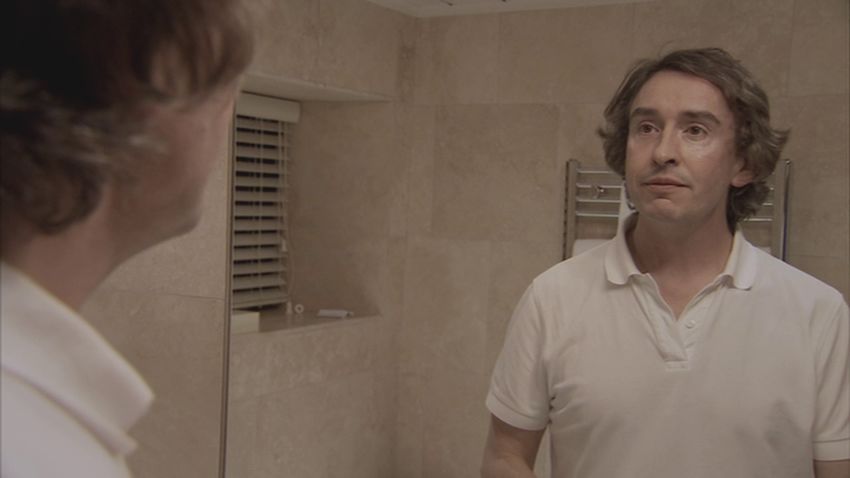
"undercurrent of despair" (Frost 2014): another implicit intertextual echo in S1E5, thus
fittingly places him visually in the tradition of the sad white clown. This reference is
visually implied in the final sequence of S1E5 where Steve is standing in front of a
mirror in a white polo shirt in an almost white bathroom while he applies night cream
to the wrinkles around his eyes and tries (and fails) to imitate Rob's "Small Man in a
Box" voice. He ends by smiling at his own reflection in a melancholic way, with the
piano music accompanying the scene further supporting this mood (see figure 1).
Figure 1: Steve as an echo of the white clown (still from The Trip, dir. Michael Winterbottom,
episode 5, 27:57).
The impressions, which are a subgroup of the intertextual references in the Trip
series, contribute to this thematic complex. As the following list of Rob and Steve's
impressions during the three trips illustrates, the majority is of (male) actors, comedians
and other professional performers.
Actors: Michael Caine, Anthony Hopkins, Richard Burton, Pierce Brosnan, Ray
Winstone, Sean Connery, Roger Moore, James Mason, Peter Sellers, Woody Allen, Al
Pacino, Marlon Brando, Ian McKellen, Christian Bale, Tom Hardy, Michael Sheen,
Daniel Day-Lewis, Robert De Niro, John Hurt, Humphrey Bogart, Diane Keaton, Clint
Eastwood, Kenneth Williams, Anthony Quayle.
Comedians: Les Dawson, Billy Connolly, Frankie Howerd, Ronnie Corbett.
TV hosts: Michael Parkinson, Terry Wogan, Jimmy Savile, Rolf Harris.
Anglistik, Jahrgang 31 (2020), Ausgabe 2
© 2020 Universitätsverlag WINTER GmbH Heidelberg
Powered by TCPDF (www.tcpdf.org)146 LUCIA KRÄMER
Singers: Paul McCartney, John Lennon, Barry Gibb, Mick Jagger, Keith Richards, David
Bowie, Julio Iglesias, Willie Nelson.
Others: Stephen Hawking, Neil Kinnock, Alan Bennett.9
The prevalence of performers on this list and the discussions between Steve and Rob
about acting and the correct ways of doing individual impressions all explicitly
thematise authenticity, the relationship of seeming and being, as well as questions of
performance. With a programme such as the Trip series, which deliberately plays with
the border between fiction and reality, it is not too far-fetched to interpret this theme of
performance also as relating to the roles that people, as social beings, play in their
everyday lives. Rob and Steve's impressions thus also raise the topic of the performative
nature of identity and, more specifically, masculinity. They can be interpreted as an
indirect reflection on questions of gender construction by giving metaphorical shape to
Judith Butler's notion that gender is the constant repetition of social performances, a
"reenactment and reexperiencing of a set of meanings already socially established"
(1990, 140). After all, the impressions in the Trip series are ultimately nothing but men
imitating and ventriloquizing the voices of other men, who, in turn, performed their
social roles by echoing the men that had come before them. This theme is brought to a
head in scenes where the characters do impressions of celebrities who themselves are
doing impressions or playing a role: for example when Steve does a Frank Spencer10
impression by Saddam Hussein (S2E2); when Rob recites a poem by Byron in the voice
of Rolf Harris trying to do Russell Crowe (S2E4); or in a segment called "Stones do
Shakespeare," where first Rob and then Steve act out lines from Hamlet using the voice
of Mick Jagger (S3E4). The echo chamber of fictional and real men from across history
that is created by the impressions in the Trip series thus conveys, albeit indirectly, a
general message about socialization: in all voices and persons and their social
performances, there are echoes of other voices and persons and social performances;11
and change over time is brought about by the fact that the repetition is not a copy but
involves a variation on or an adaptation of the 'original.' Despite repetition, change can
therefore occur, both in people's performance of social roles and in artistic creation.
9 The list strives for completeness, but due to the multiplicity of sometimes obscure
impressions in the Trip series, it is highly probable that I may not have (correctly) identified
some of them. Each of the names has been assigned to only one category, although there are
several cases that would have fitted into several (e.g. Woody Allen, Billy Connolly). Since
Alan Bennett is best known as a writer, despite also having been a comic performer, I have
included him in the 'Other' category.
10 Frank Spencer is a fictional character played by Michael Crawford in the 1970s sitcom Some
Mothers Do 'Ave 'Em (BBC, 1973-1978).
11 That an element of instability and a danger of fragmentation are involved in this chain of
voices becomes explicit when Steve comments as follows on Rob's frequent impressions:
"There's gotta be some sort of drama in someone who can only express themselves through
the voices of other people" (S1E1). In keeping with his artistic aspirations to originality, he
rejects impressions as a secondary, derivative, and inauthentic form of expression.
Anglistik, Jahrgang 31 (2020), Ausgabe 2
© 2020 Universitätsverlag WINTER GmbH Heidelberg
Powered by TCPDF (www.tcpdf.org)MASCULINITY IN COMIC MIDLIFE CRISIS IN MICHAEL WINTERBOTTOM'S TRIP SERIES 147
4. The Trip Series as Absurd Text
Rob and Steve's impressions are also a central contributory element to the absurd nature
of the Trip series, since they contain a theme of failed communication. Walters has
considered the "overuse" and repetitiveness (2013, 119) of impressions in The Trip in
a gendered way, seeing them as a means of expressing the characters' "inability to
converse without the protection of an act" and thus The Trip as a "portrait of male
emotional inarticulateness" (ibid., 122). However, one can also think these impressions
independent of sex or gender, on the lines of Chris Darke's more general observation
that since the impressions in The Trip are "delivered with an insistence that verges on
the manic," they are, for the characters, "a way of not really speaking at all" (2011, 42;
original emphasis).
This plays into an interpretation of the Trip series as an absurd text, or rather, as a
text that evokes the prevalent notion of the absurd in Anglo-Saxon literature and art.
This notion was established by Martin Esslin's study on The Theatre of the Absurd, first
published in 1961, in which he single-handedly put a new dramatic genre on the critical
map, complete with an analysis of several major formal and thematic features that
marked what he identified as a very specific theatrical trend of existentialist plays. Even
though Joanna Gavins rightly points out that the absurd remains "vaguely defined"
(2013, 5) and continues to be used to describe a vast array of different texts (ibid., 21),
the features that Esslin identified in his book are the backbone of this concept.
With its experiments with language (in the impressions), its non-Aristotelian plot
lines (especially the flattening out of the narrative arc) and its tragi-comic character,
the Trip series features three of the four common structural threads that Michael Y.
Bennett has identified in absurd literature from the 1950s to '70s (2015, 19). Moreover,
the prevalence of situation over events and, in addition, the small number of situations
that the characters find themselves in contribute to a structure of repetition, which, as
Esslin has claimed for Beckett's Waiting for Godot (1953), merely serves to underline
the essential sameness of the situation (1980, 46). This sameness, in turn, is expressive
of the senselessness and purposelessness of human existence and man's disorientation
in an irrational and meaningless universe, which are fuelled by the certainty of death
(Cornwell 2006, 5) and the question "Who am I?" (Esslin 1980, 29). In the course of
the three Trips, Winterbottom and his actors/characters go to great lengths to strengthen
all these themes by visual means, imagery and, again, intertextuality.
The question of identity, for example, is, as we have seen, raised by the mere fact
of the characters doing impressions. It is also present whenever the theme of acting
occurs – most obviously when Rob and Steve discuss actors and acting styles or when
they visit actual theatres. During a visit to Pompeii, for example, they sit in an ancient
amphitheatre discussing Anthony Hopkins' impression of Laurence Olivier in the
director's cut version of Spartacus (S2E5); and in The Trip to Spain they visit the Corral
de Comedias, an early modern theatre associated with Lope de Vega (O'Brien 2018, 6),
where they evoke the topos of theatrum mundi by performing Jacques' famous
monologue on the stages of life from As You Like It (S3E5). Moreover, mirrors and
other reflective surfaces are a recurring visual element that evokes the theme of
Anglistik, Jahrgang 31 (2020), Ausgabe 2
© 2020 Universitätsverlag WINTER GmbH Heidelberg
Powered by TCPDF (www.tcpdf.org)148 LUCIA KRÄMER
fragmented identity. While Steve's broken reflection in the window of his apartment at
the end of The Trip, which expresses his indecision and lack of wholeness in both his
private and professional lives, is one isolated example of this, recurring scenes in which
Rob or Steve talk to their own reflections in a mirror (S1E3; S1E5; S2E3) help to
perpetuate the theme of instable personalities throughout the series (see figure 1).
Man's disorientation in an indifferent universe is conveyed through the metaphor of
losing one's way, for example when Rob and Steve go around in circles while driving
in Rome (S2E4), and in seemingly innocuous lines like "Where are you?" (S1E1) or "Is
that where we're meant to be?" (S2E6). Moreover, long and extreme long shots of the
characters or their car in the landscape regularly reduce Rob and Steve visually to mere
specks on the face of the earth. In addition, especially in The Trip to Spain, these
extreme long shots are frequently from a bird's-eye perspective, which evokes the view
of an indifferent transcendental power. Moreover, Rob and Steve's journey, which
stands for the journey of life, is without destination or inherent meaning and returns the
characters to where they started from. The lyrics of the song "Windmills of Your Mind"
by Noel Harrison, which features prominently in The Trip to Spain (S3E1; S3E5;
S3E6), emphasises this theme of circularity.
Encompassing all of this are the themes of mortality and death, which are
omnipresent through shots of graveyards, catacombs and tombs (S1E2; S1E6; S2E4;
S2E5; S2E6; S3E4), conversations about (often famous) dead men and the ways they
died (e.g. P. B. Shelley, John Keats) as well as intertextual references ranging from
Hamlet's "Alas, poor Yorick" speech (S2E6) to David Bowie's song "Lazarus" (S3E3).
Due to Rob and Steve's flights of imagination, these scenes sometimes also assume
traits of the grotesque, for instance when Steve improvises the eulogy he would deliver
at Rob's funeral (S1E6) or when they discuss that, after a plane crash in the Andes,
eating Mo Farah's legs (if he were dead) would be preferable to eating Rob's (S2E1).
The sequence in Pompeii (S2E5) is one of the most remarkable ones in this respect, as
Winterbottom displays at length plaster casts of dead people exhibited there and
combines this, first, with Rob improvising a funny conversation with one of the dead
men and, later, with Steve creating a comical routine about the eruption of Vesuvio in
the voice of Frankie Howerd. As in absurd literature, the inevitability of death is met
with black comedy.
The transience and ultimate insignificance of human life in the Trip series is also
evoked by references to history. From Steve's explanation of the prehistory of Langdale
in Yorkshire (S1E3) to the traces of dinosaurs near La Rioja (S3E3), and from the ruins
of Pompeii (S2E5) or Bolton Abbey (S1E6) to museum settings like Dove Cottage
(S1E3), the Keats-Shelley Museum (S2E4) and the Alhambra (S3E6), the series evokes
(as do its intertextual references) the interconnectedness of past and present. However,
in the process, it also illustrates the insignificance of individual lives in the face of the
longue durée of the history of man or even Earth.
Steve and Rob's constant talking about age and ageing underlines their awareness
of being on their way towards inevitable death. Both characters realise,
melancholically, that young women now just tend to ignore them or look at them, as
Steve puts it, as if they were "a benevolent uncle or a pest" (S2E1). Winterbottom
Anglistik, Jahrgang 31 (2020), Ausgabe 2
© 2020 Universitätsverlag WINTER GmbH Heidelberg
Powered by TCPDF (www.tcpdf.org)MASCULINITY IN COMIC MIDLIFE CRISIS IN MICHAEL WINTERBOTTOM'S TRIP SERIES 149
underlines this visually throughout The Trip to Italy by beauty shots, sometimes from
Steve's or Rob's point of view, of attractive young women in the background of scenes,
who never interact with Rob or Steve. As always, Rob seems the more resigned
character, while Steve apparently struggles. He tries to convince himself of the
advantages of middle age, claiming in the first episode of The Trip to Spain that "We're
in a sweet spot in our lives. We really are. We're like ripe, you know? I am in my prime.
I should play Miss Jean Brodie." Yet later in the series it is obvious that he finds it hard
to accept losing his youth. The most revelatory moment in this respect is a scene in
which Rob and Steve encounter a young Englishman in Cuenca (S3E4). The differences
in their situations are acute. Both Rob and Steve have work to do: Rob is in Spain to
write the restaurant reviews for the Observer; Steve, inspired by As I Walked Out One
Midsummer Morning (1969), an account by Laurie Lee of his wandering through Spain
in the 1930s, is trying to write a book about his own travels through Spain, replicating
a journey he did when he was 18 years old (S3E1; S3E4). The young Englishman, who
remains nameless, has already been in Spain for nearly nine months and travelled all
across the country, as is shown by the many places he recommends to Rob and Steve
for a visit, from San Sebastián in the North, to Cádiz in the South and Valencia in the
East. He earns money by busking and is therefore not bound to any schedule, unlike
Steve and Rob, who are following a route approved by the people who pay for their
trip. Steve ultimately walks away abruptly from the conversation, which Rob puts down
to his annoyance at the young man's superior knowledge about Spain. A more important
reason seems to be, however, that the encounter confronts Steve with a reflection of his
younger self, which makes him realise, painfully, not only that his own youth is gone
but also which limitations age and career have brought with them.
The situation escalates when the young Englishman encourages Steve and Rob to
visit Valencia and see the Holy Grail, an idea that Rob takes up with enthusiasm:
Rob: How long does it take to get to Valencia from here?
Young man: Well, Valencia's like two hours away, man. It's close.
Rob: Let's go to Valencia.
Steve: Well, no, we're not going to Valencia. /12 We've got our whole schedule…
Young man: Go to Valencia!
Steve: No!
Rob: We can go to Valencia. It's two hours.
Steve: We got our schedule worked out. We got a pre-ordained route taking in some /
sights.
Young man: Where's the fun in that? You should stray from the path, man.
Steve: Yeah, we still are straying from the path by not going to places like Catalonia.
(S2E4)
Steve's refusal to make a spontaneous change in the itinerary to go and see the Holy
Grail in Valencia may be partly due to his contrary nature: he does not want to indulge
Rob. Yet it also fits Steve's combative mindset, which turns this encounter into a
competition of life phases. In the face of the fact that the young man's carefree way of
12 A slash (/) indicates overlapping dialogue. The next character starts speaking at this point.
Anglistik, Jahrgang 31 (2020), Ausgabe 2
© 2020 Universitätsverlag WINTER GmbH Heidelberg
Powered by TCPDF (www.tcpdf.org)150 LUCIA KRÄMER
life, his autonomy and the flexibility of going wherever he wants are no longer available
for Rob and Steve, who are constrained by family obligations, writing contracts and
scheduled itinerary, Steve tries to compensate by over-emphasising the sources of his
(middle-age) prestige, namely, professionalism and rigour, which he couples in this
scene with a deliberate rejection of the freedom and spontaneity associated with youth.
Given his behaviour towards Rob, Emma, Yolanda, and his young American girlfriend
Mischa in the rest of the show, however, it is also clear that Steve would prefer to
project the image of being as cool and carefree as the young man. Yet this would clash
with the social roles and sources of prestige conventionally ascribed to middle-aged
men. Apparently fearing to appear slightly ridiculous at his age, Steve therefore sticks
to the role of the serious adult in this scene, which is really a corset he at least partly
wishes to escape. He is caught in the wheel and submits to being caught in the wheel;
hence, the character comedy resulting from Steve's pride and jealousy in this scene is
also tinged with a palpable melancholia.
5. Conclusion
Like the chefs in the award-winning restaurants reviewed along the way in the Trip
series, Winterbottom and his virtuoso performers have created a delicious dramatic and
comical dish, in which tried and tested ingredients have been recombined and refined
into something extraordinary. The Trip series is neither fully documentary nor
mockumentary, neither serial nor series, neither travel nor food show, and neither fully
improv nor sitcom. It is best classified as a comedy-drama to illustrate this generic
hybridity. Just as the food at the reviewed restaurants fulfils the tasks of both sustenance
and art, the three Trips provide entertainment and belly laughs as well as reflections on
art, identity, masculinity and existential themes, many of which revolve around the
protagonists' middle age. The two protagonists' position corresponds to the show's
generic hybridity. Although both Rob and Steve are clearly privileged, materially well-
off and professionally successful characters, their in-between position in terms of age
– no longer youths, not yet old men – destabilises them by rendering them liminal,
which is in turn expressed in their attempts and struggles to (re)negotiate how they deal
with their work, partners, families and their own bodies. Far from being maudlin or
pessimistic, however, the show itself, like arguably all absurd texts, is ultimately life-
affirming, as it forces the viewer "to make sense of [its] contradictions" (Bennett 2015,
17) and create meaning, even if the meaning the viewer arrives at is: "It's not about the
destination. It's about the journey" (S1E5).
Works Cited
Beggan, James K. "Mid-Life Crisis." International Encyclopedia of Men and
Masculinities. Eds. Michael Flood et al. London: Routledge, 2007. 440-441.
Bennett, Michael Y. The Cambridge Introduction to Theatre and Literature of the
Absurd. Cambridge: Cambridge University Press, 2015.
Anglistik, Jahrgang 31 (2020), Ausgabe 2
© 2020 Universitätsverlag WINTER GmbH Heidelberg
Powered by TCPDF (www.tcpdf.org)MASCULINITY IN COMIC MIDLIFE CRISIS IN MICHAEL WINTERBOTTOM'S TRIP SERIES 151
Berkowitz, Joe. "The 'Curb' Effect: How Larry David Changed Comedy." 20 July 2011.
Rolling Stone. Web. [accessed 5 July 2020].
Bley Griffiths, Eleanor. "When Is The Trip To Greece on TV? Trailer and Air-Date for
the Final Series." 10 March 2020. Radio Times. Web. [accessed 5 July 2020].
Butler, Judith. Gender Trouble: Feminism and the Subversion of Identity. London:
Routledge, 1990.
Cornwell, Neil. The Absurd in Literature. Manchester: Manchester University Press,
2006.
Dargis, Manohla. "2 Pairs of Sharp Elbows on White Tablecloths." 9 June 2011. New
York Times. Web. [accessed 5 November 2019].
Darke, Chris. "Author! Author!" Film Comment 47.3 (2011): 42-45.
[accessed 2 September 2019].
Dowd, A. A. "Steve Coogan and Rob Brydon Take a Trip to Spain, but Their Shtick Is
Running on Fumes." 8 November 2017. AV Club. Web. [accessed
15 November 2019].
Edelstein, David. "The Trip to Spain Offers a Feast of Comedy and Introspection." 11
August 2017. Vulture. Web. [accessed 15 September 2019].
Esslin, Martin. The Theatre of the Absurd. Harmondsworth: Penguin, 1980.
Frost, Vicky. "The Trip to Italy: Worth the Return Journey?" 9 May 2014. The Guardian.
Web. [accessed 15 September 2019].
Gavins, Joanna. Reading the Absurd. Edinburgh: Edinburgh University Press, 2013.
Leverette, Marc. "Deconstructing Larry, 'The Last Man': Larry David, Seinfeld, Curb
Your Enthusiasm, and Comedies of the Self." Studies in Popular Culture 27.1
(2004): 1-17.
Mills, Brett. "Comedy Verité: Contemporary Sitcom Form." Screen 45.1 (2004): 63-78.
O'Brien, Richard. "'I Will Never Play the Dane:' Shakespeare and the Performer's
Failure." Literary Compass 15.8 (2018). DOI: 10.1111/lic3.12470 [accessed 5
November 2019].
"Steve Coogan and Rob Brydon: The Trip to Italy Interview." 2 April 2014. YouTube.
Web. [accessed 5
November 2019].
The Trip. Dir. Michael Winterbottom. BBC2, 2010.
The Trip to Italy. Dir. Michael Winterbottom. BBC2, 2014.
The Trip to Spain. Dir. Michael Winterbottom. Sky, 2017.
Walters, James. "Better or Differently: Style and Repetition in The Trip." Television
Aesthetics and Style. Eds. Jason Jacobs and Steven Peacock. London: Bloomsbury,
2013. 113-123.
Anglistik, Jahrgang 31 (2020), Ausgabe 2
© 2020 Universitätsverlag WINTER GmbH Heidelberg
Powered by TCPDF (www.tcpdf.org)Anglistik, Jahrgang 31 (2020), Ausgabe 2
© 2020 Universitätsverlag WINTER GmbH Heidelberg
Powered by TCPDF (www.tcpdf.org)You can also read


